
Europe Data Center Disaster Recovery Infrastructure Market Size and Share
Market Overview
| Study Period | 2021 - 2032 |
|---|---|
| Forecast Data Period | 2027 - 2032 |
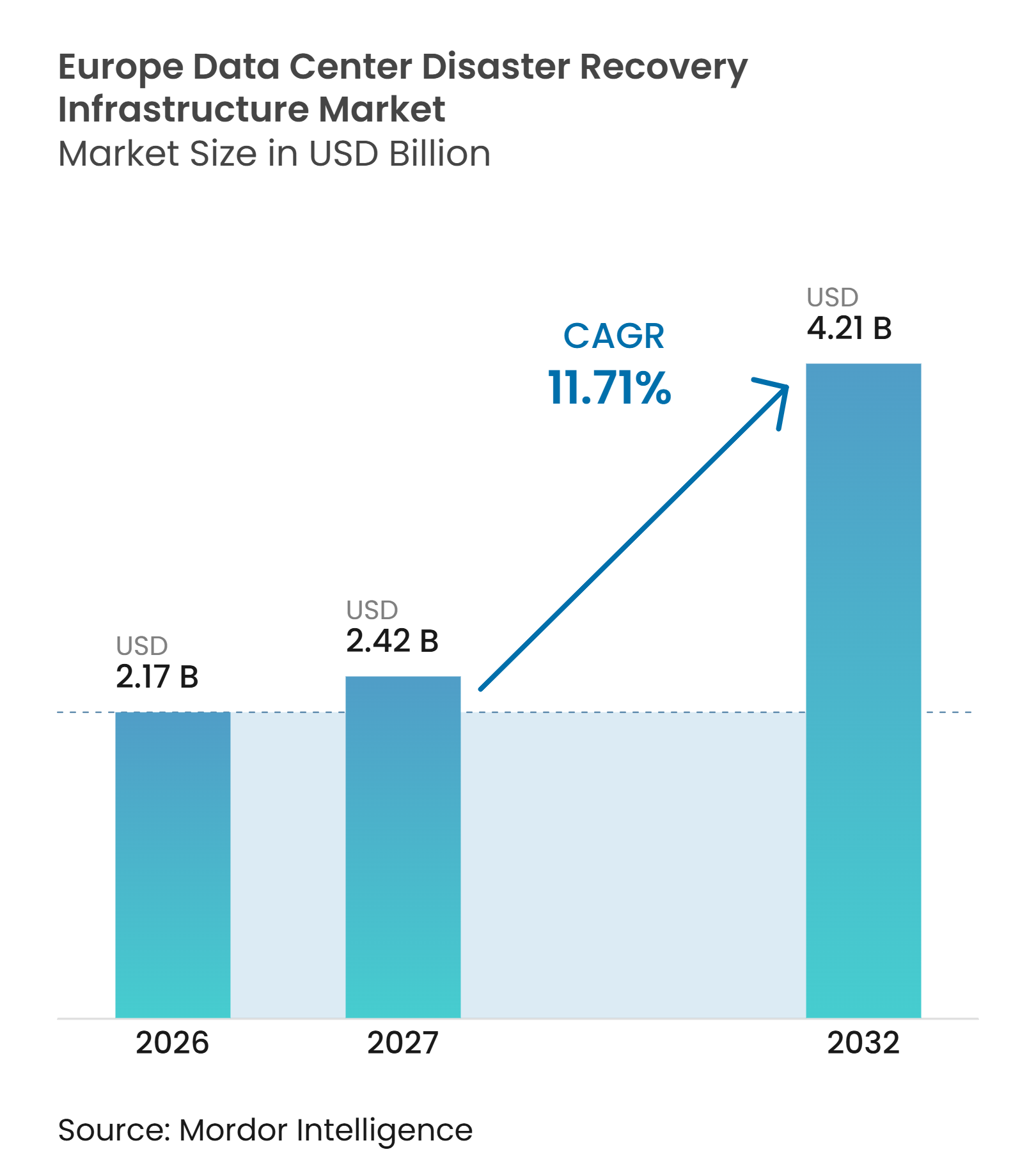
| Base Year Market Size (2026) | USD 2.17 Billion |
| Market Size (2027) | USD 2.42 Billion |
| Market Size (2032) | USD 4.21 Billion |
| Growth Rate (2027 - 2032) | 11.71 % |
| Market Concentration | Medium |
Major Players *Disclaimer: Major Players sorted in no particular order Image © Mordor Intelligence. Reuse requires attribution under CC BY 4.0. | |
Europe Data Center Disaster Recovery Infrastructure Market Analysis by Mordor Intelligence
The Europe data center disaster recovery infrastructure market size is valued at USD 2.17 billion in 2026 and is projected to reach USD 4.21 billion by 2032, growing at a CAGR of 11.71% during 2027-2032. Ransomware exposure, binding resilience rules, and wider use of hybrid and multi-cloud systems are making recovery capability a core operating requirement. Enterprises are placing greater value on immutable backups, segregated restore environments, and tested failover processes as they assess business continuity. Sovereign cloud capacity is widening the choices available to buyers that must keep data and recovery operations within a European jurisdiction. Investment is also shifting toward automation because manual recovery procedures are difficult to execute across distributed applications during a cyber incident.
Key Report Takeaways
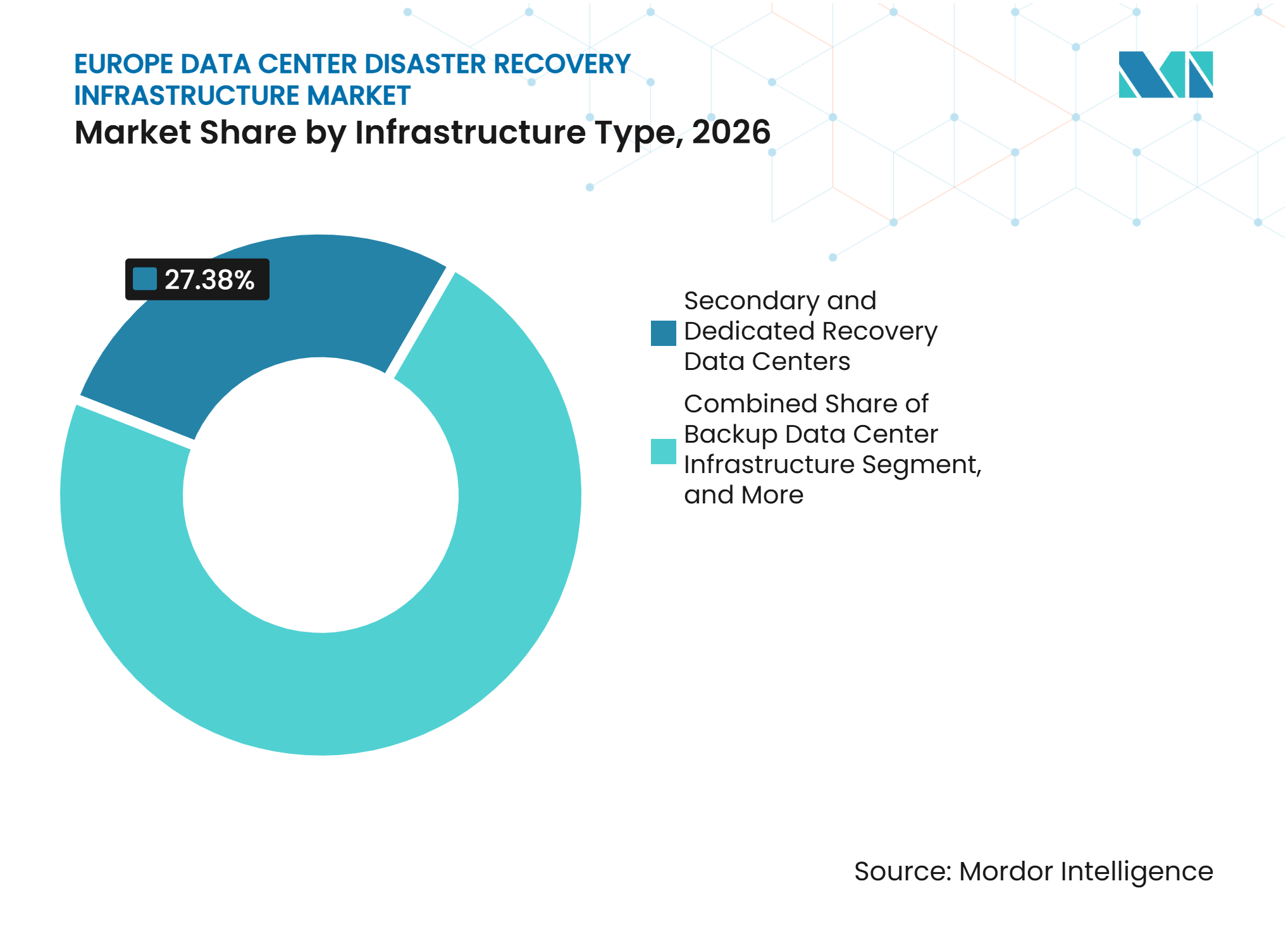
- By infrastructure type, secondary and dedicated recovery data centers held a 27.38% share of the Europe data center disaster recovery infrastructure market in 2026, while cloud-based disaster recovery infrastructure is projected to expand at a 12.24% CAGR through 2032.
- By deployment model, on-premises disaster recovery held a 33.94% share in 2026, while DRaaS is projected to expand at a 12.32% CAGR through 2032.
- By recovery architecture, active-passive architecture held a 25.76% share in 2026, while continuous data replication is projected to expand at a 12.18% CAGR through 2032.
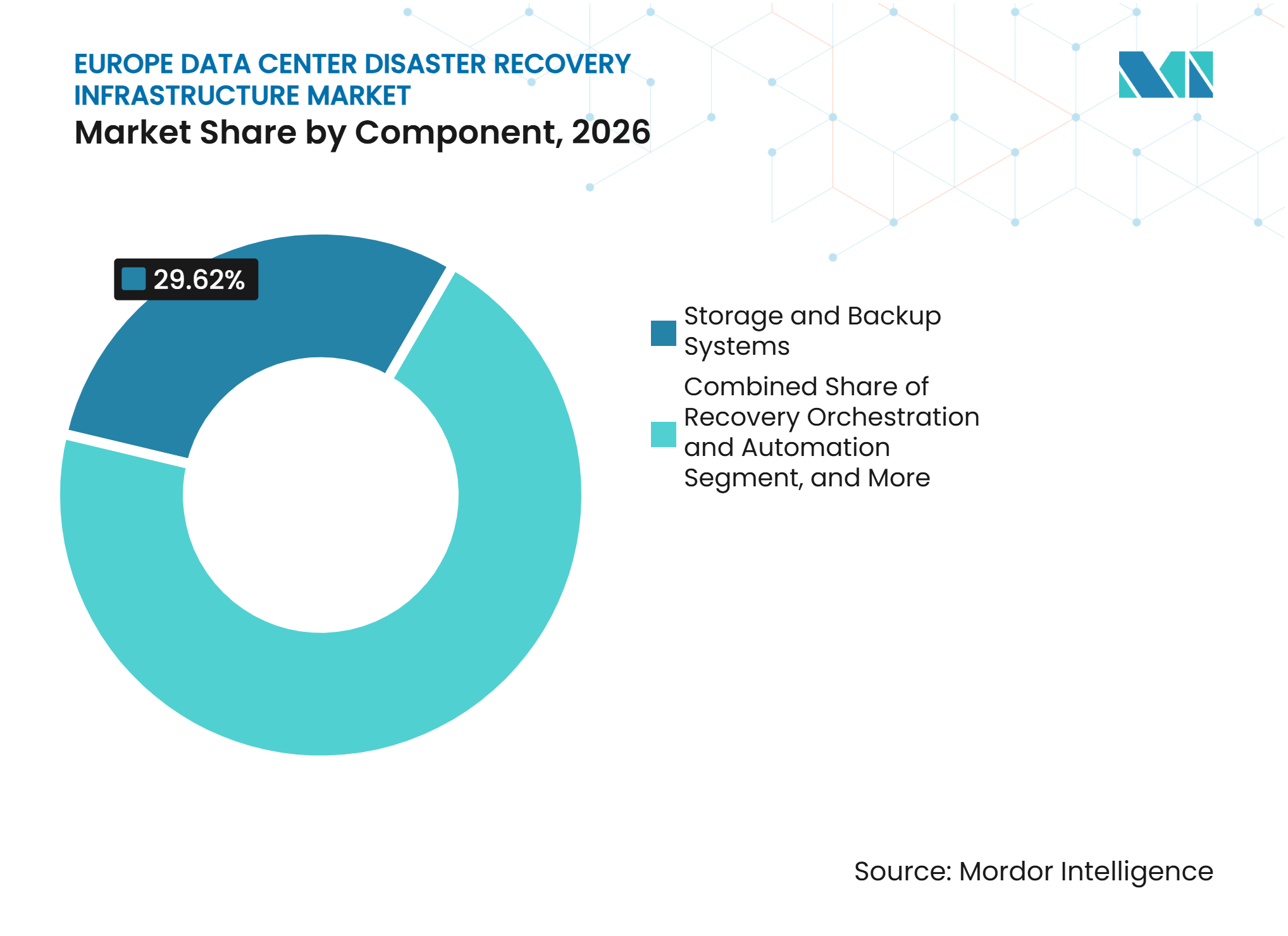
- By component, storage and backup systems held a 29.62% share in 2026, while recovery orchestration and automation is projected to expand at a 12.27% CAGR through 2032.
- By application, critical business application recovery held a 34.87% share in 2026, while cloud-native application recovery is projected to expand at a 12.43% CAGR through 2032.
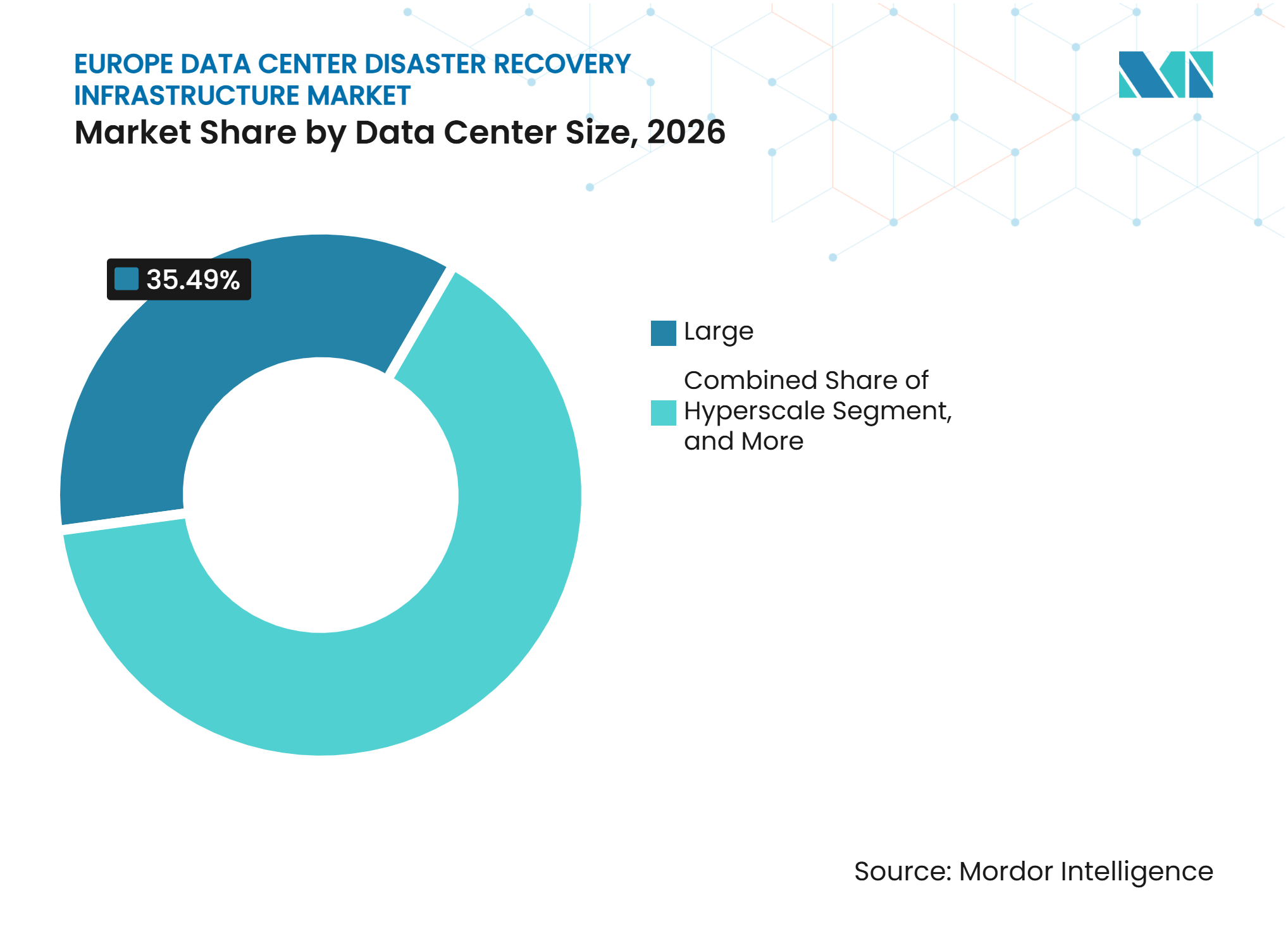
- By data center size, large data centers held a 35.49% share in 2026, while hyperscale data centers are projected to expand at a 12.34% CAGR through 2032.
- By data center type, colocation held a 41.23% share in 2026, while cloud service providers are projected to expand at a 12.16% CAGR through 2032.
- By geography, Germany held a 23.57% share in 2026, while Spain is projected to expand at a 12.28% CAGR through 2032.
Note: Market numbers in this report are based on Mordor Intelligence's proprietary estimation framework, which combines nine months of actuals with Q4 projections for base year 2026.
Market Trends and Insights
Drivers Impact Analysis of Europe Data Center Disaster Recovery Infrastructure Market*
| Driver | (~) % Impact on CAGR Forecast | Geographic Relevance | Impact Timeline |
|---|---|---|---|
| Ransomware and Cyberattack Escalation | +2.5% | Germany, United Kingdom, France, Italy, and Spain | Short term (≤ 2 years) |
| Operational-Resilience Compliance in Critical Sectors | +2.2% | EU-wide, most acute in Germany, France, the Netherlands, and Italy | Medium term (2-4 years) |
| Hybrid and Multi-Cloud Infrastructure Expansion | +2.0% | United Kingdom, Germany, and France | Medium term (2-4 years) |
| Growing Demand for Sovereign and In-Region Recovery | +1.8% | EU core, led by Germany and France | Long term (≥ 4 years) |
| Increasing Recovery Automation for Complex Workloads | +1.5% | Western Europe | Medium term (2-4 years) |
| Rising Edge and Hyperscale Data Center Capacity | +1.2% | Spain, the Nordics, and Italy | Long term (≥ 4 years) |
| Source: Mordor Intelligence | |||
Ransomware and Cyberattack Escalation Accelerates Recovery Investment
European organizations face a ransomware environment that is outpacing many security budgets. Black Kite recorded 2,066 confirmed ransomware incidents across 31 European countries from January 2025 to April 2026, and the monthly pace rose from 108 incidents in the first half of 2025 to 171 by early 2026.[1] The Europe data center disaster recovery infrastructure market is benefiting as enterprises invest in immutable backups, air-gapped vaults, and clean-room validation. Germany, the United Kingdom, France, Italy, and Spain accounted for 68.5% of recorded regional incidents in the Black Kite data, matching the concentration of recovery spending. The 2025 breach of Swedish HR software supplier Miljödata also showed how a supplier incident can spread across municipalities, universities, and enterprises, increasing attention to recovery plans that account for multi-entity disruption.
Operational-Resilience Compliance in Critical Sectors Drives Structural Demand
The Digital Operational Resilience Act, or DORA, became fully applicable on January 17, 2025, and made resilience controls enforceable for financial entities and critical ICT suppliers. The European Supervisory Authorities designated 19 critical ICT third-party providers in November 2025, including AWS, Microsoft, Google Cloud, Deutsche Telekom, Oracle, SAP, and IBM. DORA requires business impact analysis, recovery time and recovery point objectives by function, separate restore environments, and at least annual testing, supporting demand for orchestration, monitoring, and failover capability. A Veeam survey found that 96% of EMEA financial services organizations considered their resilience insufficient for DORA requirements in July 2025. Germany's NIS2 legislation entered into force in December 2025 and added requirements for backup management, continuity planning, and regular recovery testing across critical sectors.
Hybrid and Multi-Cloud Infrastructure Expansion Creates Layered Recovery Complexity
Hybrid and multi-cloud adoption is changing recovery design from a single standby location to a distributed, policy-led approach to failover. Active-passive architecture remains widely used, but continuous data replication is projected to grow at a 12.18% CAGR through 2032 as enterprises seek shorter recovery point objectives. Cloud-native application recovery is projected to grow at a 12.43% CAGR because containers and microservices create dependency patterns that conventional backup tools do not fully manage. AWS, Microsoft Azure, Google Cloud, and Oracle expanded sovereign offerings in Europe through late 2025 and 2026, bringing data residency controls into recovery design. Cohesity made RecoveryAgent generally available in September 2025, with blueprint-led recovery, malware scanning, and anomaly detection for cloud and on-premises workloads. The Europe data center disaster recovery infrastructure market therefore requires repeatable orchestration that can document a multi-cloud failover for auditors and operators.
Growing Demand for Sovereign and In-Region Recovery Reshapes Infrastructure Design
European enterprises are designing recovery environments that keep failover paths within a defined jurisdiction. AWS demonstrated in October 2026 that its European Sovereign Cloud could operate for several hours using EU-based infrastructure, software, and personnel when connectivity to its global backbone was disabled. Cubbit, SUSE, Elemento Cloud, and StorPool Storage presented a sovereign disaster recovery package in April 2026 that combined European storage, orchestration, identity, networking, and management components. AntemetA and Cohesity had already announced a French-jurisdiction data protection cloud in March 2025 to support GDPR, NIS2, and national localization needs. Sovereignty does not remove hyperscalers from the European data center disaster recovery infrastructure market, but it requires them to provide separate operating models. It also creates room for European colocation operators and managed service providers where buyers require local operational control.
Drivers Impact Analysis of Europe Data Center Disaster Recovery Infrastructure Market*
| Restraint | (~) % Impact on CAGR Forecast | Geographic Relevance | Impact Timeline |
|---|---|---|---|
| Power and Grid-Capacity Constraints | -1.8% | Frankfurt, London, Amsterdam, Paris, and Dublin, with wider EU effects | Short term (≤ 2 years) |
| Fragmented National Regulation and Cross-Border Compliance | -1.4% | EU-wide, especially Germany, France, Spain, and Italy | Medium term (2-4 years) |
| Shortage of Disaster-Recovery Engineering and Testing Talent | -1.2% | Germany and the United Kingdom, with wider global effects | Medium term (2-4 years) |
| Recovery Dependency on Concentrated Cloud and Connectivity Providers | -1.0% | EU-wide, especially single-cloud deployments | Long term (≥ 4 years) |
| Source: Mordor Intelligence | |||
Power and Grid-Capacity Constraints Limit Deployment of New Recovery Sites
Grid connection constraints are limiting the development of new recovery sites in established European hubs. The International Energy Agency reported connection queues of 7 to 10 years in Frankfurt, London, Amsterdam, Paris, and Dublin. The agency also noted that electricity supply constraints could delay up to 20% of planned European data center projects. These conditions restrict dedicated recovery capacity in markets where enterprises traditionally sought geographically separate facilities. Spain's April 2026 outage showed the value of Tier IV resilience, multi-day generator autonomy, and solar backup, as KIO Spain's Murcia facility maintained service during the event. The Europe data center disaster recovery infrastructure market is consequently drawing more interest toward Spain, Italy, and Nordic locations with more accessible grid connections.
Fragmented National Regulation and Cross-Border Compliance Add Operational Overhead
Pan-European recovery programs must manage a regulatory structure that is aligned at the EU level but implemented through national authorities. The DORA subcontracting standard, Commission Delegated Regulation EU 2025/532, entered into force on July 22, 2025, and requires financial entities to document ICT subcontracting chains that support critical functions. NIS2 implementation schedules also varied across member states into 2025, with Germany's law taking effect only in December 2025. A recovery configuration accepted for a Dutch financial institution may need additional review when the workload is restored in Germany. This increases legal, audit, and contractual work for organizations operating across jurisdictions. It also makes it harder for DRaaS providers to apply a single standardized service level agreement across Europe.
*Our forecasts treat driver/restraint impacts as directional, not additive. The impact forecasts reflect baseline growth, mix effects, and variable interactions.
Europe Data Center Disaster Recovery Infrastructure Market Segment Analysis
By Infrastructure Type:
Cloud-Based Models Challenge Dedicated Recovery AssetsSecondary and dedicated recovery data centers held 27.38% of the Europe data center disaster recovery infrastructure market share in 2026, the largest share in this segment. Financial institutions, public sector bodies, and critical infrastructure operators continue to use owned or leased secondary locations as a regulatory baseline. These facilities have substantial capital and operating costs. Backup data center infrastructure, replication, and data protection infrastructure support organizations at intermediate stages of cloud migration. Such organizations often retain on-premises production systems while holding recovery replicas in cloud environments.
Cloud-based disaster recovery infrastructure is projected to grow at a 12.24% CAGR through 2032. Sovereign cloud partitions enable replicating workloads across distributed recovery points without an equivalent expansion of the physical footprint. Failover orchestration and low-latency connectivity remain necessary because recovery architectures can fail in a real incident without both capabilities. AWS has described multi-region recovery designs that preserve EU data residency while supporting sub-hour recovery objectives. Backup storage remains the underlying retention layer across every recovery tier.



By Deployment Model:
DRaaS Scales as On-Premises Anchors the Installed BaseOn-premises disaster recovery accounted for 33.94% of the Europe data center disaster recovery infrastructure market share in 2026. The installed base reflects earlier investments in physical primary and secondary sites across European enterprises. Colocation-based and hybrid recovery models bridge the gap between fully owned assets and consumption-led services. They retain equipment in carrier-neutral facilities while extending recovery capability into cloud environments. Cloud-based disaster recovery is generally managed by the enterprise, while DRaaS includes vendor-managed recovery activation.
DRaaS is projected to grow at a 12.32% CAGR through 2032. The model appeals to mid-sized enterprises that cannot justify the costs of a dedicated secondary site and to larger enterprises consolidating recovery contracts. Third-party dependency remains important because 34% of surveyed EMEA financial services organizations identified third-party risk oversight as their hardest DORA requirement. Veeam acquired Securiti AI for USD 1.75 billion in October 2025 and introduced Veeam Data Platform v13 in November 2025. These actions show how DRaaS platforms are moving toward combined data security and recovery services.
By Recovery Architecture:
Replication Gains Ground on Traditional Standby ModelsActive-passive architecture accounted for 25.76% of the Europe data center disaster recovery infrastructure market in 2026. It remains common among enterprises that retain a fully configured standby site and route production traffic there only after a failover. Active-active systems serve financial market infrastructure, payment providers, and telecom operators that cannot tolerate interruption. Warm and cold standby systems serve lower readiness requirements, often in cost-sensitive settings. Backup and restore remains a baseline approach for smaller organizations and for data beyond critical recovery windows.
Continuous data replication is projected to grow at a 12.18% CAGR through 2032. Adoption is moving beyond financial services into manufacturing, healthcare, and cloud-native environments where recovery point objectives below 15 minutes are becoming a contractual requirement. When combined with anomaly detection, replication can help teams identify the final clean recovery point before ransomware began encrypting files. Rubrik introduced immutable codebase recovery for GitHub and Azure DevOps repositories in June 2026. This extends recovery planning to software delivery systems that have become essential business functions.
By Component:
Storage Systems Anchor Spending While Automation AcceleratesStorage and backup systems accounted for 29.62% of the component segment in the Europe data center disaster recovery infrastructure market in 2026. Traditional tape, disk, and object-storage assets still hold a large volume of recovery-tier data. Compute and server infrastructure, replication software, and network systems make up the supporting stack. Their spending is linked closely to the size and type of the protected production workload. Monitoring, testing, and failover management support simulations, recovery validation, and audit evidence required for regulated financial operations.
Recovery orchestration and automation is projected to grow at a 12.27% CAGR through 2032. The segment addresses the need to execute multi-workload failovers faster than manual processes can manage. Intuit reported an AI-supported recovery orchestration deployment on Amazon Bedrock that reduced recovery times for supported workloads from several hours to 20 minutes. Druva's curated recovery approach identifies clean file versions across several backup points rather than selecting a single restoration point. The approach is relevant where ransomware may have entered backup data before the incident was detected.

By Application:
Critical Recovery Leads as Cloud-Native Demand EscalatesCritical business application recovery held 34.87% of the application segment in the Europe data center disaster recovery infrastructure market in 2026. The category includes ERP systems, payment platforms, trading engines, and health records with near-immediate recovery needs. Database and data platform recovery supports broader continuity needs. Enterprise IT recovery and virtual machine recovery remain important in mid-sized implementations. High availability and continuous restoration are used primarily in financial market infrastructure and telecommunications.
Cloud-native application recovery is projected to grow at a 12.43% CAGR through 2032. Containers, serverless functions, and microservices have made dependencies harder to protect with conventional virtual-machine backup methods. Recovery plans must preserve Kubernetes cluster state, container registries, persistent volume settings, and service dependencies.[2] Commvault released Cloud Unity capabilities through late 2025 and early 2026, including AI-enabled Synthetic Recovery to remove compromised data during restoration. The Europe data center disaster recovery infrastructure market is therefore seeing application categories converge around recovery processes that preserve both data and runtime configuration.
By Data Center Size:
Large Facilities Lead as Hyperscale Investment AcceleratesLarge data centers held 35.49% of the data center size segment in 2026. Disaster recovery workloads remain concentrated at colocation facilities in established hub markets and secondary European locations. Medium-sized facilities support regional enterprises and national cloud providers. Small data centers are used for edge deployments, campus environments, and local recovery requirements. The facility size selected by an enterprise depends on protected workload scale, latency needs, and resilience obligations.
Hyperscale data centers are projected to grow at a 12.34% CAGR through 2032. Their growth is concentrated in markets with available grid capacity, including Spain, Nordic countries, Italy, and Warsaw. This distribution is moving some recovery infrastructure away from the older FLAP-D hubs. It also raises demand for network capacity and replication links between dispersed locations. Larger hyperscale estates can improve recovery choice, but buyers must verify whether their compliance, data residency, and operational control requirements are met.
By Data Center Type:
Colocation Dominates as Cloud Service Providers Build Sovereign Recovery CapabilityColocation held 41.23% of the data center type segment in 2026. European enterprises use carrier-neutral facilities for redundant power, diverse connectivity, and independently reviewed physical security. This model supports recovery systems that need to remain separate from the primary production site. Enterprise and edge facilities serve buyers with strict localization rules. Government authorization may be required when defense, justice, or critical national infrastructure workloads are involved.
Cloud service providers are projected to grow at a 12.16% CAGR through 2032. Sovereign partitions, local zones, and dedicated regions can bring cloud capacity within national jurisdiction and within synchronous replication latency limits. AWS Local Zones in Belgium, the Netherlands, and Portugal are part of its European Sovereign Cloud approach and are hosted in third-party colocation sites. This arrangement can blur the boundary between colocation and cloud service provider categories. Buyers need to map the operating model to their data classification and regulatory obligations.
Geography Analysis
Germany
Germany held 23.57% of the regional total in 2026. The country combines a high concentration of financial, manufacturing, and critical infrastructure operators with concurrent obligations under DORA and NIS2. Germany recorded 370 ransomware incidents from January 2025 to April 2026, the highest count in Europe in the Black Kite dataset. Google announced USD 6.41 billion in investment in German cloud infrastructure in November 2025 at the reported November 2025 exchange rate. The NIS2 legislation requires critical operators to address backup management, continuity planning, and recovery testing, while long grid connection queues in Frankfurt are redirecting some recovery-site investment to Berlin, Brandenburg, and secondary German hubs.
Spain
Spain is projected to record a 12.28% CAGR through 2032, the highest rate among the Europe data center disaster recovery infrastructure market geographies. The April 28, 2026 power outage across Spain, Portugal, and parts of southern France tested operational resilience at scale. KIO Spain's Tier IV Murcia facility maintained service through generator autonomy and sub-second UPS transfer during the outage. The event increased attention to continuity gaps and supported interest in Madrid, Barcelona, and Zaragoza as alternatives to constrained FLAP-D hubs. Government requirements introduced in August 2026 require qualifying data centers to source 80% of consumption from renewable energy under hourly controls, making compliance factors part of location selection.[3]
Emerging and Developing Geographies
The United Kingdom recorded 347 ransomware incidents between January 2025 and April 2026, which supports recovery investment in London-area and regional colocation facilities. France is developing sovereign recovery demand through the AntemetA and Cohesity partnership, while Italy offers a more accessible option for new sites, with 3-year grid connection timelines cited in the source material and a second Oracle cloud region opened in 2025. Russia's participation has been reshaped by vendor exits and sanctions-related changes since 2022, while Poland, the Netherlands, Belgium, and the Nordic countries are gaining attention where grid access and renewable power availability support new development. Nebius announced a USD 10 billion AI data center in Finland in March 2026, planned to operate at 310 MW by 2027, and cross-border deployments still require careful review of data residency, NIS2, and DORA requirements.
Competitive Landscape
Market Concentration
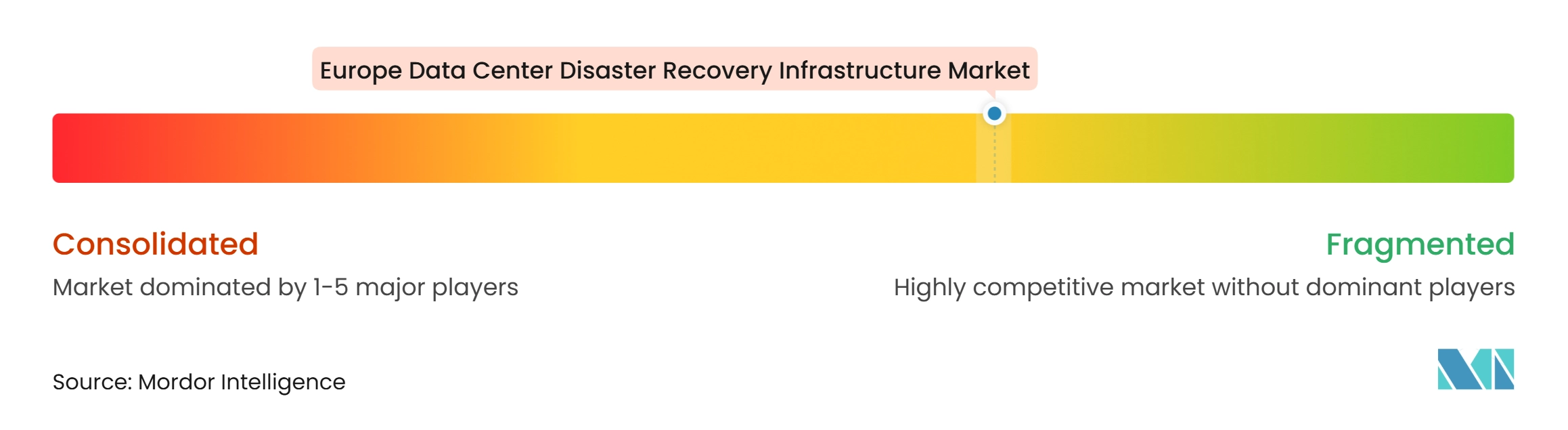
The Europe data center disaster recovery infrastructure market is moderately fragmented. Hyperscalers, specialist data resilience vendors, colocation operators, and regional managed service providers compete in overlapping areas. AWS, Microsoft, and Google are expanding sovereign cloud capacity on a scale that specialist vendors cannot match. Specialist providers compete through deeper recovery features, compliance support, and multi-cloud portability. This structure means no single supplier has a decisive position across every deployment, architecture, component, and data center category.
Veeam acquired Securiti AI for USD 1.75 billion in October 2025 and released Data Platform v13 the following month with malware analysis, immutable backup controls, and instant recovery to Microsoft Azure. Rubrik added immutable codebase recovery and controls for AI agent actions in June 2026.[4] Cohesity's RecoveryAgent uses a blueprint-led approach that combines recovery testing, malware scanning, and automation. These moves show that vendors are expanding beyond backup products toward broader cyber recovery platforms. Recovery orchestration is becoming a central competitive feature because it can identify clean recovery points and document restoration activity.
European providers such as Proact IT Group, Claranet, and Ekco Cloud Services can address buyers that want recovery operations and management controls to remain inside EU legal jurisdiction. ISO/IEC 27001-certified facilities and established NIS2 programs can help regional providers demonstrate audit readiness. DORA oversight imposes a distinct operational burden on designated critical ICT providers, as they face direct supervisory inspections and binding recommendations. Non-designated managed service providers may have more flexibility for some customer configurations.
Europe Data Center Disaster Recovery Infrastructure Industry Leaders
-
Amazon Web Services, Inc.
-
Microsoft Corporation
-
International Business Machines Corporation
-
Broadcom Inc.
-
Veeam Software Group GmbH
- *Disclaimer: Major Players sorted in no particular order
Europe Data Center Disaster Recovery Infrastructure Market Companies Covered in this Report
- Amazon Web Services, Inc.
- Microsoft Corporation
- International Business Machines Corporation
- Broadcom Inc.
- Veeam Software Group GmbH
- Commvault Systems, Inc.
- Rubrik, Inc.
- Cohesity, Inc.
- Dell Technologies Inc.
- Hewlett Packard Enterprise Company
- Oracle Corporation
- Google LLC
- Cisco Systems, Inc.
- Open Text Corporation
- Druva Inc.
- 11:11 Systems, Inc.
- Proact IT Group AB
- Ekco Cloud Services Limited
- Claranet Limited
Recent Industry Developments in Europe Data Center Disaster Recovery Infrastructure Market
- October 2026: AWS successfully conducted the first public technical exercise demonstrating independent operation of the AWS European Sovereign Cloud, running for several hours using only EU-based infrastructure, software, and personnel with the AWS Global Network backbone switched off. The exercise provided verifiable operational evidence to regulated-industry and public-sector customers across Europe that the platform can maintain business continuity without connectivity to non-EU infrastructure.
- September 2026: HPE and Oracle announced an expanded multi-year networking collaboration under which Oracle plans to deploy HPE Juniper PTX and MX routing platforms and QFX and EX switching platforms across its global AI data centers, with multi-year networking support services and financing capabilities included. The expanded agreement targets Oracle's growing AI supercluster buildout, where large GPU clusters place heavy demands on bandwidth, latency, congestion management, and fault recovery across data center fabrics.
- August 2026: Spain's government introduced elevated operational requirements for data center operators, mandating that facilities above 1 MW source 80% of their energy consumption from renewables with hourly controls, with non-compliant facilities potentially losing grid access. The regulation is driving disaster recovery facility operators to accelerate renewable energy transition programs across Spanish data center campuses.
- June 2026: Rubrik launched Rubrik Agent Cloud for Anthropic's Claude Code and Claude Cowork at Rubrik FORWARD in Las Vegas, delivering immutable codebase recovery, agent rewind for unintended AI agent actions, and the Semantic AI Governance Engine for real-time intent-driven governance of autonomous agents. The product extends disaster recovery to AI code repositories and agentic AI configurations, responding to ransomware and injection attack vectors targeting developer infrastructure.
Europe Data Center Disaster Recovery Infrastructure Market Report Scope
The Europe data center disaster recovery infrastructure market comprises hardware, software, and services that enable data centers to recover critical IT systems, applications, and data following disruptions caused by natural disasters, cyberattacks, power outages, or equipment failures. This infrastructure supports business continuity by facilitating data backup, replication, failover, and recovery processes across on-premises, cloud, and hybrid environments.
The Europe Data Center Disaster Recovery Infrastructure Market Report is Segmented by Infrastructure Type (Secondary and Dedicated Recovery Data Centers, Backup Data Center Infrastructure, Replication and Data Protection Infrastructure, Failover and Recovery Orchestration Infrastructure, Backup Storage Infrastructure, Network and Connectivity Infrastructure for Recovery, and Cloud-Based Disaster Recovery Infrastructure), Deployment Model (On-Premises Disaster Recovery, Colocation-Based Recovery, Cloud-Based Disaster Recovery, Hybrid Disaster Recovery, and Disaster Recovery-as-a-Service (DRaaS)), Recovery Architecture (Active-Active, Active-Passive, Warm Standby, Cold Standby, Backup and Restore, and Continuous Data Replication), Component (Compute and Server Infrastructure, Storage and Backup Systems, Data Replication Software, Network and Connectivity Systems, Recovery Orchestration and Automation, and Monitoring, Testing, and Failover Management), Application (Critical Business Application Recovery, Database and Data Platform Recovery, Virtual Machine and Workload Recovery, Cloud-Native Application Recovery, Enterprise IT Recovery, and High-Availability and Continuous Service Restoration), Data Center Size (Small, Medium, Large, and Hyperscale), Data Center Type (Colocation, Cloud Service Providers (CSPs), and Enterprise and Edge), and Geography (Germany, United Kingdom, France, Italy, Spain, Russia, and Rest of Europe). The Market Forecasts are Provided in Terms of Value (USD).
Segmentation Overview
| Secondary and Dedicated Recovery Data Centers |
| Backup Data Center Infrastructure |
| Replication and Data Protection Infrastructure |
| Failover and Recovery Orchestration Infrastructure |
| Backup Storage Infrastructure |
| Network and Connectivity Infrastructure for Recovery |
| Cloud-Based Disaster Recovery Infrastructure |
| On-Premises Disaster Recovery |
| Colocation-Based Recovery |
| Cloud-Based Disaster Recovery |
| Hybrid Disaster Recovery |
| Disaster Recovery-as-a-Service (DRaaS) |
| Active-Active |
| Active-Passive |
| Warm Standby |
| Cold Standby |
| Backup and Restore |
| Continuous Data Replication |
| Compute and Server Infrastructure |
| Storage and Backup Systems |
| Data Replication Software |
| Network and Connectivity Systems |
| Recovery Orchestration and Automation |
| Monitoring, Testing, and Failover Management |
| Critical Business Application Recovery |
| Database and Data Platform Recovery |
| Virtual Machine and Workload Recovery |
| Cloud-Native Application Recovery |
| Enterprise IT Recovery |
| High-Availability and Continuous Service Restoration |
| Small |
| Medium |
| Large |
| Hyperscale |
| Colocation |
| Cloud Service Providers (CSPs) |
| Enterprise and Edge |
| Germany |
| United Kingdom |
| France |
| Italy |
| Spain |
| Russia |
| Rest of Europe |
| By Infrastructure Type | Secondary and Dedicated Recovery Data Centers |
| Backup Data Center Infrastructure | |
| Replication and Data Protection Infrastructure | |
| Failover and Recovery Orchestration Infrastructure | |
| Backup Storage Infrastructure | |
| Network and Connectivity Infrastructure for Recovery | |
| Cloud-Based Disaster Recovery Infrastructure | |
| By Deployment Model | On-Premises Disaster Recovery |
| Colocation-Based Recovery | |
| Cloud-Based Disaster Recovery | |
| Hybrid Disaster Recovery | |
| Disaster Recovery-as-a-Service (DRaaS) | |
| By Recovery Architecture | Active-Active |
| Active-Passive | |
| Warm Standby | |
| Cold Standby | |
| Backup and Restore | |
| Continuous Data Replication | |
| By Component | Compute and Server Infrastructure |
| Storage and Backup Systems | |
| Data Replication Software | |
| Network and Connectivity Systems | |
| Recovery Orchestration and Automation | |
| Monitoring, Testing, and Failover Management | |
| By Application | Critical Business Application Recovery |
| Database and Data Platform Recovery | |
| Virtual Machine and Workload Recovery | |
| Cloud-Native Application Recovery | |
| Enterprise IT Recovery | |
| High-Availability and Continuous Service Restoration | |
| By Data Center Size | Small |
| Medium | |
| Large | |
| Hyperscale | |
| By Data Center Type | Colocation |
| Cloud Service Providers (CSPs) | |
| Enterprise and Edge | |
| By Geography | Germany |
| United Kingdom | |
| France | |
| Italy | |
| Spain | |
| Russia | |
| Rest of Europe |
Key Questions Answered in the Report
What is the Europe data center disaster recovery infrastructure market size?
The Europe data center disaster recovery infrastructure market is valued at USD 2.17 billion in 2026 and is projected to reach USD 4.21 billion by 2032, at an 11.71% CAGR.
What is driving demand for disaster recovery infrastructure in Europe?
Ransomware risk, DORA and NIS2 compliance, hybrid cloud adoption, and data sovereignty requirements are supporting demand.
Which deployment model has the largest share in Europe?
On-premises disaster recovery leads the deployment model segment with a 33.94% share in 2026, while DRaaS is projected to grow the fastest at 12.32% CAGR.
Which application is expanding fastest through 2032?
Cloud-native application recovery is projected to grow at a 12.43% CAGR as organizations protect containerized and microservices-based workloads.
Which country leads European demand for recovery infrastructure?
Germany holds the largest share at 23.57% in 2026, supported by critical-sector compliance needs and a large base of data center users.
Why is Spain growing quickly for disaster recovery sites?
Spain is projected to grow at 12.28% CAGR through 2032, aided by lessons from the 2026 power outage, growing data center locations, and renewable energy requirements.