
Europe Data Center Demand Response and Energy Management Market Size and Share
Market Overview
| Study Period | 2021 - 2032 |
|---|---|
| Forecast Data Period | 2027 - 2032 |
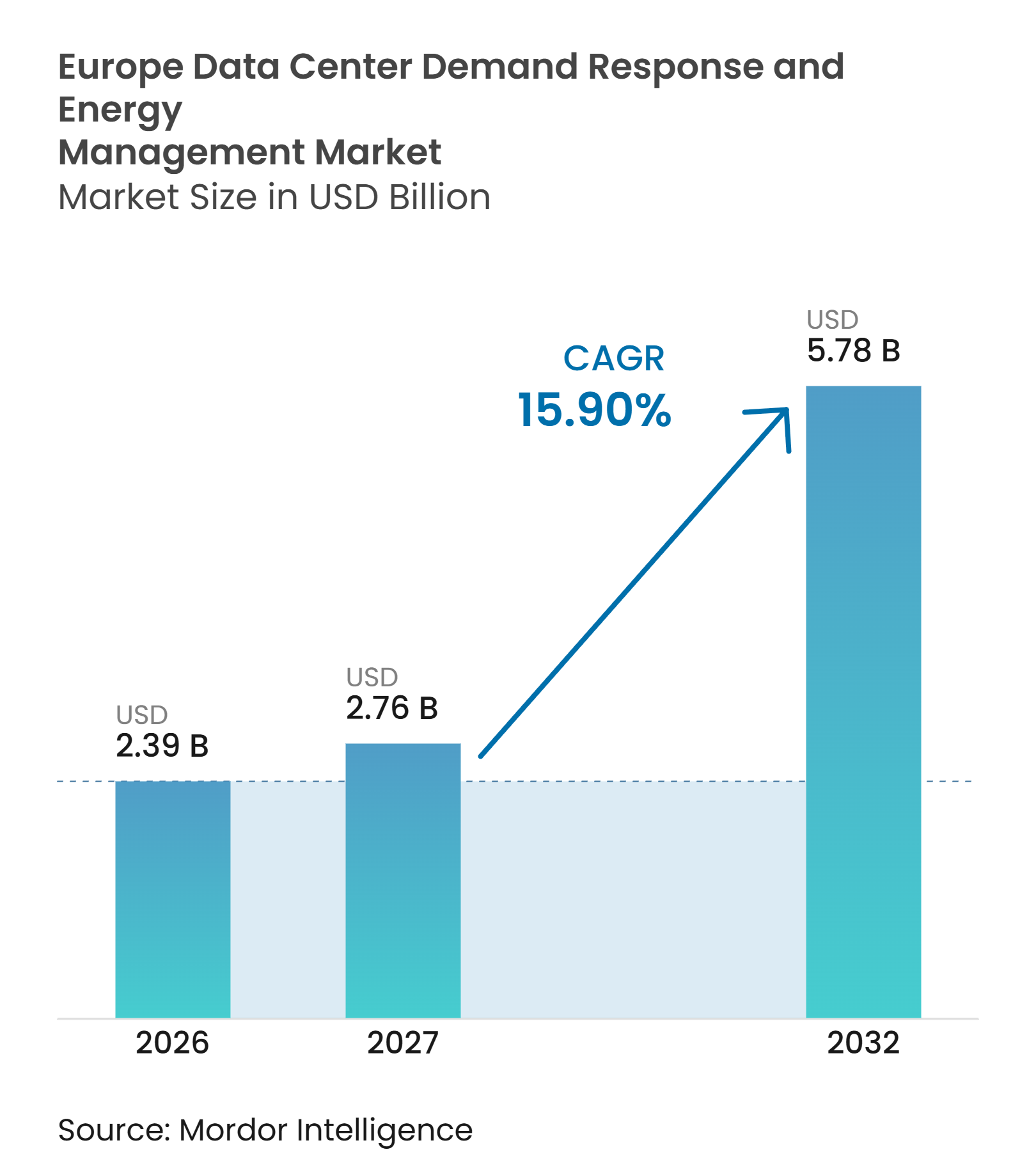
| Base Year Market Size (2026) | USD 2.39 Billion |
| Market Size (2027) | USD 2.76 Billion |
| Market Size (2032) | USD 5.78 Billion |
| Growth Rate (2027 - 2032) | 15.90 % |
| Market Concentration | Medium |
Major Players *Disclaimer: Major Players sorted in no particular order Image © Mordor Intelligence. Reuse requires attribution under CC BY 4.0. | |
Europe Data Center Demand Response and Energy Management Market Analysis by Mordor Intelligence
The Europe data center demand response and energy management market size is projected to expand from USD 2.39 billion in 2026 to USD 2.76 billion in 2027, and to USD 5.78 billion by 2032, registering a CAGR of 15.90% between 2027 and 2032. Rising AI workloads are increasing rack density and power consumption, making automated control of electricity consumption more valuable for operators. European rules on energy reporting, renewable electricity, and energy management systems are moving energy software from an optional tool to an operating requirement. Operators are also using flexible load to reduce exposure to wholesale power prices and to improve their prospects of obtaining grid connections in constrained hubs. This favors suppliers that combine facility controls, energy forecasting, and access to balancing markets. The Europe data center demand response market is therefore shaped by the need to protect uptime while making a larger share of load responsive to power-system conditions.
Key Report Takeaways
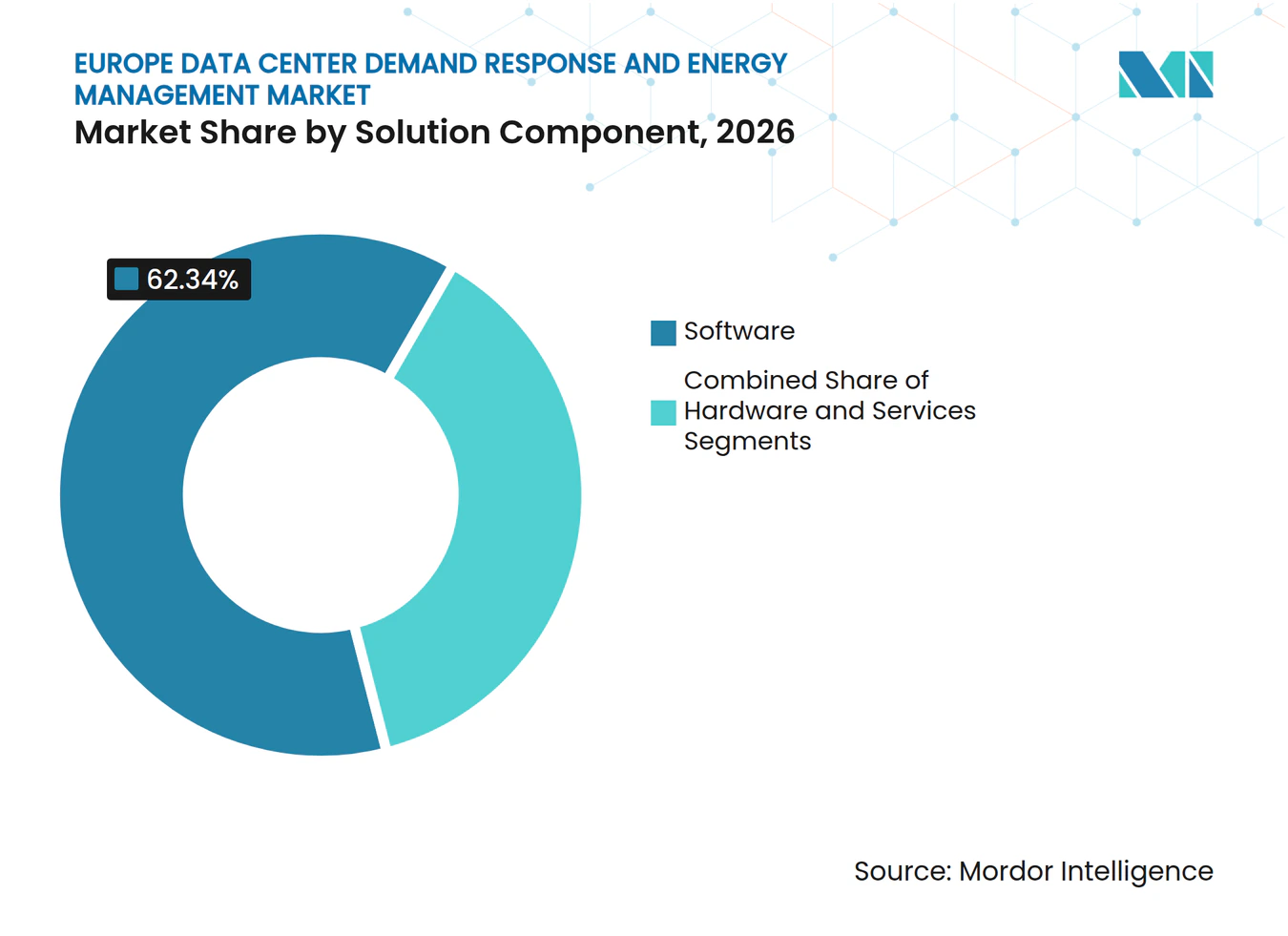
- By solution component, software held 62.34% of the Europe data center demand response and energy management market share in 2026, while services are projected to expand at a 17.81% CAGR through 2032.
- By software solution type, energy management software accounted for 56.17% of the Europe data center demand response and energy management market in 2026, while energy forecasting and optimization software is projected to expand at a 17.56% CAGR through 2032.
- By demand response program type, incentive-based programs held 68.18% of the Europe data center demand response and energy management market in 2026 and are projected to expand at an 18.44% CAGR through 2032.
- By automation level, manual and non-automated solutions held 70.22% of the Europe data center demand response and energy management market in 2026, while automated and advanced demand response solutions are projected to expand at an 18.76% CAGR through 2032.
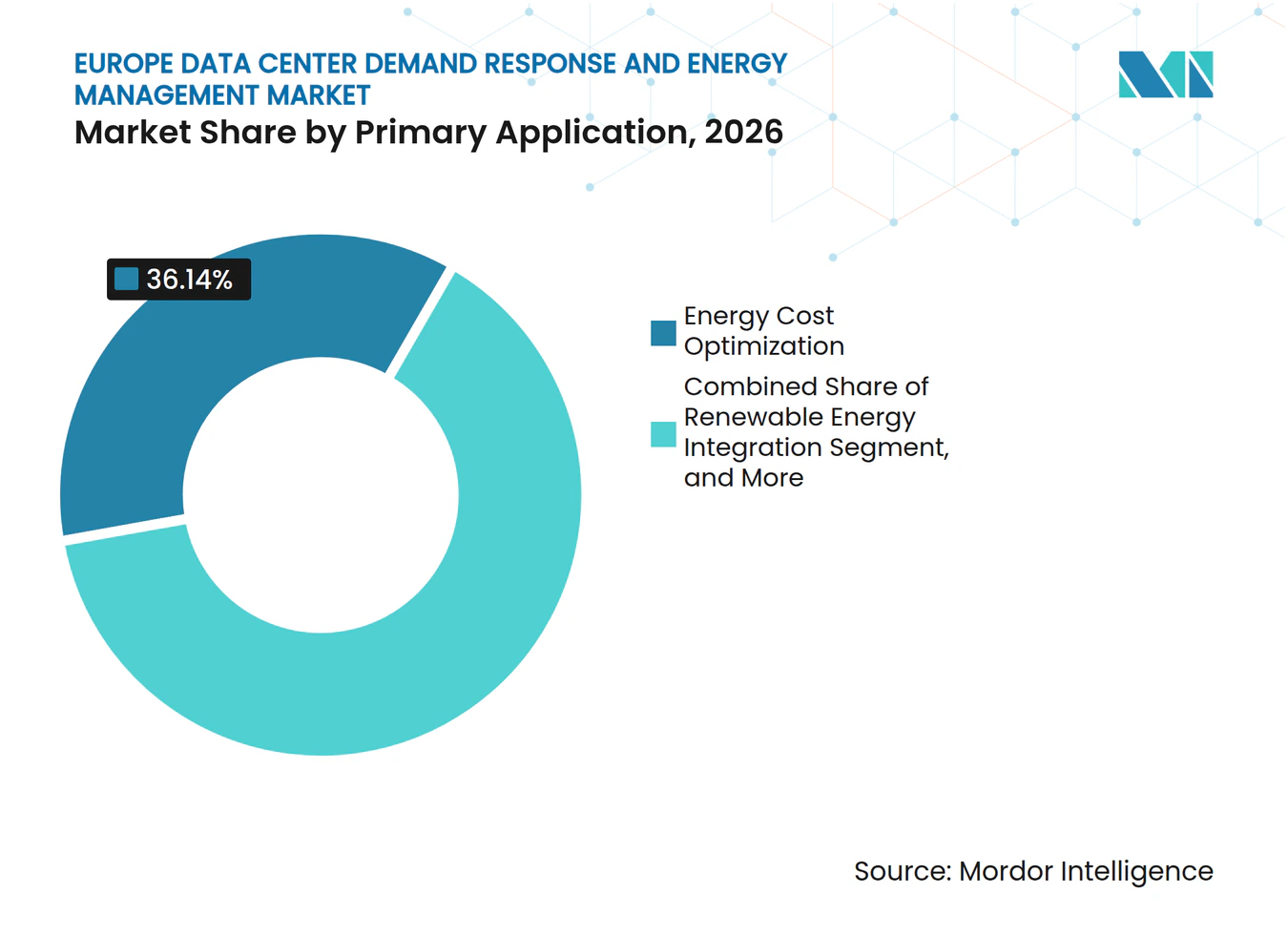
- By primary application, energy cost optimization held 36.14% of the Europe data center demand response and energy management market in 2026, while renewable energy integration is projected to expand at a 16.90% CAGR through 2032.
- By data center size, hyperscale data centers held 58.19% of the Europe data center demand response and energy management market in 2026 and are projected to expand at a 17.25% CAGR through 2032.
- By data center type, colocation data centers held 65.12% of the Europe data center demand response and energy management market in 2026, while cloud service providers are projected to expand at an 18.12% CAGR through 2032.
- By geography, Germany held 27.33% of the Europe data center demand response and energy management market in 2026, while Ireland is projected to expand at a 16.61% CAGR through 2032.
Note: Market numbers in this report are based on Mordor Intelligence's proprietary estimation framework, which combines nine months of actuals with Q4 projections for base year 2026.
Market Trends and Insights
Drivers Impact Analysis of Europe Data Center Demand Response and Energy Management Market*
| Driver | (~) % Impact on CAGR Forecast | Geographic Relevance | Impact Timeline |
|---|---|---|---|
| AI Workload Expansion and Higher Power Density | +4.8% | Europe, concentrated in FLAP-D and emerging hubs in Spain, Finland, and Italy | Short term (≤ 2 years) |
| EU Energy Efficiency and Data Center Reporting Requirements | +3.2% | EU-wide, with stronger compliance demand in Germany, the Netherlands, and Ireland | Medium term (2-4 years) |
| Renewable Energy Integration and Grid Flexibility Requirements | +2.5% | EU-wide, with strongest uptake in the Nordics, Germany, France, and Ireland | Medium term (2-4 years) |
| Electricity Price Volatility and Demand Charge Optimization | +2.0% | EU-wide, with higher electricity-cost exposure in Germany, the Netherlands, and the United Kingdom | Short term (≤ 2 years) |
| Workload Shifting and Geographic Orchestration for Grid Services | +1.8% | Germany, France, the Netherlands, and Nordic states | Medium term (2-4 years) |
| Data Center Flexibility as a Substitute for Delayed Grid Capacity | +1.2% | FLAP-D hubs, with spillover to Spain and Italy | Long term (≥ 4 years) |
| Source: Mordor Intelligence | |||
AI Workload Expansion and Rising Data Center Power Density
AI workloads are changing the amount and pattern of power required within data centers. GPU training environments commonly operate at 60-80 kW per rack, while specialized AI systems can exceed 100 kW, compared with 5-10 kW for legacy enterprise racks. ENTSO-E expects European data center electricity demand to increase by more than 50% between 2025 and 2030. Larger and more variable loads give operators a stronger reason to install controls that can adjust cooling, battery use, and selected computing tasks in response to grid signals. The Europe data center demand response market benefits because facilities with multi-megawatt changes in operating demand can become useful participants in balancing arrangements. AI inference is also likely to spread power demand across more locations and hours than concentrated training workloads, widening the need for local energy management.
EU Energy Efficiency and Data Center Reporting Requirements
The Energy Efficiency Directive, Directive (EU) 2023/1791, created a common reporting framework for EU data centers with installed IT power of at least 500 kW.[1] The associated reporting rules set an annual May 15 reporting deadline for covered facilities. Operators consuming more than 85 TJ each year must implement an ISO 50001-certified energy management system by October 11, 2027. Germany imposes additional requirements under the Energieeffizienzgesetz, including ISO 50001 certification for qualifying sites and energy reuse requirements that increase from 10% in July 2026 to 20% in July 2028. These rules are increasing demand for metering, reporting, and optimization tools, especially among mid-sized operators without large internal energy teams.
Renewable Energy Integration and Grid Flexibility Requirements
Higher renewable output is increasing the value of the data center load that can respond to changing generation conditions. Germany curtailed almost 10 TWh of renewable generation in 2025, while negative electricity prices occurred in 5% of hours across 7 EU Member States. Flexible data centers can use price signals to shift eligible workloads into periods of surplus renewable supply. Agora Energiewende found that continuous use of feasible data center flexibility could replace 20 TWh of thermal generation with renewable output, save 5 million tonnes of CO₂ each year by 2035. This supports demand for systems that combine carbon-aware scheduling, hourly renewable matching, and facility-level controls. The EU Taxonomy climate rules and the Climate Neutral Data Center Pact also increase the focus on credible measurement of energy performance and renewable sourcing.
Electricity Price Volatility and Demand Charge Optimization
Electricity cost volatility is strengthening the commercial case for automated energy management. European wholesale electricity prices averaged USD 95 per MWh in 2025, 10% above the prior year. In Germany, peak-hour gas prices increased by 19% in 2025, while solar-rich midday prices increased by 8%. Operators can use forecasting tools to move non-time-critical work, such as backup operations, AI training, and data archiving, away from high-price periods. This reduces avoidable demand charges without changing the service level of critical applications. The Europe data center demand response market also gains from colocation sites, where power costs are often passed through to tenants, and price management has a direct effect on contract economics.
Restraints Impact Analysis of Europe Data Center Demand Response and Energy Management Market*
| Restraint | (~) % Impact on CAGR Forecast | Geographic Relevance | Impact Timeline |
|---|---|---|---|
| Grid Connection Queues and Regional Power-Capacity Constraints | -3.5% | FLAP-D hubs, especially Amsterdam and Dublin, with pressure spreading to Germany and Denmark | Short term (≤ 2 years) |
| Fragmented European Demand Response Market Rules | -2.8% | EU-wide, with different flexible connection frameworks across Member States | Medium term (2-4 years) |
| Cybersecurity and Operational Technology Integration Risks | -2.1% | EU-wide, with higher exposure in interconnected hyperscale and colocation facilities | Medium term (2-4 years) |
| Limited Dispatchability of Mission-Critical Loads | -1.6% | EU-wide, especially in colocation and enterprise operating models | Long term (≥ 4 years) |
| Source: Mordor Intelligence | |||
Grid Connection Queues and Regional Power-Capacity Constraints
Grid access remains a practical constraint on both data center construction and investment in flexibility. The IEA reported that grid connection lead times in Frankfurt, London, Amsterdam, Paris, and Dublin can average 7-10 years, while a data center can be built in 1-2 years. This gap limits the number of operating facilities that can offer demand response, even as it raises the value of flexible connection models. In Ireland, new Dublin-area applications must demonstrate on-site generation and an ability to reduce demand during national stress events. Such conditions make demand response capability a factor in securing new capacity, but operators still need a connection to participate in grid programs. The result is a slower route to deployment in the areas where energy flexibility is most needed.
Fragmented European Demand Response Market Rules
Data center operators face different participation rules across European balancing markets. Flexible connection agreements exist in at least 15 Member States, but their terms are not standardized and do not consistently reflect data center operating needs. ENTSO-E also found substantial variation in market structures and regulatory frameworks across regions. Differences in prequalification rules, measurement methods, and reserve-market requirements increase compliance workload for cloud and colocation providers operating across multiple countries. Cybersecurity reviews add another layer of caution when energy platforms connect to operational technology and workload controls. Some critical workloads also remain unsuitable for curtailment, which restricts the usable share of a facility’s load. Common agreement templates and clearer technical standards would lower these barriers without reducing uptime protections.
*Our forecasts treat driver/restraint impacts as directional, not additive. The impact forecasts reflect baseline growth, mix effects, and variable interactions.
Europe Data Center Demand Response and Energy Management Market Segment Analysis
By Solution Component:
Software Anchors Revenue and Services AccelerateSoftware held 62.34% of the Europe data center demand response and energy management market share in 2026, making it the largest solution component. Operators use these platforms to continuously monitor power demand, manage renewable procurement, track compliance data, and respond to market signals. They combine inputs from power meters, cooling controls, battery systems, and workload tools into a single operating view. Hardware remains necessary because sensors, meters, UPS systems, and programmable controllers provide the physical data and response needed for optimization. Its relative share is more limited because software-defined designs can reduce the dedicated equipment required at each site.
Services are projected to expand at a 17.81% CAGR through 2032, faster than the overall Europe data center demand response market. Operators increasingly seek help with balancing market registration, dispatch, reporting, and ISO 50001 compliance instead of building all these capabilities internally. This is particularly relevant to mid-sized colocation providers that have enough load to participate but lack dedicated energy trading teams. Schneider Electric introduced EcoStruxure Foresight Operation in November 2025 to integrate data center energy and building management systems into a single control environment.



By Software Solution Type:
Energy Management Software Leads and Forecasting Gains UseEnergy management software accounted for 56.17% of the software solution type segment in 2026. It is the core system for reporting energy performance, monitoring power usage effectiveness, and documenting energy management processes. The EED reporting framework and ISO 50001 requirements increase the importance of these functions for covered facilities. Demand response platforms, monitoring tools, and analytics systems provide the event signals and granular data that support the central application. The largest installed base, therefore, remains with tools that help operators understand and control energy use within their own facilities.
Energy forecasting and optimization software is projected to expand at a 17.56% CAGR through 2032. It allows site teams to plan cooling, battery discharge, and selected computing tasks before a price spike or grid event occurs. Fraunhofer ISST and T-Systems began the DEM4DCF project in June 2026 to examine forecasting-led load optimization across time zones and geographies. The tools are most valuable when a provider controls both the facility and the computing workload.
By Demand Response Program Type:
Incentive-Based Programs Lead on Share and GrowthIncentive-based programs held 68.18% of the Europe data center demand response and energy management market in 2026, the highest share among program types. They compensate operators for reducing or shifting demand during system stress events. The model provides a defined payment opportunity without requiring constant exposure to electricity price changes. It also suits sites with backup power, redundant infrastructure, and stable baseline demand. These operating characteristics make data centers suitable participants in measured flexibility programs.
Incentive-based programs are projected to expand at an 18.44% CAGR through 2032, the fastest rate in this segmentation. Better prequalification pathways and automated controls are needed to deliver an agreed response safely. Price-based programs remain useful for sites with deferrable workloads and strong forecasting systems. Both models depend on accurate metering, verification, and communication with the relevant system operator.
By Automation Level:
Manual Solutions Lead While Advanced Systems ExpandManual and non-automated solutions held 70.22% of the Europe data center demand response and energy management market in 2026. Many operators still respond to grid signals through dashboards, operator review, and rule-based procedures. This reflects the caution required in facilities with strict uptime commitments and service-level agreements. Manual systems also allow site teams to verify conditions before any reduction in power use occurs. However, they are less suitable for fast frequency response and other services that require action within seconds.
Automated and advanced demand response solutions are projected to expand at an 18.76% CAGR through 2032. ENTSO-E found that software-driven data center load profiles can support automated fast frequency response and secondary reserve services. These systems can adjust cooling, storage, or selected workloads after predefined safety limits are met. Wider adoption will depend on secure links between energy controls, building systems, and IT scheduling tools.
By Primary Application:
Cost Optimization Leads and Renewable Integration ExpandsEnergy cost optimization held 36.14% of the primary application segment in 2026. It gives operators a direct reason to invest because shifting consumption away from peak hours can reduce operating costs. Wholesale price differences are useful when facilities can schedule backup tasks, data archiving, or selected AI workloads without affecting service delivery.[2] Peak load management and capacity-market participation use many of the same technical capabilities. The application is broadly relevant because it does not depend solely on a corporate renewable target.
Renewable energy integration is projected to expand at a 16.90% CAGR through 2032. Corporate power purchase agreements and hourly carbon-free energy goals are increasing the need to align consumption with clean generation. Germany’s renewable electricity requirements add a direct regulatory reason to improve this alignment. Ancillary services and emergency load reduction use the same platform to support grid reliability and compliance.

By Data Center Size:
Hyperscale Sites Lead and Edge Facilities Gain RelevanceHyperscale data centers held 58.19% of the Europe data center demand response and energy management market in 2026. Their scale supports dedicated energy teams, real-time telemetry, and load volumes large enough to produce material flexibility revenue. Large sites can combine cooling adjustments, battery systems, and changes to eligible computing work. The Europe data center demand response market size for this segment benefits from new AI-focused facilities with high-density power and cooling requirements. Hyperscale operators can test advanced controls at one location and apply proven practices across a regional portfolio.
Hyperscale data centers are projected to expand at a 17.25% CAGR through 2032, the fastest rate among size categories. Large and medium sites can meet market thresholds but often need aggregators to provide market access and reporting support. Smaller edge facilities can include flexible connection terms and automation requirements at the design stage. All size categories require reliable measurement and clear operating boundaries.
By Data Center Type:
Colocation Leads and Cloud Providers AccelerateColocation data centers held 65.12% of the segment in 2026. They provide shared infrastructure to many customers and form a large part of Europe’s installed base. ENTSO-E estimated that colocation facilities account for nearly half of European installed IT power supply above 50 kW. Split responsibility remains a constraint because operators control facility infrastructure while tenants control IT workloads. Colocation providers can still use facility controls, battery systems, and tenant agreements to create a response portfolio.
Cloud service providers are projected to expand at an 18.12% CAGR through 2032. They control infrastructure and workloads, enabling optimization from the scheduler to the energy-market interface. ENTSO-E expects 60-70% of European colocation capacity to be leased to hyperscalers by 2030, which narrows the distinction between the two types. Enterprise and edge sites remain more constrained when workloads cannot be deferred.
Geography Analysis
Germany: Regulation and Scale Support Adoption
Germany held 27.33% of the Europe data center demand response and energy management market share in 2026. The Energieeffizienzgesetz requires qualifying sites to meet energy-management and efficiency obligations, including a PUE limit of 1.2 for facilities commissioned from July 2026. The framework also requires renewable electricity supply from January 2027 for covered data centers. More than 700 grid connection requests received in 2025 have made flexible operation important for new projects, particularly in Frankfurt and Berlin-Brandenburg. The EnEfG registry showed that 80% of 319 registered facilities met the renewable supply requirement before the mandatory date, creating a clear need for reliable performance documentation.
Ireland: Grid Conditions Favor Faster Deployment
Ireland is projected to expand at a 16.61% CAGR through 2032, the highest geographic rate in the Europe data center demand response market. Data centers consumed 7,663 GWh in 2025, representing 23% of Ireland’s metered electricity consumption. EirGrid expects data center electricity demand to rise from 9.4 TWh in 2025 to 14.6 TWh by 2034. New Dublin applications must demonstrate on-site generation and the ability to reduce demand during grid stress, which places demand-response systems close to the investment case for new capacity. Ireland’s concentration of facilities operated by Microsoft, Google, Meta, and Amazon provides a substantial asset base for advanced energy controls.
United Kingdom, France, Netherlands, Nordics, Spain, and Italy: Distinct Paths to Flexibility
The United Kingdom’s grid capacity mismatch is increasing interest in on-site generation and flexible operation. France launched a data center grid demonstrator at Data4’s Marcoussis campus in October 2025, using digital twins to test responses to grid events and voltage variations.[3] In the Netherlands, connection constraints around Amsterdam make flexibility central to project applications, while Nordic locations combine low-carbon power and favorable cooling conditions for price-responsive AI workloads. Vertiv’s 2025 agreement for Polar’s Norway facility illustrates this direction, and Digital Realty’s ROM1 facility in Rome is expected to begin operations in 2027.
Competitive Landscape
Market Concentration
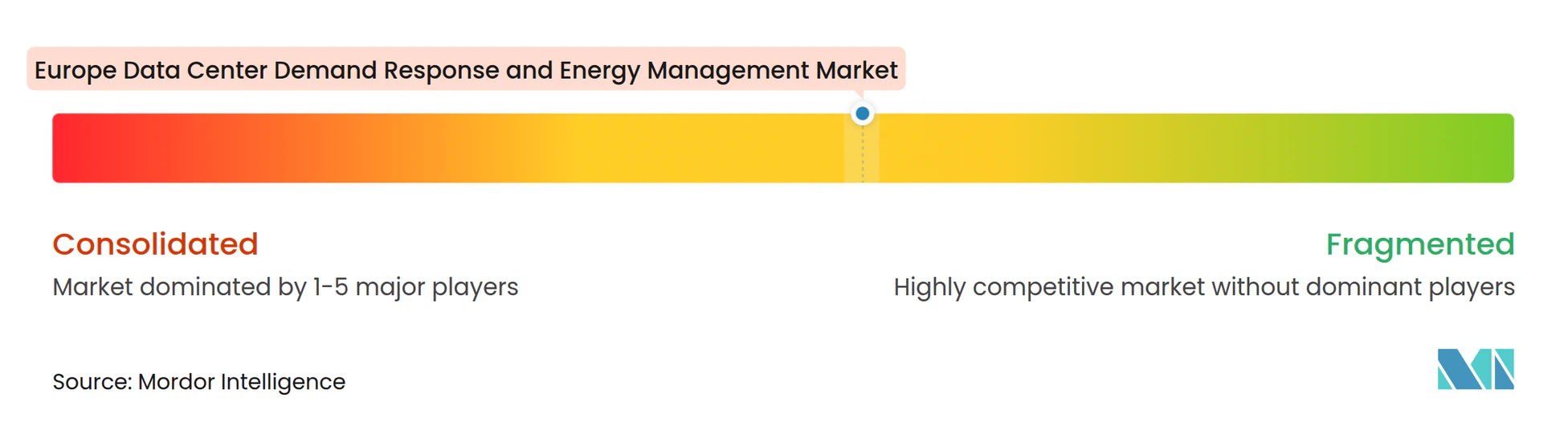
The Europe data center demand response and energy management market has a concentrated physical infrastructure layer and a more fragmented software and services layer. Schneider Electric, Vertiv, Siemens, and Eaton bring established positions in power distribution, cooling, UPS equipment, and facility controls. Demand response aggregators and energy software providers compete through forecasting capability, grid-market access, and knowledge of national participation rules. Competition is shifting from stand-alone hardware to integrated platforms that integrate power, cooling, and workload decisions. This gives specialist providers room to manage registration, measurement, and event delivery for operators without internal energy trading teams.
Schneider Electric announced AI factory reference designs with NVIDIA in September 2025 that combine power management and liquid-cooling controls with NVIDIA Mission Control.[4] Siemens and Rittal formed a partnership in March 2026 to develop standardized power distribution infrastructure for high-density data centers. Eaton and Siemens Energy announced a collaboration in June 2025 on integrated on-site generation to support data center capacity. These moves address delayed grid connections and broaden competition from product supply to resilient energy-system delivery. Technology differentiation now depends on whether a platform can coordinate IT and energy controls without creating operational risk.
Vertiv introduced its Liebert EFC free-cooling system in EMEA in March 2025, featuring a polymer heat exchanger that can switch between cooling modes via software. Data4, RTE, and Schneider Electric launched a French demonstrator in October 2025 to test data center interaction with the electricity grid. These projects can establish evidence for wider use of flexible connection agreements. Product quality, cybersecurity controls, and compliance support remain as important as the ability to lower energy costs.
Europe Data Center Demand Response and Energy Management Industry Leaders
-
Schneider Electric SE
-
Siemens AG
-
ABB Ltd.
-
Eaton Corporation plc
-
Honeywell International Inc.
- *Disclaimer: Major Players sorted in no particular order
Europe Data Center Demand Response and Energy Management Market Companies Covered in this Report
- Schneider Electric SE
- Siemens AG
- ABB Ltd.
- Eaton Corporation plc
- Johnson Controls International plc
- Honeywell International Inc.
- Vertiv Holdings Co
- Legrand SA
- nVent Electric plc
- Delta Electronics, Inc.
- Huawei Digital Power Technologies Co., Ltd.
- Socomec Group S.A.
- AEG Power Solutions B.V.
- Landis+Gyr Group AG
- EnergyHub, Inc.
- AutoGrid Systems, Inc.
- Voltus, Inc.
- CPower Energy Management LLC
- Flexitricity Limited
- Enel X S.r.l.
Recent Industry Developments in Europe Data Center Demand Response and Energy Management Market
- October 2026: Huawei Digital Power unveiled its grid-interactive AI data center strategy at DataCloud Global Congress 2026. The strategy covered power efficiency, heat reuse, bit-level workload optimization, and construction acceleration.
- April 2026: Johnson Controls presented thermal management approaches at Data Center World 2026 that could cut non-IT energy consumption by more than 50%. The presentations included YORK absorption chillers that can use waste heat and reduce chiller electricity requirements by up to 90%.
- March 2026: Siemens and Rittal entered a strategic partnership to develop standardized power distribution infrastructure for data centers serving IEC-standards markets. The arrangement introduced a power supply architecture that places power electronics in a dedicated rack beside server cabinets and supports rack densities above 100 kW.
- February 2026: Johnson Controls launched the YORK YDAM air-cooled magnetic bearing chiller. The unit delivers up to 3.5 MW of cooling and has 20% higher capacity density than competing solutions in a compact format.
Europe Data Center Demand Response and Energy Management Market Report Scope
The Europe Data Center Demand Response and Energy Management Market refers to the adoption of energy optimization, demand response, and grid-interactive technologies across data centers in Germany, the United Kingdom, France, the Netherlands, Ireland, Spain, Italy, the Nordics, and the rest of Europe. These solutions enable operators to comply with energy-efficiency and sustainability objectives, participate in electricity flexibility markets, manage power price volatility, optimize renewable energy utilization, reduce carbon emissions, and support increasingly stringent regulatory and environmental requirements.
The Europe Data Center Demand Response and Energy Management Market Report is Segmented by Solution Component (Hardware, Software, and Services), Software Solution Type (Demand Response Management Platforms, Energy Management Software, Energy Monitoring and Analytics Software, and Energy Forecasting and Optimization Software), Demand Response Program Type (Price-Based Programs, and Incentive-Based Programs), Automation Level (Manual and Non-Automated Solutions, and Automated and Advanced Demand Response Solutions), Primary Application (Peak Load Management, Emergency Load Reduction, Capacity Market Participation, Ancillary Services, Energy Cost Optimization, and Renewable Energy Integration), Data Center Size (Small, Medium, Large, and Hyperscale), Data Center Type (Colocation, Cloud Service Providers [CSPs], and Enterprise and Edge), and Geography (Germany, United Kingdom, France, Netherlands, Ireland, Spain, Italy, Nordics, and Rest of Europe). The Market Forecasts are Provided in Terms of Value (USD).
Segmentation Overview
| Hardware |
| Software |
| Services |
| Demand Response Management Platforms |
| Energy Management Software |
| Energy Monitoring and Analytics Software |
| Energy Forecasting and Optimization Software |
| Price-Based Programs |
| Incentive-Based Programs |
| Manual and Non-Automated Solutions |
| Automated and Advanced Demand Response Solutions |
| Peak Load Management |
| Emergency Load Reduction |
| Capacity Market Participation |
| Ancillary Services |
| Energy Cost Optimization |
| Renewable Energy Integration |
| Small |
| Medium |
| Large |
| Hyperscale |
| Colocation |
| Cloud Service Providers (CSPs) |
| Enterprise and Edge |
| Germany |
| United Kingdom |
| France |
| Netherlands |
| Ireland |
| Spain |
| Italy |
| Nordics |
| Rest of Europe |
| By Solution Component | Hardware |
| Software | |
| Services | |
| By Software Solution Type | Demand Response Management Platforms |
| Energy Management Software | |
| Energy Monitoring and Analytics Software | |
| Energy Forecasting and Optimization Software | |
| By Demand Response Program Type | Price-Based Programs |
| Incentive-Based Programs | |
| By Automation Level | Manual and Non-Automated Solutions |
| Automated and Advanced Demand Response Solutions | |
| By Primary Application | Peak Load Management |
| Emergency Load Reduction | |
| Capacity Market Participation | |
| Ancillary Services | |
| Energy Cost Optimization | |
| Renewable Energy Integration | |
| By Data Center Size | Small |
| Medium | |
| Large | |
| Hyperscale | |
| By Data Center Type | Colocation |
| Cloud Service Providers (CSPs) | |
| Enterprise and Edge | |
| By Geography | Germany |
| United Kingdom | |
| France | |
| Netherlands | |
| Ireland | |
| Spain | |
| Italy | |
| Nordics | |
| Rest of Europe |
Key Questions Answered in the Report
What is the size of the Europe data center demand response and energy management market?
The market is projected at USD 2.39 billion in 2026 and USD 5.78 billion by 2032, with a 15.90% CAGR from 2027 to 2032.
What is driving demand response adoption in European data centers?
The Europe data center demand response and energy management market is supported by AI power density, electricity price volatility, renewable integration, and EU reporting requirements.
Which solution component holds the largest share?
Software held 62.34% in 2026 in the Europe data center demand response market because operators need continuous monitoring, compliance reporting, and control of energy assets.
Which demand response program type is expanding fastest?
Incentive-based programs are projected to expand at an 18.44% CAGR through 2032, supported by payments for verified load reduction during grid stress events.
Why is Ireland expanding faster than other European locations?
Ireland is projected to expand at a 16.61% CAGR because data centers already used 7,663 GWh in 2025 and new connections require demonstrated flexibility.
How do grid connection delays affect data center energy strategies?
In the Europe data center demand response market, long connection queues increase interest in flexible agreements, on-site generation, energy storage, and stress-response systems.