
Europe Data Center Cyber-Physical Security Market Size and Share
Market Overview
| Study Period | 2021 - 2032 |
|---|---|
| Forecast Data Period | 2027 - 2032 |
| Base Year Market Size (2026) | USD 0.54 Billion |
| Market Size (2027) | USD 0.63 Billion |
| Market Size (2032) | USD 1.24 Billion |
| Growth Rate (2027 - 2032) | 14.50 % |
| Market Concentration | Medium |
Major Players *Disclaimer: Major Players sorted in no particular order Image © Mordor Intelligence. Reuse requires attribution under CC BY 4.0. | |
Europe Data Center Cyber-Physical Security Market Analysis by Mordor Intelligence
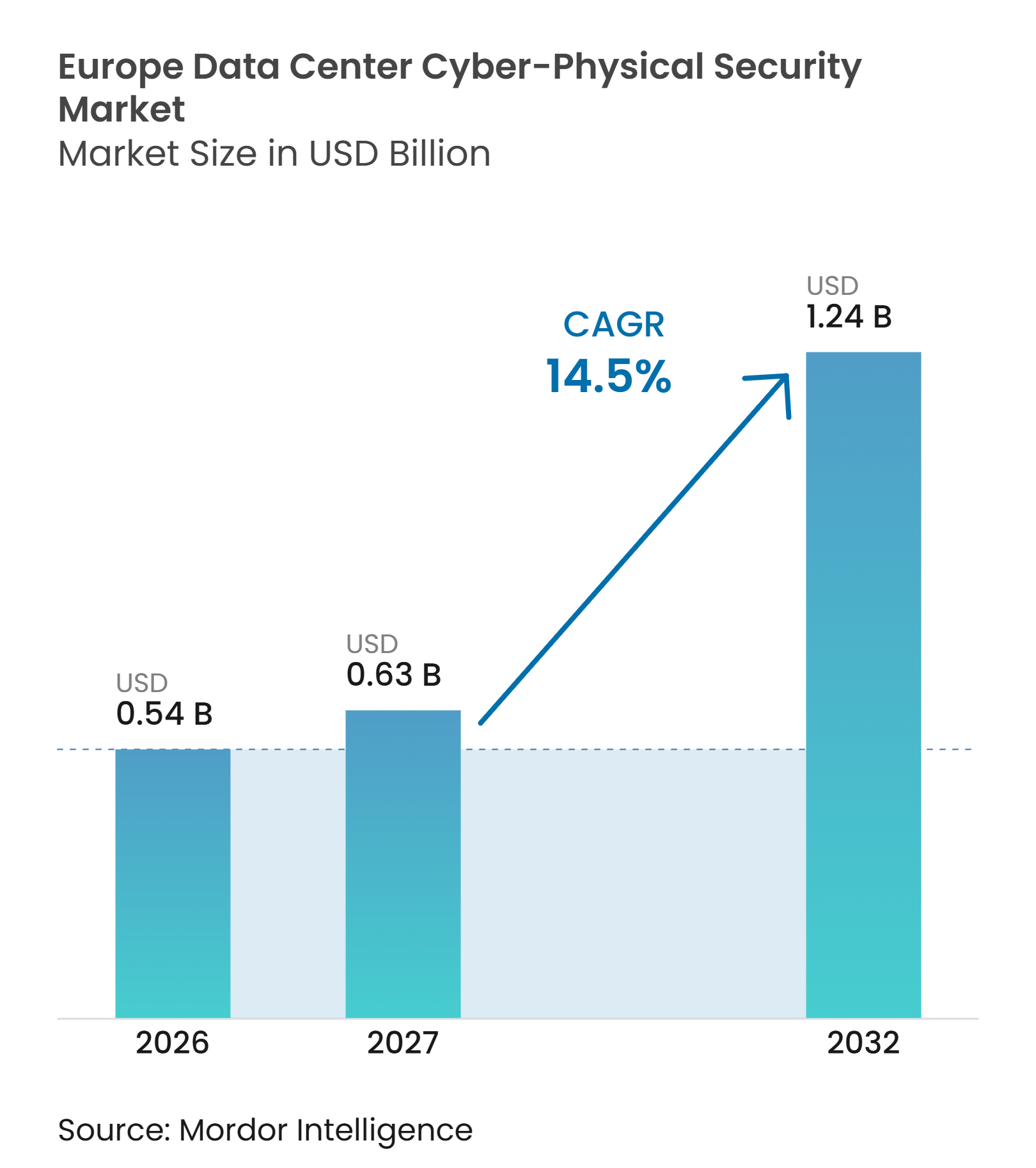
The Europe data center cyber-physical security market size was valued at USD 0.54 billion in 2026 and is estimated to grow from USD 0.63 billion in 2027 to reach USD 1.24 billion by 2032, at a CAGR of 14.5% during the forecast period (2027-2032). Demand is being shaped by new hyperscale, colocation, and AI-focused facilities that need security systems designed into the site rather than added after opening. Regulatory requirements are also moving cyber-physical security from a discretionary project to an operating requirement for many data center operators. The Europe data center cyber-physical security market is shifting toward platforms that combine network, operational technology, identity, video, and facility events in one operating view. This favors suppliers that can support compliance documentation, cross-system integration, and continuous monitoring across multiple sites. Operators also face higher execution costs in older facilities, where upgrades must be completed without interrupting customer workloads.
Key Report Takeaways
- By solution type, Network and Operational Technology Security Solutions accounted for 28.12% of the Europe data center cyber-physical security market in 2026, while Unified Cyber-Physical Security Platforms are projected to expand at a 16.26% CAGR through 2032.
- By security layer, Integrated Security Operations Platforms accounted for 32.38% in 2026 and are projected to record a 15.92% CAGR through 2032.
- By deployment model, Cloud-Based Solutions held 64.78% in 2026 and are expected to expand at a 15.39% CAGR through 2032.
- By service type, System Integration and Implementation accounted for 26.54% of the Europe data center cyber-physical security market revenue in 2026, while Security Auditing and Compliance Services are projected to advance at a 16.59% CAGR through 2032.
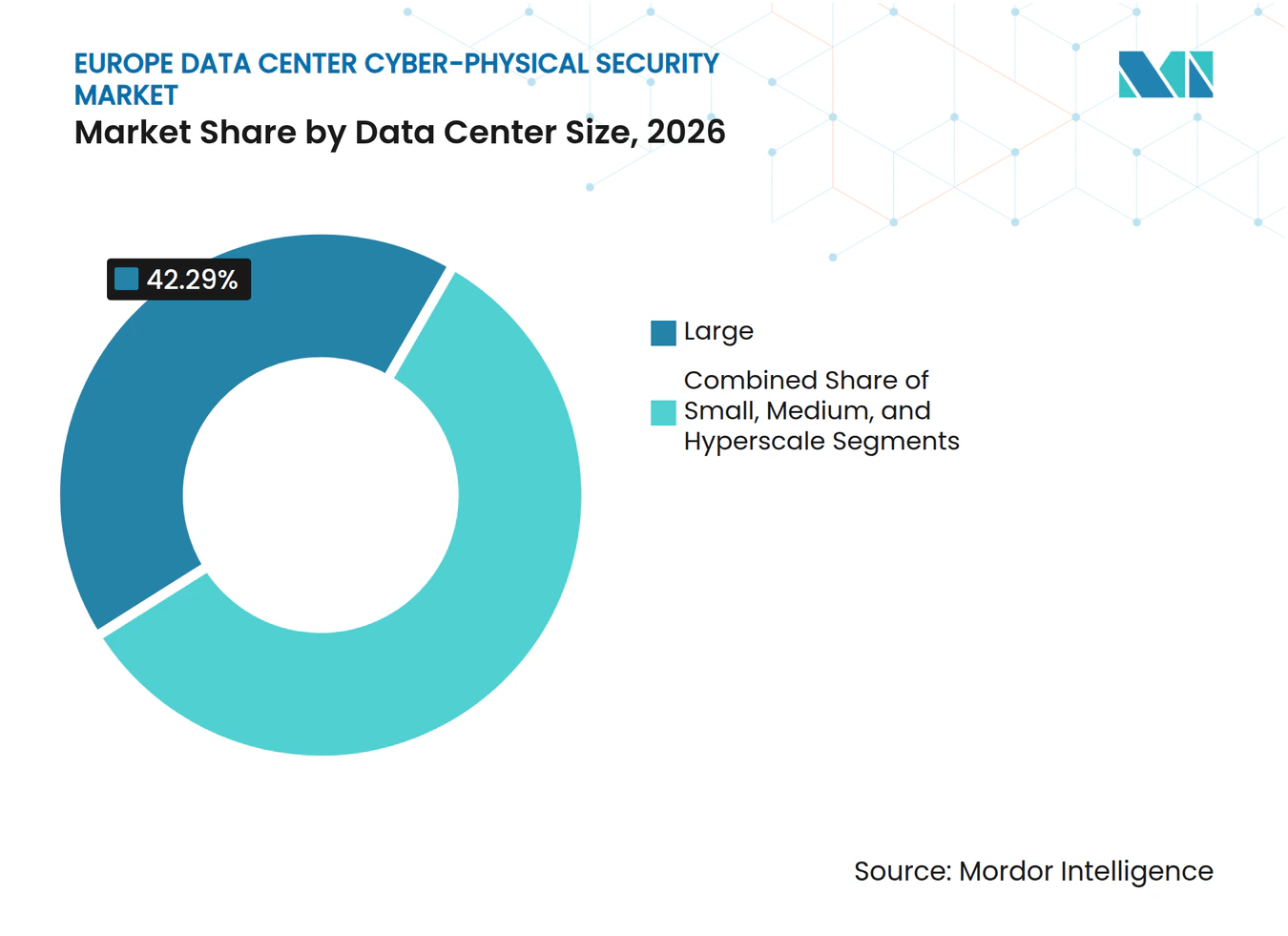
- By data center size, Large data centers held 42.29% in 2026, while Hyperscale facilities are projected to expand at a 17.27% CAGR through 2032.
- By data center type, Colocation facilities accounted for 41.64% in 2026, while Cloud Service Providers are expected to record a 17.38% CAGR through 2032.
- By geography, Germany held 38.53% share of the Europe data center cyber-physical security market in 2026, while the United Kingdom is projected to grow at a 16.93% CAGR through 2032.
Note: Market numbers in this report are based on Mordor Intelligence's proprietary estimation framework, which combines nine months of actuals with Q4 projections for base year 2026.
Market Trends and Insights
Drivers Impact Analysis of Europe Data Center Cyber-Physical Security Market*
| Driver | (~) % Impact on CAGR Forecast | Geographic Relevance | Impact Timeline |
|---|---|---|---|
| Hyperscale, Colocation, and AI Data Center Build-Outs | +3.5% | Germany, United Kingdom, France, Nordics | Short term (≤ 2 years) |
| NIS2 Compliance for Data Center Service Providers | +2.8% | EU-27, acute in Germany and Italy | Medium term (2-4 years) |
| Increasing Ransomware and Extortion Risk to Critical Digital Infrastructure | +2.2% | Germany, United Kingdom, France, Italy | Short term (≤ 2 years) |
| AI-Enabled Video Analytics and Remote Guarding | +1.8% | United Kingdom, Germany, France | Medium term (2-4 years) |
| Convergence of Physical Identity and Zero-Trust Access | +1.3% | Europe, with early gains across EU hyperscale sites | Long term (≥ 4 years) |
| Edge Data Center and Distributed IT Expansion | +0.8% | Secondary markets in Germany, France, and Italy | Long term (≥ 4 years) |
| Source: Mordor Intelligence | |||
Hyperscale, AI, and Colocation Build-Outs Redefine the Security Perimeter
The Europe data center cyber-physical security market is benefiting from a larger share of greenfield projects, where security architecture can be specified before critical equipment is installed. JLL reported that greenfield locations account for 39% of Europe’s forward pipeline, compared with 8% of projects delivered from 2022 to 2025. It also reported that planned hyperscale campuses for 2026 to 2028 are located an average of 175 km from FLAP-D hubs, which leaves operators without inherited perimeter, access, or monitoring systems. The European Data Center Association forecast cumulative European data center infrastructure investment of EUR 176 billion (USD 193.6 billion) from 2026 to 2031. SoftBank Group Corp. committed EUR 75 billion (USD 82.5 billion) to develop 5 GW of AI data center capacity in France, including a first EUR 45 billion (USD 49.5 billion) phase for 3.1 GW in Hauts-de-France.[1] Germany’s KRITIS-Dachgesetz places perimeter protection, access controls, and surveillance within the resilience expectations for large-scale critical facilities, making these systems part of a greenfield project’s core design.
NIS2 Compliance Creates a Mandatory Spend Floor Across the Region
NIS2 and Commission Implementing Regulation (EU) 2024/2690 make cyber and physical risk management a formal requirement for covered data center service providers. The implementing regulation sets more than 150 controls across 13 sections, and its Article 8 links service availability to incident reporting when a disruption exceeds 60 minutes. This places power, cooling, access, and environmental resilience within the same governance discussion as network security. Germany’s NIS2 implementation law entered into force in December 2025, while the BSI set July 31, 2026, as the registration completion date for relevant entities. Operators that also fall under the KRITIS-Dachgesetz must manage overlapping requirements for registration, authentication, access zones, and resilience documentation. Italy’s Decreto NIS2 requires notification to CSIRT Italia and the Agenzia per la Cybersicurezza Nazionale within 24 hours for initial notice, 72 hours for a full report, and 1 month for a final assessment.
Ransomware Targeting of Critical Digital Infrastructure Accelerates Convergence Spending
Ransomware remains the most significant short-term cyber incident category for European organizations, according to ENISA. Black Kite recorded a 55.1% year-over-year rise in incidents during the first 4 months of 2026, reaching an average of 171 incidents per month across 31 European countries. Germany, the United Kingdom, France, and Italy accounted for nearly 59% of the reported European incident volume, and Germany recorded 370 incidents, or 17.9% of the total. Dragos found that many OT-adjacent ransomware events begin in IT systems at the IT and OT boundary rather than inside industrial control protocols. This makes network segmentation, identity governance, and physical access monitoring central defenses for the Europe data center cyber-physical security market. A compromised building-management environment can disrupt server halls even if the attack does not directly target a SCADA application.
AI Video Analytics Shift Data Center Surveillance From Reactive to Predictive
AI-enabled video analytics can identify tailgating at mantrap entrances, unusual activity near high-density racks, and coincident perimeter and credential events that conventional CCTV may not identify without continuous staffing. The Security Industry Association noted that data center security programs increasingly use such tools to strengthen physical protection strategies.[2] Johnson Controls presented exacqVision 26.2 and Software House CCURE IQ 3.20 at GSX 2026, combining video, access control, incident response, and analytics in a unified operating environment. The company said nearly 50% of physical security teams identify AI as a key technology priority. Cisco’s integration with Axis Communications supports the management of network video devices through a shared IT security layer. These deployments can also help operators verify incidents faster while limiting retention of sensitive footage under GDPR data-minimization requirements.
Restraints Impact Analysis of Europe Data Center Cyber-Physical Security Market*
| Restraint | (~) % Impact on CAGR Forecast | Geographic Relevance | Impact Timeline |
|---|---|---|---|
| Retrofit Economics in Operating Facilities | -2.1% | Germany, United Kingdom, France | Medium term (2-4 years) |
| Shortage of Skilled Cyber-Physical Integration Personnel | -1.6% | EU-27, acute in Germany and France | Medium term (2-4 years) |
| GDPR Constraints on Biometric and Video Analytics Data | -1.0% | EU-27, especially Italy and Germany | Long term (≥ 4 years) |
| Lead-Time Volatility for Hardened Security Electronics | -0.7% | Europe procurement supply chains | Medium term (2-4 years) |
| Source: Mordor Intelligence | |||
Retrofit Economics in Operating Facilities Suppress Upgrade Velocity
Upgrading a live colocation or enterprise data center costs more than installing comparable systems in a new facility. Crews must work around continuous uptime requirements, coordinate tenant access at the rack level, and connect new equipment to older building-management systems that may not have standard application programming interfaces. Deutsche Rechenzentren stated that these conditions can extend retrofit projects to 12 to 24 months and increase costs to 2 to 3 times the greenfield equivalent. Colocation operators also have limited flexibility because many operate with narrow margins and manage tenant commitments. Phased upgrades can delay the documented security posture needed for NIS2 audit readiness. Dormakaba acquired TANlock GmbH in July 2025 for rack-lock technologies suited to both retrofit and new-installation environments, showing how suppliers are addressing this constraint
Cyber-Physical Skills Scarcity Widens the Execution Gap
The Europe data center cyber-physical security market requires professionals who can work across operational technology, physical security integration, and cybersecurity. ENISA found that 3 in 4 surveyed public and private critical infrastructure organizations struggled to recruit cybersecurity staff, while the median cybersecurity spend was EUR 1.5 million (USD 1.65 million) in 2025. Cisco reported that 82% of European respondents regarded the shortage of skilled cybersecurity professionals as a major challenge, and 50% had more than 10 unfilled positions. The required skill profile spans access-control interfaces, OT network protocols, video platforms, and NIS2 audit evidence. Existing frameworks, such as ENISA’s European Cybersecurity Skills Framework, address parts of this need but do not remove the integration gap. Specialist integrators can therefore command a premium on complex projects, while hyperscale operators increasingly use managed security services to support internal teams.
*Our forecasts treat driver/restraint impacts as directional, not additive. The impact forecasts reflect baseline growth, mix effects, and variable interactions.
Europe Data Center Cyber-Physical Security Market Segment Analysis
By Solution Type:
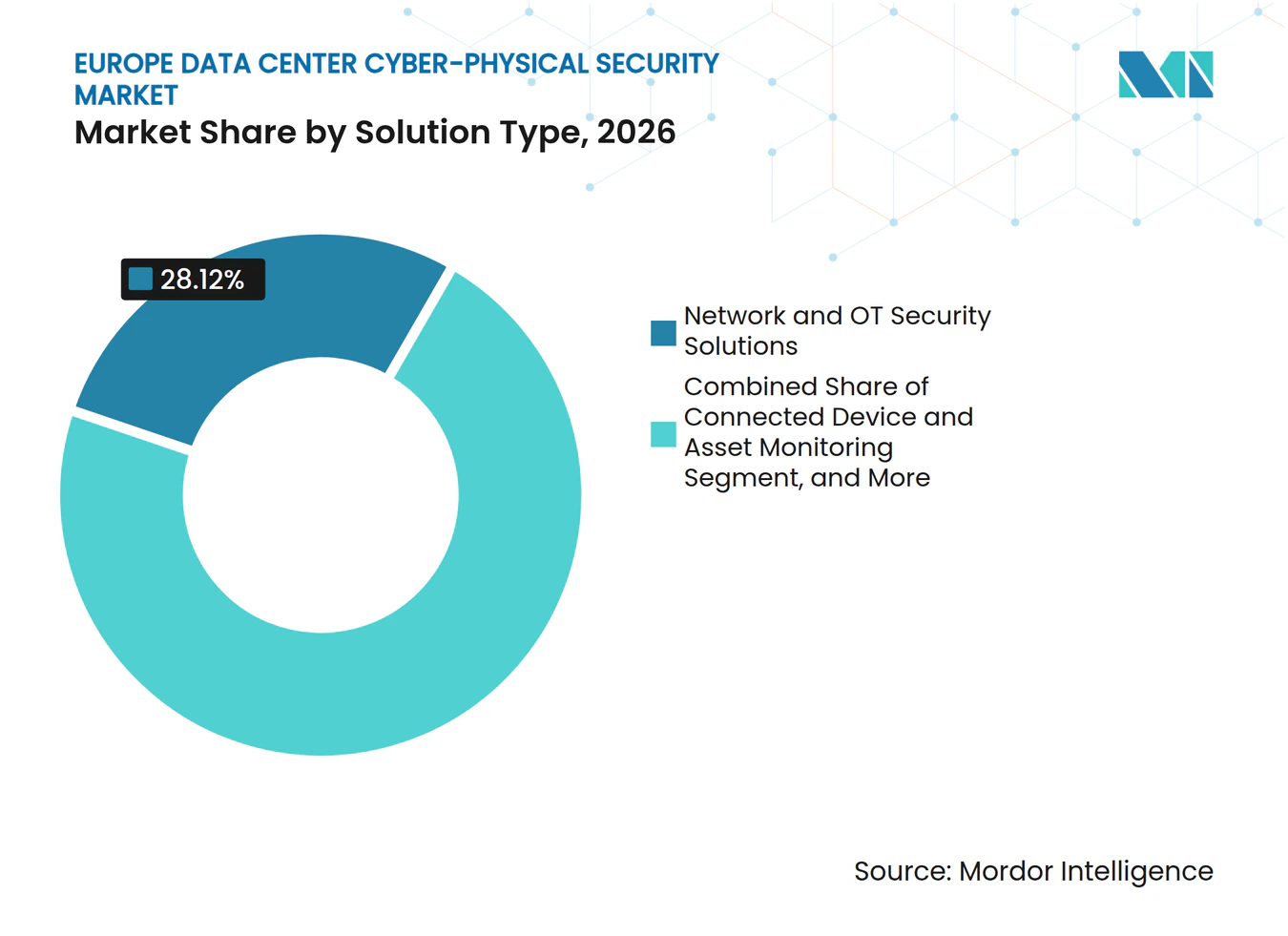
Network and OT Security Holds the Largest Position While Unified Platforms Expand FasterNetwork and Operational Technology Security Solutions held 28.12% of the Europe data center cyber-physical security market in 2026. The segment is supported by the exposure created where power management, heating, ventilation, air conditioning, and building controls connect to enterprise IT networks. These environments are often managed by separate teams with different technology priorities. Dragos reported that ransomware affecting OT-adjacent environments commonly targets boundary IT systems instead of deep SCADA stacks. This keeps network segmentation and protected access pathways at the center of operator spending.
Unified Cyber-Physical Security Platforms are projected to expand at a 16.26% CAGR through 2032. They bring firewall, identity, access-reader, camera, and facility-event data into one environment, which can improve incident review and audit documentation. Connected Device and Asset Monitoring Solutions support equipment visibility across distributed facilities. Security Information and Event Correlation Solutions provide a shared record of events from different security layers. Identity and Access Management Solutions, Integration and Incident Response Services also benefit as the Europe data center cyber-physical security industry moves away from disconnected systems.



By Security Layer:
Integrated Security Operations Platforms Lead in Scale and ExpansionIntegrated Security Operations Platforms held 32.38% of the Europe data center cyber-physical security market in 2026, the highest share among security layers. Their position reflects demand for consolidated monitoring rather than separate point systems. A platform can connect physical access, video, alarms, building conditions, and cybersecurity events in a common operating view. This makes it easier to manage incidents that involve more than one control domain. It also gives operators a clearer basis for demonstrating how controls function together.
The same platform category is projected to expand at a 15.92% CAGR through 2032. EN 50600-1:2026 requires documented physical-protection classes for data center spaces and pathways, covering unauthorized access, intrusion, fire, and environmental events. Physical Access Control Systems and Video Surveillance Systems remain core hardware layers. Building Management and Facility Control Systems are becoming more important because availability events involving cooling or power can create reportable governance issues. Environmental and Infrastructure Monitoring Systems support this broader control environment.
By Deployment Model:
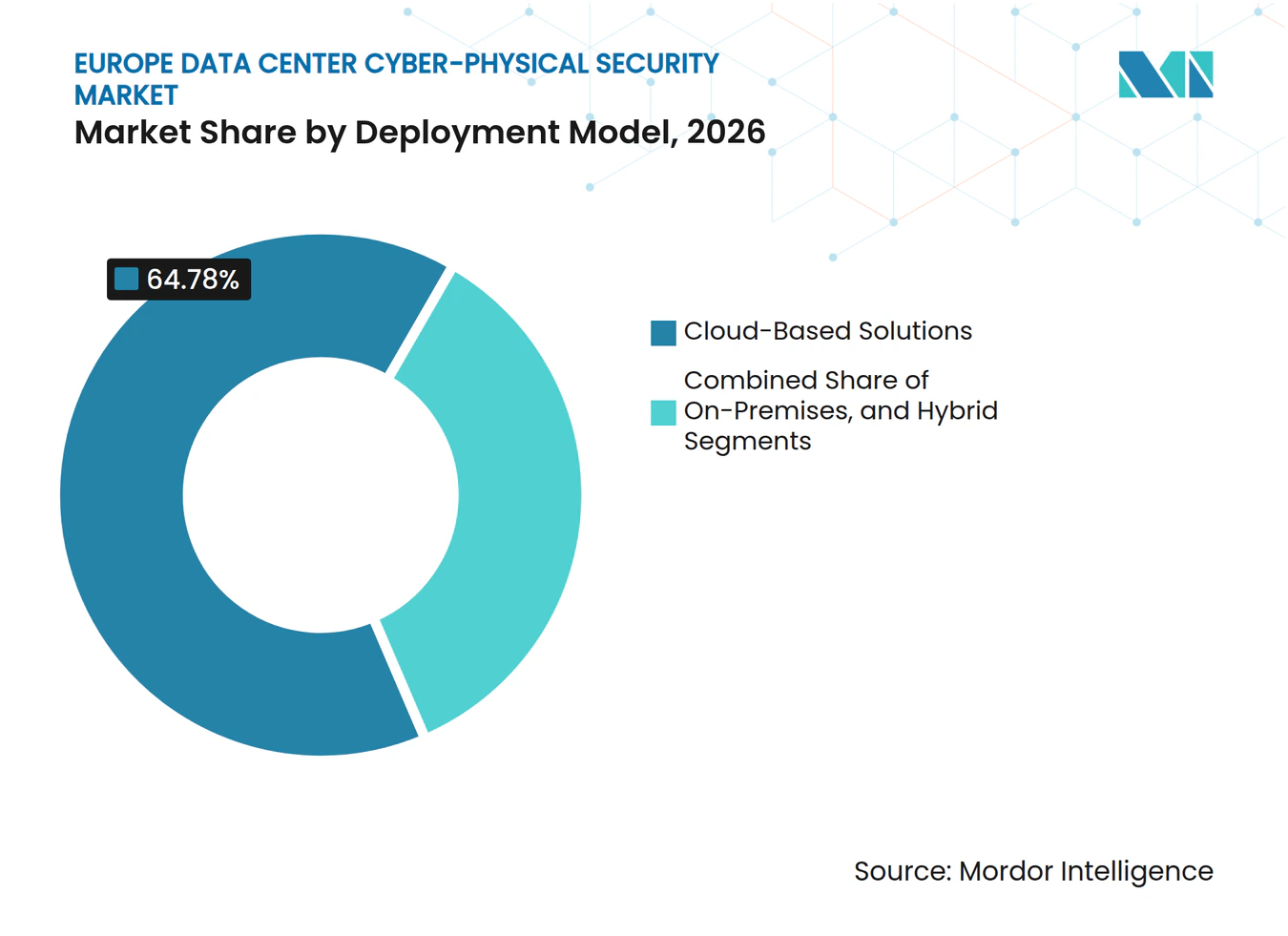
Cloud-Based Solutions Lead Through Scale and Regulatory AlignmentCloud-Based Solutions commanded 64.78% of the Europe data center cyber-physical security market share in 2026. Operators use cloud-managed platforms to apply common policies across multiple campuses and to avoid maintaining separate management environments at every site. The model is particularly useful for organizations that need continuous software updates and centralized incident visibility. It can also support managed security operating centers where internal technical resources are limited. The leadership of cloud deployment reflects both scalability needs and the demand for standardized operating procedures.
Cloud-Based Solutions are projected to expand at a 15.39% CAGR through 2032. Genetec launched a United Kingdom-hosted Security Center SaaS instance on Microsoft Azure in February 2026, designed to keep physical-security event data within United Kingdom boundaries.[3] On-Premise Solutions remain relevant where operators use air-gapped systems or manage highly classified workloads. Hybrid Solutions offers a transition path for existing sites that cannot move every system at once. The continued need for data residency, reporting readiness, and regular updates supports cloud adoption without eliminating on-site systems.

By Service Type:
System Integration Leads While Compliance Auditing AcceleratesSystem Integration and Implementation held 26.54% of the Europe data center cyber-physical security market in 2026. Multi-layer deployments require specialists to connect cameras, access systems, network controls, alarms, rack locks, and building-management infrastructure. Convergint Technologies delivered a security solution for a hyperscale data center in Frankfurt in September 2026 that covered video surveillance, biometric authentication, anti-tailgating technology, key management, cabinet locks, and alarm monitoring across active halls. The project illustrates the coordination required when a system is deployed without interrupting live operations. It also shows why integration capability remains a major buying consideration.
Security Auditing and Compliance Services are projected to advance at a 16.59% CAGR through 2032. Essential entities can face regular audits by national authorities, while important entities may be inspected where evidence of noncompliance arises. Managed Monitoring and Detection services help operators respond to staffing shortages. Incident Response and Recovery services provide specialist support after an event. Cyber-Physical Risk Assessment also remains relevant because greenfield hyperscale sites need location-specific threat models before security equipment is selected.
By Data Center Size:
Large Facilities Lead While Hyperscale Facilities Carry the Highest RateLarge data centers accounted for 42.29% of the Europe data center cyber-physical security market in 2026. The segment is anchored by established colocation facilities across Frankfurt, London, Amsterdam, and Paris. Mature sites need recurring maintenance, refresh programs, and compliance upgrades. Their security programs must protect tenant infrastructure while maintaining round-the-clock availability. This produces recurring demand for integrated systems and implementation services.
Hyperscale facilities are projected to expand at a 17.27% CAGR through 2032, the highest rate across data center size tiers. JLL documented 453 MW of forecast annual delivery across European markets for 2026, nearly 3 times the 2020 rate. Greenfield hyperscale sites can incorporate perimeter, rack, facility, and network controls from the initial design stage. Small and medium data centers continue to contribute to demand through national and distributed deployments. Their requirements favor cost-appropriate security designs that still provide centralized visibility.
By Data Center Type:
Colocation Leads While Cloud Service Providers Expand FastestColocation facilities accounted for 41.64% of the Europe data center cyber-physical security market in 2026. Their leading position follows the established role of colocation providers in mature FLAP-D locations. These operators must secure shared buildings, customer cages, common areas, and critical infrastructure. They also need audit-ready access and incident records for a varied tenant base. This makes physical and cyber controls closely connected in day-to-day operations.
Cloud Service Providers are projected to record a 17.38% CAGR through 2032. AI workloads are concentrated in cloud facilities, and NIS2-related security controls apply to cloud service providers as well as traditional colocation operators. Enterprise and Edge data centers represent the third category. JLL research presented at Capacity Europe 2026 found that inference workloads are drawing compute resources to locations within 100-150 km of end users. FiberCop is building more than 100 edge data centers from repurposed Italian telecommunications exchanges, while Telefónica expanded to 17 edge data centers across Spain in 2026.
Geography Analysis
Germany held 38.53% of the Europe data center cyber-physical security market share in 2026. Frankfurt’s data center base and mid-2026 vacancy rate of 3.1% reflect the density of critical digital infrastructure in the country. Germany’s BSIG came into force in December 2025, and the KRITIS-Dachgesetz followed on January 29, 2026. The frameworks link cybersecurity governance with physical resilience measures such as perimeter security, access control, surveillance, and detection, and the BSI set July 31, 2026, as the registration completion deadline for relevant entities. Germany also recorded 370 ransomware incidents between January 2025 and April 2026, or 17.9% of European activity, which supports demand for integrated detection and response capabilities.
The United Kingdom is projected to expand at a 16.93% CAGR through 2032, the fastest geographic rate in the Europe data center cyber-physical security market. Growth is supported by AI data center investment and post-Brexit data-sovereignty requirements. Cyble reported that the United Kingdom ranked as Europe’s most attacked country for ransomware in the first quarter of 2026. Genetec’s United Kingdom-hosted cloud instance shows that suppliers are responding with regionally hosted security infrastructure. The deployment allows United Kingdom and European organizations to store physical-security event data within United Kingdom national boundaries and supports platforms that unite data-residency controls with operational security management.
France offers a longer-term opportunity as AI capacity projects create new security procurement requirements. SoftBank’s EUR 75 billion (USD 82.5 billion), commitment for 5 GW of French AI data center capacity provides a substantial greenfield project pipeline. Italy is shaped by the Decreto NIS2 framework, and its data protection authority issued a provisional limitation in September 2025 concerning biometric-data processing in an airport facial-recognition system. The action indicates the careful controls needed when centrally stored biometric templates are used under GDPR Article 9 and creates a more constrained environment for facial-authentication deployments than the German model.
Competitive Landscape
Market Concentration
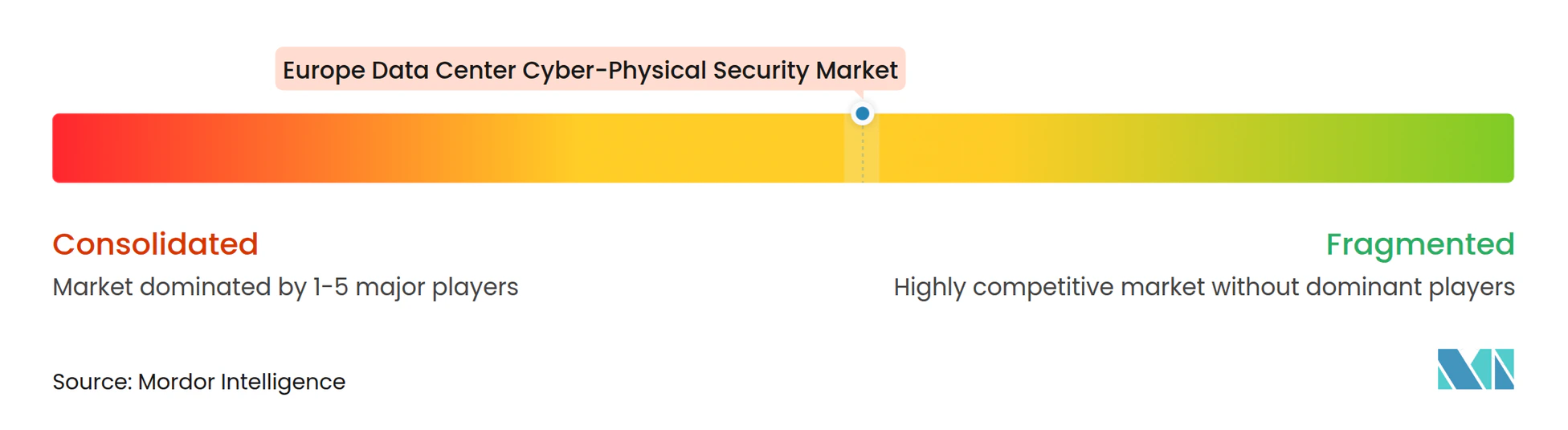
The Europe data center cyber-physical security market is moderately fragmented, with Johnson Controls, Honeywell, Schneider Electric, Genetec, and Cisco holding meaningful installed bases and specialist suppliers holding expertise in selected technology layers. Competition depends on platform capability, local delivery capacity, certifications, and the ability to support complex live-site projects. The Europe data center cyber-physical security market also includes integrators that coordinate multi-vendor deployments for operators. This structure allows established vendors and specialized suppliers to compete in different parts of the security stack.
Targeted acquisitions have been a key route to strengthening data center expertise. dormakaba acquired TANlock GmbH in July 2025 to add rack locks, authentication modules, and IP readers for critical infrastructure deployments. ASSA ABLOY acquired Kentix GmbH in October 2025 to expand its Digital and Access Solutions portfolio in the EMEIA data center segment. Convergint Technologies competes through delivery expertise for multi-vendor systems in live hyperscale facilities. Milestone Systems, Genetec, and Avigilon, a Motorola Solutions company, compete in video-management and unified physical-security platforms, while Genetec’s open-architecture and hybrid approach supports staged cloud adoption.
A capability gap remains where OT network security meets physical-access governance, as physical-security suppliers may have limited OT monitoring capability while IT-focused providers are extending their offerings into physical-event correlation. Cisco’s integration with Axis Communications connects network-video management with an IT security-management layer. Schneider Electric and NVIDIA announced a June 2025 collaboration on EcoStruxure solutions for AI data centers, including modular pods and NVIDIA-enabled racks. The Cyber Resilience Act’s active vulnerability and severe-incident reporting obligation, which entered into force on September 11, 2026, increases supply-chain scrutiny for camera and access-control manufacturers, while Securitas Technology partnered with Rohde and Schwarz in 2025 to add millimeter-wave personnel screening to its data center offering.
Europe Data Center Cyber-Physical Security Industry Leaders
-
Johnson Controls International plc
-
Honeywell International Inc.
-
Schneider Electric SE
-
Bosch Sicherheitssysteme GmbH
-
ASSA ABLOY AB
- *Disclaimer: Major Players sorted in no particular order
Europe Data Center Cyber-Physical Security Market Companies Covered in this Report
- Johnson Controls International plc
- Honeywell International Inc.
- Schneider Electric SE
- Bosch Sicherheitssysteme GmbH
- ASSA ABLOY AB
- Axis Communications AB
- Securitas Technology AB
- Convergint Technologies LLC
- Milestone Systems A/S
- Cisco Systems, Inc.
- ABB Ltd.
- Pelco Inc. (Motorola Solutions, Inc.)
- dormakaba Holding AG
- Genetec Inc.
- G4S plc
- ADT Inc.
- HID Global Corporation
- Avigilon Corporation (Motorola Solutions, Inc.)
- Hangzhou Hikvision Digital Technology Co., Ltd.
- Zhejiang Dahua Technology Co., Ltd.
Recent Industry Developments in Europe Data Center Cyber-Physical Security Market
- October 2026: The EU Cyber Resilience Act's active vulnerability and severe incident reporting obligation entered into force on September 11, 2026, requiring all manufacturers of products with digital elements, including security cameras and access control hardware, to report actively exploited vulnerabilities and severe incidents to ENISA and national competent authorities, materially raising the compliance bar for hardware vendors supplying European data center security infrastructure.
- September 2026: Convergint Technologies delivered a complex physical-security solution for a confidential hyperscale data center in Frankfurt, Germany, encompassing enterprise video surveillance, biometric authentication, anti-tailgating technology, intelligent key management, server cabinet locks, and alarm monitoring across multiple active data halls, demonstrating the scale and multi-layer complexity of European hyperscale security integration contracts.
- September 2026: Johnson Controls showcased exacqVision 26.2, Software House C•CURE IQ 3.20, and expanded Managed Services at GSX 2026, positioning AI-driven video analytics and unified security operations for mission-critical environments including data centers. The company cited that nearly 50% of physical security teams identify AI as a key technology priority.
- May 2026: SoftBank Group Corp. committed EUR 75 billion (USD 82.5 billion) to develop 5 GW of AI data center capacity in France, with a first phase of EUR 45 billion (USD 49.5 billion) for 3.1 GW in the Hauts-de-France region, announced at the Choose France summit. This represents one of the largest single AI infrastructure investment commitments in European history and creates a multi-year greenfield security procurement pipeline.
Europe Data Center Cyber-Physical Security Market Report Scope
The Europe Data Center Cyber-Physical Security Market covers revenue from cyber-physical security solutions and services deployed in data centers across Germany, the United Kingdom, France, Italy, and other European countries. The market is shaped by strict data protection and critical infrastructure regulations, privacy and biometric governance requirements, and the growing demand for integrated security operations and OT security monitoring.
The Europe Data Center Cyber-Physical Security Market Report is Segmented by Solution Type (Unified Cyber-Physical Security Platforms, Connected Device and Asset Monitoring Solutions, Security Information and Event Correlation Solutions, Network and Operational Technology Security Solutions, Identity and Access Management Solutions, and Integration and Incident Response Services), Security Layer (Physical Access Control Systems, Video Surveillance Systems, Building Management and Facility Control Systems, Environmental and Infrastructure Monitoring Systems, and Integrated Security Operations Platforms), Deployment Model (On-Premise Solutions, Cloud-Based Solutions, and Hybrid Solutions), Service Type (Cyber-Physical Risk Assessment, System Integration and Implementation, Managed Monitoring and Detection, Incident Response and Recovery, and Security Auditing and Compliance Services), Data Center Size (Small, Medium, Large, and Hyperscale), Data Center Type (Colocation, Cloud Service Providers (CSPs), and Enterprise / Edge), and Country (Germany, United Kingdom, France, Italy, and Rest of Europe). The Market Forecasts are Provided in Terms of Value (USD).
Segmentation Overview
| Unified Cyber-Physical Security Platforms |
| Connected Device and Asset Monitoring Solutions |
| Security Information and Event Correlation Solutions |
| Network and Operational Technology Security Solutions |
| Identity and Access Management Solutions |
| Integration and Incident Response Services |
| Physical Access Control Systems |
| Video Surveillance Systems |
| Building Management and Facility Control Systems |
| Environmental and Infrastructure Monitoring Systems |
| Integrated Security Operations Platforms |
| On-Premise Solutions |
| Cloud-Based Solutions |
| Hybrid Solutions |
| Cyber-Physical Risk Assessment |
| System Integration and Implementation |
| Managed Monitoring and Detection |
| Incident Response and Recovery |
| Security Auditing and Compliance Services |
| Small |
| Medium |
| Large |
| Hyperscale |
| Colocation |
| Cloud Service Providers (CSPs) |
| Enterprise / Edge |
| Germany |
| United Kingdom |
| France |
| Italy |
| Rest of Europe |
| By Solution Type | Unified Cyber-Physical Security Platforms |
| Connected Device and Asset Monitoring Solutions | |
| Security Information and Event Correlation Solutions | |
| Network and Operational Technology Security Solutions | |
| Identity and Access Management Solutions | |
| Integration and Incident Response Services | |
| By Security Layer | Physical Access Control Systems |
| Video Surveillance Systems | |
| Building Management and Facility Control Systems | |
| Environmental and Infrastructure Monitoring Systems | |
| Integrated Security Operations Platforms | |
| By Deployment Model | On-Premise Solutions |
| Cloud-Based Solutions | |
| Hybrid Solutions | |
| By Service Type | Cyber-Physical Risk Assessment |
| System Integration and Implementation | |
| Managed Monitoring and Detection | |
| Incident Response and Recovery | |
| Security Auditing and Compliance Services | |
| By Data Center Size | Small |
| Medium | |
| Large | |
| Hyperscale | |
| By Data Center Type | Colocation |
| Cloud Service Providers (CSPs) | |
| Enterprise / Edge | |
| By Country | Germany |
| United Kingdom | |
| France | |
| Italy | |
| Rest of Europe |
Key Questions Answered in the Report
What is the size of the Europe data center cyber-physical security market?
The Europe data center cyber-physical security market size was valued at USD 0.54 billion in 2026 and is estimated to grow from USD 0.63 billion in 2027 to reach USD 1.24 billion by 2032, at a CAGR of 14.50% during the forecast period (2027-2032).
Which solution type leads Europe’s data center cyber-physical security sector?
Network and Operational Technology Security Solutions lead with a 28.12% share in 2026. Unified Cyber-Physical Security Platforms are projected to expand fastest at a 16.26% CAGR through 2032.
Why are data center operators increasing cyber-physical security spending?
New AI and hyperscale facilities, NIS2-related obligations, ransomware exposure, and integrated monitoring requirements are increasing demand.
Which deployment model has the largest share?
Cloud-Based Solutions lead with 64.78% in 2026 and are projected to record a 15.39% CAGR through 2032.
Which country leads European demand?
Germany leads with 38.53% in 2026, supported by its large Frankfurt hub, regulatory requirements, and elevated ransomware exposure.
What is the fastest-growing facility type?
Cloud Service Providers are projected to advance at a 17.38% CAGR through 2032, supported by AI workload concentration and compliance requirements.