
Europe Data Center Copper and Electrical Materials Market Size and Share
Market Overview
| Study Period | 2021 - 2032 |
|---|---|
| Forecast Data Period | 2027 - 2032 |
| Base Year Market Size (2026) | USD 3.92 Billion |
| Market Size (2027) | USD 4.35 Billion |
| Market Size (2032) | USD 6.63 Billion |
| Growth Rate (2027 - 2032) | 8.79 % |
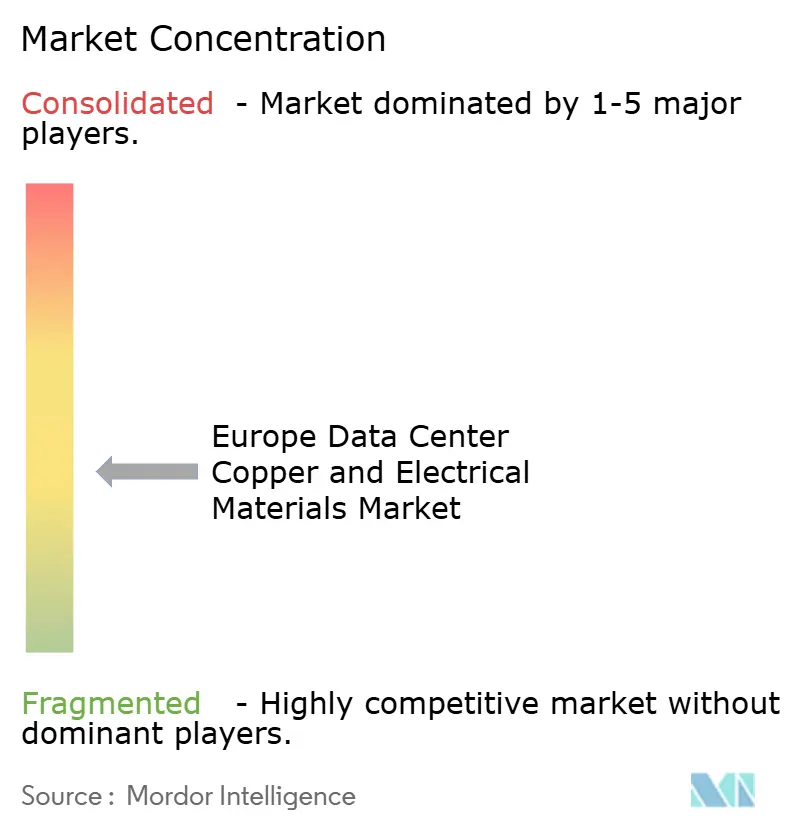
| Market Concentration | Medium |
Major Players *Disclaimer: Major Players sorted in no particular order Image © Mordor Intelligence. Reuse requires attribution under CC BY 4.0. | |
Europe Data Center Copper and Electrical Materials Market Analysis by Mordor Intelligence
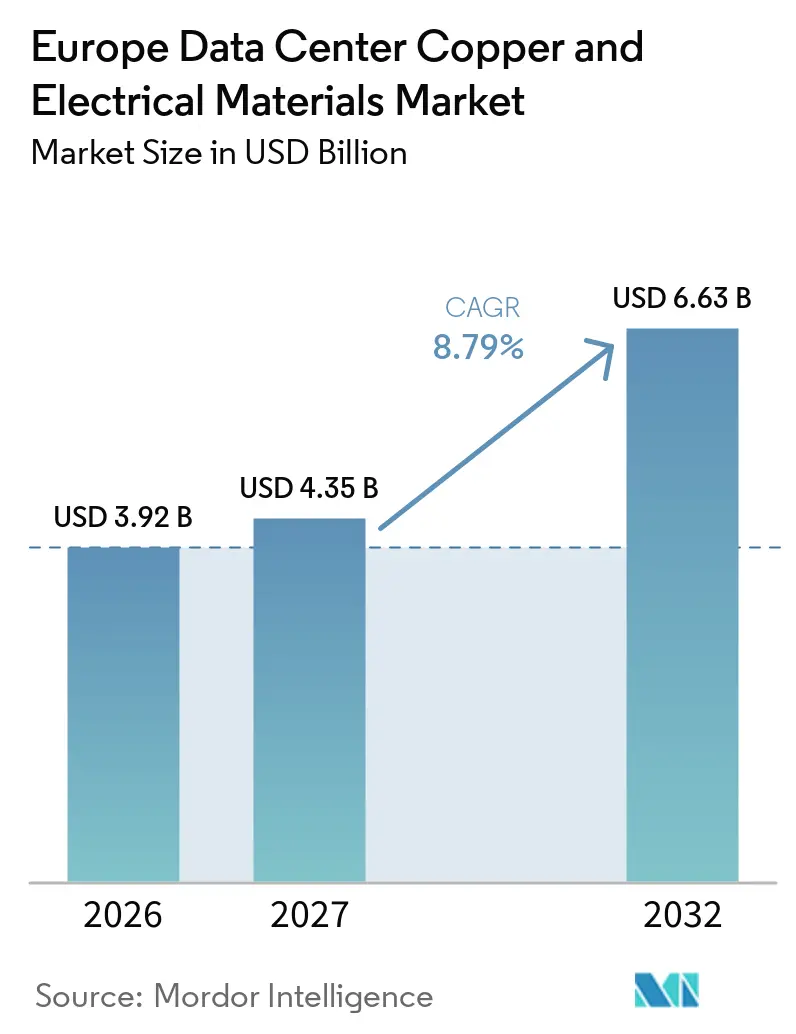
The Europe data center copper and electrical materials market size is projected to expand from USD 3.92 billion in 2026 and USD 4.35 billion in 2027 to USD 6.63 billion by 2032, registering a CAGR of 8.79% between 2027 and 2032. Rising AI workloads are increasing the amount of power equipment required within new facilities. Developers are shifting toward larger campuses and more modular electrical systems. Public investment in European computing capacity also supports demand for conductors, busbars, switchgear, and cooling-related components. Grid access remains the main constraint because delayed connections can postpone construction schedules. Higher copper prices and the eventual use of higher-voltage distribution can limit material intensity in selected installations.
Key Report Takeaways
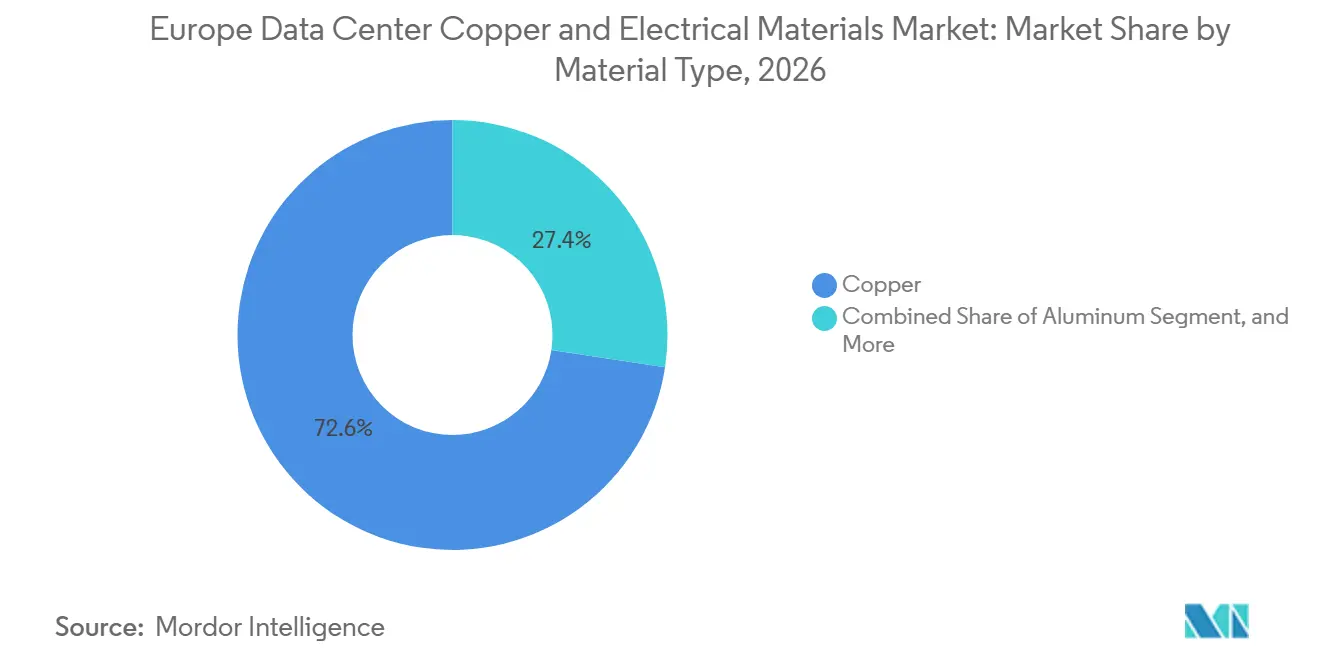
- By material type, copper held 72.61% of the Europe data center copper and electrical materials market share in 2026, while aluminum is projected to record the highest CAGR at 9.73% through 2032.
- By product type, electrical cables and conductors held 38.57% of the Europe data center copper and electrical materials market share in 2026, while busbars and busways are projected to expand at a 9.96% CAGR through 2032.
- By application, power distribution accounted for 44.23% of the Europe data center copper and electrical materials market share in 2026 and is projected to expand at a 10.29% CAGR through 2032.
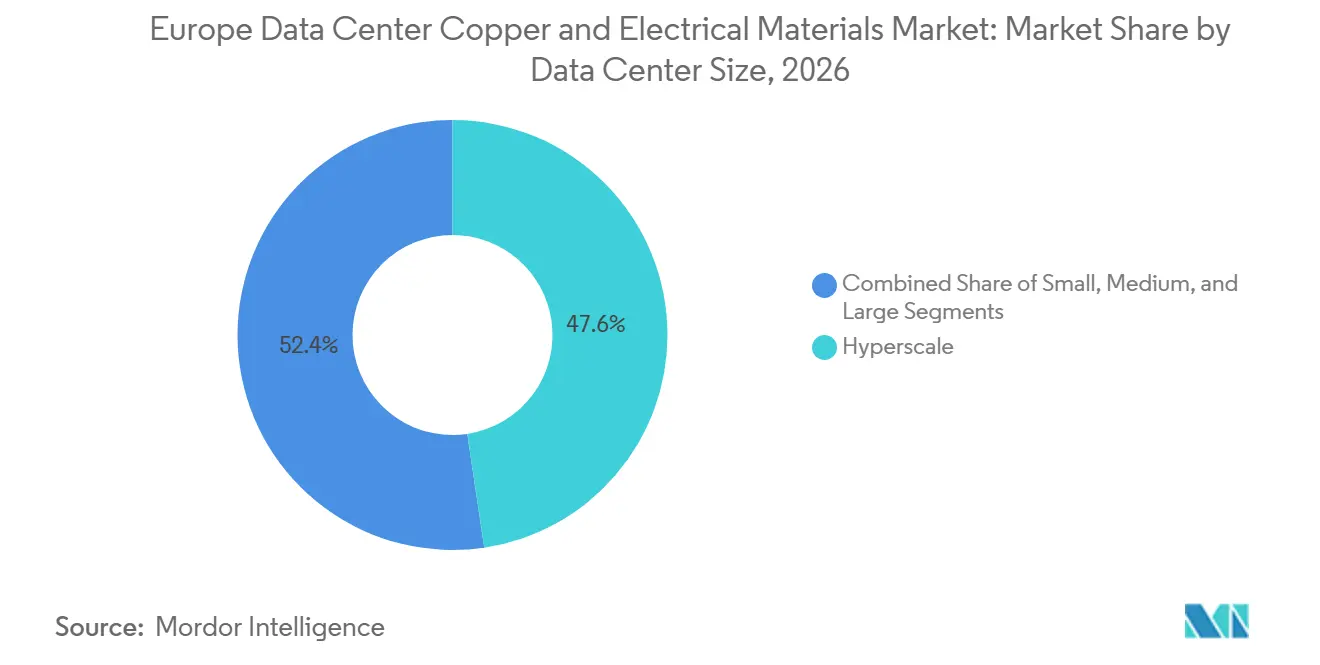
- By data center size, hyperscale facilities accounted for 47.64% of the Europe data center copper and electrical materials market share in 2026 and are projected to expand at a 10.69% CAGR through 2032.
- By data center type, colocation held 47.20% of the Europe data center copper and electrical materials market share in 2026, while cloud service providers are projected to expand at an 11.10% CAGR through 2032.
- By geography, Germany held 24.48% of the Europe data center copper and electrical materials market share in 2026, while Spain is projected to expand at an 11.32% CAGR through 2032.
Note: Market numbers in this report are based on Mordor Intelligence's proprietary estimation framework, which combines nine months of actuals with Q4 projections for base year 2026.
Market Trends and Insights
Drivers Impact Analysis of Europe Data Center Copper and Electrical Materials Market*
| Driver | (~) % Impact on CAGR Forecast | Geographic Relevance | Impact Timeline |
|---|---|---|---|
| AI and High-Density Rack Power Growth | +3.2% | Global, concentrated in Frankfurt, London, Paris, Dublin, and Amsterdam | Short term (≤ 2 years) |
| Hyperscale and Colocation Capacity Expansion | +2.5% | Pan-Europe, with Germany, the United Kingdom, and France primary markets | Short term (≤ 2 years) |
| European Data Sovereignty and Digital Infrastructure Investment | +1.5% | European Union, strongest in France, Germany, and Southern Europe | Medium term (2-4 years) |
| Modular Busway Adoption for Faster Capacity Expansion | +1.0% | Pan-Europe, strongest in hyperscale and colocation hubs | Medium term (2-4 years) |
| Retrofit Demand for Higher Rack Densities and Reliability | +0.8% | The United Kingdom, Germany, France, and the Netherlands | Short term (≤ 2 years) |
| Copper Demand From Liquid-Cooling Manifolds and Heat-Exchange Systems | +0.6% | Pan-Europe, with the highest use in AI and HPC clusters | Medium term (2-4 years) |
| Source: Mordor Intelligence | |||
AI and High-Density Rack Power Growth
AI cluster design is raising the electrical load carried by each rack. New systems can require redesigned busbars and cables rather than larger versions of existing conductors. This changes purchasing decisions across the Europe data center copper and electrical materials market. BHP stated that a 100 MW hyperscale facility can contain 27 tonnes of copper per MW. It also noted that an NVIDIA GB200 NVL72 system uses more than 5,000 copper cables over 3.2 km in total length.[1] The resulting demand is concentrated in power paths, terminations, and cooling hardware near high-density compute equipment.
The need for reliable power delivery also raises the value of qualified equipment. Operators cannot easily interrupt active capacity to replace a distribution assembly. This favors suppliers that can provide tested systems with predictable delivery schedules. It also encourages designs that allow future changes without extensive rewiring. The Europe data center copper and electrical materials market therefore benefits from higher electrical complexity, even when total facility construction is delayed. The material requirement is tied to the design of the load path, not merely to the number of servers installed.
Hyperscale and Colocation Capacity Expansion
Large cloud and colocation facilities require substantial quantities of cable, busbar, switchgear, and connection equipment. This supports demand across the Europe data center copper and electrical materials market. The European Commission has set out an AI Continent Action Plan that includes a target to expand European data center capacity materially within 5 to 7 years. The plan also includes support for AI infrastructure and gigafactories. These projects require power systems from the grid connection through the server row.
New campuses also differ from earlier facilities because they are increasingly developed outside the most established hubs. The move creates longer logistics routes for cable, copper rod, busbar, and transformer equipment. It can also require dedicated supplier coordination at project sites. Colocation remains important because it provides near-term capacity for a broad customer base. Cloud providers are also moving toward owned infrastructure where they control system specifications and procurement. That shift increases the importance of long supplier qualification cycles and direct project relationships.
European Data Sovereignty and Digital Infrastructure Investment
European policy is adding a compliance basis for local computing capacity. The proposed Cloud and AI Development Act addresses cloud capacity, secure processing, and European technology capability. These measures can support projects that need regional processing and controlled infrastructure. They also increase the relevance of equipment that meets European safety and performance standards. The Europe data center copper and electrical materials market is affected because each additional local facility requires a complete electrical system.
The InvestAI program includes support for AI gigafactories and related computing infrastructure. Publicly backed projects often follow firm commissioning schedules. This can make equipment availability more important than small changes in commodity costs. Compliance requirements also raise the value of traceability and tested assemblies. Suppliers with established European manufacturing and service networks can be better placed to support these projects. The policy focus broadens the opportunity beyond the largest commercial cloud regions.
Modular Busway Adoption for Faster Capacity Expansion
Busway systems support changes in data hall layouts without removing the entire distribution network. This is useful where rack density can increase after initial commissioning. Vertiv introduced its PowerBar Track double-stack busway system in March 2026. The company stated that the system supports up to 2,500A and uses an open-track layout for tap-off movement under load. Such designs can shorten the time needed to add or modify power connections.
Schneider Electric introduced high-density AI data center solutions in June 2025. Its prefabricated modular pod integrates power distribution, cooling, and rack infrastructure. Factory-built systems can reduce site work and standardize configuration. IEC 61439-6 is relevant for busbar trunking systems and their verification. Compliance requirements support suppliers that can document equipment performance. The Europe data center copper and electrical materials market gains from the shift toward modular power assemblies.
Restraints Impact Analysis of Europe Data Center Copper and Electrical Materials Market*
| Restraint | (~) % Impact on CAGR Forecast | Geographic Relevance | Impact Timeline |
|---|---|---|---|
| Grid Connection Delays and Power Availability Constraints | -1.2% | Pan-Europe, most severe in FLAP-D hubs | Short term (≤ 2 years) |
| Copper Price Volatility and Qualification Lead Times | -0.8% | Global, with stronger exposure in Southern and Central Europe | Medium term (2-4 years) |
| Aluminum Substitution and Higher-Voltage Distribution | -0.5% | Pan-Europe, focused on long feeder runs and campus perimeter busways | Long term (≥ 4 years) |
| Fragmented European Permitting, Standards, and Skilled-Labor Constraints | -0.3% | All European markets, especially Southern and Eastern Europe | Medium term (2-4 years) |
| Source: Mordor Intelligence | |||
Grid Connection Delays and Power Availability Constraints
Grid connections are a direct limit on the speed of data center development. The International Energy Agency reported that connection waiting periods in Europe can range from 2 to 10 years. It also identified delays in several major European hubs. A project cannot place most electrical materials until site power plans are sufficiently advanced. This can shift procurement schedules even where investor funding is already available. The Europe data center copper and electrical materials market can therefore see demand move between countries rather than disappear.
ENTSO-E reported that access to electricity was the largest challenge cited by almost 80% of European data center operators. Operators may respond by considering private substations, on-site generation, and storage systems. These alternatives still use copper-intensive equipment. However, they add engineering and approval steps before equipment orders are released. Reuters also reported that transmission-level connection timing had become a major site-selection consideration for Amazon Web Services in Europe. The restraint is strongest where power demand has already exceeded available connection capacity.
Copper Price Volatility and Qualification Lead Times
Copper price movements can pressure fixed-price construction contracts and equipment budgets. The International Energy Agency reported record copper prices in January 2026 and highlighted supply pressures across the value chain. Higher prices can prompt reviews of conductor specifications for long runs. Those reviews require engineering checks and supplier approval. The effect is more pronounced where aluminum could meet the operating requirement. It is less significant in tightly packed high-density locations where copper remains necessary.
Qualification periods can also slow construction starts. Cable plants and busbar suppliers need time to validate alternative materials and new designs. Nexans identified cable capacity as a bottleneck for AI data center construction in Europe during 2025. Its position illustrates why extra capacity cannot be added immediately. Long production lead times can preserve pricing discipline among qualified suppliers. They can also lead developers to place orders earlier in the project cycle.
*Our forecasts treat driver/restraint impacts as directional, not additive. The impact forecasts reflect baseline growth, mix effects, and variable interactions.
Europe Data Center Copper and Electrical Materials Market Segment Analysis
By Material Type:
Copper Retains High-Density Power Roles While Aluminum Expands in Larger RunsCopper held 72.61% of the Europe data center copper and electrical materials market share in 2026. Its position reflects the requirements of high-density power distribution in server rooms. Copper provides high conductivity in a compact footprint. This supports airflow and space management around tightly arranged racks. Grounding and bonding systems also depend on reliable fault-current performance. Copper is consequently used in busbars, cables, connections, and cooling-related components. Its role is strongest where equipment space is limited. The Europe data center copper and electrical materials market size for copper remains tied to the growing electrical intensity of AI facilities.
Aluminum is projected to expand at a 9.73% CAGR through 2032. It is suitable for selected medium-voltage feeder runs and overhead busways. Its lower weight can reduce structural loading across large buildings. This can be useful at campus-scale facilities with longer distribution routes. Aluminum does not replace copper in every use case. High-density in-rack systems still require compact conductors and controlled performance. Higher-voltage distribution could reduce the amount of copper required in some designs. That transition remains early and is not expected to change the material mix within the forecast period. Product design also influences installation time, maintenance access, and the ability to monitor loads. Those criteria increase the value of compatible components supplied as a complete electrical package.

By Product Type:
Busbars and Busways Support Flexible Power DistributionElectrical cables and conductors accounted for 38.57% of the Europe data center copper and electrical materials market share in 2026. Cables remain necessary across low-voltage and medium-voltage power paths. They connect transformers, switchgear, backup systems, and distribution boards. Their large installed volume gives the category a leading position. Demand also comes from control systems, termination equipment, and facility upgrades. Cable selection depends on heat tolerance, conductor choice, and the route within the facility. New construction and retrofit projects both require extensive cable systems. Supply availability can affect installation schedules where specialized products have longer lead times.
Busbars and busways are projected to expand at a 9.96% CAGR through 2032. Their modular format allows power connections to be changed as rack layouts evolve. This is valuable for operators that need to add equipment without extensive downtime. Vertiv’s 2026 PowerBar Track uses an open-track design for movable tap-off boxes.[2] Schneider Electric also introduced modular AI infrastructure that incorporates high-density power systems.[3] Copper rods and strips remain important upstream inputs for cable and busbar fabrication. Connectors and terminations become more important as power paths require more monitored connection points. Manufacturers that provide validated assemblies can reduce coordination risk for contractors and operators. This supports continued demand for both conductors and the equipment that controls them.
By Application:
Power Distribution Leads Demand Across New and Upgraded FacilitiesPower distribution accounted for 44.23% of the Europe data center copper and electrical materials market share in 2026. It is also projected to expand at a 10.29% CAGR through 2032. The category includes the equipment that carries electricity from facility-level systems to IT loads. AI clusters require higher current capacity and careful distribution design. This expands the need for switchgear, busbars, conductors, and termination hardware. Power paths must also maintain redundancy to support uptime requirements. The Europe data center copper and electrical materials market size for power distribution is shaped by both new facilities and upgrades to active sites. Higher rack loads make earlier distribution designs less suitable.
Grid connection and electrical infrastructure face the strongest effect from utility delays. The International Energy Agency has identified grid constraints as a central barrier to European data center development. Backup systems can become more relevant where reliability risks are high. These systems require generator cables, battery interconnects, and control wiring. Grounding and bonding remain smaller applications but are technically important. High fault currents can require larger copper grounding conductors. Other applications include wiring for fire suppression controls and liquid-cooling infrastructure. The link between cooling and power systems expands the electrical scope of high-density facilities. The move toward modular assemblies also reduces the amount of on-site fabrication required. It can improve schedule certainty where construction labor is limited.
By Data Center Size:
Hyperscale Facilities Set the Largest Procurement RequirementsHyperscale facilities held 47.64% of the Europe data center copper and electrical materials market share in 2026. They are projected to expand at a 10.69% CAGR through 2032. These campuses concentrate very large computing loads at individual locations. Each project requires major purchases of power distribution equipment and connection systems. BHP reported that a 100 MW hyperscale facility can contain 27 tonnes of copper per MW. The scale of these projects can justify dedicated logistics and supplier support. They are increasingly developed in secondary locations with suitable power availability. This adds complexity to materials delivery and local installation planning.
Medium and large data centers remain important because many were built for lower rack densities. These facilities can need busbar, cable, and switchgear upgrades to support AI workloads. Retrofit work allows operators to increase usable capacity without building a new site. Small edge facilities are increasing in number but have more limited copper use per site. They still require compact distribution boards, connectors, and UPS interconnects. The mix of facility sizes creates several demand patterns for electrical suppliers. Hyperscale projects favor large, planned orders. Smaller facilities favor repeatable products and local service capability. Both are relevant to the Europe data center copper and electrical materials market. The scale of these facilities also makes supplier reliability a core purchasing criterion. Capacity commitments can be as important as product pricing on major campuses.
By Data Center Type:
Colocation Provides Scale While Cloud Providers Lead Forecast ExpansionColocation held 47.20% of the Europe data center copper and electrical materials market share in 2026. Colocation operators serve a wide range of enterprise and cloud customers. Their facilities purchase cables, busbars, switchgear, and backup equipment at scale. They also upgrade existing sites as customer power requirements change. This creates recurring demand for distribution hardware. The segment remains important in established hubs where customers need space close to network interconnection points. Its purchasing model can favor equipment suppliers with a broad portfolio. It can also favor installers that can work within live environments.
Cloud service providers are projected to expand at an 11.10% CAGR through 2032. Owned facilities allow hyperscalers to control electrical specifications and sourcing. This can increase the use of direct supplier programs and longer qualification processes. Enterprise and edge sites continue to support lower-volume demand for boards, connectors, and UPS interconnects. The categories are becoming less distinct as platforms pursue large dedicated campuses. The European Commission’s AI infrastructure programs add support for regional computing capacity. The result is a wider set of projects requiring electrical materials. Suppliers need both standardized products and the ability to support customized high-density designs. Electrical materials must meet local installation requirements while supporting common European standards. This creates demand for technical documentation and after-sales engineering support.
Geography Analysis
Germany
Germany held 24.48% of the Europe data center copper and electrical materials market share in 2026. Frankfurt remains a major location for colocation and cloud infrastructure. Google announced a EUR 5.5 billion (USD 6.14 billion) commitment for cloud infrastructure and data center capacity in Germany during November 2025.[4] New facilities and upgrades support orders for cable, busbar, switchgear, and connections. The established base also requires retrofits for higher rack densities and dependable operation. Operators must settle power availability and connection plans before releasing substantial equipment orders. Electrical safety rules and equipment verification create a preference for tested systems and experienced suppliers. Germany’s industrial base also supports access to engineering capability, component manufacturing, and installation services.
Spain
Spain is projected to expand at an 11.32% CAGR through 2032. Aragón is receiving attention as a location for large cloud developments. The shift reflects pressure on power availability in more established hubs. Large facilities require extensive grid-to-chip electrical systems, including cable, busways, transformer connections, and backup equipment. The International Energy Agency has highlighted the need to manage energy constraints as European data center capacity expands. Spain’s planned development base makes grid planning as important as cloud investment. The country offers an alternative setting for projects that need land, renewable power options, and workable development pathways. Its demand profile favors suppliers that can coordinate materials across large greenfield locations.
The United Kingdom, France, Italy, and the Nordic Countries
The United Kingdom remains important because of London’s connectivity and cloud ecosystem. Long connection periods can shift projects toward Wales, Scotland, and the Midlands. France is drawing attention for large AI infrastructure plans and modular electrical equipment. Schneider Electric’s high-density portfolio shows the importance of factory-built power and cooling systems. Italy benefits from Milan’s position as a regional hub. Nordic locations attract interest because of renewable electricity, cooler conditions, and grid access. ENTSO-E has stressed that electricity access remains a critical issue across Europe. These geographies broaden the regional demand base for electrical materials.
Competitive Landscape
The Europe data center copper and electrical materials market includes large electrical equipment groups and specialist cable manufacturers. ABB, Eaton, Schneider Electric, and Siemens compete across switchgear, power distribution, and related systems. Prysmian, Nexans, and NKT focus more directly on conductor and cable supply. Vertiv and Legrand compete through modular power, UPS, busway, and integrated infrastructure solutions. The market is moderately fragmented, and competition is shaped by delivery capability, tested equipment, and support for high-density installations. No company-level market share data is available in the supplied material.
Suppliers are increasingly offering prefabricated systems rather than individual components. Schneider Electric introduced high-density AI data center solutions during 2025. Vertiv launched the PowerBar Track busway system in March 2026. These products allow operators to increase capacity with less site disruption. They also place more of the power system within qualified supply chains. Factory capability, product certification, and project integration are therefore becoming more important. The shift gives suppliers a route to capture value beyond conductor supply alone.
Cable suppliers face demand for greater volume and shorter delivery periods. Prysmian reported capacity investment aimed at digital solutions and data center growth. NKT reported additional medium-voltage capacity development in Denmark and Portugal during 2026. Direct-to-chip cooling manifolds and quick-disconnect fittings remain a developing area. This gives established electrical suppliers room to broaden their portfolios. It also creates an opening for specialized component suppliers. Environmental compliance is becoming more relevant as buyers seek efficient and lower-impact electrical equipment.
Europe Data Center Copper and Electrical Materials Industry Leaders
-
ABB Ltd.
-
Eaton Corporation plc
-
Legrand SA
-
Schneider Electric SE
-
Prysmian S.p.A.
- *Disclaimer: Major Players sorted in no particular order
Europe Data Center Copper and Electrical Materials Market Companies Covered in this Report
- ABB Ltd.
- Eaton Corporation plc
- Legrand SA
- Schneider Electric SE
- Siemens AG
- Prysmian S.p.A.
- Nexans S.A.
- Vertiv Holdings Co
- nVent Electric plc
- Rittal GmbH & Co. KG
- Socomec Group
- GE Vernova Inc.
- Hitachi Energy Ltd.
- Mitsubishi Electric Corporation
- TE Connectivity Ltd.
- Amphenol Corporation
- LS Cable & System Ltd.
- NKT A/S
- Furukawa Electric Co., Ltd.
- Belden Inc.
- Weidmüller Interface GmbH & Co. KG
Recent Industry Developments in Europe Data Center Copper and Electrical Materials Market
- September 2026: Schneider Electric launched standardized prefabricated power modules delivering up to 2.5 MW per module for European hyperscale and colocation markets. Powered by Galaxy VXL UPS technology, the new Prefabricated Power Modules represent the largest single-container prefabricated power solution the company has brought to market, targeting AI-dense environments requiring scalable, high-density copper power infrastructure.
- August 2026: NKT completed additional medium-voltage capacity in Denmark and confirmed its new high-voltage factory in Karlskrona, Sweden, remains on schedule for 2027 commissioning. Additional medium-voltage capacity in Portugal is expected operational by the end of 2026, expanding European copper cable supply as data center construction demand outpaces production capacity.
- June 2026: Schneider Electric signed a framework agreement with SoftBank to supply prefabricated power and cooling modules for a EUR 45 billion (USD 50.28 billion) data center program in France. A dedicated factory at Dunkirk's port, creating 350 permanent jobs and delivering from 2028, establishes a direct multi-year anchor for French electrical materials demand.
- March 2026: Vertiv launched the PowerBar Track double-stack busway system rated up to 2,500A under IEC 61439-6. The open-track architecture supports live tap-off box relocation while carrying active load, with built-in metering, and is available in copper and aluminum conductor variants.
Europe Data Center Copper and Electrical Materials Market Report Scope
The Europe data center copper and electrical materials market encompasses the procurement, regional distribution, and deployment of specialized copper, aluminum, and alternative conducting materials engineered for high-density computing infrastructure across Western, Eastern, Northern, and Southern Europe.
The Europe Data Center Copper and Electrical Materials Market Report is Segmented by Material Type (Copper, Aluminum, and Other Electrical Conductive Materials), Product Type (Electrical Cables and Conductors, Busbars and Busways, Copper Rods and Strips, Electrical Connectors and Termination Materials, and Other Electrical Materials), Application (Power Distribution, Power Backup Systems, Grid Connection and Electrical Infrastructure, Grounding and Bonding, and Other Electrical Applications), Data Center Size (Small, Medium, Large, and Hyperscale), Data Center Type (Colocation, Cloud Service Providers [CSPs], and Enterprise / Edge), and Country (United Kingdom, Germany, France, Italy, Spain, and Rest of Europe). The Market Forecasts are Provided in Terms of Value (USD).
Segmentation Overview
| Copper |
| Aluminum |
| Other Electrical Conductive Materials |
| Electrical Cables and Conductors |
| Busbars and Busways |
| Copper Rods and Strips |
| Electrical Connectors and Termination Materials |
| Other Electrical Materials |
| Power Distribution |
| Power Backup Systems |
| Grid Connection and Electrical Infrastructure |
| Grounding and Bonding |
| Other Electrical Applications |
| Small |
| Medium |
| Large |
| Hyperscale |
| Colocation |
| Cloud Service Providers (CSPs) |
| Enterprise / Edge |
| United Kingdom |
| Germany |
| France |
| Spain |
| Italy |
| Rest of Europe |
| By Material Type | Copper |
| Aluminum | |
| Other Electrical Conductive Materials | |
| By Product Type | Electrical Cables and Conductors |
| Busbars and Busways | |
| Copper Rods and Strips | |
| Electrical Connectors and Termination Materials | |
| Other Electrical Materials | |
| By Application | Power Distribution |
| Power Backup Systems | |
| Grid Connection and Electrical Infrastructure | |
| Grounding and Bonding | |
| Other Electrical Applications | |
| By Data Center Size | Small |
| Medium | |
| Large | |
| Hyperscale | |
| By Data Center Type | Colocation |
| Cloud Service Providers (CSPs) | |
| Enterprise / Edge | |
| By Country | United Kingdom |
| Germany | |
| France | |
| Spain | |
| Italy | |
| Rest of Europe |
Key Questions Answered in the Report
What is the Europe data center copper and electrical materials market size?
The Europe data center copper and electrical materials market size is projected to expand from USD 3.92 billion in 2026 and USD 4.35 billion in 2027 to USD 6.63 billion by 2032. This represents an 8.79% CAGR between 2027 and 2032.
What is driving demand for copper and electrical materials in European data centers?
AI workloads, higher rack power density, hyperscale construction, and facility upgrades are increasing the requirement for power distribution equipment. European policy support for AI infrastructure also encourages new local computing capacity.
Which material leads data center electrical installations in Europe?
Copper held a 72.61% share in 2026 because compact, high-density power systems depend on conductivity and space efficiency. Aluminum remains relevant for selected long feeder runs and overhead campus systems.
Which product category is expected to expand fastest through 2032?
Busbars and busways are projected to expand at a 9.96% CAGR as operators need flexible power distribution that supports capacity changes. Their modular layout can allow connections to move without replacing the wider power path.
Why are grid connection delays important for European data center projects?
Connection delays can postpone construction and equipment orders because the site power plan must be advanced before many materials are ordered. They can also increase demand for substations, backup systems, and storage equipment.
Which European country is expected to record the fastest expansion?
Spain is projected to expand at an 11.32% CAGR through 2032. Large cloud development activity and demand for grid-to-chip electrical infrastructure support the country’s role as a major secondary location.