
Europe Data Center Construction Materials Supply Chain Market Size and Share
Market Overview
| Study Period | 2021 - 2032 |
|---|---|
| Forecast Data Period | 2027 - 2032 |
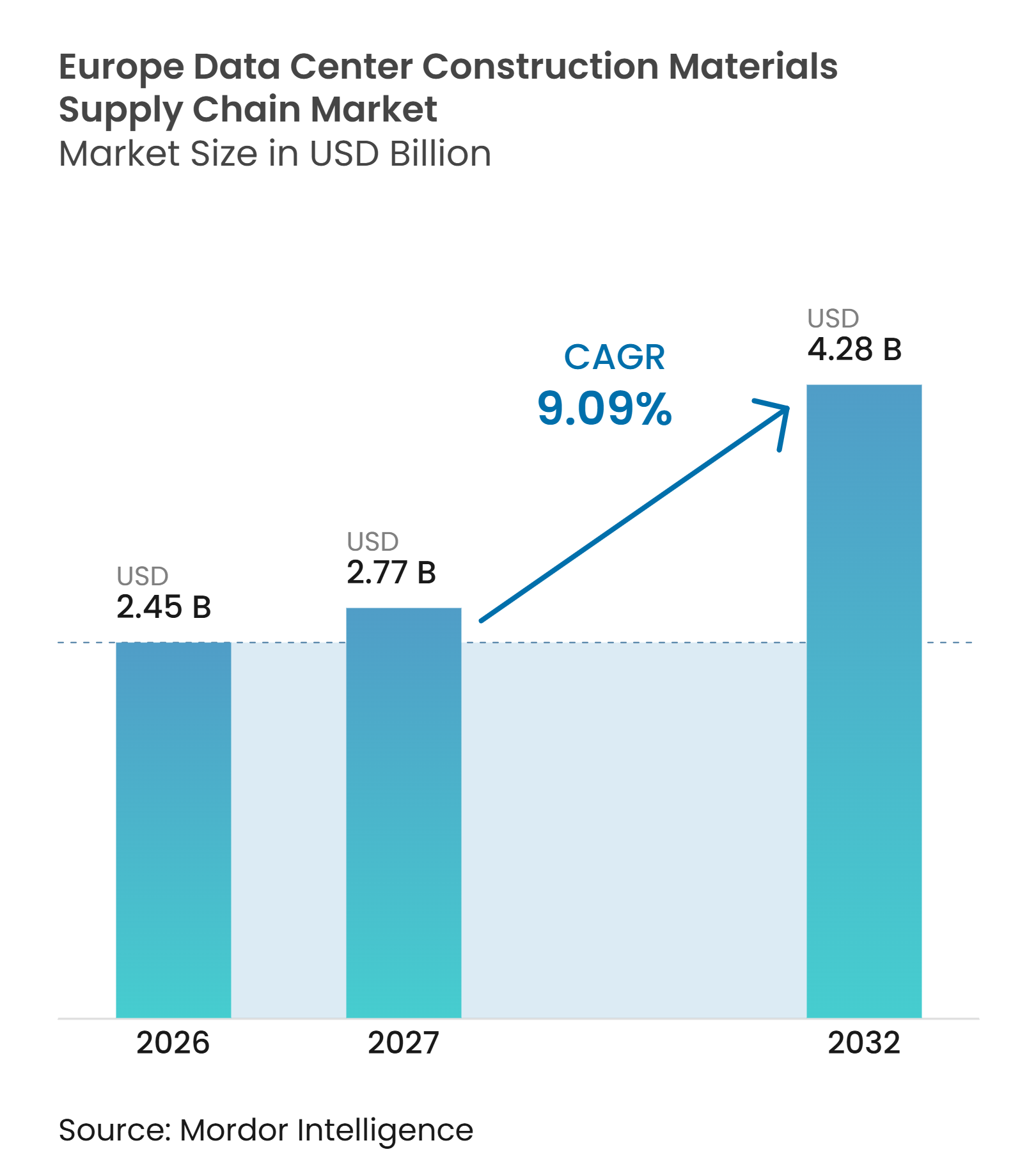
| Base Year Market Size (2026) | USD 2.45 Billion |
| Market Size (2027) | USD 2.77 Billion |
| Market Size (2032) | USD 4.28 Billion |
| Growth Rate (2027 - 2032) | 9.09 % |
| Market Concentration | Medium |
Major Players *Disclaimer: Major Players sorted in no particular order Image © Mordor Intelligence. Reuse requires attribution under CC BY 4.0. | |
Europe Data Center Construction Materials Supply Chain Market Analysis by Mordor Intelligence
The Europe data center construction materials supply chain market size is projected to expand from USD 2.45 billion in 2026 and USD 2.77 billion in 2027 to USD 4.28 billion by 2032, registering a CAGR of 9.09% between 2027 and 2032. Demand is tied to larger data center campuses, which require substantial quantities of structural steel, concrete, insulation, cladding, and specialized fit-out materials. AI-ready facilities are increasing the materials requirement for each deployed megawatt because higher rack densities require stronger floors, coolant containment, and more detailed mechanical interfaces. Development is also moving toward locations with available land and power, which raises demand for civil and structural packages on greenfield sites. This shift creates openings for regional distributors and fabricators, while it also requires them to manage longer transport routes and uneven local supply capacity. Procurement is becoming more direct for the largest operators, although EPC contractors remain important where projects require coordination across material categories, regulations, and site schedules.
Key Report Takeaways
- By material type, structural steel and reinforcement steel held 30.58% of the Europe data center construction materials supply chain market share in 2026, while insulation materials are projected to expand at a 9.53% CAGR through 2032.
- By construction phase, structural construction accounted for 41.18% of the Europe data center construction materials supply chain market size in 2026, while site preparation and civil works are projected to expand at a 9.79% CAGR through 2032.
- By procurement model, EPC-led procurement held a 51.34% share in 2026, while direct procurement by data center developers and operators is projected to expand at a 10.22% CAGR through 2032.
- By data center size, hyperscale facilities held a 53.41% share in 2026 and are projected to expand at a 10.74% CAGR through 2032.
- By data center type, colocation facilities accounted for a 49.22% share in 2026, while cloud service providers are projected to expand at an 11.24% CAGR through 2032.
- By geography, the United Kingdom held 30.61% share in 2026, while Spain is projected to expand at an 11.43% CAGR through 2032.
Note: Market numbers in this report are based on Mordor Intelligence's proprietary estimation framework, which combines nine months of actuals with Q4 projections for base year 2026.
Market Trends and Insights
Drivers Impact Analysis of Europe Data Center Construction Materials Supply Chain Market*
| Driver | (~) % Impact on CAGR Forecast | Geographic Relevance | Impact Timeline |
|---|---|---|---|
| AI-Ready Hyperscale and Colocation Capacity Expansion | +2.8% | Europe, concentrated in the United Kingdom, Germany, and France, with expansion into Spain and the Nordic countries | Short term (≤ 2 years) |
| Rapid Growth in High-Density Compute and Liquid-Cooling Infrastructure | +2.0% | FLAP-D markets and expanding secondary locations | Medium term (2-4 years) |
| EU Capacity Expansion and Sovereign Cloud Requirements | +1.6% | European Union, with early gains in France, Germany, and Spain | Medium term (2-4 years) |
| Shift Toward Secondary Markets With Available Power and Land | +1.1% | Spain, Nordic countries, Central and Eastern Europe, Italy, and Portugal | Medium term (2-4 years) |
| Standardized and Modular Construction for Faster Commissioning | +0.8% | Europe, with faster adoption in the United Kingdom and Nordic countries | Short term (≤ 2 years) |
| Embodied-Carbon Reduction and Circular Construction Specifications | +0.6% | United Kingdom, Germany, and Nordic countries, with early adoption in Southern Europe | Long term (≥ 4 years) |
| Source: Mordor Intelligence | |||
AI-Ready Hyperscale and Colocation Capacity Expansion
AI workloads are changing both the scale and the technical requirements of new facilities. Current campus requirements range from 300 MW to 700 MW per site, compared with the 50 MW to 100 MW scale that previously characterized many large cloud projects. The larger formats increase demand for foundations, steel frames, precast components, and building-envelope materials. They also create more complex sequencing between civil works, structural packages, and later fit-out activities. Colocation operators are adding capacity to serve demand that cannot be met immediately by self-built campuses. This supports the Europe data center construction materials supply chain market because both hyperscale and colocation projects require substantial shell, core, and specialized mechanical materials.
Rapid Growth in High-Density Compute and Liquid-Cooling Infrastructure
The move from air cooling to liquid cooling changes the materials specification for each new data hall. Racks above 50 kW require reinforced floor slabs, higher structural loading allowances, secondary coolant containment, and more detailed pipe penetrations. Panasonic began accepting European orders in March 2026 for coolant distribution units with 400 kW and 800 kW capacities, showing that liquid-cooling equipment is being specified at large scale from the start of a project.[1] These requirements increase the value of insulation, mechanical support systems, and specialist construction inputs. They also increase the need for early coordination between design teams, contractors, and material suppliers. The Europe data center construction materials supply chain market therefore benefits from a shift toward higher-value materials rather than only higher construction volumes.
EU Capacity Expansion and Sovereign Cloud Requirements
The European Commission proposed the Cloud and AI Development Act in June 2026 to support a major increase in European data center capacity over the next five to seven years. The Commission also moved forward with a EUR 180 million (USD 203 million) tender under its cloud sovereignty work, reinforcing demand for compute infrastructure that meets European requirements. Sovereignty rules and cybersecurity expectations favor facilities that can support domestic data processing. This directs investment toward locations with established infrastructure and capable local delivery networks. France and Germany are well placed because they combine major demand centers with deeper contractor and materials supply bases. The Europe data center construction materials supply chain market gains when sovereign-compliant projects move from policy commitments into construction programs.
Shift Toward Secondary Markets With Available Power and Land
Limited power availability in established hubs is pushing development into Spain, the Nordic countries, and Central and Eastern Europe. These locations can offer larger land parcels and more practical options for new campus layouts. Greenfield work requires broader material packages than incremental redevelopment because it includes site preparation, foundations, access infrastructure, and full structural shells. This favors suppliers that can provide consistent delivery outside established metropolitan clusters. It also creates opportunities for local concrete producers, steel fabricators, and distributors that can serve new regional corridors. The Europe data center construction materials supply chain market is therefore becoming more geographically distributed, even though major hubs still retain a large installed base.
Restraints Impact Analysis of Europe Data Center Construction Materials Supply Chain Market*
| Restraint | (~) % Impact on CAGR Forecast | Geographic Relevance | Impact Timeline |
|---|---|---|---|
| Grid-Connection Queues and Power Availability Constraints | -1.9% | FLAP-D markets, including the United Kingdom, Germany, France, the Netherlands, and Ireland, with early pressure in Dublin and Amsterdam | Short term (≤ 2 years) |
| Volatility in Steel, Copper, Concrete, and Energy Costs | -1.4% | Europe, with greater exposure in the United Kingdom and Central Europe | Medium term (2-4 years) |
| Scarcity of Advanced-Commissioning and Design Skills | -0.7% | European Union, with acute shortages in Nordic and Central and Eastern European locations | Medium term (2-4 years) |
| Fragmented Permitting and Local Acceptance for Large Campuses | -0.5% | Netherlands, Denmark, Germany, and urban areas of the United Kingdom | Long term (≥ 4 years) |
| Source: Mordor Intelligence | |||
Grid-Connection Queues and Power Availability Constraints
Grid connection delays remain the clearest structural constraint because a project cannot create material demand until it moves into active construction. The International Energy Agency stated that securing a European Union grid connection can take from 2 years to 10 years. In established European hub markets, the queue can be much longer than the physical construction period for a facility. This weakens near-term order visibility for steel, concrete, insulation, and related suppliers. It also encourages developers to secure land and start early civil planning in alternative areas with clearer power pathways. The Europe data center construction materials supply chain market can still expand, but its timing will depend heavily on the conversion of announced capacity into grid-connected construction starts.
Volatility in Steel, Copper, Concrete, and Energy Costs
Materials price volatility remains difficult for suppliers and contractors working on fixed-price packages. The UK Department for Business and Trade reported that fabricated structural steel prices rose 21.2% and concrete reinforcing bars rose 12.5% in the 12 months to August 2026.[2] Cement and other energy-intensive products also remain above their earlier cost base because carbon compliance costs can pass through the supply chain. Contractors are responding with shorter bid-validity periods, price-adjustment clauses, and earlier material purchases. These measures reduce exposure but require stronger cash management and storage planning. The Europe data center construction materials supply chain market remains attractive, although cost changes can reduce contractor margins and delay procurement decisions.
*Our forecasts treat driver/restraint impacts as directional, not additive. The impact forecasts reflect baseline growth, mix effects, and variable interactions.
Europe Data Center Construction Materials Supply Chain Market Segment Analysis
By Material Type:
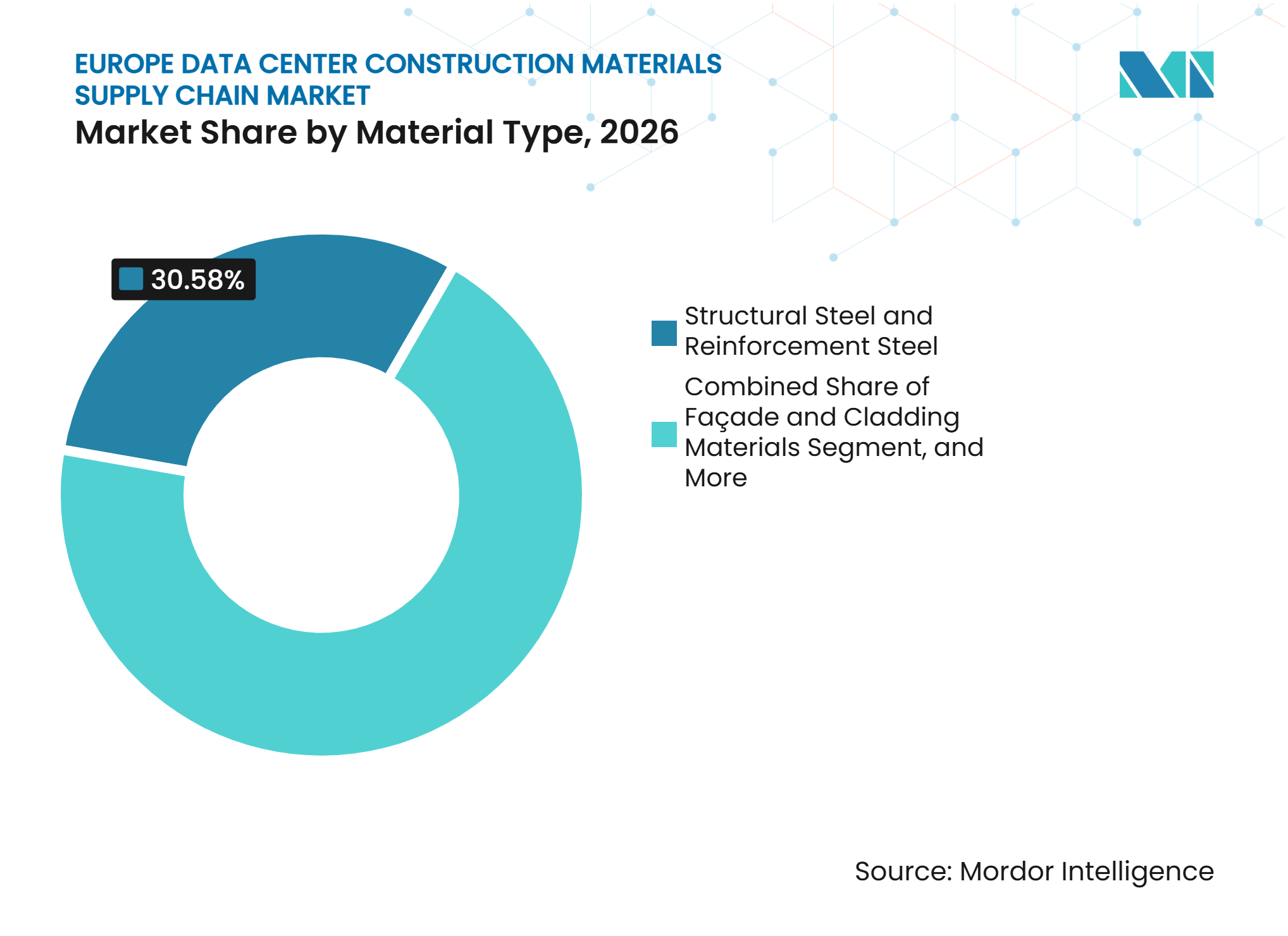
Structural Steel and Reinforcement Steel Anchor Market ValueStructural steel and reinforcement steel held 30.58% of the Europe data center construction materials supply chain market share in 2026. Steel remains essential for large-format shell-and-core construction because it supports wide spans, rapid assembly, and the growing use of modular structural systems. Reinforcing steel is also required in foundations and floor slabs that support heavy equipment and high-density racks. Hyperscale projects need large, repeatable structural packages, which makes material availability and fabrication capacity important procurement considerations. Precast concrete is gaining importance where developers need to shorten the time spent on site. Cement, concrete, and aggregates remain the largest inputs by volume for foundations and civil works. Façade, cladding, flooring, and roofing materials increase as projects advance through the building envelope and fit-out stages. The Europe data center construction materials supply chain market size for insulation materials is projected to expand at a 9.53% CAGR through 2032, supported by thermal management needs in liquid-cooled facilities. This development makes coordination between thermal specialists, structural designers, and material distributors more important during the early design stages of a project.
Material specifications are also changing as operators give more attention to carbon performance and construction speed. Steel-framed prefabricated modules can reduce on-site work and offer more predictable production conditions. Vertiv reported that a lifecycle assessment under EN 15978 found steel-framed prefabricated modules achieved up to 3.5 times lower embodied carbon per MW than concrete-shell designs.[3] This finding supports the use of modular structural approaches where an operator has low-carbon construction objectives. Insulation demand is rising because liquid-cooling systems require more careful thermal separation and support around high-density equipment areas. Cable management, raised-floor components, structural accessories, and specialist penetrations also gain value as data halls become more technically dense. Suppliers that can document carbon attributes and deliver dependable lead times are likely to be better positioned in large projects. The wider materials mix remains tied to the construction method selected for each campus. Material choices must also suit the timing, location, and technical requirements of each building phase. This increases the value of suppliers that understand how structural and fit-out choices interact across a complete campus. Conventional construction and prefabricated construction can use similar inputs, but they place different demands on fabrication lead times, logistics, and site installation planning.



By Construction Phase:
Site Preparation and Civil Works Drive Greenfield GrowthStructural construction accounted for 41.18% of the Europe data center construction materials supply chain market size in 2026. The phase includes steel frames, precast elements, reinforcement, and major concrete works that are central to hyperscale campus delivery. Large projects require reliable sequencing between foundations, superstructure installation, and the building envelope. This explains why structural packages represent a large share of spending before later stages of fit-out are complete. Site preparation and civil works are projected to expand at a 9.79% CAGR through 2032. This reflects the greater role of greenfield development in Spain, the Nordic countries, and Central and Eastern Europe. These sites need excavation, drainage, access routes, foundations, and utility-related works before the vertical structure can begin. The growth of this phase benefits local suppliers of aggregates, ready-mixed concrete, reinforcement, and related civil materials. It also requires early supplier engagement because civil packages must be available before a site can support more specialized structural work.
Construction timing is becoming more compressed as developers seek to secure commissioning slots. Civil works and structural packages may be mobilized at the same time rather than in a fully sequential order. This places more pressure on supply chain managers to coordinate material delivery, fabrication schedules, labor, and site access. Building envelope and roofing work follows structural completion, while interior and fit-out packages become more important as equipment density rises. Mature clusters with more redevelopment can have a different materials profile from new locations that require a complete civil and structural build. Modular and off-site methods can reduce site labor requirements, although they remain less common than conventional approaches. Their role may increase as project schedules tighten and skilled labor becomes harder to secure. The Europe data center construction materials supply chain market continues to depend on the pace at which each phase can move from planning into installation. This makes early coordination valuable for suppliers serving several construction packages at the same campus. Delays in one early package can affect subsequent materials orders, making schedule discipline central to supplier planning. Suppliers must therefore align production capacity with both the construction sequence and the timing of site access.
By Procurement Model:
EPC-Led Procurement Intermediates the Majority of SpendEPC-led procurement held 51.34% of the Europe data center construction materials supply chain market share in 2026. Operators often rely on specialist EPC contractors because they can coordinate multiple material categories, manage approved vendor lists, and align ordering with the construction schedule. This model is especially useful for projects facing variable permitting conditions, grid connection uncertainty, and large multi-trade scopes. Contractors can aggregate demand for steel, concrete, insulation, cladding, and mechanical support materials. They can also manage site delivery plans when the pace of construction changes. Distributor- and supplier-led procurement remains relevant for smaller facilities and individual packages. However, its share at the upper end is constrained by the increasing share of large campuses. EPC contractors retain an important role because many operators prefer a single point of coordination for complex builds. Their established supplier relationships can also help align orders with changing site requirements and delivery windows. This remains useful when operators need coordinated action across structural, civil, envelope, and specialized mechanical packages. Their role is particularly valuable when site conditions or project schedules require fast changes to material quantities and delivery plans.
Direct procurement by data center developers and operators is projected to expand at a 10.22% CAGR through 2032. Large hyperscalers can purchase directly from fabricators, precast producers, and insulation suppliers when their volumes are high enough to justify bilateral arrangements. This transfers more price and lead-time management from the contractor to the operator. It can also give the operator closer control over critical material availability. EPC firms are responding with digital procurement tools, dual-sourcing approaches, and more detailed supplier planning. These practices are designed to preserve bid certainty when commodity prices move during a tender period. Mid-sized operators are likely to continue using EPC procurement because managing cross-category materials flows requires experience and resources. The Europe data center construction materials supply chain industry is therefore likely to retain both procurement models, with the balance varying by operator scale and project complexity. Suppliers need to support both models because direct relationships and contractor-led frameworks can coexist within the same construction program.
By Data Center Size:
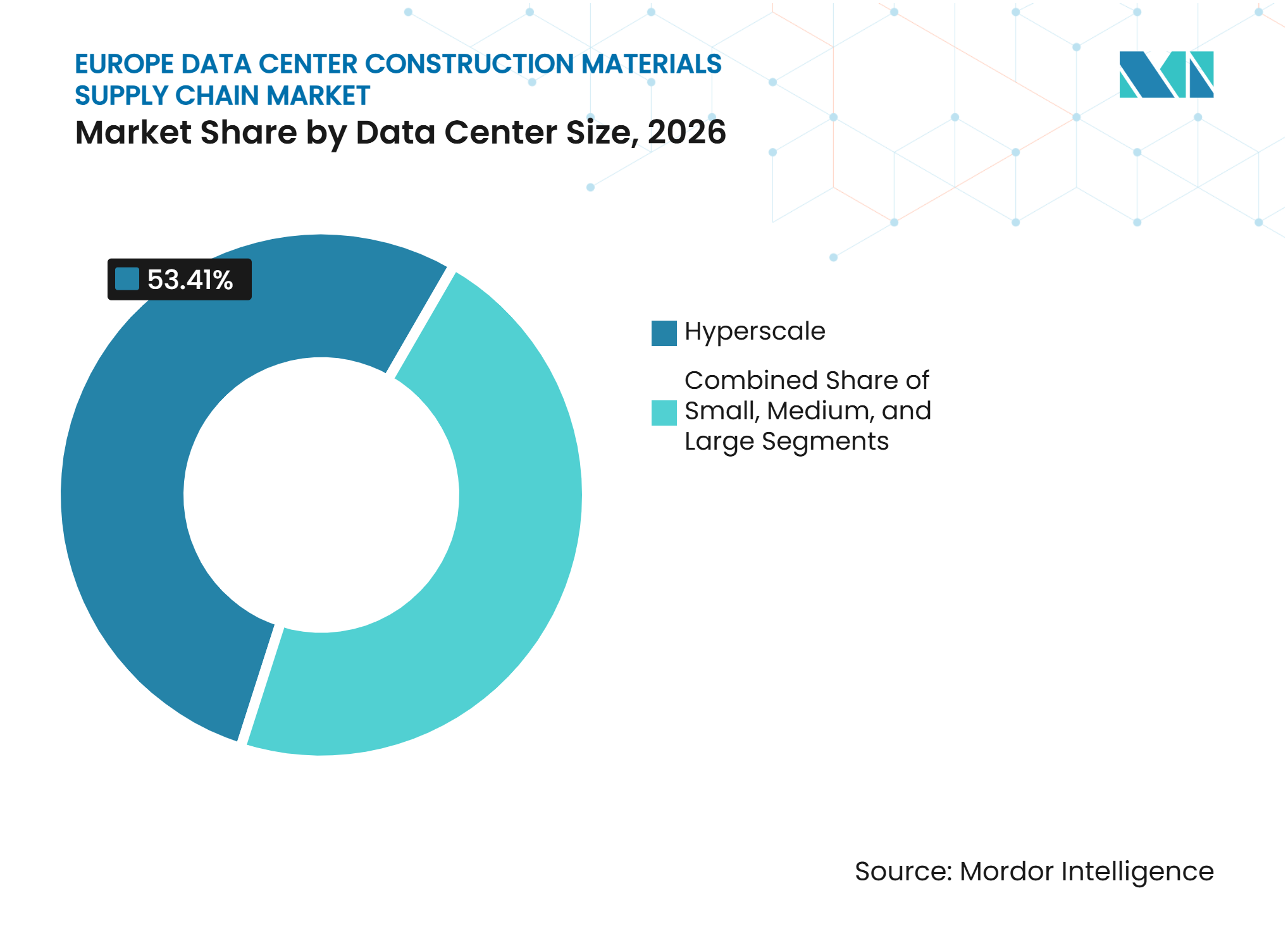
Hyperscale Leads in Both Share and Forecast Growth RateHyperscale data centers held 53.41% of Europe data center construction materials supply chain market share in 2026 and are projected to expand at a 10.74% CAGR through 2032. A single large campus can require more material than many smaller facilities because it combines extensive civil works, large structural packages, and repeated data hall construction. These sites are designed for phased build-out, which can support recurring orders for key materials over several years. Their size also increases the importance of supplier capacity, delivery reliability, and coordination across multiple construction packages. Large data centers remain an important category for colocation and enterprise cloud providers that need scalable capacity without a full hyperscale footprint. Medium and small facilities support enterprise and edge applications where latency and data-residency requirements call for distributed locations. Their material requirements are lower per project, but they provide a steadier base of demand across more locations. Hyperscale construction remains the principal driver of volume and procurement concentration. Its phased nature can provide continuity for suppliers, although each phase still depends on power access, permitting, and the operator’s delivery timetable.
The rise of hyperscale projects is creating a more divided supplier landscape. Firms that can fabricate and deliver large quantities on strict program schedules can develop stronger direct relationships with large operators. Smaller suppliers may focus on regional projects, specialized packages, or medium-sized facilities where order sizes are more accessible. This division does not remove the need for local suppliers because even a major campus relies on nearby concrete, aggregates, transport, and site services. It does, however, raise the value of prequalification and proven delivery records. AI-ready designs add to the material intensity of hyperscale projects through stronger floors, more cooling infrastructure, and more complex internal layouts. This means that the Europe data center construction materials supply chain market is affected by both the number of new campuses and the technical density within each campus. Suppliers that combine scale with credible technical support may have an advantage in this segment. This includes the capacity to support standardized designs while responding to local construction and logistics conditions. Repeatable delivery is valuable because campus phases often share specifications but have different construction schedules. Their ability to meet repeat specifications across several buildings can be as important as the price offered for an individual package.

By Data Center Type:
Colocation Leads While Cloud Service Providers Post Fastest GrowthColocation data centers accounted for 49.22% of the Europe data center construction materials supply chain market share in 2026. These facilities remain a major delivery model in established hubs because they serve multiple tenants and can add capacity in phases. Their construction includes the same core need for structural materials, building envelopes, insulation, and fit-out components. Colocation projects are increasingly designed to support AI-ready rack densities and liquid-cooling capability. This increases material specification per MW compared with earlier designs. Enterprise and edge facilities add demand where users require local capacity and data residency, although their share is lower than that of the largest categories. Their distributed nature can sustain orders for regional contractors and materials suppliers. Colocation therefore remains a central source of construction activity even as self-built cloud campuses receive more attention. Operators can extend these facilities in stages, which can support planned material ordering across successive phases. Its multi-tenant model can also support phased extensions that create repeat demand for familiar materials and construction systems.
Cloud service providers are projected to expand at an 11.24% CAGR through 2032. Major operators are moving from leased space toward self-built European campuses, which brings materials procurement directly into their construction programs. These facilities are often planned in secondary locations where a complete greenfield bill of materials is needed for each phase. Spain, Finland, and Poland are relevant examples of locations where new capacity can require extensive civil and structural work. The technical requirements of cloud facilities and colocation facilities are becoming more similar as both adopt higher-density compute and liquid-cooling readiness. This raises the value of specialist insulation, mechanical supports, cable management, and related fit-out inputs. The Europe data center construction materials supply chain industry benefits as each category adopts more demanding design specifications. The relative balance between colocation and cloud construction will depend on power access, the speed of self-build programs, and the availability of suitable sites. Project requirements will continue to shape whether suppliers serve incremental extensions or full greenfield builds. This requires dependable coordination between operators, contractors, fabricators, distributors, and local construction teams from the earliest procurement decisions. Both facility types will continue to require suppliers that can meet technical specifications without disrupting closely managed commissioning schedules.
Geography Analysis
United Kingdom
The United Kingdom held 30.61% of the Europe data center construction materials supply chain market share in 2026. Its position reflects a mature hyperscale cluster, an established base of EPC contractors, and a deep network of steel fabricators and precast concrete suppliers. These capabilities can reduce procurement friction compared with less developed markets, even as demand tightens available capacity. The UK Government recorded significant increases in fabricated structural steel and reinforcement bar prices through August 2026, which makes early purchasing and contractual price management more important. Power availability remains the key structural challenge because projects cannot progress into full construction without a practical grid connection. The International Energy Agency has identified energy constraints as a central issue for meeting Europe’s data center objectives. This is encouraging development in areas where land and power access can better support large sites. The United Kingdom’s existing delivery base still gives it an advantage in coordinating complex materials packages.
Spain
Spain is projected to expand at an 11.43% CAGR through 2032 in the Europe data center construction materials supply chain market. Its appeal rests on large land parcels, improving renewable power connectivity, and a permitting environment that can support large campus applications. These factors favor greenfield projects that require full civil, foundation, structural, envelope, and fit-out packages. The result is a different demand profile from mature hubs where redevelopment may account for a larger share of activity. Construction in Spain is likely to require substantial volumes of structural steel, concrete, aggregates, insulation, and façade materials as campuses advance through their phases. The wider shift toward secondary locations also creates new routes for regional distributors and specialist fabricators. Suppliers that can provide dependable delivery beyond the main urban centers will be relevant to these projects. This makes Spain an important location for the Europe data center construction materials supply chain market, particularly where operators seek alternatives to constrained hub markets.
Germany, France, Italy, Nordic Countries, and Central and Eastern Europe
Germany retains a substantial position because Frankfurt remains a major hub, and secondary locations are attracting additional capacity. Hochtief and Palladio Partners broke ground in March 2026 on the YEXIO data center in Bad Lippspringe, using direct water cooling and solid timber construction intended to reduce embodied carbon. France is supporting new AI-focused construction, including development that reuses industrial locations and incorporates liquid cooling and heat recovery. Italy continues to benefit from Milan’s role as an interconnection hub and from expanding colocation and cloud requirements in the Po Valley. Nordic countries offer access to land and lower-cost energy, but project timing can still depend on grid availability and local supply capacity. Skanska signed a EUR 100 million (USD 112.78 million) contract for a five-story expansion at atNorth’s Espoo facility in Finland during 2026, with the work including full fit-out activities.[4] Central and Eastern Europe is attracting interest through sites near Prague and in Poland, although grid constraints can affect delivery timing. Compliance factors such as the EU Energy Efficiency Directive and national energy rules are encouraging lower-carbon specifications, which can support demand for material choices that demonstrate environmental performance.
Competitive Landscape
Market Concentration
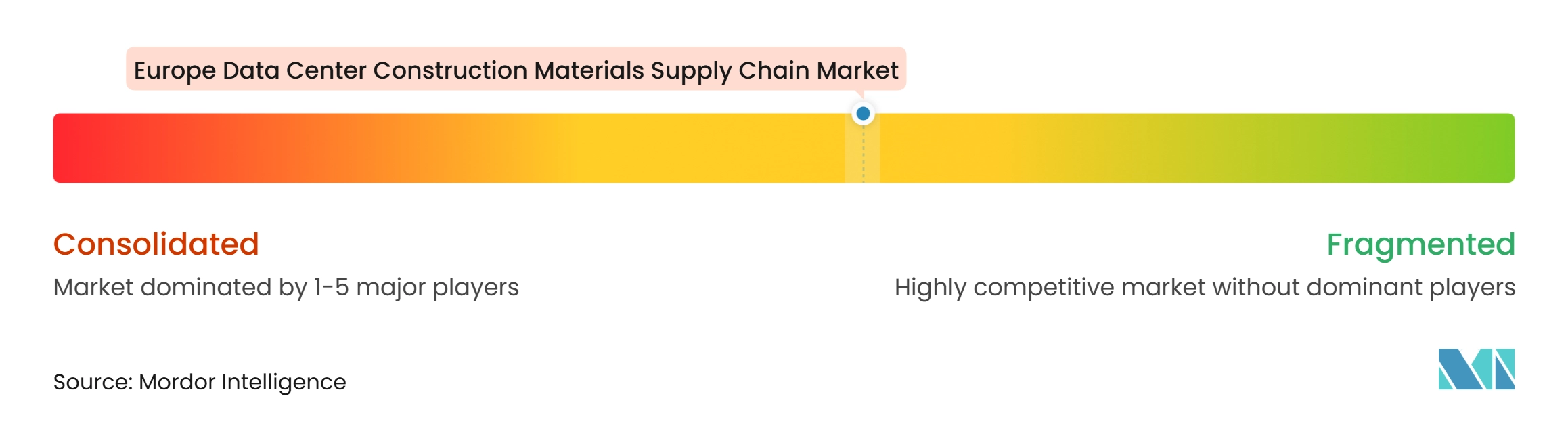
The Europe data center construction materials supply chain market is moderately fragmented at the materials production layer and more concentrated among EPC contractors. Skanska, Hochtief, VINCI Construction, AECOM, Jacobs Solutions, and Exyte compete for large campus mandates through their ability to manage complex programs across several European jurisdictions. Their strengths include multi-category procurement, approved supplier networks, and experience with tight commissioning schedules. Material supply is more dispersed across cement, aggregates, insulation, cladding, and regional fabrication markets. Structural steel is relatively more concentrated, and its price movements can affect contractor margins. Leading contractors use established delivery methods to coordinate structural, mechanical, and civil packages. This helps them manage project risk when power, permitting, and material pricing conditions change. The Europe data center construction materials supply chain market remains open to specialist suppliers that can meet strict technical and delivery requirements.
White-space opportunities are most evident in emerging regional distribution networks, specialist insulation, liquid-cooling materials, and modular construction. These opportunities are particularly relevant where new campuses are located outside mature hubs and local supply networks are less established. Hochtief’s YEXIO approach uses standardized structural components with locally sourced civil and mechanical materials, illustrating how a contractor can combine repeatable design with regional procurement. Contractors are also using digital procurement platforms and demand planning to reduce lead-time and price risks. The approach can improve visibility across high-volume orders and help manage changes in delivery schedules. Sustainability criteria are becoming more prominent in supplier selection as operators seek lower-carbon materials and circular construction practices. This can favor suppliers that can provide credible documentation on sourcing and embodied-carbon performance.
Company actions show how large contractors are positioning around cooling, modularity, and regional expansion. VINCI’s subsidiary Cobra IS received a EUR 165 million (USD 186.08 million) contract for a data center in the Iberian Peninsula, covering mechanical, electrical, and plumbing installations for 126 dry coolers serving 200 MW of computing capacity. Hochtief expanded its standardized YEXIO network into the United Kingdom through HOCHTIEF Data Center Partner Limited. Panasonic’s European cooling launch adds another value-chain example of equipment suppliers responding to AI-related demand. These moves show that competition extends beyond core construction into specialized cooling, procurement systems, and standardization. Regional material producers can still participate where they meet quality, volume, and delivery requirements. The competitive balance will continue to be shaped by the ability to manage large projects without sacrificing local supply responsiveness.
Europe Data Center Construction Materials Supply Chain Industry Leaders
-
Holcim AG
-
DPR Construction
-
Skanska AB
-
Saint-Gobain
-
Kingspan Group plc
- *Disclaimer: Major Players sorted in no particular order
Europe Data Center Construction Materials Supply Chain Market Companies Covered in this Report
- Holcim AG
- CBRE Group Inc.
- Bouygues Energies and Services SAS
- Mercury Engineering Unlimited Co.
- DPR Construction
- AECOM
- Jacobs Solutions Inc.
- Collen Construction Ltd.
- Skanska AB
- ISG plc
- Arup Group Ltd.
- Lendlease Corporation Ltd.
- Vinci Construction
- Hochtief AG
- Exyte GmbH
- STRABAG SE
- Turner Construction Company
- Kingspan Group plc
- ArcelorMittal Europe
- Saint-Gobain
Recent Industry Developments in Europe Data Center Construction Materials Supply Chain Market
- October 2026: CBRE Group, Inc. announced a definitive agreement to acquire Onnec Group Limited, a provider of data center infrastructure services for the world’s largest technology companies in Europe and Asia Pacific. The acquisition will significantly enhance CBRE’s ability to support its clients’ data center needs on a global basis. Onnec will operate as part of CBRE’s Critical Infrastructure Services line of business.
- August 2026: Skanska signed a contract with CRA Prague Gateway DC to build a data center near Prague for CZK 2.1 billion (USD 93 million), covering site infrastructure, foundation structures, and a precast concrete skeleton. Construction began in August 2026, with completion scheduled for 2028.
- April 2026: The European Commission awarded an EUR 180 million (USD 203 million) sovereign cloud contract to four providers under the Cloud Sovereignty Framework, establishing demand mandates for EU-based digital infrastructure and underpinning construction activity for sovereign-compliant facilities.
- March 2026: Panasonic began accepting orders in Europe for Coolant Distribution Units for generative AI data centers in 400 kW and 800 kW capacities, extending its liquid cooling systems business established via the 2023 acquisition of Italy-based Tecnair.
Europe Data Center Construction Materials Supply Chain Market Report Scope
The Europe data center construction materials supply chain market encompasses the end-to-end procurement, logistics, and distribution of structural, architectural, and specialized industrial materials required to build data center facilities across the European region.
The Europe Data Center Construction Materials Supply Chain Market Report is Segmented by Material Type (Structural Steel and Reinforcement Steel, Cement, Concrete, and Aggregates, Precast Concrete Products, Roofing and Waterproofing Materials, Insulation Materials, Façade and Cladding Materials, Flooring and Interior Construction Materials, and Other Construction Materials), Construction Phase (Site Preparation and Civil Works, Structural Construction, Building Envelope and Roofing, and Interior and Fit-Out Works), Procurement Model (Direct Procurement by Data Center Developers and Operators, Engineering, Procurement, and Construction-Led Procurement, and Distributor and Supplier-Led Procurement), Data Center Size (Small, Medium, Large, and Hyperscale), Data Center Type (Colocation, Cloud Service Providers [CSPs], and Enterprise / Edge), and Country (United Kingdom, Germany, France, Spain, Italy, and Rest of Europe). The Market Forecasts are Provided in Terms of Value (USD).
Segmentation Overview
| Structural Steel and Reinforcement Steel |
| Cement, Concrete, and Aggregates |
| Precast Concrete Products |
| Roofing and Waterproofing Materials |
| Insulation Materials |
| Façade and Cladding Materials |
| Flooring and Interior Construction Materials |
| Other Construction Materials |
| Site Preparation and Civil Works |
| Structural Construction |
| Building Envelope and Roofing |
| Interior and Fit-Out Works |
| Direct Procurement by Data Center Developers and Operators |
| Engineering, Procurement, and Construction-Led Procurement |
| Distributor and Supplier-Led Procurement |
| Small |
| Medium |
| Large |
| Hyperscale |
| Colocation |
| Cloud Service Providers (CSPs) |
| Enterprise / Edge |
| United Kingdom |
| Germany |
| France |
| Spain |
| Italy |
| Rest of Europe |
| By Material Type | Structural Steel and Reinforcement Steel |
| Cement, Concrete, and Aggregates | |
| Precast Concrete Products | |
| Roofing and Waterproofing Materials | |
| Insulation Materials | |
| Façade and Cladding Materials | |
| Flooring and Interior Construction Materials | |
| Other Construction Materials | |
| By Construction Phase | Site Preparation and Civil Works |
| Structural Construction | |
| Building Envelope and Roofing | |
| Interior and Fit-Out Works | |
| By Procurement Model | Direct Procurement by Data Center Developers and Operators |
| Engineering, Procurement, and Construction-Led Procurement | |
| Distributor and Supplier-Led Procurement | |
| By Data Center Size | Small |
| Medium | |
| Large | |
| Hyperscale | |
| By Data Center Type | Colocation |
| Cloud Service Providers (CSPs) | |
| Enterprise / Edge | |
| By Country | United Kingdom |
| Germany | |
| France | |
| Spain | |
| Italy | |
| Rest of Europe |
Key Questions Answered in the Report
What is the size of the Europe data center construction materials supply chain market?
The Europe data center construction materials supply chain market is projected to expand from USD 2.45 billion in 2026 and USD 2.77 billion in 2027 to USD 4.28 billion by 2032, at a 9.09% CAGR.
Which material category has the largest share in Europe data center construction?
Structural steel and reinforcement steel held the largest share at 30.58% in 2026, supported by large shell-and-core projects and reinforced floor requirements.
Why are insulation materials gaining importance in data center projects?
Insulation materials are projected to expand at a 9.53% CAGR through 2032 because high-density, liquid-cooled facilities need tighter thermal management and more specialized mechanical detailing.
What is limiting construction activity for European data centers?
Grid connection queues are the most significant limit because projects cannot enter active construction until power access is secured.
Which country is projected to expand fastest through 2032?
Spain is projected to expand at an 11.43% CAGR through 2032, supported by greenfield opportunities, land availability, and evolving power connectivity.
How are hyperscale facilities changing materials procurement?
Hyperscale facilities held 53.41% share in 2026 and are projected to expand at a 10.74% CAGR, increasing the use of direct purchasing by the largest operators while preserving EPC coordination for complex projects.