
Europe Data Center Battery Energy Storage Market Size and Share
Market Overview
| Study Period | 2021 - 2032 |
|---|---|
| Forecast Data Period | 2027 - 2032 |
| Base Year Market Size (2026) | USD 4.04 Billion |
| Market Size (2027) | USD 4.70 Billion |
| Market Size (2032) | USD 10.14 Billion |
| Growth Rate (2027 - 2032) | 16.65 % |
| Market Concentration | Medium |
Major Players *Disclaimer: Major Players sorted in no particular order Image © Mordor Intelligence. Reuse requires attribution under CC BY 4.0. | |
Europe Data Center Battery Energy Storage Market Analysis by Mordor Intelligence
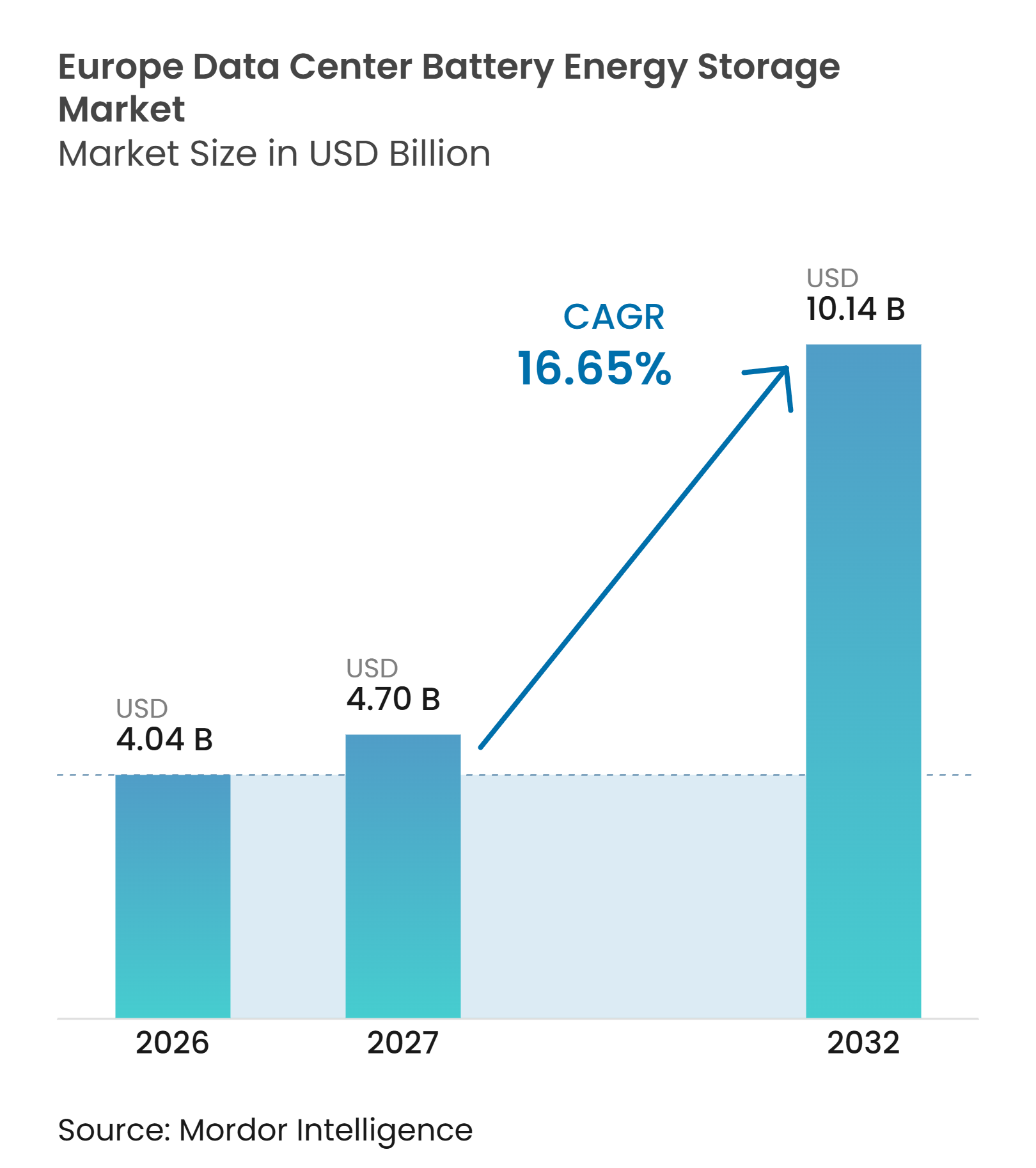
The Europe data center battery energy storage market size was valued at USD 4.04 billion in 2026 and estimated to expand from USD 4.70 billion in 2027 to reach USD 10.14 billion by 2032, at a CAGR of 16.65% during the forecast period 2027-2032. AI computing is changing power requirements at new facilities, increasing the need for battery systems that can manage large, variable loads without disrupting sensitive servers, network equipment, or the redundancy arrangements operators use to protect service availability. Grid connection delays are also making behind-the-meter storage more relevant during site selection and project design, especially where developers need a practical way to operate within constrained connection terms while longer network reinforcement programs continue. Renewable power procurement is moving storage beyond backup use and toward power firming and load shifting, which lets an operator consider electricity timing and reliability together instead of treating the battery as equipment used only during an outage. Suppliers are responding with higher-power battery designs, software features, and products that meet tighter safety and traceability rules, because facility owners need equipment that can be qualified for demanding sites and then operate across several energy-management functions. The Europe data center battery energy storage market is therefore shaped by both digital infrastructure expansion and the need for more flexible electricity operations, bringing cell manufacturers, systems integrators, software providers, utilities, and data center developers into the same project decisions.
Key Report Takeaways
- By battery chemistry, LFP held 36.16% of the Europe data center battery energy storage market in 2026, while sodium-ion is projected to expand at a 17.55% CAGR through 2032.
- By system component, battery cells and modules held 37.21% of the Europe data center battery energy storage market revenue in 2026, while energy management software is projected to expand at a 17.89% CAGR through 2032.
- By primary application, UPS and short-duration backup held 43.19% of the Europe data center battery energy storage market revenue in 2026, while renewable energy integration is projected to expand at an 18.25% CAGR through 2032.
- By storage duration, below-one-hour systems held 59.08% of the Europe data center battery energy storage market revenue in 2026, while above-four-hour systems are projected to expand at an 18.57% CAGR through 2032.
- By data center size, hyperscale facilities held 57.23% of the Europe data center battery energy storage market revenue in 2026 and are projected to expand at an 18.86% CAGR through 2032.
- By data center type, colocation facilities held 61.44% of the Europe data center battery energy storage market revenue in 2026, while CSPs are projected to expand at a 19.27% CAGR through 2032.
- By geography, Germany held 27.88% of the Europe data center battery energy storage market revenue in 2026, while the Nordics are projected to expand at a 17.24% CAGR through 2032.
Note: Market numbers in this report are based on Mordor Intelligence's proprietary estimation framework, which combines nine months of actuals with Q4 projections for base year 2026.
Market Trends and Insights
Drivers Impact Analysis of Europe Data Center Battery Energy Storage Market*
| Driver | (~) % Impact on CAGR Forecast | Geographic Relevance | Impact Timeline |
|---|---|---|---|
| AI Infrastructure Expansion and Rising Rack Power Density | +5.2% | Global, with primary impact in FLAP-D and Nordic campuses | Short term (≤ 2 years) |
| Hyperscale and Colocation Capacity Additions Across FLAP-D and Nordic Hubs | +3.8% | FLAP-D core markets and Nordics, with spillover to Spain and Italy | Medium term (2-4 years) |
| Grid Interconnection Constraints Increasing the Value of Behind-the-Meter Storage | +3.2% | Germany, Netherlands, Ireland, and UK, with early gains in Spain | Short term (≤ 2 years) |
| Renewable Power Procurement and Need for Firming and Time Shifting | +2.5% | Nordics, Ireland, Spain, with spillover to Germany and France | Medium term (2-4 years) |
| Grid-Services Revenue for Frequency Regulation and Demand Response | +1.5% | Germany, Nordics, UK, and Ireland where FFR and aFRR markets are active | Medium term (2-4 years) |
| European Battery Passport and Traceability Requirements Accelerating Qualified Local Supply | +0.8% | EU-wide, with early supply-chain impact in Germany and Poland | Long term (≥ 4 years) |
| Source: Mordor Intelligence | |||
AI Infrastructure Expansion and Rising Rack Power Density
AI training loads are changing the power profile that data center infrastructure must support. Cummins reported that NVIDIA Blackwell platforms reached peak rack densities of 132 kW, while future platforms were expected to require 250-900 kW per rack. These requirements place greater pressure on UPS systems during sudden load changes. Battery systems with high-rate discharge capability can help manage these loads without relying solely on standby generation, which may not respond as well to repeated, rapidly changing power draws from accelerated computing equipment. The Europe data center battery energy storage market benefits where operators treat battery capacity as part of the electrical design rather than a later reliability upgrade. This shift favors systems that combine power density, thermal controls, and control software, because the electrical layer must respond quickly without reducing the reliability margin expected from a data center power system or increasing the complexity of routine operations, testing, and maintenance.
Hyperscale and Colocation Capacity Additions Across FLAP-D and Nordic Hubs
Capacity additions are spreading beyond the traditional FLAP-D hubs, but these hubs still matter for colocation demand. The International Energy Agency stated that Europe needs to resolve energy constraints to deliver its data center capacity goals. Hyperscale operators can place training workloads near available power, while latency-sensitive services remain close to major user centers. This approach creates demand for battery systems in both mature and secondary locations, since each location requires power infrastructure tailored to its specific mix of latency needs, grid availability, generation resources, and operational redundancy. The Europe data center battery energy storage market benefits because secondary sites often need more on-site flexibility than established hubs. Batteries can support backup needs while also reducing the effect of uneven grid capacity, which is particularly useful where project development is proceeding faster than transmission and distribution reinforcement.
Grid Interconnection Constraints Increasing the Value of Behind-the-Meter Storage
Grid access has become a defining issue for many European data center projects. Directive EU 2024/1711 supports non-firm and flexible connection approaches, which can be relevant for sites with storage and active load management. Battery storage gives operators a way to manage constrained connections and short periods of grid stress. It can also support curtailment arrangements that would be difficult for facilities without flexible assets. This makes storage part of project enablement in locations where a full firm connection is not immediately available, rather than merely an asset purchased to protect the facility after construction is complete and the facility is handed over to the operating team.
Renewable Power Procurement and Need for Firming and Time Shifting
Renewable procurement is broadening the role of batteries at data center campuses. Wind and solar generation do not always match a facility's demand profile, especially during continuous computing operations. Storage can shift energy across time and strengthen the value of renewable purchase agreements. Wärtsilä noted that microgrids can help accelerate data center expansion while supporting Europe's energy transition. Operators can use batteries to improve renewable matching and manage grid events within the same installation. The Europe data center battery energy storage market gains from this broader set of operating roles, since storage can be evaluated against both reliability benefits and the value of managing renewable electricity over time.
Restraints Impact Analysis of Europe Data Center Battery Energy Storage Market*
| Restraint | (~) % Impact on CAGR Forecast | Geographic Relevance | Impact Timeline |
|---|---|---|---|
| Fire-Safety Qualification and Thermal-Runaway Mitigation Costs | -3.5% | EU-wide, with stricter enforcement in Germany, France, and the UK | Short term (≤ 2 years) |
| Import Dependence for Cells, Cathode Materials, and BMS Semiconductors | -2.8% | EU-wide, with Germany and the Netherlands most exposed as the largest markets | Medium term (2-4 years) |
| Grid Connection Delays and Permitting Complexity | -1.8% | FLAP-D markets, especially the Netherlands and Ireland | Short term (≤ 2 years) |
| Limited Recycling Capacity for Data Center Battery Assets | -0.9% | EU-wide, with pressure concentrated in early-decommissioning markets | Long term (≥ 4 years) |
| Source: Mordor Intelligence | |||
Fire-Safety Qualification and Thermal-Runaway Mitigation Costs
Fire safety requirements can add cost and time to new battery installations. UL published the fifth edition of ANSI/CAN/UL 9540A in March 2025, including large-scale fire testing for battery energy storage systems. The Open Compute Project also identifies UL 9540A and IEC 62619 as requirements that may apply to energy storage systems in data center settings. Operators may need to revise enclosure design, spacing, suppression systems, and site layouts. These steps can extend commissioning schedules, particularly for indoor installations. The Europe data center battery energy storage market faces a higher entry threshold for new chemistries with less extensive fire-test evidence, as developers and insurers may prefer products that already have a more established testing record.
Import Dependence for Cells, Cathode Materials, and BMS Semiconductors
European projects remain exposed to overseas battery supply chains. The IEA stated that China held around 95% of global LFP cathode production capacity and around 90% of global anode manufacturing capacity in 2026. This dependence can affect equipment availability, compliance paperwork, and project delivery schedules. The EU battery regulation requires traceability arrangements for batteries, raising the importance of supplier documentation. The European Commission published guidance in August 2026 to support preparations for the digital battery passport.[1] The Europe data center battery energy storage market may reward suppliers that can provide auditable material and manufacturing records, since traceability must be maintained across a supply chain that often involves several countries and component providers.
*Our forecasts treat driver/restraint impacts as directional, not additive. The impact forecasts reflect baseline growth, mix effects, and variable interactions.
Europe Data Center Battery Energy Storage Market Segment Analysis
By Battery Chemistry:
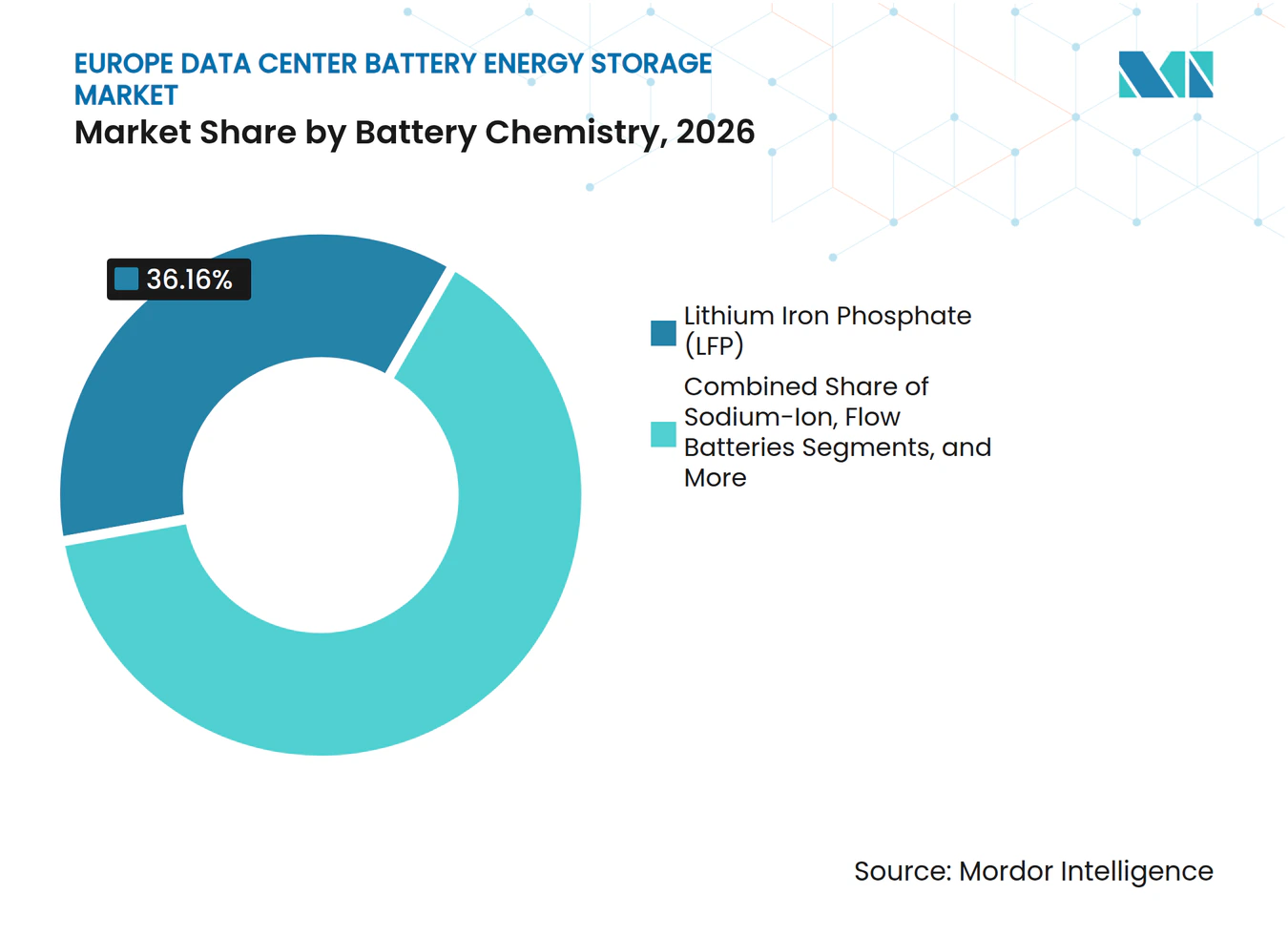
LFP Leads While Sodium-Ion Gains MomentumLFP accounted for 36.16% of battery chemistry revenue in 2026, supported by thermal stability, long cycle life, and an established supplier base. CATL, BYD, and LG Energy Solution supply LFP products for large stationary storage applications. NMC remained relevant in parts of the installed colocation base, although indoor fire-permitting requirements limited its appeal for some new projects. Lead-acid batteries continued to serve older enterprise and edge UPS assets where replacement cycles remained slow. Flow batteries from suppliers such as Invinity, CellCube, and Elestor retained a selective role where non-flammability and longer backup duration justified the cost premium, particularly when indoor placement and extended renewable-firming duties made conventional lithium-ion designs less suitable.
Sodium-ion is projected to expand at a 17.55% CAGR through 2032, supported by data center training loads that can require deep and high-power discharge cycles. This chemistry can provide full-discharge capability, unlike an LFP warranty structure that may limit the depth of discharge. The Europe data center battery energy storage market size for LFP reflects established demand, while sodium-ion offers a different operating profile for new projects. The European Commission's battery passport guidance increases the value of chemistry supply chains with clear documentation, including the ability to trace information from materials and components through manufacturing, delivery, installation, and subsequent battery management. Selection will depend on safety evidence, discharge requirements, duration, available space, and procurement visibility, as operators must balance technical performance with the documentation and qualification required for a specific facility.



By System Component:
Cells Lead in Value While Software Adds Operating FlexibilityBattery cells and modules accounted for 37.21% of system component revenue in 2026 and remain the largest hardware element in a BESS installation. Battery management systems, power conversion systems, and racks provide the control and electrical interfaces needed for reliable operation. Thermal management becomes more important as high-power AI workloads generate more heat during rapid discharge. European integrators can differentiate through software, safety controls, and compliance with local grid codes. The Europe data center battery energy storage industry has room for both global cell suppliers and specialist integration providers, because an installed system must link the cells, inverters, racks, cooling equipment, and site controls into a dependable operating unit.
Energy management software is projected to grow at a 17.89% CAGR through 2032 because a single system can meet multiple operational requirements. It can coordinate backup readiness, peak shaving, renewable firming, frequency regulation, and demand-response participation. Software can also monitor battery condition and prioritize stored energy during grid events. TESVOLT and Samsung SDI announced a collaboration on cybersecure battery systems for public utilities in June 2025.[2] Recurring software services may help integrators offset pressure on battery hardware pricing, especially where customers value ongoing monitoring, battery health management, and flexible dispatch across multiple services more than they value stand-alone equipment supply.
By Primary Application:
Backup Remains Central While Renewable Integration AcceleratesUPS and short-duration backup accounted for 43.19% of primary application revenue in 2026 and remain central to data center reliability planning. These systems bridge short interruptions and protect computing equipment while backup generation starts or grid conditions stabilize. Many facilities have replaced lead-acid UPS systems with lithium-ion equipment during recent investment cycles. Extended-duration backup becomes more relevant where connection agreements require facilities to provide greater self-support during grid events. Peak shaving and load shifting can also improve the value of the same asset in markets with time-of-use electricity charges, allowing the battery to address operating costs when it is not needed for an immediate backup event.
Renewable energy integration is projected to expand at an 18.25% CAGR through 2032, bringing batteries into a wider role in power firming and load shifting. Eurelectric reported in June 2026 that Microsoft and EirGrid demonstrated data center assets could support grid flexibility without compromising resilience. This case can encourage operators to size systems beyond the minimum backup requirement and reserve capacity for electricity-market participation, provided the control strategy protects the resilience commitment that the facility has made to its customers. The UPS segment remains substantial, but the integration of renewables shifts the direction of new demand. Advanced controls are needed to protect backup capability while enabling grid service use, since the system must retain sufficient stored energy to meet the facility's reliability obligations after participating in an external flexibility program.
By Storage Duration:
Short Systems Dominate While Longer Assets Gain New UsesBelow-one-hour systems held 59.08% of duration-segment revenue in 2026, reflecting the installed base of UPS and power-quality applications. One- to two-hour configurations can provide extended ride-through and limited peak shaving at enterprise and edge facilities. Two- to four-hour systems better support solar firming and the movement of generation into higher-demand periods. Short-duration requirements have shaped the current installed base because facilities historically prioritized continuity over electricity-market use. Generator replacement economics also influence duration choices, where moderate battery extensions can reduce fuel and maintenance needs, while longer systems can support a greater share of the site's demand during periods of grid constraint.
Above-four-hour systems are projected to expand at an 18.57% CAGR through 2032 as operators seek more operating flexibility. Longer assets can move capacity between ancillary services and wholesale-market opportunities where local rules permit. Wärtsilä described new energy storage opportunities in its 2026 outlook, including grid-forming applications. The Europe data center battery energy storage market size for short-duration systems remains larger today, but longer assets can support backup, renewable output, and grid participation. System selection will depend on local revenue rules, power requirements, site space, and safety approvals, because a longer-duration asset must earn value from several functions to justify its additional energy capacity.
By Data Center Size:
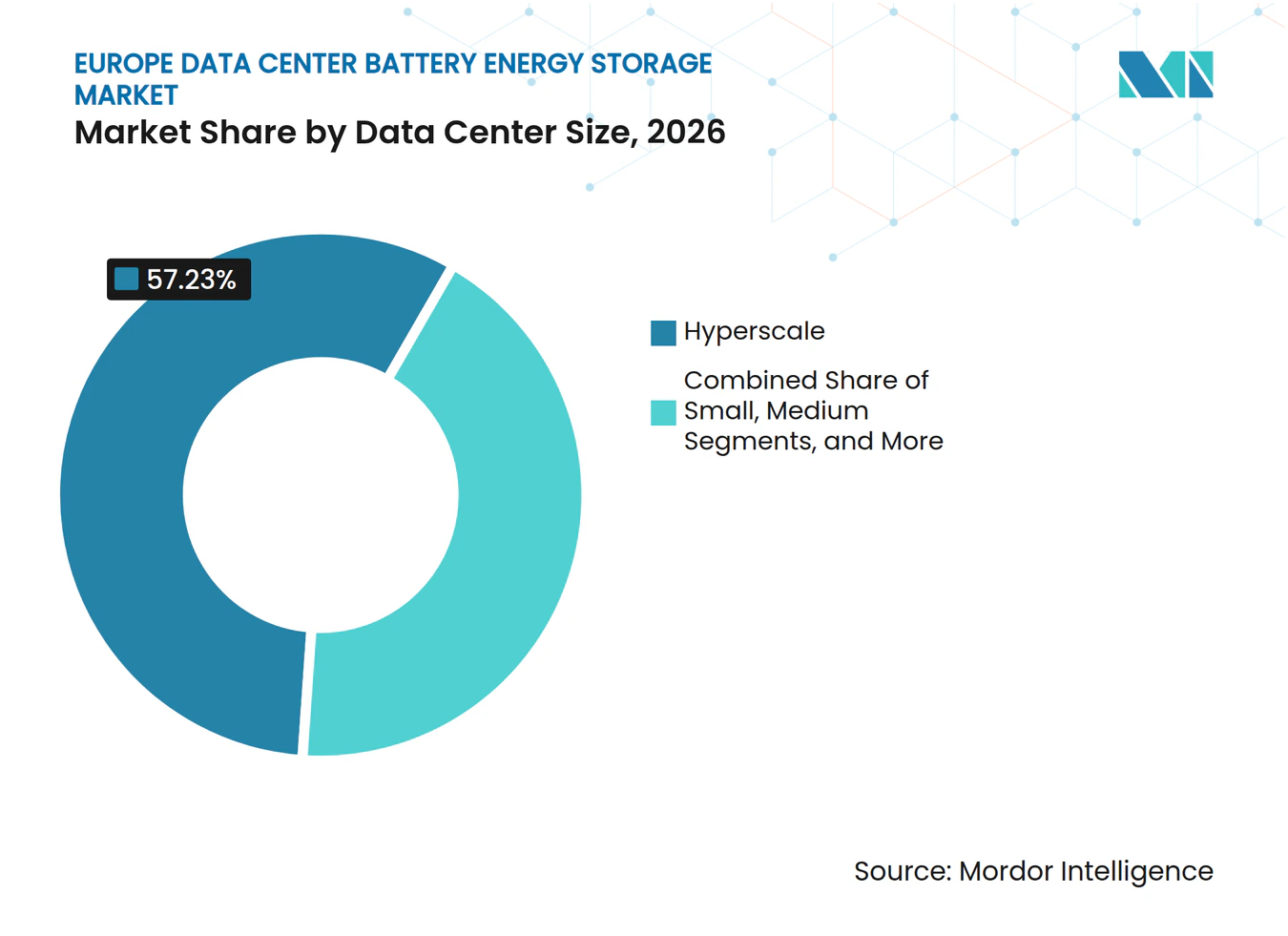
Hyperscale Facilities Set the Demand PatternHyperscale data centers accounted for 57.23% of revenue in 2026 and are projected to grow at an 18.86% CAGR through 2032. Large campuses require substantial electrical infrastructure and can combine storage with dedicated or shared grid connections. Prime Capital announced Project Jupiter in Brandenburg in December 2025, combining a 500 MW/2,000 MWh battery project with a planned hyperscale data center through a shared 380 kV connection. This model integrates power access and storage planning before the data center is fully developed, reducing the separation between electricity infrastructure decisions and the design choices that determine where a large computing campus can be built. Large data centers form the next major group and continue their transition from lead-acid to LFP UPS systems, as operators seek a more modern storage design without the very large site footprints required for campus-scale installations.
Medium and small sites are more likely to adopt modular storage at the UPS layer, where phased deployment can match replacement schedules. Hyperscale requirements influence the chemistry, duration, and control features supplied across the Europe data center battery energy storage market. High rack density can increase the need for fast-response systems, as Cummins documented for AI-oriented data center designs. Campus-scale projects can combine reliability, power quality, renewable firming, and grid flexibility into a single investment case. Larger facilities can test these operating models before similar approaches are adopted in smaller data centers, giving equipment suppliers early evidence of how combined backup, grid, and renewable functions work in demanding environments.

By Data Center Type:
Colocation Leads While CSPs Build AI CapacityColocation data centers held 61.44% of revenue by type in 2026 because they combine a broad installed base with strong tenant uptime commitments. Tier III and Tier IV facilities commonly require redundant power arrangements that battery systems can support. Lithium-ion systems can meet shorter-duration requirements within a more compact footprint than legacy alternatives. Enterprise and edge facilities are expanding more slowly, but modular systems can support their lead-acid replacement cycle. Colocation demand reflects both the density of existing sites and the requirement to maintain service continuity for multiple tenants, where an interruption can affect several customers and create a stronger case for proven redundant power arrangements.
CSPs are projected to expand at a 19.27% CAGR through 2032 as cloud platforms add AI computing capacity. Microsoft and EirGrid demonstrated that data center assets could provide flexible services while protecting operational resilience. CSP projects can create demand for systems that support both backup and electricity-market functions on a larger scale. The distinction from colocation demand often lies in scale and operating model, rather than in whether batteries are needed. Edge and enterprise installations remain relevant where modular systems can be deployed without large campus investments, particularly when site owners want to add resilience in stages rather than commit to a full energy-storage redevelopment.
Geography Analysis
Germany: The Largest Regional Base
Germany held 27.88% of the Europe data center battery energy storage market share in 2026. Frankfurt's FLAP-D position, active FCR and aFRR markets, and a large data center base support demand. Germany's Federal Energy Efficiency Act requires a PUE of 1.2 for new data centers from July 2026. Project Jupiter shows how developers can co-locate a large battery system and data center on a shared high-voltage connection.
Nordics: Renewable Power Supports the Fastest Expansion
The Nordics are projected to expand at a 17.24% CAGR through 2032. Low-cost renewable power, a cool climate, and a large data center pipeline support demand for storage. Batteries can provide backup and renewable firming at sites that use wind and solar generation. The IEA has identified energy constraints as a central issue in delivering Europe's data center goals.[3] Nordic facilities can use storage to manage the timing difference between variable generation and continuous computing demand, helping operators use renewable resources while maintaining the predictable power quality required by sensitive IT equipment.
Other European Markets: Different Regulations and Power Conditions Shape Demand
The United Kingdom is testing flexible demand from AI data centers, while Ireland's new-site framework increases the role of renewable matching. The Netherlands faces grid concentration risk due to a high share of national data center electricity demand. France benefits from nuclear-backed reliability and a capacity mechanism, while Spain is drawing new investment through renewable resources. Italy and Alpine markets provide further secondary-site demand. EU battery passport preparation will affect supply-chain documentation across EU markets, making procurement records, material traceability, and product information more important during battery selection and installation planning.
Competitive Landscape
Market Concentration
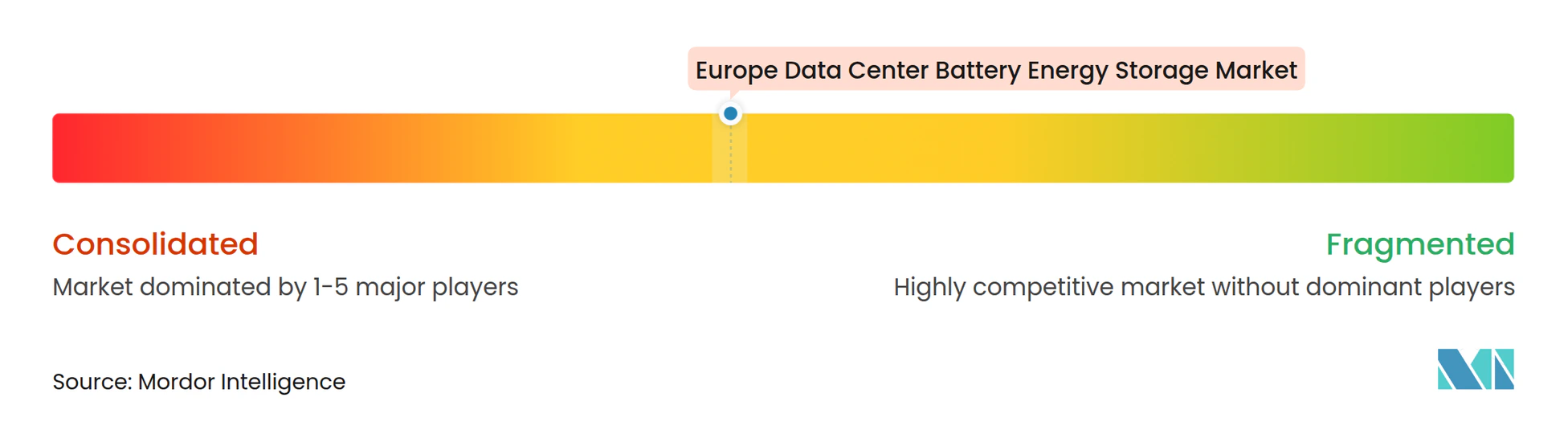
The Europe data center battery energy storage market has a concentrated cell-supply layer and a more fragmented integration layer. CATL, BYD, LG Energy Solution, and Samsung SDI supply technologies for large stationary storage applications. European integrators, including Saft, TESVOLT, and Leclanché, compete through project integration, controls, and regulatory fit. Product certification and traceable supply chains can be as important as equipment cost, particularly when developers need to demonstrate readiness for safety, sourcing, and compliance to customers, authorities, and financing partners.
TESVOLT and Samsung SDI announced a collaboration in June 2025 to develop cybersecure battery systems for public utilities. Prime Capital's December 2025 Project Jupiter agreement links storage deployment with data center power access. These approaches can favor suppliers that coordinate storage, grid, and site-development requirements. Proven safety documentation can also matter, as large facilities face more detailed fire testing and permitting requirements. Suppliers can use cybersecurity and system controls to meet critical infrastructure requirements.
CATL signed a 3 GWh battery supply agreement with ContourGlobal in August 2026 for projects in the United Kingdom, Greece, and Chile. The agreement included containerized systems for four-hour discharge and battery take-back arrangements, showing that customers can assess large battery contracts by delivery capacity, duration, operational performance, and end-of-life responsibilities simultaneously. Large-scale supply agreements and end-of-life planning are becoming important within the Europe data center battery energy storage market. Smaller integrators can still compete by offering compliance support and specialized control systems, particularly when customers need a solution tailored to local grid rules, site constraints, and critical infrastructure requirements. Competitive outcomes will depend on combining a reliable hardware supply with certification and operating software, because a battery system must meet procurement requirements before it can demonstrate performance in daily facility operations.
Europe Data Center Battery Energy Storage Industry Leaders
-
BYD Company Limited
-
LG Energy Solution, Ltd.
-
Samsung SDI Co., Ltd.
-
Panasonic Energy Co., Ltd.
-
GS Yuasa International Ltd.
- *Disclaimer: Major Players sorted in no particular order
Europe Data Center Battery Energy Storage Market Companies Covered in this Report
- Contemporary Amperex Technology Co., Limited
- BYD Company Limited
- LG Energy Solution, Ltd.
- Samsung SDI Co., Ltd.
- Panasonic Energy Co., Ltd.
- EVE Energy Co., Ltd.
- Gotion High-tech Co., Ltd.
- CALB Group Co., Ltd.
- Farasis Energy (Ganzhou) Co., Ltd.
- Saft Groupe S.A.
- Exide Technologies
- GS Yuasa International Ltd.
- Leclanché S.A.
- Invinity Energy Systems plc
- Redflow Limited
- CellCube Energy Storage Systems Inc.
- Elestor B.V.
- VoltStorage GmbH
- TESVOLT AG
- VARTA AG
Recent Industry Developments in Europe Data Center Battery Energy Storage Market
- October 2026: HiTHIUM, At a gathering of European partners in Marbella, Spain on October 9, 2026, HiTHIUM unveiled its "Li-Na Synergy" dual-chemistry strategy and launched the AIDC Grid Shield program for AI data centers. The company shared production details for its Spanish gigafactory, establishing domestic BESS manufacturing supply for Iberian data center projects and committing to both LFP and sodium-ion roadmaps for the European market.
- August 2026: CATL, CATL signed a 3 GWh LFP BESS supply agreement with ContourGlobal for projects in the UK and Greece, 526 containerized units rated at 5.64 MWh each, configured for four-hour discharge. CATL committed to end-of-life battery take-back and recycling in compliance with EU sustainability requirements, marking a shift toward lifecycle accountability in large European BESS contracts.
- July 2026: BYD Company Limited, BYD Energy Storage signed an agreement with Greenvolt Power for supply of BYD Haohan systems for the 600 MW/2.4 GWh Siedlce BESS project in Poland, set to be the largest BESS facility in Poland and one of the largest in Europe. Construction commenced in Q3 2026, with commercial operation targeted by end-2027, supporting Polish grid stability and renewable integration.
- February 2026: Inlyte Energy and NTS Colocation AG, Inlyte Energy and NTS Colocation AG announced a partnership to deploy up to 2 MW of iron-sodium BESS by 2028, starting with a 600 kWh pilot at NTS's Bern, Switzerland data center. The collaboration targets long-duration, non-flammable storage as an alternative to indoor lithium-ion UPS for Tier IV-certified facilities with stringent fire-permitting requirements.
Europe Data Center Battery Energy Storage Market Report Scope
The Europe Data Center Battery Energy Storage Market refers to the adoption of battery storage systems and power-management solutions across data centers in Germany, the United Kingdom, France, the Netherlands, Ireland, Spain, Italy, the Nordics, and the rest of Europe. These solutions support power resilience, renewable energy integration, energy-cost optimization, participation in electricity flexibility markets, and compliance with regional sustainability and decarbonization objectives.
The Europe Data Center Battery Energy Storage Market Report is Segmented by Battery Chemistry (Lithium Iron Phosphate [LFP], Nickel Manganese Cobalt [NMC], Lead-Acid, Sodium-Ion, Flow Batteries, and Other Battery Chemistries), System Component (Battery Cells and Modules, Battery Racks and Cabinets, Battery Management Systems [BMS], Power Conversion Systems [PCS], Thermal Management and Safety Systems, and Energy Management Software), Primary Application (UPS and Short-Duration Backup, Extended-Duration Backup Power, Peak Shaving and Load Shifting, Renewable Energy Integration, and Microgrid and Grid Services), Storage Duration (Below 1 Hour, 1-2 Hours, Above 2-4 Hours, and Above 4 Hours), Data Center Size (Small, Medium, Large, and Hyperscale), Data Center Type (Colocation, Cloud Service Providers [CSPs], and Enterprise and Edge), and Geography (Germany, United Kingdom, France, Netherlands, Ireland, Spain, Italy, Nordics, and Rest of Europe). The Market Forecasts are Provided in Terms of Value (USD).
Segmentation Overview
| Lithium Iron Phosphate (LFP) |
| Nickel Manganese Cobalt (NMC) |
| Lead-Acid |
| Sodium-Ion |
| Flow Batteries |
| Other Battery Chemistries |
| Battery Cells and Modules |
| Battery Racks and Cabinets |
| Battery Management Systems (BMS) |
| Power Conversion Systems (PCS) |
| Thermal Management and Safety Systems |
| Energy Management Software |
| UPS and Short-Duration Backup |
| Extended-Duration Backup Power |
| Peak Shaving and Load Shifting |
| Renewable Energy Integration |
| Microgrid and Grid Services |
| Below 1 Hour |
| 1-2 Hours |
| Above 2-4 Hours |
| Above 4 Hours |
| Small |
| Medium |
| Large |
| Hyperscale |
| Colocation |
| Cloud Service Providers (CSPs) |
| Enterprise and Edge |
| Germany |
| United Kingdom |
| France |
| Netherlands |
| Ireland |
| Spain |
| Italy |
| Nordics |
| Rest of Europe |
| By Battery Chemistry | Lithium Iron Phosphate (LFP) |
| Nickel Manganese Cobalt (NMC) | |
| Lead-Acid | |
| Sodium-Ion | |
| Flow Batteries | |
| Other Battery Chemistries | |
| By System Component | Battery Cells and Modules |
| Battery Racks and Cabinets | |
| Battery Management Systems (BMS) | |
| Power Conversion Systems (PCS) | |
| Thermal Management and Safety Systems | |
| Energy Management Software | |
| By Primary Application | UPS and Short-Duration Backup |
| Extended-Duration Backup Power | |
| Peak Shaving and Load Shifting | |
| Renewable Energy Integration | |
| Microgrid and Grid Services | |
| By Storage Duration | Below 1 Hour |
| 1-2 Hours | |
| Above 2-4 Hours | |
| Above 4 Hours | |
| By Data Center Size | Small |
| Medium | |
| Large | |
| Hyperscale | |
| By Data Center Type | Colocation |
| Cloud Service Providers (CSPs) | |
| Enterprise and Edge | |
| By Geography | Germany |
| United Kingdom | |
| France | |
| Netherlands | |
| Ireland | |
| Spain | |
| Italy | |
| Nordics | |
| Rest of Europe |
Key Questions Answered in the Report
What is the size of the Europe data center battery energy storage market?
The Europe data center battery energy storage market was valued at USD 4.04 billion in 2026 and is estimated to reach USD 10.14 billion by 2032, expanding at a 16.65% CAGR from 2027 to 2032 as storage takes on wider reliability and grid-management roles.
What is driving battery deployment at European data centers?
AI power demand, grid connection constraints, renewable power matching, and stronger backup requirements are increasing the need for battery systems.
Which battery chemistry leads European data center storage demand?
LFP led battery chemistry revenue with a 36.16% share in 2026 because it combines thermal stability, cycle life, and established supply.
Which application is expanding fastest for these battery systems?
Renewable energy integration is projected to expand at an 18.25% CAGR through 2032 as operators use batteries for power firming and load shifting.
Which European geography offers the fastest expansion?
The Nordics are projected to expand at a 17.24% CAGR through 2032, supported by renewable power, climate conditions, and new data center capacity.
Why is energy management software important for data center batteries?
Energy management software is projected to expand at a 17.89% CAGR through 2032 because it can coordinate backup, peak shaving, renewable firming, and grid services.