
Europe Data Center Automation Market Size and Share
Market Overview
| Study Period | 2021 - 2032 |
|---|---|
| Forecast Data Period | 2027 - 2032 |
| Base Year Market Size (2026) | USD 3.38 Billion |
| Market Size (2027) | USD 4.07 Billion |
| Market Size (2032) | USD 10.29 Billion |
| Growth Rate (2027 - 2032) | 20.41 % |
| Market Concentration | Medium |
Major Players *Disclaimer: Major Players sorted in no particular order Image © Mordor Intelligence. Reuse requires attribution under CC BY 4.0. | |
Europe Data Center Automation Market Analysis by Mordor Intelligence
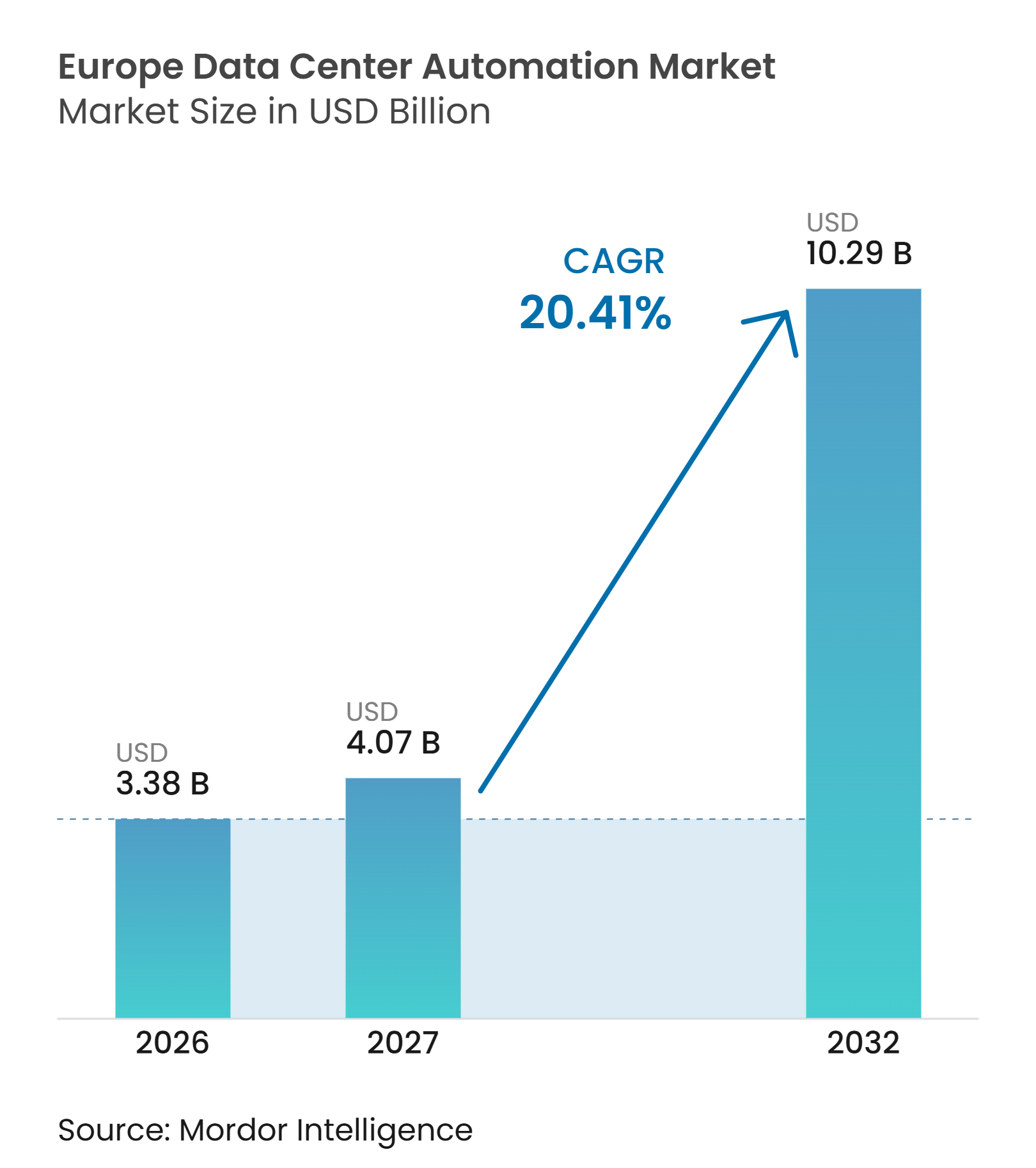
The Europe Data Center Automation Market size is expected to increase from USD 3.38 billion in 2026 to USD 4.07 billion in 2027 and reach USD 10.29 billion by 2032, growing at a CAGR of 20.41% over 2027-2032.
The Europe data center automation market is being shaped by larger AI computing deployments, which require closer control of power, cooling, and electrical systems. Automation is also becoming more important as operators manage more complex hybrid and multicloud environments with limited specialist staffing. Energy reporting rules and tighter performance requirements are increasing demand for systems that collect operating data continuously and support more efficient facility management. The Europe data center automation market also benefits from new construction in regional hubs, while the large installed base of older sites creates a parallel opportunity for retrofit, integration, and modernization.
Key Report Takeaways
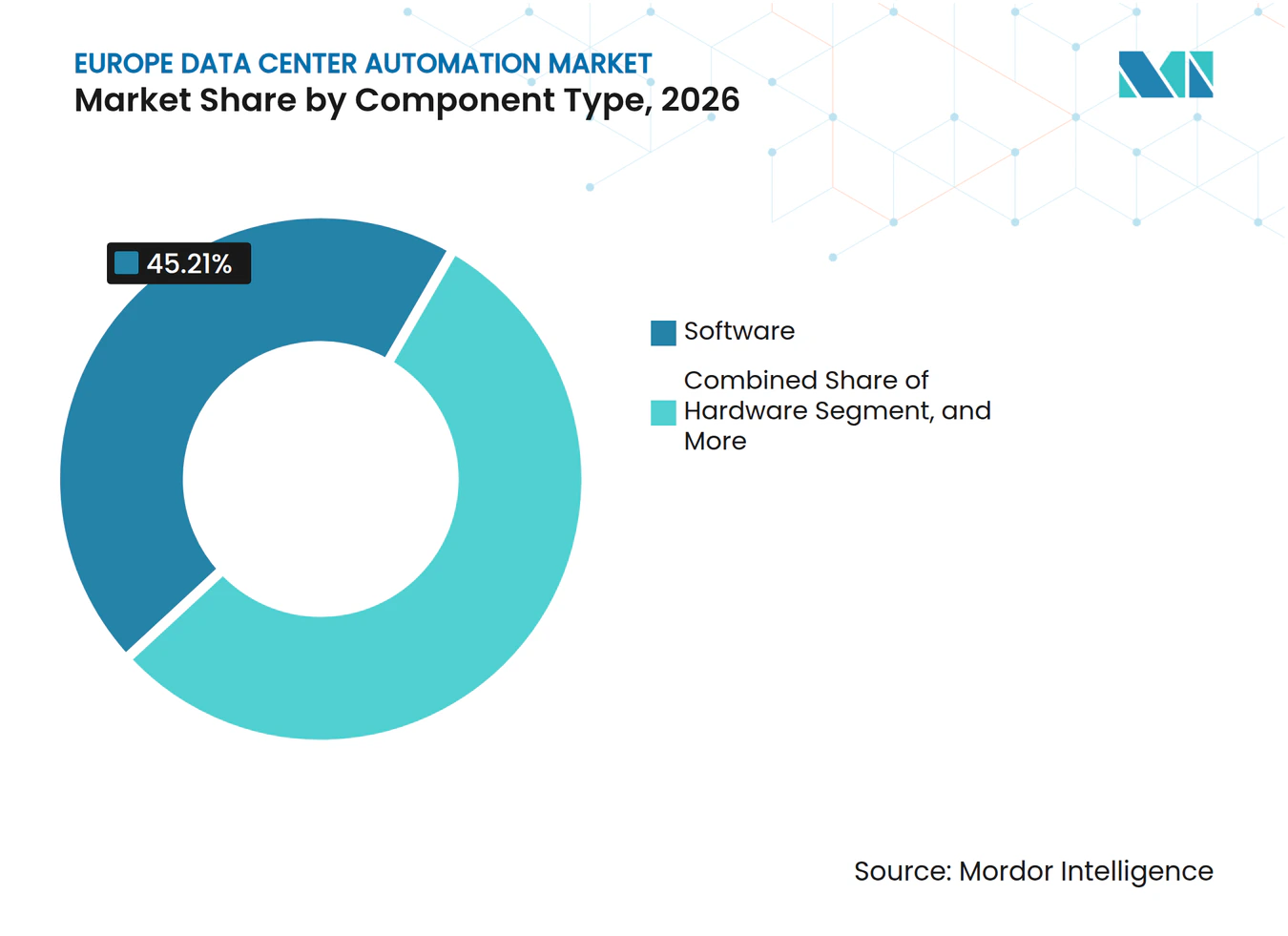
- By component type, software held 45.21% of the Europe data center automation market share in 2026, while services are projected to expand at a 21.01% CAGR through 2032.
- By data center size, hyperscale facilities held 36.31% of the Europe data center automation market share in 2026 and are projected to expand at a 21.19% CAGR through 2032.
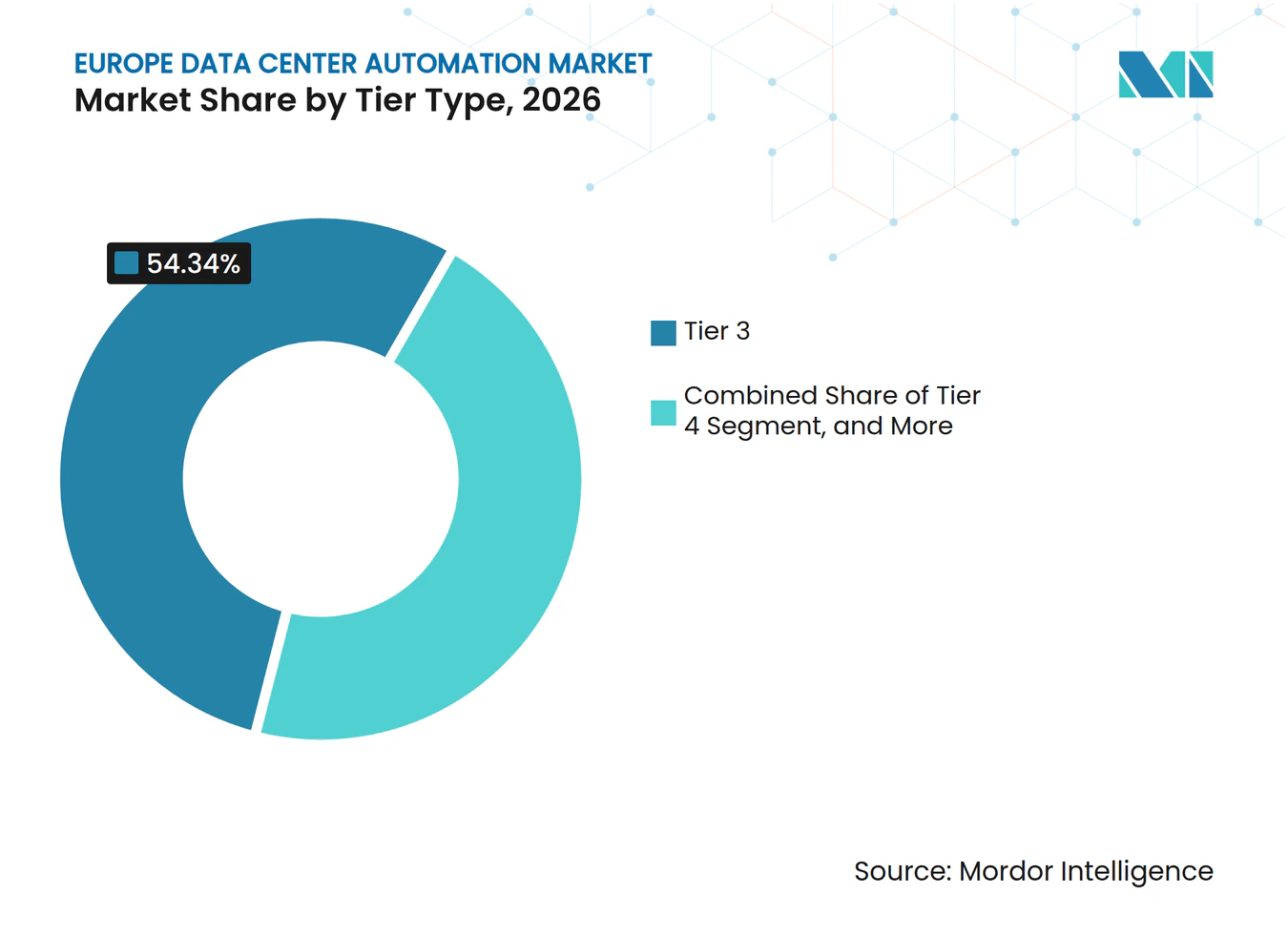
- By tier type, Tier 3 facilities accounted for 54.34% of revenue in 2026, while Tier 4 facilities are projected to expand at a 21.04% CAGR through 2032.
- By geography, Germany held 22.18% of revenue in 2026, while the rest of Europe is projected to expand at a 22.16% CAGR through 2032.
Note: Market numbers in this report are based on Mordor Intelligence's proprietary estimation framework, which combines nine months of actuals with Q4 projections for base year 2026.
Market Trends and Insights
Drivers Impact Analysis of Europe Data Center Automation Market*
| Driver | (~) % Impact on CAGR Forecast | Geographic Relevance | Impact Timeline |
|---|---|---|---|
| AI Workload Growth and High-Density Infrastructure | +7.4% | EU-wide, strongest in Germany, United Kingdom, Ireland, and Netherlands | Short term (≤ 2 years) |
| Cloud, Hybrid IT, and Multicloud Complexity | +5.2% | EU-wide, with spillover to the Nordics and Iberia | Medium term (2-4 years) |
| EU Energy Performance and Sustainability Reporting Requirements | +3.8% | EU-wide, with the highest intensity in Germany, France, and Ireland | Medium term (2-4 years) |
| Data Center Skills Shortages Increasing Automation Returns | +2.1% | EU-wide, most acute in FLAP-D markets | Short term (≤ 2 years) |
| Distributed Edge and Sovereign Data Infrastructure Expansion | +1.2% | Germany, France, Sweden, and Finland, with broader EU sovereign cloud deployment | Long term (≥ 4 years) |
| Source: Mordor Intelligence | |||
AI Workload Growth and High-Density Infrastructure
The Europe data center automation market is responding to AI workloads that put greater demands on facility operations than earlier computing models. Rack power densities above 40 kW are becoming common for AI inference deployments, while some next-generation designs may approach 1 MW per rack. These loads require power, cooling, and mechanical systems to react together as workloads change. Manual adjustment of cooling and power systems can increase operational risk when demand patterns change quickly. Digital control systems can coordinate those systems in real time and give operators earlier visibility into thermal or electrical constraints. This requirement supports demand for the Europe data center automation market across both new AI facilities and upgrades to existing sites.
Cloud, Hybrid IT, and Multicloud Complexity
Hybrid and multicloud operations are increasing the need for common visibility across on-premises infrastructure and cloud-connected workloads. The European data center automation market, therefore, includes a growing requirement for building management systems, supervisory control platforms, and IT orchestration tools that exchange operational data. The NIS2 implementing regulation requires covered cloud computing and data center service providers to manage assets, apply multifactor authentication, and report significant incidents under defined conditions.[1] These obligations make consistent asset and operating data more valuable for operators who must document controls across several environments. Retrofit and modernization providers can address this need by connecting existing control systems rather than replacing every facility system at once. The Europe data center automation market is consequently creating opportunities for service providers that can integrate multiple vendors and older equipment.
EU Energy Performance and Sustainability Reporting Requirements
Energy performance rules are moving data center reporting toward more consistent and measurable operating information. Article 12 of the EU Energy Efficiency Directive requires annual reporting of energy and sustainability information for data centers that meet the directive’s capacity threshold. Germany applies more stringent national thresholds and requires qualifying facilities to use certified energy management systems. Germany also set power usage effectiveness requirements for existing and new facilities, which makes ongoing measurement of power and cooling performance important. Automated DCIM and building management platforms can collect this data more consistently than manual processes. This regulatory setting supports demand for software and analytics within the Europe data center automation market.
Data Center Skills Shortages Increasing Automation Returns
Europe data center development is underway as operators face a limited supply of engineers and technicians with relevant operational experience. This shortage makes manual monitoring, commissioning, and troubleshooting harder to scale across a larger facility base. Automation can reduce repetitive tasks and provide operators with prioritized operating information. Johnson Controls notes that AI-supported diagnostics and robotic process automation can reduce the need for manual troubleshooting in data center operations. The Europe data center automation market can therefore help operators increase the output of existing operations teams without relying solely on additional headcount.
Restraints Impact Analysis of Europe Data Center Automation Market*
| Restraint | (~) % Impact on CAGR Forecast | Geographic Relevance | Impact Timeline |
|---|---|---|---|
| High Upfront Cost and Long Payback for Brownfield Retrofits | -4.6% | EU-wide, strongest in FLAP-D metro markets and secondary hubs | Medium term (2-4 years) |
| Legacy Operational Technology and IT Interoperability Constraints | -3.2% | EU-wide, with legacy operational technology concentrated in Germany, the United Kingdom, and the Netherlands | Long term (≥ 4 years) |
| Cybersecurity and Operational Technology Risk of Connected Controls | -1.8% | EU-wide, with NIS2 and IEC 62443 compliance pressure across member states | Medium term (2-4 years) |
| Operator Hesitancy Toward Autonomous Control Changes | -0.8% | Enterprise and colocation facilities across the EU | Short term (≤ 2 years) |
| Source: Mordor Intelligence | |||
High Upfront Cost and Long Payback for Brownfield Retrofits
Brownfield modernization is a major constraint for the Europe data center automation market because many European facilities were not built for unified control architectures. A live retrofit can require new sensors, programmable controllers, control-system redesign, and integration across suppliers without disrupting contracted uptime. Operators often sequence this work through retro-commissioning, cooling changes, power distribution upgrades, and the deployment of liquid cooling. Each stage has its own capital requirement and recovery period. Grid constraints can compound the challenge, particularly when operators must decide between upgrading an existing site and developing a less-constrained location. Schneider Electric identifies power capacity and economic viability as important considerations in brownfield modernization for AI-ready data centers.[2]
Legacy Operational Technology and IT Interoperability Constraints
Older facilities often combine controllers from several generations, proprietary protocols, and building management systems that were not designed for open integration. This can make deployment more difficult in the Europe data center automation market, rather than simply adding a software configuration task. The NIS2 implementing regulation sets requirements for asset management, encryption, and multifactor authentication, but older devices may not natively support all controls. Operators may need network segmentation and compensating controls to securely connect these assets. IEC 62443 provides a framework for separating systems into security zones and controlling communications between them. These technical requirements can extend implementation schedules for sites that retain older operational technology.
*Our forecasts treat driver/restraint impacts as directional, not additive. The impact forecasts reflect baseline growth, mix effects, and variable interactions.
Europe Data Center Automation Market Segment Analysis
By Component Type:
Software Leads Revenue and Services AccelerateSoftware held 45.21% of the Europe data center automation market share in 2026. This position reflects the broader adoption of DCIM, building management, supervisory control, digital twin, and analytics platforms across hyperscale and enterprise facilities. DCIM systems are moving beyond asset records toward operational tools that bring power, cooling, and IT information into a common view. Vertiv introduced SmartRun in June 2026 as a digital twin connected with the NVIDIA Omniverse DSX Blueprint, enabling teams to validate power, cooling, and deployment choices before physical build-out. Energy reporting obligations also raise the value of systems that record operational metrics continuously.
Services are projected to expand at a 21.01% CAGR from 2027 to 2032, making them the fastest-growing component category. The Europe data center automation services market benefits from the need to connect existing systems across a region with substantial brownfield capacity. System integrators can support design, commissioning, modernization, and ongoing optimization without requiring a complete replacement of working infrastructure. Hardware remains necessary for these projects, including programmable logic controllers, distributed digital controllers, remote I/O, sensors, gateways, human-machine interfaces, and field controllers. Emerson launched its DeltaV Automation Platform for Data Centers in August 2026 to integrate thermal, mechanical, and electrical systems into a single scalable control architecture.



By Data Center Size:
Hyperscale Anchors Spending and GrowthHyperscale facilities held 36.31% of the Europe data center automation market share in 2026 and are projected to expand at a 21.19% CAGR through 2032. Their large campuses require coordinated controls across power, cooling, mechanical equipment, and IT systems. These facilities increasingly use campus-level digital twins and supervisory layers rather than standalone building management tools. This design increases the importance of software, integration, and lifecycle services on each project. The Europe data center automation market benefits as operators build AI-ready facilities that require high-density power and thermal management.
Large data centers form the next important revenue tier and are investing in automation to support energy reporting and operating efficiency. Medium facilities are gaining importance in regional locations, including enterprise-owned sites and colocation facilities outside the largest hubs. Financial-sector demand for regional capacity is also supported by the requirements of the Digital Operational Resilience Act, which became fully applicable in January 2025. Small facilities remain the smallest category, although edge deployments can create additional demand for remote monitoring and standardized operating processes. Deutsche Telekom, Orange, Telefónica, TIM, and Vodafone demonstrated the European Edge Continuum in February 2026, providing a federated framework for edge services.
By Tier Type:
Tier 3 Holds the Largest Position and Tier 4 Expands FastestTier 3 facilities accounted for 54.34% of the Europe data center automation market in 2026. This reflects the large installed base of facilities that can be concurrently maintained in major European colocation markets. Operators in this tier are investing in building-management optimization, DCIM monitoring, and supervisory control integration to support efficiency and reporting requirements. The Uptime Institute reported a global average power usage effectiveness value of 1.54 in 2025, while the European Commission Joint Research Center estimated an average of 1.6 for European facilities. This gap supports continued investment in controls that help operators manage energy use.
Tier 4 facilities are projected to expand at a 21.04% CAGR from 2027 to 2032. Financial institutions and sovereign cloud operators require highly resilient systems that can meet stringent operational and regulatory requirements. Sparkle’s Metamorfosis II site in Greece received Uptime Institute Tier IV Constructed Facility Certification in June 2026. Tier 4 facilities need separate monitoring and control of fully redundant power and cooling paths. They also require control architectures designed to avoid a single point of software failure.

Geography Analysis
Germany Data Center Automation Market
Germany held 22.18% of the Europe data center automation market share in 2026. The country had close to 2,000 facilities with installed IT demand above 100 kW, with installed capacity of 2,980 MW in 2025 and forecast to exceed 5,000 MW by 2030. Germany’s energy efficiency law requires qualifying facilities to meet energy management and power usage effectiveness requirements. These rules make closed-loop power and thermal automation important for new and existing operations. The federal government also adopted a data center strategy covering energy and sustainability, sites and land, technology, and digital sovereignty.[3]
Western and Southern Europe Data Center Automation Market
The Netherlands, the United Kingdom, and Ireland form the next group of national contributors to the Europe data center automation market. Amsterdam’s restrictions on new data centers direct attention toward extracting more capacity and efficiency from existing infrastructure. Ireland reopened grid connections under conditions that include on-site dispatchable generation, which can support new projects while adding operating complexity. Spain, Italy, and Sweden are gaining investment as development spreads beyond established hubs.
Northern and Eastern Europe Data Center Automation Market
The rest of Europe is projected to expand at a 22.16% CAGR from 2027 to 2032, the fastest geographic rate in the Europe data center automation market. Nordic locations benefit from power availability and lower-carbon generation, while Portugal is becoming a major hyperscale location. Pure DC announced Phase 1 of its Seinäjoki AI campus in Finland in July 2026, with investment exceeding EUR 1.5 billion (USD 1.69 billion) and 110 MW of AI-ready capacity. PURE DC Finland is also developing the LUMI-AI data center at Kajaani for sovereign scientific computing. Poland, Portugal, and central and eastern European locations can enhance accessibility as operators seek alternatives to constrained primary hubs.
Competitive Landscape
Market Concentration
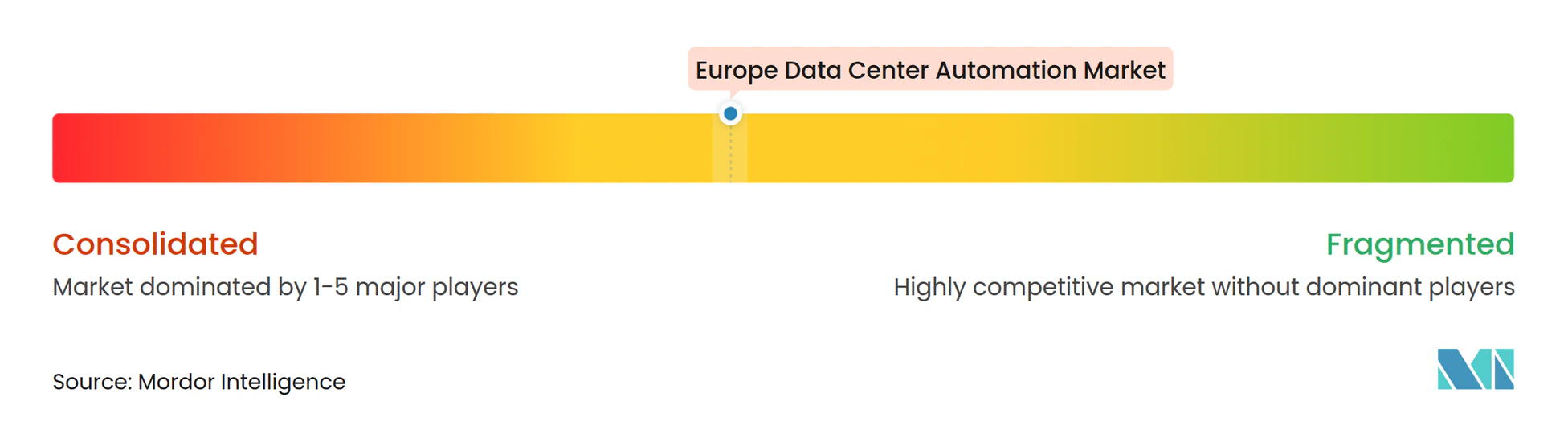
The Europe data center automation market has a moderately consolidated top tier that includes Schneider Electric, Siemens, ABB, Honeywell International, Emerson Electric, and Vertiv. These companies compete across electrical equipment, programmable controls, DCIM software, and services. Suppliers are building reference designs with AI infrastructure providers to reduce deployment complexity. Schneider Electric introduced software-defined medium-voltage switchgear with Equinix at YOTTA 2026 in September 2026, combining power equipment with software programmability for higher-density data center architectures. Suppliers with established cybersecurity and control portfolios can also benefit as facilities respond to connected-control risks.
Specialist providers such as FNT GmbH, Nlyte Software, and Sunbird Software can serve as orchestration layers atop infrastructure monitoring tools. Digital twin applications are an area of active product development, with Vertiv, Eaton, and Emerson extending their offerings into model-based operating simulation. The Europe data center automation market also includes regional integrators such as Caverion Corporation and DEOS AG, which combine local regulatory knowledge with multivendor project delivery. Legrand completed the acquisition of TES in March 2026, adding a United Kingdom power-distribution specialist to its data center portfolio.
Competition also centers on manufacturing capacity, cooling technologies, and the ability to support dense AI workloads. Vertiv announced plans in September 2026 to add 22,000 square meters of manufacturing space in Slovakia for power, switchgear, and thermal-management equipment.[4] ABB is developing direct-current power architectures for AI data centers as part of its Infinitus portfolio. ABB Emerson’s August 2026 platform launch similarly reflects demand for unified control of thermal, mechanical, and electrical systems. These moves show that the Europe data center automation market is being contested through product integration, capacity expansion, and targeted acquisitions rather than through a single product category.
Europe Data Center Automation Industry Leaders
-
Schneider Electric SE
-
Siemens AG
-
Johnson Controls International plc
-
Honeywell International Inc.
-
ABB Ltd
- *Disclaimer: Major Players sorted in no particular order
Europe Data Center Automation Market Companies Covered in this Report
- ABB Ltd
- Beckhoff Automation GmbH and Co. KG
- Carrier Global Corporation
- Cisco Systems, Inc.
- Caverion Corporation
- Delta Controls Inc.
- DEOS AG
- Eaton Corporation plc
- Emerson Electric Co.
- FNT GmbH
- Honeywell International Inc.
- IBM Corporation
- Johnson Controls International plc
- Legrand SA
- Mitsubishi Electric Corporation
- Nlyte Software Limited
- Rockwell Automation, Inc.
- Schneider Electric SE
- Siemens AG
- Sunbird Software, Inc.
- Trane Technologies plc
- Vertiv Holdings Co
Recent Industry Developments in Europe Data Center Automation Market
- October 2026: Eaton signed a definitive agreement to acquire COL Group from Oaktree’s Power Opportunities strategy for an enterprise value of EUR 810 million (USD 915 million). COL Group manufactures medium-voltage electrical distribution solutions, including SF₆-free switchgear and grid automation technologies, and has close to 400 employees across facilities in Turin, Milan, Bergamo, and Catania, Italy. The transaction is expected to close in Q1 2027 and is intended to expand Eaton’s European power-distribution manufacturing footprint for data center and utility customers.
- September 2026: Schneider Electric unveiled software-defined medium-voltage switchgear at YOTTA 2026, deployed in a live colocation data center with Equinix. The RM AirSeT 38 Software Defined platform extends the SF₆-free AirSeT range from 24 kV to 38 kV. It supports higher-density AI data center power architectures and allows medium-voltage systems to evolve with AI infrastructure.
- September 2026: Vertiv announced plans to add 22,000 square meters of manufacturing space at its Nové Mesto nad Váhom campus in Slovakia over 18 to 24 months. The project targets production of power, switchgear, and thermal-management equipment for high-density AI and high-performance computing applications across EMEA. Vertiv expects to add roles across manufacturing, engineering, and operations during 2027 to 2029.
- August 2026: Emerson launched the DeltaV Automation Platform for Data Centers. The platform integrates thermal, mechanical, and electrical systems through a scalable architecture based on Emerson’s DeltaV distributed control system and programmable logic controllers. It includes AI for engineering workflows in AI-scale data centers that require speed, reliability, and operational standardization.
Europe Data Center Automation Market Report Scope
The Europe Data Center Automation Market refers to the market for hardware, software, and services used to automate, monitor, and optimize data center operations and infrastructure. These solutions support the management of IT systems, power and cooling infrastructure, workloads, resource allocation, and facility operations to improve operational efficiency, reduce human intervention, optimize energy consumption, and enhance reliability and scalability. The market is driven by the growing adoption of cloud computing, increasing demand for data processing and storage, the expansion of hyperscale data centers, and the need for energy-efficient and intelligent infrastructure management.
The Europe Data Center Automation Market Report is Segmented by Component Type (Hardware, Software, and Services), Data Center Size (Hyperscale, Large, Medium, and Small), Tier Type (Tier 1 and 2, Tier 3, and Tier 4), and Geography (Germany, Netherlands, United Kingdom, Ireland, Spain, Italy, Sweden, Norway, Finland, and Rest of Europe). The Market Forecasts are Provided in Terms of Value (USD).
Segmentation Overview
| Hardware | Programmable Logic Controllers (PLCs) |
| Direct Digital Controllers (DDCs) | |
| Remote I/O and Field Controllers | |
| Sensors and Monitoring Devices | |
| Gateways and Communication Devices | |
| Human Machine Interface (HMI) Panels | |
| Other Automation Hardware (Others include industrial PCs (IPCs), edge controllers, protocol converters, industrial network switches, embedded automation controllers, among others) | |
| Software | Building Management and Automation Systems (BMS/BAS) |
| Supervisory Control and Data Acquisition (SCADA) | |
| Data Center Infrastructure Management (DCIM) | |
| Digital Twin Platforms | |
| Analytics and Optimization Software | |
| Other Automation Software (Others include engineering and configuration software, historian software, alarm management software, among others) | |
| Services | Design and Consulting Services |
| System Integration Services | |
| Installation and Commissioning Services | |
| Monitoring, Maintenance, and Support Services | |
| Retrofit and Modernization Services |
| Hyperscale |
| Large |
| Medium |
| Small |
| Tier 1 and 2 |
| Tier 3 |
| Tier 4 |
| Germany |
| Netherlands |
| United Kingdom |
| Ireland |
| Spain |
| Italy |
| Sweden |
| Norway |
| Finland |
| Rest of Europe |
| By Component Type | Hardware | Programmable Logic Controllers (PLCs) |
| Direct Digital Controllers (DDCs) | ||
| Remote I/O and Field Controllers | ||
| Sensors and Monitoring Devices | ||
| Gateways and Communication Devices | ||
| Human Machine Interface (HMI) Panels | ||
| Other Automation Hardware (Others include industrial PCs (IPCs), edge controllers, protocol converters, industrial network switches, embedded automation controllers, among others) | ||
| Software | Building Management and Automation Systems (BMS/BAS) | |
| Supervisory Control and Data Acquisition (SCADA) | ||
| Data Center Infrastructure Management (DCIM) | ||
| Digital Twin Platforms | ||
| Analytics and Optimization Software | ||
| Other Automation Software (Others include engineering and configuration software, historian software, alarm management software, among others) | ||
| Services | Design and Consulting Services | |
| System Integration Services | ||
| Installation and Commissioning Services | ||
| Monitoring, Maintenance, and Support Services | ||
| Retrofit and Modernization Services | ||
| By Data Center Size | Hyperscale | |
| Large | ||
| Medium | ||
| Small | ||
| By Tier Type | Tier 1 and 2 | |
| Tier 3 | ||
| Tier 4 | ||
| By Geography | Germany | |
| Netherlands | ||
| United Kingdom | ||
| Ireland | ||
| Spain | ||
| Italy | ||
| Sweden | ||
| Norway | ||
| Finland | ||
| Rest of Europe | ||
Key Questions Answered in the Report
What is the size of the Europe data center automation market?
The Europe data center automation market is valued at USD 3.38 billion in 2026 and is forecast to reach USD 10.29 billion by 2032, expanding at a 20.41% CAGR from 2027 to 2032.
Which component leads data center automation spending in Europe?
Software leads with a 45.21% revenue share in 2026, supported by DCIM, building management, digital twin, and analytics platforms.
Which facility size is expanding fastest in Europe?
Hyperscale facilities are projected to expand at a 21.19% CAGR through 2032, supported by large AI-ready campus deployments.
Why are operators investing in automation systems?
Operators are using automation to coordinate high-density power and cooling systems, meet reporting requirements, and manage more infrastructure with limited specialist staffing.
Which European geography has the strongest projected expansion?
Rest of Europe is projected to expand at a 22.16% CAGR through 2032, supported by investment in Nordic, Portuguese, Polish, and other regional locations.
What is the main challenge in automating existing facilities?
Brownfield upgrades can require new sensors, controls, and multivendor integration while keeping live facilities available, which raises cost and can extend payback periods.