
Europe Container Homes Market Size and Share
Market Overview
| Study Period | 2021 - 2032 |
|---|---|
| Forecast Data Period | 2027 - 2032 |
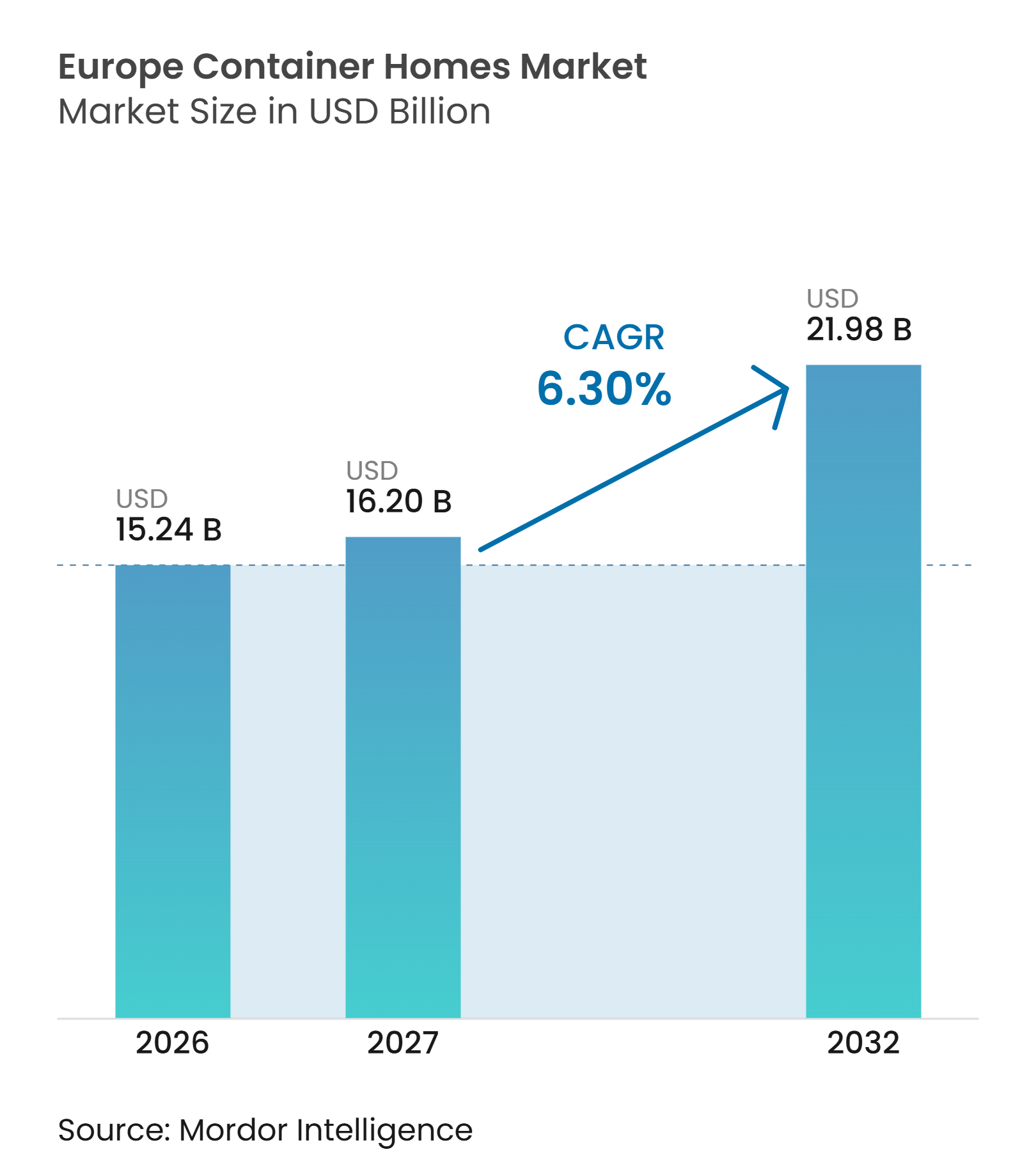
| Base Year Market Size (2026) | USD 15.24 Billion |
| Market Size (2027) | USD 16.20 Billion |
| Market Size (2032) | USD 21.98 Billion |
| Growth Rate (2027 - 2032) | 6.30 % |
| Market Concentration | Medium |
Major Players *Disclaimer: Major Players sorted in no particular order Image © Mordor Intelligence. Reuse requires attribution under CC BY 4.0. | |
Europe Container Homes Market Analysis by Mordor Intelligence
The Europe Container Homes Market size is projected to be USD 15.24 billion in 2026, USD 16.20 billion in 2027, and reach USD 21.98 billion by 2032, growing at a CAGR of 6.30% from 2027 to 2032.
The Europe container homes market is supported by a housing supply gap that is increasing pressure on public authorities to add homes quickly. The Joint Research Centre estimates that the European Union needs more than 2 million new homes each year through 2035 to meet demand. Energy rules also favor systems that can document insulation, thermal performance, and other design specifications before on-site work begins. The Europe container homes market is therefore moving beyond short-term affordability projects toward certified residential, social housing, and emergency accommodation applications. Suppliers with factory capacity, repeatable building approvals, and public procurement experience are better placed to benefit, while fragmented planning rules and limited consumer financing continue to restrict private demand.
Key Report Takeaways
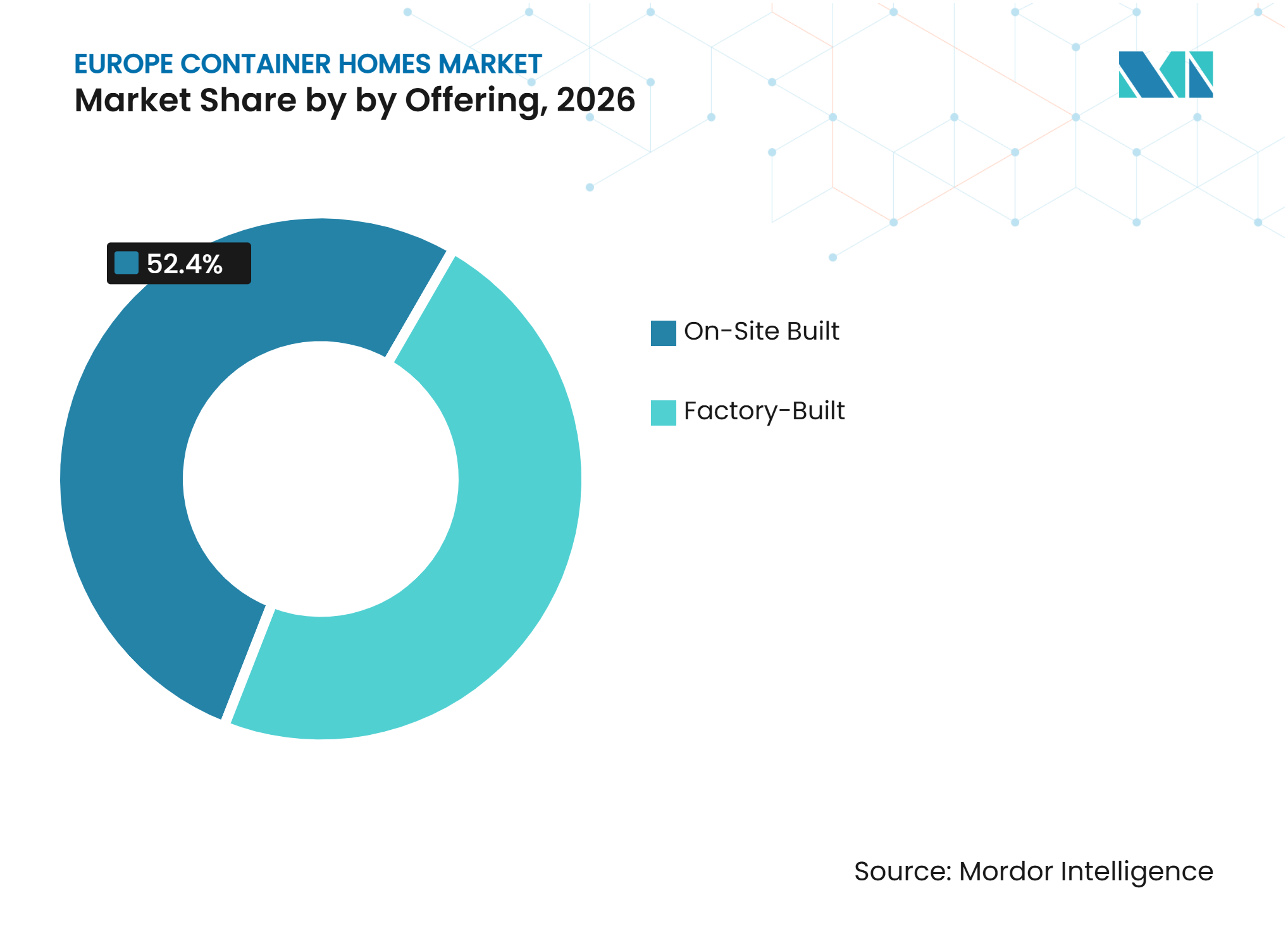
- By offering, on-site built units held 52.40% of the Europe container homes market in 2026, while factory-built units are forecast to expand at a 7.05% CAGR through 2032.
- By construction type, fixed structures held 56% of the Europe container homes market size in 2026, while movable units are forecast to expand at a 7.45% CAGR through 2032.
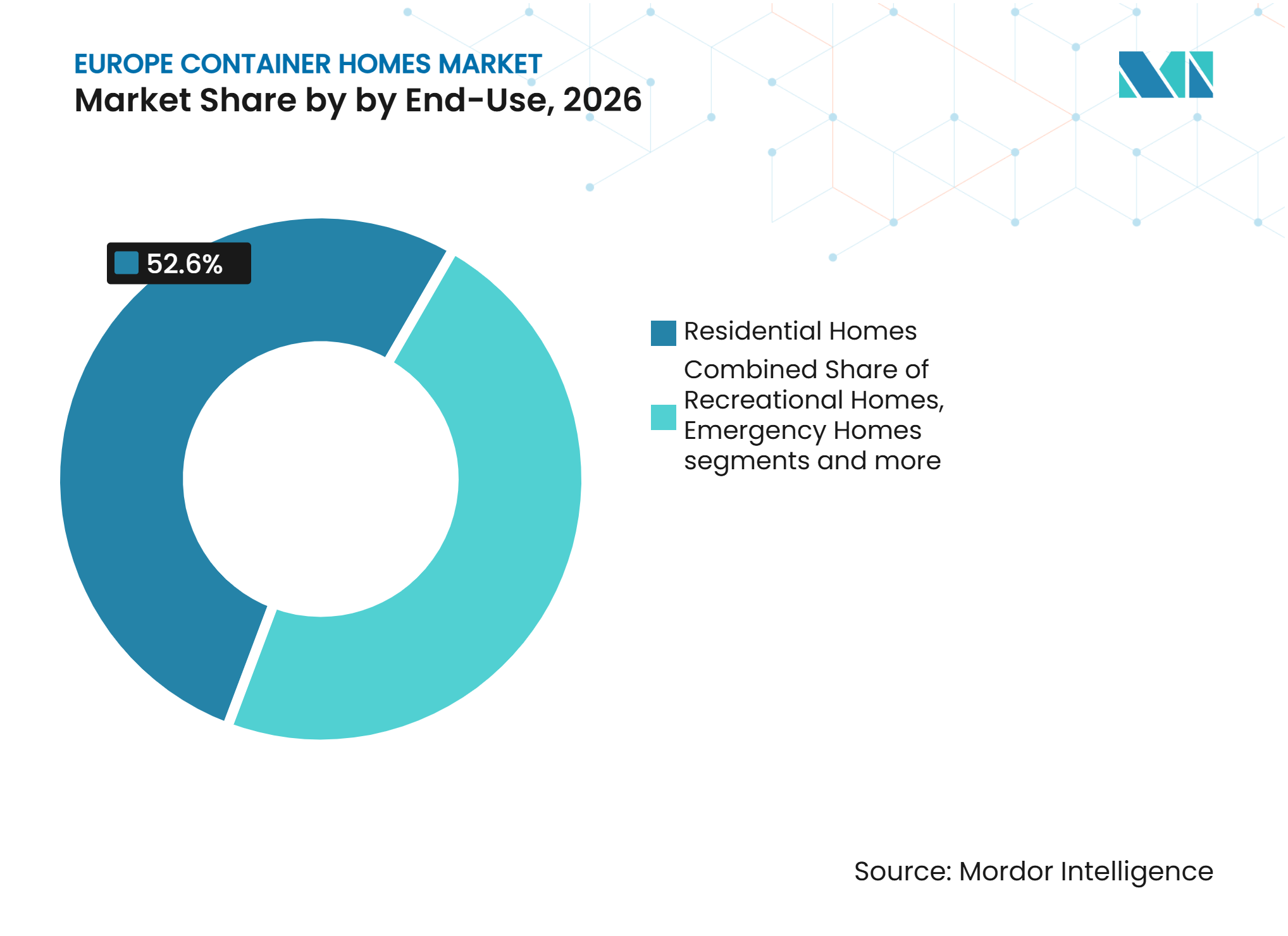
- By end-use, residential homes held 52.6% of the Europe container homes market size in 2026, while emergency homes are forecast to expand at a 7.55% CAGR through 2032.
- By country, Germany held 24% of the Europe container homes market share in 2026, while the Rest of Europe is forecast to expand at a 6.95% CAGR through 2032.
Note: Market numbers in this report are based on Mordor Intelligence's proprietary estimation framework, which combines nine months of actuals with Q4 projections for base year 2026.
Market Trends and Insights
Drivers Impact Analysis of Europe Container Homes Market*
| Driver | (~) % Impact on CAGR Forecast | Geographic Relevance | Impact Timeline |
|---|---|---|---|
| Housing Supply Shortfalls and Affordability Pressure | +1.8% | EU-wide, concentrated in Germany, France, and the United Kingdom | Medium term (2-4 years) |
| Modular and Prefabricated Construction Expansion | +1.5% | Germany, Netherlands, and Austria | Short term (≤ 2 years) |
| Energy Performance Rules and Circular Steel Use | +1.2% | EU-wide, accelerated in Germany, France, and the Nordic countries | Medium term (2-4 years) |
| Student, Refugee, and Emergency Accommodation Demand | +0.9% | Germany, United Kingdom, Nordic countries, and Rest of Europe | Short term (≤ 2 years) |
| Movable-Unit Demand in Nordic Markets | +0.4% | Norway, Sweden, Denmark, and Finland | Medium term (2-4 years) |
| Source: Mordor Intelligence | |||
Housing-Supply Shortfalls and Affordability Pressure
The Europe container homes market is benefiting from a housing shortage that public policy is treating as a structural concern. The Joint Research Centre estimated that more than 7 million additional dwellings will be needed above current plans through 2035[1]. The European Parliament also called for measures that reduce administrative delay and improve housing delivery[2]. Container systems suit municipal projects because units can be transported, stacked, fitted out, and connected in a shorter site period than conventional construction. This matters where local authorities need operational housing capacity rather than only planning approvals. Long-term framework agreements by social housing bodies can give manufacturers a steadier order flow than individual private residential projects.
Expansion of Modular and Prefabricated Construction
The Europe container homes market gains from wider acceptance of modular construction in Germany and neighboring markets. Factory-made systems can combine electrical, plumbing, insulation, and internal finishes before delivery, which reduces the work required at the site. Daiwa House Modular Europe reported that its Landsberger Allee project in Berlin used 3,289 modules for 1,548 apartments, showing the scale at which modular housing can be deployed. Euronews reported that prefabricated homes represented 26% of new single- and two-family homes in Germany in 2024. This established production base makes pre-approved systems more familiar to housing associations and public buyers. The same conditions support suppliers that can repeat designs without re-engineering each project.
Sustainability, Energy-Performance Rules, and Circular Use of Steel Containers
The revised Energy Performance of Buildings Directive requires member states to set energy standards and national renovation plans that support the transition to zero-emission buildings[3]. This regulatory influence favors container homes that carry clear records for insulation, U-values, and thermal bridges before construction begins. A 2026 study of retrofit solutions for container homes across 22 European climate zones found energy payback periods of 13 to 35 years, with shorter periods in colder locations. Research from the University of Bologna also found that direct reuse of structural steel can substantially reduce carbon intensity compared with new blast-furnace steel production. These factors strengthen the case for designs that incorporate reused steel while meeting performance requirements. Higher design standards, however, make technical capability more important when suppliers enter regulated markets.
Demand for Student, Refugee, and Emergency Accommodation
The Europe container homes market has a separate demand stream from emergency, refugee, and student accommodation. Public buyers can fund large requirements through procurement programs instead of relying on consumer purchasing decisions. Berlin tendered temporary container facilities at the former Tegel Airport site for housing capacity serving 2,600 people through May 2031. Sweden has pre-positioned more than 200 housing modules in Kristinehamn with capacity for 1,050 people as part of its emergency preparedness arrangements. These programs favor units that can be reused, relocated, and supported by documented energy performance. They also create multi-year production requirements that can help manufacturers use factory capacity consistently.
Restraints Impact Analysis of Europe Container Homes Market*
| Restraint | (~) % Impact on CAGR Forecast | Geographic Relevance | Impact Timeline |
|---|---|---|---|
| Fragmented Permitting and National Building-Code Requirements | -0.9% | EU-wide | Long term (≥ 4 years) |
| Limited Mortgage, Insurance, and Valuation Infrastructure | -0.7% | United Kingdom, France, Italy, and Rest of Europe | Medium term (2-4 years) |
| Strict Energy-Performance and Cold-Climate Compliance Costs | -0.5% | Germany and Nordic countries | Medium term (2-4 years) |
| Competition from Timber-Frame and Volumetric Modular Alternatives | -0.3% | Germany and United Kingdom | Long term (≥ 4 years) |
| Source: Mordor Intelligence | |||
Fragmented Permitting, Building Codes, and Energy Compliance Costs
Permitting fragmentation remains a direct constraint on the Europe container homes market because residential approvals are governed nationally and locally. The Energy Performance of Buildings Directive sets a common direction, but member states implement the requirements through their own building rules. Local land-use plans can also limit the use of metallic or nontraditional structures in residential zones. France’s rules require a building permit for a habitable container above 20 square meters, according to the source material provided. Compliance with insulation and cold-climate design requirements raises the need for robust design and certification work. Until approvals become easier to repeat across jurisdictions, project timing will remain less certain than for established local construction methods.
Limited Financing, Insurance, and Competition from Alternative Systems
Private buyers face constraints when lenders, insurers, and appraisers have limited evidence for the long-term value of container homes. The source material indicates that mortgage eligibility often depends on a permanent foundation, a full building permit, and evidence of energy compliance. These conditions leave movable or temporary units outside the usual residential finance process. The Europe container homes industry also competes with timber-frame and other volumetric modular systems that may already have stronger market familiarity. Buyers may prefer alternatives when they need a conventional financing route or a building method that local planners understand. This means container suppliers need to pair cost and delivery advantages with warranties, approvals, and performance documentation.
*Our forecasts treat driver/restraint impacts as directional, not additive. The impact forecasts reflect baseline growth, mix effects, and variable interactions.
Europe Container Homes Market Segment Analysis
By Offering:
On-Site Built Units Retain Broad Use While Factory-Built Units Gain GroundOn-site built units held 52.4% of demand in 2026 in the Europe container homes market. They remain useful where constrained access, difficult terrain, site-specific layouts, or separate interior fit-out requirements make delivery of a completed module less practical. Rural residences, recreational cabins, and projects with bespoke designs often use this approach. The segment also reflects the earlier stage of acceptance in parts of Southern Europe, where developers and authorities are still becoming familiar with purpose-built container housing. Its position shows that factory production has not removed the need for installation flexibility. On-site work remains relevant when the project calls for adaptation to local plot conditions.
Factory-built units are forecast to expand at a 7.05% CAGR through 2032 in the Europe container homes market. Their appeal comes from integrated systems that can arrive with electrical, plumbing, and insulation packages already installed. Daiwa House Modular Europe reported up to 90% prefabrication at its Fürstenwalde facility for units delivered to the Berlin project at Landsberger Allee. Factory delivery can reduce the amount of on-site construction to stacking and final connections. It also gives institutional buyers a more repeatable way to assess specifications and delivery dates. This supports the shift toward pre-approved building systems in public housing and emergency accommodation contracts.


By Construction Type:
Fixed Structures Lead While Movable Units Serve Institutional ProgramsFixed structures held 56% of demand in 2026 in the Europe container homes market. Their lead is linked to the residential use case, where a permanent foundation, utility connection, and building permit can help a home qualify as real property. These attributes are important for conventional mortgage financing and standard homeowner insurance. Fixed units also fit long-term social housing projects where residents require stable services and permanent addresses. The structure therefore aligns with the needs of buyers seeking a residence rather than a temporary asset. Its leadership reflects both end-user preferences and the requirements of established financing systems.
Movable units are forecast to advance at a 7.45% CAGR through 2032 in the Europe container homes market. Demand is strongest in institutional programs for emergency housing, reception centers, military facilities, and workforce accommodation. Sweden’s emergency preparedness program provides an example of a reuse model, with housing modules kept available for rapid deployment. The value proposition is based on repeat use because units can be stored, transported, and placed at a new site. Suppliers that use common connection interfaces across fixed and movable units can serve distinct customer groups without completely separate product lines. This operational flexibility supports investment in standardized module systems.
By End-Use:
Residential Homes Form the Core While Emergency Homes Grow FasterResidential homes accounted for 52.6% of demand in 2026 in the Europe container homes market. The segment is supported by the region’s need for additional dwellings and the ability of certified units to meet permanent-residence requirements. The Joint Research Centre has stated that the European Union needs more than 2 million new homes each year through 2035. Residential projects benefit when the building system can document energy performance early in the approval process. This makes factory-built systems relevant to social housing as well as private development. The segment remains central because it links container housing to the wider shortage of permanent homes.
Emergency homes are forecast to grow at a 7.55% CAGR through 2032, the highest rate among end uses in the Europe container homes market. Government requirements for refugee accommodation and civil emergency capacity create funded demand that does not depend on retail pricing. Berlin’s Tegel Airport tender illustrates the scale of this requirement, with facilities intended to accommodate 2,600 people. Emergency orders can help manufacturers finance testing, certification, and production equipment that also support residential output. Recreational and care-related uses remain additional outlets for container systems, but they do not change the larger role of residential and emergency demand. The combination of these two applications broadens the customer base for suppliers with certified products.


Geography Analysis
Germany
Germany accounted for 24% of the European container homes market in 2026. The country’s demand is shaped by social housing procurement, refugee accommodation, and modular residential construction. Daiwa House Modular Europe completed the stacking of 3,289 modules for the 1,548-apartment Landsberger Allee development in May 2026, with the project designed to meet the KfW-55 energy standard. The Energy Performance of Buildings Directive and German energy rules make documented building performance important in project selection. Producers that can supply pre-certified insulation and repeatable designs have an advantage in this environment.
Rest of Europe
The rest of Europe is forecast to grow at a 6.95% CAGR through 2032 in the Europe container homes market. Growth comes from institutional programs that require rapid deployment in Central and Eastern Europe and the Nordic countries. Sweden has placed more than 200 emergency housing modules in Kristinehamn for a capacity of 1,050 people. CPH Village planned 154 container student homes at Copenhagen Nordhavn for 2027, which shows a related urban use case. These projects depend on units that can be relocated, stored, and connected quickly when public demand changes.
United Kingdom, France, and Italy
The Europe container homes market has varied demand patterns across the United Kingdom, France, and Italy. In the United Kingdom, local planning decisions and the ability to meet mortgage-related assurance requirements shape whether a project is viable. France has contrasting conditions because urban land-use plans can limit metallic structures while rural communities may allow them more readily. The Fismes project, which used recycled shipping containers for 7 homes, provides a current public-sector example in France.
Competitive Landscape
Market Concentration

The Europe container homes market is moderately fragmented, with larger Germany- and Netherlands-based modular producers competing alongside regional fabricators. The main divide is between suppliers able to handle repeated institutional contracts and smaller firms serving local projects. Scale matters because public buyers need consistent production capacity, documentation, and reliable delivery schedules. Daiwa House Modular Europe has demonstrated this capability through large residential projects in Germany and the Netherlands. The Europe container homes market therefore rewards firms that can serve both permanent homes and temporary accommodation without changing their production model completely.
Companies are expanding capacity and using large projects to build credibility with housing associations and public authorities. Daiwa House Modular Europe delivered 105 modular social housing units at Strandeiland in Amsterdam in 2026, with designs intended for 20 years of occupancy before relocation and reuse. It also started work on 379 social housing units at Circusterrein in Hilversum, while factory production ran in parallel with foundation work. ELA Container UK moved to a 40,000 square foot facility in 2026, more than doubling its earlier 17,000 square foot footprint. These moves show that capacity and repeatable delivery are central competitive priorities.
Sustainability documentation is another area of differentiation because buyers increasingly consider circular use of steel and building energy performance. Research from the University of Bologna supports the environmental case for direct structural steel reuse. Smaller firms can compete when they offer local service or specialized reused-container designs, but they may find it difficult to match the certification and output of larger producers. The Europe container homes market still offers room for suppliers in places where emergency accommodation demand is increasing faster than local certified capacity.
Europe Container Homes Industry Leaders
-
ELA Container GmbH
-
Tempohousing
-
CONTAINEX Container-Handelsgesellschaft mbH
-
ALHO Unternehmensgruppe
-
SÄBU Morsbach GmbH
- *Disclaimer: Major Players sorted in no particular order
Europe Container Homes Market Companies Covered in this Report
- ELA Container GmbH
- Tempohousing
- CONTAINEX Container-Handelsgesellschaft mbH
- ALHO Unternehmensgruppe
- High Cube
- Contain Haus
- KB Container
- Acker Raum-Systeme GmbH
- Container City (Urban Space Management)
- YMC Container Solutions
- Domino Homes
- BOLLE Modular
- The Box System
- Cube Homes
- Emtolive
- Sogeco Living SA
- Daiwa House Modular Europe GmbH
- CPH Village
- BCS Containersysteme
- SMS Containermodule Deutschland GmbH
Recent Industry Developments in Europe Container Homes Market
- May 2026: Daiwa House Modular Europe GmbH completed module stacking, the final of 3,289 modules, at Landsberger Allee, Berlin on May 18, 2026. Europe’s largest modular housing project comprises 1,548 apartments for state housing provider Gewobag and targets delivery in late 2026 or early 2027 at the KfW-55 energy standard, including 1,316 subsidized affordable units.
- May 2026: Daiwa House Modular Europe completed 105 modular social housing units at Strandeiland, Amsterdam for housing corporation de Alliantie within 8 months. The project includes 18 studios, 62 2-room apartments, and 25 3-room apartments designed for 20-year occupancy before relocation and reuse.
- January 2026: Condecta Group acquired ALHO Group’s Swiss FAGSI container operations, including the Wikon site in Lucerne and a fleet of 1,150 FAGSI rental containers, to develop the operation as a center of excellence for mobile space solutions.
Europe Container Homes Market Report Scope
Segmentation Overview
| Factory-Built |
| On-Site Built |
| Fixed |
| Movable |
| Residential Homes |
| Recreational Homes |
| Emergency Homes |
| Nursing Homes |
| Germany |
| United Kingdom |
| France |
| Italy |
| Rest of Europe |
| By Offering | Factory-Built |
| On-Site Built | |
| By Construction Type | Fixed |
| Movable | |
| By End-Use | Residential Homes |
| Recreational Homes | |
| Emergency Homes | |
| Nursing Homes | |
| By Country | Germany |
| United Kingdom | |
| France | |
| Italy | |
| Rest of Europe |
Key Questions Answered in the Report
What is the size of the Europe container homes market?
The sector is projected at USD 15.24 billion in 2026 and is forecast to reach USD 21.98 billion by 2032 at a 6.30% CAGR
Which offering is growing fastest in Europe container homes?
Factory-built units are the fastest-growing offering, with a forecast CAGR of 7.05% through 2032.
Why are container homes being adopted for public housing?
Public buyers use container systems because they can support faster deployment and documented energy performance for residential and emergency accommodation.
Which country leads demand for container homes in Europe?
Germany leads demand with a 24% share in 2026, supported by social housing, refugee accommodation, and large modular projects.
What is the fastest-growing end use for container homes?
Emergency homes are the fastest-growing end use, with a forecast CAGR of 7.55% through 2032.
What limits wider adoption of container homes?
Fragmented permits, uneven mortgage and insurance access, and competition from other modular systems constrain wider adoption.