
Europe Commercial Roofing Market Size and Share
Market Overview
| Study Period | 2021 - 2032 |
|---|---|
| Forecast Data Period | 2027 - 2032 |
| Base Year Market Size (2026) | USD 10.79 Billion |
| Market Size (2027) | USD 11.43 Billion |
| Market Size (2032) | USD 15.30 Billion |
| Growth Rate (2027 - 2032) | 6.00 % |
| Market Concentration | Medium |
Major Players *Disclaimer: Major Players sorted in no particular order Image © Mordor Intelligence. Reuse requires attribution under CC BY 4.0. | |
Europe Commercial Roofing Market Analysis by Mordor Intelligence
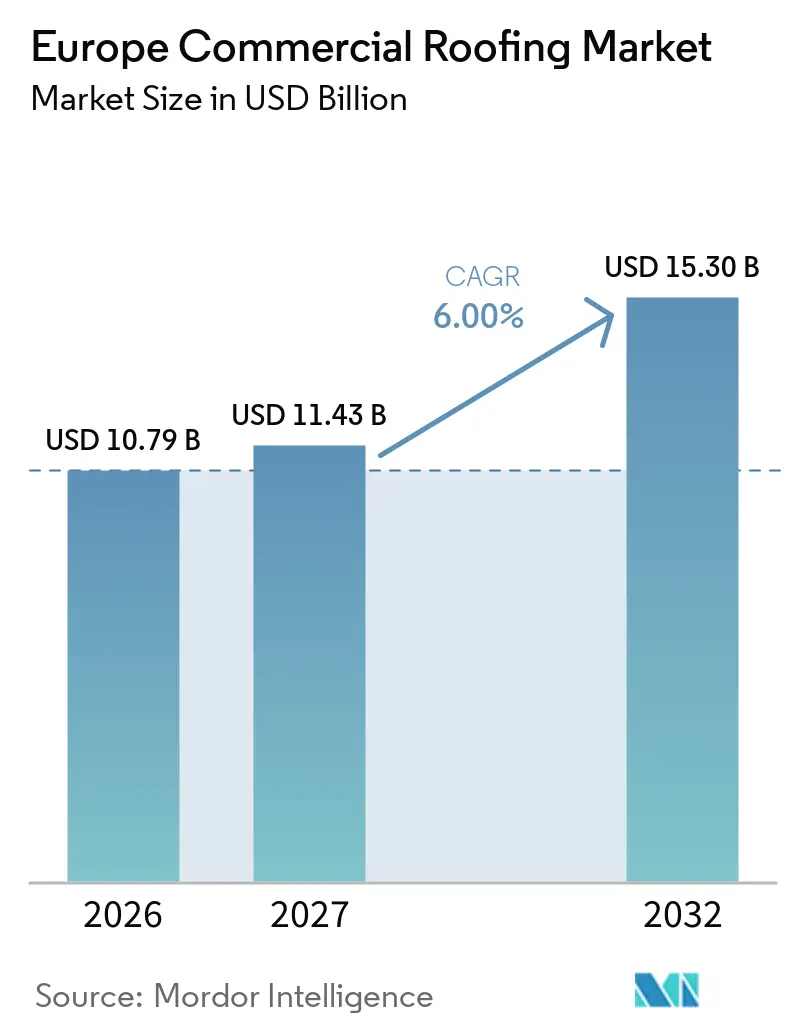
The Europe Commercial Roofing Market size is expected to grow from USD 10.79 billion in 2026 to USD 11.43 billion in 2027 and is forecast to reach USD 15.30 billion by 2032 at 6% CAGR over 2027-2032.
An aging non-residential building base and tighter energy rules are moving more projects from limited repair work toward full roof-system upgrades. The revised Energy Performance of Buildings Directive requires member states to improve the weakest nonresidential buildings, which gives owners a clearer reason to combine insulation, waterproofing, and energy measures. Solar, heat-pump, and green-roof installations also change roof specifications because many existing structures need reinforcement, drainage improvements, or new membranes before added loads can be accepted. The Europe commercial roofing market therefore offers the strongest opportunities to suppliers and contractors that can provide tested systems, technical documentation, and local installation support. National fire rules, heritage approvals, and restricted urban access will continue to lengthen some project schedules.
Key Report Takeaways
- By material type, single-ply membranes, including thermoplastic polyolefin, ethylene propylene diene monomer, and polyvinyl chloride, held 47.12% of the Europe commercial roofing market share in 2026, while Others is forecast to grow at a 7.14% CAGR through 2032.
- By construction type, new construction accounted for 65.00% of the Europe commercial roofing market size in 2026, while reroofing and replacement is forecast to grow at a 7.55% CAGR through 2032.
- By application, the industrial category held 34.32% of the Europe commercial roofing market and end use is forecast to grow at an 8.10% CAGR through 2032.
- By geography, Germany held 24.00% of the Europe commercial roofing market size in 2026, while Rest of Europe is forecast to grow at a 7.20% CAGR through 2032.
Note: Market numbers in this report are based on Mordor Intelligence's proprietary estimation framework, which combines nine months of actuals with Q4 projections for base year 2026.
Market Trends and Insights
Drivers Impact Analysis of Europe Commercial Roofing Market*
| Drivers | (~) % Impact on CAGR Forecast | Geographic Relevance | Impact Timeline |
|---|---|---|---|
| Building Renovation Mandates and Energy Performance Targets | +2.1% | EU-wide, with strong relevance in Germany, France, Italy, and Spain | Medium term (2-4 years) |
| Heat Pump and Photovoltaic Roof Loading Demand | +1% | Germany, France, Spain, and the Netherlands | Short term (≤ 2 years) |
| Rooftop Biodiversity and Stormwater Compliance | +0.8% | France, the United Kingdom, the Netherlands, and Germany | Medium term (2-4 years) |
| Adaptive Reuse of Industrial and Commercial Buildings | +0.7% | The United Kingdom, Germany, the Netherlands, and France | Long term (≥ 4 years) |
| Circular Construction Procurement and Product Transparency | +0.6% | EU-wide, with early gains in Germany, the United Kingdom, and Nordic countries | Medium term (2-4 years) |
| Cross-Border Standardization of Membrane and Insulation Systems | +0.4% | EU-wide | Long term (≥ 4 years) |
| Source: Mordor Intelligence | |||
Building Renovation Mandates and Energy Performance Targets
The revised Energy Performance of Buildings Directive gives the Europe commercial roofing market a policy-led renovation pipeline. It requires member states to renovate the worst-performing 16% of nonresidential building floor area by 2030 and 26% by 2033[1]. Member states must submit final national building renovation plans by December 2026, and these plans must address financing and workforce needs for envelope upgrades[2]. Hamburg supports energy modernization of nonresidential properties through 2027, including roof insulation and prefabricated roof modules. Contractors and manufacturers that plan capacity around national compliance dates can be better placed for country-level demand peaks.
Heat Pump and Photovoltaic Roof Loading Demand
Heat pumps and photovoltaic installations are making roof capacity a more important part of commercial building upgrades. The Energy Performance of Buildings Directive sets phased solar requirements for new public and commercial buildings over 250 square meters from 2026, followed by existing nonresidential buildings from 2027[3]. Many owners must first review the membrane condition, insulation, drainage, and load-bearing capacity of the roof. Research referenced in the supplied evidence indicates that 30% to 40% of existing commercial and industrial properties may face structural constraints before photovoltaic systems can be installed. This sequence makes roof renewal in Europe's commercial roofing market a prerequisite for some energy projects in the Europe commercial roofing market. It also favors contractors that can coordinate roofing and solar-system requirements early in project design.
Rooftop Biodiversity and Stormwater Compliance
Green-roof and water-management requirements raise the technical content of commercial roof projects. France requires new commercial buildings to dedicate at least 30% of their roof area to green or solar infrastructure. Paris has exceeded its initial target to green 150 hectares of buildings and is targeting a further 40 hectares by 2030. Scientific research reports green-roof stormwater retention rates from 55% to 88%, a range relevant to public refurbishment specifications. These requirements favor reinforced and root-resistant membranes, drainage layers, and systems that can carry higher structural loads.
Adaptive Reuse of Industrial and Commercial Buildings
Adaptive reuse creates roofing work that does not follow a standard new-build or replacement cycle. The conversion of The Bottle Works in Guildford from a dairy bottling plant into office space used a bespoke flat-roof insulation solution to meet fire requirements while respecting the building’s listed character. In Germany, changes to more than 10% of a roof can trigger minimum thermal-performance requirements for the full roof assembly. Projects in reused buildings increasingly combine waterproofing, insulation, solar readiness, and green-roof features in a single scope. Structural assessments become necessary where the new roof loading differs from the original condition, which creates a role for suppliers with design and advisory capability.
Restraints Impact Analysis of Europe Commercial Roofing Market*
| Restraints | (~) % Impact on CAGR Forecast | Geographic Relevance | Impact Timeline |
|---|---|---|---|
| National Differences in Fire and Construction Rules | -0.9% | EU-wide, especially Germany, France, the United Kingdom, and Spain | Long term (≥ 4 years) |
| High Urban Access, Scaffolding, and Labor Costs | -0.7% | London, Paris, Amsterdam, and Milan | Medium term (2-4 years) |
| Heritage Building and Protected Façade Constraints | -0.6% | France, the United Kingdom, Italy, Spain, and Germany | Long term (≥ 4 years) |
| Limited Installation Windows in Dense Cities | -0.4% | Major metropolitan areas in Western Europe | Short term (≤ 2 years) |
| Source: Mordor Intelligence | |||
National Differences in Fire and Construction Rules
Fire classification remains a barrier to common roofing specifications across Europe. EN 13501-5 uses methods described in CEN/TS 1187, but Germany, Belgium, the Netherlands, and Poland use BROOF(t1), while France, Italy, and Spain use BROOF(t3), and the United Kingdom and Ireland use BROOF(t4). A result under one method cannot automatically support compliance in another national system. Spain’s industrial fire-safety rules add requirements that affect choices for large commercial roof assemblies. Italy’s photovoltaic rules add compartmentation and spacing requirements that increase design work for solar projects. Contractors and developers must keep separately approved product lists, which raises procurement effort and reduces scale benefits.
High Urban Access, Scaffolding, and Labor Costs
High urban access, scaffolding, and labor costs constrain commercial roofing work in dense European cities. London, Paris, Amsterdam, and Milan often require detailed access plans, safety controls, and coordination with building occupants. Limited street access and restricted work periods can increase the time needed to complete installation. These conditions raise project costs and make smaller replacement programs harder to justify. Contractors with local crews and established access-planning capability are better placed to manage these projects.
*Our forecasts treat driver/restraint impacts as directional, not additive. The impact forecasts reflect baseline growth, mix effects, and variable interactions.
Europe Commercial Roofing Market Segment Analysis
By Material Type:
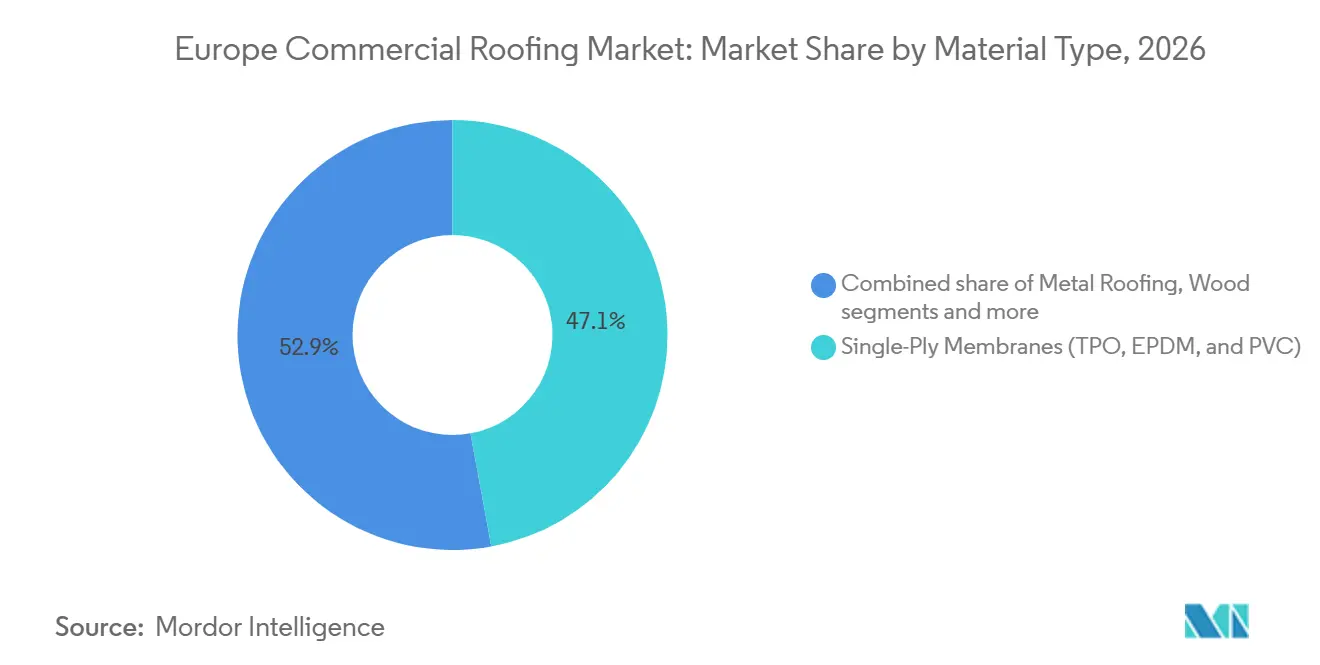
Single-Ply Systems Set the Performance BenchmarkSingle-ply membranes held 47.12% of the commercial roofing market share in Europe in 2026 and remain the default specification for many new commercial flat roofs. This group includes thermoplastic polyolefin, ethylene propylene diene monomer, and polyvinyl chloride, which are commonly shortened to TPO, EPDM, and PVC. PVC is the fastest-growing material subtype and is projected to record a 7.14% CAGR through 2032. Its position is supported by recycling networks in France, Italy, and Central and Eastern Europe, as well as demand for reflective surfaces on commercial roofs. RENOLIT ALKORPLAN Bright was used on a 2,800 square meter pharmaceutical warehouse renovation in Colmar, France, where its Solar Reflectance Index of 115 supported cooling performance and photovoltaic efficiency.
Bituminous membranes retain an important installed base on older commercial flat roofs, while metal roofing serves industrial and logistics buildings. Clay and concrete tiles remain relevant for pitched-roof replacement in Mediterranean markets, and wood-based or other systems serve heritage and specialist projects. The German membrane association reported a decline in basic and polymer bitumen membrane volumes, while plastic and elastomer systems gained attention in commercial applications. This pattern supports a gradual move toward plastic and elastomer membranes in the Europe commercial roofing market. PVC faces a more mixed outlook because tighter lead limits and local public-building restrictions in some areas favor TPO and EPDM alternatives. Tests published in 2026 found lower flame spread for PVC membranes than TPO in specified test configurations, which supports PVC use where external fire performance is important.

By Construction Type:
Reroofing Builds a Regulatory-Backed Demand FloorNew construction accounted for 65.00% of the commercial roofing market size in Europe in 2026, supported by industrial, logistics, healthcare, and office development. Reroofing and replacement is the fastest-growing construction type, with a projected 7.55% CAGR through 2032. Demand reflects the replacement cycle for membranes fitted during post-1990 commercial development and the need to meet energy-performance standards. In Germany, new flat-roof waterproofing declined from 69.4 million square meters in 2024 to 67.2 million square meters in 2025, yet plastic and elastomer membranes were the only material group with positive volume growth. This makes the Europe commercial roofing market reroofing pipeline less dependent on short-term construction starts.
Flemish minimum energy-performance standards can impose financial penalties when nonresidential buildings are sold or transferred without required rooftop insulation upgrades. Such rules change reroofing from a discretionary project into a compliance requirement for some owners. Occupied commercial properties also need access planning, safety controls, and phased installation, which favor contractors with local site-management skills. Adding photovoltaic arrays or green-roof systems often requires structural assessment, so owners increasingly choose full roof-system replacement rather than a simple overlay. This supports higher-value work across membranes, insulation, drainage, fasteners, and technical services in the Europe commercial roofing market.
By Application:
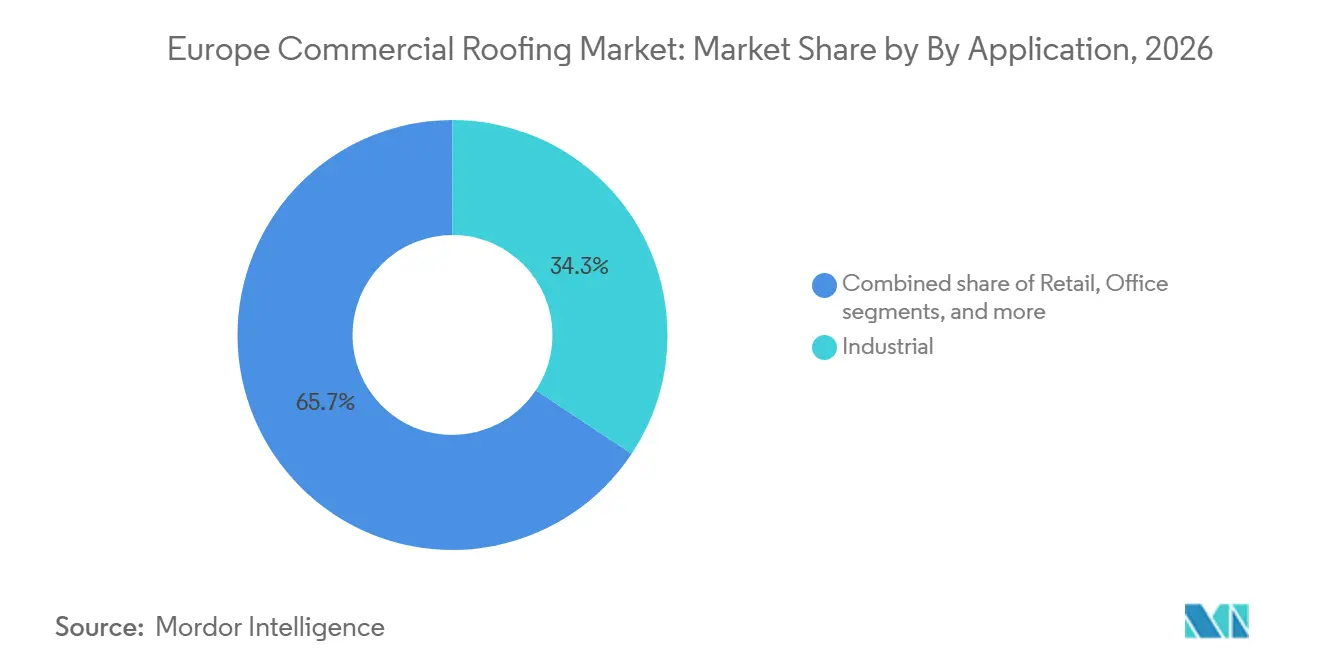
Industrial Demand Drives Volume, Healthcare Supports ValueIndustrial end use is forecast to grow at an 8.10% CAGR through 2032, driven by logistics construction, manufacturing activity, and solar-ready roof requirements. Healthcare facilities can require high thermal performance and detailed quality documentation, which raises the value of their roofing specifications. Retail and office projects also face sustainability requirements that address insulation, roof reflectance, and environmental product information. These uses keep Europe commercial roofing market demand spread across a broad range of commercial property types.
Industrial roofs provide the largest practical surfaces for commercial solar systems, often covering 10,000 to 100,000 square meters per facility. The Energy Performance of Buildings Directive sets phased solar obligations for new and existing nonresidential buildings, increasing the need for roof capacity reviews. Scientific research cited in the draft finds that 30% to 40% of existing commercial and industrial buildings have load limits that require roof upgrades before photovoltaic arrays can be fitted. This creates a Europe commercial roofing market sequence in which roofing work is completed before the energy project can proceed. Suppliers that coordinate membrane selection, insulation design, and solar integration can address this broader project need in the Europe commercial roofing market.
Geography Analysis
Germany held 24.00% of the commercial roofing market size in Europe in 2026, supported by a large nonresidential building base, energy rules, and industrial construction. The German roofing membrane association reported growing adoption of plastic and elastomer membranes in commercial and industrial applications. Hamburg’s support program adds a local financing route for roof insulation and energy upgrades.
The United Kingdom retains a separate compliance setting because it uses the BROOF(t4) roof-fire method. This creates Europe commercial roofing market testing and product-approval work for continental suppliers entering the country. Sika broadened its United Kingdom roofing presence into the builders’ merchant channel through its acquisition of Cromar Building Products. France requires green or solar infrastructure on at least 30% of new commercial roof area, which favors reinforced membranes and integrated drainage systems. Italy and Spain use BROOF(t3) testing, while new fire and photovoltaic rules are adding system-review requirements for commercial properties.
Rest of Europe is the fastest-growing geography, with a 7.20% CAGR forecast through 2032. Its logistics and manufacturing development supports Europe's commercial roofing market demand for large flat-roof installations and higher-specification systems. City Point Okęcie in Warsaw became the first building in Poland to use Ruukki LowCarbon panels, which have verified environmental product declarations and a reported lifecycle carbon footprint up to 50% lower than conventional products. The Netherlands is supporting Europe's commercial roofing market service consolidation among roofing-service businesses, while Nordic countries sustain demand for cold-climate membrane systems. The Czech Republic and Austria are also emerging logistics corridors, and national adoption of European building rules will gradually increase performance requirements across Central and Eastern Europe.
Competitive Landscape
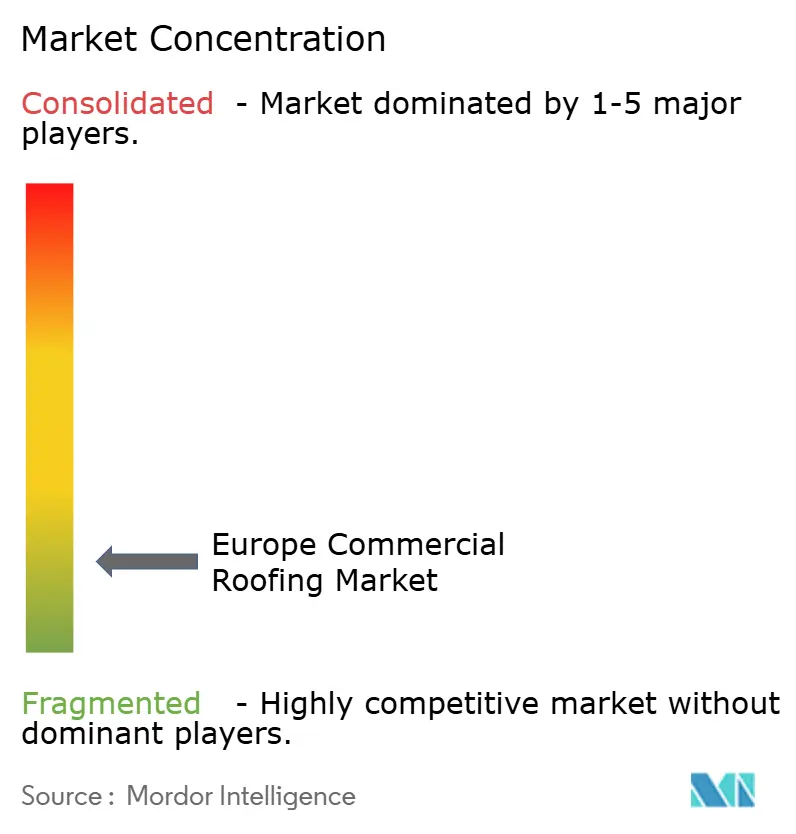
The Europe commercial roofing market is fragmented because material supply, contracting, installation, and maintenance are organized differently across countries. Global suppliers such as Sika, Carlisle Companies, Johns Manville, IKO Industries, and Owens Corning compete in materials, while BMI Group, Soprema, and Protan have strong regional positions. Technical support, installer training, and local approvals remain central in the Europe commercial roofing market and important sources of differentiation. The revised Construction Products Regulation makes lifecycle and environmental documentation more important in project qualification. Suppliers with verified environmental product declarations can be better placed for public and sustainability-led tenders.
Sika’s acquisition of Cromar Building Products illustrates a strategy centered on distribution as well as roofing materials. Tremco Construction Products Group completed its acquisition of Kalzip in April 2026, adding aluminum roof and façade systems to its building-envelope portfolio. Wienerberger acquired the remaining stake in GSE Integration, expanding its ability to provide in-roof photovoltaic solutions alongside roofing systems. These moves show that integrated roofing, energy, and envelope offers are becoming more important than stand-alone product supply.
Environmental documentation has become important in the Europe commercial roofing market as a competitive requirement rather than a supplementary feature. Ruukki offers verified environmental product declarations for its Low Carbon sandwich panels, reporting up to 50% lower lifecycle global-warming potential and recycled content up to 88% in selected configurations. BME Group uses the Tracera platform to manage environmental product declaration data and supplier sustainability information across its supply chain. Solar-ready membranes, photovoltaic partnerships, and prefabricated renovation systems remain areas where companies can develop differentiated offers. Competition in the Europe commercial roofing market will continue to favor firms that can combine documentation, installation knowledge, and local delivery capacity.
Europe Commercial Roofing Industry Leaders
-
GAF Materials Corporation
-
Owens Corning
-
Carlisle Companies Incorporated
-
Johns Manville
-
Duro-Last Inc.
- *Disclaimer: Major Players sorted in no particular order
Europe Commercial Roofing Market Companies Covered in this Report
- GAF Materials Corporation
- Owens Corning
- Carlisle Companies Incorporated
- Johns Manville
- Duro-Last Inc.
- CentiMark Corporation
- Tecta America
- Flynn Group
- Baker Roofing Company
- Beacon Building Products
- Atlas Roofing Corporation
- IKO Industries Ltd.
- TAMKO Building Products Inc.
- Versico Roofing Systems
- Metal-Era Inc.
- Malarkey Roofing Products
- Metal Sales Manufacturing Corporation
- Petersen Aluminum Corporation
- Englert, Inc.
- ATAS International, Inc.
Recent Industry Developments in Europe Commercial Roofing Market
- October 2026: Holcim announced an advanced circular single-ply roofing membrane production line at its Heinsberg, Germany facility, with commissioning targeted for the second half of 2027. The line is designed to produce up to 12 million square meters of thermoplastic polyolefin and polyisobutylene membranes each year. It will reuse all edge-trim offcuts through a near-zero-scrap-to-landfill process. The investment supports Holcim’s commitment to recycle more than 20 million tons of construction materials by 2030.
- June 2026: novotegra and ArcelorMittal announced Ondatherm Solar, a system that integrates photovoltaic modules directly onto ArcelorMittal sandwich roof panels. The system uses chip-free, non-penetrating fixing with short novotegra profiles. It supports above-rail, micro-inverter, and rear-ventilation configurations while reducing installation time and material use. The solution addresses structural-load and installation-window constraints on commercial and industrial metal roofs.
- April 2026: Teqt Group acquired Flachdach BREIVOGEL GmbH in Germany’s Frankfurt/Main region. BREIVOGEL specializes in flat roofing and advanced waterproofing for commercial, industrial, public-sector, and residential clients. The acquisition deepens Teqt Group’s commercial flat-roofing platform in Germany.
Europe Commercial Roofing Market Report Scope
Segmentation Overview
| Asphalt Shingles |
| Clay & Concrete Tiles |
| Metal Roofing |
| Bituminous / Modified Bitumen Membranes |
| Single-Ply Membranes (TPO, EPDM, and PVC) |
| Wood |
| Others |
| New Construction |
| Reroofing and Replacement |
| Retail |
| Office |
| Industrial |
| Others |
| Germany |
| United Kingdom |
| France |
| Italy |
| Spain |
| Rest of Europe |
| By Material Type | Asphalt Shingles |
| Clay & Concrete Tiles | |
| Metal Roofing | |
| Bituminous / Modified Bitumen Membranes | |
| Single-Ply Membranes (TPO, EPDM, and PVC) | |
| Wood | |
| Others | |
| By Construction Type | New Construction |
| Reroofing and Replacement | |
| By Application | Retail |
| Office | |
| Industrial | |
| Others | |
| By Countries | Germany |
| United Kingdom | |
| France | |
| Italy | |
| Spain | |
| Rest of Europe |
Key Questions Answered in the Report
What is the forecast for commercial roofing demand in Europe?
The Europe commercial roofing market is projected to rise from USD 11.43 billion in 2027 to USD 15.30 billion by 2032, at a 6% CAGR.
Which roofing material leads commercial projects in Europe?
Single-ply membranes lead with a 47.12% share in 2026. PVC is the fastest-growing material subtype at a 7.14% CAGR through 2032.
Why is reroofing growing faster than new commercial construction?
Reroofing and replacement is projected to grow at a 7.55% CAGR because aging roofs must meet higher insulation, energy, and solar-readiness requirements.
Which end use is expanding fastest?
Industrial end use is expected to grow at an 8.10% CAGR through 2032, supported by logistics facilities and solar-ready roof upgrades.
Which European country is expected to grow fastest?
Rest of Europe is projected to expand at a 7.20% CAGR through 2032, supported by logistics and manufacturing construction.
How do European building rules affect roof specifications?
Energy, solar, biodiversity, and fire rules increase demand for documented, reinforced, and technically tested roof systems.