
Europe Commercial Dishwasher Market Size and Share
Market Overview
| Study Period | 2021 - 2032 |
|---|---|
| Forecast Data Period | 2027 - 2032 |
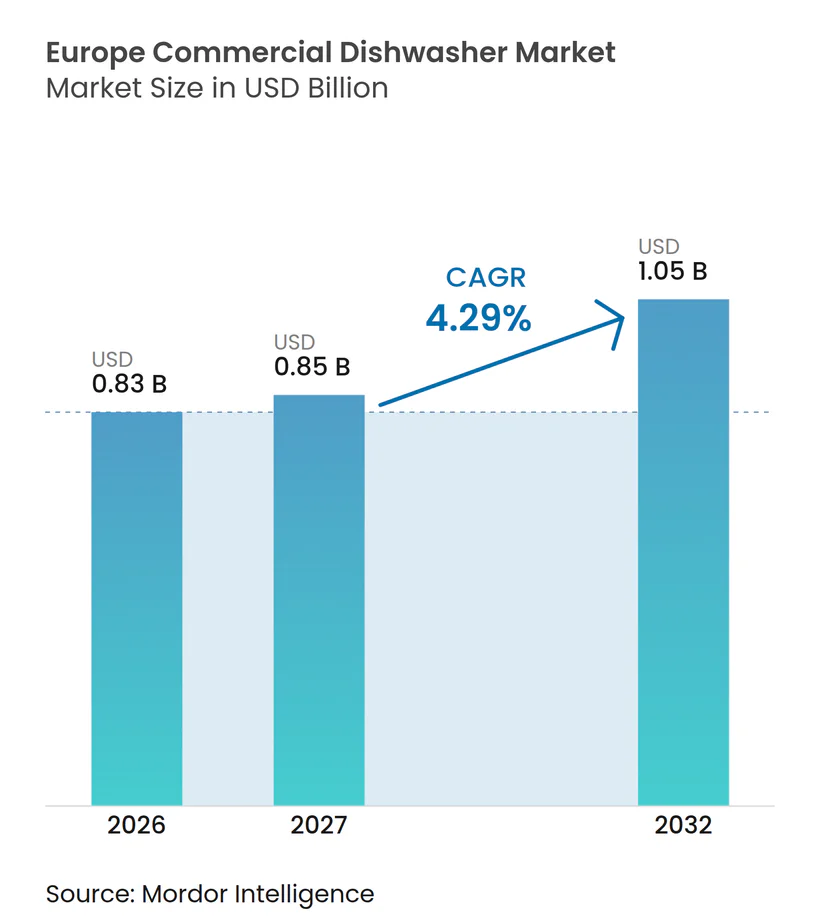
| Base Year Market Size (2026) | USD 0.83 Billion |
| Market Size (2027) | USD 0.85 Billion |
| Market Size (2032) | USD 1.05 Billion |
| Growth Rate (2027 - 2032) | 4.29 % |
| Market Concentration | Medium |
Major Players *Disclaimer: Major Players sorted in no particular order Image © Mordor Intelligence. Reuse requires attribution under CC BY 4.0. | |
Europe Commercial Dishwasher Market Analysis by Mordor Intelligence
The Europe commercial dishwasher market size is expected to grow from USD 0.83 billion in 2026 to USD 0.85 billion in 2027 and is forecast to reach USD 1.05 billion by 2032 at a 4.29% CAGR over 2027-2032. The Europe commercial dishwasher market is supported by hotel construction, restaurant renovation, and replacement demand from kitchens that need dependable sanitation equipment. The European Commission’s 2025 to 2030 working plan identifies professional dishwashers for potential ecodesign measures in 2026, which increases the importance of water and energy performance in purchasing decisions[1]. Labor constraints also favor equipment that reduces daily intervention through automatic cycles, self-cleaning functions, and remote fault identification. Suppliers are responding with connected platforms, heat recovery, and service models that make utility costs and machine availability central to customer discussions. The European commercial dishwasher market therefore has opportunities in replacement programs, premium equipment, and long-term service arrangements, although capital costs and installation constraints remain relevant for smaller operators.
Key Report Takeaways
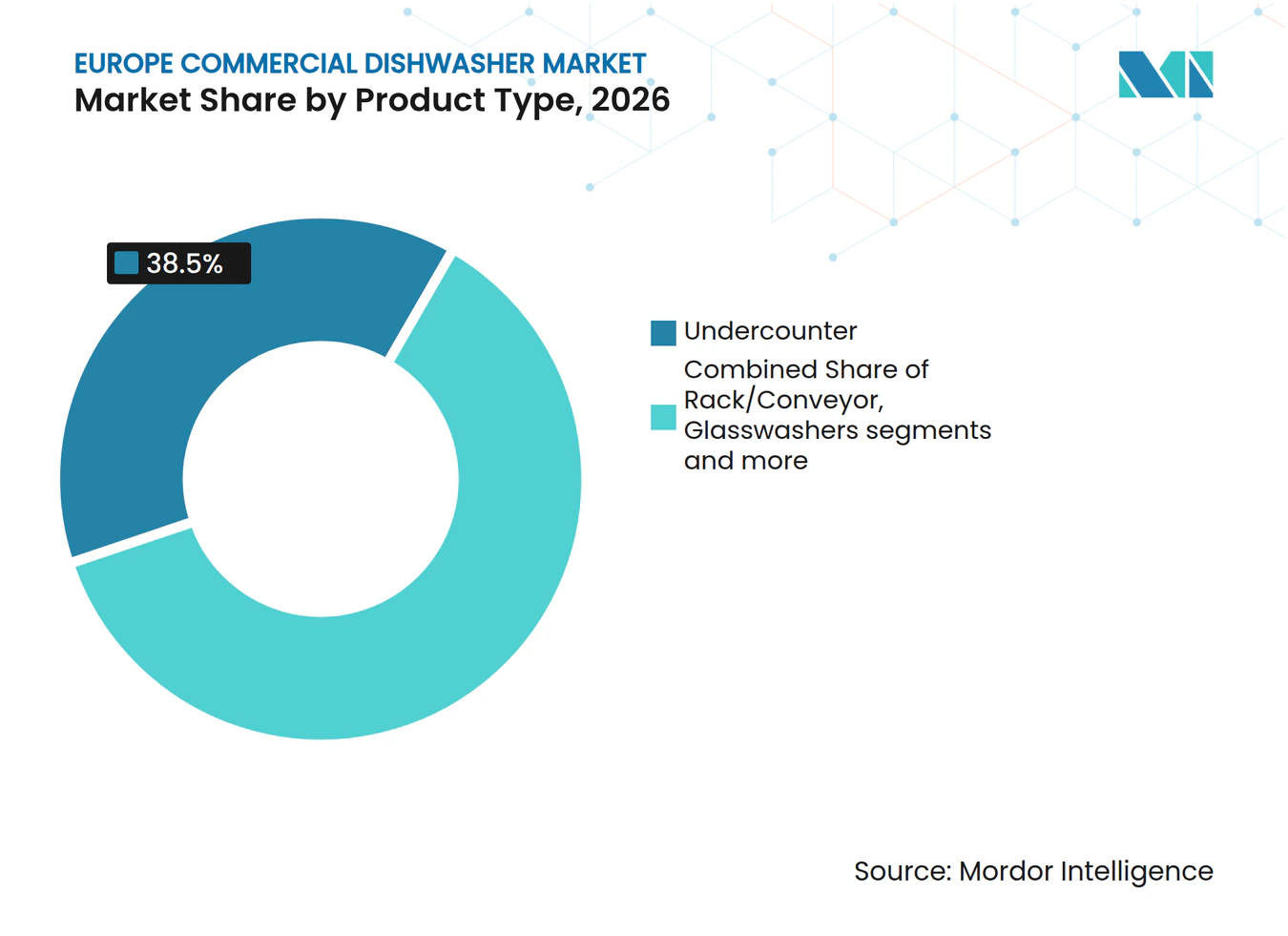
- By product type, undercounter dishwashers accounted for 38.5% of the European commercial dishwasher market in 2026, while glasswashers are projected to record a CAGR of 5.5% through 2032.
- By capacity, the 50–150 racks-per-hour segment accounted for 53.6% of the market in 2026, while dishwashers processing more than 150 racks per hour are projected to register a CAGR of 5.1% through 2032.
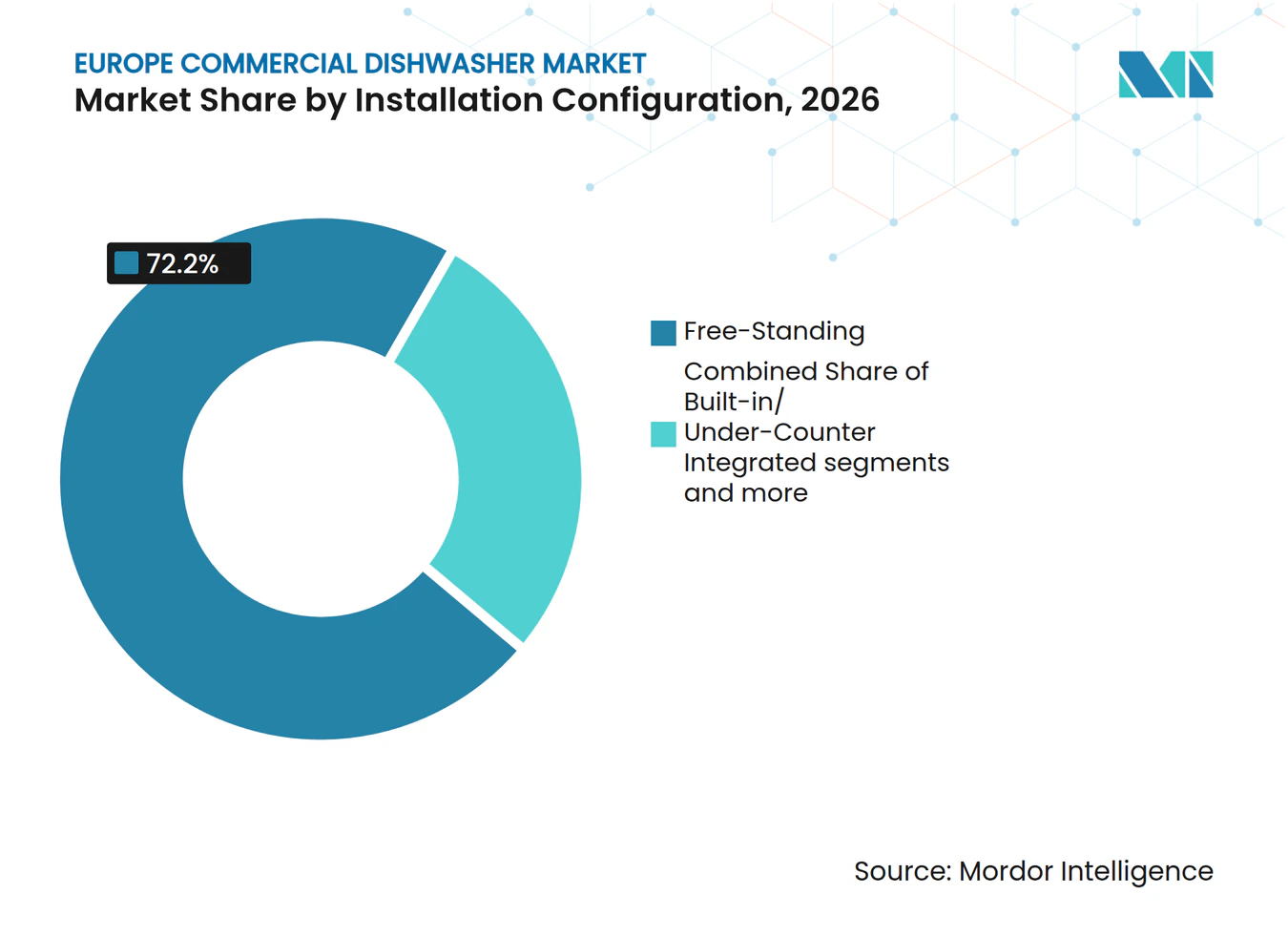
- By installation configuration, free-standing units accounted for 72.2% of the market in 2026, while built-in configurations are projected to achieve a CAGR of 5.2% through 2032.
- By price range, mid-range equipment accounted for 48.6% of the market in 2026, while premium equipment is projected to register a CAGR of 4.8% through 2032.
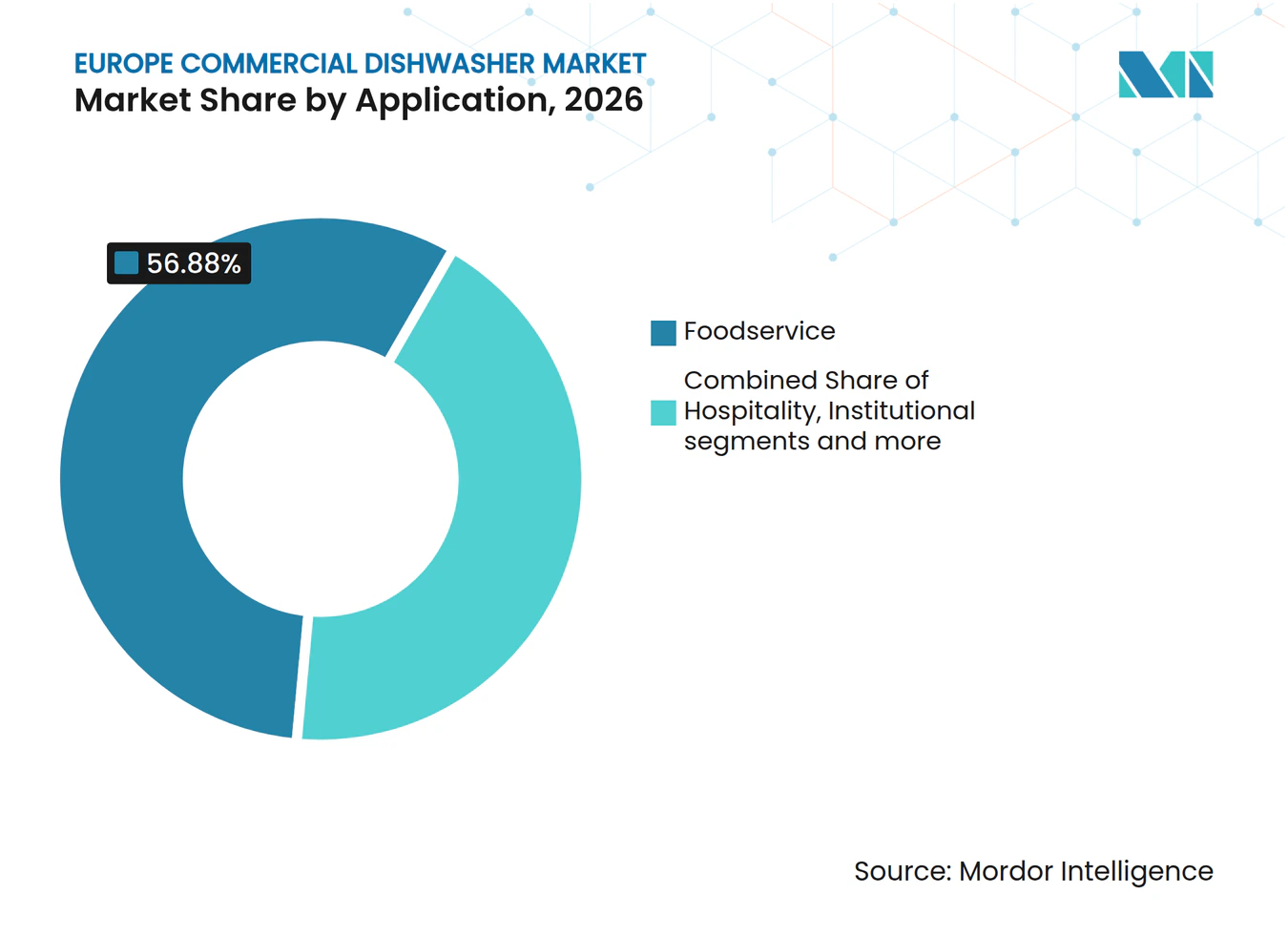
- By application, foodservice accounted for 56.9% of the market in 2026, while hospitality applications are projected to record a CAGR of 4.8% through 2032.
- By distribution channel, dealers and distributors accounted for 79.3% of the market in 2026, while direct sales are projected to achieve a CAGR of 5.4% through 2032.
- By geography, Germany accounted for 23.2% of the European commercial dishwasher market in 2026, while Spain is projected to register a CAGR of 5.1% through 2032.
Note: Market numbers in this report are based on Mordor Intelligence's proprietary estimation framework, which combines nine months of actuals with Q4 projections for base year 2026.
Market Trends and Insights
Drivers Impact Analysis of Europe Commercial Dishwasher Market*
| Driver | (~) % Impact on CAGR Forecast | Geographic Relevance | Impact Timeline |
|---|---|---|---|
| Expansion of Foodservice and Hospitality Infrastructure | +1.1% | Pan-European, concentrated in Germany, Spain, France, and Italy | Medium term (2-4 years) |
| EU Hygiene and Food-Safety Compliance Requirements | +0.8% | EU27 and UK, strongest in Germany, France, and Italy | Short term (≤ 2 years) |
| Commercial Kitchen Labor Shortages and Automation Demand | +0.7% | Pan-European, most acute in Spain, Italy, Croatia, UK, and Germany | Medium term (2-4 years) |
| Replacement of Water- and Energy-Intensive Legacy Equipment | +0.6% | Pan-European, with early gains in Germany and the Nordics | Medium term (2-4 years) |
| Demand for Connected Monitoring and Predictive Maintenance | +0.4% | Western Europe and the Nordics, with early activity in Central and Eastern Europe | Long term (≥ 4 years) |
| Retrofit Demand from Space-Constrained Urban Kitchens | +0.3% | Dense urban markets including London, Paris, Amsterdam, Barcelona, and Milan | Long term (≥ 4 years) |
| Source: Mordor Intelligence | |||
Expansion of Foodservice and Hospitality Infrastructure
Hotel openings, refurbishments, and foodservice investment continue to create commercial kitchen procurement activity across Europe. New properties require complete kitchen fit-outs, while renovations often replace older warewashing equipment alongside ventilation, storage, and food preparation systems. This pattern can support sales even when restaurant visits do not rise at the same rate as hospitality investment. Spain and Italy remain relevant locations because tourism and accommodation projects increase the number of kitchens that need compact or high-throughput equipment. The European commercial dishwasher market benefits when operators select machines early in a project, since equipment choices are then incorporated into kitchen layouts and utility planning. Manufacturers with design support, installation capability, and local service coverage are better placed to participate in these projects.
EU Hygiene and Food-Safety Compliance Requirements
Food business operators in the European Union must apply hygiene procedures based on HACCP principles under Regulation EC 852/2004. Mechanical dishwashing supports sanitation control when operators can consistently document wash conditions and maintain equipment properly. The European Commission’s current working plan places professional dishwashers among the product groups considered for ecodesign adoption in 2026. This direction raises the value of machines that record temperature, cycles, water use, and service needs. Procurement teams are likely to favor equipment that can demonstrate compliance and efficiency rather than relying on manual checks. The European commercial dishwasher market also benefits when upcoming requirements lead operators to plan replacements before formal measures take effect.
Commercial Kitchen Labor Shortages and Automation Demand
Commercial kitchens need equipment that is easier to operate when staff availability is limited. Operators increasingly value guided programs, automatic cleaning, clear controls, and fault alerts because these functions reduce reliance on specialized daily handling. Transgourmet Deutschland’s 2025 cooperation with GoodBytz illustrates the wider interest in kitchen automation and standardized foodservice operations[2]. Connected warewashing aligns with this approach because it can select programs and notify service teams when attention is needed. These features do not eliminate the need for staff, but they can reduce interruptions and improve consistency during busy service periods. The European commercial dishwasher market is therefore moving toward equipment that supports simpler work routines as well as wash performance.
Replacement of Water- and Energy-Intensive Legacy Equipment
Older commercial dishwashers can use more water and energy than newer models, making replacement economics important for high-use kitchens. Electrolux Professional states that its NeoBlue Touch undercounter dishwasher uses 2.1 liters of water per cycle and can reduce energy use by up to 40% against comparable conventional machines[3]. These operating costs matter most where machines run throughout the day and where utility charges are closely managed. Buyers are increasingly assessing water use, heat recovery, repairability, and expected service life alongside the initial equipment price. The European commercial dishwasher market can gain from this shift when manufacturers provide credible annual operating-cost information rather than broad efficiency claims. Connected monitoring and compact retrofit models also support replacement demand in established kitchens where space or infrastructure limits the options available.
Restraints Impact Analysis of Europe Commercial Dishwasher Market*
| Restraint | (~) % Impact on CAGR Forecast | Geographic Relevance | Impact Timeline |
|---|---|---|---|
| High Upfront Equipment and Installation Costs | -0.3% | Pan-European, most acute in SME-heavy markets including Spain, Italy, and Eastern Europe | Short term (≤ 2 years) |
| Volatility in Stainless Steel, Electronics, and Freight Costs | -0.2% | Global supply chain with pass-through to European OEM pricing | Medium term (2-4 years) |
| Limited Availability of Skilled Service Technicians | -0.2% | Pan-European, with greater pressure in peripheral and rural markets | Long term (≥ 4 years) |
| Incompatibility with Legacy Drainage, Ventilation, and Electrical Infrastructure | -0.1% | Dense urban markets with older building stock in the UK, France, and Italy | Long term (≥ 4 years) |
| Source: Mordor Intelligence | |||
High Upfront Equipment and Installation Costs
Mid-range and premium machines can require a significant initial commitment when connectivity, heat recovery, water treatment, delivery, and installation are included. This creates a practical barrier for independent restaurants, cafés, and other smaller operators with limited capital flexibility. Leasing and service-based offers can reduce the immediate payment, but some customers remain cautious about multi-year agreements. The result is that larger institutions and multi-site operators can replace equipment sooner than smaller businesses. Older machines may remain in service longer when replacement is deferred, even if they have higher operating costs. The European commercial dishwasher market consequently depends on finance options, clear payback evidence, and equipment configurations that match smaller kitchen budgets.
Volatility in Stainless Steel, Electronics, and Freight Costs
Commercial dishwashers use stainless steel, electronics, pumps, controls, and other components that can be affected by supply-chain movements. The Bureau of International Recycling reported in 2025 that tariffs contributed to uncertainty in stainless steel and special alloys markets[4]. Cost changes can compress manufacturer margins or lead to shorter quotation periods for customers. This is particularly relevant for connected equipment because new platforms also require investment in sensors, software, and controls. Limited service-engineer availability adds another constraint because digital alerts create value only when qualified technicians can respond. Legacy drainage, ventilation, and electrical systems can further increase the installation cost for urban kitchens, slowing decisions even where demand for replacement equipment is clear.
*Our forecasts treat driver/restraint impacts as directional, not additive. The impact forecasts reflect baseline growth, mix effects, and variable interactions.
Europe Commercial Dishwasher Market Segment Analysis
By Product Type:
Undercounter Equipment Leads While Glasswashers Gain MomentumUndercounter dishwashers held 38.5% of the European commercial dishwasher market share in 2026, making them the largest product group. Their compact dimensions and relatively straightforward installation suit independent restaurants, bars, cafés, and smaller foodservice kitchens. These operators often need reliable performance without dedicating substantial floor area to warewashing. Door and hood machines offer a step up in throughput for businesses that exceed the practical capacity of undercounter units. Rack and conveyor equipment serves larger kitchens that process a continuous flow of plates, trays, and utensils. Flight-type systems remain appropriate for institutional feeding, major hotels, event facilities, and central kitchens with very high volumes. Product selection is therefore closely tied to available space, service intensity, and the amount of warewashing handled during peak periods. The European commercial dishwasher market remains broad because each product group solves a different operational requirement.
Glasswashers are projected to grow at a CAGR of 5.5% through 2032, faster than the overall market. Bars, cafés, hotel beverage outlets, and event venues need frequent, rapid glasswashing during concentrated periods of demand. In these settings, cycle speed, glass care, drying quality, and a small footprint can be more important than the ability to process large dinnerware loads. Beverage-led formats also benefit from equipment that fits under counters or behind bars without disrupting the customer-facing layout. Suppliers can differentiate through programs designed for delicate glassware and through controls that make use simple for changing staff teams. The fastest-growing product category reflects the importance of beverage service across urban hospitality and food-to-go locations. It also provides a route for manufacturers to introduce connected functions into smaller equipment footprints. This product mix keeps the European commercial dishwasher market relevant to both compact outlets and high-volume institutional sites.



By Capacity:
Mid-Tier Machines Anchor Volume While High-Throughput Units AdvanceThe 50 to 150 racks per hour tier accounted for 53.6% of the European commercial dishwasher market share in 2026. This range suits mid-size hotel restaurants, contract caterers, and established independent operators that need predictable throughput without the cost or space demand of industrial-scale equipment. It often balances output, installation requirements, labor needs, and utility use in a way that fits mainstream commercial kitchens. Below 50 racks per hour equipment serves cafés, boutique bars, small restaurants, and first-time commercial buyers. These buyers commonly prioritize compact design, ease of operation, and a manageable initial price. The 50 to 150 racks per hour segment supports broad replacement demand because it covers many of the kitchen formats found across the region. Manufacturers also use this tier to offer optional water treatment, heat recovery, and connected monitoring. This makes it an important platform for moving customers toward higher-value specifications over time.
Equipment above 150 racks per hour is forecast to grow at a CAGR of 5.1% through 2032. Large hotels, institutional kitchens, central production facilities, and event caterers require high volumes to be processed with limited disruption during operating peaks. Conveyor and flight-type systems are designed for these situations because they handle a continuous workflow and can be integrated into organized dish return areas. These installations also have a stronger case for planned maintenance, remote diagnostics, and service-level agreements, since downtime can affect many meals. High-throughput buyers may also be more able to justify investment in connected systems when savings are spread across multiple machines or locations. The segment is supported by hospitality projects that require full kitchen installations rather than simple equipment replacements. It gives the European commercial dishwasher market exposure to capital projects with larger order values. Suppliers that can coordinate design, installation, training, and service will have an advantage in this capacity class.
By Installation Configuration:
Free-Standing Units Remain Standard While Built-In Demand BuildsFree-standing configurations accounted for 72.2% of the European commercial dishwasher market share in 2026. They have long been the standard choice because installers can access the equipment more easily and operators can adjust kitchen layouts during renovation. This design is practical for restaurants, institutional kitchens, and hospitality operations that value service access and flexibility. Free-standing units can also simplify replacement when an older machine reaches the end of its useful life. Pass-through and line-integrated systems serve specialized settings where dish flow is organized around a specific kitchen process. Their role is important in central kitchens, institutional canteens, and large-scale operations that must coordinate washing, sorting, and storage. Configuration choices depend on the kitchen’s physical layout as much as on its wash volume. This maintains a large installed base for free-standing equipment across the European commercial dishwasher market.
Built-in configurations are expected to grow at a CAGR of 5.2% through 2032. They are well suited to premium hospitality sites and compact food service locations where equipment needs to integrate neatly within a constrained layout. Railway concourses, converted retail units, small urban formats, and food-to-go operations may have limited scope for stand-alone machines. Built-in equipment can provide a more consistent kitchen design, but it requires careful planning for drainage, ventilation, electrical connections, and future service access. The 2025 amendment to EN IEC 60335-2-58 updated safety requirements for commercial electric dishwashing machines, including provisions relating to construction and heating. These requirements reinforce the need for compliant design across configuration types. The segment’s growth indicates that compact integration is becoming a more important purchase factor in urban kitchens. Suppliers that offer simple installation guidance and flexible formats can address this demand without compromising serviceability.

By Price Range:
Mid-Range Equipment Holds the Core While Premium Models Grow FasterMid-range equipment held 48.6% of the European commercial dishwasher market size in 2026. This tier is the default choice for many casual dining chains, contract caterers, and mid-scale hotels that need dependable wash results and manageable ownership costs. It offers a balance between basic equipment and advanced machines with full connectivity or heat recovery systems. Economy models continue to serve price-sensitive operators and smaller businesses that prioritize immediate affordability. The mid-range category also gives manufacturers a broad platform for upgrades, such as water softeners, improved filtration, and optional digital tools. This approach allows buyers to match features to their budget and local operating needs. Replacement decisions in this range often focus on reliability, service support, and expected utility costs. As a result, the mid-range tier remains central to demand across the European commercial dishwasher market.
Premium dishwashers are forecast to grow at a CAGR of 4.8% through 2032. This category is supported by operators that place higher value on reduced utility use, documented service performance, remote monitoring, and automated cycle selection. Winterhalter states that its EcoPilot software learns usage patterns and can reduce energy consumption by up to 17% on compatible Connected Wash machines. Premium customers increasingly seek practical payback cases rather than design features alone. Heat recovery, connected diagnostics, and advanced filtration can improve the operating proposition for high-use sites. The segment is therefore tied to total ownership costs and service continuity, not only to the purchase price. Buyers with larger estates can also use common equipment platforms to standardize training and maintenance. This makes premium equipment an important route for recurring digital and service revenue within the European commercial dishwasher market.
By Application:
Foodservice Provides the Core While Hospitality ExpandsFoodservice held 56.9% of the European commercial dishwasher market share in 2026. Restaurants, cafés, bars, contract caterers, and quick-service locations require daily warewashing and have limited tolerance for equipment downtime. This gives the application a stable replacement requirement even when individual operators face changing customer demand. Foodservice kitchens vary widely in size, which supports sales across undercounter, hood-type, rack, and conveyor formats. Operators typically value wash consistency, short cycle times, practical service access, and equipment that works reliably with existing kitchen infrastructure. Smaller locations may focus on compact equipment, while larger chains may centralize procurement and maintenance. The category also has a direct link to beverage service, where glasswashers are essential to daily operations. Foodservice remains the operating base of the Europe commercial dishwasher market because it combines a large installed base with ongoing replacement needs.
Hospitality is forecast to grow at a CAGR of 4.8% through 2032. Hotels need dishwasher capacity in restaurants, breakfast operations, banqueting areas, staff facilities, and sometimes separate beverage outlets. New hotels and refurbished properties can select equipment as part of a broader kitchen specification, creating opportunities for suppliers to provide coordinated system proposals. Hospitality buyers may favor low noise, energy efficiency, reliable service coverage, and models that fit a particular guest-service concept. Institutional users also provide important demand through hospitals, education facilities, corporate campuses, and public-sector kitchens that buy equipment through structured procurement processes. Catering and central kitchen operators can require high-capacity systems where connected monitoring and planned maintenance have clear operational value. The application mix gives manufacturers several routes to growth across kitchen sizes and buyer types. It also allows the European commercial dishwasher market to benefit from both daily replacement demand and larger project-based sales.
By Distribution Channel:
Dealers Retain Scale While Direct Sales IncreaseDealers and distributors held 79.3% of the European commercial dishwasher market share in 2026. Their role is important because customers often need local support for specification, installation, commissioning, spare parts, and routine maintenance. European foodservice markets are geographically diverse, and many operators continue to value relationships with regional equipment partners. Dealers can combine dishwasher sales with other kitchen equipment, which makes them useful during complete refurbishments and new-site openings. They also provide a route to smaller operators that may not be practical for a manufacturer to serve directly in every location. Service capability can be as important as product availability because a machine failure can disrupt a kitchen immediately. This channel structure explains why local distribution remains the main sales path for the Europe commercial dishwasher market. Manufacturers must therefore balance direct account growth with strong dealer relationships.
Direct sales are projected to grow at a CAGR of 5.4% through 2032. Multi-site hospitality and foodservice operators increasingly seek central contracts that provide consistent pricing, agreed service levels, common equipment specifications, and access to operating data. Direct relationships can make sense where an operator has many locations or requires support across more than one country. They are particularly relevant for connected platforms, where manufacturers may manage software registration, remote diagnostics, and service coordination more directly. Remote diagnostics can help service teams prepare for maintenance visits and can strengthen the case for direct account management. Direct sales are not expected to displace dealers in every segment, but they can grow where customers require integrated service commitments. The channel’s growth reflects a shift toward longer customer relationships rather than one-time equipment transactions.
Geography Analysis
Germany
Germany held 23.2% of the European commercial dishwasher market in 2026. The country has a substantial base of institutional catering, corporate dining, and commercial foodservice activity that supports equipment replacement and servicing demand. Winterhalter and MEIKO are headquartered in Germany, which gives domestic customers close access to product development and established manufacturer service networks. This supplier presence can help operators learn about new equipment features earlier in the buying process. Regulatory influence also remains relevant because EU hygiene and ecodesign policy affects product requirements across the country. Germany is well placed for early adoption of equipment that combines resource efficiency, repairability, and connected service support.
Spain
Spain is forecast to grow at a 5.1% CAGR through 2032. The country’s hospitality and tourism base supports demand from hotels, restaurants, cafés, and seasonal venues that need dependable daily warewashing. Winterhalter opened a EUR 15 million (USD 17.6 million) headquarters in Málaga in January 2026, with R&D, logistics, and Iberian sales operations in a 15,000 sq.m. facility. This investment strengthens local access to equipment and support for hospitality customers. Labor constraints also make simple machine operation and automated routines valuable in seasonal kitchens. Spain’s growth opportunity is closely linked to suppliers that can serve both large hospitality projects and smaller operators with compact, serviceable equipment.
United Kingdom, France, Italy, the Nordics, Benelux, and Rest of Europe
The United Kingdom, France, Italy, the Nordics, Benelux, and Central and Eastern Europe represent diverse demand patterns within the European commercial dishwasher market. USDA Foreign Agricultural Service data placed the United Kingdom foodservice sector at USD 133 billion in 2025, with food-to-go formats such as coffee shops, cafés, and bakeries supporting demand for compact warewashing equipment. France and Italy have broad independent restaurant bases, where replacement decisions can be constrained by building infrastructure and smaller capital budgets. Nordic buyers place greater weight on lifecycle criteria and circular materials in some procurement processes. In January 2025, Wexiödisk announced a partnership with Aperam to use Infinite certified stainless steel with 98% recycled content across its dishwasher range. Benelux markets have shown strong interest in higher-specification equipment, while Central and Eastern European markets provide room for first-time commercial installations as chains and franchises expand. Across these areas, compliance requirements, building conditions, service reach, and operating-cost priorities shape the mix of products sold.
Competitive Landscape
Market Concentration
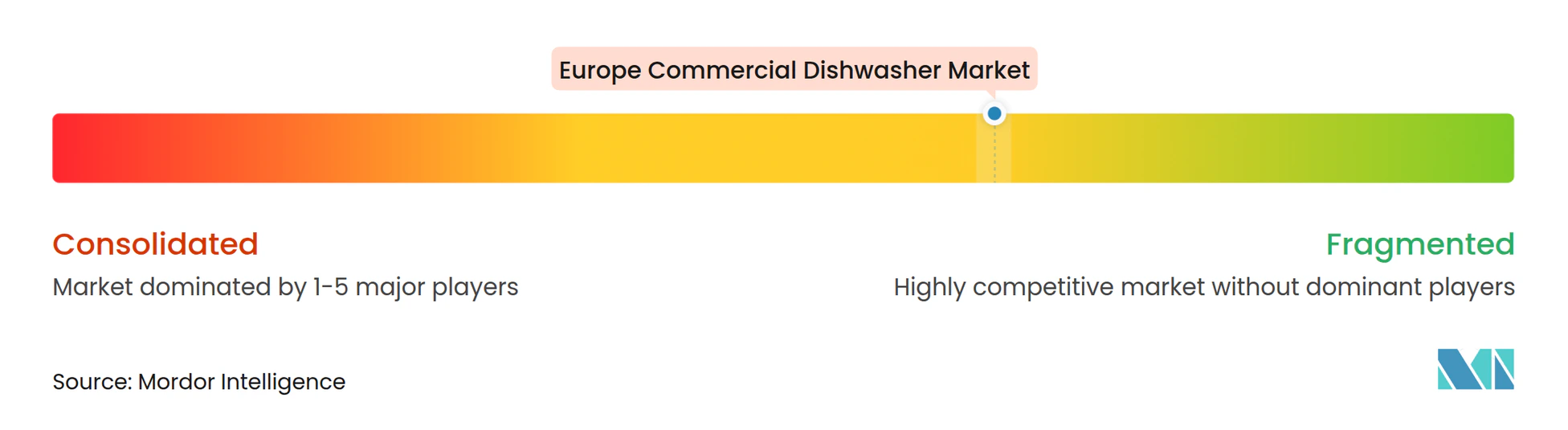
The European commercial dishwasher market is moderately concentrated, with Winterhalter, MEIKO, Electrolux Professional, the Ali Group portfolio, and Hobart positioned among the leading suppliers. These companies compete across product breadth, technical reliability, service coverage, and energy and water performance. Fagor Industrial, Silanos, Classeq, and Wexiödisk add pressure through focused portfolios, manufacturing efficiency, and regional distribution. Competition also involves installation support, spare-parts access, training, and the ability to keep equipment operating during peak service periods. This breadth allows suppliers to address settings from compact hospitality sites to central kitchens and institutional facilities.
Digital service models are becoming a significant point of differentiation in the European commercial dishwasher market. Connected platforms can support remote diagnostics, operating data, maintenance planning, and more consistent wash-program selection. In May 2026, Winterhalter launched EcoPilot for its Connected Wash platform, using historical usage patterns to activate efficient programs for UC-series and PT-series machines. Diversey, a Solenis company, launched IntelliDish CONTROL in October 2025 to monitor wash temperature, detergent use, and cycle data with cloud connectivity. These offerings connect equipment sales to ongoing operating support and can make system changes more difficult once service processes are integrated.
In March 2026, Fagor Professional partnered with the Gastronomy Open Ecosystem, providing clients access to culinary innovation, sustainability research, and digital-kitchen development programs. Classeq launched its CP500 pass-through range in 2025 with dishwasher or glasswasher configurations and integrated steam recovery for sites with limited ventilation. In February 2026, Electrolux Professional launched a compact pot and pan washer for constrained commercial kitchens, using 4.7 liters per cycle and reducing the need for manual pre-washing. These moves show that competition extends from sophisticated connected systems to simpler, space-efficient equipment.
Europe Commercial Dishwasher Industry Leaders
-
Winterhalter Gastronom GmbH
-
Illinois Tool Works Inc.
-
MEIKO Maschinenbau GmbH & Co. KG
-
Electrolux Professional AB
-
Miele & Cie. KG
- *Disclaimer: Major Players sorted in no particular order
Europe Commercial Dishwasher Market Companies Covered in this Report
- Winterhalter Gastronom GmbH
- MEIKO Maschinenbau GmbH & Co. KG
- Illinois Tool Works Inc. (Hobart)
- Electrolux Professional AB
- Miele & Cie. KG
- Comenda Ali S.p.A.
- DIHR - Ali Group S.r.l.
- KROMO - Ali Group S.r.l.
- Fagor Industrial S. Coop.
- Wexiödisk AB
- Classeq Ltd.
- Silanos S.r.l.
- Eurotec S.r.l. - Colged
- Elframo S.p.A.
- Smeg S.p.A. - Smeg Professional
- Krupps S.r.l.
- JEMI S.A.
- Metos Oy Ab
- Maidaid-Halcyon
- Hoshizaki Corporation
- Granuldisk AB
- Norris Industries Ltd
Recent Industry Developments in Europe Commercial Dishwasher Market
- May 2026: Winterhalter launched EcoPilot, an AI-based software layer for its Connected Wash platform covering UC-series undercounter and PT-series hood-type machines. The system learns from historical usage patterns, activating energy-efficient programs during off-peak periods to cut energy consumption by up to 17% without compromising hygiene outcomes. It is available at no additional cost to all Connected Wash-registered machines manufactured from 2019 onwards.
- March 2026: Fagor Professional Food Service signed a strategic partnership with the Gastronomy Open Ecosystem, an initiative of the Basque Culinary Center. The arrangement provides Fagor clients access to culinary innovation resources, sustainability research, and digital-kitchen development programs. It reflects a repositioning from pure equipment supply toward a broader culinary-technology partner role.
- February 2026: Electrolux Professional launched the Pot & Pan Compact Washer for high-demand commercial kitchens with constrained floor space. The product uses 4.7 liters per cycle, which is stated to be up to 30% lower than conventional machines, and eliminates manual pre-washing for heavily soiled kitchenware.
- October 2025: Diversey, a Solenis company, launched IntelliDish CONTROL, an IoT solution that monitors wash temperatures, detergent use, and cycle data through cloud connectivity for foodservice and hospitality operators. Diversey states that mechanical dishwashing can account for up to 60% of back-of-house activity in restaurants and hotels, underscoring the operational role of real-time monitoring.
Europe Commercial Dishwasher Market Report Scope
Segmentation Overview
| Rack/Conveyor |
| Undercounter |
| Door or Hood Type |
| Glasswashers |
| Flight-type / continuous conveyor dishwashers |
| Below 50 racks/hour |
| 50–150 racks/hour |
| Above 150 racks/hour |
| Free-Standing |
| Built-in / under-counter integrated |
| Pass-through / line-integrated |
| Economy |
| Mid-Range |
| Premium |
| Foodservice |
| Hospitality |
| Institutional |
| Catering and Central Kitchens |
| Others |
| Direct Sales |
| Dealers and Distributors |
| United Kingdom |
| Germany |
| France |
| Spain |
| Italy |
| Benelux |
| Nordics |
| Rest of Europe |
| By Product Type | Rack/Conveyor |
| Undercounter | |
| Door or Hood Type | |
| Glasswashers | |
| Flight-type / continuous conveyor dishwashers | |
| By Capacity | Below 50 racks/hour |
| 50–150 racks/hour | |
| Above 150 racks/hour | |
| By Installation Configuration | Free-Standing |
| Built-in / under-counter integrated | |
| Pass-through / line-integrated | |
| By Price Range | Economy |
| Mid-Range | |
| Premium | |
| By Application | Foodservice |
| Hospitality | |
| Institutional | |
| Catering and Central Kitchens | |
| Others | |
| By Distribution Channel | Direct Sales |
| Dealers and Distributors | |
| By Country | United Kingdom |
| Germany | |
| France | |
| Spain | |
| Italy | |
| Benelux | |
| Nordics | |
| Rest of Europe |
Key Questions Answered in the Report
What is the forecast growth rate for commercial dishwashers in Europe?
The Europe commercial dishwasher market is forecast to grow at a CAGR of 4.29% from 2027 to 2032, reaching USD 1.05 billion by 2032. Replacement demand, efficiency requirements, and automation needs across Europe support this outlook.
Which product type leads commercial dishwasher sales in Europe?
Undercounter dishwashers lead with a 38.5% share in 2026 because they suit the compact kitchens used by restaurants, cafés, and bars. Their manageable installation requirements also support broad replacement demand.
Which commercial dishwasher category is growing fastest in Europe?
Glasswashers are projected to grow at a CAGR of 5.5% through 2032, supported by demand from beverage-service settings. Speed, glass care, and a small footprint are key requirements in these operations.
Why are premium commercial dishwashers growing in demand?
Premium machines provide connected monitoring, heat recovery, automatic cycle management, and clearer operating-cost benefits. They are forecast to grow at a CAGR of 4.8% through 2032.
Which European country has the highest growth outlook for commercial dishwashers?
Spain has the fastest growth outlook, with a projected CAGR of 5.1% through 2032, supported by tourism and hospitality development. Local service access and financing options remain important for its fragmented foodservice customer base.