
Europe Cargo Insurance Market Size and Share
Market Overview
| Study Period | 2021 - 2032 |
|---|---|
| Forecast Data Period | 2027 - 2032 |
| Base Year Market Size (2026) | USD 9.30 Billion |
| Market Size (2027) | USD 9.60 Billion |
| Market Size (2032) | USD 11.40 Billion |
| Growth Rate (2027 - 2032) | 3.50 % |
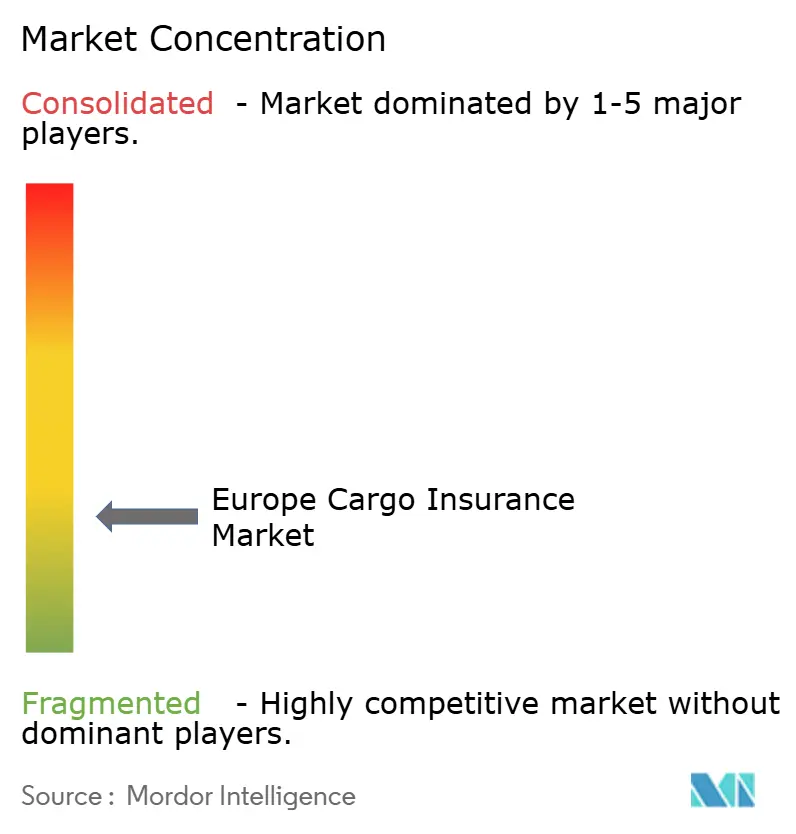
| Market Concentration | Low |
Major Players *Disclaimer: Major Players sorted in no particular order Image © Mordor Intelligence. Reuse requires attribution under CC BY 4.0. | |
Europe Cargo Insurance Market Analysis by Mordor Intelligence
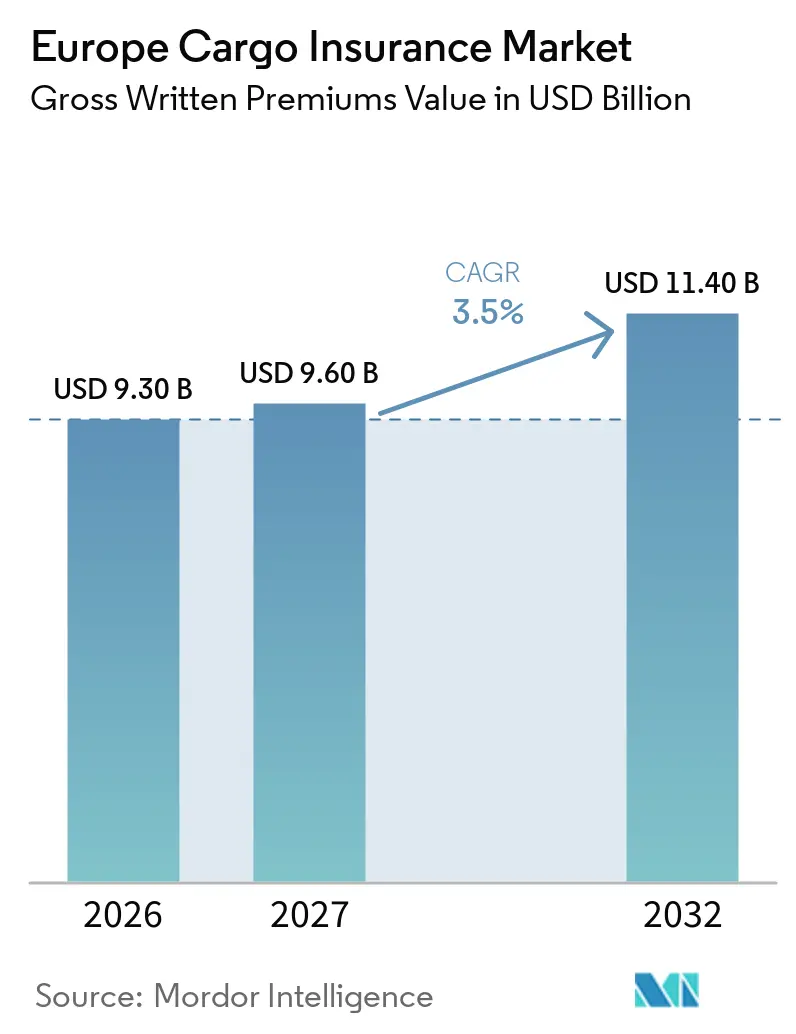
The Europe Cargo Insurance Market size in terms of gross written premiums value is expected to grow from USD 9.30 billion in 2026 to USD 9.60 billion in 2027 and is forecast to reach USD 11.40 billion by 2032 at 3.5% CAGR over 2027-2032.
European trade corridors continue to support demand because sea-borne imports from outside the European Union were valued at EUR 1,270 billion (USD 1,371.6 billion) in 2025, while trade increasingly includes goods with high declared values. Higher-value finished goods, precision equipment, electronics, and battery shipments can increase the insured value of each consignment even when freight activity does not rise at the same pace. The Europe cargo insurance market is also being shaped by cargo theft, rerouted shipping lanes, and the need for wider protection across production, transit, and storage. Digital distribution is widening access for smaller buyers, while specialist insurers are developing coverage for technology-intensive and complex cargo risks. The United Kingdom, Germany, and the Benelux region remain central to underwriting capacity and cargo concentration, although Central and Eastern European logistics corridors are creating additional growth opportunities.
Key Report Takeaways
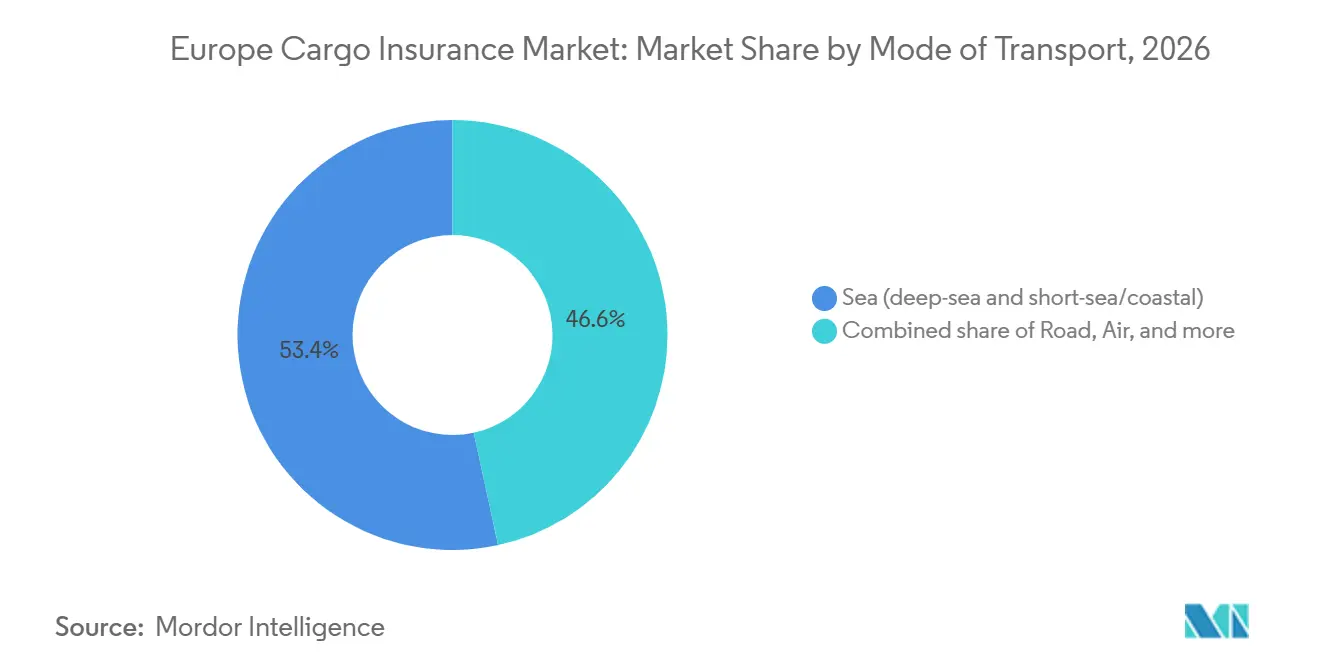
- By mode of transport, sea captured 53.4% of the Europe cargo insurance market share in 2026, while air is projected to grow at a 5.8% CAGR through 2032.
- By cargo profile, containerized cargo held 33.8% of the Europe cargo insurance market share in 2026, while project, heavy-lift, and out-of-gauge cargo is forecast to expand at a 5.4% CAGR through 2032.
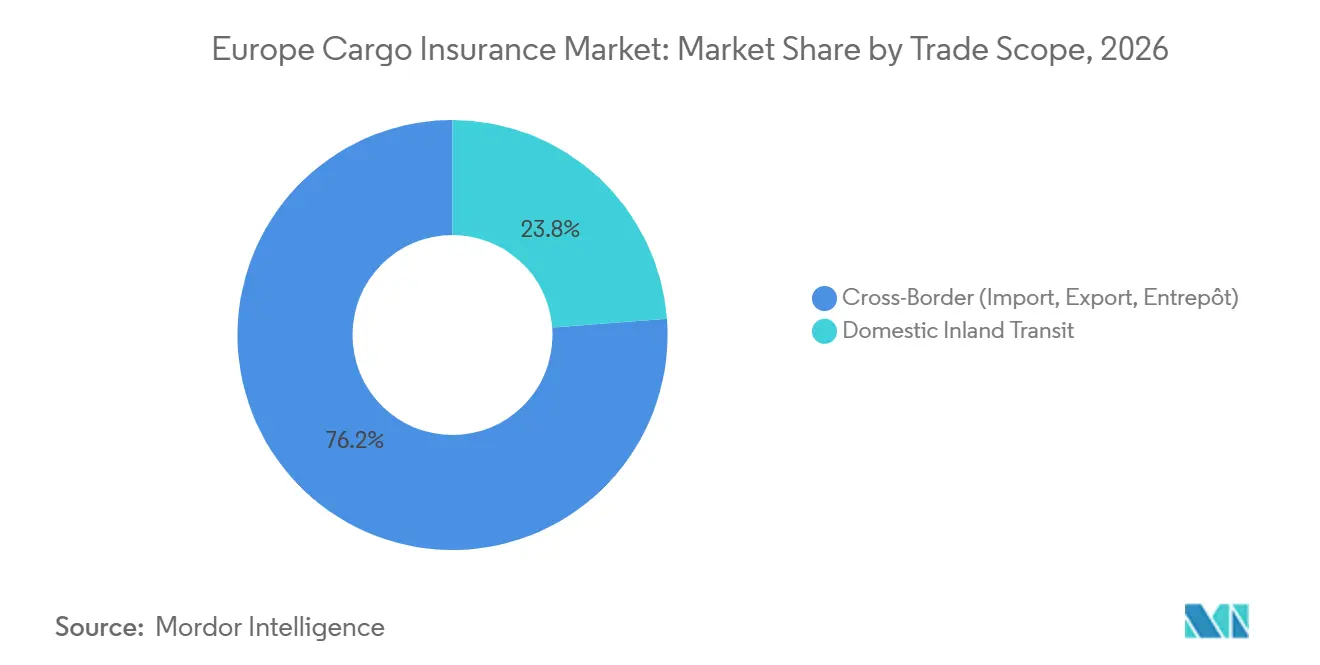
- By trade scope, cross-border cargo accounted for 76.2% of the Europe cargo insurance market size in 2026, while domestic inland transit is advancing at a 4.5% CAGR through 2032.
- By distribution channel, brokers and agents held 70.3% of the Europe cargo insurance market share in 2026, while online and digital platforms are expected to grow at a 9.8% CAGR through 2032.
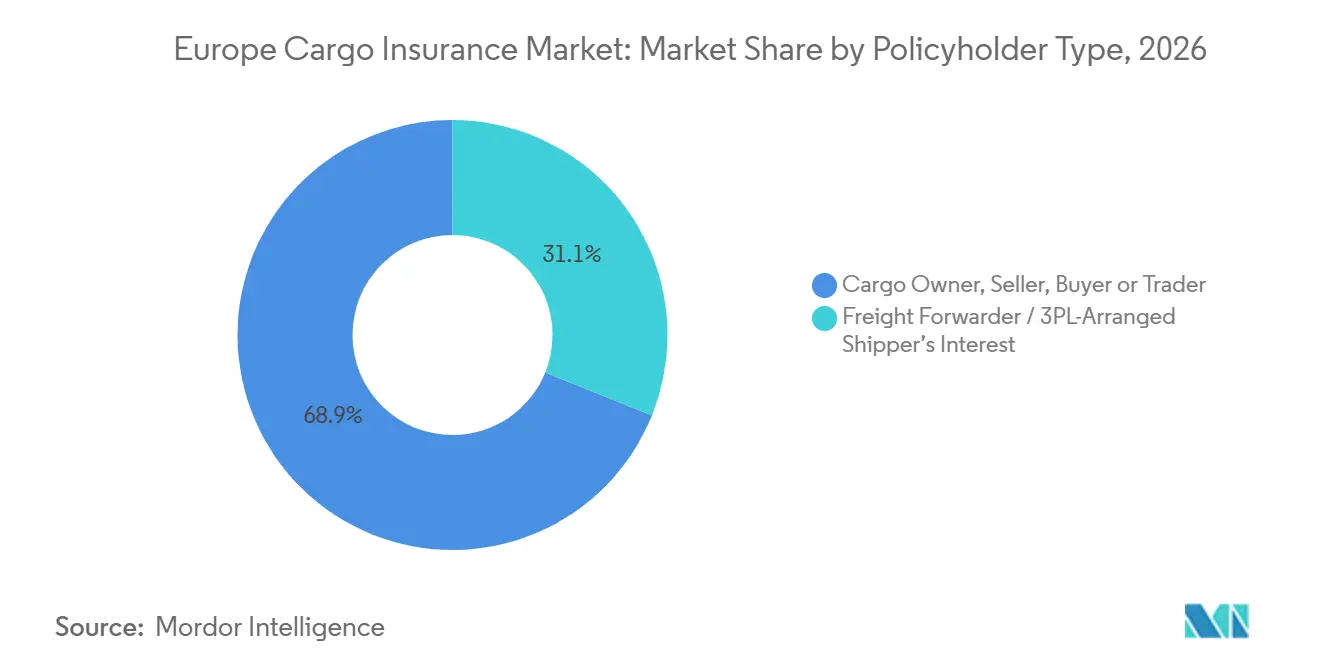
- By policyholder type, cargo owners, sellers, buyers, and traders accounted for 68.9% of the Europe cargo insurance market share in 2026, while freight forwarder and third-party logistics arranged coverage is projected to grow at a 5.2% CAGR through 2032.
- By end-user industry, energy and bulk commodities held 22.5% of the Europe cargo insurance market share in 2026, while electronics and high-value manufactured goods are forecast to grow at a 6.2% CAGR through 2032.
- By geography, the United Kingdom held 34.4% of the Europe cargo insurance market share in 2026, while the Rest of Europe cluster is forecast to expand at a 4.8% CAGR through 2032.
Note: Market numbers in this report are based on Mordor Intelligence's proprietary estimation framework, which combines nine months of actuals with Q4 projections for base year 2026.
Market Trends and Insights
Drivers Impact Analysis of Europe Cargo Insurance Market*
| Driver | (~) % Impact on CAGR Forecast | Geographic Relevance | Impact Timeline |
|---|---|---|---|
| Growth in Cross-Border Shipments and Insured Cargo Values | +0.9% | Global, concentrated in the United Kingdom, Germany, France, the Netherlands, and the Antwerp-Rotterdam corridor | Medium term (2-4 years) |
| High-Value Electronics, Electric Vehicle, and Battery Shipments | +0.7% | European Union manufacturing and import hubs, including Germany, the Netherlands, Belgium, and the United Kingdom | Long term (≥ 4 years) |
| Supply-Chain Resilience and Stock Throughput Coverage | +0.5% | Global, with Europe benefiting through London Market structures | Medium term (2-4 years) |
| Digital Cargo Insurance Distribution and Embedded Coverage | +0.6% | Europe, the Middle East, and Africa, with early gains in the United Kingdom, Benelux, and the Nordic countries | Short term (≤ 2 years) |
| Geopolitical Disruptions and Rerouted Trade Corridors | +0.4% | Mediterranean ports, North Sea feeder routes, and the United Kingdom landbridge | Short term (≤ 2 years) |
| Cargo Risk Monitoring and Specialized Transit Coverage | +0.3% | Global, including Hamburg, Rotterdam, Antwerp, and Felixstowe | Long term (≥ 4 years) |
| Source: Mordor Intelligence | |||
Growth in Cross-Border Shipments and Insured Cargo Values
The Europe cargo insurance market is supported by the movement of goods across European transport networks and international trade routes. In 2025, European Union road freight transported 13.29 billion tonnes of goods, an increase of 1.8% from 2024. Extra-European Union sea imports reached EUR 1,270 billion (USD 1,371.6 billion) in value, while sea exports amounted to EUR 1,069 billion (USD 1,154.5 billion)[1]. Higher-value manufactured goods, machinery, and other commercial products can increase the insured value of individual consignments, even when shipment volumes remain stable. However, trade volumes and values are demand indicators rather than direct measures of cargo insurance premiums, which also depend on coverage limits, policy terms, pricing, and insured exposure.
Expansion of High-Value Electronics, Electric Vehicles, and Battery Shipments
The concentration of high-value goods in air freight and the changing composition of manufactured trade support demand for specialized cargo insurance. In 2025, air transport accounted for 20.7% of European Union import value and 29.1% of export value, despite representing only 0.3% of import weight and 2.9% of export weight. These figures highlight the importance of protecting high-value consignments against theft, handling damage, and transit-related losses. In September 2025, the International Union of Marine Insurance published updated best-practice recommendations for the safe ocean and short-sea carriage of electric vehicles, addressing battery-related fire risks and mitigation measures[2]. Insurers and cargo owners can use these risk considerations to improve cargo declarations, stowage procedures, and underwriting assessments, particularly for electric vehicles and lithium-ion battery shipments.
Rising Demand for Supply-Chain Resilience and Stock Throughput Coverage
Supply-chain disruption is encouraging businesses to review how insurance protects inventory across production, transportation, and storage. Stock throughput policies can combine these exposures under a coordinated insurance arrangement, making them relevant to manufacturers, retailers, and businesses managing frequent cross-border inventory movements. A 2025 survey of more than 900 senior business leaders commissioned by Maersk found that supply-chain resilience frontrunners lost less than 1% of revenue to disruption in their last fiscal year, compared with an average loss of 3.9% across surveyed companies[3]. For insurers and brokers, broader cargo and stock throughput programs provide an opportunity to address connected transit and inventory exposures, subject to policy wording, exclusions, and underwriting requirements.
Growth in Digital Cargo Insurance Distribution and Embedded Insurance
Digital underwriting and broker platforms are improving access to cargo insurance, particularly for small and medium-sized businesses with relatively straightforward risks. In June 2025, Hiscox launched its Cargo API solution for smaller cargo and stock throughput risks, offering limits of up to USD 5 million and near-instant quotation and binding for eligible risks through broker partners[4]. In September 2026, Sompo and Acturis launched a marine cargo insurance proposition on the Acturis platform, enabling brokers to obtain quotations and digitally bind eligible risks subject to underwriting criteria.
Restraints Impact Analysis of Europe Cargo Insurance Market*
| Restraints | Approx. Impact on CAGR Forecast | Geographic Relevance | Impact Timeline |
|---|---|---|---|
| Soft Premium Rates from Excess Capacity and Intense Underwriting Competition | -1.0% | Global, particularly London, Lloyd's, and major European insurance markets | Short term (≤ 2 years) |
| Trade Volatility and Uncertainty in Shipment Volumes and Insured Values | -0.7% | European Union-wide, particularly export-dependent economies such as Germany and Italy | Medium term (2–4 years) |
| Accumulation Risk Across Ports, Warehouses, and Logistics Hubs | -0.5% | Major European ports and logistics hubs, including Rotterdam, Antwerp-Bruges, Hamburg, and Mediterranean shipping gateways | Medium to long term (2–5 years) |
| Complex War-Risk Exclusions, Sanctions, and Coverage Restrictions | -0.6% | Europe-wide, particularly trade routes exposed to geopolitical tensions in the Black Sea and adjacent maritime corridors | Short to medium term (1–3 years) |
| Rising Cargo Theft, Fraud, and Claims Verification Challenges | -0.4% | Europe-wide, with heightened exposure along major road-freight corridors and logistics hubs in France, Germany, Italy, and Spain | Short to medium term (1–3 years) |
| Source: Mordor Intelligence | |||
Soft Premium Rates from Excess Capacity and Intense Underwriting Competition
Excess underwriting capacity and competition are constraining premium-rate improvement in the European cargo insurance market. In September 2026, the International Union of Marine Insurance reported that additional capacity and competitive pressure continued to soften the global marine cargo market, particularly in Europe. Global cargo insurance premiums reached USD 24.2 billion in 2025, an increase of 6.9% from 2024, although currency movements accounted for a substantial part of the reported growth. Greater competition allows buyers with favorable loss histories and well-controlled exposures to negotiate more competitive terms, limiting premium growth despite increases in insured values. Europe's cargo loss ratio declined to approximately 40% in 2025. Consequently, insurers must balance competitive pricing against future claims development, risk accumulation, and underwriting profitability. Continued capacity expansion may constrain premium growth until market conditions support stronger pricing discipline.
Trade Volatility and Uncertainty in Shipment Volumes and Insured Values
Fluctuations in trade activity, commodity prices, and shipping routes can make cargo insurance premium growth less predictable across Europe. Eurostat reported that the European Union's goods trade balance moved from a EUR 51 billion (USD 55.1 billion) surplus in the first quarter of 2025 to a EUR 21.8 billion (USD 23.6 billion) deficit in the second quarter of 2026. Separately, inland waterway freight transport in the European Union declined by 3% in 2025 to 118 billion tonne-kilometres, reflecting changes in freight activity across the region. Under annual open-cover policies, changes in shipment frequency, commodity prices, and declared cargo values can affect premium adjustments and the accuracy of exposure estimates. Trade rerouting and changes in transit patterns can also alter accumulation exposures and underwriting requirements.
*Our forecasts treat driver/restraint impacts as directional, not additive. The impact forecasts reflect baseline growth, mix effects, and variable interactions.
Europe Cargo Insurance Market Segment Analysis
By Mode of Transport:
Sea Retains the Largest Premium Base While Air Expands FasterSea transport held 53.4% of the Europe cargo insurance market size in 2026, supported by its role in 73.3% of European Union import weight and 72.6% of export weight. These percentages refer to the weight of goods traded with non-European Union countries, rather than the share of cargo insurance premiums. Sea freight remains important for containerized manufactured goods, industrial equipment, energy products, and bulk commodities moving between Europe and major international markets. Short-sea shipping also connects European ports and regional trade corridors, creating demand for cover across maritime transit and associated inland movements. Longer voyages, port congestion, and cargo accumulation can increase underwriting complexity and influence policy terms. Maritime transport therefore remains a key contributor to the European cargo insurance market.
Air is projected to grow at a 5.8% CAGR through 2032, making it the fastest-growing transport mode in the Europe cargo insurance market. Air freight is relevant to electronics, pharmaceuticals, precision equipment, and other high-value goods requiring rapid delivery. European Union airports recorded 6.9 million commercial flights in 2025, an increase of 3.8% from 2024. Road freight supports domestic and intra-European shipments, while rail and inland waterways serve selected industrial and bulk transport corridors. The relative growth of each mode depends on shipment values, trade patterns, policy pricing, and the specific risks insured.
By Cargo Profile:
Containerized Goods Lead the Base While Project Cargo Adds Specialist DemandContainerized cargo held 33.8% of premium in 2026 because it is widely used for manufactured goods, consumer products, and general merchandise. Standardized container handling supports regular shipments across maritime and intermodal networks, although individual consignments differ in value, security requirements, and loss exposure. Containerized goods move through ports, warehouses, distribution centres, and inland freight networks, creating exposures at multiple stages of transit. Dry bulk and liquid bulk cargo also contribute to the market through energy, chemical, agricultural, and industrial supply chains.
Project, heavy-lift, and out-of-gauge cargo is forecast to grow at a 5.4% CAGR through 2032. Offshore wind installations, rail infrastructure, and industrial modernization projects can generate demand for specialist cover for oversized or high-value components. Individual consignments may require customized loading, lifting, route surveys, storage arrangements, and transit planning because replacement components can be costly or difficult to source. Rolling cargo, including electric vehicles, also requires attention to battery-related fire hazards and appropriate stowage and emergency procedures. Break-bulk cargo remains relevant for steel, bagged commodities, and equipment that cannot be transported efficiently in standard containers.
By Trade Scope:
Cross-Border Programs Lead While Domestic Inland Protection BroadensCross-border cargo accounted for 76.2% of written premium in 2026. Import, export, and entrepôt shipments connect European businesses to international suppliers and customers through sea, air, road, and rail networks. Multinational insurance programs can require coordination across jurisdictions, transport modes, and local policy arrangements. The United Kingdom's departure from the European Union has also introduced additional customs formalities for many movements between Great Britain and the European Union, although insurance requirements depend on the contract, goods, and transport arrangements. These factors can increase administrative complexity for businesses managing international shipments.
Domestic inland transit is forecast to expand at a 4.5% CAGR through 2032. E-commerce fulfilment, regional distribution networks, and frequent movements between warehouses and customers can support demand for inland cargo cover. TAPA EMEA recorded 440 cargo theft incidents across its reporting region in January 2025, with Germany accounting for 110 incidents, or 25% of the recorded total. These figures reflect reported incidents in the association's intelligence system rather than the full incidence of cargo crime across Europe. Domestic cargo owners may seek insurance beyond carrier liability where contractual limits do not cover the full value of the goods.
By Distribution Channel:
Brokers Hold the Largest Role While Digital Platforms Expand AccessBrokers and agents held 70.3% of written premium in 2026. They play an important role in arranging cover for complex, multimodal, and multinational shipments that require tailored policy wording and coordination across insurers. Brokers can also help clients assess declared values, transit routes, cargo accumulation, security controls, and coverage exclusions. Their advisory role remains relevant for large commercial accounts and risks requiring specialist underwriting. Direct insurer distribution also serves businesses with established insurance relationships and relatively straightforward cargo requirements.
Online and digital platforms are projected to grow at a 9.8% CAGR through 2032. Hiscox launched its Cargo API in June 2025 to provide brokers with digital access to transit, stock-only, and stock throughput cover for eligible cargo risks, with limits of up to USD 5 million. In September 2026, Sompo and Acturis launched a marine cargo insurance proposition on the Acturis platform, allowing brokers to obtain quotations and digitally bind eligible risks subject to underwriting criteria. These examples demonstrate practical developments in digital distribution, particularly in the United Kingdom. Digital channels can reduce processing time for eligible risks, but the projected 9.8% CAGR requires support from the underlying channel forecast.
By Policyholder Type:
Cargo Owners Remain Central While Logistics Intermediaries Add CoverageCargo owners, sellers, buyers, and traders accounted for 68.9% of premium in 2026. Their insurance needs depend on contractual responsibilities, ownership interests, and the allocation of transit risk under the applicable sales agreement. Under Incoterms rules, insurance obligations differ by rule: CIF and CIP require the seller to arrange specified cargo insurance, while many other rules do not impose the same seller obligation. Open-cover policies can accommodate recurring shipments, with premiums adjusted according to declared values, shipment frequency, and policy terms. This makes cargo owners and trading businesses an important customer group across European supply chains.
Freight forwarder and third-party logistics-arranged coverage is forecast to grow at a 5.2% CAGR through 2032. Logistics providers can offer shipper's interest insurance or facilitate cargo protection through freight-management and customer-service arrangements. In February 2026, AXA XL and U.S. Marine Insurance Group announced their collaboration to provide shipper's interest insurance for transportation, logistics, and construction clients. This arrangement illustrates the role of specialist insurance partnerships in serving logistics-related exposures.
By End-User Industry:
Energy Provides Scale While Electronics Drives the Fastest GrowthEnergy and bulk commodities held 22.5% of premium in 2026. Oil, refined petroleum products, liquefied gas, metals, and other bulk commodities generate substantial cargo exposures across maritime and inland transport networks. Insured values and annual premium can fluctuate with commodity prices, shipment volumes, transit distances, and policy conditions. Agricultural and food products also contribute to regional cargo movements. Eurostat reported that food products, beverages, and tobacco accounted for 16.6% of European Union road freight transport performance, measured in tonne-kilometers, in 2025.
Electronics and high-value manufactured goods are expected to grow at a 6.2% CAGR through 2032. Semiconductors, consumer electronics, battery components, and precision equipment can carry high declared values relative to their physical size, increasing the potential financial impact of theft or damage. The 2025 Cargo Theft Report published by TT Club and BSI in April 2026 identified electronics among the commodity groups targeted by cargo thieves, alongside food and beverages, agricultural goods, and automotive parts. Chemicals and pharmaceuticals can require specialized handling and protection against contamination, temperature excursions, and other cargo-specific risks.
Geography Analysis
The United Kingdom held 34.4% of the Europe cargo insurance market size in 2026, reflecting London’s role in specialty underwriting and complex commercial placements. London provides access to insurers, Lloyd’s syndicates, brokers, and managing general agents serving international marine and cargo risks. Trade between Great Britain and the European Union involves customs and transit formalities that can add administrative requirements for cross-border shipments. TAPA EMEA recorded 50 cargo theft incidents in the United Kingdom in January 2025, compared with 110 in Germany, highlighting security concerns across major European freight markets. Germany also represents a major cargo insurance market because of its industrial production, export activity, and extensive road-freight network.
France, Italy, Spain, and the Benelux countries form a major secondary geography for the Europe cargo insurance market. Spain's port system benefited from maritime rerouting during the Red Sea disruption, with port traffic increasing by 6% in 2024 as some carriers redirected services around southern Africa. Rotterdam and Antwerp-Bruges handle substantial international cargo flows, creating insurance exposures across terminals, warehouses, and connecting inland transport networks. Italy contributes demand through manufacturing, automotive components, fashion, food, and industrial exports, while France has exposure across aerospace, pharmaceuticals, luxury goods, and agricultural products. Changes in shipping routes can affect transit duration, handling requirements, and cargo accumulation at ports. These factors increase the importance of route assessment and appropriate accumulation controls.
The Nordic countries provide a developed marine and transport insurance base through Sweden, Norway, Denmark, and Finland. Swedish marine and other transport insurance premiums exceeded SEK 2.5 billion (USD 0.24 billion) in 2025, with cargo insurance accounting for 53% of the reported total. The Rest of Europe cluster is forecast to expand at a 4.8% CAGR through 2032 as regional manufacturing and logistics networks support inland and cross-border shipments. Poland is an important road-freight market: Eurostat reported that it accounted for 20.2% of European Union road freight transport performance in 2025, the largest share among member states. Czechia and other Central and Eastern European markets also participate in integrated European supply chains. The revised Solvency II framework is scheduled to take effect on 30 January 2027, updating the prudential rules applicable to insurers in the European Union.
Competitive Landscape
The Europe cargo insurance market includes large commercial insurers, Lloyd’s market participants, specialist carriers, and managing general agents. Allianz Commercial, AXA XL, Zurich Insurance Group, Chubb, and Assicurazioni Generali are established participants in large commercial placements. Competition centers on underwriting expertise, available capacity, claims service, distribution reach, and specialist coverage design. Other relevant participants include AIG, HDI Global, QBE, Tokio Marine HCC, Sompo, Liberty Specialty Markets, Berkshire Hathaway Specialty Insurance, Markel, Arch, AXIS, TT Club, Beazley, CNA Hardy, and MS Amlin. Lloyd’s remains an important market for complex and specialist cargo risks through its network of syndicates and specialist distribution channels.
Insurers and Lloyd’s market participants are developing consortium structures and technology-enabled operations to improve placement efficiency and address complex cargo exposures. In July 2025, Arch Insurance International launched the Arch Flex Cargo & Logistics Consortium, bringing together five London Market syndicates and offering a line size of up to GBP 25 million (USD 31.6 million). The consortium covers marine cargo, stock throughput, standalone stock, logistics liability, warehouseman’s legal liability, and related risks, with Arch providing a single point of contact and claims handling. In March 2026, Brit launched its BRIDGE cargo consortium, offering up to USD 80 million in cargo line capacity for international risks. These initiatives demonstrate how insurers are combining syndicated capacity and specialist underwriting to serve larger and more complex placements.
Specialist products are also addressing technology-intensive cargo and expanding access to tailored cover. In June 2026, Overhaul and Navium launched the Helix Consortium, a solution designed for artificial intelligence infrastructure cargo, combining real-time cargo risk-management technology with Lloyd’s underwriting capacity and offering transit limits of up to USD 75 million. DUAL Europe launched its cargo insurance business effective 1 September 2025, offering tailored cover for different cargo types, including project cargo, stock and transit exposures, and waterborne war extensions. Insurers combining specialist risk assessment, disciplined pricing, efficient claims handling, and accessible distribution are positioned to compete across Europe's evolving cargo insurance market.
Europe Cargo Insurance Industry Leaders
-
Allianz SE
-
AXA S.A.
-
Zurich Insurance Group Ltd.
-
Chubb Limited
-
Assicurazioni Generali S.p.A.
- *Disclaimer: Major Players sorted in no particular order
Europe Cargo Insurance Market Companies Covered in this Report
- Allianz Commercial
- AXA XL
- Zurich Insurance Group
- Chubb Limited
- Assicurazioni Generali S.p.A.
- American International Group, Inc. (AIG)
- HDI Global SE
- QBE Insurance Group Limited
- Tokio Marine HCC
- Sompo Holdings, Inc.
- Liberty Specialty Markets
- Lloyd’s of London
- Berkshire Hathaway Specialty Insurance
- Markel International
- Arch Capital Group Ltd.
- AXIS Capital Holdings Limited
- TT Club Mutual Insurance N.V.
- Beazley plc
- CNA Hardy
- MS Amlin
Recent Industry Developments in Europe Cargo Insurance Market
- September 2026: Acturis and Sompo Holdings announced the launch of Sompo’s Marine Cargo Insurance proposition on the Acturis SaaS platform, providing United Kingdom brokers with digital quote-and-bind capability for eligible marine cargo risks.
- July 2026: The European Insurance and Occupational Pensions Authority published its final guidelines and draft technical standards, completing the Solvency II review mandate, covering reporting and disclosure, group solvency, and technical provisions, all effective January 30, 2027.
- June 2026: Navium Marine, The Fidelis Partnership, and cargo risk management firm Overhaul launched the Helix Consortium at Lloyd’s, offering a transit limit of USD 75 million and a storage limit of USD 25 million for artificial intelligence data center hardware.
- March 2026: Brit Group Holdings Limited launched the BRIDGE marine cargo consortium, offering up to USD 80 million of cargo capacity for complex and large risks.
Europe Cargo Insurance Market Report Scope
Segmentation Overview
| Sea (Deep-Sea and Short-Sea / Coastal) |
| Inland Waterway |
| Road |
| Rail |
| Air |
| Containerized Cargo |
| Dry Bulk Cargo |
| Liquid Bulk Cargo |
| Break-Bulk and General Cargo |
| Project, Heavy-Lift and Out-of-Gauge |
| Rolling Cargo / Ro-Ro |
| Cross-Border (Import, Export, Entrepôt) |
| Domestic Inland Transit |
| Brokers and Agents |
| Direct Insurers |
| Online and Digital Platforms |
| Cargo Owner, Seller, Buyer or Trader |
| Freight Forwarder / 3PL-Arranged Shipper’s Interest |
| Food, Beverage, and Agri-Commodities |
| Energy and Bulk Commodities |
| Chemicals and Pharmaceuticals |
| Automotive and Industrial Equipment |
| Electronics and High-Value Manufactured Goods |
| Retail, Consumer Goods, and E-Commerce |
| Construction and Infrastructure Project Owners |
| Others |
| United Kingdom |
| Germany |
| France |
| Italy |
| Spain |
| BENELUX |
| Nordics |
| Rest of Europe |
| By Mode of Transport | Sea (Deep-Sea and Short-Sea / Coastal) |
| Inland Waterway | |
| Road | |
| Rail | |
| Air | |
| By Cargo Profile | Containerized Cargo |
| Dry Bulk Cargo | |
| Liquid Bulk Cargo | |
| Break-Bulk and General Cargo | |
| Project, Heavy-Lift and Out-of-Gauge | |
| Rolling Cargo / Ro-Ro | |
| By Trade Scope | Cross-Border (Import, Export, Entrepôt) |
| Domestic Inland Transit | |
| By Distribution Channel | Brokers and Agents |
| Direct Insurers | |
| Online and Digital Platforms | |
| By Policyholder Type | Cargo Owner, Seller, Buyer or Trader |
| Freight Forwarder / 3PL-Arranged Shipper’s Interest | |
| By End-User Industry | Food, Beverage, and Agri-Commodities |
| Energy and Bulk Commodities | |
| Chemicals and Pharmaceuticals | |
| Automotive and Industrial Equipment | |
| Electronics and High-Value Manufactured Goods | |
| Retail, Consumer Goods, and E-Commerce | |
| Construction and Infrastructure Project Owners | |
| Others | |
| By Country | United Kingdom |
| Germany | |
| France | |
| Italy | |
| Spain | |
| BENELUX | |
| Nordics | |
| Rest of Europe |
Key Questions Answered in the Report
What is the forecast growth rate for Europe cargo insurance through 2032?
The Europe cargo insurance market is forecast to grow at a 3.5% CAGR from 2027 to 2032, increasing from USD 9.6 billion in 2027 to USD 11.4 billion in 2032.
Which transport mode has the largest premium share in Europe cargo insurance?
Sea transport leads with a 53.4% share in 2026, supported by its role in European Union import and export freight flows.
Which distribution channel is growing fastest for cargo insurance in Europe?
Online and digital platforms are forecast to grow at a 9.8% CAGR through 2032 as digital quotation, binding, and embedded cover expand.
Why is air cargo insurance growing faster than other transport modes?
Air cargo is projected to grow at a 5.8% CAGR because it carries high-value electronics, pharmaceuticals, battery components, and precision equipment.
Which country has the largest share of Europe cargo insurance?
The United Kingdom holds a 34.4% share in 2026 because London remains an important center for specialty underwriting, broker activity, and complex placements.
What risks are shaping cargo insurance demand in Europe?
Theft, longer voyages caused by route disruption, electric vehicle battery risks, and wider supply-chain protection needs are increasing demand for specialist coverage.