
Europe Carbon Capture and Storage Market Size and Share
Market Overview
| Study Period | 2022 - 2032 |
|---|---|
| Forecast Data Period | 2027 - 2032 |
| Base Year Market Size (2026) | USD 0.85 Billion |
| Market Size (2027) | USD 1.01 Billion |
| Market Size (2032) | USD 3.23 Billion |
| Growth Rate (2027 - 2032) | 26.12 % |
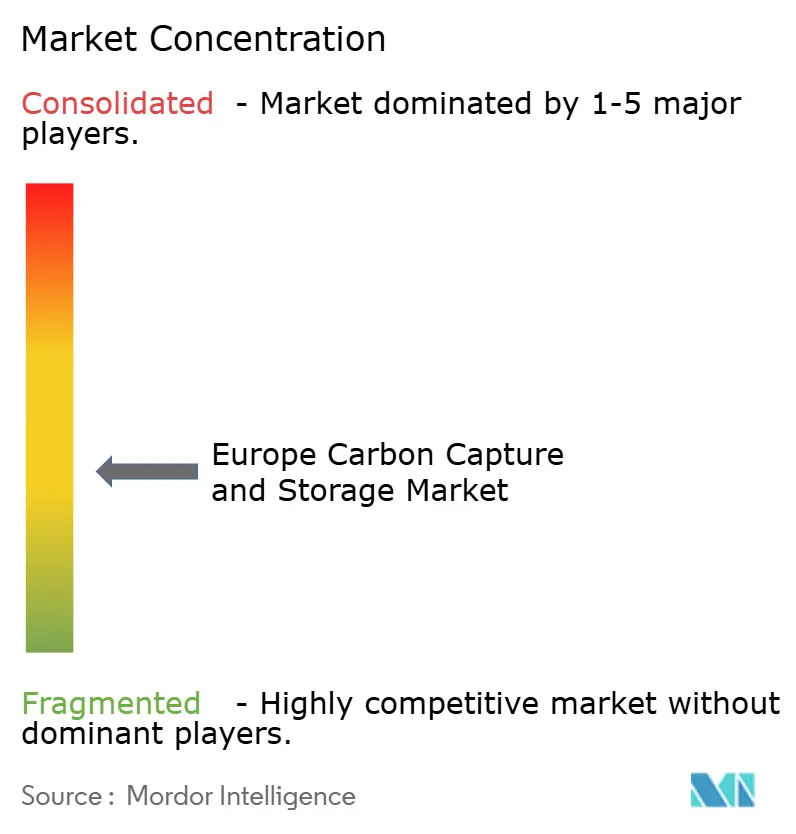
| Market Concentration | Medium |
Major Players *Disclaimer: Major Players sorted in no particular order Image © Mordor Intelligence. Reuse requires attribution under CC BY 4.0. | |
Europe Carbon Capture and Storage Market Analysis by Mordor Intelligence
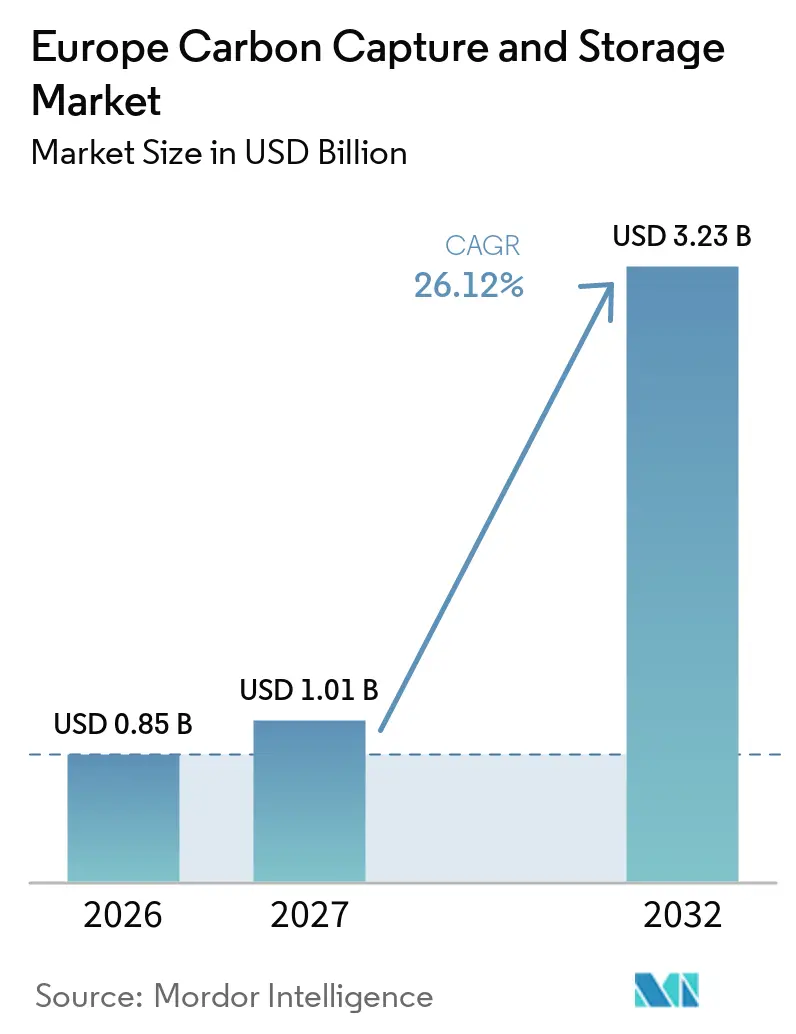
The Europe carbon capture and storage market was valued at USD 0.85 billion in 2026 and is estimated to grow from USD 1.01 billion in 2027 to USD 3.23 billion by 2032, at a CAGR of 26.12% during the forecast period (2027-2032). The market is transitioning from pilot activity to commercial projects, as storage developers now hold contracted capacity and industrial customers require compliance options. The EU Net-Zero Industry Act mandates 50 million tonnes of annual CO2 injection capacity by 2030, with designated oil and gas producers required to contribute to that capacity. Shared transport and storage systems are reducing the need for individual emitters to develop their own pipelines and storage sites. Funding from the Innovation Fund is supporting first-of-a-kind projects, although project economics, permitting, and liability rules remain material constraints. The strongest market opportunities lie in storage hubs, industrial capture projects, shipping links, and services that reduce delivery risk.
Key Report Takeaways
- By technology, pre-combustion capture held 79.3% of the Europe CCS market share in 2026, while oxy-fuel combustion capture is projected to grow at a 29.3% CAGR through 2032.
- By end-user industry, oil and gas accounted for 67.2% of the Europe CCS market share in 2026 and is forecast to expand at a 27.4% CAGR through 2032.
- By geography, the United Kingdom held 27.7% of revenue in 2026 and is projected to grow at a 26.9% CAGR through 2032.
Note: Market numbers in this report are based on Mordor Intelligence's proprietary estimation framework, which combines nine months of actuals with Q4 projections for base year 2026.
Market Trends and Insights
Drivers Impact Analysis of Europe Carbon Capture and Storage Market*
| Driver | (~) % Impact on CAGR Forecast | Geographic Relevance | Impact Timeline |
|---|---|---|---|
| EU Net-Zero Industry Act Storage Target and Producer Obligations | +5.8% | EU-wide, especially North Sea states, Germany, and Belgium | Short term (≤ 2 years) |
| EU Emissions Trading System Economics and Industrial Decarbonization Mandates | +4.7% | EU installations, especially Germany, the Netherlands, France, and Italy | Medium term (2-4 years) |
| Public Funding and De-Risking of First-of-a-Kind Projects | +4.2% | EU-wide, especially Germany, the United Kingdom, Norway, the Netherlands, and Belgium | Short term (≤ 2 years) |
| Shared Cross-Border CO₂ Transport and Storage Hubs | +3.6% | Norway, the United Kingdom, the Netherlands, Denmark, Belgium, and the Baltic region | Medium term (2-4 years) |
| Open-Access CO₂ Storage-as-a-Service Business Models | +3.0% | Norway, the Netherlands, Italy, and the Mediterranean | Medium term (2-4 years) |
| CO₂ Shipping and Port-Based Clusters Connecting Distributed Emitters | +2.4% | Rotterdam, Antwerp, Zeebrugge, Immingham, the Baltic, and the Mediterranean | Long term (≥ 4 years) |
| Source: Mordor Intelligence | |||
EU Net-Zero Industry Act Storage Target and Producer Obligations
The EU target of 50 million tonnes of annual CO₂ injection capacity by 2030 establishes a defined infrastructure requirement for the European carbon capture and storage market.[1] In May 2025, the European Commission assigned individual storage contribution shares to 44 oil and gas producers. These producers must develop permitted injection capacity or secure access through third-party operators by December 2030. Annual progress reporting from 2026 will create a visible record of implementation. Long-term storage agreements support investment decisions by providing contracted demand. Northern Lights approved its Phase 2 expansion in March 2025 on commercial terms, demonstrating how producer obligations and customer agreements can support additional capacity.
EU Emissions Trading System Economics and Industrial Decarbonization Mandates
EU emissions pricing places a direct cost on unabated emissions from covered industrial facilities. The gradual reduction of free allowances through 2034 increases the value of reliable abatement options for cement, steel, chemicals, and hydrogen production. Innovation Fund awards recycle part of the system's proceeds into capital for lower-emission projects. The European CCS market is most competitive where plants generate concentrated CO₂ streams and face high compliance costs. Cement and steel projects receive particular attention because process emissions cannot be fully eliminated through electrification. This pattern directs deployment toward industrial clusters where capture plants can connect to shared transport and storage infrastructure.
Public Funding and De-Risking of First-of-a-Kind Projects
Public funding remains central to early commercial deployment, as project developers must finance equipment, transport links, wells, monitoring systems, and long operating periods. The Innovation Fund committed EUR 2.7 billion to 54 clean industry projects in March 2026.[2] Heidelberg Materials secured four Innovation Fund grants in November 2025 for projects in Belgium, France, Italy, and Poland. Eni's Ravenna CCS Phase 2 project was selected under the 2025 Innovation Fund Large Scale category in October 2026. These awards reduce financing risk, but compliance with the EU CCS Directive remains a prerequisite before projects can proceed. The funding model favors projects with mature engineering, credible storage access, and clear customer demand.
Shared Cross-Border CO₂ Transport and Storage Hubs
Open-access networks allow smaller emitters to use transport and storage systems without financing a dedicated value chain. Northern Lights began commercial CO₂ storage in the Aurora reservoir in August 2025, with Phase 1 capacity of 1.5 million tonnes per year. The European CCS market benefits when infrastructure accepts emissions from multiple countries and industrial sectors. Fluxys and Open Grid Europe launched the Ruhbens project in March 2026, covering a 500-kilometer corridor linking Ruhr emitters with North Sea storage through Zeebrugge. Shipping, ports, and shared pipelines can serve sites that lack direct access to an offshore network. Cross-border investment remains dependent on permits, regulatory alignment, and agreements between the relevant governments.
Restraints Impact Analysis of Europe Carbon Capture and Storage Market*
| Restraint | (~) % Impact on CAGR Forecast | Geographic Relevance | Impact Timeline |
|---|---|---|---|
| High Capital Intensity and Capture Energy Penalty | -3.8% | EU-wide, especially dilute-source steel, waste-to-energy, and chemical facilities | Short term (≤ 2 years) |
| Permitting, Cross-Border Transport and Liability Fragmentation | -3.2% | Norway-EU and United Kingdom-EU projects, especially outside North Sea routes | Medium term (2-4 years) |
| Limited European Manufacturing Capacity for Solvents, Compressors and Column Vessels | -1.5% | EU-wide, with specialty component supply concentrated outside the EU | Medium term (2-4 years) |
| Storage Liability, Monitoring and Carbon-Removal Accounting Uncertainty | -1.2% | EU-wide, especially Poland, the Baltic region, and the Mediterranean | Long term (≥ 4 years) |
| Source: Mordor Intelligence | |||
High Capital Intensity and Capture Energy Penalty
A complete European CCS chain can cost EUR 150 per tonne of CO2, while ETS prices have not consistently covered that full cost. Post-combustion amine capture can consume 15-25% of a plant's power output, increasing equipment and operating requirements. Equinor reduced its planned 2026-2027 capital expenditure in the power and low-carbon segment and limited new CCS investment to selected lower-cost options. As a result, the Europe carbon capture and storage (CCS) market favors projects with concentrated CO2 streams, such as gas processing, blue hydrogen, and oxy-fuel cement. Dilute-source retrofits require sustained subsidies, improved energy performance, or higher carbon costs to attract investment. This cost divide risks widening the gap between well-capitalized North Sea projects and those in less developed corridors.
Permitting, Transport, and Liability Fragmentation
The EU CCS Directive establishes the framework for geological storage, but national permitting approaches remain uneven. Cross-border transport requires coordination across licensing, shipping, pipeline access, monitoring, and liability arrangements. The European Commission opened a public consultation on CO2 markets and infrastructure in October 2025. Operators also face supply constraints for key equipment, including solvents, compressors, and absorption vessels. New storage regions must establish clear rules for long-term monitoring and the accounting of permanent removals. These constraints can delay final investment decisions even when funding and customer interest are in place.
*Our forecasts treat driver/restraint impacts as directional, not additive. The impact forecasts reflect baseline growth, mix effects, and variable interactions.
Europe Carbon Capture and Storage Market Segment Analysis
By Technology:
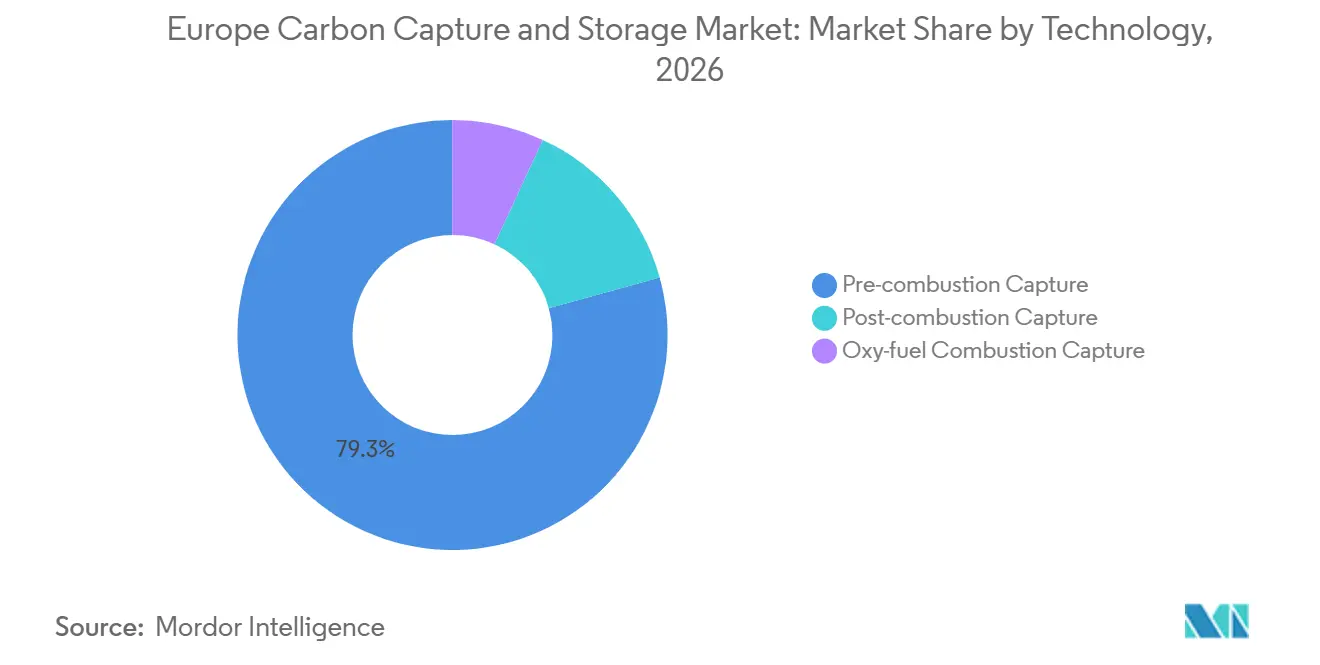
Pre-Combustion Leads, Oxy-fuel Capture Gains Cement ProjectsPre-combustion capture held 79.3% of the Europe carbon capture and storage (CCS) market share in 2026. It benefits from established use in natural gas processing and blue hydrogen production. These applications produce concentrated streams that require less separation work than dilute flue gas. Oil and gas operators have directed early investments toward assets where capture is easier to integrate with existing processing systems, making pre-combustion systems an important entry point for the European CCS market. Post-combustion capture supports industrial facilities that cannot change their core processes quickly. Heidelberg Materials opened its Brevik CCS facility in June 2025, which captures 400,000 tonnes of CO₂ annually at its cement plant.[3] Schlumberger Limited (SLB) Capturi reported commercial deployment progress across cement, waste-to-energy, and bioenergy projects during 2025.
Oxy-fuel combustion capture is forecast to grow at a 29.3% CAGR through 2032. The segment is gaining support from cement projects that use oxy-fuel kilns to produce a more concentrated CO₂ stream. Heidelberg Materials received grants for Antoning in Belgium, AirvaultGOCO₂ in France, DREAM in Italy, and HuCCSar in Poland. These projects indicate that cement producers are pursuing multi-site programs rather than isolated demonstrations. Air Liquide and Holcim agreed in February 2026 to deploy Cryocap OXY technology at the Obourg cement plant in Belgium.[4] Integrated oxygen supply and capture systems can simplify project design for kiln operators. Technology suppliers are competing on process performance, integration capability, and delivery certainty. Oxy-fuel adoption can also reduce downstream conditioning requirements before shipping or pipeline transport.

By End-user Industry:
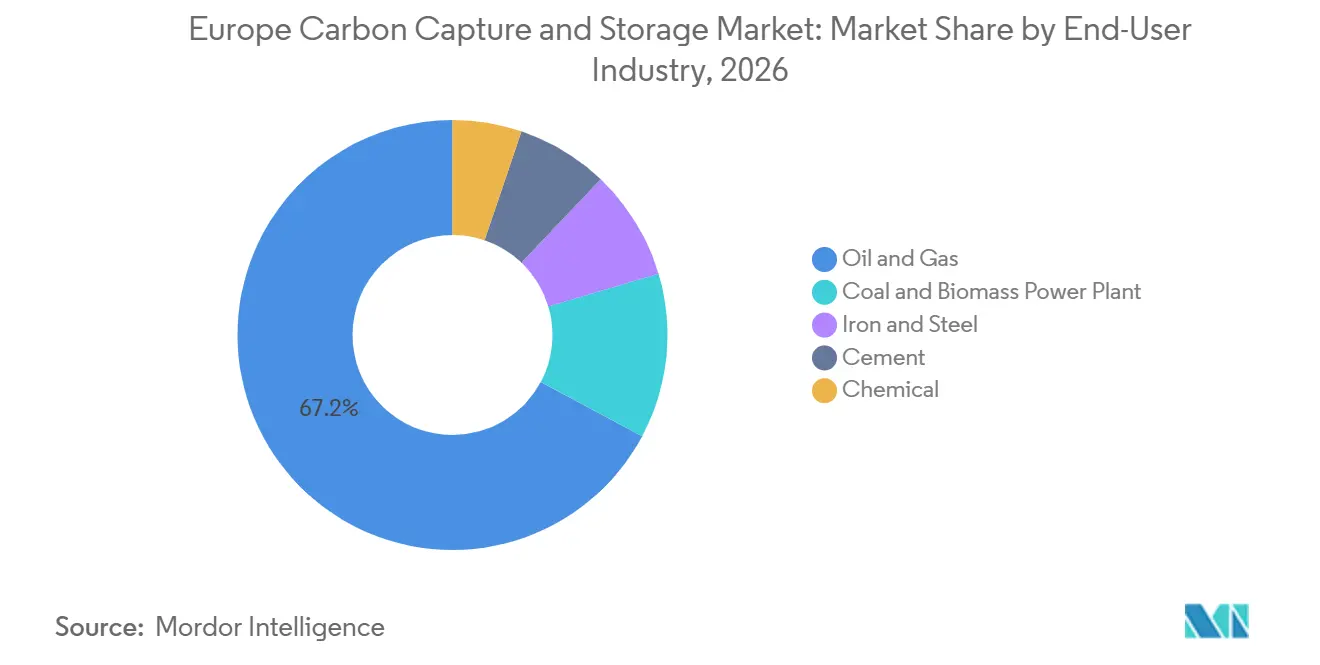
Oil and Gas Anchors Deployment, Cement Broadens DemandOil and gas accounted for 67.2% of the Europe CCS market size in 2026 and is projected to grow at a 27.4% CAGR through 2032. The sector has offshore reservoirs, pipeline experience, subsurface knowledge, and direct obligations under the Net Zero Industry Act (NZIA). Northern Lights, the East Coast Cluster, Liverpool Bay, and Viking CCS reflect the role of energy companies in building third-party storage services. Storage operators can use these assets to serve industrial customers beyond their own facilities. The sector's growth is linked to the 2030 injection-capacity timetable and the need to advance sites from appraisal into operation. Bioenergy facilities present a distinct opportunity, as captured biogenic CO₂ can support permanent carbon removal services. Ørsted's Kalundborg CO₂ Hub uses five Schlumberger Limited (SLB) Capturi units and targets 430,000 tonnes of biogenic CO₂ per year.
Cement has the broadest industrial project pipeline across several European countries. The Europe CCS market is expanding in this segment because cement process emissions are difficult to reduce through fuel switching alone. Brevik established an operating reference point for industrial-scale cement capture in June 2025. The Padeswood project in North Wales entered the execution phase in December 2025 and targets 800,000 tonnes of CO₂ per year. Iron and steel and chemical projects remain at an earlier stage in their deployment cycle. Their investment cases improve where shared networks provide predictable transport and offshore storage access. Certification for permanent carbon removals may also support biomass and cement projects that deliver verifiable geological storage.
Geography Analysis
The United Kingdom held 27.7% of the Europe carbon capture and storage (CCS) market share in 2026 and is projected to grow at a 26.9% CAGR through 2032. Government support has advanced cluster projects around Teesside, Humber, and North Wales. The East Coast Cluster and HyNet reached financial close following the government's funding commitment. The Northern Endurance Partnership is building transport and storage infrastructure for Teesside and Humber emitters. Viking CCS completed its FEED phase in early 2025 and secured development funding approval in July 2026. The United Kingdom holds a strong position as cluster policy, storage resources, and industrial demand are developing in parallel.
Norway is Europe's primary provider of cross-border storage services. Northern Lights started commercial operations in August 2025 with 1.5 million tonnes per year of capacity. Phase 2 is expected to raise injection capacity to at least 5 million tonnes per year by 2028. This expansion is supported by a 15-year agreement with Stockholm Exergi for 900,000 tonnes of biogenic CO2 per year. The Netherlands is also building a major domestic platform through Porthos, which targets 2.5 million tonnes per year of operational capacity in 2026. TNO identified substantial storage potential in Dutch offshore depleted fields and saline aquifers in July 2025. These resources support the planned Aramis development and strengthen the North Sea's role in the Europe CCS market.
Germany, France, Italy, Belgium, and the wider European region are expanding the addressable project base. Germany has significant offshore storage potential in the North Sea, while the Ruhbens corridor provides a route from Ruhr industry to Belgian and North Sea systems. Italy's Ravenna CCS hub has 500 million tonnes of declared reservoir capacity and aims for 4 million tonnes per year by 2030. Belgium is developing Antwerp as a CO2 logistics center through local network operator appointments and an initial pipeline between Zandvliet and Lillo. France and Poland have gained support through cement capture awards. Baltic and Mediterranean projects could widen access beyond the North Sea, but they still require transport links, storage licensing, and common operating rules. Russia has a limited role in the forecast period due to geopolitical constraints that restrict its participation in European value chains.
Competitive Landscape
The Europe carbon capture and storage market has a concentrated storage and transport layer and a more fragmented capture technology layer. Northern Lights, Eni, and Harbour Energy control or are developing a significant share of early commercial storage capacity. These companies hold advantages in licensed sites, subsurface capabilities, infrastructure planning, and customer agreements. Northern Lights is jointly owned by Equinor, Shell, and TotalEnergies and operates as an open-access cross-border system. Eni is developing Ravenna as a Mediterranean storage hub, while Harbour Energy is progressing Viking CCS in the Humber. These positions are difficult to replicate, as a new entrant must secure storage rights, permits, funding, and customer contracts. The Europe CCS market therefore rewards early infrastructure ownership more than equipment supply alone.
Capture, engineering, compression, and transport supply remain more open to competition. Aker Solutions, SLB Capturi, Mitsubishi Heavy Industries, Linde, Fluor, Air Liquide, Siemens Energy, and Technip Energies compete for project delivery roles. Aker Solutions won a FEED contract in March 2026 for a CO2 terminal in Klaipėda, Lithuania. Mitsubishi Heavy Industries and Worley entered the execution phase for the Padeswood cement capture facility in December 2025. Technip Energies and Shell Catalysts and Technologies formed a global alliance in July 2025 for Cansolv carbon capture delivery. These developments indicate that suppliers are combining process technology, engineering, and construction support. Customers favor integrated offerings as they can reduce coordination risk between capture equipment and transport systems.
The most significant gaps remain in southern Europe, the Baltic region, and services for mid-sized emitters. Ravenna supports the Mediterranean, but France, Spain, and Adriatic industrial areas still require broader transport and storage options. The Baltic CCS Consortium is progressing a planned Klaipėda terminal that would provide regional emitters with a shipping route. Standardized modular equipment is also important for facilities that cannot justify a custom large-scale plant. Mitsubishi Heavy Industries expanded its CO2MPACT Full-Module range in August 2026 to include a 450,000-tonne-per-year model. ExxonMobil's Rotterdam carbonate fuel cell pilot targets lean CO2 streams that are harder for conventional systems to address. Companies that can manage permitting, engineering, transport, storage, and monitoring together hold an advantage in the Europe CCS market, as clients seek lower execution risk.
Europe Carbon Capture and Storage Industry Leaders
-
Shell plc
-
Equinor ASA
-
TotalEnergies SE
-
Linde plc
-
Air Products and Chemicals, Inc.
- *Disclaimer: Major Players sorted in no particular order
Europe Carbon Capture and Storage Market Companies Covered in this Report
- Air Liquide S.A.
- Air Products and Chemicals, Inc.
- Aker Solutions ASA
- BP p.l.c.
- Eni S.p.A.
- Equinor ASA
- Exxon Mobil Corporation
- Fluor Corporation
- Fluxys Belgium SA
- Harbour Energy plc
- Heidelberg Materials AG
- Linde plc
- Mitsubishi Heavy Industries, Ltd.
- Ørsted A/S
- Shell plc
- Siemens Energy AG
- SLB (Schlumberger Limited)
- Sulzer Ltd.
- Technip Energies N.V.
- TotalEnergies SE
Recent Industry Developments in Europe Carbon Capture and Storage Market
- October 2026: The European Commission selected Eni and Snam's Ravenna CCS Phase 2 project under the 2025 Innovation Fund Large Scale category. The project aims to reach 4 million tonnes of CO2 storage capacity annually by 2030, with total geological storage potential exceeding 500 million tonnes, positioning Ravenna as a major CCS hub for Southern Europe and the Mediterranean region.
- July 2026: The UK government approved development funding for Harbour Energy's Viking CCS project in the Humber region. The project targets 10 million tonnes of CO2 storage per year by 2030 and holds a verified storage resource of approximately 300 million tonnes, making it one of the UK's largest planned offshore CO2 storage developments.
- March 2026: Fluxys c-grid and Open Grid Europe launched the Ruhbens CO2 Corridor, a cross-border carbon transport network linking Germany's Ruhr industrial region to North Sea storage sites through Belgium's Zeebrugge hub. The planned infrastructure could transport up to 20 million tonnes of CO2 annually, strengthening Europe's CCS value chain.
- March 2026: The Flemish government formally appointed Fluxys c-grid Antwerp as the local CO2 network operator for the Port of Antwerp area. Construction commenced on the first pipeline section between Zandvliet and Lillo, creating foundational infrastructure for large-scale industrial carbon capture and transportation projects.
Europe Carbon Capture and Storage Market Report Scope
A carbon capture and storage (CCS) system is a technology designed to capture carbon dioxide (CO₂) emissions from industrial processes and power generation facilities before they are released into the atmosphere. The captured CO₂ is then transported and permanently stored in deep geological formations such as depleted oil and gas reservoirs, saline aquifers, and unmineable coal seams. CCS plays a critical role in reducing greenhouse gas emissions from hard-to-abate sectors and supports climate change mitigation and net-zero emission goals.
The Europe carbon capture and storage market is segmented by technology, end-user industry, and geography. By technology, the market is segmented into pre-combustion capture, post-combustion capture, and oxy-fuel combustion capture. By end-user industry, the market is segmented into oil and gas, coal and biomass power plants, iron and steel, cement, and chemicals. The report also covers the market size and forecasts for the Europe carbon capture and storage market across 6 countries in the region. For each segment, the market sizing and forecasts are provided on the basis of value (USD).
Segmentation Overview
| Pre-combustion Capture |
| Post-combustion Capture |
| Oxy-fuel Combustion Capture |
| Oil and Gas |
| Coal and Biomass Power Plant |
| Iron and Steel |
| Cement |
| Chemical |
| North America | Germany |
| United Kingdom | |
| France | |
| Norway | |
| Netherlands | |
| Russia | |
| Rest of Europe |
| By Technology | Pre-combustion Capture | |
| Post-combustion Capture | ||
| Oxy-fuel Combustion Capture | ||
| By End-user Industry | Oil and Gas | |
| Coal and Biomass Power Plant | ||
| Iron and Steel | ||
| Cement | ||
| Chemical | ||
| By Geography | North America | Germany |
| United Kingdom | ||
| France | ||
| Norway | ||
| Netherlands | ||
| Russia | ||
| Rest of Europe | ||
Key Questions Answered in the Report
How large is the Europe carbon capture and storage market in 2026?
The Europe carbon capture and storage market size is USD 0.85 billion in 2026 and is forecast to reach USD 3.23 billion by 2032 at a 26.12% CAGR.
Which technology currently leads carbon capture and storage deployment in Europe?
Pre-combustion capture held 79.3% of revenue in 2026, as concentrated CO₂ streams are common in gas processing and blue hydrogen production.
Which carbon capture and storage technology is growing fastest in Europe?
Oxy-fuel combustion capture is forecast to grow at a 29.3% CAGR through 2032, supported by cement projects.
Why is the United Kingdom important for carbon capture and storage (CCS)?
The United Kingdom held 27.7% of regional revenue in 2026 and has advanced major cluster projects in Teesside, Humber, and North Wales.
What are the main barriers to carbon capture and storage (CCS) projects?
High capital requirements, capture energy use, permitting delays, cross-border regulations, and liability uncertainty can slow project decisions.
Which companies are active in European carbon capture and storage (CCS)?
Infrastructure developers include Equinor, Shell, TotalEnergies, Eni, and Harbour Energy, while technology and equipment suppliers include Aker Solutions, SLB Capturi, Mitsubishi Heavy Industries, Air Liquide, Linde, and Technip Energies.