
Europe Building Inspection Services Market Size and Share
Market Overview
| Study Period | 2020 - 2031 |
|---|---|
| Forecast Data Period | 2026 - 2031 |
| Base Year Market Size (2025) | USD 2.34 Billion |
| Market Size (2026) | USD 2.51 Billion |
| Market Size (2031) | USD 3.56 Billion |
| Growth Rate (2026 - 2031) | 7.24 % |
| Market Concentration | Medium |
Major Players *Disclaimer: Major Players sorted in no particular order Image © Mordor Intelligence. Reuse requires attribution under CC BY 4.0. | |
Europe Building Inspection Services Market Analysis by Mordor Intelligence
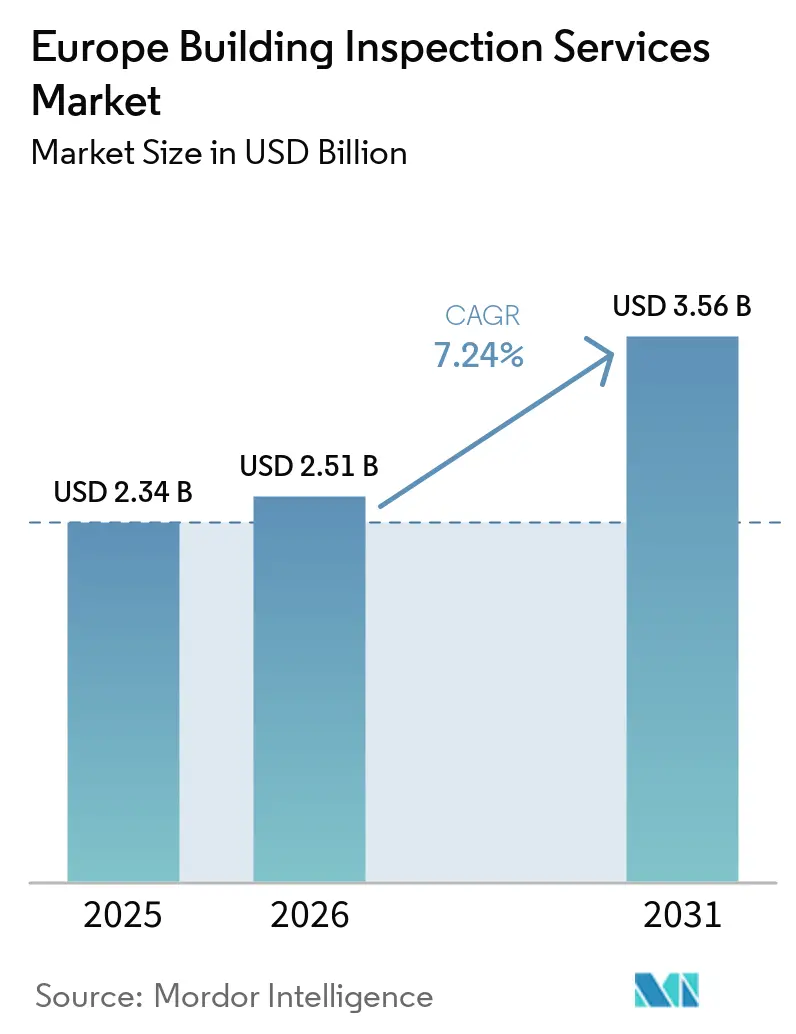
The Europe Building Inspection Services Market size is projected to expand from USD 2.34 billion in 2025 and USD 2.51 billion in 2026 to USD 3.56 billion by 2031, registering a CAGR of 7.24% between 2026 and 2031.
The Europe building inspection services market is being shaped by energy rules that move inspection work from discretionary maintenance toward documented compliance. The recast Energy Performance of Buildings Directive requires national implementation by May 2026, which gives providers a clearer pipeline of certification and reassessment work. Older buildings remain the central source of demand because 85% of EU buildings were constructed before 2000, and 75% have poor energy performance. The Europe building inspection services market also benefits when investors, public bodies, and property managers need consistent asset information for renovation plans. Service providers with qualified specialists, country-level compliance knowledge, and digital survey capabilities are better placed to capture recurring assignments. Labor shortages and differing national approval rules may limit delivery capacity, especially where regulations take effect quickly.
Key Report Takeaways
- By service, specific element inspection services held 41.8% of the Europe building inspection services market share in 2025, while other specialized services are forecast to grow at a 9.3% CAGR through 2031.
- By sourcing type, in-house services held 54.9% of the Europe building inspection services market share in 2025, while outsourced services are forecast to grow at an 8.6% CAGR through 2031.
- By application, residential properties accounted for 49.7% of the Europe building inspection services market size in 2025, while commercial properties are forecast to grow at an 8.2% CAGR through 2031.
- By end user, property owners and investors held 34.6% of Europe building inspection services market revenue in 2025, while government and municipalities are forecast to grow at a 9.1% CAGR through 2031.
- By geography, Germany held 22.4% of Europe building inspection services market revenue in 2025, while the Rest of Europe is forecast to grow at an 8.1% CAGR through 2031.
Note: Market size and forecast figures in this report are generated using Mordor Intelligence’s proprietary estimation framework, updated with the latest available data and insights as of January 2026.
Europe Building Inspection Services Market Trends and Insights
Drivers Impact Analysis*
| Drivers | (~) % Impact on CAGR Forecast | Geographic Relevance | Impact Timeline |
|---|---|---|---|
| Energy Performance and Renovation Obligations | +2.1% | EU-wide, strongest in Germany, France, the Netherlands, Italy | Medium term (2-4 years) |
| Fire and Building Safety Oversight | +1.5% | UK, EU-wide | Short term (≤ 2 years) |
| Aging Building Stock | +1.2% | Western and Southern Europe | Long term (≥ 4 years) |
| Green Building and Carbon Reporting Requirements | +1.0% | EU-wide, concentrated in large listed property owners | Medium term (2-4 years) |
| Digital Building Logbooks and Renovation Passports | +0.6% | EU-wide, early adoption in the Netherlands and Germany | Short term (≤ 2 years) |
| Cross-Border Asset Management by Institutional Owners | +0.4% | Germany, France, UK, Netherlands | Long term (≥ 4 years) |
| Source: Mordor Intelligence | |||
Energy Performance and Building Renovation Obligations
The Europe building inspection services market gains demand from minimum energy performance standards for non-residential buildings. The recast directive requires the worst-performing 16% of non-residential stock to be renovated by 2030. It also sets a 2033 target for the worst-performing 26% of that stock. Member states must submit national building renovation plans by December 2026, creating a need for baseline assessments and documented building data[1]. A major renovation generally requires a renewed energy performance certificate, which can create repeat work for assessors. Italy updated its energy-performance calculation methods in October 2025, adding rigor to inspections of heating, ventilation, and air-conditioning systems[2].
Fire and Building Safety Oversight
Fire and safety rules create inspection needs that are separate from energy upgrades. In the United Kingdom, local authorities have faced shortages of inspectors certified by the Building Safety Regulator. German technical experts inspected 70,447 safety-relevant building systems in 2024. They identified major defects in 27% of inspected systems and minor defects in 44%[3]. France introduced cable classification requirements for new or renovated buildings with planning applications submitted after May 2025. These requirements add inspection and certification work before installation. The revised Construction Products Regulation broadens attention to product-level information and environmental documentation within building projects.
Aging Building Stock
Older assets provide a long-term basis for the Europe building inspection services market. The input data shows that 35% of EU buildings are more than 50 years old. Germany’s renovation rate was 0.7% in 2024, below the 2% rate cited as necessary for EU climate objectives. This gap leaves a large stock requiring diagnosis before repair, energy upgrades, or safety remediation. Italy opened applications in September 2025 for a USD 1.5 billion social-housing energy-efficiency program. Participating buildings require pre- and post-renovation audits and must achieve at least a 30% energy improvement. The resulting work is linked to the physical condition of assets rather than only to short-term construction cycles.
Green Building and Carbon Reporting Requirements
Carbon reporting requirements expand the information expected from property assessments. The Corporate Sustainability Reporting Directive required covered companies to report financial year 2024 data in 2025. Property owners, therefore, need traceable data on energy use, building condition, and emissions. Such requirements can widen a conventional survey into a broader review of operational and embodied carbon. This supports work in certification, carbon verification, and technical building assessment. SOCOTEC Italia acquired Greenwich in 2025 to add green-building certification and environmental, social, and governance services. Digital building logbooks and renovation passports reinforce this shift by requiring structured site information that can be updated over an asset’s life.
Restraints Impact Analysis*
| Restraints | (~) % Impact on CAGR Forecast | Geographic Relevance | Impact Timeline |
|---|---|---|---|
| Shortage of Qualified Inspectors and Energy Specialists | -0.9% | EU-wide, most acute in the UK, Germany, and France | Short term (≤ 2 years) |
| Divergent National Standards and Approval Procedures | -0.6% | Cross-border, especially DACH, Mediterranean, and Nordic countries | Medium term (2-4 years) |
| Building Data Protection and Governance Risk | -0.3% | EU-wide | Medium term (2-4 years) |
| Cost of Advanced Inspection Equipment and Software | -0.2% | Emerging and smaller European economies | Long term (≥ 4 years) |
| Source: Mordor Intelligence | |||
Shortage of Qualified Inspectors and Energy Specialists
The supply of qualified personnel is a direct constraint on the Europe building inspection services market. The EU LIFE program updated skills roadmaps in 15 member states after consultations with more than 6,000 organizations. Scotland reported a 52-post staffing gap in building standards services during 2025. Its workforce report projected a gap of 120 staff by 2028 and 144 staff by 2035. Nearly 46.5% of its current workforce was aged over 50, raising the risk of retirement-related losses. Providers may face longer scheduling periods and higher retention costs when certified expertise is scarce. Training programs can reduce this pressure, but they require time before new specialists can conduct regulated work.
Divergent National Standards and Approval Procedures
National differences make cross-border delivery more difficult for inspection providers. Requirements vary across energy certificates, fire classifications, data handling, and assessor accreditation. France extended compliance deadlines for some building automation and temperature-control systems from 2027 to 2030 in December 2025. Research on renovation passports also identifies inconsistent rights management as a barrier to a common lifecycle system. Building data governance can slow the sharing of inspection records between owners, assessors, and public bodies. Smaller providers can also find drone systems, thermal imaging, modeling software, and qualified staff expensive to obtain. These conditions favor firms with established local teams, broader technical resources, and compliance processes across several countries.
*Our forecasts treat driver/restraint impacts as directional, not additive. The impact forecasts reflect baseline growth, mix effects, and variable interactions.
Segment Analysis
By Service: Specific Element Expertise Supports Revenue While Specialized Work Grows
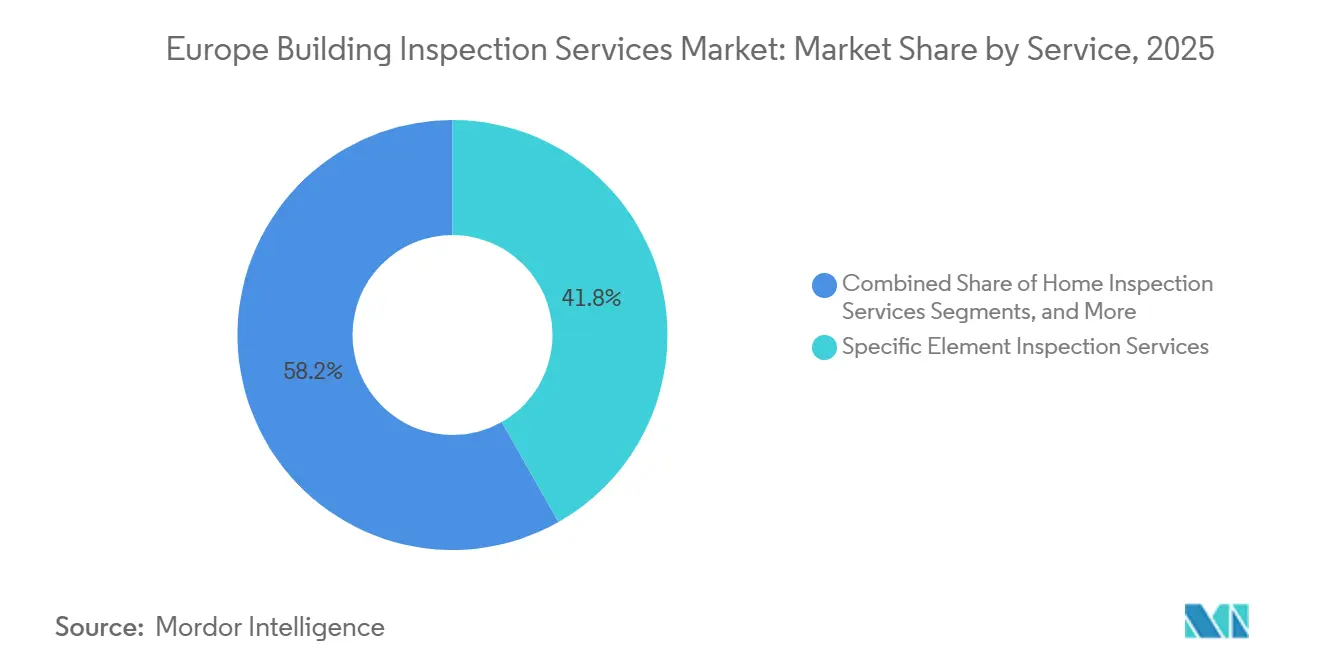
Specific element inspection services captured 41.8% of revenue in 2025, making them the largest service category in the Europe building inspection services market. The category covers detailed assessments of structural components, heating, ventilation, and air-conditioning systems, electrical installations, and facades. Its scale reflects the need for evidence at the level of individual systems and building elements. These examinations support certificates, maintenance decisions, renovation design, and corrective action. The Europe building inspection services industry depends on personnel who can interpret building conditions and regulatory requirements together.
Other specialized services are forecast to grow at a 9.3% CAGR through 2031. This category includes drone-based facade diagnostics, indoor air-quality testing, acoustic surveys, and digital condition monitoring. Kiwa’s Building Scan service uses drones, three-dimensional models, and automated analysis to identify cracks, erosion, and concrete deterioration. France’s collective energy performance certificate requirements also support continued work in residential assessments. The Europe building inspection services market benefits when these tools complement professional judgment rather than replace it.

By Sourcing Type: In-House Capacity Remains Important While Outsourcing Expands
In-house services held 54.9% of revenue in 2025, retaining the largest position within the Europe building inspection services market. Government bodies, utilities, and public real estate operators often keep inspection capability internally to manage liability and sensitive asset information. Internal teams can maintain familiarity with building portfolios and local operating procedures. They can coordinate routine inspections with wider facilities management duties. This model does not remove the need for external specialists when projects require advanced technical capabilities.
Outsourced services are forecast to advance at an 8.6% CAGR through 2031. Thermal imaging, drone surveys, carbon assessments, and complex heating, ventilation, and air-conditioning audits can exceed the capacity of general internal teams. SOCOTEC secured a 6-year contract in September 2025 to conduct more than 100,000 inspections in Groningen and Drenthe from 2026. Many large owners are likely to keep an internal coordination role while purchasing specialized work externally. This approach can increase the inspections completed for each asset instead of merely moving work between providers.
By Application: Residential Demand Leads While Commercial Compliance Grows Faster
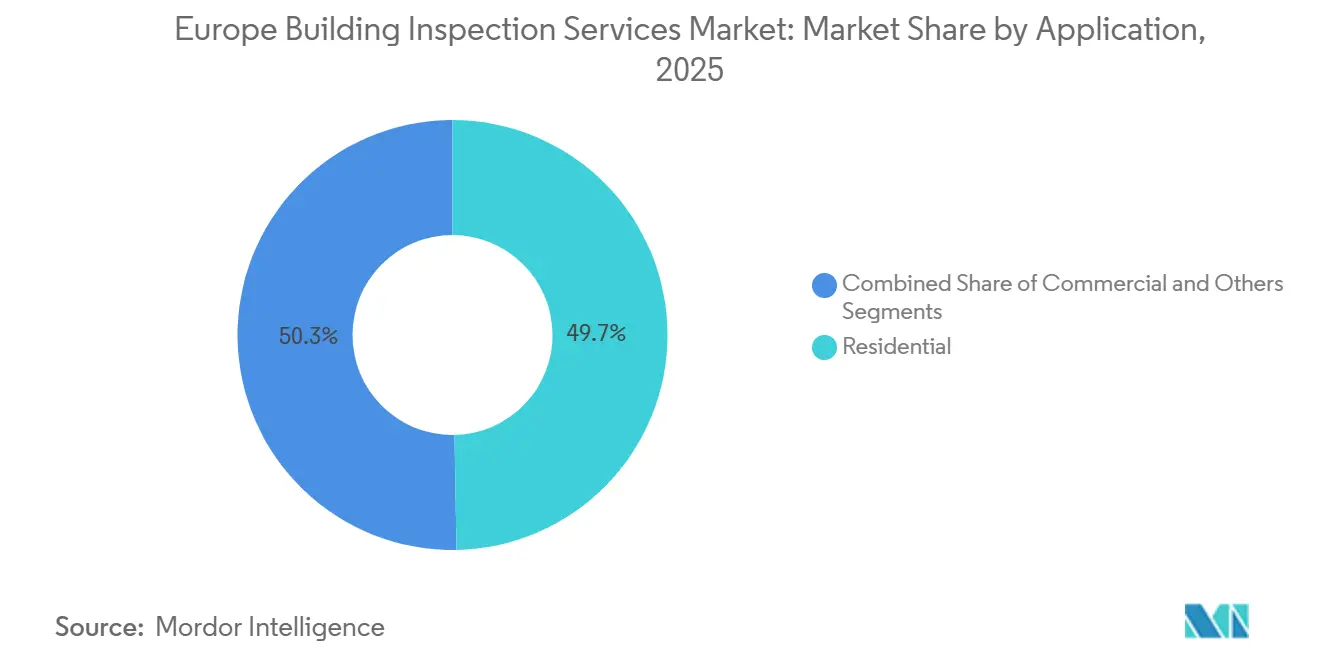
Residential properties represented 49.7% of revenue in 2025 and formed the largest application area. Existing housing stock requires inspections for sale, rental, energy performance, renovation, and common building systems. This high volume supports a wide base of routine and technical assignments. The recast directive focuses on improving existing buildings, which maintains attention on residential properties. Social-housing renovation programs add further need for before-and-after assessment.
Commercial properties are forecast to record an 8.2% CAGR through 2031. The worst-performing 16% of non-residential stock must meet renovation requirements by 2030, with broader coverage by 2033. Commercial owners also need information for sustainability reporting, financing, asset transactions, and operational planning. Other applications include industrial sites, public infrastructure, and mixed-use properties. RINA Prime Value Services received authorization in 2025 to conduct structural diagnostics, seismic assessments, and material testing on existing Italian buildings and infrastructure.
By End User: Property Owners Lead, While Public Bodies Have the Strongest Growth Rate
Property owners and investors held 34.6% of 2025 revenue, the largest end-user position. They use inspection reports to support acquisitions, financing, renovation plans, insurance decisions, and portfolio maintenance. Their need for consistent asset information is reinforced by reporting rules and lender expectations. Cross-border ownership can increase the value of common processes and comparable survey outputs. It remains a core customer base for the Europe building inspection services industry.
Government and municipalities are forecast to grow at a 9.1% CAGR through 2031. Public renovation programs, social-housing upgrades, and building-safety enforcement create structured inspection demand. Facility-management firms, insurers, brokers, and financial institutions form additional demand channels. Heating, ventilation, and air-conditioning systems are subject to periodic inspection requirements under the recast directive. Inspection providers can reach these users through direct contracts and facility-management relationships.
Geography Analysis
Germany held 22.4% of 2025 revenue, making it the largest national part of the Europe building inspection services market. The country has established inspection institutions through TÜV and DEKRA networks. The United Kingdom faces additional safety-related work under its post-Grenfell framework. Italy’s social-housing program requires verified energy gains and pre- and post-renovation audits.
The Netherlands and Scandinavian countries provide a demand for technically advanced building assessment. The Groningen mining-damage program will involve more than 100,000 inspections beginning in 2026. TÜV SÜD acquired Domutech in 2024 to establish building lifecycle services in Denmark. The transaction reflected interest in property inspection, energy certificates, and digital lifecycle services. Russia remains outside the EU regulatory framework, which limits its integration with EU-wide inspection rules.
The rest of Europe is forecast to grow at an 8.1% CAGR through 2031, the fastest geographic rate. EU-funded programs can require certified compliance with energy and quality standards before funds are released. The EU LIFE BUILD UP Skills initiative delivered updated roadmaps across 15 member states during 2024 and 2025. This can improve service availability where qualified workforce capacity expands.
Competitive Landscape
The Europe building inspection services market has moderate concentration. Large testing, inspection, and certification groups maintain pan-European client relationships and country-level compliance resources. Relevant groups include SGS, Bureau Veritas, Intertek, DEKRA, TÜV SÜD, TÜV Rheinland, SOCOTEC, and DNV. National specialists, including RINA, Kiwa, Applus+, and Eurofins, retain strong positions in selected countries and technical niches. Local providers remain relevant because fire safety, energy assessments, geotechnics, and building data practices are country-specific.
Strategic activity focuses on technical capability and selected geographic expansion. Bureau Veritas agreed in January 2025 to acquire Contec AQS and related Italian businesses, adding 190 experts and reporting 2024 revenue of USD 33 million. It agreed to acquire Lotusworks in April 2026 to expand its position in mission-critical facilities. Kiwa partnered with DronePort Rotterdam to combine drones, automated classification, and three-dimensional condition models. RINA became an accredited Building Resilience Index verification provider in September 2025.
SOCOTEC reported a 2024 turnover of USD 1.8 billion across 27 countries and continued country-level acquisitions. Its acquisition of Greenwich in Italy added green-building certification and sustainability services. The Europe building inspection services market remains open to smaller providers with recognized expertise or established local relationships. Larger providers retain an advantage in assignments spanning multiple jurisdictions or technical disciplines.
Recent Industry Developments
- September 2026: Bureau Veritas completed its recommended cash acquisition scheme for Intertek Group plc by EQT X funds, with minority participation from Luxinva and Mubadala, announced in June 2026, consolidating a leading testing, inspection, and certification firm with European building inspection capabilities into a private equity-backed platform focused on long-term growth in mandated inspection services.
- June 2026: CERTANIA Gruppe acquired Van Santen Advies, a Netherlands-based specialist in asbestos compliance and building inspections, expanding its Buildings and Infrastructure portfolio in the Dutch market.
- April 2026: Bureau Veritas agreed to acquire Lotusworks, a global provider of mission-critical asset commissioning and quality assurance, establishing a platform representing 15% of its Buildings and Infrastructure division.
Europe Building Inspection Services Market Report Scope
| Home Inspection Services |
| Specific Element Inspection Services |
| Commercial Building Inspection Services |
| Other Specialised Services |
| In-House Services |
| Outsourced Services |
| Residential |
| Commercial |
| Other Applications |
| Real-Estate Agencies and Brokers |
| Property Owners and Investors |
| Government and Municipalities |
| Insurance and Financial Institutions |
| Facility-Management Firms |
| United Kingdom |
| Germany |
| France |
| Italy |
| Spain |
| Netherlands |
| Russia |
| Rest of Europe |
| By Service | Home Inspection Services |
| Specific Element Inspection Services | |
| Commercial Building Inspection Services | |
| Other Specialised Services | |
| By Sourcing Type | In-House Services |
| Outsourced Services | |
| By Application | Residential |
| Commercial | |
| Other Applications | |
| By End User | Real-Estate Agencies and Brokers |
| Property Owners and Investors | |
| Government and Municipalities | |
| Insurance and Financial Institutions | |
| Facility-Management Firms | |
| By Countries | United Kingdom |
| Germany | |
| France | |
| Italy | |
| Spain | |
| Netherlands | |
| Russia | |
| Rest of Europe |
Key Questions Answered in the Report
What is driving demand for building inspection services in Europe?
Energy performance requirements, safety oversight, older building stock, and reporting needs are increasing the use of documented inspections.
How large is the Europe building inspection services market?
It is estimated at USD 2.51 billion in 2026 and is projected to reach USD 3.56 billion by 2031, growing at a 7.24% CAGR.
Which service category leads revenue?
Specific element inspection services led with 41.8% of 2025 revenue, supported by demand for system- and component-level assessments.
Which application is growing fastest?
Commercial properties are forecast to grow at an 8.2% CAGR through 2031 as compliance deadlines expand inspection needs.
Which end user will grow fastest?
Government and municipalities are forecast to grow at a 9.1% CAGR through 2031, supported by public renovation and safety programs.
Which geography is expanding fastest?
The rest of Europe is forecast to grow at an 8.1% CAGR through 2031 as funded renovation programs introduce structured compliance requirements.