
Europe Biopesticides and Biofertilizers Market Size and Share
Market Overview
| Study Period | 2022 - 2032 |
|---|---|
| Forecast Data Period | 2027 - 2032 |
| Base Year Market Size (2026) | USD 2.93 Billion |
| Market Size (2027) | USD 3.23 Billion |
| Market Size (2032) | USD 5.31 Billion |
| Growth Rate (2027 - 2032) | 10.45 % |
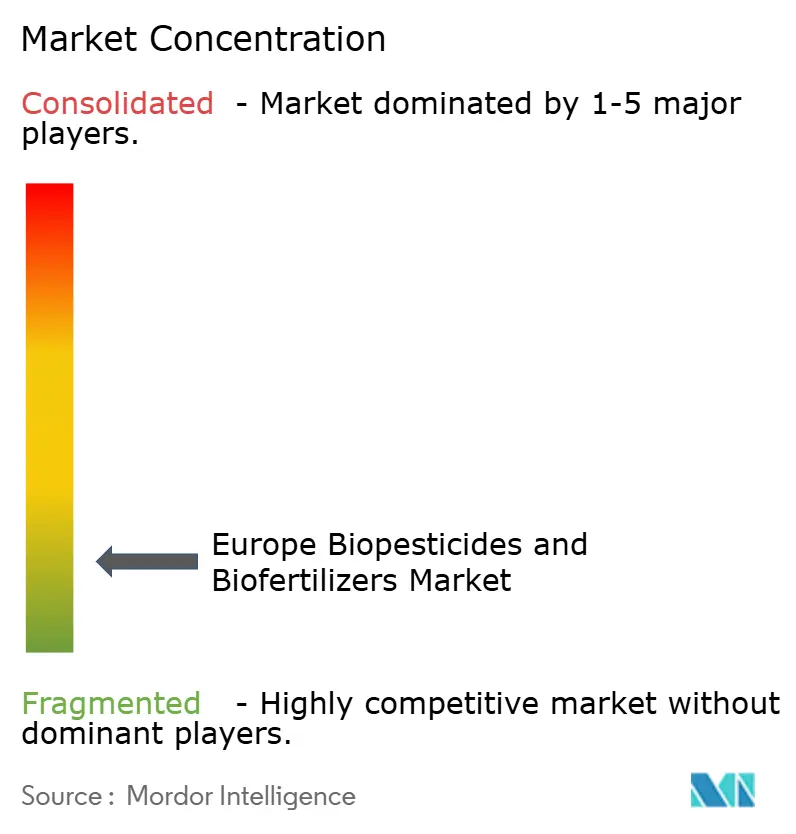
| Market Concentration | Low |
Major Players *Disclaimer: Major Players sorted in no particular order Image © Mordor Intelligence. Reuse requires attribution under CC BY 4.0. | |
Europe Biopesticides and Biofertilizers Market Analysis by Mordor Intelligence
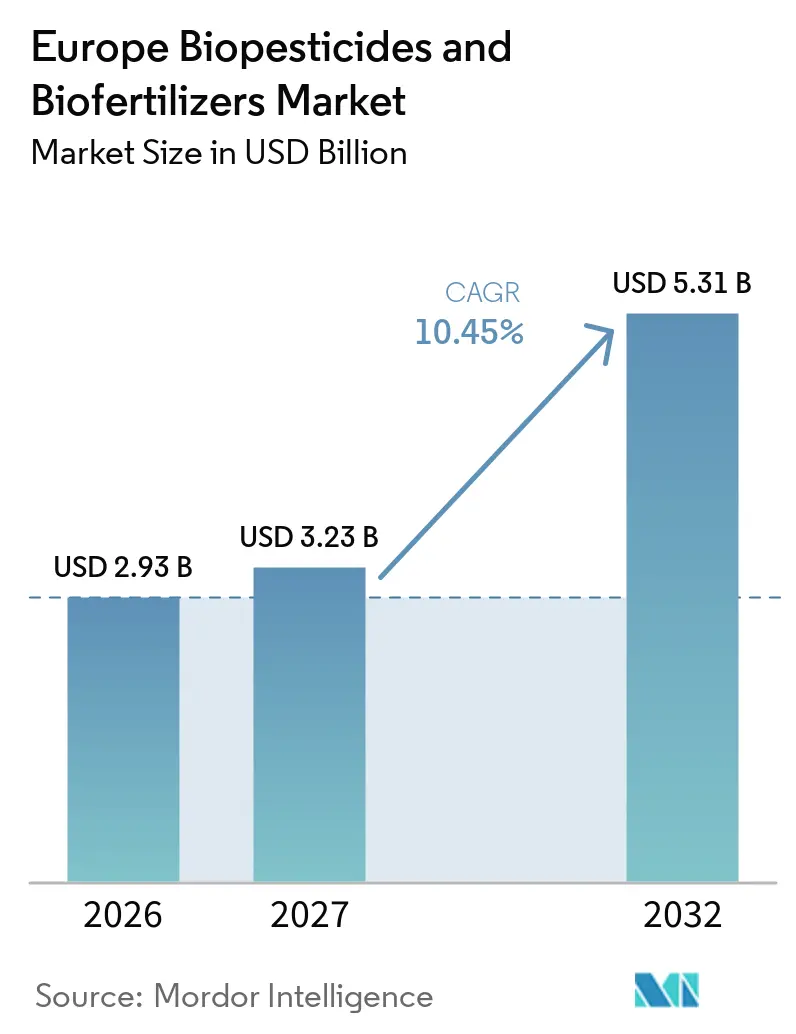
The Europe biopesticides and biofertilizers market size was valued at USD 2.93 billion in 2026 and is forecast to grow from USD 3.23 billion in 2027 to USD 5.31 billion by 2032, at a CAGR of 10.45% from 2027 to 2032. Tighter regulations on synthetic crop protection products and demand for residue-compliant produce are shaping the market. Proposed changes to European Union food and feed safety rules aim to clarify definitions of biocontrol and accelerate market access for biological products[1]. Resistance to established crop protection tools is also increasing the relevance of biological products in integrated pest management programs. The market presents opportunities for suppliers offering reliable field support, stable formulations, and products that meet local registration requirements. Larger crop-input companies are expanding their biological portfolios, while specialist suppliers compete through crop knowledge and grower relationships.
Key Report Takeaways
- By product type, biopesticides accounted for 76% of the market share in 2026, while biofertilizers are forecast to grow at an 11.4% CAGR from 2027 to 2032.
- By crop type, row crops accounted for 75% of the Europe biopesticides and biofertilizers market share in 2026, while horticultural crops are forecast to grow at an 11.9% CAGR from 2027 to 2032.
- By geography, France accounted for 18% of the Europe biopesticides and biofertilizers market size in 2026, while Spain is forecast to grow at a 13.4% CAGR from 2027 to 2032.
Note: Market numbers in this report are based on Mordor Intelligence's proprietary estimation framework, which combines nine months of actuals with Q4 projections for base year 2026.
Europe Biopesticides and Biofertilizers Market Trends and Insights
Drivers Impact Analysis*
| Driver | (~) % Impact on CAGR Forecast | Geographic Relevance | Impact Timeline |
|---|---|---|---|
| EU Regulatory Reforms to Facilitate Biocontrol Product Authorization | +3.0% | Global, with highest intensity in EU, France, Germany, Italy, Spain, United Kingdom | Short term (≤ 2 years) |
| Expansion of Organic Farming and Residue-Sensitive Crop Production | +2.0% | EU core, France, Germany, Italy, Spain, Netherlands | Medium term (2-4 years) |
| Growing Need for Resistance Management and Alternative Crop Protection Solutions | +1.5% | France, Spain, Italy, Germany, with spillover to Rest of Europe | Medium term (2-4 years) |
| Public Incentives and Regulatory Support for Biological Inputs | +1.2% | Germany, France, Italy, United Kingdom | Medium term (2-4 years) |
| Increasing Adoption of Microbial Solutions for Crop Stress Management | +0.8% | Spain, Italy, France | Long term (≥ 4 years) |
| Advances in Microbial Fermentation and Discovery Technologies | +0.7% | Germany, Netherlands, United Kingdom | Long term (≥ 4 years) |
| Source: Mordor Intelligence | |||
EU Regulatory Reforms to Facilitate Biocontrol Product Authorization
The Europe biopesticides and biofertilizers market may benefit from proposed European Union regulatory reforms aimed at accelerating access to biological crop protection products. The European Commission's December 2025 Food and Feed Safety Simplification Package proposes a clearer definition of biocontrol substances, prioritized assessment procedures, and provisional authorizations for eligible products under specified conditions. The proposal also seeks to streamline authorization and mutual recognition procedures. If adopted and implemented, these measures could reduce regulatory delays and improve access to biological crop protection solutions, although the timing and extent of their impact will depend on the final legislative provisions and implementation.
Expansion of Organic Farming and Residue-Sensitive Crop Production
Organic and residue-sensitive production creates recurring demand for biological inputs. Regulation (EU) 2018/848 restricts the use of external inputs in organic production and permits only authorized products and substances for specified uses, making eligible alternatives important for these farms[2]. Export-oriented growers also face customer requirements on pesticide residues and must protect commercial access when those standards become part of retail procurement conditions. These requirements are relevant for horticultural and viticultural supply chains serving Japanese, Gulf, and North American buyers. Spanish horticultural exporters and French wine producers face buyer scrutiny over production practices and residue compliance. The Europe biopesticides and biofertilizers market can therefore extend beyond formally certified organic farms, as conventional growers also seek biological inputs to meet customer requirements and support residue-management practices.
Growing Need for Resistance Management and Alternative Crop Protection Solutions
The Europe biopesticides and biofertilizers market is supported by resistance management needs in major field crops. Research published in iScience in 2025 reported reduced sensitivity to established synthetic chemistry against Septoria tritici blotch across European wheat systems[3]. The loss of fungicide efficacy against resistant pathogen populations makes rotation with biological tools more valuable, especially where growers must protect performance over several cropping cycles. Biofungicides and bioinsecticides can support integrated pest management programs where growers need more than one control method and cannot rely on a single chemical class. This driver is rooted in farm performance rather than policy compliance alone and can therefore remain relevant during periods of weaker commodity prices, when growers continue to weigh product reliability against input costs and seek effective options to sustain crop protection over successive growing seasons.
Public Incentives and Regulatory Support for Biological Inputs
Eco-schemes under the Common Agricultural Policy can improve the economics of biological inputs. National programs in Germany, France, Italy, and the United Kingdom also encourage integrated pest management. The 2025 Omnibus proposal would allow provisional authorizations for products containing new biocontrol substances, addressing delays between active substance approval and national product authorization. Smaller specialist suppliers may benefit, as they often rely on a limited product range and have fewer resources to manage lengthy regulatory procedures. In the Europe biopesticides and biofertilizers market, streamlined authorization processes could reduce regulatory delays and the costs associated with maintaining product dossiers before commercialization, improving market access for eligible biological crop protection products.
Restraints Impact Analysis*
| Restraint | (~) % Impact on CAGR Forecast | Geographic Relevance | Impact Timeline |
|---|---|---|---|
| Higher Application Costs Compared with Conventional Synthetic Inputs | -2.0% | Spain, Italy, France, Germany, most pronounced in row-crop commodity systems | Short term (≤ 2 years) |
| Variable Field Performance Across Agronomic Conditions | -1.8% | All priority countries, most pronounced in continental and Nordic climates | Medium term (2-4 years) |
| Fragmented Country-Level Registration and Evidence Requirements | -1.2% | Germany, France, Italy, Spain, United Kingdom | Short term (≤ 2 years) |
| Shelf Life, Storage, and Cold-Chain Sensitivity | -0.8% | Spain, Italy, France, United Kingdom, decentralized rural distribution networks | Medium term (2-4 years) |
| Source: Mordor Intelligence | |||
Higher Application Costs Compared with Conventional Synthetic Inputs
Biological inputs can cost more per hectare than established synthetic products. They may require multiple applications, careful timing, and additional advisory support before growers achieve consistent efficacy, which makes comparisons based solely on product price misleading. This is a significant concern for wheat, barley, and maize growers operating with narrow margins and limited tolerance for uncertain purchasing decisions. Large operators in France and Germany can sometimes offset higher unit costs through efficient application logistics and lower resistance-management spending across multiple seasons. Smaller farms in southern and eastern Europe face a greater burden when trialing a new program on only part of their cultivated area. In the Europe biopesticides and biofertilizers market, suppliers that demonstrate cost-effectiveness over the full growing season, including application frequency and potential agronomic benefits, can strengthen the case for adoption in commodity crops.
Variable Field Performance Across Agronomic Conditions
Microbial performance is affected by soil pH, organic matter, temperature, moisture, application method, and the existing site microbiome. These variables make consistent performance difficult to establish across Europe's diverse soil and climate conditions, including continental and Nordic regions, where seasonal conditions can differ sharply. A 2025 academic review published in BioControl found that current European Union regulations do not fully capture the complexity of microbial plant protection products. Variable results can make growers reluctant to repurchase a product after an unsuccessful season that causes visible crop damage or lower yields. Precision application and practical crop advice can improve product placement, timing, and reliability by linking product use to local agronomic conditions. The Europe biopesticides and biofertilizers market therefore requires robust, location-specific field evidence and practical guidance to help growers assess product performance under their own agronomic conditions and make informed repeat-purchase decisions.
*Our forecasts treat driver/restraint impacts as directional, not additive. The impact forecasts reflect baseline growth, mix effects, and variable interactions.
Segment Analysis
By Product Type: Biopesticides Dominate, While Biofertilizers Register the Fastest Growth
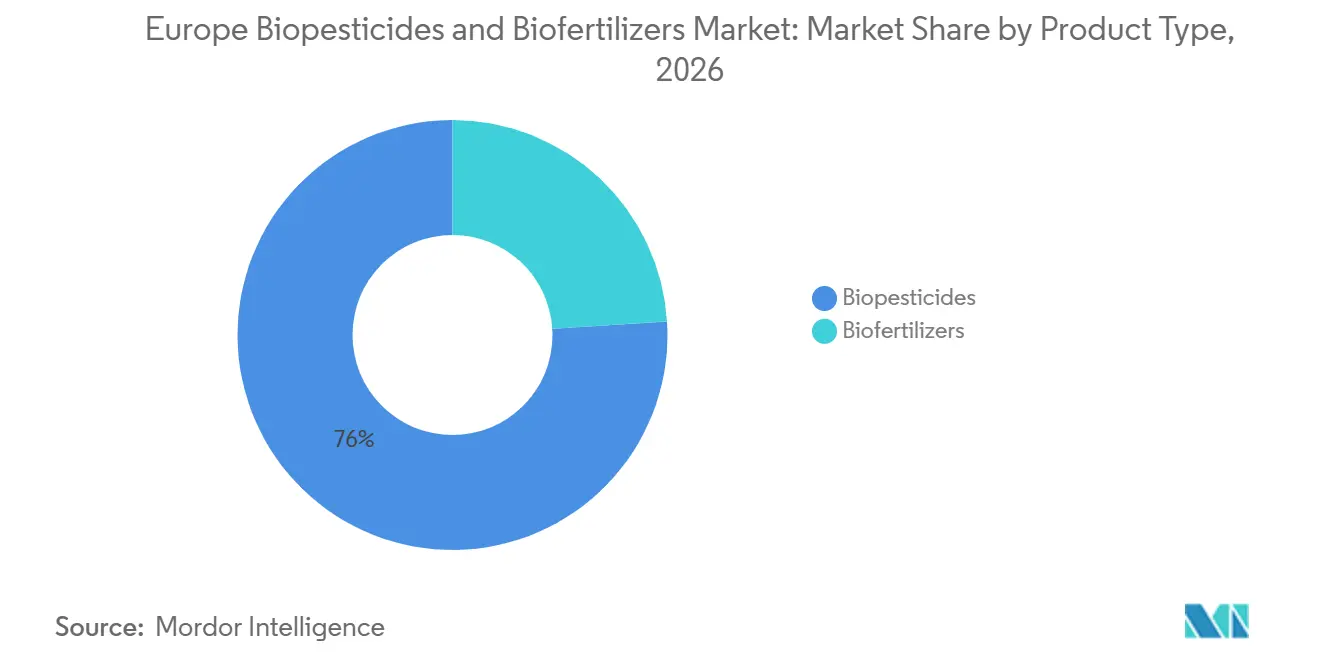
Biopesticides held 76% of the Europe biopesticides and biofertilizers market share in 2026. Their position reflects established sales channels for bioinsecticides, biofungicides, and bionematicides. Bioinsecticides are used against aphids, whitefly, and lepidopteran pests across several crop systems, while biofungicides address soil-borne and foliar diseases in high-value crops. Bacillus- and Trichoderma-based products and entomopathogenic fungal products have supported commercial adoption on European farms. Bioherbicides remain less established due to narrow selectivity windows and a limited list of registered active substances for biological weed control. Their limited presence creates an opening for products with stronger crop safety and more reliable field performance. Bionematicides and RNA interference-based products are also receiving increased attention for registration as synthetic nematicide options decline.
Biofertilizers are forecast to grow at a CAGR of 11.4% from 2027 to 2032. Nitrogen-fixing strains such as Azospirillum, Azotobacter, and Rhizobium are being adopted in cereal and legume rotations. Phosphorus-solubilizing bacteria are also relevant where growers seek to reduce mineral fertilizer use without compromising crop establishment. Mycorrhizal products are particularly relevant to horticulture and tree crops facing water stress under Mediterranean conditions. In 2025, Corteva Agriscience signed a European distribution agreement with Simbiose for a phosphorus-solubilization biofertilizer, subject to regulatory approval. The European Biostimulant Industry Council reported that 63% of its members were blocked from registration under Component Material Category 7. This category currently permits only four microbial types, which limits the pace at which new microbial products can reach the Europe biopesticides and biofertilizers market.

By Crop Type: Row Crops Dominate, While Horticultural Crops Register the Fastest Growth
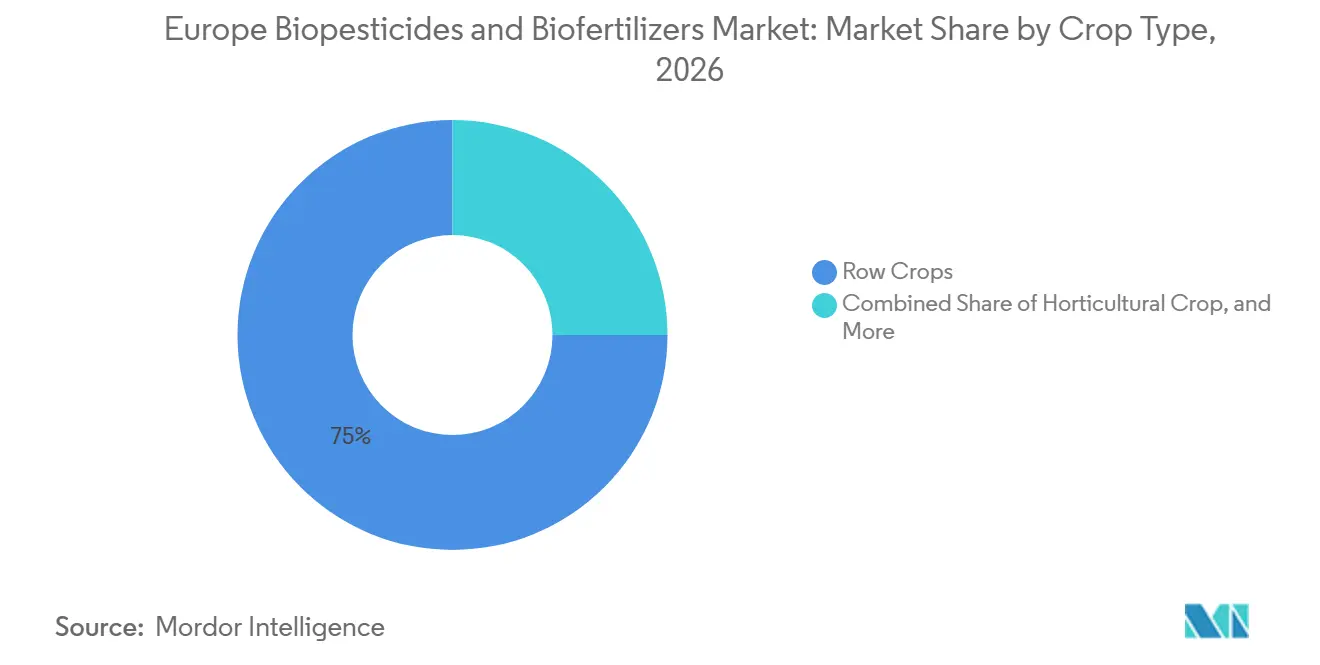
Row crops accounted for 75% of the Europe biopesticides and biofertilizers market size in 2026. Cereals, oilseeds, and legumes cover extensive acreage across continental Europe, supporting demand for seed-applied inoculants and biological rotation products. Phosphorus-solubilizing bacteria and rhizobial inoculants are gaining interest in wheat and barley systems, with a value proposition centered on nutrient efficiency and potential input-cost savings. Cash crops such as sugar beet, industrial hemp, and tobacco represent a smaller opportunity. Sustainability requirements from European food and beverage manufacturers are increasing interest in biological protocols for these crops.
Horticultural crops are forecast to grow at an 11.9% CAGR from 2027 to 2032. Greenhouse tomato, pepper, cucumber, and soft-fruit systems incorporate biological products into regular crop management. Protected cultivation allows tighter application control and planned biocontrol release cycles, making residue-free certification and integrated pest management protocols commercially important. The higher value of fresh produce can make input cost less decisive than product quality and buyer access. The Netherlands, Spain, and Belgium are important centers for this model. Buyer codes can encourage biological programs ahead of new legal requirements. The Europe biopesticides and biofertilizers market can expand further as data from these programs improves grower confidence and standardizes agronomic practice.
Geography Analysis
France held 18% of the Europe biopesticides and biofertilizers market share in 2026. This position reflects a mature biocontrol ecosystem, a large crop production base, and established demand for biological crop protection. Germany is an important hub for biological crop protection research and production. In May 2026, BASF SE commissioned its BioHub plant in Ludwigshafen to produce biological crop protection ingredients. Italy's adoption of biological products is concentrated in vineyards, olive groves, and vegetable cultivation, where organic farming supports continued demand.
Spain is forecast to grow at a 13.4% CAGR from 2027 to 2032. Its role as a major European fruit and vegetable exporter increases attention to residue thresholds set by international buyers, while cooperatives and national pesticide-use measures help distribute agronomic advice. The Netherlands has less cultivated land but remains an important innovation and distribution base. In both Spain and the Netherlands, the Europe biopesticides and biofertilizers market is supported by export-oriented horticulture and specialized crop production systems. Koppert B.V. and Acadian Plant Health expanded their distribution agreement in January 2025 to cover Europe, the Middle East, and Africa, beginning with France. The partnership combines Koppert's biological pest and disease control expertise with Acadian's biostimulant technology to provide integrated solutions that support crop health, resilience, and productivity. The United Kingdom operates its own authorization pathway following its exit from European Union mutual recognition, and Bayer's 2025 Velsinum distribution agreement signals commercial interest in its biological nematicide segment.
Turkey, Russia, and the Rest of Europe present different growth conditions. Turkey's vegetable and citrus exports are driving demand for biological fungicides and insecticides, while Russia's grain and oilseed farms are considering domestic biological inputs and seed-applied inoculants as lower-cost nutrient tools. Nordic markets have strong demand where organic production is well established. The Europe biopesticides and biofertilizers market has growth potential in Poland, Romania, and Hungary, as Common Agricultural Policy eco-schemes encourage integrated pest management and wider use of biological products.
Competitive Landscape
The Europe biopesticides and biofertilizers market was fragmented in 2026. Integrated crop-input companies compete by adding biological technologies to established sales networks, while specialist firms compete through agronomic service, species knowledge, and local cooperative relationships. BASF SE completed its acquisition of AgBiTech in March 2026, adding virus-based biological pest control for caterpillars. The deal adds a differentiated biological mode of action to BASF's existing portfolio for row crops. Competition is therefore based on both product performance and the ability to reach growers with technical support.
Specialist suppliers can compete by leveraging crop-specific expertise or proprietary strains. Koppert B.V.'s March 2025 agreement with Orion focused on in-furrow biological crop protection for European row crops, demonstrating how partnerships in application equipment can address field performance concerns. Novonesis A/S has a large microbial inoculant strain library and generated 36% of 2025 revenue in Europe, the Middle East, and Africa. Its research base supports multifunctional biofertilizer formulations that combine nutrient support and disease suppression in a single application. Smaller innovators can use licensing arrangements when they lack the capital for direct commercialization across Europe.
Opportunities remain in shelf-stable formulations that reduce cold-chain requirements. Low-cost row-crop programs and integrated packages that combine biopesticides and biofertilizers also remain underdeveloped. Biobest expanded its production capacity by acquiring full ownership of its biological control production entity in Morocco in September 2026, while BASF SE introduced Apthena, a beneficial insect attractant, in the United Kingdom in July 2026. These developments reflect continued investment in both production capacity and product differentiation.
Europe Biopesticides and Biofertilizers Industry Leaders
-
BASF SE
-
Bayer AG
-
Syngenta Group
-
Corteva Agriscience, Inc.
-
Koppert B.V.
- *Disclaimer: Major Players sorted in no particular order
Recent Industry Developments
- May 2026: BASF SE commissioned its BioHub fermentation plant in Ludwigshafen, Germany, following an investment in the high double-digit million-euro range. The facility produces biological crop protection ingredients, including Bacillus amyloliquefaciens for Serifel and a key building block for Inscalis, strengthening BASF’s in-house production capacity and supply chain resilience.
- March 2026: BASF SE Agricultural Solutions completed its acquisition of AgBiTech after receiving all necessary regulatory approvals. AgBiTech specializes in biological pest control using naturally occurring viruses to manage caterpillar pests in major row crops. The acquisition expands BASF’s biological insect control portfolio and supports the broader adoption of biological crop protection solutions.
- March 2025: Corteva Agriscience, Inc., and Simbiose signed an exclusive distribution agreement for Europe, granting Corteva commercial rights to a phosphorus-solubilizing biofertilizer across most continental European markets.
Europe Biopesticides and Biofertilizers Market Report Scope
The Europe biopesticides and biofertilizers market covers biological products used for crop protection and nutrient management, including biopesticides that control pests and diseases and biofertilizers that improve nutrient availability and soil fertility.
The Europe Biopesticides and Biofertilizers Report is Segmented by Product Type (Biofertilizers and Biopesticides), by Crop Type (Cash Crops, Horticultural Crops, and Row Crops), and by Geography (France, Germany, Italy, Netherlands, Spain, Russia, Turkey, United Kingdom, and the Rest of Europe). The Market Forecasts are provided in Terms of Value (USD) and Volume (Metric Tons).
| Biofertilizers | Azospirillum |
| Azotobacter | |
| Mycorrhiza | |
| Phosphate-Solubilizing Bacteria | |
| Rhizobium | |
| Other Biofertilizers | |
| Biopesticides | Biofungicides |
| Bioherbicides | |
| Bioinsecticides | |
| Other Biopesticides |
| Cash Crops |
| Horticultural Crops |
| Row Crops |
| France |
| Germany |
| Italy |
| Netherlands |
| Spain |
| Russia |
| Turkey |
| United Kingdom |
| Rest of Europe |
| By Product Type | Biofertilizers | Azospirillum |
| Azotobacter | ||
| Mycorrhiza | ||
| Phosphate-Solubilizing Bacteria | ||
| Rhizobium | ||
| Other Biofertilizers | ||
| Biopesticides | Biofungicides | |
| Bioherbicides | ||
| Bioinsecticides | ||
| Other Biopesticides | ||
| By Crop Type | Cash Crops | |
| Horticultural Crops | ||
| Row Crops | ||
| By Geography | France | |
| Germany | ||
| Italy | ||
| Netherlands | ||
| Spain | ||
| Russia | ||
| Turkey | ||
| United Kingdom | ||
| Rest of Europe | ||
Key Questions Answered in the Report
What is the forecast value of the Europe biopesticides and biofertilizers market?
The market is forecast to grow from USD 3.23 billion in 2027 to USD 5.31 billion by 2032, at a CAGR of 10.45% from 2027 to 2032.
What is driving demand for biological crop inputs in Europe?
Demand is supported by residue-management requirements, resistance management needs, organic production, and the adoption of biological inputs in integrated pest management programs.
Which product category is growing fastest in Europe?
Biofertilizers are forecast to grow at an 11.4% CAGR from 2027 to 2032.
Which crop type has the strongest forecast growth?
Horticultural crops are forecast to grow at an 11.9% CAGR from 2027 to 2032.