
Market Overview
| Study Period | 2021 - 2031 |
|---|---|
| Forecast Data Period | 2026 - 2031 |
| Historical Data Period | 2021 - 2024 |
| Growth Rate | 12.46 % |
| Market Concentration | Medium |
Major Players *Disclaimer: Major Players sorted in no particular order Image © Mordor Intelligence. Reuse requires attribution under CC BY 4.0. | |
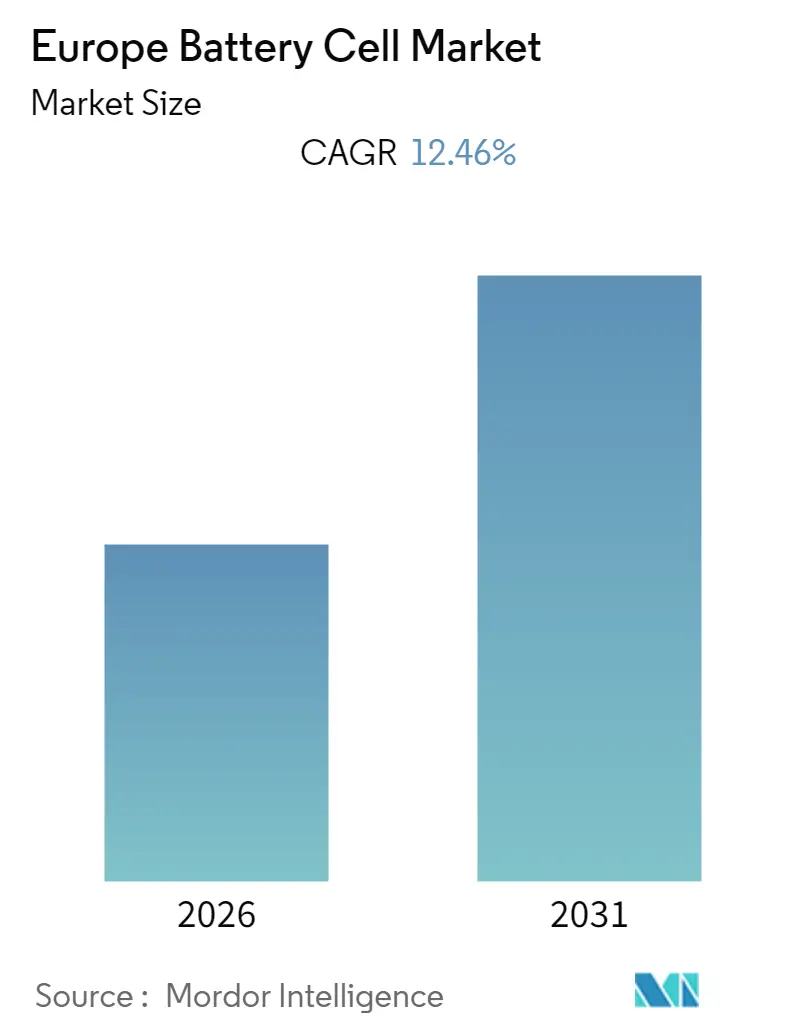
Europe Battery Cell Market Analysis by Mordor Intelligence
The Europe Battery Cell Market size is expected to register a CAGR of 12.46% during the forecast period.
- The automotive battery segment is expected to dominate the market during the forecast period. This can be ascribed to the government's supportive policies, and increased awareness about the EV among consumers is expected to drive the market during the forecast period.
- The development of advanced batteries, which have high heat and fire resistance, a higher charging cycle and longer life, is likely to present a significant opportunity for the battery cell manufacturers in the market in the near future.
- Germany has dominated the battery cell market. The government's supportive policies for the research and development of electric vehicles, coupled with higher investment in renewable energy, are anticipated to drive the market in the country.
Note: Market size and forecast figures in this report are generated using Mordor Intelligence’s proprietary estimation framework, updated with the latest available data and insights as of 2026.
Europe Battery Cell Market Trends and Insights
The Automotive Battery Segment is Expected to Dominate the Market
- In recent years, Europe witnessed significant growth in EVs and the demand for EVs is expected to propel during the forecast period owing to factors like increasing investment in the sector due to favourable government policies and various incentives for electric vehicle battery manufacturing players.
- Vehicles with internal combustion (ICE) are getting replaced with battery-powered vehicles. Due to growing environmental concerns, technology has been shifting toward electric vehicles (EVs). Mostly, lithium-ion batteries are used in Evs as they provide high energy density, low self-discharge, less weight, and low maintenance.
- In January 2021, the Commission approved a second Important Project of Common European Interest to support innovation and research in the battery value chain. The project is called 'European Battery Innovation' and was jointly prepared and notified by Belgium, Croatia, Austria, Finland, Germany, France, Greece, Poland, Italy, Slovakia, Sweden, and Spain. In the coming years, the twelve countries are expected to provide up to EUR 2.9 billion in funding, which is likely to unlock around EUR 9 billion in private investments.
- For ICE vehicles, the lead-based battery is widely used and is expected to continue to be the only viable mass-market battery system for the foreseeable future. Lithium-ion batteries still require higher cost reductions for SLI applications to be considered a viable mass-market alternative to lead-based batteries.
- Lithium-ion battery systems propel plug-in hybrid and electric vehicles. Due to their high energy density, fast recharge capability, and high discharge power, lithium-ion batteries are the only available technology that meets OEM requirements for the vehicles' driving range and charging time. The lead-based traction batteries are not competitive for full hybrid or electric vehicles due to their lower specific energy and weight.
- All these development are anticipated to increase the sales of battery cells in the automobile segment during the forecast period.
The Germany to Dominate the Market
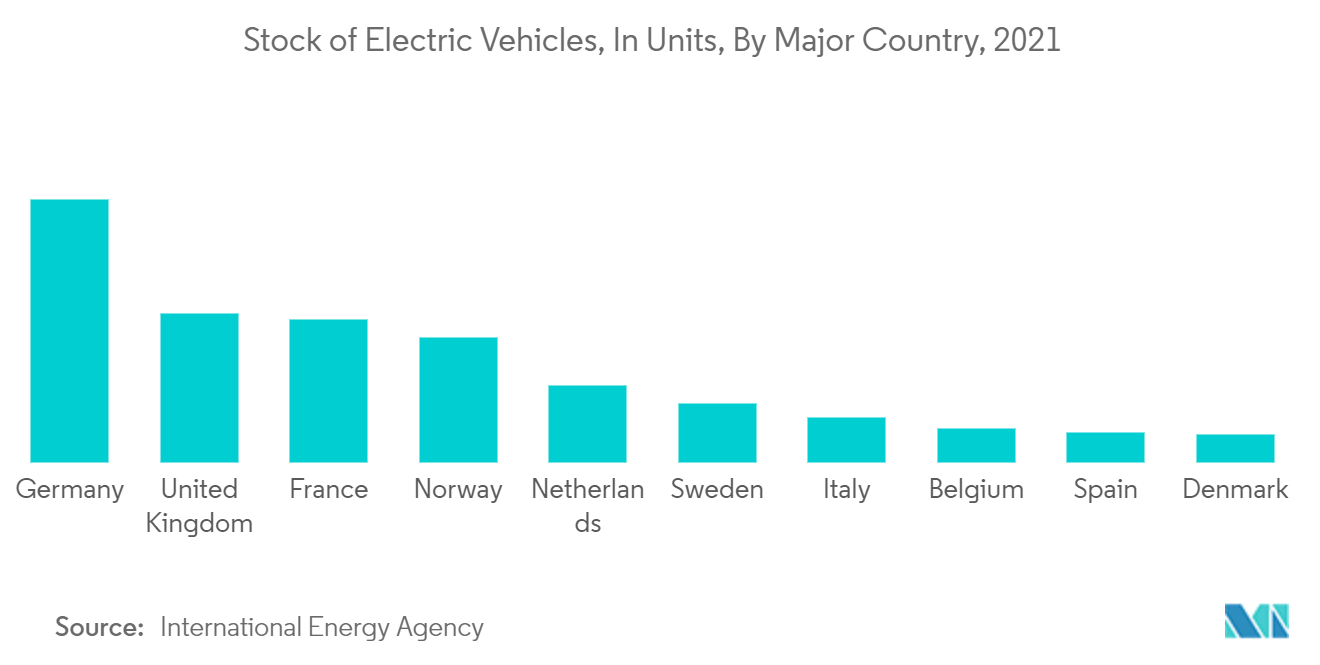
- The automotive industry plays a vital role in the German economy. The automotive industry in Germany is witnessing growth in electric cars, as seen in the chart beside. Electric car battery sales are expected to grow to USD 60 billion by 2030. Thus, with the growth in the adoption of electric cars, there exists significant growth potential for battery manufacturing and prismatic battery cells.
- Thus, it becomes essential for Germany to ensure efficient and cost-effective battery manufacturing, thereby maintaining a firm hold over the entire EV value chain. Hence, Germany considers batteries one of the critical elements to ensure industrial prosperity.
- To avoid loss of value addition in the booming EV market to other countries, such as the United States, which offers a digital platform for autonomous driving, coupled with Artificial Intelligence (AI), and China, which is into mass manufacturing of batteries, Germany has been making efforts to build domestic battery manufacturing capabilities.
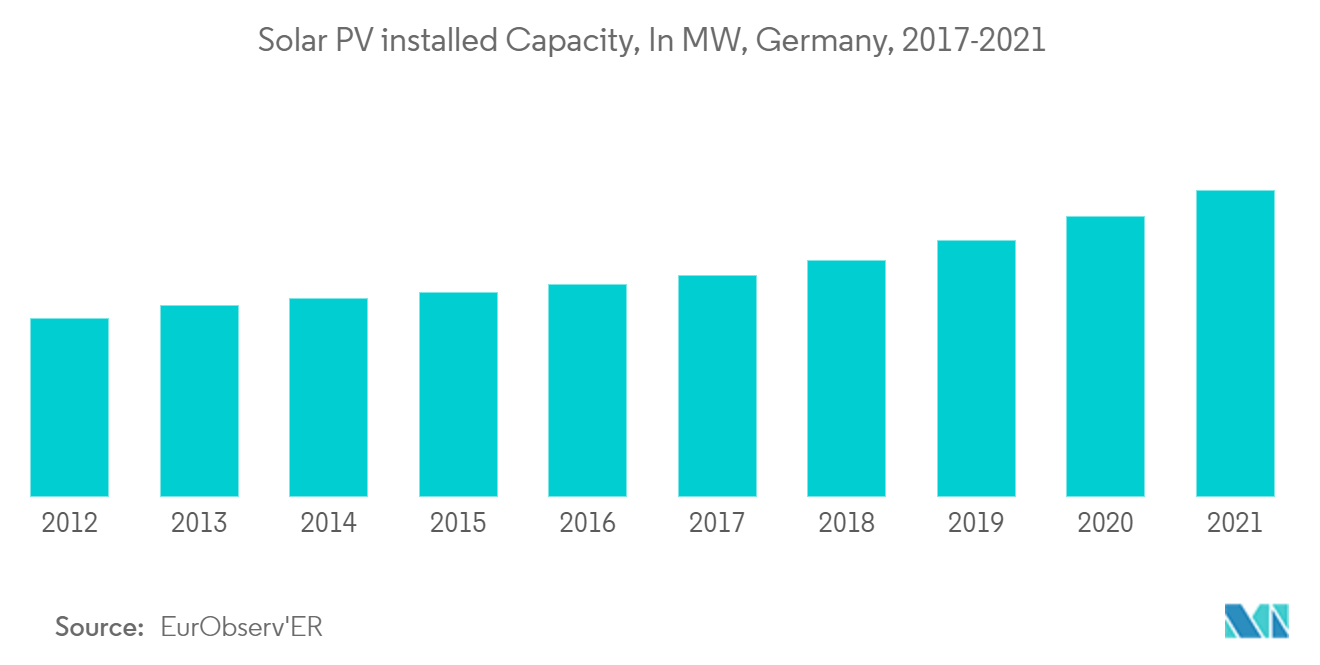
- Moreover, there has been large-scale adoption of solar power in the country. According to Germany's Renewable Energy Act (EEG), the country has set a target of achieving a share of 40-45% of renewable energy sources out of the total energy consumption in the country by 2025. As a result, there has been significant growth in solar installed capacity, as seen in the chart beside.
- As Germany invests heavily in developing solar energy across all segments, such as residential, commercial, and utility, all three segments are expected to see sustained growth during the forecast period. In September 2021, Germany registered the addition of 406.4 MW of new PV capacity, of which more than 321.6 MW was attributable to rooftop and ground-mounted systems up to 750 kW in size and built under the FiT (Feed-in-Tariff) scheme.
- Due to this development Germany is expected to to dominte the battery cell market in Europe during the forecast period.
Regulatory Landscape
The EU Battery Regulation (Regulation (EU) 2023/1542) is the central policy framework shaping battery cell manufacturing in the EU. It sets sustainability, safety, and circularity requirements across EV, industrial, and portable batteries sold in the EU. General application began 18 February 2024, and Extended Producer Responsibility (EPR) and material recovery targets have been in effect since 18 August 2025, tightening compliance for cell producers, OEMs, and recyclers.
In 2025, Regulation (EU) 2025/1561 adjusted the due diligence obligations, postponing the start of battery due diligence reporting and sourcing requirements to 18 August 2027, with the Commission guidance deadline set for 26 July 2026. In parallel, the battery passport is scheduled to apply from 18 February 2027 for LMT, industrial batteries above 2 kWh, and EV batteries, increasing traceability and data management requirements for EU supply chains.
Value Chain Analysis
Europe's battery cell value chain covers raw material sourcing (lithium, nickel, cobalt, manganese, graphite), refining and precursor, cathode and anode active material production, cell manufacturing (prismatic, cylindrical, pouch), module/pack assembly, integration into automotive and stationary storage systems, and end-of-life collection and recycling under EU circularity obligations. The European Battery Alliance (EBA) has also pointed to a shift from project launch activity toward industrial execution, which increases emphasis on ramp discipline, yield, quality systems, and scalable operations as capacity builds out.
Manufacturing scale-up has been fast. Europe exceeded 200 GWh of battery cell manufacturing capacity by early 2026, compared with about 1 GWh in 2017, reflecting gigafactory build-out and associated module/pack capacity across the region. Cross-border investment and partnerships remain a defining feature of the chain, including CATL and Stellantis NV's joint venture project in Spain (reported as a EUR 4.1 billion facility, with Madrid authorizing imported Chinese labor for construction through late 2028), alongside other major Chinese-led investments such as BYD in Hungary (reported at EUR 4 billion) and CATL's European footprint in Germany and Hungary. These developments support local module/pack ecosystems and supplier localization around cell manufacturing sites, while also raising the need to align upstream materials and recycling capacity with EU compliance timelines.
Competitive Landscape
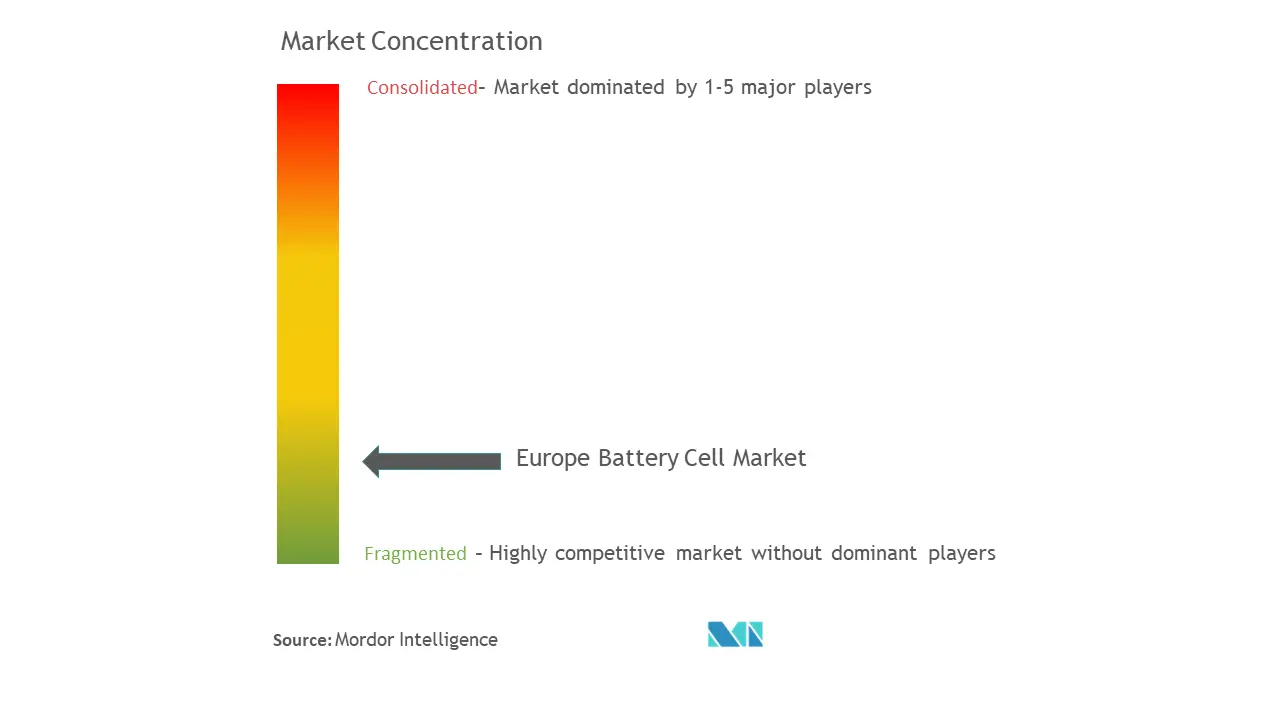
The Europe battery cell market is highly fragmented. Some of the key players in the market include BYD Co. Ltd, Contemporary Amperex Technology Co. Limited, Duracell Inc., EnerSys, and Clarios.
Europe Battery Cell Industry Leaders
-
BYD Co. Ltd
-
Contemporary Amperex Technology Co. Limited
-
Duracell Inc.
-
EnerSys
-
Clarios
- *Disclaimer: Major Players sorted in no particular order
Market Opportunities and Future Outlook
Policy-linked financing and industrial programs are creating clear opportunities in large-scale cell manufacturing and the localization of enabling steps (materials, modules, and qualification). In June 2026, the Battery Booster facility was established, offering EUR 1.5 billion in interest-free loans funded from EU ETS revenues to support scaling battery cell manufacturing to 10 GWh+ capacity within the EEA.
Stationary energy storage deployments are also expanding demand for cell suppliers beyond automotive. Contracts increasingly use grid-scale energy terms that translate into sizeable cell volumes. For example, BYD Energy Storage was selected to supply 600 MW/2.4 GWh for the Siedlce BESS project in Poland, with construction starting in Q3 2026 and commissioning by the end of 2027. In addition, the EU's planned Industrial Accelerator Act is positioned as a demand-side lever for European-made batteries and components, giving manufacturers and supply-chain partners another route to compete through compliance readiness and localized capacity in key European markets.
Recent Industry Developments
- June 2026: BYD announced it is exploring acquisition of an existing brownfield manufacturing plant in Southern Europe for a second European passenger vehicle assembly site, with the previously planned Turkey plant on hold. The move strengthens BYD's regional footprint and battery-supply positioning for European programs.
- May 2026: A new 5 GWh battery module assembly line at Debrecen, Hungary became operational following receipt of the necessary permits. The expansion strengthens local supply for European OEM programs and improves logistics and lead times versus imported modules, reflecting CATL's European expansion.
- October 2024: EnerSys made an equity investment in Verkor and signed a prototype agreement to develop and produce EnerSys ENS1 lithium-ion battery cells at Verkor's Grenoble innovation center. The collaboration connects EnerSys to European cell R&D and supports product localization for regional customers.
Research Methodology Framework and Report Scope
Market Definition and Coverage
This market covers the value of battery cells supplied in Europe, counted as cells sold for use in EV packs and other end uses across the region, with revenues captured at the cell level in USD.
Scope exclusions: It excludes upstream raw materials (such as lithium, nickel, and cobalt), battery packs and modules as standalone products, charging equipment, and recycling services.
Segmentation Overview
- Type
- Prismatic
- Cylindrical
- Pouch
- Application
- Automotive Batteries (HEV, PHEV, EV)
- Industrial Batteries (Motive, Stationary (Telecom, UPS, Energy Storage Systems (ESS), etc.)
- Portable Batteries (Consumer Electronics etc.)
- Power Tools Batteries
- SLI Batteries
- Others
- Geography
- United Kingdom
- Germany
- France
- Italy
- Rest of Europe
Data Sources, Market Sizing, and Validation
Desk Research
We start by mapping the Europe demand and supply picture for battery cells, and then we align definitions across sources so the same unit is not counted twice. Public sources are used to anchor the basic building blocks such as EV registrations, industrial activity signals, and cross-border movements of batteries and key components.
Non-paywalled sources we used to frame inputs included Eurostat trade and industrial statistics, European Commission and Joint Research Centre battery publications, International Energy Agency battery and EV outlook tables, EPO patent databases for technology direction, and updates from the European Battery Alliance plus national energy agencies. We also review company annual reports, investor presentations, and plant announcements for capacity timelines, ramp-ups, and mix shifts. Where required, paid subscriptions for company financials and intelligence, news and financials, patent databases, and shipment-level import-export data were used to verify dates, normalize site names, and avoid missing major sites. The sources listed here are illustrative only, and we also referenced many other public and paid sources to collect data, validate inputs, and close information gaps.
Primary Interviews and Surveys
Primary work was used to pressure-test the model with practical checks, since battery cell pricing and utilization can move from quarter to quarter. We spoke with a mix of cell supply chain participants, buyers, and technical specialists across Europe, then rechecked assumptions by geography and by end-use demand patterns so desk inputs were not taken at face value.
Distribution of primary research fieldwork respondents
| Company type | Respondent position |
|---|---|
| Top tier: 30% | CXOs: 13% |
| Mid tier: 54% | Functional/Unit leaders: 43% |
| Smaller Players: 16% | Managers: 44% |
Market-Sizing & Forecasting
For sizing, we apply top-down and bottom-up once, where the top-down view is built by reconstructing Europe cell demand from EV production and registrations, average pack sizes (kWh), chemistry and form-factor mix, and then converting to cell value using observed ASP ranges. To keep it realistic, the totals are corroborated with selective bottom-up approximations, such as capacity roll-ups by announced gigafactory lines, ramp-up curves, and sampled ASP times volume checks from buyer conversations.
Inputs that mattered in this market included EV and PHEV build plans by country, average battery kWh per vehicle by segment, share of locally produced versus imported cells, utilization rates at major plants, and cell ASP movements linked to cathode chemistry shifts and contract reset cycles. When site level data was incomplete, gaps were handled by using conservative ramp assumptions and triangulating with trade flows and procurement lead-time feedback.
Forecasting is run using scenario analysis with a simple multivariate structure, where EV output, battery kWh intensity, and assumed ASP progression are the main drivers. Final year-by-year paths are adjusted after expert feedback, especially in periods with policy changes, delayed plant starts, or rapid price declines.
Data Validation & Update Cycle
Outputs are checked in steps, where the first pass focuses on whether volumes and prices reconcile with independent signals such as capacity additions, utilization commentary, and import-export movements. If variance is large, we re-open the input sheet, re-check conversion factors (kWh to cell value), and re-contact sources when a specific assumption cannot be defended.
Before sign-off, a second analyst reviews the model logic and flags anomalies by country and application so that one strong data point does not pull the full total. The report is refreshed annually, and interim updates are made when material events occur, for example major plant delays, policy shifts, or sharp pricing resets. Right before delivery, we run a final update pass so clients receive the latest consistent view.
Mordor Intelligence's Europe Battery Cell Market Size Measured Against Other Published Estimates
It is normal to see different market values for Europe battery cells, since publishers may not agree on what level of the value chain is being counted and which years are treated as the true base. The gap usually comes from a mix of boundary choices, pricing logic, and how quickly assumptions are refreshed when new capacity or price resets happen.
Key gap drivers in this market are whether figures are built from GWh and then priced with spot-like benchmarks versus contract ASPs, whether imports are netted out or counted alongside domestic output, and how pack-level revenues are separated from cell-level revenues. A refresh-led build that revisits quarterly ASPs, uses a consistent annual currency conversion window, and rechecks utilization checkpoints close to publication can shift the current-year total. This is one reason the outcome differs for Mordor Intelligence.
Benchmark comparison
| Source | Market Size | Gaps in Research Methodology |
|---|---|---|
| Mordor Intelligence | USD 9.85 B (2024) | |
| Industry Association A | USD 8.10 B (2024) | Often reported from announced production output converted from GWh using a single blended EUR per kWh assumption, which can understate value when higher density automotive cells take share and when contract ASPs lag spot movements. |
| Global Consultancy B | USD 12.40 B (2024) | May include battery modules and pack assembly value, and in some cases applies aggressive ramp-up and utilization assumptions for new plants that have not yet stabilized at nameplate output. |
The spread mainly reflects what is included at the cell boundary, plus how ASPs and ramp-ups are treated in fast-moving years. Our approach stays traceable because volumes are tied to EV and industrial demand signals, then prices are cross-checked with procurement feedback and trade-based sanity checks before the totals are locked.
Key Questions Answered in the Report
What is the current Europe Battery Cell Market size?
The Europe Battery Cell Market is projected to register a CAGR of 12.46% during the forecast period (2026-2031)
Who are the key players in Europe Battery Cell Market?
BYD Co. Ltd, Contemporary Amperex Technology Co. Limited, Duracell Inc., EnerSys and Clarios are the major companies operating in the Europe Battery Cell Market.
What years does this Europe Battery Cell Market cover?
The report covers the Europe Battery Cell Market historical market size for years: 2020, 2021, 2022, 2023 and 2024. The report also forecasts the Europe Battery Cell Market size for years: 2026, 2027, 2028, 2029, 2030 and 2031.