
Europe Aviation Insurance Market Size and Share
Market Overview
| Study Period | 2021 - 2032 |
|---|---|
| Forecast Data Period | 2027 - 2032 |
| Base Year Market Size (2026) | USD 2.40 Billion |
| Market Size (2027) | USD 2.5 Billion |
| Market Size (2032) | USD 3 Billion |
| Growth Rate (2027 - 2032) | 3.70 % |
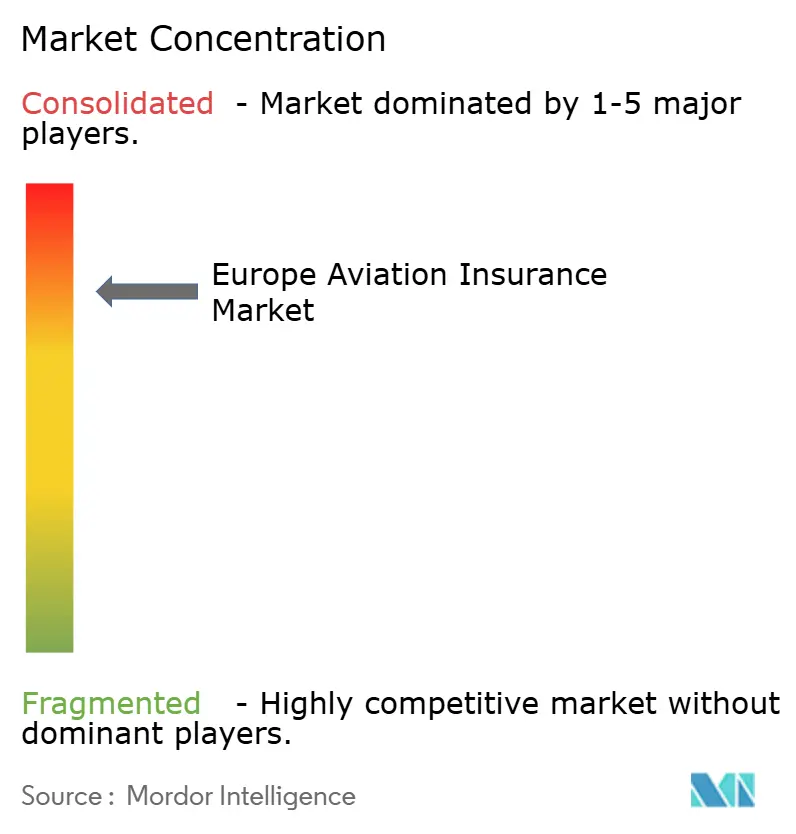
| Market Concentration | High |
Major Players *Disclaimer: Major Players sorted in no particular order Image © Mordor Intelligence. Reuse requires attribution under CC BY 4.0. | |
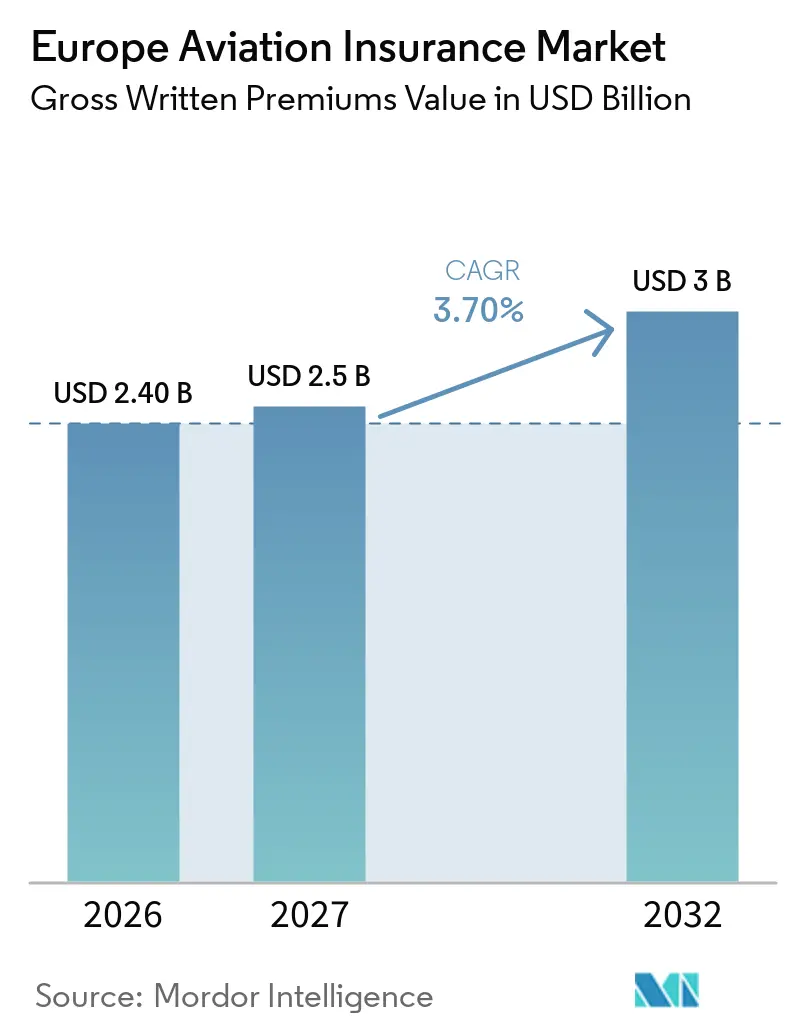
Europe Aviation Insurance Market Analysis by Mordor Intelligence
The Europe aviation insurance market size in terms of gross written premiums was valued at USD 2.40 billion in 2026 and is estimated to grow from USD 2.5 billion in 2027 to reach USD 3 billion by 2032, at a CAGR of 3.70% during the forecast period (2027-2032).
The Europe aviation insurance market is supported by a recovery in flight activity, fleet renewal, and rising insured values for modern aircraft. EUROCONTROL recorded 11.1 million flights in 2025, 4.1% above 2024, and forecasts 12.8 million flights by 2032, which increases the number of aircraft, operators, and facilities requiring coverage. Mandatory liability requirements under European rules provide a recurring base of demand, while repair costs increase the insured value attached to hull and liability policies. General aviation, business aviation, and unmanned aircraft systems create opportunities that are less dependent on airline pricing conditions, although war-risk losses and reinsurance costs are making capacity decisions more selective. The Europe aviation insurance market also faces greater attention to geopolitical, cyber, and supply chain exposures, which can change pricing and policy conditions quickly. The resulting demand is not uniform across coverages, but the mix of compulsory liability, higher aircraft values, and emerging operations supports a broader premium base.
Key Report Takeaways
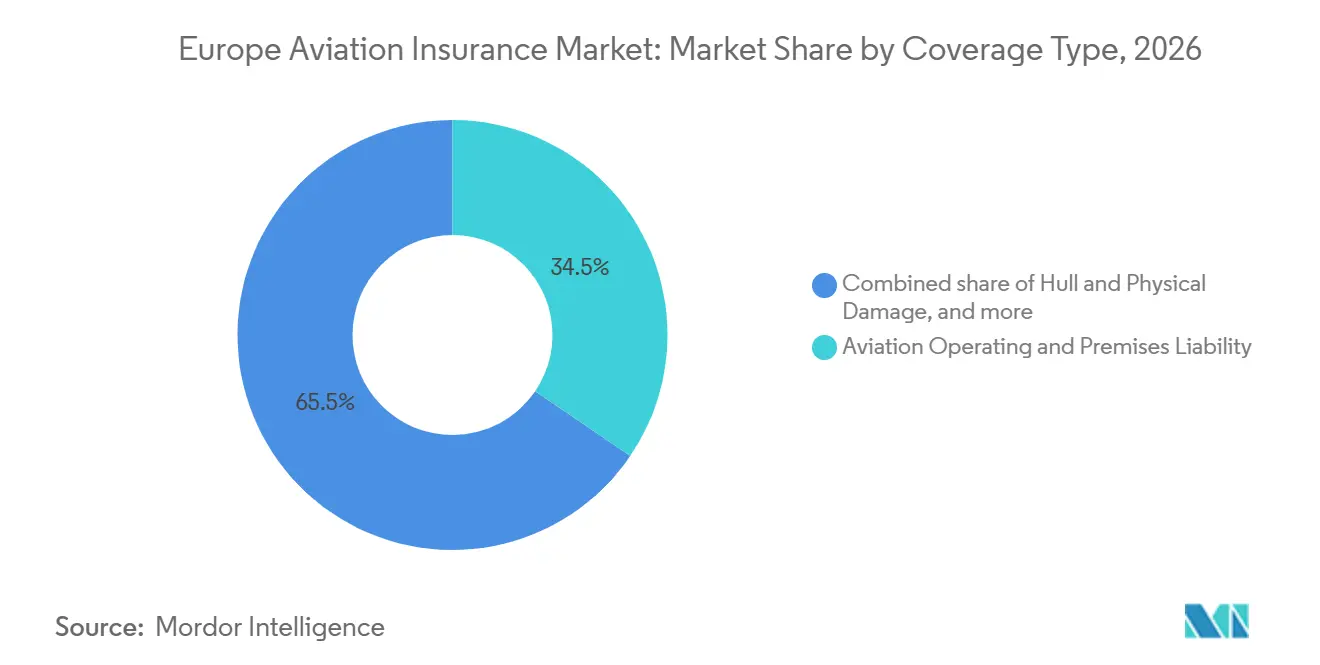
- By coverage type, aviation operating and premises liability captured a 34.5% share of the Europe aviation insurance market in 2026, while aviation products liability is projected to grow at a 5.3% CAGR through 2032.
- By end user, general and business aviation operators captured a 43.2% share of the Europe aviation insurance market in 2026, while aviation products liability insureds are projected to grow at a 5.4% CAGR through 2032.
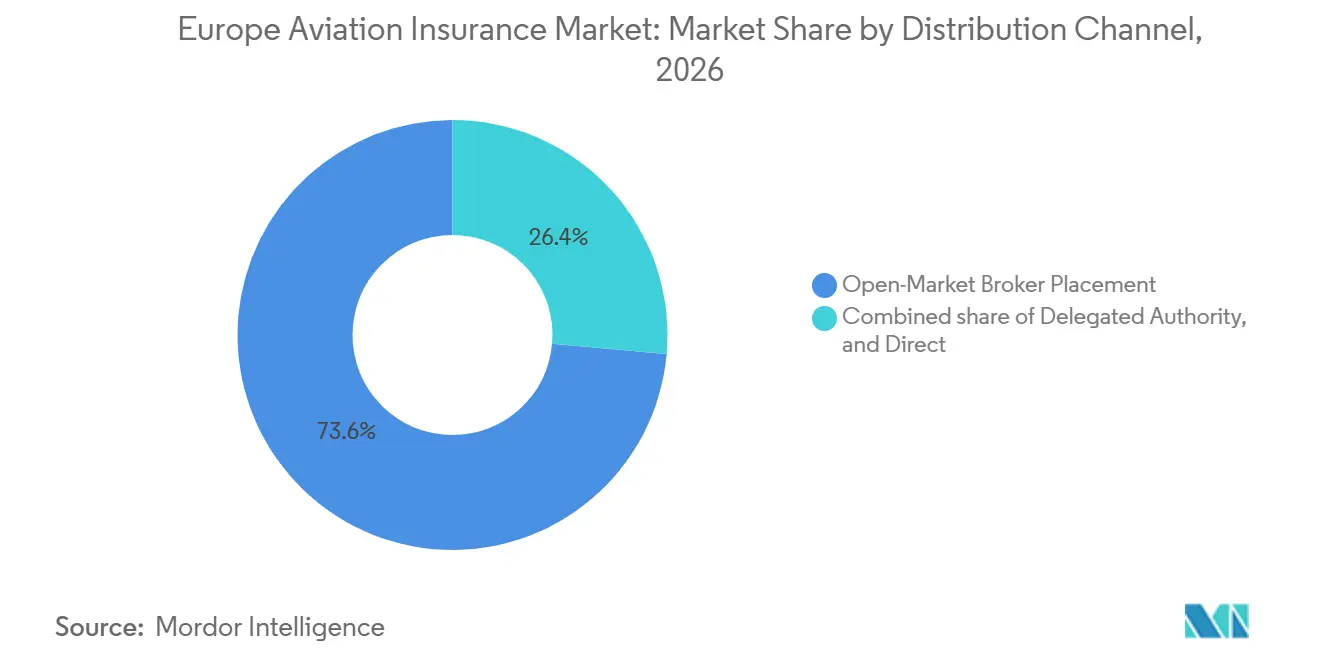
- By distribution channel, open-market broker placement captured a 73.6% share of the Europe aviation insurance market in 2026, while delegated authority is projected to grow at a 7.1% CAGR through 2032.
- By geography, the United Kingdom captured a 29.8% share of the Europe aviation insurance market in 2026, while Italy is projected to grow at a 4.8% CAGR through 2032.
Note: Market numbers in this report are based on Mordor Intelligence's proprietary estimation framework, which combines nine months of actuals with Q4 projections for base year 2026.
Market Trends and Insights
Drivers Impact Analysis of Europe Aviation Insurance Market*
| Driver | (~) % Impact on CAGR Forecast | Geographic Relevance | Impact Timeline |
|---|---|---|---|
| Passenger Air Traffic and Fleet Renewal | +1.5% | Pan-European; greatest premium uplift in Western and Southern Europe | Short term (≤ 2 years) |
| Mandatory European Liability Compliance | +0.8% | EU-wide; additional United Kingdom CAA layer post-Brexit; UAS compliance emerging across all member states | Medium term (2–4 years) |
| Expansion of General, Business Aviation, and UAS Operations | +1.0% | Pan-European; highest growth in DACH, Nordics, and Italy | Short term (≤ 2 years) |
| Broker-Led Placement of Complex Cross-Border Risks | +0.4% | Pan-European; most structurally complex in United Kingdom-EU cross-border placements post-Brexit | Medium term (2–4 years) |
| Repair-Slot and Parts Inflation Elevating Claim Severity | +0.5% | Global; most acute for European MRO-dependent operators and lessors with ageing narrow-body fleets | Short term (≤ 2 years) |
| Connected Aircraft and AI Dependence Expanding Cyber and Systemic Accumulation Exposure | +0.6% | Global; EU NIS2 compliance driver concentrated in Europe | Long term (≥ 4 years) |
| Source: Mordor Intelligence | |||
Passenger Air Traffic and Fleet Renewal
European aviation traffic returned to pre-pandemic levels in 2025, with approximately 11.1 million flights recorded across the EUROCONTROL network, representing growth of around 4.1% year on year. EUROCONTROL's Spring 2026 forecast projects approximately 12.8 million annual flights by 2032, with average annual growth of 2.1% over the forecast period from 2026 to 2032, although geopolitical and economic uncertainty could affect the trajectory[1]. Fleet renewal provides an additional source of demand for aviation insurance. Airbus and Boeing had approximately 16,150 firm commercial aircraft orders in their combined global backlog as of July 2026, reflecting sustained demand for new aircraft, although this figure does not represent confirmed additions to European fleets. New-generation aircraft, advanced engines and increasingly sophisticated onboard systems can increase insured asset values and the financial severity of individual losses. These developments support demand for hull and liability coverage, although the effect on premiums will depend on insured fleet composition, aircraft values, underwriting conditions, and reinsurance costs.
Mandatory European Liability Compliance
European Union Regulation (EC) No. 785/2004 requires covered air carriers and aircraft operators flying within, into, out of, or over European Union Member State territory to maintain minimum insurance for passenger, baggage, cargo, and third-party liabilities, including specified war and terrorism risks. Minimum coverage includes 250,000 Special Drawing Rights (SDR) per passenger, 1,288 SDR per passenger for baggage, and 22 SDR per kilogram for cargo, while third-party liability limits vary according to aircraft maximum take-off mass, ranging from 750,000 SDR to 700 million SDR per accident[2]. These mandatory requirements sustain baseline demand for aviation liability insurance, while insurers' premiums depend on aircraft characteristics, operational risks, claims experience, and market conditions. In Italy, the National Civil Aviation Authority (ENAC) published an updated insurance requirements regulation and associated sanctions framework on 4 March 2025, replacing its earlier circular. For insurers, regulatory compliance sustains baseline demand, while the coverage required for individual operators continues to depend on aircraft weight, operational exposure, and applicable liability categories.
Expansion of General Aviation, Business Aviation and Unmanned Aircraft Operations
The expansion of business aviation, general aviation, and unmanned aircraft system (UAS) operations is broadening the range of risks that aviation insurers must assess. European Union drone rules distinguish between operational categories and apply risk-based authorization requirements to operations in the specific category, creating a framework for assessing more complex activities, including certain operations beyond visual line of sight. In June 2026, the European Union Aviation Safety Agency (EASA) published a revised version of its easy access rules for unmanned aircraft systems, incorporating updated guidance associated with the specific operations risk assessment (SORA) 2.5 methodology[3]. Insurance needs vary according to the type of operation, aircraft characteristics, applicable national requirements, and contractual obligations. As commercial drone operations expand, insurers may find opportunities in third-party liability, physical damage, and specialist coverage, while continuing to face challenges in quantifying emerging risks and potential losses involving multiple aircraft or shared traffic-management systems.
Connected Aircraft and AI Dependence Expanding Cyber and Systemic Accumulation Exposure
Increasing reliance on connected aircraft, digital flight operations, and integrated airline IT systems is elevating the importance of cyber risk in aviation insurance. The July 2024 CrowdStrike-related technology outage demonstrated the potential for a single technology disruption to cause widespread operational losses: Delta Air Lines reported approximately 7,000 flight cancellations over five days, and the incident was associated with an estimated USD 550 million impact on the airline. Although this incident was not evidence of an attack on aircraft flight systems, it illustrates how dependence on shared digital infrastructure can disrupt airline operations and generate substantial financial losses. EASA's Part-IS framework introduces information-security risk-management requirements for covered aviation organizations, with relevant requirements applying from October 2025 or February 2026, depending on the regulation and organization concerned. For insurers, the combination of interconnected systems, third-party technology dependencies, and operational continuity risks increases the importance of cyber exclusions, coverage definitions, and accumulation management.
Restraints Impact Analysis of Europe Aviation Insurance Market*
| Restraint | (~) % Impact on CAGR Forecast | Geographic Relevance | Impact Timeline |
|---|---|---|---|
| War-Risk Capacity Volatility and Premium Hardening | -0.4% | Eastern Europe; Gulf-adjacent routes; broad European carrier exposure | Short term (≤ 2 years) |
| High-Severity Losses and Reinsurance Cost Pressure | -0.3% | Global; Europe-domiciled carriers and Lloyd's syndicates most directly affected | Medium term (2–4 years) |
| Sanctions and Cross-Border Claims Enforceability | -0.3% | Eastern Europe; UK-EU boundary; Middle East exposure for European carriers and lessors | Long term (≥ 4 years) |
| Coverage Ambiguity for New Propulsion and Sustainable Aviation Fuel Supply Chains | -0.2% | Pan-European; Nordics and DACH as early adopters of hydrogen and electric propulsion trials | Long term (≥ 4 years) |
| Source: Mordor Intelligence | |||
War-Risk Capacity Volatility and Premium Hardening
War-risk pricing can change quickly when geopolitical events alter the risk faced by aircraft, routes, or insured assets. The March 2026 appeal involving Chubb, Fidelis, Lloyd's, and AerCap continued to influence reserve considerations for insurers with Russia-Ukraine exposure. Aviation war-risk accumulation differs from many property exposures because the location and scale of risk can change in a short period. This uncertainty can restrict coverage availability or require additional premiums for hull-war and war-liability cover. The Europe aviation insurance market consequently faces less predictable conditions in a specialist line that can affect both underwriting appetite and reinsurance planning. Carriers may respond through closer monitoring of routes, asset locations, exclusions, and the limits available to a single buyer.
High-Severity Losses and Reinsurance Cost Pressure
High-severity claims and higher repair costs increase the cost of providing aviation coverage. Older fleets may require more maintenance visits, while parts availability and mechanic shortages can raise the cost and duration of a repair. These conditions require underwriters to reconsider limits, retentions, and the coverage offered to individual accounts. Loss experience can also make reinsurers more selective, particularly for complex airline and war-risk portfolios. The Europe aviation insurance market may therefore see selective underwriting even where buyer demand remains strong. This can lengthen placement discussions for accounts with complex loss histories, high values, or difficult reinsurance requirements.
*Our forecasts treat driver/restraint impacts as directional, not additive. The impact forecasts reflect baseline growth, mix effects, and variable interactions.
Europe Aviation Insurance Market Segment Analysis
By Coverage Type:
Liability Mandates Anchor Demand and Products Exposure Expands FastestAviation operating and premises liability held 34.5% of the Europe aviation insurance market share in 2026, making it the leading coverage type. Its position reflects demand for protection against third-party bodily injury and property damage arising from aviation operations, alongside applicable European insurance requirements. Hull and physical damage coverage remains important as rising aircraft replacement values, engine costs, and repair complexity influence insured exposures. Aviation war and allied perils remains a specialist line, with capacity and pricing influenced by geopolitical developments, exposure accumulation, and reinsurance conditions. The combination of mandatory liability requirements and specialized operational risks makes coverage design an important consideration for aviation insurance buyers.
Aviation products liability is projected to grow at a 5.3% CAGR through 2032, the highest rate among coverage types. Growth opportunities are linked to aerospace manufacturing, increasingly complex aircraft systems, and potential product-related claims involving engines, components, and onboard equipment. Manufacturers and suppliers face liability exposure arising from alleged defects, product failures, and safety-related incidents, supporting demand for specialized coverage. Other specialty cover also serves airports, ground handlers, and maintenance facilities exposed to operational and third-party liabilities. These buyers may combine premises, operational, and professional risks within broader aviation insurance programs.
By End User:
General and Business Aviation Leads and Manufacturer Liability Scales FastestGeneral and Business Aviation Operators held 43.2% of the Europe aviation insurance market share in 2026, representing the largest end-user category. The segment includes corporate jets, helicopters, flight training academies, charter services, and private aircraft owners. Its insurance requirements vary according to aircraft values, operating activities, flight hours, and liability exposures. Airlines and Commercial Operators continue to account for substantial insured asset values and complex liability requirements, while competition among insurers can influence renewal pricing and underwriting margins.
Aviation Products Liability Insureds are forecast to grow at a 5.4% CAGR through 2032. European original equipment manufacturers, component suppliers, and system integrators face potential liability claims associated with aircraft manufacturing, component performance, and product safety. Aircraft Lessors and Financiers remain a significant end-user group because insurance helps protect aircraft assets against physical damage and specified liability exposures. AXA XL's Balthazar Finance platform has reported more than USD 5.6 billion deployed across 82 aircraft finance transactions, illustrating the role of insurance-backed financing solutions in the aviation sector. Airport and facility operators also require coverage for property damage, operational interruption, and third-party liabilities.
By Distribution Channel:
Specialist Broker Placement Remains Central and Delegated Authority Grows FastestOpen-market broker placement held 73.6% of Europe aviation insurance market share in 2026. Specialist brokers help airlines, aircraft lessors, manufacturers, and other aviation businesses access underwriting capacity, negotiate policy terms, and coordinate complex placements involving multiple insurers. Large commercial programs may require tailored coverage, high liability limits, and coordination across jurisdictions. Direct placement remains an option for certain smaller or more standardized aviation risks, depending on the insurer's distribution model and the customer's requirements. Specialist broker placement therefore remains important for complex risks that require market access and tailored policy structures.
Delegated authority is projected to grow at a 7.1% CAGR through 2032. Managing general agents and specialist underwriting platforms can distribute niche aviation products by using established underwriting expertise and delegated authority from insurers. In April 2025, Apollo and Moonrock launched a USD 122.5 million drone, electric vertical take-off and landing (eVTOL), and aviation innovation insurance facility, comprising up to USD 100 million in liability coverage and USD 22.5 million in property damage cover. The facility illustrates how specialist underwriting and delegated distribution can address emerging aviation risks. Further growth will depend on underwriting performance, available insurer capacity, and effective portfolio risk controls.
Geography Analysis
The United Kingdom held a 29.8% share of Europe aviation insurance premiums in 2026, the highest country share in the region. London's Lloyd's and company markets provide specialist underwriting capacity for airline hull, liability, and other aviation risks. Lloyd's gross written premium rose 6.9% to GBP 34.7 billion (USD 46.2 billion) in the first half of 2026, reflecting growth in new and existing syndicates despite a more competitive pricing environment. Reserve developments related to the Russia-Ukraine conflict remain relevant to underwriting decisions and capital allocation. Germany and France are also important aviation markets, supported by major airline groups, aerospace manufacturing and associated supply chains.
Italy is projected to grow at a 4.8% CAGR through 2032, the fastest country rate in the Europe aviation insurance market. Italian airports handled approximately 229.7 million passengers in 2025, representing 5% growth year on year, while Rome Fiumicino handled 50.9 million passengers and Milan Malpensa recorded approximately 31 million. Italy's aviation activity supports demand for aircraft hull, liability, and airport-related insurance, while airport development and fleet investment may create further opportunities.
Spain, the Benelux countries, the Nordic countries and the rest of Europe complete the regional profile. Spain's airline and tourism sectors support demand for commercial aviation and airport-related insurance, while the Benelux countries have relevant aviation, logistics and aerospace activities. The Nordic countries present distinct exposures associated with regional connectivity, weather conditions and remote operations. Central and Eastern Europe also contributes demand through airline activity, airport development and expanding aviation services. These markets broaden the regional opportunity for aviation insurers, brokers and specialist underwriting platforms, with growth varying according to local aviation activity and risk profiles.
Competitive Landscape
The Europe aviation insurance market is consolidated, with established global insurers and specialist aviation underwriters holding significant positions across commercial airline hull, liability, aerospace products and specialty risks. Key participants include Global Aerospace, Allianz Commercial, AXA XL, Chubb, Munich Re, QBE and Tokio Marine Kiln, alongside specialist providers such as Beazley and Lloyd's market participants. High technical underwriting requirements, substantial capital needs and reliance on reinsurance favour established players, particularly for complex airline programmes and large liability exposures. Competition remains active in general aviation and emerging-risk segments, where specialist providers offer tailored coverage and alternative distribution models.
Leading insurers continue to strengthen their broader specialty capabilities and regional operations. Munich Re reported a net result of EUR 6.1 billion for 2025 and introduced its Ambition 2030 strategy, while Allianz Commercial continues to develop its regional leadership structure. These developments reflect continued investment in underwriting expertise and regional execution, although broader corporate results do not directly establish aviation-specific market share. Specialist underwriting platforms are also expanding coverage for emerging exposures. In April 2025, Apollo and Moonrock launched a USD 122.5 million drone, electric vertical take-off and landing (eVTOL), and aviation innovation insurance facility, illustrating how delegated underwriting can provide capacity for developing aviation risks.
Connected aircraft, digital infrastructure dependencies and unmanned aviation are increasing demand for specialised underwriting, cyber coverage and accumulation management. Established insurers benefit from their capital strength, technical expertise and reinsurance relationships, while specialist platforms address evolving risks through tailored products.
Europe Aviation Insurance Industry Leaders
-
Allianz Global Corporate & Specialty SE
-
American International Group, Inc.
-
AXA XL
-
Munich Re Specialty
-
Tokio Marine Kiln Insurance Services Limited
- *Disclaimer: Major Players sorted in no particular order
Europe Aviation Insurance Market Companies Covered in this Report
- Allianz Commercial
- American International Group (AIG)
- AXA XL
- Chubb
- Munich Re
- Global Aerospace
- Tokio Marine Kiln
- QBE Insurance Group
- Sompo International
- Starr Insurance Companies
- Beazley
- HDI Global
- Berkshire Hathaway Specialty Insurance
- Zurich Insurance Group
- MSIG Europe
- MAPFRE
- Liberty Mutual Insurance Europe
- Markel
- Travelers
- W. R. Berkley Europe
Recent Industry Developments in Europe Aviation Insurance Market
- September 2026: HDI Global Belgium established a dedicated aviation underwriting team based in Brussels, led by Stijn Keppens, to serve Benelux and Southern European markets. The team covers private and business aviation, flying clubs, flight schools, helicopters, and unmanned aircraft, strengthening local access to the insurer's wider aviation underwriting capabilities.
- September 2026: Marsh's first-half 2026 review found that aviation insurance capacity remained available but was being deployed more selectively. Higher repair costs, claims severity, geopolitical uncertainty, and rising aircraft values increased underwriting scrutiny in airline hull and liability insurance, while general aviation remained competitive and aviation war-risk capacity remained relatively stable.
- September 2026: Allianz Commercial announced that Nina Arquint would become President, Commercial, Europe, Middle East and Africa, effective 1 April 2027.
- March 2026: Tokio Marine Kiln appointed Cameron Glover as an underwriter in its aviation department, focusing on airport and products liability risks. Joining from AIG's Manufacturers and Airports team, the appointment supports Tokio Marine Kiln's aerospace underwriting strategy and specialist liability capabilities.
Europe Aviation Insurance Market Report Scope
Segmentation Overview
| Hull and Physical Damage |
| Aviation Operating and Premises Liability |
| Aviation Products Liability |
| Aviation War and Allied Perils |
| Other Specialty |
| Airlines and Commercial Operators |
| General and Business Aviation Operators |
| Aviation Products Liability Insureds |
| Aircraft Lessors and Financiers |
| Airports and Aviation Infrastructure |
| Open-Market Broker Placement |
| Delegated Authority |
| Direct |
| United Kingdom |
| Germany |
| France |
| Italy |
| Spain |
| France |
| BENELUX |
| Nordics |
| Rest of Europe |
| By Coverage Type | Hull and Physical Damage |
| Aviation Operating and Premises Liability | |
| Aviation Products Liability | |
| Aviation War and Allied Perils | |
| Other Specialty | |
| By End User | Airlines and Commercial Operators |
| General and Business Aviation Operators | |
| Aviation Products Liability Insureds | |
| Aircraft Lessors and Financiers | |
| Airports and Aviation Infrastructure | |
| By Distribution Channel | Open-Market Broker Placement |
| Delegated Authority | |
| Direct | |
| By Country | United Kingdom |
| Germany | |
| France | |
| Italy | |
| Spain | |
| France | |
| BENELUX | |
| Nordics | |
| Rest of Europe |
Key Questions Answered in the Report
What is the forecast growth rate for aviation insurance in Europe?
The Europe aviation insurance market is forecast to grow at a 3.7% CAGR from 2027 to 2032, reaching USD 3.0 billion in 2032.
Which coverage type is growing fastest in European aviation insurance?
Aviation Products Liability is forecast to expand at a 5.3% CAGR through 2032.
Which end-user group has the largest share in European aviation insurance?
General and Business Aviation Operators held a 43.2% share in 2026. This group includes corporate jets, offshore helicopters, training aircraft, charter services, and private aircraft, each with distinct hull and liability requirements.
Why is the United Kingdom important for aviation insurance?
The United Kingdom held a 29.8% share in 2026, supported by the underwriting depth of Lloyd's and company markets in London.
Which country is expected to grow fastest through 2032?
Italy is forecast to grow at a 4.8% CAGR, supported by rising passenger traffic and airport infrastructure investment.
How are drones affecting aviation insurance demand?
Drone operations increase demand for liability and specialized cover, while also raising accumulation concerns when many aircraft operate through connected systems.