
Europe Advertising Video-on-Demand (AVOD) Market Size and Share
Market Overview
| Study Period | 2020 - 2031 |
|---|---|
| Forecast Data Period | 2026 - 2031 |
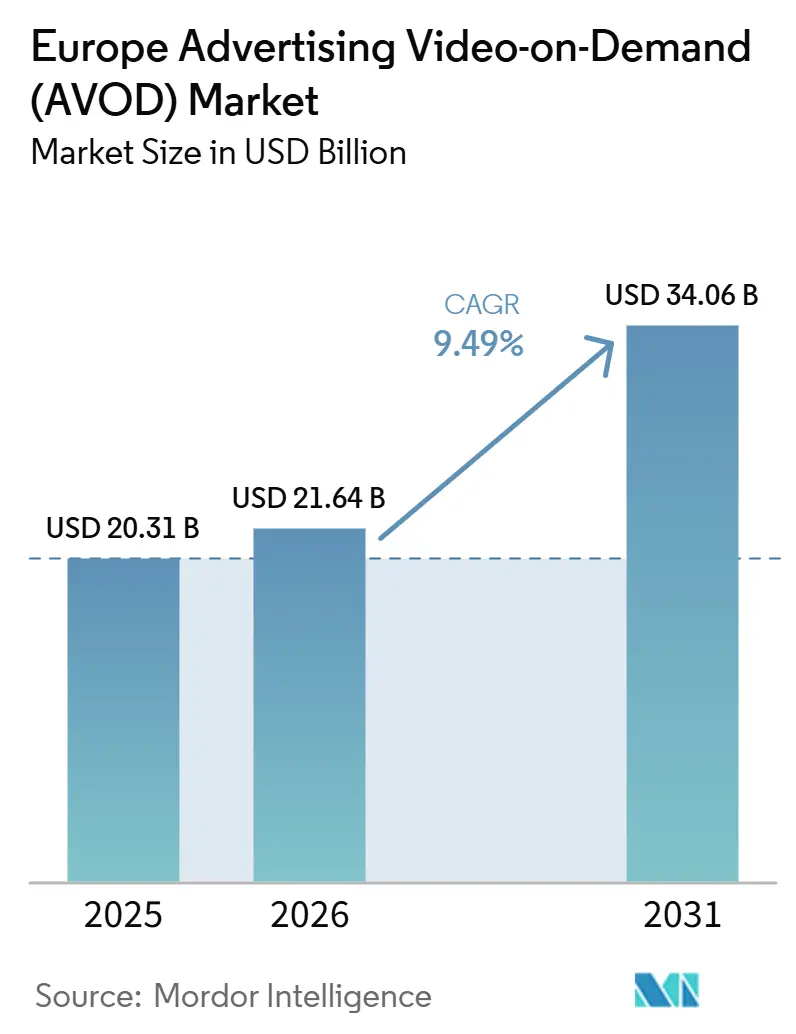
| Base Year Market Size (2025) | USD 20.31 Billion |
| Market Size (2026) | USD 21.64 Billion |
| Market Size (2031) | USD 34.06 Billion |
| Growth Rate (2026 - 2031) | 9.49 % |
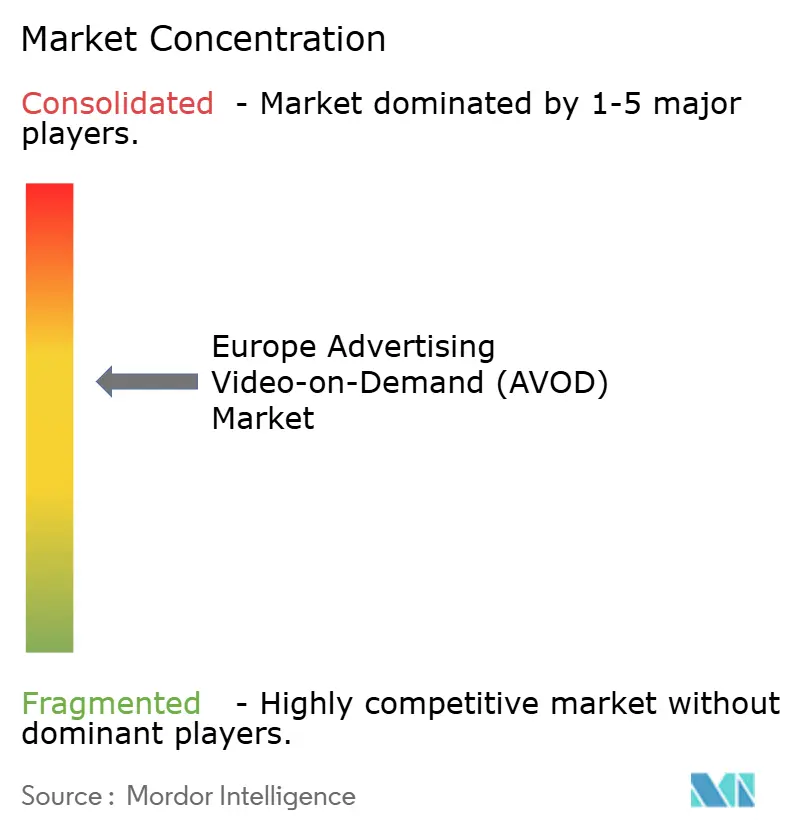
| Market Concentration | Medium |
Major Players *Disclaimer: Major Players sorted in no particular order Image © Mordor Intelligence. Reuse requires attribution under CC BY 4.0. | |
Europe Advertising Video-on-Demand (AVOD) Market Analysis by Mordor Intelligence
The Europe advertising video-on-demand (AVOD) market size is projected to be USD 20.31 billion in 2025, USD 21.64 billion in 2026, and reach USD 34.06 billion by 2031, registering a CAGR of 9.49% between 2026 and 2031. The Europe advertising video-on-demand (AVOD) market is benefiting from the wider shift of viewing and advertising budgets toward streaming services with advertising options. Video advertising in Europe grew 19.6% in 2025 to EUR 34.0 billion (USD 39.22 billion), and video represented more than half of display investment for the first time. Global streaming platforms are adding inventory through advertising tiers, while broadcasters are extending their own video-on-demand and free ad-supported streaming television services. Programmatic buying is making premium video inventory more accessible, although privacy rules and fragmented local markets continue to limit consistent campaign delivery across Europe. The Europe advertising video-on-demand (AVOD) market therefore favors platforms that combine recognizable content, direct audience relationships, and reliable advertising measurement.
Key Report Takeaways
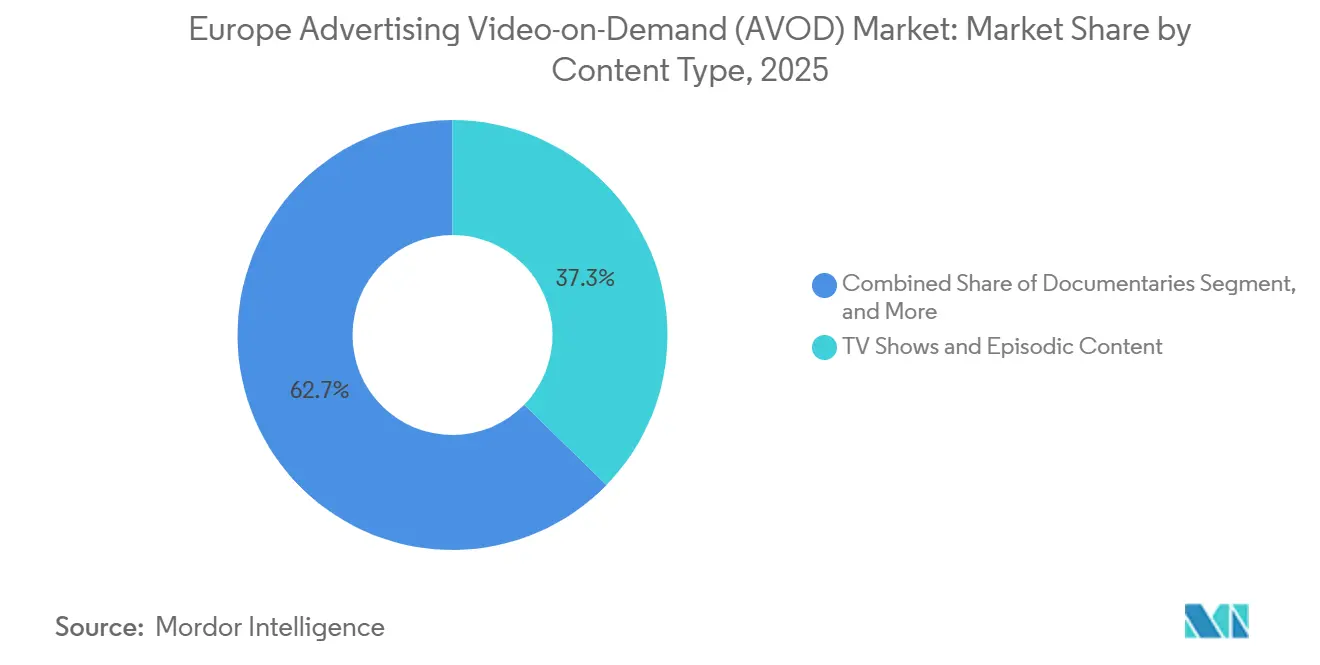
- By content type, TV Shows and Episodic Content held 37.29% of the Europe advertising video-on-demand (AVOD) market share in 2025, while Documentaries are projected to expand at a 10.21% CAGR through 2031.
- By device type, Smartphones and Tablets accounted for 35.86% of the Europe advertising video-on-demand (AVOD) market in 2025, while Smart TVs are projected to expand at a 10.06% CAGR through 2031.
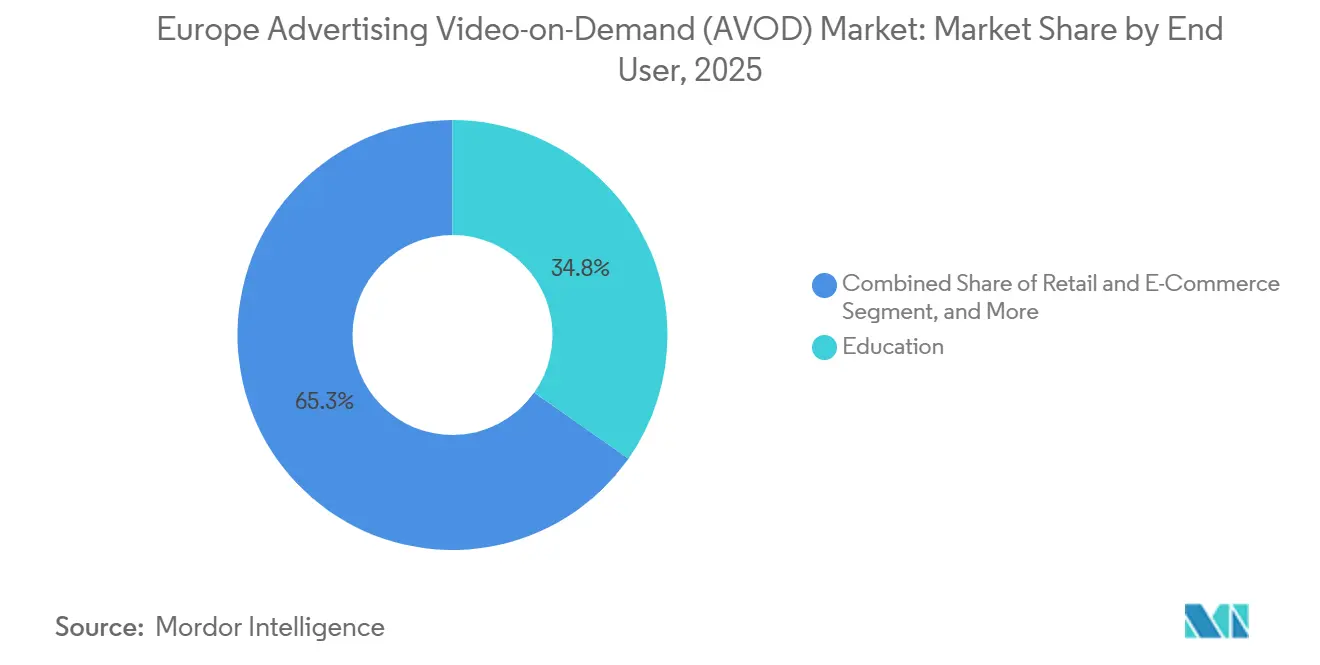
- By end user, Education held 34.75% of the Europe AVOD market in 2025, while Retail and E-Commerce are projected to expand at a 9.91% CAGR through 2031.
- By ad format, Pre-Roll accounted for 41.64% of the Europe advertising video-on-demand (AVOD) market in 2025, while Mid-Roll is projected to expand at a 9.78% CAGR through 2031.
- By geography, the United Kingdom held 27.64% of the Europe advertising video-on-demand market share in 2025, while Spain is projected to expand at a 9.84% CAGR through 2031.
Note: Market size and forecast figures in this report are generated using Mordor Intelligence’s proprietary estimation framework, updated with the latest available data and insights as of January 2026.
Market Trends and Insights
Drivers Impact Analysis of Europe Advertising Video-on-Demand (AVOD) Market*
| Driver | (~) % Impact on CAGR Forecast | Geographic Relevance | Impact Timeline |
|---|---|---|---|
| Expansion of Ad-Supported Streaming Tiers | +2.1% | Global, concentrated in the United Kingdom, Germany, France, Spain, and Italy | Short term (≤ 2 years) |
| Migration of Television Viewing to Connected TV | +1.8% | United Kingdom, Spain, Italy, and Netherlands, with spillover to DACH and Eastern Europe | Medium term (2–4 years) |
| Broadcaster VOD and FAST Content Expansion | +1.4% | United Kingdom, France, Germany, Italy, and Spain | Medium term (2–4 years) |
| Rising Programmatic Video Advertising Adoption | +1.2% | United Kingdom-led, with expansion to France, Germany, and Spain | Medium term (2–4 years) |
| Publisher-Controlled Identity Signals in Connected TV | +0.7% | GDPR-governed European Union markets, especially Germany, France, and Italy | Long term (≥ 4 years) |
| Localized Sports and Public-Service Content Monetization | +0.5% | All European Union markets, with early gains in the United Kingdom, Spain, and France | Medium term (2–4 years) |
| Source: Mordor Intelligence | |||
Expansion of Ad-Supported Streaming Tiers
Ad-supported plans from Netflix, Amazon Prime Video, and Disney+ are adding more premium inventory to the Europe advertising video-on-demand (AVOD) market. Netflix’s advertising tier recorded a 32% increase in viewing time across 5 Western European markets between November 2024 and April 2025, which showed that existing users were engaging more frequently with the service. Spain and the United Kingdom each recorded 34% growth during that period, placing both countries among the strongest markets for this viewing model. Ad-supported plans accounted for more than 60% of new Netflix subscriptions in the first quarter of 2026. Amazon Prime Video also expanded available inventory after making advertising the default option for its service, rather than requiring subscribers to choose advertising-supported viewing at sign-up. The larger inventory base is supporting revenue growth, although supply is increasing faster than monetization efficiency in some placements.
Migration of Television Viewing to Connected TV
Connected TV accounted for 50% of premium video advertising views in Europe during the second half of 2025, after increasing 33% year over year. Smart TV penetration reached 94% in Spain, 93% in Italy, 88% in the United Kingdom, and 86% in Germany during 2025, giving advertisers broad access to households through internet-connected screens. This device base is moving more streaming consumption to living-room screens, where advertisers seek longer viewing sessions and higher attention. The Europe AVOD market is also gaining new placement types as smart TV home screens become advertising inventory. Samsung Ads has used TotalView to provide a unified data set across 70 million European smart TVs, helping advertisers assess unduplicated reach across linear and connected television viewing. SVOD viewing in Europe increased more than 200% in 2024, while BVOD viewing rose nearly 30%.[1]IAB Europe, “IAB Europe’s Guide to Programmatic for CTV,” IAB Europe, iabeurope.eu
Broadcaster VOD and FAST Content Expansion
Broadcasters are expanding BVOD and FAST services to retain advertising budgets that might otherwise move to global streaming platforms. ITVX, TF1+, RTL+, Mediaset Infinity, and ATRESplayer use local catalogs and established viewer relationships to support this position, particularly where national programming and public-service content remain important to audiences. BVOD was projected to generate EUR 2.6 billion (USD 2.80 billion), in European advertising revenue during 2025. FAST revenue was projected to increase from EUR 1.34 billion (USD 1.44 billion), in 2025 to EUR 3.04 billion (USD 3.27 billion) by 2030. This content expansion creates more locally relevant inventory in the Europe advertising video-on-demand (AVOD) market, while giving broadcasters another route to distribute older catalog content. It also raises competition for independent AVOD services that do not have a subscription base or broadcaster-owned audience data.
Rising Programmatic Video Advertising Adoption
Programmatic connected TV advertising views increased 38% year over year in Europe during the second half of 2025.[2]FreeWheel, “CTV Accounts for 50% of Ad Views Across Europe, FreeWheel Video Marketplace Report H2 2025,” Advanced Television, advanced-television.com The pool of unique programmatic advertisers increased 21%, showing that more buyers are using the channel and that activity is not limited to a small group of established video buyers. Germany’s online video advertising revenue was projected to reach EUR 4.2 billion (USD 4.52 billion), in 2026. The United Kingdom had 55% of buyers transacting connected TV programmatically, compared with 25% in Germany. This difference indicates that programmatic adoption remains uneven across major European markets. Wider use of consent and format standards can make the Europe AVOD market easier to access for advertisers operating across several countries.
Restraints Impact Analysis of Europe Advertising Video-on-Demand (AVOD) Market*
| Restraint | (~) % Impact on CAGR Forecast | Geographic Relevance | Impact Timeline |
|---|---|---|---|
| Data Privacy and Consent Restrictions | -1.9% | Pan-European, especially Germany, France, and Italy | Long term (≥ 4 years) |
| Audience and Inventory Fragmentation | -1.4% | All European markets, especially Eastern Europe and smaller national markets | Medium term (2–4 years) |
| Ad-Load Fatigue and Viewer Churn Risk | -0.9% | Spain, Italy, and the United Kingdom | Short term (≤ 2 years) |
| Uneven Measurement and Local Inventory Liquidity | -0.7% | Rest of Europe and Eastern Europe, with partial mitigation in the United Kingdom and France | Long term (≥ 4 years) |
| Source: Mordor Intelligence | |||
Data Privacy and Consent Restrictions
Privacy and consent requirements remain a material constraint on advertising targeting in the Europe advertising video-on-demand market. The European Data Protection Board’s November 2025 guidance clarified that Article 26 of the Digital Services Act prohibits targeted advertising using special-category personal data, reducing the types of information available for audience selection. The restriction adds to existing GDPR obligations for platforms and advertisers. A proposed GDPR reform could permit users to reject personalized advertising through a centralized Personal Information Management System signal. The proposal includes an exemption for media service providers, which could favor companies with direct subscriber relationships. Broadcasters with authenticated consent systems can therefore have an advantage over services that rely mainly on device-based identifiers in the Europe Advertising Video-on-Demand (AVOD) market.
Audience and Inventory Fragmentation
Europe had 3,931 video-on-demand services and video-sharing platforms as of December 2025, creating a highly dispersed inventory base. The scale of available services makes it harder for advertisers to assemble consistent reach across countries, especially when campaigns require local language, rights, and audience considerations. Samsung’s TotalView and the planned Sky, Channel 4, and ITV Universal Ads marketplace are intended to improve reach management within specific ecosystems. These efforts do not yet provide a single cross-border advertising infrastructure. The United Kingdom’s programmatic video activity remains much larger than activity in France and Germany. Advertisers seeking pan-European delivery must still manage localized inventory, market-specific campaigns, and separate measurement practices.
*Our forecasts treat driver/restraint impacts as directional, not additive. The impact forecasts reflect baseline growth, mix effects, and variable interactions.
Europe Advertising Video-on-Demand (AVOD) Market Segment Analysis
By Content Type:
Episodic Programming Holds the Leading PositionTV Shows and Episodic Content accounted for 37.29% of the Europe advertising video-on-demand market in 2025. The segment benefits from the repeat viewing and regular release patterns associated with serialized programming, which can keep audiences returning to the same service over several weeks. Broadcaster services such as ITVX, TF1+, RTL+, Mediaset Infinity, and ATRESplayer use established television catalogs to maintain a regular supply of episodes. Those catalogs support advertising breaks within content sessions. This availability makes episodic programming useful for advertisers seeking repeat exposure over several viewing occasions.
Documentaries are projected to expand at a 10.21% CAGR through 2031, making them the fastest-growing content category. The format is associated with premium and brand-safe viewing environments. Documentary programming on BVOD services can run lower advertising loads and offer direct-sold advertising opportunities. Movies and Films remain the second-largest content category. Their AVOD supply is limited by content-windowing arrangements that differ across European countries. Other content types include live sports clips, user-generated video, and reality formats, while the European Broadcasting Union expanded Eurovision Sport to United Kingdom FAST platforms in May 2026.[3]European Broadcasting Union, “Eurovision Sport Expands Onto FAST Platforms as EBU Accelerates Platform Strategy,” European Broadcasting Union, ebu.ch



By Device Type:
Mobile Devices Lead Viewing While Smart TVs Gain ValueSmartphones and Tablets held 35.86% of the Europe AVOD market in 2025. Mobile viewing remains important among consumers aged 18-34 who use ad-supported services as a lower-cost alternative to pay television and often watch outside traditional evening viewing hours. Mobile devices enable viewing during short sessions and outside the home. Their broad usage supports reach-based advertising campaigns. The segment remains central to the Europe advertising video-on-demand industry because viewers frequently move between devices.
Smart TVs are projected to expand at a 10.06% CAGR through 2031. High household penetration in the EU5 is supporting the shift to large-screen streaming. Advertisers value this setting because it supports longer viewing sessions and premium connected TV placements. In June 2026, Samsung Ads opened smart TV home-screen inventory to programmatic buying through The Trade Desk and Google Display and Video 360. Laptops and Desktops retained 10% of European premium streaming advertising views, mainly among office-based audiences. Streaming sticks and game consoles remain relevant where smart TV penetration is lower or viewers prefer external devices.
By End User:
Education Leads Spending While Retail and E-Commerce AccelerateEducation accounted for 34.75% of the Europe advertising video-on-demand (AVOD) market in 2025. Institutional digital content adoption and the European Commission’s Digital Education Action Plan 2021-2027 supported this position. Educational organizations use video services to distribute course material and reach learners across different locations, including users who cannot attend classes in person. The segment has a broad need for accessible streaming formats. This demand helps sustain advertising-supported video use across schools, universities, and related institutions.
Retail and E-Commerce are projected to expand at a 9.91% CAGR through 2031. The segment is supported by the convergence of retail media and connected television advertising. Retail media spending on connected television was projected to grow 3 times faster than retail media search. Amazon Audiences data integration with Netflix inventory launched across the United Kingdom, Germany, France, Italy, and Spain on May 18, 2026. The arrangement gave retail and e-commerce advertisers a way to apply behavioral purchase signals to premium streaming inventory. BFSI, Media and Entertainment, Information Technology and Telecommunications, and Healthcare remain important end-user groups, although pharmaceutical advertising rules limit healthcare campaign reach in several European countries.
By Ad Format:
Pre-Roll Maintains Scale While Mid-Roll ExpandsPre-Roll accounted for 41.64% of the Europe advertising video-on-demand (AVOD) market size in 2025. The format is standardized across most AVOD services and compatible with a wide range of demand-side platforms, which reduces operational differences for buyers across video publishers. It gives advertisers a consistent way to reach viewers before a content session begins. Its simple implementation supports programmatic activation. These factors have kept Pre-Roll ahead of other formats in the Europe advertising video-on-demand industry.
Mid-Roll is projected to expand at a 9.78% CAGR through 2031. Longer documentaries and episodic programs create more opportunities for advertising breaks during content sessions. In July 2026, IAB Tech Lab finalized guidance for 6 native connected TV format signals in the programmatic bidstream. The guidance can help buyers distinguish Mid-Roll from other contextual placements. Netflix also presented programmatic pause advertisements during its May 2026 upfront. Post-Roll remains the smallest format and is used mainly for lower-cost retargeting after viewers finish a content unit.
Geography Analysis
United Kingdom Advertising Video-on-Demand (AVOD) Market
The United Kingdom accounted for 27.64% of the Europe advertising video-on-demand (AVOD) market size in 2025. It is Europe’s most mature programmatic AVOD ecosystem. In 2025, 42% of United Kingdom viewers chose AVOD services, a 7-percentage-point increase that placed AVOD ahead of BVOD and SVOD at 36% each. The country also had 55% of connected TV buyers transacting programmatically, compared with 25% in Germany. Channel 4 Streaming recorded 17% growth in viewing hours in the first quarter of 2026. These conditions support the country’s leading position in the Europe advertising video-on-demand market.
Germany and France Advertising Video-on-Demand (AVOD) Market
Germany and France represent large but distinct opportunities. Germany’s streaming video advertising revenue was projected to increase 18% to EUR 2.61 billion (USD 2.81 billion), in 2026. France’s video display advertising grew 18% to EUR 1.402 billion (USD 1.51 billion), in 2025. The TF1 and Netflix distribution partnership began in France on June 19, 2026. The arrangement placed TF1+ content within Netflix’s French service. Its commercial outcome can influence whether similar agreements are considered by other European broadcasters and streamers.
Broader European Markets
Spain is projected to expand at a 9.84% CAGR through 2031, the fastest rate among the countries assessed. In 2025, 75% of Spanish viewers consumed FAST or AVOD content weekly, and 60% reported that they no longer watched linear television. Italy had 93% smart TV penetration and strong adoption of ad-supported Netflix and Disney+ plans. Russia remained isolated from much of the pan-European programmatic infrastructure and requires separate investment consideration. Poland, the Netherlands, the Nordics, and Eastern European markets offer additional room for connected TV development. Magnite expanded its programmatic connected TV partnership with Dentsu to Sweden in June 2026.
Competitive Landscape
The Europe advertising video-on-demand (AVOD) market has a fragmented group of services but a concentrated share of monetizable advertising inventory. Alphabet through YouTube, Amazon, and Netflix hold influential positions alongside broadcaster platforms, FAST operators, and advertising technology providers. Four technology platforms, Alphabet, Amazon, ByteDance, and Meta, were estimated to control 72% of German in-stream video advertising revenue in 2026. This concentration affects the ability of smaller services to secure advertiser demand and measurement investment. At the same time, national broadcasters have direct audience relationships and local programming that global platforms cannot fully replicate.
RTL Group completed its acquisition of Sky Deutschland from Comcast in June 2026. The transaction created a DACH business with 12.3 million subscribers and a target of EUR 250 million (USD 293 million) in annual synergies within 3 years. The move added scale in content, distribution, and advertising operations. Broadcasters are also building publisher-controlled identity systems that can support consent-based advertising under GDPR requirements. This approach can strengthen their position against open-marketplace inventory that depends more heavily on device-based identifiers. The Europe AVOD market is therefore shaped by both global platform scale and local broadcaster control of premium audiences.
Device manufacturers are expanding their role through vertically integrated FAST and advertising services. Samsung TV Plus replaced Pluto TV as Europe’s highest-grossing FAST pure-play in 2025, with a significant share of the EUR 630 million (USD 737 million) in European FAST pure-play revenue. Samsung Ads also made smart TV home-screen inventory available to programmatic buyers in June 2026. FreeWheel’s Buyer Cloud integration with Channel 4, the Sky, Channel 4, and ITV Universal Ads marketplace, and Magnite’s SpringServe work with Samsung are consolidating supply-side access. These initiatives seek to improve the quality and usability of connected TV inventory. A remaining opportunity is authenticated audience data packaging for mid-market advertisers that need pan-European reach without extensive internal advertising infrastructure.
Europe Advertising Video-on-Demand (AVOD) Industry Leaders
Alphabet Inc.
Amazon.com, Inc.
Netflix, Inc.
RTL Group S.A.
Comcast Corporation
- *Disclaimer: Major Players sorted in no particular order
Europe Advertising Video-on-Demand (AVOD) Market Companies Covered in this Report
- Alphabet Inc.
- Amazon.com, Inc.
- Netflix, Inc.
- RTL Group S.A.
- ITV plc
- ProSiebenSat.1 Media SE
- Paramount Global
- The Walt Disney Company
- Comcast Corporation
- Samsung Electronics Co., Ltd.
- LG Electronics Inc.
- Rakuten Group, Inc.
- Dailymotion SA
- TF1 Group
- Groupe M6
- France Télévisions
- Mediaset S.p.A.
- RAI - Radiotelevisione Italiana S.p.A.
- Atresmedia Corporación de Medios de Comunicación, S.A.
- Channel Four Television Corporation
- Roku, Inc.
- Brightcove Inc.
- Kaltura, Inc.
- Vimeo, Inc.
- FreeWheel, A Comcast Company
- Magnite, Inc.
- The Trade Desk, Inc.

Recent Industry Developments in Europe Advertising Video-on-Demand (AVOD) Market
- July 2026: AMC Global Media launched The Walking Dead Universe FAST channel on ITVX, extending ad-supported reach across Rakuten TV, Pluto TV, LG Channels, and Samsung TV Plus simultaneously, the first major genre-specific FAST expansion onto a United Kingdom BVOD platform in 2026.
- June 2026: RTL Group completed the acquisition of Sky Deutschland from Comcast, unconditionally approved by the European Commission in April 2026, creating a 12.3-million-subscriber DACH entity with EUR 250 million in targeted annual synergies within 3 years.
- June 2026: Magnite and Dentsu extended their EMEA programmatic connected TV partnership to Sweden, building on Magnite’s SpringServe infrastructure to enable data-driven connected TV buying in the Nordic market for the first time.
- April 2026: IAB Europe published its Guide to Programmatic for CTV, establishing consent signaling, media quality, and fraud prevention standards for programmatic buying across linear-style and behavioral connected TV advertising formats across 25+ European markets.


Europe Advertising Video-on-Demand (AVOD) Market Report Scope
The Europe Advertising Video-on-Demand (AVOD) Market encompasses the ecosystem of digital video streaming services that provide consumers with free or low-cost access to on-demand video content in exchange for viewing advertisements, including platforms offering movies, television programs, user-generated content, live-streamed content, and original productions across connected TVs, smartphones, tablets, computers, and other internet-enabled devices.
The Europe Advertising Video-on-Demand (AVOD) Market Report is Segmented by Content Type (Movies and Films, TV Shows and Episodic Content, Documentaries, and Other Content Types), Device Type (Smartphones and Tablets, Smart TVs, Laptops and Desktops, and Other Device Types), End User (Media and Entertainment, Retail and E-Commerce, BFSI, Education, Information Technology and Telecommunications, Healthcare, and Other End Users), Ad Format (Pre-Roll, Mid-Roll, and Post-Roll), and Geography (Germany, United Kingdom, France, Italy, Spain, Russia, and Rest of Europe). The Market Forecasts are Provided in Terms of Value (USD).
| Movies and Films |
| TV Shows and Episodic Content |
| Documentaries |
| Other Content Types |
| Smartphones and Tablets |
| Smart TVs |
| Laptops and Desktops |
| Other Device Types |
| Media and Entertainment |
| Retail and E-Commerce |
| BFSI |
| Education |
| Information Technology and Telecommunications |
| Healthcare |
| Other End Users |
| Pre-Roll |
| Mid-Roll |
| Post-Roll |
| Germany |
| United Kingdom |
| France |
| Italy |
| Spain |
| Russia |
| Rest of Europe |
| By Content Type | Movies and Films |
| TV Shows and Episodic Content | |
| Documentaries | |
| Other Content Types | |
| By Device Type | Smartphones and Tablets |
| Smart TVs | |
| Laptops and Desktops | |
| Other Device Types | |
| By End User | Media and Entertainment |
| Retail and E-Commerce | |
| BFSI | |
| Education | |
| Information Technology and Telecommunications | |
| Healthcare | |
| Other End Users | |
| By Ad Format | Pre-Roll |
| Mid-Roll | |
| Post-Roll | |
| By Geography | Germany |
| United Kingdom | |
| France | |
| Italy | |
| Spain | |
| Russia | |
| Rest of Europe |


Key Questions Answered in the Report
What is the size of the Europe advertising video-on-demand market?
The Europe advertising video-on-demand market was valued at USD 20.31 billion in 2025 and stood at USD 21.64 billion in 2026. It is projected to reach USD 34.06 billion by 2031.
What is driving advertising-supported video growth in Europe?
Advertising tiers from major streaming platforms, connected TV adoption, broadcaster video-on-demand expansion, and programmatic buying are increasing premium video inventory and advertiser access.
Which content type has the largest share in Europe's AVOD sector?
TV Shows and Episodic Content held 37.29% of the market in 2025. Documentaries are projected to record the fastest growth at a 10.21% CAGR through 2031.
Which device category leads AVOD viewing in Europe?
Smartphones and Tablets held 35.86% of the market in 2025. Smart TVs are projected to expand fastest at a 10.06% CAGR through 2031 as connected TV viewing grows.
Which European country leads AVOD revenue?
The United Kingdom held 27.64% of AVOD revenue in 2025. Spain is projected to expand fastest, with a 9.84% CAGR through 2031.
What factors constrain AVOD advertising in Europe?
Privacy and consent requirements, fragmented inventory, advertising fatigue, and uneven measurement can limit targeting, campaign scale, and advertising yields.
Page last updated on:





