
ESIM IoT Lifecycle Management Market Size and Share
Market Overview
| Study Period | 2021 - 2032 |
|---|---|
| Market Size (2027) | USD 1.37 Billion |
| Market Size (2032) | USD 3.84 Billion |
| Growth Rate (2027 - 2032) | 22.89 % |
| Fastest Growing Market | Asia-Pacific |
| Largest Market | Europe |
| Market Concentration | Medium |
Major Players *Disclaimer: Major Players sorted in no particular order Image © Mordor Intelligence. Reuse requires attribution under CC BY 4.0. | |
ESIM IoT Lifecycle Management Market Analysis by Mordor Intelligence
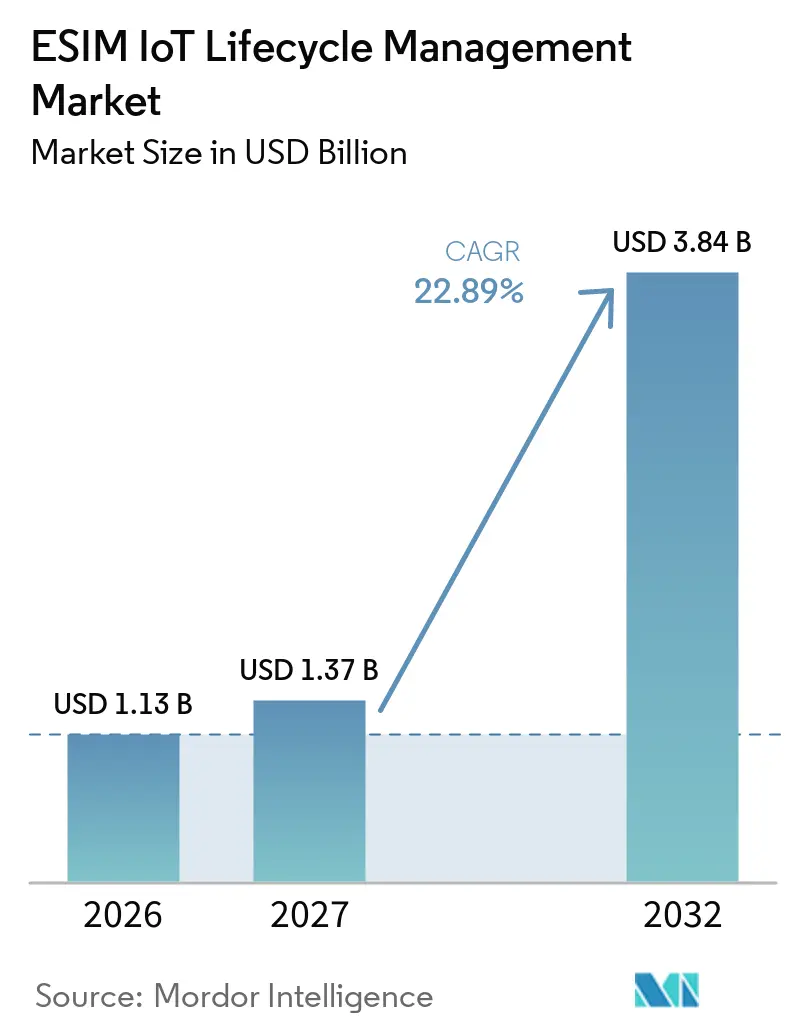
The eSIM IoT Lifecycle Management Market size is expected to increase from USD 1.13 billion in 2026 to USD 1.37 billion in 2027 and reach USD 3.84 billion by 2032, growing at a CAGR of 22.89% over 2027-2032. The eSIM IoT lifecycle management market is supported by industrial device fleets that need secure connectivity over long operating lives, including assets that are costly, unsafe, or otherwise impractical to access after installation, where physical replacement can interrupt service and create additional coordination work. Remote profile management reduces the need to replace physical SIM cards when a device changes carriers or crosses borders. The GSMA SGP.32 standard supports remote provisioning for devices that have limited user interfaces or intermittent connectivity. This shift gives enterprises more flexibility in managing suppliers, while increasing demand for secure provisioning systems and integration services. The eSIM IoT lifecycle management market also faces transition costs because many enterprises must support SGP.02, SGP.22, and SGP.32 environments at the same time.
Key Report Takeaways
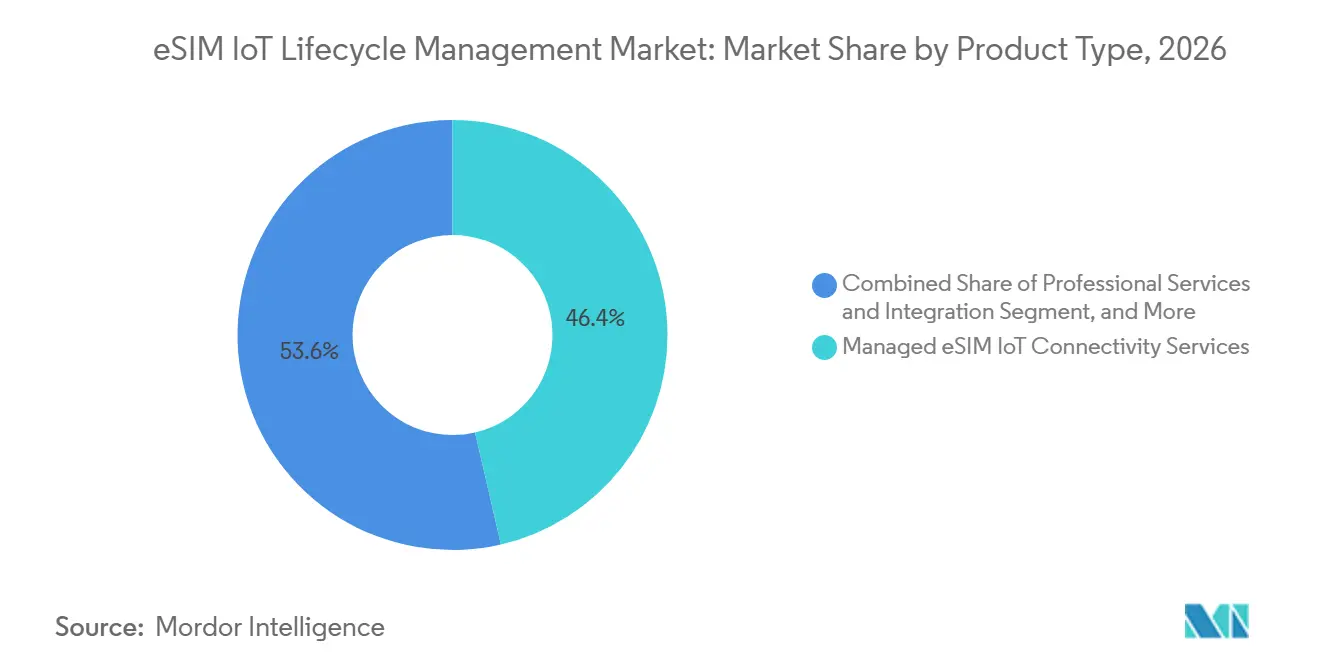
- By product type, managed eSIM IoT connectivity services held 46.38% of the eSIM IoT lifecycle management market share in 2026, while lifecycle management software and platforms are projected to expand at a 24.53% CAGR through 2032.
- By deployment model, cloud-based deployment accounted for 63.47% of the eSIM IoT lifecycle management market size in 2026, while hybrid deployment is projected to expand at a 24.28% CAGR through 2032.
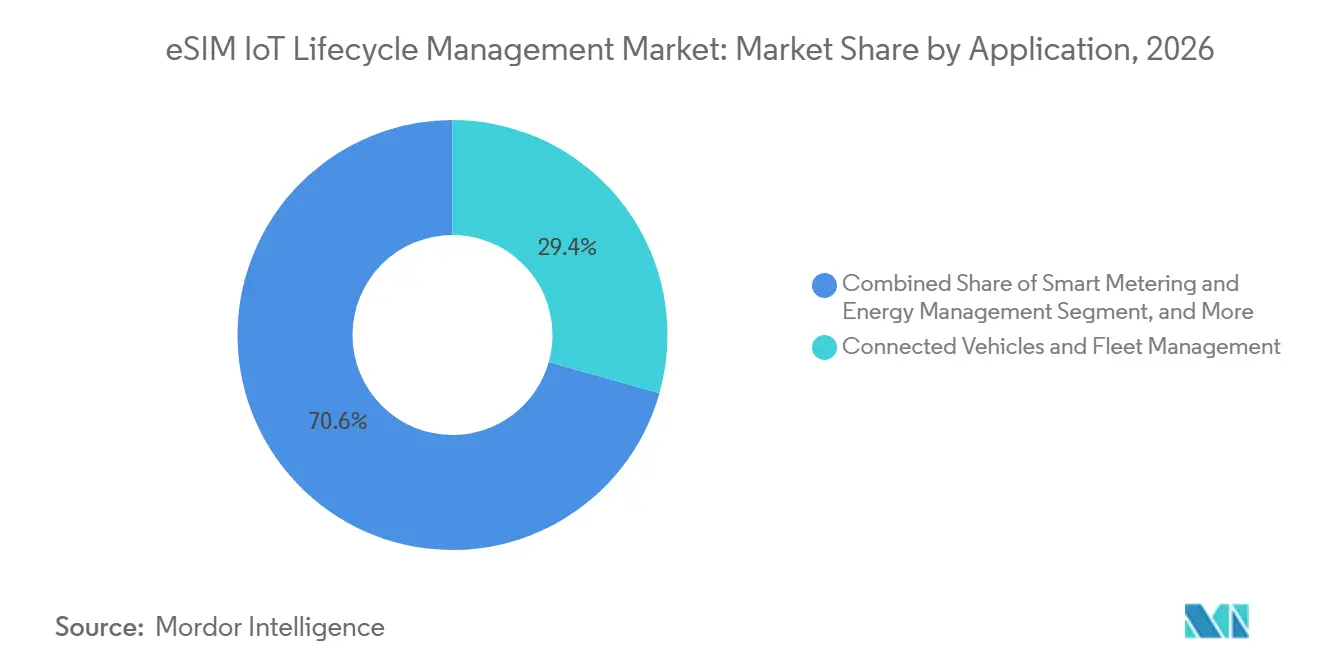
- By application, connected vehicles and fleet management accounted for 29.36% of revenue in 2026, while the smart metering and energy management segment is projected to expand at a 24.67% CAGR through 2032.
- By end-user, mobile network operators and MVNOs held 32.74% of the eSIM IoT lifecycle management market share in 2026, while IoT connectivity aggregators are projected to expand at a 24.61% CAGR through 2032.
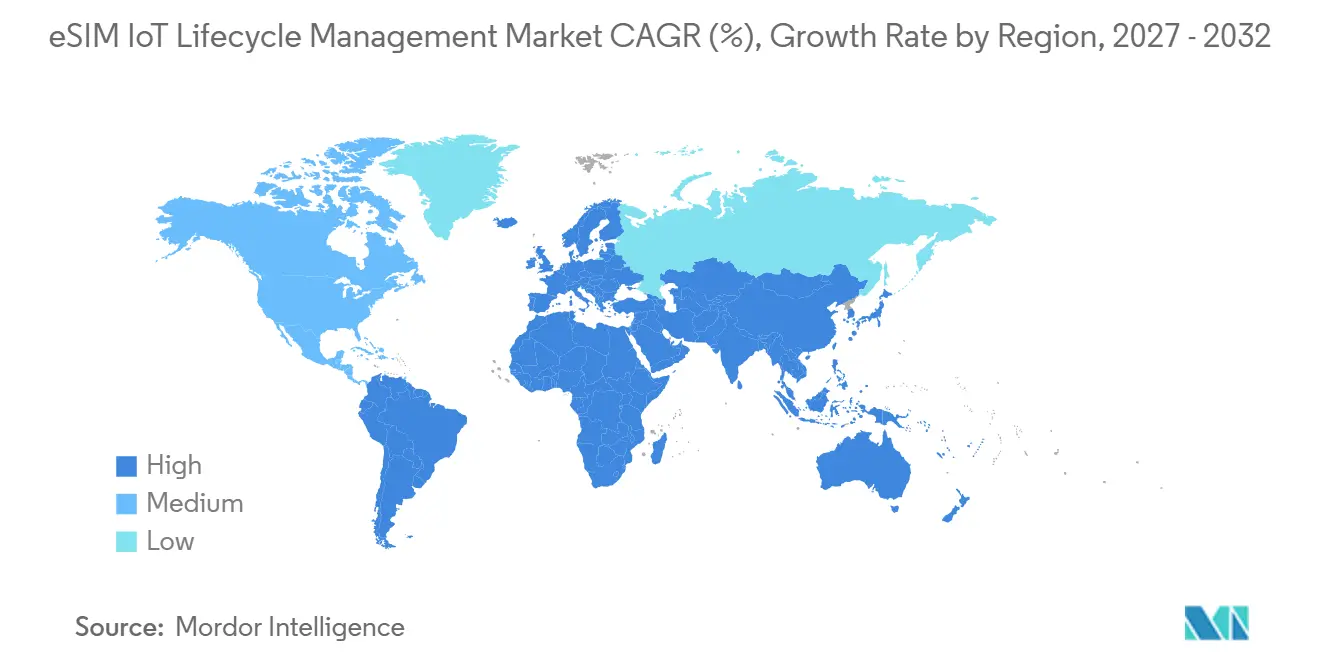
- By geography, Europe held 34.26% of the eSIM IoT lifecycle management market share in 2026, while Asia-Pacific is projected to expand at a 24.72% CAGR through 2032.
Note: Market numbers in this report are based on Mordor Intelligence's proprietary estimation framework, which combines nine months of actuals with Q4 projections for base year 2026.
Market Trends and Insights
Drivers Impact Analysis of ESIM IoT Lifecycle Management Market*
| Driver | (~) % Impact on CAGR Forecast | Geographic Relevance | Impact Timeline |
|---|---|---|---|
| Industrial IoT Fleets Requiring Long-Life Remote Connectivity Control | +4.2% | Global, with concentration in North America, Europe, and Asia-Pacific industrial hubs | Long term (≥ 4 years) |
| SGP.32 Standardization for Constrained and User-Interface-Limited Devices | +3.8% | Global, with early adoption in North America and Europe and scaling into Asia-Pacific | Medium term (2-4 years) |
| Automotive Telematics and Cybersecurity Compliance Requirements | +3.2% | North America and Europe, with early spillover to Asia-Pacific and the Middle East | Medium term (2-4 years) |
| Remote Provisioning Savings in Multi-Country Deployments | +2.8% | Global, especially in cross-border logistics, utilities, and fleet operations | Short term (≤ 2 years) |
| Battery-Efficient Profile Management for Intermittently Connected Devices | +2.1% | Asia-Pacific and Europe, particularly in smart metering and asset tracking | Long term (≥ 4 years) |
| Local-Profile and Multi-Operator Resilience for Permanent-Roaming Exposure | +1.6% | Europe, South America, the Middle East, and Africa | Medium term (2-4 years) |
| Source: Mordor Intelligence | |||
Industrial IoT Fleets Requiring Long-Life Remote Connectivity Control
Industrial fleets of smart meters, pipeline monitors, grid sensors, and logistics trackers are a major source of demand for the eSIM IoT lifecycle management market. These devices often operate for 10-20 years and may outlast several carrier contracts. Replacing a physical SIM across a dispersed fleet can require a site visit, hardware handling, and service interruption. Remote provisioning allows operators to change connectivity arrangements without retrieving the device. Telenor IoT announced the commercial availability of SGP.32 SIM cards in 2026 for large-scale IoT deployments, indicating that the standard has moved beyond pilot activity.[1] The cost of a mid-life carrier change can be high when devices are installed in remote or restricted locations, making lifecycle automation more important as fleet sizes increase.
SGP.32 Standardization for Constrained and User-Interface-Limited Devices
The GSMA SGP.32 specification addresses remote management for IoT devices that lack a user interface or a persistent data connection. An eIM server can initiate provisioning asynchronously, allowing a fleet to be managed without manual device interaction.[2] The eSIM IoT lifecycle management market benefits because the specification separates profile management from the connectivity provider. This can allow enterprises to select a connectivity provider independently from their eSIM management layer. IDEMIA introduced a fully GSMA-certified end-to-end SGP.32 solution in August 2025, covering both the eUICC and eIM components. Certification is becoming more relevant in procurement because automotive and utility buyers need dependable evidence that a platform can support standardized provisioning workflows.
Automotive Telematics and Cybersecurity Compliance Requirements
Connected vehicle services increasingly depend on reliable lifecycle control for telematics, diagnostics, and over-the-air software updates. The United States connected-vehicle supply chain rule became effective in March 2025 and imposed supply chain requirements on covered connected-vehicle hardware and software.[3] eSIM provisioning is relevant because automakers need reliable records of how connectivity profiles are issued and managed. G+D announced in 2026 that it would provide subscription management services to Rivian for the R2 using SGP.32 technology. A single eUICC can support local profiles across markets, reducing the need to create country-specific SIM hardware variants. The eSIM IoT lifecycle management market, therefore, has a role in helping manufacturers manage compliance and connectivity over a vehicle's operating life.
Remote Provisioning Savings in Multi-Country Deployments
Multi-country fleets can incur physical SIM costs through inventory management, customs procedures, technician visits, and downtime. Remote profile switching can reduce these operational constraints when a device is moved to a new territory or carrier, particularly where a replacement would require coordination between local field teams. Cisco and Tata Communications announced a 2025 collaboration that integrated Tata Communications' MOVE platform with Cisco IoT Control Center.[4] The collaboration covered large international IoT estates and shows why enterprises value centralized connectivity control. SGP.32 version 1.3 also includes in-factory profile provisioning procedures that can support secure commissioning before a device leaves production. This reduces uncertainty associated with shipping unprovisioned devices and can simplify international deployment planning for the eSIM IoT lifecycle management market.
Restraints Impact Analysis of ESIM IoT Lifecycle Management Market*
| Restraint | (~) % Impact on CAGR Forecast | Geographic Relevance | Impact Timeline |
|---|---|---|---|
| Coexistence Costs Across SGP.02, SGP.22, and SGP.32 Estates | -2.8% | Global, most acute in North America and Europe with large legacy SGP.02 fleets | Long term (≥ 4 years) |
| Device, eUICC, Firmware, and Regional Certification Readiness Gaps | -2.2% | Asia-Pacific and South America, with certification delays in emerging economies | Medium term (2-4 years) |
| Profile-Switching Governance and Connectivity Outage Risk | -1.6% | Global, most acute in critical infrastructure and healthcare | Medium term (2-4 years) |
| Commercial and Regulatory Constraints on Local Operator Access | -1.2% | Europe and Asia-Pacific, where permanent roaming restrictions and SIM registration rules apply | Short term (≤ 2 years) |
| Source: Mordor Intelligence | |||
Coexistence Costs Across SGP.02, SGP.22, and SGP.32 Estates
Many organizations must operate legacy SGP.02 systems alongside newer SGP.22 and SGP.32 environments. This requires parallel backend infrastructure, licensing, security controls, and specialist engineering resources. The older SM-SR approach does not directly align with SGP.32 eIM management logic, so migration cannot always be completed through a simple software update. The eSIM IoT lifecycle management market can face longer sales cycles when enterprises need to protect existing investments. Smaller platform providers may find it difficult to fund multi-standard support while meeting evolving certification requirements. This environment favors vendors that can manage legacy and new provisioning environments without increasing operational risk for the customer.
Device, eUICC, Firmware, and Regional Certification Readiness Gaps
Software availability does not ensure that every connected device is ready for SGP.32 deployment. Module vendors, eUICC suppliers, device manufacturers, and local regulators may have different readiness timelines, so a service provider may be technically ready before the installed device base is. Firmware qualification can take longer for low-power devices because these products use limited radio capacity and longer update cycles. SIM-registration requirements can also add operational steps for cross-border fleets where local registration and identity procedures apply. The eSIM IoT lifecycle management market may therefore advance faster in new deployments than in fleets that require hardware or firmware changes, especially where a device cannot be readily retrieved. Enterprises in less mature certification environments may incur additional bilateral testing costs before deployment is approved, making adoption more difficult for lower-cost sensor programs.
*Our forecasts treat driver/restraint impacts as directional, not additive. The impact forecasts reflect baseline growth, mix effects, and variable interactions.
ESIM IoT Lifecycle Management Market Segment Analysis
By Product Type:
Software Platforms Gain Momentum Alongside Managed ServicesManaged eSIM IoT Connectivity Services held 46.38% of revenue in 2026. The segment remains important because many enterprises prefer a provider that manages carrier relationships, roaming arrangements, subscription activity, alerts, and day-to-day exception handling. This approach can reduce complexity in SGP.32 infrastructure is still being introduced across markets and operating environments. Managed services are particularly relevant for organizations that do not want to operate their own provisioning environment or employ specialists for each operator relationship. They also provide support for day-to-day connectivity administration across multiple countries, which remains a practical reason for their continued role in the eSIM IoT lifecycle management market.
Lifecycle Management Software and Platforms are projected to expand at a 24.53% CAGR through 2032. This part of the eSIM IoT lifecycle management market is supported by eIM tools that automate provisioning, policy enforcement, profile changes, approvals, and record management across device fleets. Software platforms can create logs that help enterprises demonstrate control over provisioning activity and investigate connection issues without visiting the device. Kigen offers its eIM platform through managed cloud and hybrid deployment options, which illustrates the range of delivery models available to buyers. Professional Services and Integration remain relevant because eUICC, eIM, SM-DP+, security tools, and enterprise systems often require tailored integration. The eSIM IoT lifecycle management industry also relies on these services when customers move from older provisioning environments, test a new operating model, or need internal teams trained on revised processes.

By Deployment Model:
Cloud Leads While Hybrid Supports Data Residency NeedsCloud-based deployment represented 63.47% of revenue in 2026. Enterprises use cloud services to access scalable provisioning infrastructure without building and maintaining all systems internally, thereby shortening implementation time for a distributed fleet. Certified cloud environments can also help providers serve customers in multiple regions from a common operational platform while applying consistent access controls and software updates. G+D and AWS announced a cloud-based remote eSIM provisioning collaboration in February 2026. The arrangement shows how vendors are using cloud distribution channels to reach carriers, enterprises, and IoT service providers.
Hybrid deployment is projected to expand at a 24.28% CAGR through 2032. This architecture allows organizations to combine cloud scalability with locally managed components where data residency, operational control, or security requirements apply. The eSIM IoT lifecycle management market size for hybrid systems benefits from demand in regulated utilities, government-related networks, and industries with local data controls that cannot place every operational function in a shared environment. Germany's approach to M2M data handling is one reason utility operators may prefer a hybrid arrangement. On-premises systems still serve some sovereign and defense-related use cases. However, their slower adoption reflects broader acceptance of certified shared cloud infrastructure and the lower maintenance burden it entails.
By Application:
Vehicle Connectivity Leads While Smart Metering Advances RapidlyConnected Vehicles and Fleet Management accounted for 29.36% of revenue in 2026. Automakers need stable connectivity for diagnostics, telematics, software updates, emergency functions, and digital services during the vehicle's operating life. A single-SKU design can use one globally compatible eUICC and apply a local profile after production, rather than holding separate SIM stock for each destination. This reduces the number of SIM variants that a manufacturer needs to manage in its supply chain and can simplify factory planning. It also helps the eSIM IoT lifecycle management market address international vehicle launches in which local connectivity needs, operator relationships, and compliance requirements differ.
Smart Metering and Energy Management is projected to expand at a 24.67% CAGR through 2032. Utilities need long-lived connectivity for two-way meter communication, distributed energy monitoring, EV charging coordination, and network fallback. ESMIG has identified eSIM technology as relevant to resilient and interoperable smart-meter connectivity. Devices in this application may remain installed for 15-20 years, allowing remote profile management to limit future fieldwork and support continuity as connectivity terms change. Industrial automation, logistics, asset tracking, and healthcare monitoring further broaden the demand for applications. Healthcare places strong emphasis on audit controls and data handling, while logistics uses provisioning automation to reduce country-specific SIM inventory and manual activation work.
By End User:
Operators Retain Scale While Aggregators Expand Their RoleMobile Network Operators and MVNOs held 32.74% of revenue in 2026. They remain the usual provisioning counterparty for enterprises that buy managed connectivity with network access. Their established operator relationships and existing SIM-management systems support their current position. These providers can also offer bundled support for roaming, subscriptions, and connectivity policies. The eSIM IoT lifecycle management market continues to rely on operators, as networks still provide the underlying connectivity.
IoT Connectivity Aggregators are projected to expand at a 24.61% CAGR through 2032. SGP.32 allows eIM ownership to be separated from connectivity provision, giving enterprises an option to use a neutral management layer. Aggregators can provide a consolidated view across multiple network suppliers, which is useful for regional or global fleets. Original Equipment Manufacturers are also increasing their direct engagement with eIM platforms to keep control of the device-to-cloud relationship. Enterprise IoT owners may adopt self-managed systems once provisioning volumes justify the use of dedicated infrastructure. System integrators and managed service providers remain important because they link provisioning systems to enterprise resource planning and asset management platforms.
Geography Analysis
Europe ESIM IoT Lifecycle Management Market
Europe held 34.26% of the eSIM IoT lifecycle management market share in 2026. The region benefits from automotive production in Germany, smart-meter programs in the United Kingdom, and early industrial IoT deployment in Nordic countries, where established communications infrastructure supports connected asset management. The EU Cyber Resilience Act and NIS2 requirements strengthen the need for security updates, audit trails, certificate management, and clearly governed access across connected-product lifecycles. Registration requirements can also create country-specific operational work for cross-border fleet operators. Telefónica Tech and Thales launched a commercial SGP.32 solution integrated with Telefónica's Kite platform in July 2026.
APAC ESIM IoT Lifecycle Management Market
Asia-Pacific is projected to expand at a 24.72% CAGR through 2032. China's commercial approval for eSIM smartphone services in October 2025 marked an important development for broader eSIM adoption. Thales, Singtel, Optus, AIS, and Globe Telecom announced plans to launch a multi-operator enterprise eSIM IoT network using SGP.32 in 2026. Japan and South Korea have established enterprise IoT capabilities, while India presents a large opportunity for connected services and deployment models tailored to domestic needs. Tata Communications supported BSNL's pan-India eSIM service launch, creating a reference point for domestic eSIM deployment and an important consideration for the eSIM IoT lifecycle management market.
The Americas and MEA ESIM IoT Lifecycle Management Market
North America has a substantial eSIM IoT lifecycle management market base in connected vehicles, cross-border logistics, and utility modernization. The United States connected-vehicle rule has increased attention on secure telematics supply chains for future vehicle programs. South America is at an earlier stage of commercial development, with agriculture, mining, and transport logistics creating relevant use cases in which long-distance travel can be costly. Module readiness and cross-operator dependencies can limit near-term deployment in the region. The Middle East is using eSIM lifecycle capabilities for smart-city and industrial automation programs. Africa is also at an early stage, with remote mining and off-grid energy monitoring creating demand for connectivity aggregation services.
Competitive Landscape
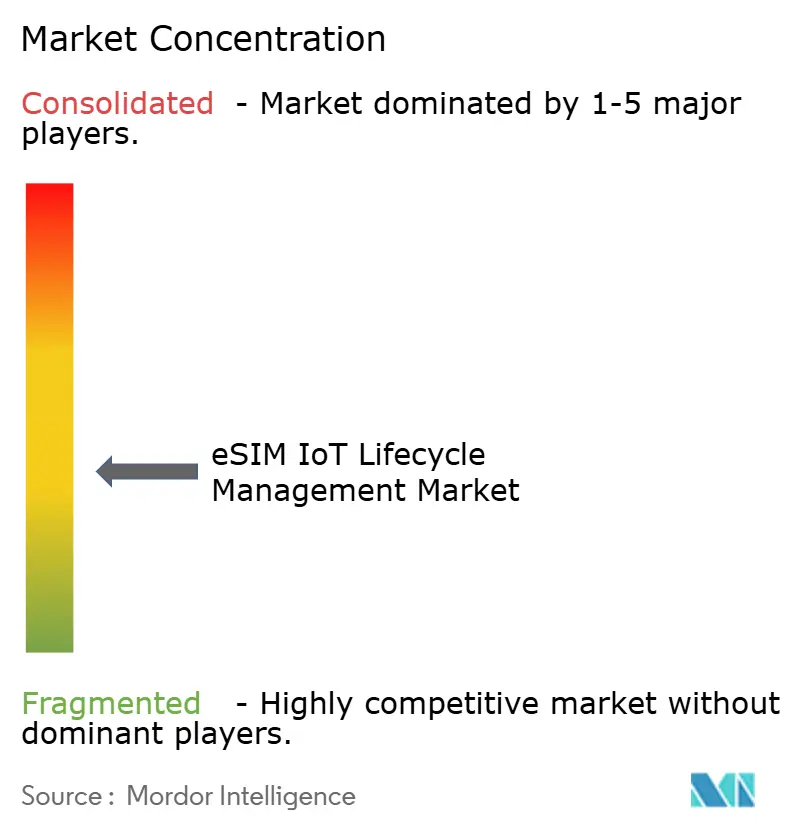
The eSIM IoT lifecycle management market has a moderately consolidated upper tier and a fragmented group of aggregators, module vendors, and regional managed service providers. Leading providers compete across eUICC technology, eIM platforms, subscription management, cloud-based provisioning services, and their ability to support customers before and after profile activation. Thales, G+D, IDEMIA, and Valid are established participants in the provisioning ecosystem. Competition is shaped by GSMA certification, platform reliability, geographic reach, and the ability to integrate with enterprise IoT systems. Buyers also evaluate whether a provider can manage several generations of eSIM provisioning technology during the transition to SGP.32, protect information held in provisioning systems, and provide practical support when a connection must be changed quickly.
G+D and AWS announced a cloud-based remote eSIM provisioning collaboration in February 2026, including a live SGP.32 deployment for Amazon's eero Signal device. Telefonica Tech and Thales introduced a commercial SGP.32 solution connected to the Kite platform in July 2026. IDEMIA launched a fully GSMA-certified end-to-end SGP.32 solution in August 2025. These moves show that leading companies are building product portfolios around certified provisioning and enterprise-grade deployment within the eSIM IoT lifecycle management market. They also show that providers are using partnerships to combine connectivity orchestration, security, cloud delivery, and commercial reach across multiple customer channels.
There is still a gap for enterprises operating mixed SGP.02 and SGP.32 fleets. Vendors that can provide a common operational view across these environments may reduce the burden of a staged migration and help customers avoid using separate processes for each provisioning generation. Newer SGP.32-focused aggregators can enter without the cost of maintaining legacy SM-SR infrastructure. Chipset and eUICC suppliers can also compete by embedding in-factory profile provisioning capabilities into device hardware. The eSIM IoT lifecycle management market, therefore, includes competition at both the software layer and the factory commissioning stage. Scale, certification status, operational support, and integration capability remain more important than a single feature. The eSIM IoT lifecycle management industry is likely to remain open to specialized providers where regional compliance or vertical requirements are demanding.
ESIM IoT Lifecycle Management Industry Leaders
-
Thales Group
-
Giesecke+Devrient GmbH
-
IDEMIA Group S.A.S.
-
Kigen Ltd.
-
Valid Solucoes S.A.
- *Disclaimer: Major Players sorted in no particular order
ESIM IoT Lifecycle Management Market Companies Covered in this Report
- Thales Group
- Giesecke+Devrient GmbH
- IDEMIA Group S.A.S.
- Kigen Ltd.
- Cisco Systems, Inc.
- Eseye Limited
- Wireless Logic Group Limited
- Telenor ASA
- Vodafone Group Plc
- Deutsche Telekom AG
- Tata Communications Limited
- 1GLOBAL Limited
- Workz Group Limited
- Valid Solucoes S.A.
- Telit Communications Limited (Telit Cinterion)
- u-blox Holding AG
- STMicroelectronics N.V.
- Infineon Technologies AG
- Aeris Communications, Inc.
- KORE Group Holdings, Inc.
Recent Industry Developments in ESIM IoT Lifecycle Management Market
- September 2026: Deutsche Telekom launched T-Travel, a global eSIM product offering mobile data packages across 200-plus destinations activated directly on an eSIM-enabled device, marking a deliberate extension of the operator's eSIM brand beyond its traditional mobile subscriber base into international travel connectivity.
- July 2026: Telefonica Tech and Thales launched a commercial SGP.32-based eSIM solution integrated with Telefónica's Kite platform, enabling enterprises to manage multi-carrier subscriptions centrally without pre-established bilateral operator integrations.
- April 2026: Telenor IoT commenced commercial delivery of SGP.32 SIM cards on April 17, among the first major operators globally to transition from pilot to production-grade SGP.32 supply, with AI-driven monitoring integrated into its managed connectivity platform.
- February 2026: G+D and AWS launched a cloud-based Remote eSIM Provisioning solution for consumer and IoT applications, with G+D transitioning eSIM workloads to AWS infrastructure and making its solutions available via AWS Marketplace to carriers, enterprises, and IoT service providers.
Global ESIM IoT Lifecycle Management Market Report Scope
The eSIM IoT Lifecycle Management Market Report is Segmented by Product Type (Lifecycle Management Software and Platforms, Managed eSIM IoT Connectivity Services, and Professional Services and Integration), Deployment Model (Cloud-Based, On-Premises, and Hybrid), Application (Connected Vehicles and Fleet Management, Smart Metering and Energy Management, Industrial Automation and Smart Manufacturing, Logistics and Asset Tracking, Healthcare Monitoring and Medical Devices, and Other Applications), End-User (Original Equipment Manufacturers, Mobile Network Operators and MVNOs, Enterprise IoT Owners, IoT Connectivity Aggregators, and System Integrators and Managed Service Providers), and Geography (North America, South America, Europe, Asia-Pacific, Middle East, and Africa). The Market Forecasts are Provided in Terms of Value (USD).
Segmentation Overview
| Lifecycle Management Software and Platforms |
| Managed eSIM IoT Connectivity Services |
| Professional Services and Integration |
| Cloud-Based |
| On-Premises |
| Hybrid |
| Connected Vehicles and Fleet Management |
| Smart Metering and Energy Management |
| Industrial Automation and Smart Manufacturing |
| Logistics and Asset Tracking |
| Healthcare Monitoring and Medical Devices |
| Other Applications |
| Original Equipment Manufacturers |
| Mobile Network Operators and MVNOs |
| Enterprise IoT Owners |
| IoT Connectivity Aggregators |
| System Integrators and Managed Service Providers |
| North America | United States |
| Canada | |
| Mexico | |
| South America | Brazil |
| Argentina | |
| Rest of South America | |
| Europe | United Kingdom |
| Germany | |
| France | |
| Italy | |
| Spain | |
| Russia | |
| Rest of Europe | |
| Asia-Pacific | China |
| Japan | |
| South Korea | |
| India | |
| Australia | |
| Rest of Asia-Pacific | |
| Middle East | Saudi Arabia |
| United Arab Emirates | |
| Rest of Middle East | |
| Africa | South Africa |
| Nigeria | |
| Rest of Africa |
| By Product Type | Lifecycle Management Software and Platforms | |
| Managed eSIM IoT Connectivity Services | ||
| Professional Services and Integration | ||
| By Deployment Model | Cloud-Based | |
| On-Premises | ||
| Hybrid | ||
| By Application | Connected Vehicles and Fleet Management | |
| Smart Metering and Energy Management | ||
| Industrial Automation and Smart Manufacturing | ||
| Logistics and Asset Tracking | ||
| Healthcare Monitoring and Medical Devices | ||
| Other Applications | ||
| By End-User | Original Equipment Manufacturers | |
| Mobile Network Operators and MVNOs | ||
| Enterprise IoT Owners | ||
| IoT Connectivity Aggregators | ||
| System Integrators and Managed Service Providers | ||
| By Geography | North America | United States |
| Canada | ||
| Mexico | ||
| South America | Brazil | |
| Argentina | ||
| Rest of South America | ||
| Europe | United Kingdom | |
| Germany | ||
| France | ||
| Italy | ||
| Spain | ||
| Russia | ||
| Rest of Europe | ||
| Asia-Pacific | China | |
| Japan | ||
| South Korea | ||
| India | ||
| Australia | ||
| Rest of Asia-Pacific | ||
| Middle East | Saudi Arabia | |
| United Arab Emirates | ||
| Rest of Middle East | ||
| Africa | South Africa | |
| Nigeria | ||
| Rest of Africa | ||
Key Questions Answered in the Report
What is the eSIM IoT lifecycle management market size?
The eSIM IoT lifecycle management market is projected to reach USD 3.84 billion by 2032 from USD 1.37 billion in 2027, at a 22.89% CAGR.
What is driving demand for eSIM lifecycle management?
Long-life industrial devices, remote provisioning needs, SGP.32 adoption, and automotive connectivity requirements are supporting demand.
Which eSIM IoT product category has the largest revenue share?
Managed eSIM IoT Connectivity Services held the largest share at 46.38% in 2026.
Which application is projected to advance most rapidly?
Smart Metering and Energy Management is projected to expand at a 24.67% CAGR through 2032.
Which region leads eSIM IoT lifecycle management revenue?
Europe led with 34.26% revenue share in 2026, supported by automotive, smart metering, and industrial IoT use cases.
Why do enterprises use hybrid eSIM deployment models?
Hybrid models combine cloud scalability with local control where data residency and security requirements apply.