
Esim Hardware Market Size and Share
Market Overview
| Study Period | 2020 - 2031 |
|---|---|
| Market Volume (2026) | 0.73 Billion units |
| Market Volume (2031) | 1.73 Billion units |
| Growth Rate (2026 - 2031) | 19.01 % |
| Fastest Growing Market | Asia-Pacific |
| Largest Market | North America |
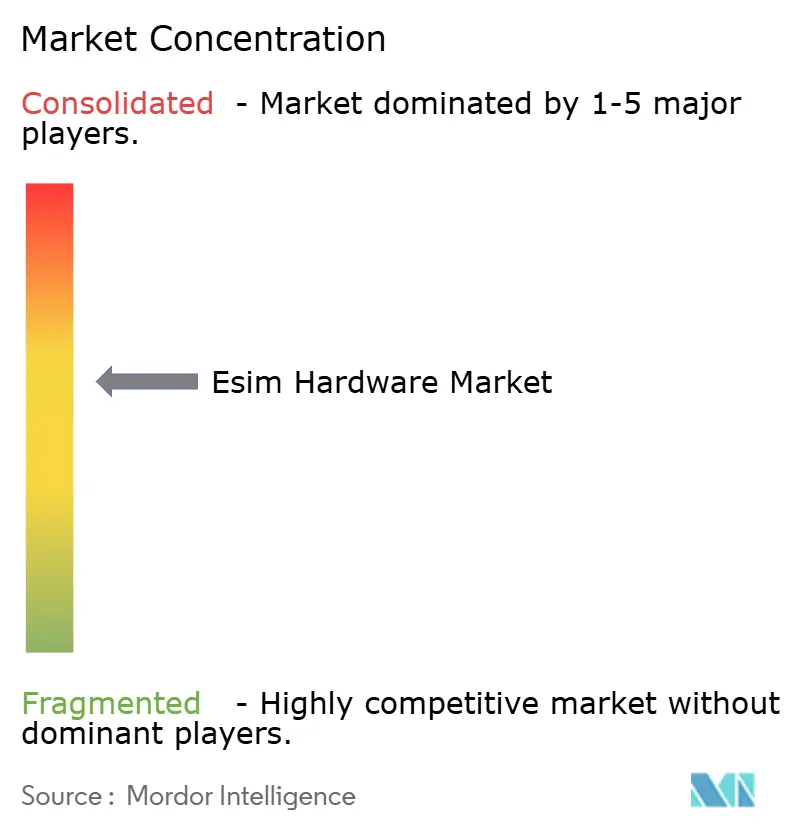
| Market Concentration | Medium |
Major Players *Disclaimer: Major Players sorted in no particular order Image © Mordor Intelligence. Reuse requires attribution under CC BY 4.0. | |
Esim Hardware Market Analysis by Mordor Intelligence
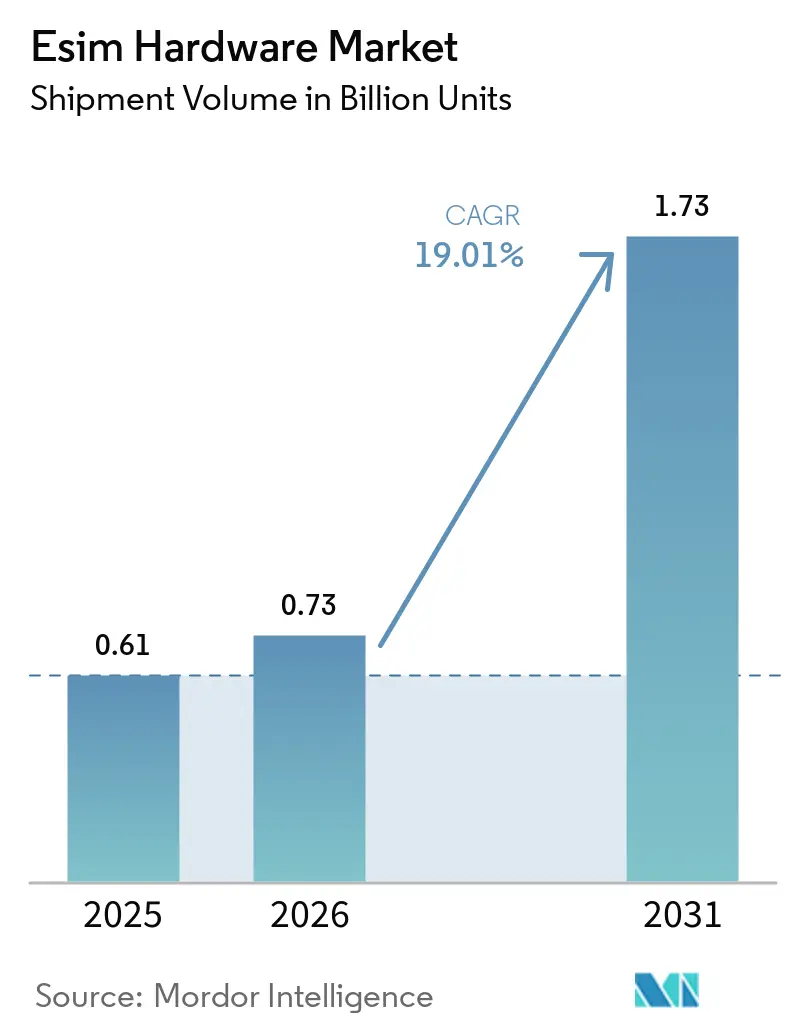
The Esim Hardware Market size in terms of shipment volume was valued at 0.61 billion units in 2025 and is estimated to grow from 0.73 billion units in 2026 to reach 1.73 billion units by 2031, at a CAGR of 19.01% during the forecast period (2026-2031).
The Esim hardware market is being supported by 5G standalone private networks, which need embedded credentials that can be provisioned remotely. Device makers are also moving toward designs without physical SIM trays, increasing demand for certified eUICC and integrated SIM hardware. Commercial use of the GSMA SGP.32 standard is widening the addressable base for remotely managed IoT connections. European requirements for 4G and 5G emergency calling in new vehicle types are creating demand for updated telematics equipment alongside demand from new vehicles. These forces bring consumer devices, enterprise connectivity, and regulatory compliance into the same eSIM hardware market outlook.
Key Report Takeaways
- By network type, 4G/LTE held 57.45% of eSIM hardware market volume in 2025, while 5G is projected to expand at a 20.99% CAGR through 2031.
- By form factor, MFF2 retained 69.85% of eSIM hardware market volume in 2025, while wafer-level CSP is expected to expand at a 19.36% CAGR through 2031.
- By device type, smartphones accounted for 45.78% of volume in 2025, while wearables are projected to expand at a 20.67% CAGR through 2031.
- By application, consumer electronics held 46.02% of volume in 2025, while automotive and transportation is forecast to expand at a 19.48% CAGR through 2031.
- By geography, North America held 38.69% of eSIM hardware market volume in 2025, while Asia-Pacific is projected to expand at a 19.88% CAGR through 2031.
Note: Market size and forecast figures in this report are generated using Mordor Intelligence’s proprietary estimation framework, updated with the latest available data and insights as of January 2026.
Global Esim Hardware Market Trends and Insights
Drivers Impact Analysis*
| Driver | (~) % Impact on CAGR Forecast | Geographic Relevance | Impact Timeline |
|---|---|---|---|
| 5G Standalone and Private-Network Rollouts | +4.5% | Global, led by the United States, Germany, the United Kingdom, China, and Japan | Long term (≥ 4 years) |
| Migration to eSIM-Only Flagships | +3.8% | North America, Europe, and Asia-Pacific, notably China from October 2025 | Short term (≤ 2 years) |
| Automotive eCall and Cybersecurity Requirements | +3.2% | Europe, with effects on North American and Asia-Pacific OEM supply chains | Medium term (2-4 years) |
| Remote Provisioning and Lower Operator Logistics Costs | +2.6% | Global, strongest in North America and Europe | Medium term (2-4 years) |
| Government IoT Security Rules for Soldered Credentials | +2.1% | North America and the European Union, with effects on Asia-Pacific export markets | Long term (≥ 4 years) |
| SGP.32 for Large-Scale IoT Deployments | +2.0% | Global, led by industrial corridors in North America, Europe, and Asia-Pacific | Long term (≥ 4 years) |
| Source: Mordor Intelligence | |||
Accelerating 5G Standalone and Private-Network Rollouts
The eSIM hardware market is benefiting from private 5G standalone networks that need secure credentials without conventional carrier SIM handling. The Global Mobile Suppliers Association identified 2,003 organizations deploying private mobile networks across 88 countries in Q1 2026, with customer references expanding at a 37% CAGR since 2019.[1]Global mobile Suppliers Association, “Private Mobile Networks June 2026,” Global mobile Suppliers Association, gsacom.com. Manufacturing, education, and mining led adoption, and more than half of private-network references announced since 2022 used 5G. Enterprises operating these networks need remote provisioning because they cannot depend on mobile network operator SIM logistics for every device, so they source certified eUICC hardware through silicon vendors and module integrators. Network slicing also requires chips that can maintain multiple operator profile slices, separating slice-capable products from standard eSIM silicon. This extends the eSIM hardware market to factories, campuses, mines, and logistics sites while reducing the role of traditional SIM OS distribution in some deployments.
Migration to eSIM-Only Flagships
The migration to eSIM-only flagship devices is increasing demand for certified eUICC and iSIM hardware. Trusted Connectivity Alliance members reported that global eSIM shipments increased 18% in 2025 and consumer profile downloads increased 43%, showing that more devices were moving into active use. North America remained the strongest consumer region, while adoption increased sharply in the Middle East, Africa, and South America. Each device without a physical SIM tray needs an embedded credential, linking device design decisions directly to component volumes, and more than 60 eSIM-enabled smartphone models were launched in the first half of 2025. China’s domestic policy changes in October 2025 require locally issued profiles, giving suppliers such as Unigroup Guoxin and CEC Huada a clearer route into local handset supply chains. Global suppliers still benefit from wider device adoption in the eSIM hardware market, but device makers must align hardware design, profile management, and local approval processes before activation at scale.[2]Trusted Connectivity Alliance, “Trusted Connectivity Alliance Members Confirm Acceleration of Global eSIM Growth in 2025, With Estimated eSIM Shipments Increasing 18% and Consumer Adoption up 43%,” Trusted Connectivity Alliance, trustedconnectivityalliance.org.
Automotive eCall and Cybersecurity Requirements
European eCall rules are raising demand for eSIM-capable telematics modules as legacy networks are phased out. New M1 and N1 vehicle types have required 4G or 5G packet-switched eCall support since January 1, 2026, pushing automakers to update emergency connectivity designs. The eSIM hardware market gains from this shift because new telematics modules need secure, remotely managed credentials. A July 2025 update allowed manufacturers more time to apply new CEN standards, with mandatory application beginning January 1, 2027, for IMS-based packet-switched eCall systems. UNECE Regulation No. 155 also supports stronger cybersecurity controls for connected vehicles, including over-the-air updates and vehicle-to-everything services. The installed base of vehicles using 2G or 3G eCall modules may need upgrades as networks are withdrawn, creating demand separate from new-vehicle production.
Remote Provisioning and Lower Operator Logistics Costs
Remote provisioning is changing the connectivity cost structure for operators and enterprise IoT users. Moving 30-40% of activations to eSIM can reduce costs tied to SIM procurement, packaging, shipping, and retail handling within the first year. GSMA SGP.32 supports a single-SKU approach that reduces regional SIM variants, simplifies warehousing, and shortens launch timelines across markets. IDEMIA Secure Transactions, Tele2 IoT, and Cisco introduced an end-to-end SGP.32 solution in February 2025, showing that zero-touch provisioning was moving into deployable enterprise operations. Device makers can also reduce inventory tied up in regional product variants through a common bill of materials. At higher production volumes, these savings can offset the embedded hardware premium in the eSIM hardware market and reduce delays when products are shipped from one production site to several service territories.
Restraints Impact Analysis*
| Restraint | (~) % Impact on CAGR Forecast | Geographic Relevance | Impact Timeline |
|---|---|---|---|
| Legacy and Next-Generation IoT Specification Fragmentation | -3.2% | Global IoT deployments, especially industrial fleets using SGP.02 and SGP.32 | Medium term (2-4 years) |
| Limited eSIM Awareness Outside Premium Devices | -2.4% | South America, Africa, Southeast Asia, and mid-tier device segments globally | Medium term (2-4 years) |
| Hardware Exposure to Tamper and Side-Channel Attacks | -1.8% | Global, with the strictest assurance requirements in the European Union and United States | Long term (≥ 4 years) |
| Dual-Stack Certification and Fleet Migration Costs | -1.5% | Europe and North America, where SGP.02 industrial fleets are established | Medium term (2-4 years) |
| Source: Mordor Intelligence | |||
Legacy and Next-Generation IoT Specification Fragmentation
The eSIM hardware market faces procurement delays because legacy and new IoT specifications are operating in parallel. Existing M2M deployments follow GSMA SGP.02, while newer deployments are moving to SGP.32, and the standards use incompatible remote provisioning protocols with different platform stacks. Organizations must decide whether to extend existing SGP.02 fleets or purchase new SGP.32-certified hardware, creating budget uncertainty that can delay procurement by 12-18 months. Silicon and eSIM OS suppliers must sustain separate certification paths, which can extend development cycles and slow cost reductions from higher production volumes. Smaller suppliers may find it difficult to fund compliance work across both architectures at the same time. Enterprises may delay new orders until implementation choices become clearer, especially for fleets operating across countries that need stable lifecycle support.
Limited eSIM Awareness Outside Premium Devices
Limited consumer awareness outside premium devices remains a restraint on wider eSIM use. Global smartphone eSIM penetration stood at 23% in 2024, while adoption was concentrated in North America because eSIM-only smartphones accelerated operator investment and customer familiarity. In South America, Africa, and parts of Asia-Pacific, operators often need active support programs and consumer education before activation becomes routine. The gap is most visible in mid-range and budget devices, where embedded credentials are only beginning to appear, limiting the eSIM hardware market in the large volume of smartphones sold below the premium tier. Awareness constraints also apply to enterprise IoT users in less digitized sectors, where procurement teams may continue using physical SIM supply chains despite higher long-term ownership costs. Carriers and module suppliers need to explain activation, lifecycle management, and security benefits, while greater mid-tier availability and consumer familiarity remain important for activation rates.
*Our forecasts treat driver/restraint impacts as directional, not additive. The impact forecasts reflect baseline growth, mix effects, and variable interactions.
Segment Analysis
By Network Type: 4G/LTE Retains the Installed Base While 5G Expands Demand
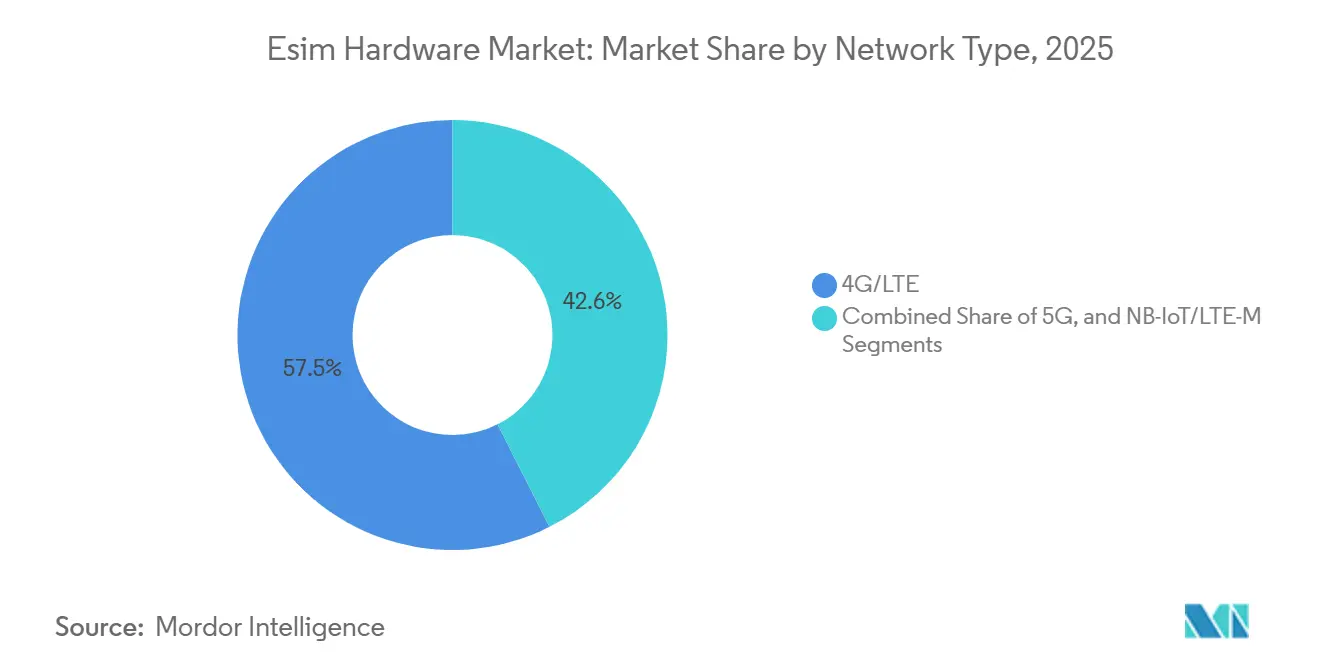
4G/LTE held 57.45% of the eSIM hardware market share in 2025, reflecting its established position in smartphones and M2M modules. Devices produced from 2021 through 2025 mainly used 4G/LTE as their primary connectivity option, supported by broad carrier coverage in North America, Europe, and urban Asia-Pacific. Smartphones, automotive telematics units, and industrial gateways continue to use certified 4G/LTE hardware in large volumes. NB-IoT/LTE-M serves lower-power uses such as smart metering, agricultural monitoring, and asset tracking, where continuous connectivity matters more than high data throughput. MFF2 eUICC chips are common in these applications because they are designed for long service life and demanding temperature conditions.
The GSMA published SGP.32 V1.3 in May 2026 with provisions for network-constrained and user-interface-constrained IoT devices. The update confirms that the newer provisioning model applies to low-data-rate devices as well as broadband cellular equipment. 5G is projected to expand at a 20.99% CAGR from 2026 to 2031 as private 5G and compatible consumer devices add demand, and the GSA reported 974 organizations deploying 5G private mobile networks globally in June 2026. Dual-mode chipsets supporting both 4G/LTE and 5G are likely to remain important during the transition because they preserve network flexibility.



By Form Factor: MFF2 Leads Volume While Smaller Packages Gain Use
MFF2 retained 69.85% of the eSIM hardware market volume in 2025 because its standardized pinout supports established automotive and industrial designs. The form factor is widely used in telematics control units, industrial gateways, and smart energy meters because it prevents the physical removal of a SIM from fixed or difficult-to-access equipment. ETSI TS 102 671 Release 18 supports multi-supplier qualification across temperatures from -40°C to +105°C. MFF2 measures 5×6 mm and can fit existing printed circuit board layouts without changes, helping manufacturers manage long production cycles. It remains suitable where reliability matters more than extreme miniaturization.[3]Giesecke+Devrient GmbH, “Compact, Efficient and Sustainable, eSIM New Form Factors,” Giesecke+Devrient, gi-de.com
ETSI Release 18 introduced MFF3 and MFF4 packages in 3×3 mm and 2×2 mm sizes, providing standardized sizes between MFF2 and wafer-level packaging. Wafer-level CSP is forecast to expand at a 19.36% CAGR from 2026 to 2031 as smartphone and wearable makers seek lower profiles and less board area. Infineon introduced the OPTIGA Connect Consumer OC1230 in the first half of 2026 as a 28 nm eSIM turnkey solution for wearables and ultra-thin smartphones, featuring lower power consumption and connected-product security features. Plug-in eSIM remains relevant for retrofits, while system-in-package and integrated iUICC designs are gaining use in compact devices.
By Device Type: Smartphones Lead Volume While Wearables Expand Faster
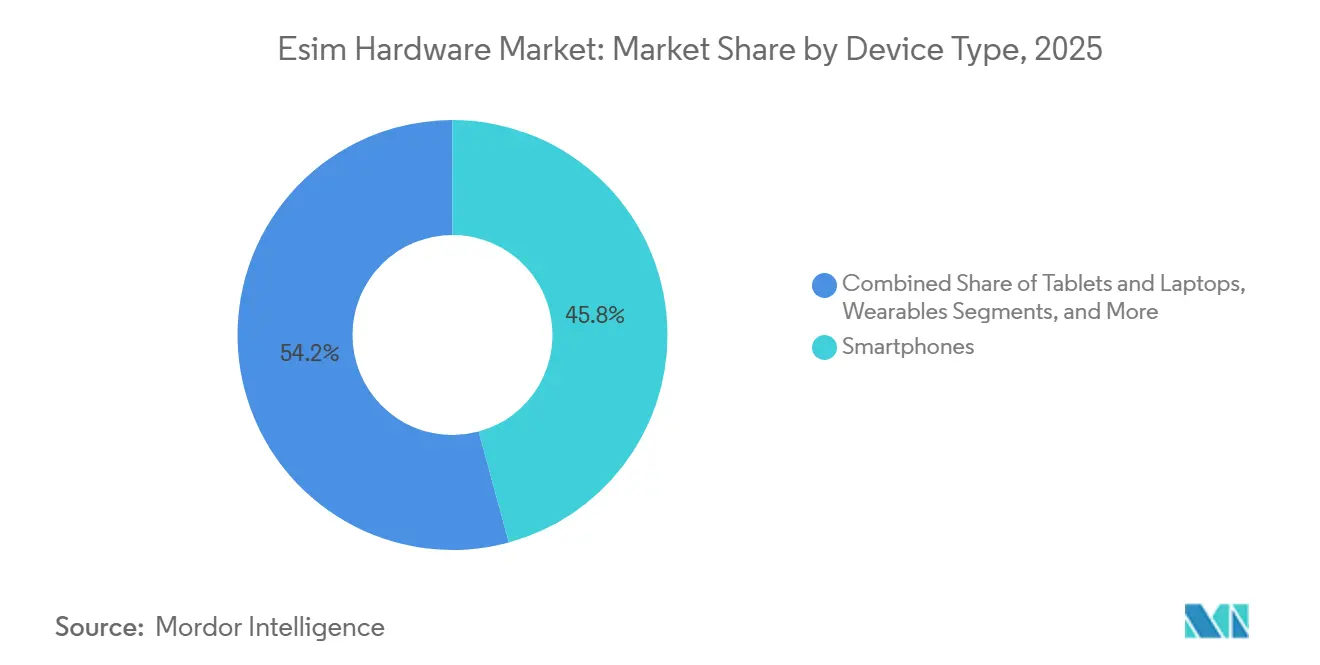
Smartphones accounted for 45.78% of the eSIM hardware market volume in 2025, making them the largest device category. Flagship launches in North America and Europe supported this position, while Chinese regulatory changes added a new activation path from October 2025. Domestic Chinese profile requirements also make local suppliers more relevant to handset supply. Tablets and laptops are a separate category where adoption is slower but increasingly useful for enterprise mobility, because information technology teams can provision cellular connections remotely in the field. M2M and IoT modules provide another major route to market for certified embedded credentials.
Module suppliers integrate eUICC chips into products for automotive, logistics, and smart-grid uses, which are among the first commercial settings for SGP.32 provisioning. Wearables are projected to expand at a 20.67% CAGR from 2026 to 2031, the fastest rate among device categories. Cellular smartwatches and fitness devices need very small embedded chips because physical SIM trays are impractical, and health functions make always-on connectivity more relevant. The eSIM hardware market size for wearables is supported by 28 nm wafer-level CSP products before the technology moves into higher-volume smartphone designs.
By Application: Consumer Electronics Holds Volume While Automotive Scales Fastest
Consumer electronics held 46.02% of the eSIM hardware market share in 2025, supported by shipments of smartphones, tablets, and wearables. Each new device generation that removes a physical SIM tray increases hardware procurement for embedded connectivity. Consumer profile downloads increased 43% in 2025, confirming that more embedded devices were being activated. Industrial and manufacturing, logistics and asset tracking, energy and utilities, and healthcare devices form the broader IoT application base. These uses can carry higher unit values because their eUICC hardware often needs wider temperature tolerance, longer lifecycle support, and reliable remote management across dispersed equipment.
Automotive and transportation is projected to expand at a 19.48% CAGR from 2026 to 2031. The January 2026 requirement for packet-switched eCall in new vehicle types is an immediate support factor. Connected vehicle platforms use embedded credentials for over-the-air software updates and vehicle-to-everything services, while Thales and Telefónica introduced an SGP.32-based solution for global IoT deployments in July 2026. Logistics and asset tracking is also gaining relevance as trackers need multi-country network access without physical SIM management, supporting a broader eSIM hardware market across fixed, mobile, and vehicle-based equipment.
Geography Analysis
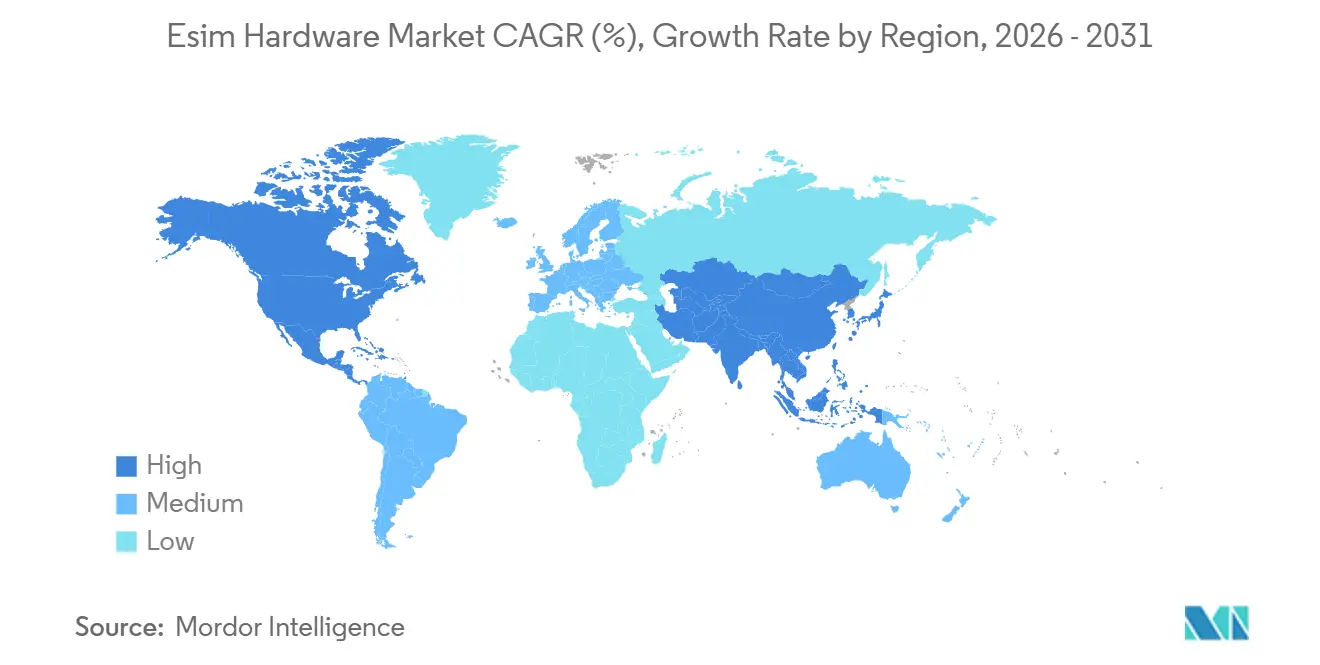
North America held 38.69% of the eSIM hardware market volume in 2025, giving the region the leading position. Earlier eSIM-only smartphone adoption helped operators build activation infrastructure ahead of many other regions. The Trusted Connectivity Alliance identified North America as the region with the strongest consumer adoption in 2025. The United States accounted for a large part of activated eSIM connections, while Canadian private mobile networks added an enterprise demand source. Canada’s private mobile network deployments increased 5% in Q1 2026, and Mexico’s automotive and industrial IoT manufacturing base also supports demand as production moves closer to North American end markets.
South America saw consumer eSIM adoption double in 2025, although its absolute base remained smaller than North America’s. The increase indicates that regional operators are expanding the activation infrastructure needed for future device shipments. Europe remains the second-largest regional contributor because of smartphone activity, vehicle connectivity requirements, eCall rules for packet-switched emergency calls, and wider cybersecurity requirements for digital products. New eCall technical standards will apply from January 1, 2027, while the United Kingdom is developing SGP.32-native programs through EE, Vodafone, Three, and O2.[4]European Commission, “Commission Delegated Regulation (EU) 2025/1871 Amending eCall Technical Standards for 4G/5G Networks,” EUR-Lex, eur-lex.europa.eu.
Asia-Pacific is projected to expand at a 19.88% CAGR from 2026 to 2031, making it the fastest-growing geography in the eSIM hardware market. China’s domestic activation policy broadened the basis for consumer eSIM adoption from October 2025. India gained another support factor when Tata Communications and BSNL introduced pan-India eSIM infrastructure in October 2025 for smartphone and smart-meter uses. Japan and South Korea use embedded credentials in connected vehicles, wearable payment devices, and smart manufacturing, while Australia is extending use through enterprise and government IoT programs. Saudi Arabia and the UAE are investing in smart-city and industrial IoT systems, while Africa recorded doubled consumer adoption in 2025, led by South Africa and Nigeria, although demand is expected to remain below developed-market levels through 2031.

Competitive Landscape
The eSIM hardware market has a moderately consolidated structure because a limited group of semiconductor and security suppliers controls much of the certified eUICC supply. STMicroelectronics, Infineon Technologies, and NXP Semiconductors lead silicon-level design, while Giesecke+Devrient and Thales have important roles in eSIM operating systems and subscription management platforms. Certification requirements, secure manufacturing controls, GSMA compliance, ETSI form-factor qualification, and site security accreditation raise the investment needed for new suppliers. The concentration of technical qualifications supports established suppliers even as new IoT use cases create additional opportunities. The eSIM hardware market remains competitive across silicon, operating systems, and integrated solutions.
STMicroelectronics announced the ST54M in June 2026, a single-die product that combines a post-quantum cryptography accelerator, NFC, a secure element, and eSIM functions for future smartphone and personal-electronics security needs. Infineon introduced its OC1230 in the first half of 2026 for wearables and thin smartphone platforms, with lower power use and connected-product security requirements. Giesecke+Devrient introduced a cloud-based SGP.32 platform in February 2026 and deployed the technology in a consumer connectivity device. These moves combine hardware, security functions, and remote provisioning capabilities. They show how leading suppliers are strengthening their positions in the eSIM hardware market.
Competition is also increasing around SGP.32-certified IoT hardware, where IDEMIA Secure Transactions introduced a fully GSMA-certified solution in August 2025 and reported selection by more than 20 global industry players. Valid is targeting mass production readiness for an SGP.32-compliant eSIM OS on Infineon’s TEGRION SLx22 secure element from Q3 2026. Qualcomm and IDEMIA demonstrated a reprogrammable iSIM for compact IoT devices, which could place pressure on standalone chip demand in high-volume uses. Chinese suppliers Unigroup Guoxin and CEC Huada are widening their domestic portfolios following China’s policy change.[5]IDEMIA Secure Transactions, “IDEMIA Launches Industry’s First Fully GSMA-Certified SGP.32 eSIM Solution,” IDEMIA, idemIA.com.
Esim Hardware Industry Leaders
STMicroelectronics N.V.
Infineon Technologies AG
NXP Semiconductors N.V.
Giesecke+Devrient GmbH
Thales Group
- *Disclaimer: Major Players sorted in no particular order

Recent Industry Developments
- July 2026: Thales Group and Telefónica Tech launched a commercial SGP.32-based multi-operator eSIM solution for global IoT deployments, enabling enterprises to manage multiple operator profiles and switch connectivity providers across geographies through a unified platform.
- June 2026: STMicroelectronics announced the ST54M, a single-die secure mobile chip integrating eSIM functionality, secure element, NFC, and a dedicated post-quantum cryptography hardware accelerator for next-generation connected devices.
- May 2026: GSMA published SGP.32 v1.3, updating the eSIM IoT specification with enhanced provisions for network- and user-interface-constrained IoT devices, including eUICC architecture, interfaces, and security requirements.
- February 2026: IDEMIA Secure Transactions, Acceleronix, and Tele2 IoT introduced an In-Factory Profile Provisioning Early Access Program to enable secure eSIM profile provisioning during device manufacturing and support a single-SKU approach for OEMs.


Global Esim Hardware Market Report Scope
The eSIM Hardware Market Report is Segmented by Network Type (4G/LTE, 5G, and NB-IoT/LTE-M), Form Factor (MFF2, Wafer-Level CSP, Plug-In eSIM, and System-in-Package and Integrated iUICC), Device Type (Smartphones, Tablets and Laptops, Wearables, and M2M/IoT Modules), Application (Consumer Electronics, Automotive, Industrial, Logistics, and Other Applications (Energy and Utilities and Healthcare and Medical Devices)), and Geography (North America, South America, Europe, Asia-Pacific, Middle East, Africa). The Market Forecasts are Provided in Terms of Volume (Units).
| 4G/LTE |
| 5G |
| NB-IoT/LTE-M |
| MFF2 |
| Wafer-Level CSP |
| Plug-In eSIM |
| System-in-Package and Integrated iUICC |
| Smartphones |
| Tablets and Laptops |
| Wearables |
| M2M and IoT Modules |
| Consumer Electronics |
| Automotive and Transportation |
| Industrial and Manufacturing |
| Logistics and Asset Tracking |
| Other Applications (Energy and Utilities and Healthcare and Medical Devices) |
| North America | United States |
| Canada | |
| Mexico | |
| South America | Brazil |
| Argentina | |
| Rest of South America | |
| Europe | Germany |
| United Kingdom | |
| France | |
| Italy | |
| Spain | |
| Russia | |
| Rest of Europe | |
| Asia-Pacific | China |
| Japan | |
| South Korea | |
| India | |
| Australia | |
| Rest of Asia-Pacific | |
| Middle East | Saudi Arabia |
| United Arab Emirates | |
| Rest of Middle East | |
| Africa | South Africa |
| Nigeria | |
| Rest of Africa |
| By Network Type | 4G/LTE | |
| 5G | ||
| NB-IoT/LTE-M | ||
| By Form Factor | MFF2 | |
| Wafer-Level CSP | ||
| Plug-In eSIM | ||
| System-in-Package and Integrated iUICC | ||
| By Device Type | Smartphones | |
| Tablets and Laptops | ||
| Wearables | ||
| M2M and IoT Modules | ||
| By Application | Consumer Electronics | |
| Automotive and Transportation | ||
| Industrial and Manufacturing | ||
| Logistics and Asset Tracking | ||
| Other Applications (Energy and Utilities and Healthcare and Medical Devices) | ||
| By Geography | North America | United States |
| Canada | ||
| Mexico | ||
| South America | Brazil | |
| Argentina | ||
| Rest of South America | ||
| Europe | Germany | |
| United Kingdom | ||
| France | ||
| Italy | ||
| Spain | ||
| Russia | ||
| Rest of Europe | ||
| Asia-Pacific | China | |
| Japan | ||
| South Korea | ||
| India | ||
| Australia | ||
| Rest of Asia-Pacific | ||
| Middle East | Saudi Arabia | |
| United Arab Emirates | ||
| Rest of Middle East | ||
| Africa | South Africa | |
| Nigeria | ||
| Rest of Africa | ||


Key Questions Answered in the Report
What is the eSIM hardware market size?
The eSIM hardware market is projected at 0.73 billion units in 2026 and is forecast to reach 1.73 billion units by 2031, at a 19.01% CAGR.
Which network type holds the largest eSIM hardware volume?
4G/LTE held 57.45% of global volume in 2025, supported by the installed base of smartphones, telematics units, and M2M modules.
Which eSIM form factor is used most widely?
MFF2 retained 69.85% of volume in 2025 because it suits established automotive, industrial, and smart-meter designs.
Which device category is expanding fastest for embedded SIM hardware?
Wearables are projected to expand at a 20.67% CAGR through 2031 as cellular smartwatches and fitness devices need compact embedded credentials.
Why are connected vehicles increasing demand for eSIM hardware?
New European vehicle types have required 4G or 5G packet-switched eCall support since January 2026, driving upgrades to telematics modules.
Which region is expected to expand fastest through 2031?
Asia-Pacific is projected to expand at a 19.88% CAGR, supported by policy and infrastructure developments in China and India.
Page last updated on:


 Your data is secure and never sold or shared.


