
Equipment Rental Insurance Market Size and Share
Market Overview
| Study Period | 2020 - 2031 |
|---|---|
| Market Size (2026) | USD 4.40 Billion |
| Market Size (2031) | USD 5.60 Billion |
| Growth Rate (2026 - 2031) | 4.90 % |
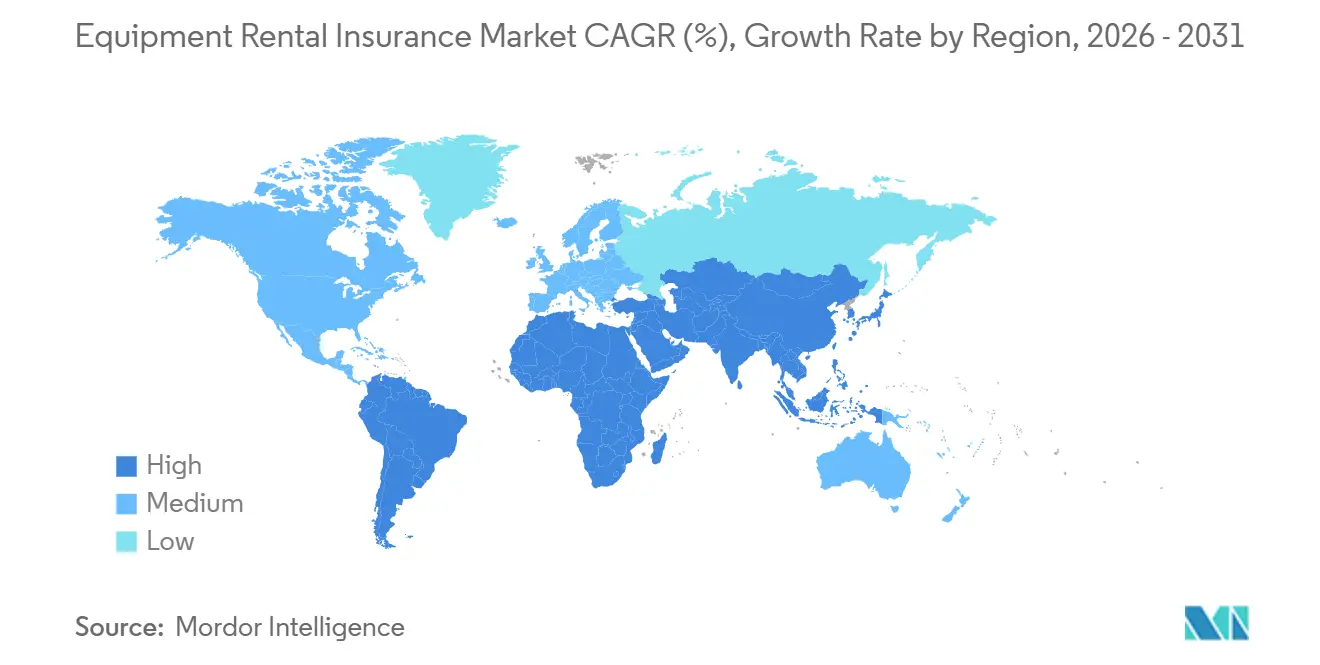
| Fastest Growing Market | Asia-Pacific |
| Largest Market | North America |
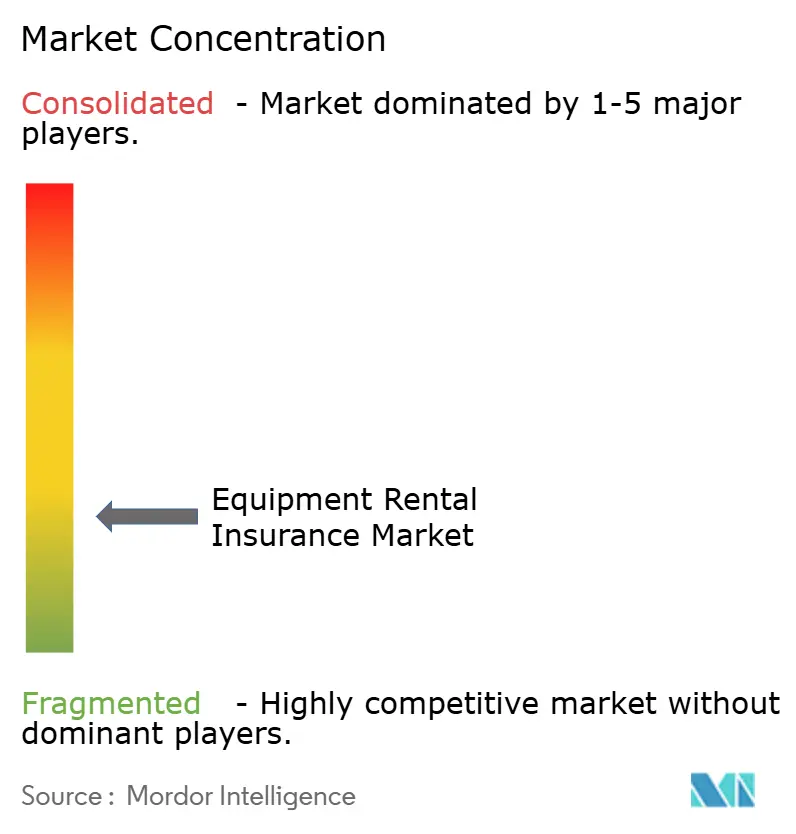
| Market Concentration | Low |
Major Players *Disclaimer: Major Players sorted in no particular order Image © Mordor Intelligence. Reuse requires attribution under CC BY 4.0. | |
Equipment Rental Insurance Market Analysis by Mordor Intelligence
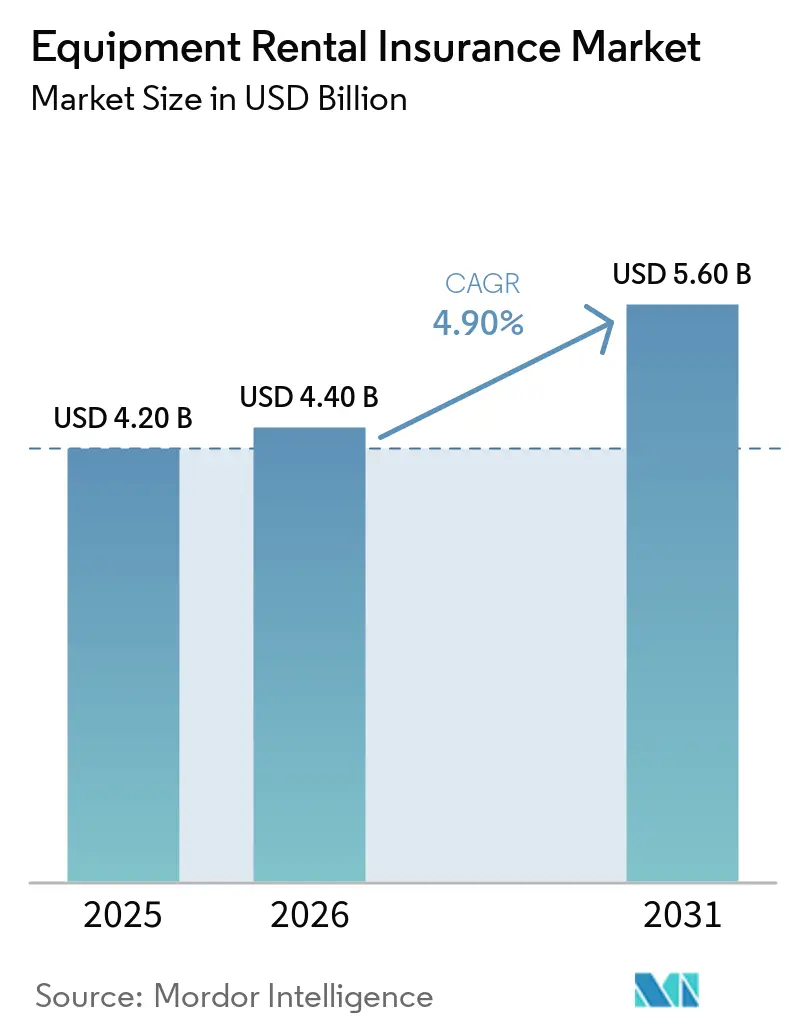
The Equipment Rental Insurance Market size is projected to expand from USD 4.20 billion in 2025 and USD 4.40 billion in 2026 to USD 5.60 billion by 2031, registering a CAGR of 4.90% between 2026 and 2031.
The equipment rental insurance market is supported by construction, industrial, and specialty rental fleets that hold high-value mobile assets. Higher replacement values and tighter contractual coverage requirements raise insured values and expand coverage triggers. This supports premium growth even when policy counts do not increase at the same pace. The equipment rental insurance market, therefore, remains a specialty coverage category with structural support while broader commercial property lines face margin pressure. Rental penetration in the United States reached 59% of construction equipment in use, compared with 53% in 2019, which places more equipment with third-party users and creates multi-party liability and physical damage exposures. Caterpillar disclosed USD 2.6 billion in annualized tariff exposure in 2026, while John Deere forecast USD 1.2 billion in pretax tariff costs, increasing repair and replacement costs across the equipment rental insurance market.
Key Report Takeaways
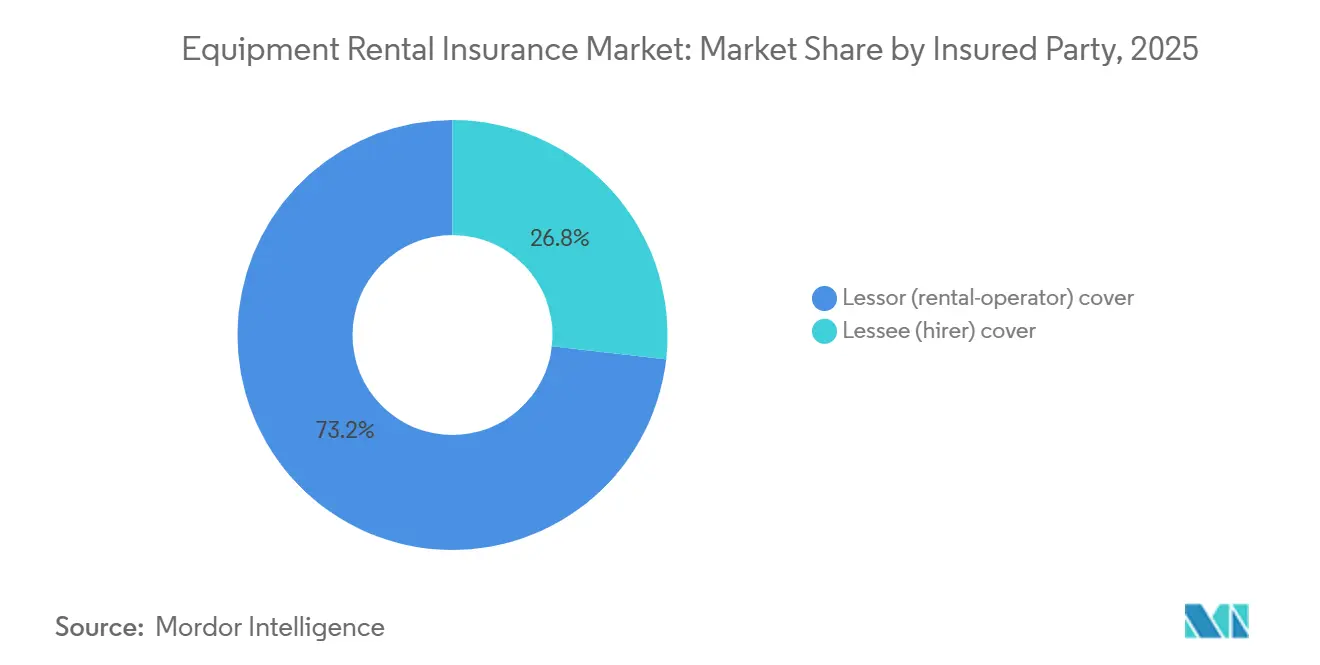
- By insured party, lessor cover captured 73.2% of the equipment rental insurance market share in 2025, while lessee cover is projected to grow at 6.2% CAGR through 2031.
- By equipment type, construction, earthmoving, road-building, and access equipment held 45.6% of the equipment rental insurance market share in 2025, while power-generation, HVAC, and compressed-air equipment are forecast to grow at 6.8% CAGR through 2031.
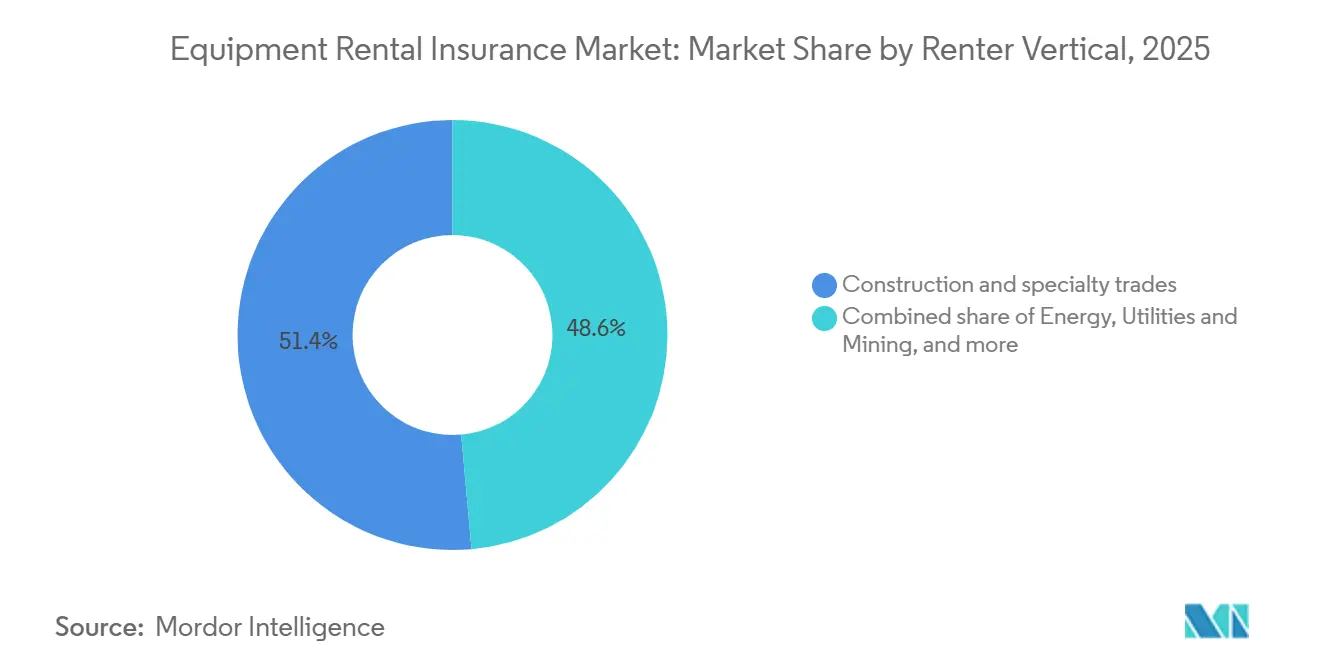
- By renter-vertical, construction and specialty trades captured 51.4% of the equipment rental insurance market share in 2025, while healthcare is projected to grow at 6.6% CAGR through 2031.
- By distribution channel, retail brokers and independent agents held 47.1% of the equipment rental insurance market share in 2025, while digital and affinity platforms are forecast to grow at 9.6% CAGR through 2031.
- By geography, North America captured 49.8% of the equipment rental insurance market share in 2025, while Asia-Pacific is projected to grow at 6.7% CAGR through 2031.
Note: Market size and forecast figures in this report are generated using Mordor Intelligence’s proprietary estimation framework, updated with the latest available data and insights as of January 2026.
Global Equipment Rental Insurance Market Trends and Insights
Drivers Impact Analysis*
| Driver | (~) % Impact on CAGR Forecast | Geographic Relevance | Impact Timeline |
|---|---|---|---|
| Expansion of Construction and Industrial Rental Fleets | +1.2% | Global, concentrated gains in North America and Asia-Pacific | Long term (≥ 4 years) |
| Higher Equipment Replacement and Repair Costs | +0.9% | Global, most acute in North America and Europe | Medium term (2-4 years) |
| Physical Damage and Liability Coverage Requirements | +0.8% | North America and the European Union, with growing mandates in the Asia-Pacific core markets | Long term (≥ 4 years) |
| Equipment Theft and Off-Site Loss Exposure | +0.6% | North America, Australia, and the United Kingdom | Medium term (2-4 years) |
| Telematics for Theft Prevention and Claims Management | +0.5% | Global, with early leadership in North America and the European Union | Long term (≥ 4 years) |
| Embedded Protection in Digital Rental Transactions | +0.6% | Global, with the fastest adoption in North America and Western Europe | Short term (≤ 2 years) |
| Source: Mordor Intelligence | |||
Expansion of Construction and Industrial Equipment Rental Fleets
The equipment rental insurance market benefits as contractors shift from ownership toward rental. The American Rental Association forecasts combined United States construction and industrial equipment rental revenue of USD 83.5 billion in 2026, up 3.4% from the prior year[1]https://news.ararental.org/updated-ara-economic-forecast-points-to-continued-growth. It forecasts growth of 4.4% in 2027 and 5.1% in 2028. The 59% rental penetration rate means that equipment is more often used by several operators during a rental period. That operating model creates liability exposures that standard commercial property policies were not designed to price. United Rentals reported record revenue in the second quarter of 2026, with fleet productivity rising 3.4% year over year. Its dispersed fleet model requires blanket coverage across multiple states, supporting specialist inland marine and rental programs in the equipment rental insurance market.
Rising Replacement Values and Repair Costs of Rented Equipment
Tariff escalation in 2026 has changed the economics of equipment loss settlement. Caterpillar disclosed USD 2.6 billion in annualized tariff exposure, and John Deere estimated USD 1.2 billion in pretax tariff costs for fiscal 2026. These costs can raise replacement values above scheduled policy limits. An insured paid USD 8 million for a crane and USD 1.4 million in tariffs to import it, showing a replacement-cost gap in scheduled-value coverage. Repair and replacement costs also remain exposed to parts availability and labor conditions. These costs increase the importance of maintaining current scheduled values and deductibles. These conditions place greater attention on agreed-value clauses and current equipment schedules across the equipment rental insurance market.
Contractual Requirements for Physical-Damage and Liability Coverage
Rental agreements convert equipment risk into stated insurance demand across equipment categories. Large operators require lessees to name the lessor as an additional insured and loss payee. They also require certificates of insurance and limits linked to fair market value before the equipment leaves the yard. These practices reflect the ISO Inland Marine Contractors Equipment Floater framework used in many United States rental agreements. In September 2025, Assurant and Evident introduced a risk management solution with certificate verification, real-time compliance monitoring, and instant Loss Damage Waiver enrollment[2]https://index.businessinsurance.com/businessinsurance/article/bizwire-2025-9-9-assurant-and-evident-deliver-industry-first-end-to-end-risk-protection-for-commercial-equipment-rental-industry. The platform is used in construction, agriculture, and forestry rentals to protect assets before they leave the yard. It also shifts some lessee purchasing decisions from independent brokers to rental-desk and digital placements, changing distribution within the equipment rental insurance market.
Increasing Equipment Theft and Off-Site Loss Exposure
Off-site equipment loss increases loss ratios in the equipment rental insurance market. Rental fraud and conversion theft create a distinct exposure because equipment can be obtained through a transaction before it disappears. The National Equipment Register reported in 2025 that fraudulent rental and conversion thefts were important loss drivers at rental operator locations and dealer yards[3]https://www.ner.net/labor-day-heavy-equipment-theft-trends-infographic-and-security-tips-and-best-practices-2025/. Toro Dingo and Bobcat MT series mini loaders were specifically identified in this pattern. High-turnover rental models do not produce the same loss-frequency profile as contractor-owned fleets. Standard inland marine schedules may therefore give insufficient weight to this exposure. Specialist managing general agents with rental-specific data can use those differences in pricing and underwriting.
Restraints Impact Analysis*
| Restraint | (~) % Impact on CAGR Forecast | Geographic Relevance | Impact Timeline |
|---|---|---|---|
| Claims Inflation and Longer Repair or Replacement Lead Times | -0.8% | Global, most acute in North America and Europe | Medium term (2-4 years) |
| Damage Waivers and Existing Commercial Insurance Alternatives | -0.6% | North America and the European Union | Long term (≥ 4 years) |
| Underwriting Complexity in Multi-User Short-Term Rentals | -0.5% | Global, especially Asia-Pacific markets, with nascent specialty infrastructure | Medium term (2-4 years) |
| Cyber and Data Integrity Risks in Connected Equipment | -0.4% | Global, with early regulatory pressure in the European Union | Long term (≥ 4 years) |
| Source: Mordor Intelligence | |||
Claims Inflation and Extended Equipment Repair/Replacement Lead Times
Claims inflation remains difficult to manage because several cost factors can occur at the same time. Tariff escalation increases the cost of parts and replacement equipment. Technician availability and labor costs also add pressure to repair programs. Specialized electrical switchgear and transformers can extend replacement lead times, while only 20% of large units are produced domestically in the United States. Carriers can respond through reduced excess-of-loss capacity or higher deductibles, which transfers costs to rental operators and limits near-term premium growth in the equipment rental insurance market.
Damage Waivers and Existing Commercial Insurance as Alternatives to Dedicated Rental Insurance
Damage waivers and Loss Damage Waivers are a direct alternative to dedicated lessee policies. Rental operators retain waiver fees rather than ceding them as insurance premiums. Large contractors with blanket inland marine coverage may also decline a waiver and dedicated rental coverage. Their master contractor's equipment floater can still exclude short-term rentals above the defined item-value limits. Specialist rental programs address that gap. The Assurant and Evident platform identifies deficient coverage and enrolls lessees in protection products before equipment leaves the yard. Distribution remains difficult when commercial lessees assume that a master policy is sufficient without reviewing rental exclusions.
*Our forecasts treat driver/restraint impacts as directional, not additive. The impact forecasts reflect baseline growth, mix effects, and variable interactions.
Segment Analysis
By Insured Party: Lessor Programs Anchor Revenue While Lessee Coverage Accelerates
Lessor cover held 73.2% of the equipment rental insurance market share in 2025. The position reflects the capital intensity of owning and operating rental fleets. The top 100 equipment rental firms in North America generated USD 43.6 billion in revenue in 2024, demonstrating the scale of equipment values requiring physical damage, liability, and business interruption protection. United Rentals reported USD 15.3 billion in total revenue for full-year 2024. Large lessor programs are typically high-limit, long-duration blanket policies arranged through specialty inland marine brokers. These arrangements support stable premium relationships for the equipment rental insurance market. Fleet owners also need coverage that applies across dispersed assets, operators, and rental locations. This reinforces the segment’s dominant position.
Lessee cover is the smaller insured-party category, but it is projected to grow at 6.2% CAGR from 2026 to 2031. Contractual insurance mandates support adoption by individual contractors, tradespeople, and institutional hirers. Point-of-rental enrollment platforms also make coverage available during the transaction. Lessee policies usually have shorter terms and higher transaction frequency than lessor fleet programs. They also have narrower coverage triggers. This structure can create unit economics for brokers that are accustomed to annual schedules. ISO Rented Equipment Coverage endorsements establish baseline lessee standards and help standardize terms. These standards can reduce adverse selection as the segment grows. The equipment rental insurance industry th, therefore, needs distribution models that can handle frequent and smaller placements.


By Equipment Type: Construction Leads, While Power and HVAC Grow With Data-Center Demand
Construction, earthmoving, road-building, and access equipment accounted for 45.6% of the equipment rental insurance market size in 2025. Its lead reflects broad use across the rental sector. The Infrastructure Investment and Jobs Act supports more than 56,000 transportation projects, sustaining demand for excavators, cranes, and road equipment. This keeps physical damage loss frequency and policy renewal premiums elevated. Industrial and material-handling equipment also contributes to premium volume. Agricultural, grounds-care, forestry, mining, energy-services, event, entertainment, medical, IT, electronics, office, and other equipment each carry distinct loss profiles. Their geographic exposures and contract structures require tailored underwriting. This breadth prevents a single policy approach from serving all equipment categories.
Power-generation, HVAC, and compressed-air equipment are forecast to grow at 6.8% CAGR from 2026 to 2031. Data-center construction and grid-resilience investment support demand for these specialty rental assets. United Rentals reported that its specialty segment grew 13.6% in full-year 2025 to USD 4.6 billion and represented 37% of the company's revenue. Aggreko reported a 20% year-over-year revenue increase in 2025 to USD 3.4 billion. Its data-center work generated USD 391 million and recorded a 66% compound average growth rate since 2021. Aggreko operates more than 10 gigawatts of fleet capacity across 200 locations in 80 countries. These assets have high replacement costs and can create business interruption claims when downtime occurs. The equipment rental insurance market must therefore assess both equipment values and the operational consequences of interruption.
By Renter Vertical: Construction Dominates, While Healthcare Grows Through Asset Complexity
Construction and specialty trades held 51.4% of the equipment rental insurance market size in 2025. The sector relies heavily on rented machinery for project delivery. Manufacturing and other industrial users make up part of the remaining renter base. Energy, utilities, mining, agriculture, forestry, events, entertainment, media production, government, public sector, commercial, institutional, and consumer do-it-yourself users make up the balance. Manufacturing and energy or utilities are meaningful premium clusters, especially for long-duration power and climate-control rentals. Data-center operators and renewable-energy developers use these assets for project work. Consumer and do-it-yourself tool hire is a smaller lessee segment. Damage waiver products often dominate this segment, which limits standalone premium but creates utilization data for specialist managing general agents.
Healthcare is forecast to grow at 6.6% CAGR from 2026 to 2031. Hospital systems, outpatient facilities, and diagnostic providers increasingly rent MRI, CT, and specialized diagnostic equipment rather than capitalizing on their balance sheets. Agiliti Health's lease terms require lessees to maintain comprehensive property damage and risk insurance. The terms also require the lessor to be named as the loss payee from shipment through return. These requirements enforce insurance purchasing in a manner similar to construction rentals. High replacement values increase the financial exposure for diagnostic equipment. FDA device-tracking requirements add operating complexity. A dedicated healthcare equipment floater can therefore better address this exposure than a blanket contractors' policy.
By Distribution Channel: Brokers Remain Central, While Digital Platforms Change Lessee Enrollment
Retail brokers and independent agents held 47.1% of the equipment rental insurance market share in 2025. Complex equipment schedules make broker support valuable for high-value machinery fleets. Rental operators also use brokers for loss-control consultation and specialty market access. Wholesale and surplus-lines brokers, direct insurer sales forces, and embedded rental-desk placements account for the remaining traditional distribution. Travelers extended its Travis® digital platform in 2026 to include qualifying contractors' equipment policies up to USD 5 million. The change shows how established carriers are adding digital tools without leaving the broker model. Brokers remain important where fleet values, coverage requirements, and loss controls are complex. This channel continues to anchor the equipment rental insurance market.
Digital and affinity platforms are forecast to grow at 9.6% CAGR from 2026 to 2031. This pace exceeds the growth projected for other distribution channels. The Assurant and Evident platform automates certificate verification and enables immediate enrollment in protection products at the rental point. It narrows the gap between equipment leaving the yard and a standalone policy being bound. The model can bypass the traditional broker for short-term and lower-value rentals. It can also support higher-value lessee enrollment as automated data feeds mature. Usage-based structures can link premium to equipment utilization hours captured through telematics. This can improve pricing precision and reduce adverse selection in the short-term rental business.
Geography Analysis
North America held 49.8% of the equipment rental insurance market share in 2025. The United States had construction and general tool rental revenue of USD 83.5 billion in 2026, making it the largest single equipment rental market globally. Rental penetration reached 59% of construction equipment in use. Transportation, renewable-energy, and data-center projects sustain equipment utilization. The Infrastructure Investment and Jobs Act supports more than 56,000 transportation projects. Canada and Mexico add premium volume through construction and energy activity. Intact Financial expects low-to-mid single-digit growth in commercial and specialty lines in 2026. North America also leads contractual requirements for lessee coverage and embedded enrollment adoption.
Asia-Pacific is forecast to grow at 6.7% CAGR from 2026 to 2031. India is expected to record the highest equipment rental growth rate in Asia-Pacific, supported by the Bharatmala Pariyojana road development program and urban construction. China’s New Infrastructure initiative supports rental pools for cranes, excavators, and tower equipment. These assets serve 5G networks, intercity rail, and data-center development. Rental-specific insurance penetration remains lower in Southeast Asia, Indonesia, Vietnam, and Thailand than in mature regions. This creates room for growth as multinational rental operators apply contractual insurance standards to regional lessee networks. HDI Global launched its Xcelerate29 strategy in February 2026 and targets selective specialty expansion in North America, Southeast Asia, and the Middle East. The strategy shows carrier interest in equipment-intensive specialty coverage where penetration is lower.
Europe, South America, the Middle East, and Africa account for the remaining global premiums. The European Rental Association supports rental over ownership through sustainability frameworks, which expands the insurable fleet in the United Kingdom, Germany, France, Italy, and Spain. Its cybersecurity work identifies connected telematics equipment as a developing risk requiring policy attention. Aviva and Zurich provide commercial coverage across European markets. Specialist inland marine programs backed by Lloyd’s of London address complex fleets across several countries. Brazil and Argentina support construction-related rental insurance growth in South America, although insurance penetration remains lower. Saudi Arabia and the United Arab Emirates have major construction and energy projects that raise demand for rental coverage. International project owners also apply global insurance compliance standards to contractors in the Middle East and Africa.

Competitive Landscape
The equipment rental insurance market remains fragmented, with specialist managing general agents and program administrators serving multi-party and short-duration rental exposures. Travelers differentiates through its inland marine and contractors’ equipment capabilities, including coverage for rented, leased, and borrowed equipment and a 24-hour waiting period for rental replacement equipment after a covered loss. Chubb uses its u*writer Contractors’ Equipment platform to provide online rates, quotes,s and binders, including for equipment schedules of up to USD 5 million, reducing placement friction for eligible mid-market risks. Markel maintains construction, inland marine, program, and digital distribution capabilities, creating potential opportunities for specialized program administrators and managing general agents.
QBE backed a USD 10 million specialized inland marine equipment program through Rokstone North American Marine in February 2026. The program targets small-to midsize contractors, equipment dealers, and rental operators. It responds to capacity gaps created when established carriers reduce construction-related exposure. Assurant and Evident introduced a transaction-level risk management and protection platform in September 2025. This approach focuses on the lessee coverage gap at the rental counter. HDI Global’s February 2026 strategy also targets specialty expansion in engineering and construction lines across North America, Southeast Asia, and the Middle East. These moves show a focus on distribution, targeted capacity, and geographic expansion rather than broad market participation.
Embedded enrollment remains limited for lessee-side coverage at the transaction scale. Agricultural, industrial, and healthcare rental verticals may therefore need additional digital protection options. Coverage for battery-electric earthmovers and connected HVAC equipment is not standardized across policy forms. Insurers need telematics-based data before they can price these exposures with greater confidence. Healthcare and diagnostic equipment rentals also have limited dedicated coverage relative to their insured values. Inland Marine Underwriters Association guidance and ISO filing requirements shape the competitive framework in the United States state markets. Carriers that diverge from standardized forms must manage regulatory requirements carefully. The competitive structure includes large international insurers and specialist program providers. That mix supports differentiation in underwriting, distribution, and product design.
Equipment Rental Insurance Industry Leaders
Allianz SE
AXA XL
Zurich Insurance Group
Chubb Limited
American International Group, Inc.
- *Disclaimer: Major Players sorted in no particular order

Recent Industry Developments
- June 2026: Travelers extended its Travis® digital platform to include contractor equipment insurance policies up to USD 5 million in value for qualifying risks, enabling brokers to quote, rate, and issue coverage digitally for mid-market equipment schedules.
- May 2026: Intact Financial Corporation reported strong Q1 2026 results and maintained its expectation of low-to-mid single-digit industry premium growth in commercial and specialty lines for 2026, reflecting confidence in equipment-intensive construction and industrial segments
- February 2026: QBE International Markets backed a USD 10 million specialized inland marine equipment program launched by Rokstone North American Marine, targeting small-to-midsize contractors, equipment dealers, and rental operators. The program includes contractors' equipment, commercial output policies, equipment sales and rental, and ancillary inland marine coverages, bringing Rokstone's total United States Marine capacity to USD 60 million supported by Allianz, QBE, and Lloyd's of London.
- September 2025: Rokstone North American Marine made two senior inland marine underwriter hires, one in San Francisco and one in Boston, as part of a strategy to double its United States inland marine team and deploy technology-driven service capabilities through its proprietary AtomX digital platform.


Global Equipment Rental Insurance Market Report Scope
| Lessor (Rental-Operator) Cover |
| Lessee (Hirer) Cover |
| Construction, Earthmoving, Road-Building and Access Equipment |
| Industrial and Material-Handling Equipment |
| Power-Generation, HVAC and Compressed-Air Equipment |
| Agricultural, Grounds-Care and Forestry Equipment |
| Mining and Energy-Services Equipment |
| Event, Entertainment and Production Equipment |
| Medical and Diagnostic Equipment |
| IT, Electronics and Office Equipment |
| Other Equipment |
| Construction and Specialty Trades |
| Manufacturing and Other Industrial |
| Energy, Utilities and Mining |
| Agriculture and Forestry |
| Events, Entertainment and Media Production |
| Healthcare |
| Government and Public Sector |
| Other Commercial and Institutional |
| Consumer / DIY Tool Hire |
| Retail Brokers and Independent Agents |
| Wholesale and Surplus-Lines Brokers |
| Direct Insurer Sales Force |
| Embedded / Rental-Desk Placement of a Licensed Product |
| Digital and Affinity Platforms |
| North America | United States |
| Canada | |
| Mexico | |
| South America | Brazil |
| Argentina | |
| Rest of South America | |
| Europe | United Kingdom |
| Germany | |
| France | |
| Italy | |
| Spain | |
| Rest of Europe | |
| Asia-Pacific | China |
| Japan | |
| India | |
| South Korea | |
| Australia | |
| Indonesia | |
| Thailand | |
| Malaysia | |
| Singapore | |
| Vietnam | |
| Rest of Asia-Pacific | |
| Middle East and Africa | Saudi Arabia |
| United Arab Emirates | |
| Turkey | |
| South Africa | |
| Egypt | |
| Rest of Middle East and Africa |
| By Insured Party | Lessor (Rental-Operator) Cover | |
| Lessee (Hirer) Cover | ||
| By Equipment Type | Construction, Earthmoving, Road-Building and Access Equipment | |
| Industrial and Material-Handling Equipment | ||
| Power-Generation, HVAC and Compressed-Air Equipment | ||
| Agricultural, Grounds-Care and Forestry Equipment | ||
| Mining and Energy-Services Equipment | ||
| Event, Entertainment and Production Equipment | ||
| Medical and Diagnostic Equipment | ||
| IT, Electronics and Office Equipment | ||
| Other Equipment | ||
| By Renter Vertical | Construction and Specialty Trades | |
| Manufacturing and Other Industrial | ||
| Energy, Utilities and Mining | ||
| Agriculture and Forestry | ||
| Events, Entertainment and Media Production | ||
| Healthcare | ||
| Government and Public Sector | ||
| Other Commercial and Institutional | ||
| Consumer / DIY Tool Hire | ||
| By Distribution Channel | Retail Brokers and Independent Agents | |
| Wholesale and Surplus-Lines Brokers | ||
| Direct Insurer Sales Force | ||
| Embedded / Rental-Desk Placement of a Licensed Product | ||
| Digital and Affinity Platforms | ||
| By Geography | North America | United States |
| Canada | ||
| Mexico | ||
| South America | Brazil | |
| Argentina | ||
| Rest of South America | ||
| Europe | United Kingdom | |
| Germany | ||
| France | ||
| Italy | ||
| Spain | ||
| Rest of Europe | ||
| Asia-Pacific | China | |
| Japan | ||
| India | ||
| South Korea | ||
| Australia | ||
| Indonesia | ||
| Thailand | ||
| Malaysia | ||
| Singapore | ||
| Vietnam | ||
| Rest of Asia-Pacific | ||
| Middle East and Africa | Saudi Arabia | |
| United Arab Emirates | ||
| Turkey | ||
| South Africa | ||
| Egypt | ||
| Rest of Middle East and Africa | ||


Key Questions Answered in the Report
What is the projected value of equipment rental insurance by 2031?
The equipment rental insurance market is forecast to reach USD 5.6 billion by 2031, growing at a 4.9% CAGR from 2026 to 2031.
Which insured party leads equipment rental coverage?
Lessor cover led with 73.2% share in 2025 because fleet owners need high-limit coverage for physical damage, liability, and business interruption.
Which equipment category is growing fastest in rental coverage?
Power-generation, HVAC, and compressed-air equipment is projected to grow at 6.8% CAGR through 2031, supported by data-center construction and grid-resilience investment.
Why are digital rental protection platforms expanding?
Digital and affinity platforms are projected to grow at 9.6% CAGR because they can verify coverage and enroll lessees at the point of rental.
Which region is expanding fastest for this coverage?
Asia-Pacific is forecast to grow at 6.7% CAGR through 2031, supported by infrastructure development and lower rental-specific insurance penetration.
What risk most affects rental equipment claims?
Higher parts prices, repair costs, replacement lead times, theft, and multi-user operating patterns affect claims and underwriting.
Page last updated on:





