
Enterprise Cellular IoT Connectivity Market Size and Share
Market Overview
| Study Period | 2021 - 2032 |
|---|---|
| Market Size (2027) | USD 9.63 Billion |
| Market Size (2032) | USD 19.74 Billion |
| Growth Rate (2027 - 2032) | 15.44 % |
| Fastest Growing Market | Middle East |
| Largest Market | Asia-Pacific |
| Market Concentration | Medium |
Major Players *Disclaimer: Major Players sorted in no particular order Image © Mordor Intelligence. Reuse requires attribution under CC BY 4.0. | |
Enterprise Cellular IoT Connectivity Market Analysis by Mordor Intelligence
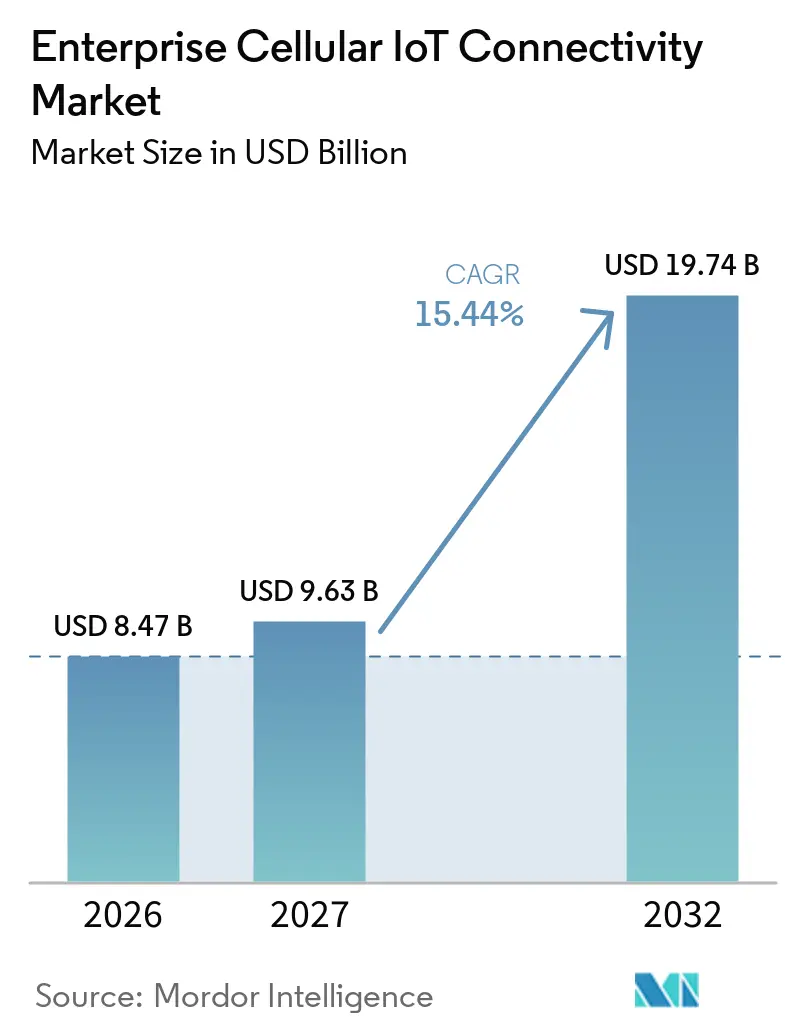
The Enterprise Cellular IoT Connectivity Market size is projected to be USD 8.47 billion in 2026, USD 9.63 billion in 2027, and reach USD 19.74 billion by 2032, growing at a CAGR of 15.44% from 2027 to 2032. The enterprise cellular IoT connectivity market is being shaped by investment in 5G Standalone architecture, lower cellular module costs, and demand for managed platforms that coordinate several carriers through one operating layer, which can simplify control of large fleets, reduce the work required to manage separate service arrangements, and give operating teams a clearer view of device status across locations. Enterprise buyers increasingly look for connectivity management, analytics, implementation support, lifecycle controls, and reliable integration with their existing operational systems rather than standalone hardware, which favors recurring service models and makes day-to-day platform use, dependable support, and compatibility with existing processes more important in supplier selection. Network operators and connectivity specialists are responding with eSIM orchestration, cloud-based controls, broader device support, and systems that let customers manage profiles, service policies, connectivity data, and supplier relationships through fewer operating tools, with the 2025 commercial launch of GSMA’s SGP.32 standard supporting easier multi-country provisioning and more flexible management of operator profiles without replacing physical SIMs. The enterprise cellular IoT connectivity market also benefits from deployments in transport, utilities, logistics, and production facilities, where connected devices support continuous operations, supply operating data, help organizations monitor equipment and assets that may be widely distributed, and reduce gaps between physical operations and digital management systems. At the same time, battery limits, legacy network retirements, fragmented security and certification requirements, and supply uncertainty can raise the cost and complexity of device upgrades, particularly when an organization must maintain older equipment while introducing newer technology, coordinate replacements across large installed fleets, and meet local requirements that differ between operating countries.
Key Report Takeaways
- By offering, services held 56.83% of the enterprise cellular IoT connectivity market share in 2026, while software is projected to expand at a 17.18% CAGR through 2032.
- By network type, public cellular networks held 79.36% of the enterprise cellular IoT connectivity market share in 2026, while private cellular networks are projected to expand at a 17.32% CAGR through 2032.
- By enterprise size, large enterprises held 65.47% of the enterprise cellular IoT connectivity market share in 2026, while small and medium enterprises are projected to expand at a 16.87% CAGR through 2032.
- By application, connected mobility held 27.64% of the enterprise cellular IoT connectivity market share in 2026, while industrial monitoring and automation is projected to expand at a 17.26% CAGR through 2032.
- By end-user industry, automotive and transportation held 29.18% of the enterprise cellular IoT connectivity market share in 2026, while manufacturing and industrial is projected to expand at a 17.21% CAGR through 2032.
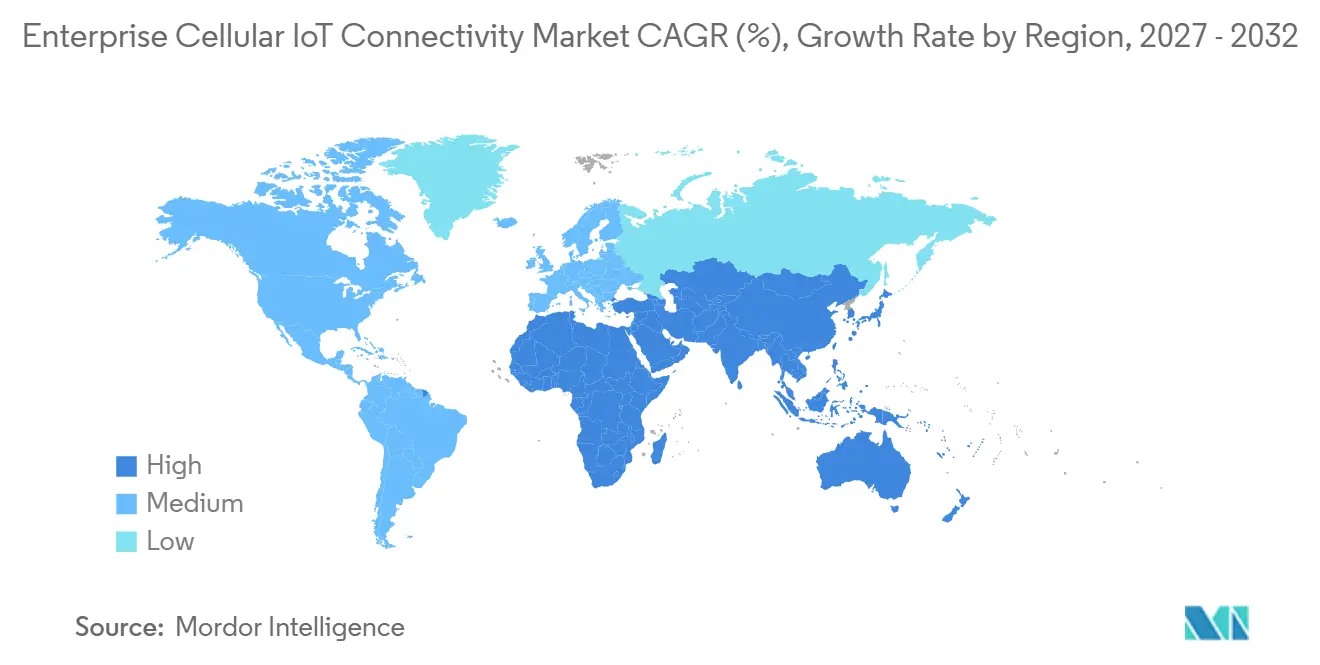
- By geography, Asia-Pacific held 43.72% of the enterprise cellular IoT connectivity market share in 2026, while the Middle East is projected to expand at a 17.08% CAGR through 2032.
Note: Market numbers in this report are based on Mordor Intelligence's proprietary estimation framework, which combines nine months of actuals with Q4 projections for base year 2026.
Market Trends and Insights
Drivers Impact Analysis of Enterprise Cellular IoT Connectivity Market*
| Driver | (~) % Impact on CAGR Forecast | Geographic Relevance | Impact Timeline |
|---|---|---|---|
| 5G RedCap Expansion Into Mid-Tier Enterprise Devices | +2.8% | Global, with early adoption in Asia-Pacific, North America, and Europe | Medium term (2-4 years) |
| Smart Metering and Smart-City Connectivity Mandates | +2.5% | Global, concentrated in South Asia, Europe, and South America | Medium term (2-4 years) |
| Declining Cat-1bis Module Costs | +2.2% | Global, with the largest volume impact in China and India | Short term (≤ 2 years) |
| Enterprise Demand for Multi-Country Connectivity Orchestration | +2.0% | Global, especially North America and Europe | Short term (≤ 2 years) |
| Asset-Tracking and Supply-Chain Visibility Requirements | +1.8% | Global | Short term (≤ 2 years) |
| eSIM and iSIM-Based Reduction of Connectivity Lock-In | +1.5% | Global, with early gains in Asia-Pacific and Europe | Medium term (2-4 years) |
| Source: Mordor Intelligence | |||
5G RedCap Expansion Into Mid-Tier Enterprise Devices
5G Reduced Capability, or RedCap, extends 5G connectivity to device categories that previously relied on LTE Cat-3 and Cat-4 technology. The Global Mobile Suppliers Association identified 30 operators in 21 countries investing in RedCap as of April 2025, including deployments by China Mobile, STC Kuwait, and T-Mobile US.[1] Commercial RedCap deployments show that operators are beginning to position the technology for mid-tier IoT applications that require a balance among device capabilities, power consumption, and equipment cost. The enterprise cellular IoT connectivity market can benefit as RedCap creates a more practical upgrade option for devices that need more capacity than low-power networks provide. Release 18 eRedCap further simplifies the technology for LTE Cat-1 and Cat-1bis device classes, while e& UAE tested eRedCap on a live network in 2026. This progression can reduce the complexity of the device portfolio for organizations that maintain large numbers of connected assets.
Smart Metering and Smart-City Connectivity Mandates
Smart metering policies create a steady demand for cellular devices because utility upgrades require long operating lives and reliable remote communication. The United Kingdom’s post-2025 policy framework requires energy suppliers to replace 2G- and 3G-connected meters before 2033, with the domestic rollout to be completed by 2030.[2] India had deployed 5.28 crore smart meters under national schemes by December 2025, against a target under the Revamped Distribution Sector Scheme to cover 19.79 crore consumers.[3] Brazil’s 2026 ordinance set annual targets for advanced metering in electricity distribution areas, reinforcing the use of digital metering infrastructure. These requirements expand the enterprise cellular IoT connectivity market by making connectivity a required part of grid modernization rather than an optional technology purchase. Broader cellular availability in these areas can also support deployments of asset tracking and environmental monitoring.
Declining Cat-1bis Module Costs
Lower Cat-1bis module prices are making cellular connectivity more attainable for high-volume and cost-sensitive device programs. Single-antenna designs and greater chipset integration reduce component requirements compared with conventional Cat-1 modules. This change improves the economics of connected point-of-sale terminals, smart labels, building sensors, and similar moderate-data devices. The enterprise cellular IoT connectivity market can therefore reach applications that previously used low-power wide-area options because those options had lower device costs. Lower equipment costs do not eliminate the need for suitable service plans, device management, and local certification. It does, however, make it easier for providers to address smaller deployments and price-sensitive customers in China and India.
Enterprise Demand for Multi-Country Connectivity Orchestration
Organizations that operate devices across countries must manage data-residency rules, roaming restrictions, and local SIM registration requirements. Connectivity orchestration platforms address this burden by centralizing SIM lifecycle controls and eSIM provisioning. Tata Communications and Cisco announced in September 2025 that Tata Communications’ MOVE solution would be embedded in Cisco’s IoT Control Center, supporting more than 350 million eSIM operating-system instances across 200+ countries. Cisco’s platform served more than 32,000 enterprises and 270 million SIM IoT devices at the time of the announcement.[4] The enterprise cellular IoT connectivity market is moving toward platforms with usable controls, deeper integrations, and multi-carrier flexibility. Providers that make cross-border connectivity easier to operate can develop more durable customer relationships than providers that only sell SIM capacity.
Restraints Impact Analysis of Enterprise Cellular IoT Connectivity Market*
| Restraint | (~) % Impact on CAGR Forecast | Geographic Relevance | Impact Timeline |
|---|---|---|---|
| Battery-Life Constraints in Remote 5G and High-Data Deployments | -1.8% | Global, especially remote Asia-Pacific and Africa | Medium term (2-4 years) |
| 2G and 3G Sunset-Related Retrofit Costs | -1.5% | Europe, North America, and South America | Short term (≤ 2 years) |
| Cellular IoT Chipset and Mature-Node Supply Volatility | -1.2% | Global, particularly North America and Asia-Pacific | Short term (≤ 2 years) |
| Fragmented Security, Certification, and Data-Residency Requirements | -0.9% | Global | Long term (≥ 4 years) |
| Source: Mordor Intelligence | |||
Battery-Life Constraints in Remote 5G and High-Data Deployments
Power consumption remains a constraint for battery-powered devices operating in remote locations where charging or battery replacement is difficult. A 2025 study in Information found that cellular IoT design must carefully manage receiver power consumption to improve device resilience. A 2025 IEEE study also found that energy-saving approaches for 5G Standalone must be balanced against latency and reliability requirements. The enterprise cellular IoT connectivity market, therefore, continues to support diverse network options for low-power sensors and high-data equipment. Many enterprises use NB-IoT or LTE-M for constrained sensors, while using Cat-1bis or RedCap for moderate-data devices. eRedCap’s 5 MHz design can help reduce energy demand, but wider gains depend on newer chipsets reaching commercial scale.
2G and 3G Sunset-Related Retrofit Costs
The retirement of 2G and 3G networks creates upgrade costs for fleets that were designed around long-term legacy support. Module replacements may require on-site visits to replace radios, SIMs, and firmware in vehicles or remote equipment, and those activities can be difficult to coordinate across widely distributed assets. The largest cost burden can arise when physical replacement must be performed during a scheduled maintenance visit rather than via a remote software update. Such costs can delay modernization when device owners lack a clear replacement plan, an accurate device inventory, or sufficient operational time to replace equipment. The enterprise cellular IoT connectivity market must therefore offer migration paths that coordinate hardware replacement with scheduled maintenance cycles and help customers avoid disruption to ongoing services.
*Our forecasts treat driver/restraint impacts as directional, not additive. The impact forecasts reflect baseline growth, mix effects, and variable interactions.
Enterprise Cellular IoT Connectivity Market Segment Analysis
By Offering:
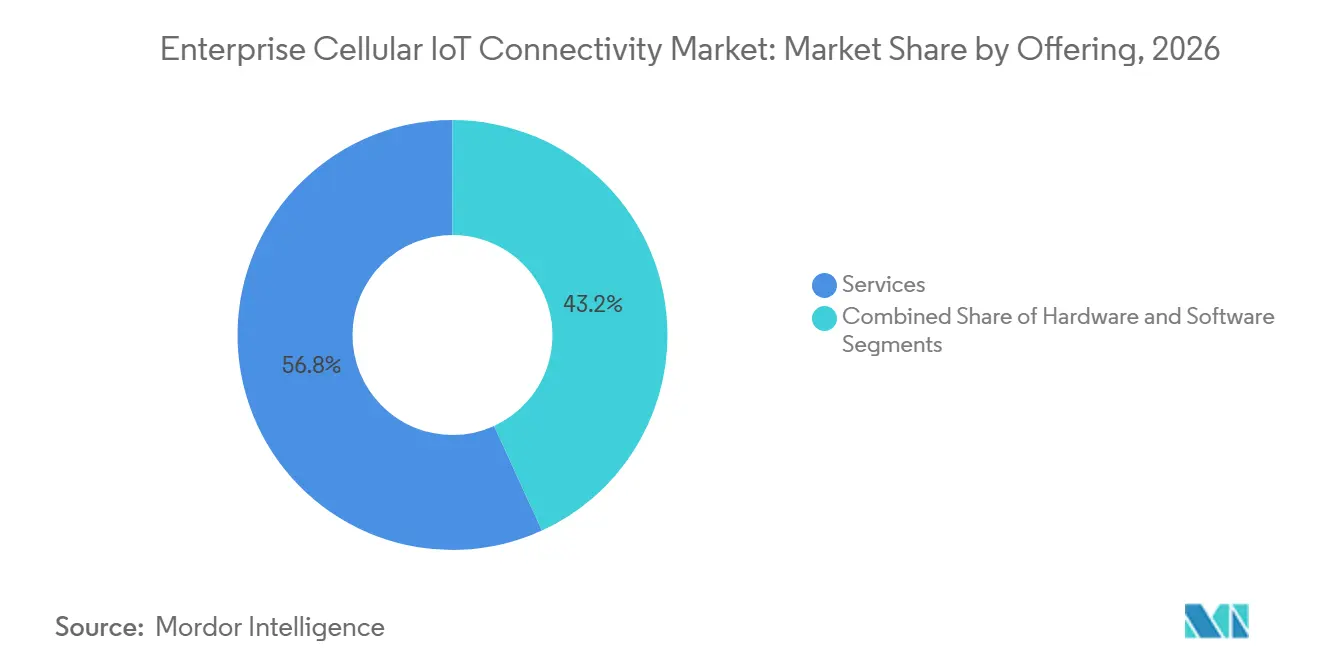
Services Lead Revenue While Software Expands QuicklyServices held 56.83% of the enterprise cellular IoT connectivity market share in 2026, confirming that value is increasingly captured after deployment through day-to-day connectivity operations rather than at the initial equipment sale. This position reflects a clear preference for managed connectivity, analytics, and professional support over one-time device procurement, particularly when a program spans different networks, device types, operating sites, and local requirements. Providers earn recurring revenue when they manage SIMs, monitor connection quality, support deployment work, and resolve service issues across a customer’s device fleet. These operating activities are often embedded in daily workflows, which raises the value of a continued service relationship and makes replacement more difficult once systems are in use. Hardware remains necessary because each new connected device contributes to the installed base that services later support.
Software is projected to grow at a 17.18% CAGR through 2032, as enterprises use software layers to make large device fleets easier to monitor and manage. AI-enabled connectivity tools, eSIM orchestration, and edge integration are making software more important to device operations, particularly where customers require visibility across several suppliers and countries. These systems can help enterprises monitor network quality, organize device profiles, identify device issues before they disrupt operations, and set policies applied consistently across the fleet. The enterprise cellular IoT connectivity market is likely to reward providers that combine managed connectivity with software tools customers can use across multiple carriers without requiring separate operational processes. Cat-1bis and RedCap module commoditization places pricing pressure on hardware, making service quality, platform integration, and software capabilities more important sources of differentiation.

By Network Type:
Private Cellular Networks Record the Fastest ExpansionPublic cellular networks accounted for 79.36% of revenue in 2026, reflecting their established role in connecting assets operating beyond a single site. They remain the usual choice for noncritical deployments because coverage already exists, and organizations can avoid building dedicated infrastructure before connecting devices. Public networks support mobile assets, distributed sensors, and many telematics applications with relatively simple deployment models, especially when devices move across cities, regions, or national networks. Their broad reach helps enterprises connect equipment across large geographic areas without having to manage the underlying radio network. They may be less suitable where congestion, control, predictable on-site performance, or local data handling requirements are central to the project.
Private cellular networks are projected to expand at a 17.32% CAGR through 2032. The enterprise cellular IoT connectivity market size for private networks is supported by manufacturing, logistics, and critical infrastructure programs that require controlled coverage, predictable performance, and isolation from general public traffic. More than 1,700 organizations in nearly 80 countries had deployed private LTE or 5G networks by Q1 2025. Nokia found that 87% of private wireless adopters achieved return on investment within 1 year, and 81% reported lower-than-expected setup costs. Connectivity aggregation also matters where enterprises need multi-carrier resilience without building a complete private network, and GSMA’s SGP.32 framework supports this model through eSIM-based management of multiple operator profiles.
By Enterprise Size:
Large Enterprises Anchor Demand While Smaller Firms Gain AccessLarge enterprises held 65.47% of revenue in 2026, reflecting their ability to fund broad programs that connect facilities, vehicles, equipment, and employees. Multi-site private networks, enterprise SIM contracts, and platform integrations require investment and specialist teams that larger organizations are more likely to have. Automotive manufacturers, global logistics operators, and energy utilities have also built connected device fleets over many years, giving them a substantial installed base. Their installed bases create ongoing demand for managed services, software, network upgrades, and support for operational changes throughout each device's life cycle. The enterprise cellular IoT connectivity market remains closely linked to these organizations because their programs involve many devices, numerous operating locations, and complex operating requirements.
Small and medium enterprises are projected to expand at a 16.87% CAGR through 2032. Falling module costs, fixed-price connectivity offers, and cloud-based management tools reduce the technical and financial barriers for smaller organizations that may not employ specialized telecom staff. RedCap validation for industrial small and medium enterprises demonstrates that providers are developing technology options for this customer group. The enterprise cellular IoT connectivity market can reach more smaller buyers when providers reduce the need for internal telecommunications knowledge and offer standardized deployment options. Ease of use and total cost of ownership are particularly important because small teams often need solutions that work without extensive customization, lengthy implementation, or complex carrier negotiations.
By Application:
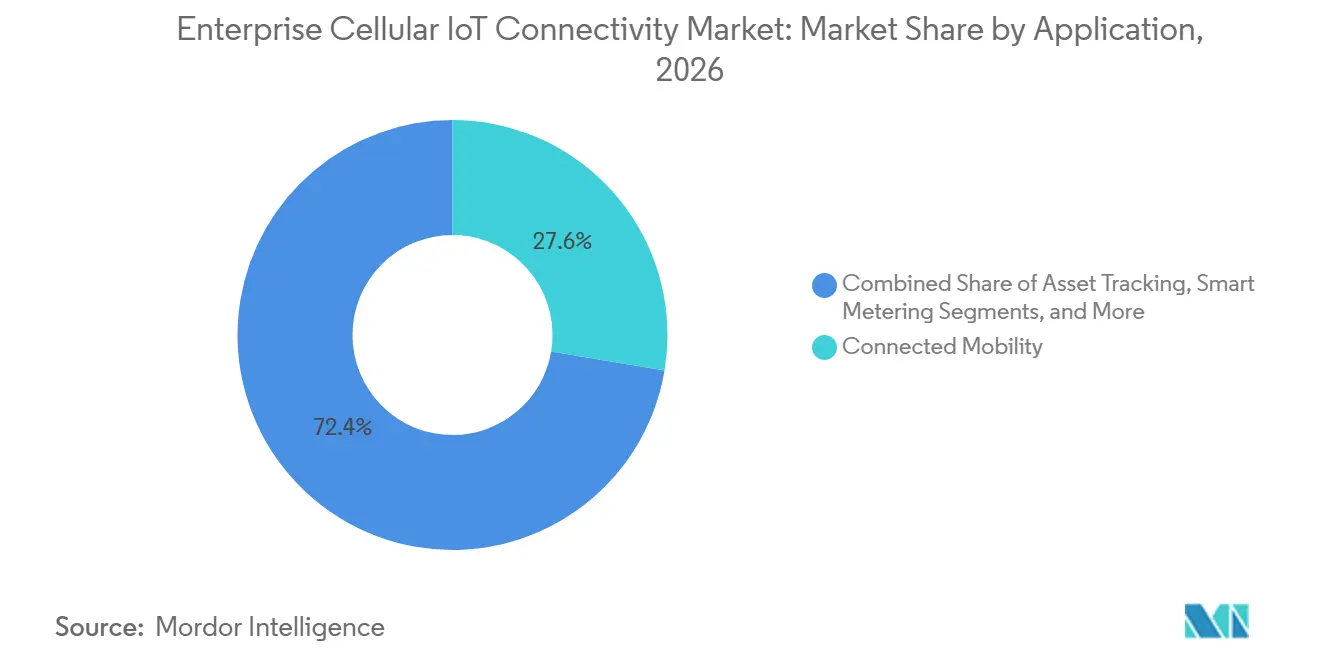
Connected Mobility Leads While Industrial Automation AcceleratesConnected mobility held 27.64% of revenue in 2026, supported by both long-established vehicle telematics and newer connected transport services. Vehicle telematics, fleet management, over-the-air updates, and vehicle-to-everything communications all depend on reliable cellular links that can operate while vehicles travel through different coverage areas. Operators and vehicle manufacturers are also preparing for LTE shutdowns that are expected to begin from 2030 in several markets, which makes technology migration a planning issue for existing fleets. The continued commercial development of vehicle-to-everything services shows that connectivity is becoming more closely integrated with transport operations. The enterprise cellular IoT connectivity market benefits from this installed base because each connected vehicle may need years of service management, security controls, platform support, and periodic technology upgrades.
Industrial monitoring and automation are projected to expand at a 17.26% CAGR through 2032. Private 5G can support predictive maintenance, digital twins, and coordination of autonomous guided vehicles where consistent on-site coverage, lower interference, and operational control are needed. Asset tracking also benefits from lower Cat-1bis costs, which make cellular connectivity more feasible for containers, pallets, rental equipment, and other assets that move beyond a single fixed site. Nokia’s private wireless contract for Maersk’s 450-vessel fleet illustrates the use of cellular technology for real-time cargo tracking. Smart metering creates significant deployment volumes in utilities, while healthcare remains a higher-value area with demanding compliance needs and strict requirements for dependable device connectivity.
By End-User Industry:
Automotive and Transportation Leads While Manufacturing ScalesAutomotive and transportation accounted for 29.18% of revenue in 2026, supported by a decade of spending on embedded telematics and connected-vehicle capabilities. This position reflects a long-running investment in embedded telematics and increasingly capable connected-vehicle platforms that can provide information throughout a vehicle’s operating life. Fleet operators need location, condition, and route data, while vehicle manufacturers use cellular links for diagnostics, software updates, customer services, and the administration of growing vehicle fleets. The 5G Automotive Association’s 2030 roadmap described an expected period of mass 5G vehicle-to-everything deployment in commercial vehicles from 2026 to 2029. These needs make automotive and transportation a central demand base for the enterprise cellular IoT connectivity market, as connectivity is integral to both daily fleet operations and long-term vehicle support.
Manufacturing and industrial is projected to expand at a 17.21% CAGR through 2032. Private 5G deployments across manufacturing facilities show that production sites are moving from limited pilots toward larger-scale connectivity programs. Equipment suppliers are also expanding private 5G infrastructure across multiple countries, providing manufacturers with more options for local network design. Energy and utilities constitute another major end-user group, as smart meters and grid monitoring require low-power connectivity at scale across dispersed customer premises and network assets. Logistics, healthcare, and other verticals add demand through supply-chain visibility, remote patient monitoring, and operational systems that benefit from secure device communications.
Geography Analysis
APAC Enterprise Cellular IoT Connectivity Market
Asia-Pacific accounted for 43.72% of revenue in 2026, making it the largest regional segment in the enterprise cellular IoT connectivity market. The region combines large cellular device bases with active deployments in India, South Korea, Japan, and China, where operators, utilities, manufacturers, and logistics organizations are applying cellular connectivity to diverse operational needs. India’s smart meter program is a major driver of device demand, while manufacturers and logistics operators also use cellular networks to support automation, equipment monitoring, and distributed asset management. Industrial RedCap initiatives in South Korea also show that the region is moving beyond network construction toward more specialized business deployments.
The Americas and Europe Enterprise Cellular IoT Connectivity Market
North America and Europe continue to benefit from mature enterprise adoption, automotive telematics, technology migration, and a base of organizations capable of funding complex deployments. Major North American operators are among the early commercial providers for mid-tier 5G IoT services. Europe’s industrial users are also adopting private networks to improve on-site control, performance, and support for automated operations. Industrial deployments at European production sites demonstrate how private wireless is being used in sectors where reliable coverage and operational control are important. South America faces immediate pressure from the costs of 2G and 3G migrations, though smart meter requirements and logistics applications can support longer-term adoption when operators and device owners coordinate replacement plans.
MEA Enterprise Cellular IoT Connectivity Market
The Middle East is projected to expand at a 17.08% CAGR through 2032, making it a major growth area within the enterprise cellular IoT connectivity market. National digitization plans and regional 5G investment are supporting industrial use cases across the Gulf Cooperation Council, where energy, logistics, and public infrastructure create a clear need for secure connected devices. GSMA research covering 851 enterprises in the Middle East and North Africa found a projected 3.3-year return on IoT investment in Saudi Arabia, compared with a regional average of 4.7 years. Africa is gaining support from utility deployments in South Africa and Nigeria, where connected meters and remote infrastructure monitoring are relevant. Vodafone IoT and Iridium announced an NTN NB-IoT integration in 2025, planned for commercial launch in 2026, extending coverage options beyond terrestrial networks and improving the reach of remote use cases.
Competitive Landscape
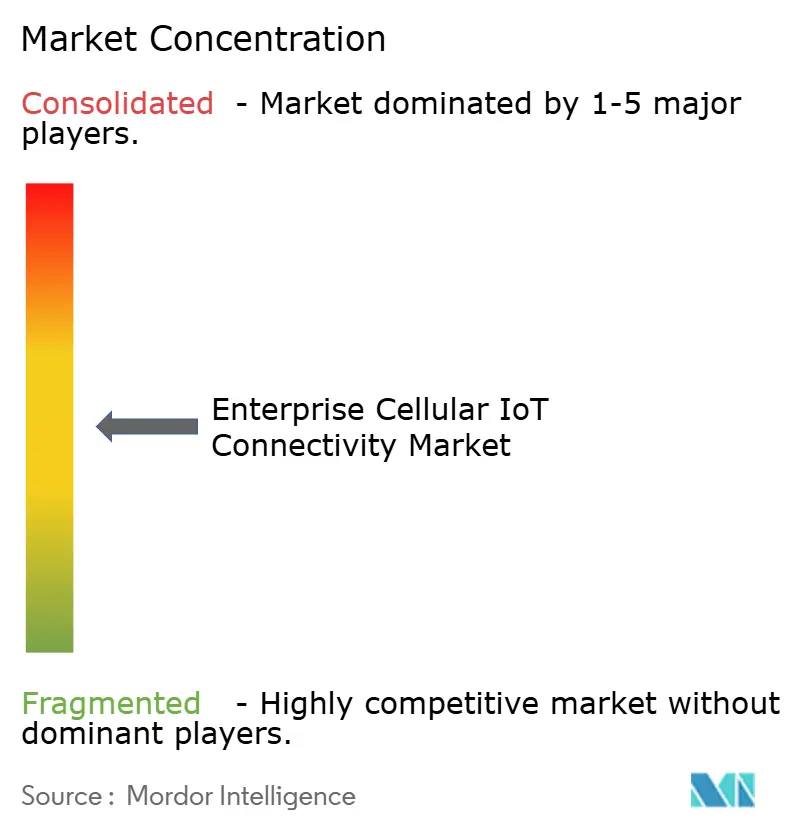
The enterprise cellular IoT connectivity market is moderately concentrated. Vodafone, AT&T, Verizon, China Mobile, and Deutsche Telekom compete on network scale, international reach, established relationships with business customers, and the ability to support large programs spanning multiple operating locations. Vodafone reported more than 230 million IoT connections and was named a Leader in the 2026 Gartner Magic Quadrant for Managed IoT Connectivity Services for the 12th consecutive year. Larger operators can bundle access, managed services, account support, and network expertise for customers with extensive device fleets and strict operating requirements. Their primary challenge is meeting requests for flexible, developer-friendly systems across multiple networks and countries without adding complexity to the customer’s daily management.
IoT-focused mobile virtual network operators such as KORE, emnify, floLIVE, Soracom, Eseye, and Wireless Logic compete through cloud-native platforms and application programming interface support. Their value proposition centers on multi-carrier controls, simpler integration, and the ability to support customers that need local compliance across several markets without maintaining separate connectivity arrangements. SGP.32 is important because it enables operator profile switching without a physical SIM replacement. KORE and Kigen announced SGP.32-compliant connectivity solutions in April 2026, with commercial availability planned later that year. The enterprise cellular IoT connectivity market is therefore increasingly shaped by platform capabilities, profile management, service flexibility, and radio coverage.
Strategic activity also extends into hardware and services. KORE completed its take-private transaction in July 2026 at an enterprise value of USD 726 million, with support from Searchlight Capital Partners and Abry Partners. Texas Instruments agreed to acquire Silicon Labs in February 2026 for USD 7.5 billion, bringing together analog processing and wireless system-on-chip capabilities that are relevant to the availability and economics of connected devices. Nokia’s work with Maersk shows how equipment suppliers are also building a role in enterprise logistics deployments, as the enterprise cellular IoT connectivity market demands integrated delivery across devices, network systems, and operating environments.
Enterprise Cellular IoT Connectivity Industry Leaders
-
Vodafone Group plc
-
AT&T Inc.
-
Verizon Communications Inc.
-
China Mobile Limited
-
Deutsche Telekom AG
- *Disclaimer: Major Players sorted in no particular order
Enterprise Cellular IoT Connectivity Market Companies Covered in this Report
- Vodafone Group plc
- AT&T Inc.
- Verizon Communications Inc.
- China Mobile Limited
- China Unicom (Hong Kong) Limited
- Deutsche Telekom AG
- Telefonica, S.A.
- Orange S.A.
- Tata Communications Limited
- KORE Group Holdings, Inc.
- Wireless Logic Group Limited
- 1NCE GmbH
- emnify GmbH
- Eseye Limited
- floLIVE Ltd.
- Soracom, Inc.
- Onomondo ApS
- Telit Cinterion
- Aeris Communications, Inc.
- Tele2 AB (Tele2 IoT)
Recent Industry Developments in Enterprise Cellular IoT Connectivity Market
- September 2026: Kajeet and Heddian announced a strategic agreement under which Heddian acquires Kajeet's private wireless deployment business while Kajeet licenses its Sentinel connectivity management platform, concentrating Kajeet on software orchestration and expanding Heddian's managed services for enterprise private wireless deployments.
- July 2026: KORE Group Holdings Inc. completed its take-private transaction at an enterprise value of approximately USD 726 million, backed by Searchlight Capital Partners and Abry Partners, providing capital to accelerate SGP.32-based orchestration and geographic expansion.
- April 2026: KORE Group Holdings Inc. and Arm Kigen announced a portfolio of SGP.32-compliant connectivity solutions, with commercial availability planned for later in 2026, targeting global enterprise deployments requiring resilient multi-network approaches, streamlined roaming, and local connectivity with intelligent failover.
- March 2026: Soracom, Inc. opened pre-orders for its Connectivity Hypervisor, a SGP.32-compatible platform for dynamic remote management and switching of multiple operator profiles on a single IoT eSIM, at Mobile World Congress 2026, enabling enterprises to maintain a single device SKU globally while optimizing connectivity by region and application need.
Global Enterprise Cellular IoT Connectivity Market Report Scope
The Enterprise Cellular IoT Connectivity Market Report is Segmented by Offering (Hardware, Software, and Services), Network Type (Public Cellular Networks, Private Cellular Networks, and Connectivity Aggregation Networks), Enterprise Size (Large Enterprises, and Small and Medium Enterprises), Application (Asset Tracking, Smart Metering, Industrial Monitoring and Automation, Connected Mobility, Healthcare Connectivity, and Other Applications), End-User Industry (Automotive and Transportation, Energy and Utilities, Manufacturing and Industrial, Logistics and Supply Chain, Healthcare and Life Sciences, and Other End-User Industries), and Geography (North America, South America, Europe, Asia-Pacific, Middle East, and Africa). The Market Forecasts are Provided in Terms of Value (USD).
Segmentation Overview
| Hardware |
| Software |
| Services |
| Public Cellular Networks |
| Private Cellular Networks |
| Connectivity Aggregation Networks |
| Large Enterprises |
| Small and Medium Enterprises |
| Asset Tracking |
| Smart Metering |
| Industrial Monitoring and Automation |
| Connected Mobility |
| Healthcare Connectivity |
| Other Applications |
| Automotive and Transportation |
| Energy and Utilities |
| Manufacturing and Industrial |
| Logistics and Supply Chain |
| Healthcare and Life Sciences |
| Other End-User Industries |
| North America | United States |
| Canada | |
| Mexico | |
| South America | Brazil |
| Argentina | |
| Rest of South America | |
| Europe | Germany |
| United Kingdom | |
| France | |
| Italy | |
| Spain | |
| Russia | |
| Rest of Europe | |
| Asia-Pacific | China |
| India | |
| Japan | |
| South Korea | |
| Australia | |
| Rest of Asia-Pacific | |
| Middle East | Saudi Arabia |
| United Arab Emirates | |
| Rest of Middle East | |
| Africa | South Africa |
| Nigeria | |
| Rest of Africa |
| By Offering | Hardware | |
| Software | ||
| Services | ||
| By Network Type | Public Cellular Networks | |
| Private Cellular Networks | ||
| Connectivity Aggregation Networks | ||
| By Enterprise Size | Large Enterprises | |
| Small and Medium Enterprises | ||
| By Application | Asset Tracking | |
| Smart Metering | ||
| Industrial Monitoring and Automation | ||
| Connected Mobility | ||
| Healthcare Connectivity | ||
| Other Applications | ||
| By End-User Industry | Automotive and Transportation | |
| Energy and Utilities | ||
| Manufacturing and Industrial | ||
| Logistics and Supply Chain | ||
| Healthcare and Life Sciences | ||
| Other End-User Industries | ||
| By Geography | North America | United States |
| Canada | ||
| Mexico | ||
| South America | Brazil | |
| Argentina | ||
| Rest of South America | ||
| Europe | Germany | |
| United Kingdom | ||
| France | ||
| Italy | ||
| Spain | ||
| Russia | ||
| Rest of Europe | ||
| Asia-Pacific | China | |
| India | ||
| Japan | ||
| South Korea | ||
| Australia | ||
| Rest of Asia-Pacific | ||
| Middle East | Saudi Arabia | |
| United Arab Emirates | ||
| Rest of Middle East | ||
| Africa | South Africa | |
| Nigeria | ||
| Rest of Africa | ||
Key Questions Answered in the Report
What is the size of the enterprise cellular IoT connectivity market?
The enterprise cellular IoT connectivity market is projected to reach USD 19.74 billion by 2032, from USD 9.78 billion in 2027, at a 15.44% CAGR. Demand is supported by managed connectivity, lower module costs, and the use of cellular links across utilities, transport, logistics, and production sites. The forecast also reflects greater use of platform software that helps enterprises organize device profiles, monitor connection quality, handle network changes, and support equipment that operates across several locations or countries, while allowing providers to deliver ongoing technical support and management services after the initial device connection is established, managed, and integrated with operational workflows.
What is driving enterprise adoption of cellular IoT connectivity?
5G RedCap, smart meter deployment, lower Cat-1bis costs, and platforms that manage multi-country connectivity are supporting adoption. These factors help organizations connect a broader range of devices while managing profiles, supplier relationships, device lifecycles, and operating data through a smaller number of systems.
Which offering segment leads enterprise cellular IoT connectivity?
Services lead with a 56.83% share in 2026, reflecting demand for managed connectivity, analytics, and deployment support. The position shows that customers value the work needed to operate and support large device fleets after hardware has been deployed, rather than focusing only on the initial equipment purchase.
Which network type is expanding the fastest?
Private cellular networks are projected to expand at a 17.32% CAGR through 2032 as industrial users seek controlled, reliable on-site coverage. This option is especially relevant for manufacturing, logistics, and critical infrastructure operations where network control, consistent performance, and the handling of operational data are important.
Which application accounts for the largest revenue share?
Connected mobility holds a 27.64% share in 2026, supported by telematics, fleet management, software updates, and vehicle-to-everything communications. The application also creates ongoing demand for connection management, security, and periodic device upgrades as vehicle operators prepare for changes in network technology.
Which region is expanding the fastest for enterprise cellular IoT connectivity?
The Middle East is projected to expand at a 17.08% CAGR through 2032, supported by national digitization plans and 5G investment. Energy, logistics, and public infrastructure deployments provide a basis for industrial connected-device use cases across the Gulf Cooperation Council.