
Energy Retrofit Tools Market Size and Share
Market Overview
| Study Period | 2022 - 2032 |
|---|---|
| Market Size (2027) | USD 16.92 Billion |
| Market Size (2032) | USD 28.74 Billion |
| Growth Rate (2027 - 2032) | 11.18 % |
| Fastest Growing Market | Asia-Pacific |
| Largest Market | Asia-Pacific |
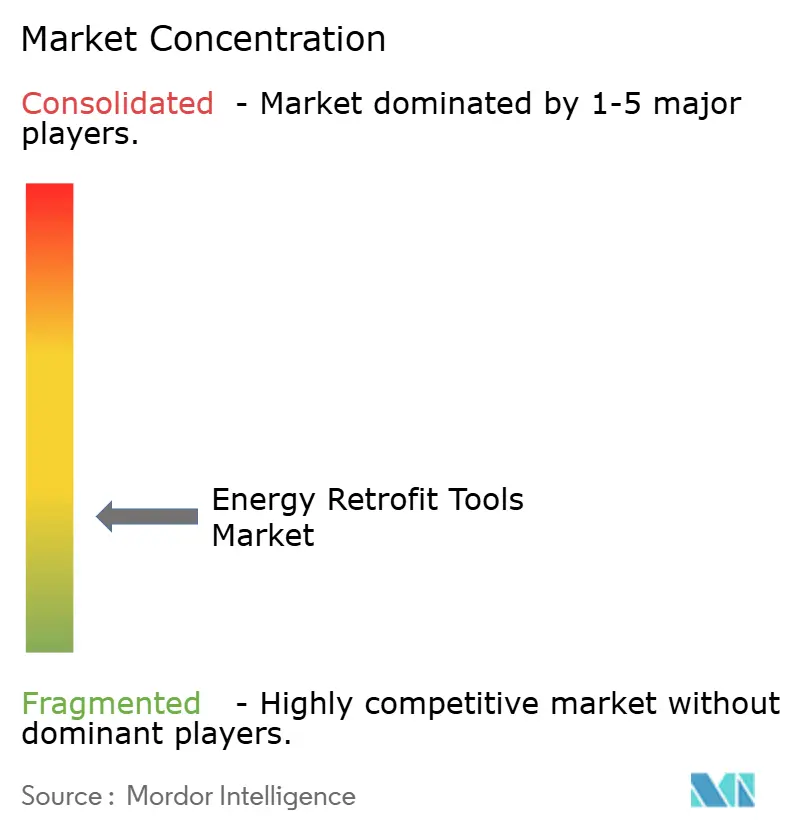
| Market Concentration | Low |
Major Players *Disclaimer: Major Players sorted in no particular order Image © Mordor Intelligence. Reuse requires attribution under CC BY 4.0. | |
Energy Retrofit Tools Market Analysis by Mordor Intelligence
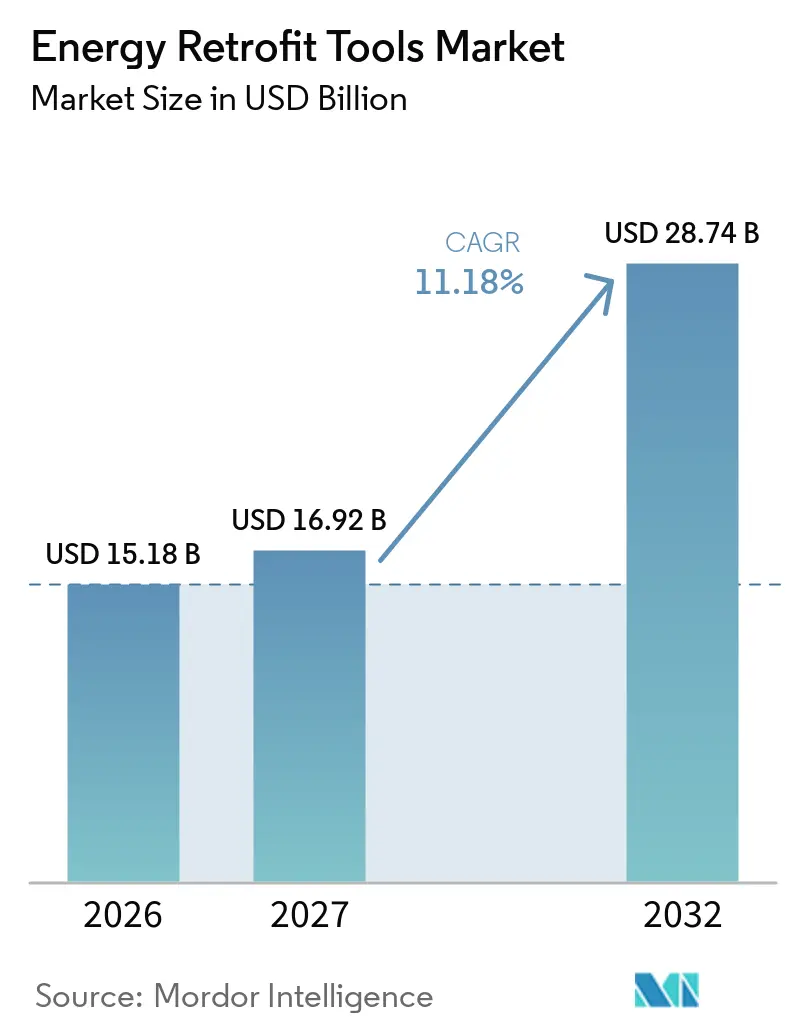
The Energy Retrofit Tools Market size is expected to increase from USD 15.18 billion in 2026 to USD 16.92 billion in 2027 and reach USD 28.74 billion by 2032, at a CAGR of 11.18% over 2027-2032. Mandatory building decarbonization rules, volatile energy costs, and the growing use of AI-based diagnostic platforms are changing how owners, energy service companies, and facility managers select retrofit tools. The Global energy retrofit tools market is moving beyond isolated upgrades as buyers combine audit tools, building energy modeling software, and real-time analytics within a common operating plan. Investment conditions support this change, since retrofit spending across China, the United States, and the European Union exceeded USD 120 billion in 2024, while global end-use efficiency investment is expected to approach USD 800 billion in 2026.[1] Large platform providers are expanding their software, controls, and managed-service offers, while cloud-based suppliers are making modeling and analytics more accessible to mid-sized property portfolios. Labor shortages and long payback periods remain limits on adoption, especially where financing programs and qualified retrofit contractors are less available.
Key Report Takeaways
- By tool type, Energy Audit and Assessment Tools held 22.3% of the Global energy retrofit tools market share in 2026, while Smart Building Analytics and Energy Management Platforms are forecast to grow at a 12.4% CAGR through 2032.
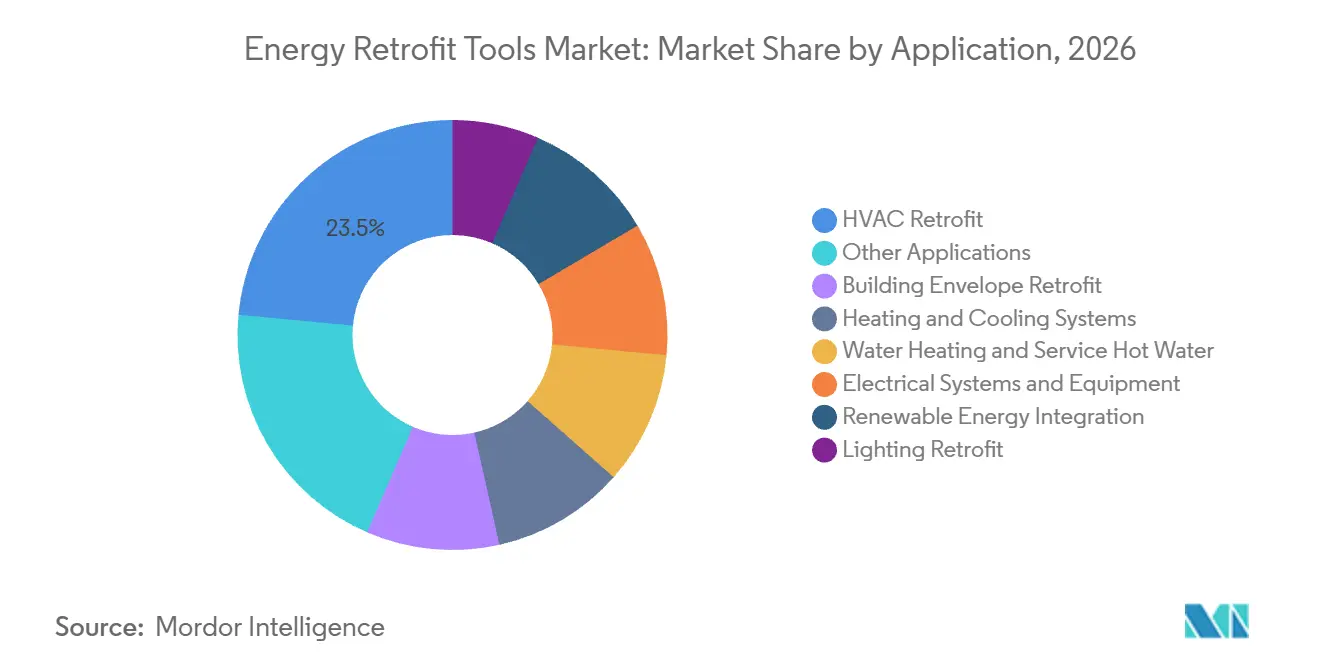
- By application, HVAC Retrofit accounted for 23.5% of the Global energy retrofit tools market share in 2026, while Renewable Energy Integration is projected to expand at an 11.8% CAGR through 2032.
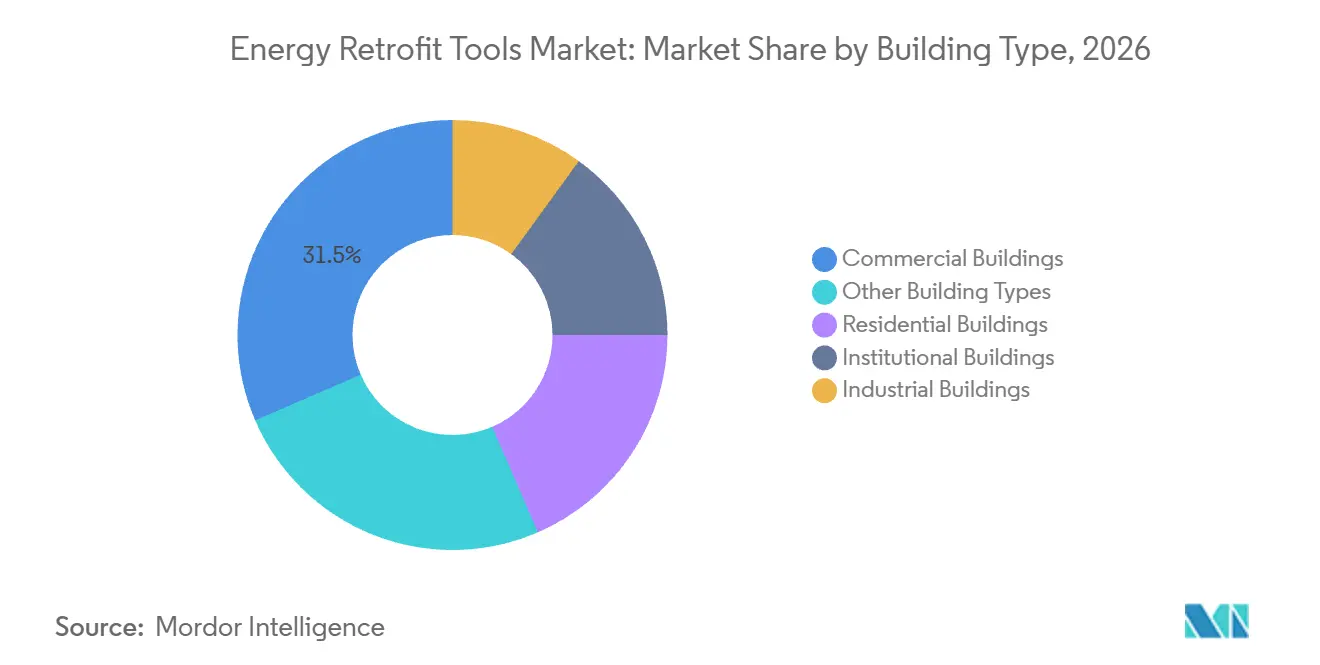
- By building type, Commercial Buildings held 31.5% revenue share in 2026, while Industrial Buildings are forecast to record an 11.5% CAGR through 2032.
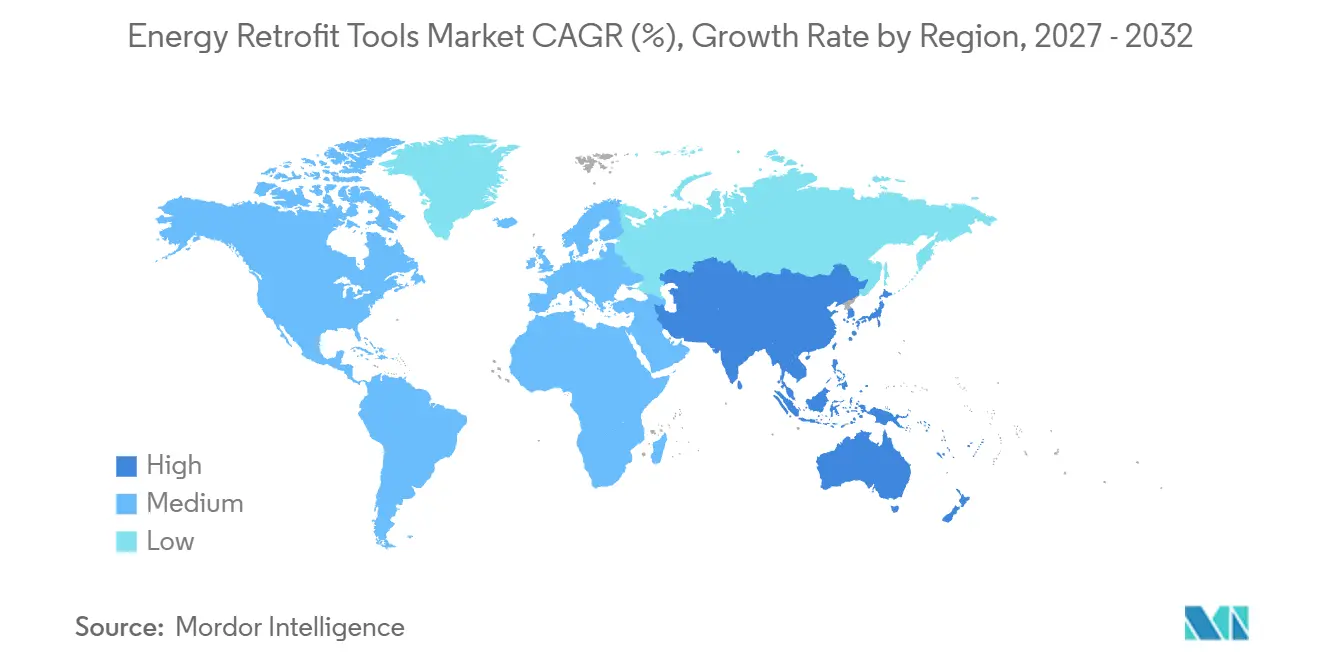
- By geography, Asia-Pacific led with 35.6% revenue share in 2026 and is projected to grow at an 11.7% CAGR through 2032.
Note: Market numbers in this report are based on Mordor Intelligence's proprietary estimation framework, which combines nine months of actuals with Q4 projections for base year 2026.
Market Trends and Insights
Drivers Impact Analysis of Energy Retrofit Tools Market*
| Driver | (~) % Impact on CAGR Forecast | Geographic Relevance | Impact Timeline |
|---|---|---|---|
| Building Energy Performance Standards and Retrofit Mandates | +2.8% | Global, with highest intensity in Europe, North America, and East Asia | Short term (≤ 2 years) |
| Rising Energy Costs and Operating Expense Pressure | +2.1% | Global, with greater exposure in Europe and energy-import-dependent Asia-Pacific economies | Short term (≤ 2 years) |
| Aging Building Stock and Deferred Maintenance | +1.4% | North America, Europe, and Japan | Medium term (2-4 years) |
| Corporate Net-Zero and ESG Commitments | +1.5% | OECD markets with SEC, TCFD, and CSRD disclosure obligations | Medium term (2-4 years) |
| AI-Enabled Building-Twin Analytics | +1.3% | North America and core Asia-Pacific markets | Medium term (2-4 years) |
| Outcome-Based Financing and Energy-Performance Contracts | +1.0% | North America, Europe, and Asia-Pacific markets with established ESCO infrastructure | Long term (≥ 4 years) |
| Source: Mordor Intelligence | |||
Building Energy Performance Standards and Retrofit Mandates
Mandatory energy performance rules are a near-term demand driver for audit tools and building energy modeling software in the Global energy retrofit tools market. The recast Energy Performance of Buildings Directive requires residential buildings to reach at least class D by 2030 and class B or higher by 2033, affecting 34 million dwellings. New York City imposed carbon-intensity penalties under Local Law 97 from 2024, which increased the need for commissioning and compliance tools. Trane Technologies reported that its September 2025 electrification retrofit at 55 Water Street avoided USD 1.2 million in annual Local Law 97 penalties and accessed USD 9 million in Inflation Reduction Act tax credits. Germany’s requirement for heating systems to use 65% renewable energy extends to existing buildings from mid-2026, increasing the need for assessment and planning tools. ISO 50002-2:2025 also provides building-specific guidance for energy audits, which supports more consistent tool selection and reporting.[2]
Rising Energy Costs and Operating Expense Pressure
Higher commercial electricity and natural-gas costs since 2024 have made efficiency projects more relevant to operating budgets in the Global energy retrofit tools market. Commercial HVAC retrofits that combine variable-speed equipment, smart controls, and heating electrification can deliver energy savings of 25% to 45%, with payback periods of 4 to 8 years. Participants in the U.S. Department of Energy Better Buildings Initiative reported annual energy-cost reductions of 2.8%, equal to USD 1.2 per square foot. Global end-use efficiency investment is expected to approach USD 800 billion in 2026, which the International Energy Agency links to continued demand for efficiency measures.[3] Energy-import-dependent economies in Southeast Asia and South Asia face greater exposure to utility-cost increases, which improves the case for lower-cost energy management platforms. This cost pressure also supports outcome-based financing and energy-performance contracts where established ESCO systems can reduce the initial burden on building owners.
Aging Building Stock and Deferred Maintenance
Aging buildings expand the pool of assets that need audits, commissioning, and integrated modeling in the Global energy retrofit tools market. More than 70% of the global building stock predates modern efficiency standards and uses 40% to 50% more energy per unit area than newer buildings. The U.S. Department of Energy identifies more than 5.9 million commercial buildings as HVAC retrofit candidates. Buildings constructed between 1980 and 2005 are a priority because many of their HVAC systems are at or beyond a 15- to 25-year design life. Their energy use can be 35% to 40% higher than that of modern alternatives. Deferred maintenance makes single-measure reviews less useful, so owners are more likely to use building energy modeling software that can test linked upgrade measures together.
AI-Enabled Building-Twin Analytics
AI-enabled digital-twin platforms are broadening the Global energy retrofit tools market by automating model creation, fault detection, and savings verification. In August 2026, Johnson Controls expanded OpenBlue with Energy and Comfort Intelligence and an AI assistant called OBI. The company stated that the new features can reduce air-circulation energy use by nearly 10% and cut implementation time by up to 95% through automated device onboarding.[4] A University of Cambridge study reported that Data2BEM reduced building energy modeling time from 8 to 32 hours to 48 minutes while maintaining industry-benchmark accuracy. A 2026 Scientific Reports study found that federated learning and digital twins improved energy efficiency by 34.6% and reduced lifecycle costs by 27.3% in Chinese urban residential communities. These tools reduce reliance on scarce specialist labor and allow cloud-based suppliers to serve mid-sized commercial portfolios that previously had limited access to advanced modeling.
Restraints Impact Analysis of Energy Retrofit Tools Market*
| Restraint | (~) % Impact on CAGR Forecast | Geographic Relevance | Impact Timeline |
|---|---|---|---|
| High Upfront Capital Expenditure and Extended Payback Periods | -1.8% | Global, most acute where green banking and soft-loan programs are limited | Short term (≤ 2 years) |
| Landlord-Tenant Split Incentives | -0.8% | Europe and North America, especially high-renter markets | Medium term (2-4 years) |
| Shortage of Skilled Retrofit Labor and Project Managers | -0.7% | North America and Europe, with spillover to Asia-Pacific | Short term (≤ 2 years) |
| Performance Measurement Uncertainty and Savings-Verification Risk | -0.5% | Global, with stronger effects in early-stage ESCO markets in the Middle East, Africa, and South America | Long term (≥ 4 years) |
| Source: Mordor Intelligence | |||
High Upfront Capital Expenditure and Extended Payback Periods
High initial spending remains a practical limit for the Global energy retrofit tools market, especially among mid-sized property owners. A complete deployment can require building energy modeling licenses, audit consulting, HVAC commissioning equipment, and analytics implementation at the same time. The International Energy Agency reported that annual efficiency investment needs to rise from USD 660 billion to USD 1.9 trillion by 2030 to align with net-zero goals, indicating a funding gap that technology procurement cannot resolve on its own. The U.S. Department of Energy verified USD 647.8 million in annual savings across 200 federal Energy Savings Performance Contract projects in fiscal year 2024. Those results show that outcome-based financing can address capital barriers where mature ESCO infrastructure is present. In South America and the Middle East and Africa, weaker green-bond markets and limited financing structures can delay adoption despite policy support.
Landlord-Tenant Split Incentives and Delivery Constraints
Landlord-tenant split incentives can slow retrofit decisions in the Global energy retrofit tools market because owners pay the capital cost while tenants receive much of the energy-bill benefit. Germany’s residential renovation rate fell to 0.67% in 2025, below the 1.6% to 2.0% pace set out in its climate-action plan. Research published in Resource and Energy Economics found a measurable efficiency gap between owner-occupied and rental housing in Germany. The source material also indicates that lifecycle costs and emissions in rented buildings can be up to 60% and 283% higher than in owner-occupied equivalents. Shortages of retrofit labor and project managers compound the issue by delaying installations and savings realization. Measurement and verification risk also matters in early-stage ESCO markets, where owners may hesitate to purchase analytics platforms without clear ways to validate the savings promised by a project.
*Our forecasts treat driver/restraint impacts as directional, not additive. The impact forecasts reflect baseline growth, mix effects, and variable interactions.
Energy Retrofit Tools Market Segment Analysis
By Tool Type:
Audit Tools Anchor Revenue as Analytics Platforms AccelerateEnergy Audit and Assessment Tools held 22.3% of the Global energy retrofit tools market size in 2026. Their position reflects the role of the audit as the baseline for building energy models, HVAC commissioning plan, or later performance review. Mandatory audit obligations under the European Energy Efficiency Directive, ISO 50002-2:2025, and national programs support recurring demand for these tools. The United Kingdom’s Energy Savings Opportunity Scheme and India’s designated-consumer audit requirement provide similar use cases. Tools that automate EN 16247-compliant report preparation have reduced audit time from 6 to 8 hours to 30 minutes, allowing service firms to raise audit throughput by 3 to 4 times without matching growth in headcount.
Smart Building Analytics and Energy Management Platforms are forecast to grow at a 12.4% CAGR through 2032. Their demand comes from wider acceptance of autonomous control and newer AI-based platform releases in the Global energy retrofit tools market. Building Energy Modeling Software, the second-largest tool type, is moving from specialist desktop systems toward cloud platforms supported by large-language-model features. HVAC Diagnostic and Commissioning Tools remain important for verifying compliance pathways, including under European refrigerant rules that prohibit substances with global warming potential above 150 from 2025. Building Envelope Inspection Tools and Renewable Energy Tools complete the category structure, with renewable tools gaining use as solar-integrated projects expand under programs such as U.S. Solar for All.
By Application:
HVAC Retrofit Leads While Renewable Integration Reshapes Value PropositionHVAC Retrofit accounted for 23.5% of the Global energy retrofit tools market size in 2026. Aging equipment replacement cycles, electrification rules, and European refrigerant regulations support this application. The U.S. Department of Energy estimates that more than 5.9 million commercial buildings are HVAC retrofit candidates, and legacy systems can use 35% to 40% more energy than modern alternatives. Trane Technologies reported that its 55 Water Street project reduced steam use by 70% and energy intensity by nearly 20%. The Energy Performance of Buildings Directive also calls for member states to renovate at least 3% of public building stock annually, with HVAC upgrades serving as a major route to compliance.
U.S. Solar for All grants, REPowerEU targets, and building-integrated photovoltaic adoption in Asia-Pacific support this direction in the Global energy retrofit tools market. Lighting Retrofit remains relevant in institutional and secondary commercial buildings where LED conversion remains incomplete. Building Envelope Retrofit is shaped by European energy-performance class requirements, since class B or higher by 2033 will require upgrades across much of the region’s residential building stock. Heating and cooling systems, water heating, electrical systems and equipment, and other applications follow national electrification schedules, with heat-pump retrofits advancing fastest where electricity-to-gas price relationships and incentive programs are favorable.
By Building Type:
Commercial Buildings Lead, Industrial Retrofit Gains Strategic UrgencyCommercial Buildings accounted for 31.5% of revenue in 2026. Benchmarking ordinances, tenant sustainability preferences, and investor screening criteria support the segment’s demand for audit, modeling, and building-management tools in the Global energy retrofit tools market. The U.S. Environmental Protection Agency’s ENERGY STAR framework continues to shape purchasing decisions for commercial real-estate companies. Empire State Realty Trust reported in April 2026 that energy use at the Empire State Building had fallen 49% since 2007 and had fallen 39% across its office portfolio. BXP initiated 2.1 million square feet of retro-commissioning in 2025, bringing its 3-year total to 15.3 million square feet and requiring digital tools to coordinate work across properties.
Industrial Building sites are often outside municipal building performance standards, manufacturers and logistics operators face pressure from corporate net-zero and disclosure requirements. The EU Corporate Sustainability Reporting Directive and similar SEC climate disclosure expectations bring more industrial floor space into verifiable energy-intensity reporting within the Global energy retrofit tools market. This is creating demand in a segment that has historically received less attention from platform vendors. Residential Buildings face constraints from landlord-tenant split incentives, while Institutional Buildings can access Energy Savings Performance Contracts and Utility Energy Service Contracts, supported by the fiscal year 2024 federal program savings results.
Geography Analysis
APAC Energy Retrofit Tools Market
Asia-Pacific held 35.6% of revenue in 2026 and is projected to grow at an 11.7% CAGR through 2032. This region leads the Global energy retrofit tools market through China’s dual-carbon policies and India’s building-energy-code expansion. Hainan Province introduced near-zero-energy building standards in April 2026 that require energy use at least 45% below national mandatory norms. India’s Bureau of Energy Efficiency expanded the Energy Conservation Building Code across climate zones and building categories. The country’s green-bond pipeline exceeded USD 5 billion through 2025, while Japan’s Zero Energy House target for all residential buildings by 2030 supports demand for audit, modeling, and HVAC diagnostic tools.
North America and Europe Energy Retrofit Tools Market
North America and Europe are mature regions with different compliance structures. North American demand is supported by city-level performance standards in New York, Boston, Denver, and Seattle, which apply financial penalties to buildings that miss energy-intensity requirements. The U.S. Energy Savings Performance Contract program invested USD 2.8 billion in federal projects through Utility Energy Service Contracts, which support tool deployment in the Global energy retrofit tools market. In Europe, the recast Energy Performance of Buildings Directive and Germany’s 65% renewable-heating requirement for existing buildings from mid-2026 support procurement of audit tools. Germany’s 0.67% renovation rate in 2025 points to unmet compliance needs, while ISO 50001, LEED, and BREEAM requirements influence vendor qualification.
MEA and South America Energy Retrofit Tools Market
South America and the Middle East and Africa remain earlier-stage opportunities for the Global energy retrofit tools market. Brazil, Chile, and Argentina lead adoption in South America, supported by multinational occupier requirements, energy-service contracts, Chile’s green-building certification framework, and Brazil’s PROCEL program. Saudi Arabia requires audits for large energy users through its National Energy Efficiency Program, while the United Arab Emirates applies green-building regulations to new commercial and residential development in Abu Dhabi and Dubai. Gaps in green financing, local standards, and ESCO ecosystems limit broad platform adoption but favor lower-cost and regionally adapted audit tools.
Competitive Landscape
The global energy retrofit tools market is fragmented among large platform suppliers and a fragmented group of smaller vendors. Johnson Controls, Schneider Electric, Siemens, Honeywell, and Trane Technologies have established positions in smart analytics and building automation. Their offerings combine hardware, software, and managed services, and acquisitions remain an important way to add AI, controls, and regional delivery capabilities. Trane Technologies acquired BrainBox AI in January 2025, adding autonomous HVAC control deployed across more than 14,000 buildings. The company also entered an agreement in November 2025 to acquire a 49% stake in Kieback+Peter Group, extending building-automation access in Europe.
Johnson Controls expanded OpenBlue in August 2026 with energy and comfort intelligence powered by Nantum AI and the OBI assistant. Schneider Electric unveiled EcoStruxure Foresight Operation in November 2025 to bring energy, power, and building systems into an AI-powered supervisory interface. The company reported engineering workflow reductions of up to 40% and operational efficiency improvements of up to 50%, with early-adopter availability in the third quarter of 2026. These moves position integrated platforms around operating outcomes rather than individual devices. The Global energy retrofit tools market also includes cloud-based suppliers that offer software subscriptions suited to mid-sized commercial and industrial users.
The mid-sized commercial and industrial tier in the Global energy retrofit tools market has limited access to platform analytics, leaving room for cloud-based tools with lower entry costs. Thermal-drone imaging and AI-supported anomaly detection are emerging within building-envelope inspection, while ESCOs are seeking measurement-and-verification platforms that support ASHRAE Guideline 14 and IPMVP methods without proportional increases in labor. Climate disclosure requirements are widening the buyer pool to include real-estate investment trusts, insurers, and infrastructure funds, while large incumbents retain an advantage through existing customer relationships and integrated service capacity. The fragmented mid-tier remains active alongside these leading providers.
Energy Retrofit Tools Industry Leaders
-
Johnson Controls International plc
-
Schneider Electric SE
-
Siemens AG
-
Honeywell International Inc.
-
Ameresco, Inc.
- *Disclaimer: Major Players sorted in no particular order
Energy Retrofit Tools Market Companies Covered in this Report
- Johnson Controls International plc
- Schneider Electric SE
- Siemens AG
- Honeywell International Inc.
- Ameresco, Inc.
- Trane Technologies plc
- Daikin Industries, Ltd.
- Carrier Global Corporation
- ABB Ltd.
- Eaton Corporation plc
- ENGIE SA
- AECOM
- Mitsubishi Electric Corporation
- Emerson Electric Co.
- Signify N.V.
- Danfoss A/S
- Veolia
- Kingspan Group plc
- Rockwool A/S
- Orion Energy Systems, Inc.
Recent Industry Developments in Energy Retrofit Tools Market
- August 2026: Johnson Controls unveiled AI-powered expansions to its OpenBlue platform, including Energy & Comfort Intelligence powered by Nantum AI and an agentic AI assistant called OBI, which reduces building airside energy use by nearly 10%. Automated device onboarding cuts implementation time by up to 95%, compressing deployment from months to days across complex multi-building campuses.
- June 2026: Johnson Controls launched Metasys 16.0 with Node-RED visual integration tools that accelerate third-party integrations by up to 80%, reduce integration costs by 60% to 70%, and provide unified real-time visibility into energy use, peak-load analytics, indoor air quality, and emissions.
- February 2026: Trane Technologies completed the acquisition of Stellar Energy Americas, a provider of turnkey data center cooling solutions. The acquisition expanded its modular, prefabricated cooling portfolio for high-density computing environments and strengthened its data center retrofit capabilities.
- November 2025: Trane Technologies entered a definitive agreement to acquire a 49% minority stake in Kieback+Peter Group, based in Berlin. The agreement covers commercialization across Europe, the Middle East, and Africa, and includes an option for full ownership after 3 years.
Global Energy Retrofit Tools Market Report Scope
Energy retrofit tools refer to the physical equipment, digital software, and diagnostic technologies used by engineers, contractors, energy auditors, and facility managers to assess, plan, install, and optimize energy-saving upgrades in existing buildings. The energy retrofit tools market (also recognized in the industry as the energy retrofit systems market) refers to the global commercial market dedicated to upgrading existing buildings, industrial plants, and infrastructure with modern, energy-efficient technologies.
The energy retrofit tools market is segmented by tool type, which includes building energy modeling (BEM) software, audit tools, heating, ventilation, and air conditioning (HVAC) diagnostic equipment, envelope inspection systems, smart analytics platforms, renewable energy integration tools, and other specialized devices. In terms of application, the market is divided into HVAC upgrades, lighting systems, building envelope improvements, heating and cooling enhancements, water heating modifications, electrical system optimizations, renewable integration, and other miscellaneous applications. Based on building type, the sector is categorized into residential, commercial, industrial, institutional, and other building classifications. The report also covers the market size and forecasts for the global energy retorfit tools market across 26 countries in key regions. For each segment, the market sizing and forecasts have been provided on the basis of value (USD).
Segmentation Overview
| Building Energy Modeling (BEM) Software |
| Energy Audit and Assessment Tools |
| HVAC Diagnostic and Commissioning Tools |
| Building Envelope Inspection Tools |
| Smart Building Analytics and Energy Management Platforms |
| Renewable Energy Tools |
| Other Tools |
| HVAC Retrofit |
| Lighting Retrofit |
| Building Envelope Retrofit |
| Heating and Cooling Systems |
| Water Heating and Service Hot Water |
| Electrical Systems and Equipment |
| Renewable Energy Integration |
| Other Applications |
| Residential Buildings |
| Commercial Buildings |
| Industrial Buildings |
| Institutional Buildings |
| Other Building Types |
| North America | United States |
| Canada | |
| Mexico | |
| Europe | Germany |
| France | |
| Italy | |
| Spain | |
| United Kingdom | |
| Poland | |
| Russia | |
| Rest of Europe | |
| Asia-Pacific | China |
| India | |
| Japan | |
| South Korea | |
| Australia | |
| Indonesia | |
| Vietnam | |
| Thailand | |
| Rest of Asia-Pacific | |
| South America | Brazil |
| Argentina | |
| Chile | |
| Rest of South America | |
| Middle East and Africa | Saudi Arabia |
| United Arab Emirates | |
| Egypt | |
| South Africa | |
| Morocco | |
| Rest of Middle East and Africa |
| By Tool Type | Building Energy Modeling (BEM) Software | |
| Energy Audit and Assessment Tools | ||
| HVAC Diagnostic and Commissioning Tools | ||
| Building Envelope Inspection Tools | ||
| Smart Building Analytics and Energy Management Platforms | ||
| Renewable Energy Tools | ||
| Other Tools | ||
| By Application | HVAC Retrofit | |
| Lighting Retrofit | ||
| Building Envelope Retrofit | ||
| Heating and Cooling Systems | ||
| Water Heating and Service Hot Water | ||
| Electrical Systems and Equipment | ||
| Renewable Energy Integration | ||
| Other Applications | ||
| By Building Type | Residential Buildings | |
| Commercial Buildings | ||
| Industrial Buildings | ||
| Institutional Buildings | ||
| Other Building Types | ||
| By Geography | North America | United States |
| Canada | ||
| Mexico | ||
| Europe | Germany | |
| France | ||
| Italy | ||
| Spain | ||
| United Kingdom | ||
| Poland | ||
| Russia | ||
| Rest of Europe | ||
| Asia-Pacific | China | |
| India | ||
| Japan | ||
| South Korea | ||
| Australia | ||
| Indonesia | ||
| Vietnam | ||
| Thailand | ||
| Rest of Asia-Pacific | ||
| South America | Brazil | |
| Argentina | ||
| Chile | ||
| Rest of South America | ||
| Middle East and Africa | Saudi Arabia | |
| United Arab Emirates | ||
| Egypt | ||
| South Africa | ||
| Morocco | ||
| Rest of Middle East and Africa | ||
Key Questions Answered in the Report
What is the expected value of the global energy retrofit tools market by 2032?
The Global energy retrofit tools market is forecast to reach USD 28.74 billion by 2032, rising from USD 15.18 billion in 2026 at an 11.18% CAGR.
Which tool type has the largest revenue position?
Energy Audit and Assessment Tools led tool types with 22.3% share in 2026 because audits provide the baseline for modeling, commissioning, and compliance work.
Which application is growing fastest through 2032?
Renewable Energy Integration is projected to grow at an 11.8% CAGR through 2032, supported by solar programs, REPowerEU targets, and building-integrated photovoltaics.
Why are building owners adopting energy retrofit tools?
Building owners use these tools to respond to energy costs, building-performance rules, aging HVAC systems, and reporting requirements while planning and verifying upgrades.
Which region leads demand for energy retrofit tools?
Asia-Pacific held 35.6% of revenue in 2026 and is forecast to record the fastest regional growth at an 11.7% CAGR through 2032.
What limits adoption of energy retrofit platforms?
High initial costs, limited financing, split landlord-tenant incentives, labor shortages, and uncertainty around savings verification can delay procurement and deployment.