
Encryption Key Lifecycle Management Market Size and Share
Market Overview
| Study Period | 2020 - 2031 |
|---|---|
| Market Size (2026) | USD 3.51 Billion |
| Market Size (2031) | USD 9.26 Billion |
| Growth Rate (2026 - 2031) | 21.41 % |
| Fastest Growing Market | Asia-Pacific |
| Largest Market | North America |
| Market Concentration | Medium |
Major Players *Disclaimer: Major Players sorted in no particular order Image © Mordor Intelligence. Reuse requires attribution under CC BY 4.0. | |
Encryption Key Lifecycle Management Market Analysis by Mordor Intelligence
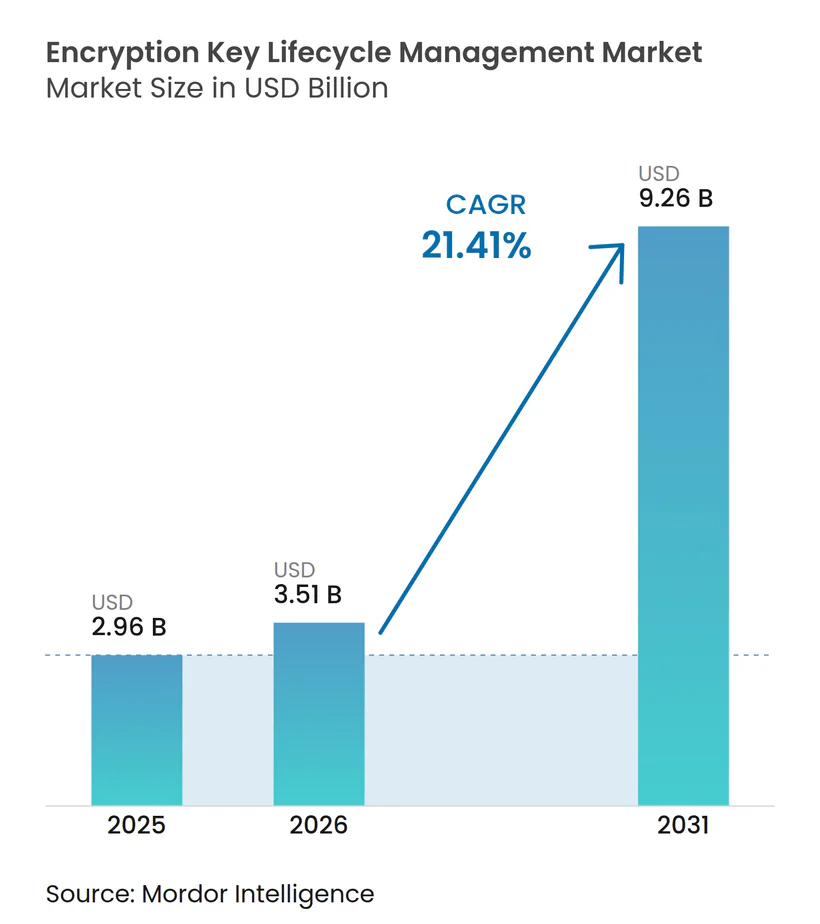
The encryption key lifecycle management market size is expected to increase from USD 2.96 billion in 2025 to USD 3.51 billion in 2026 and reach USD 9.26 billion by 2031, growing at a CAGR of 21.41% over 2026-2031. Regulatory requirements are making documented control of encryption keys a standard procurement need across regulated organizations. Multi-cloud operations are also widening the number of keys, systems, and policies that security teams must oversee. Post-quantum planning is advancing cryptographic inventory and migration efforts, even where a full transition remains years away. These conditions favor platforms that integrate key generation, storage, rotation, recovery, and audit into a single operating framework. The encryption key lifecycle management market is therefore moving toward longer compliance-led purchasing cycles rather than isolated spending after a security incident.
Key Report Takeaways
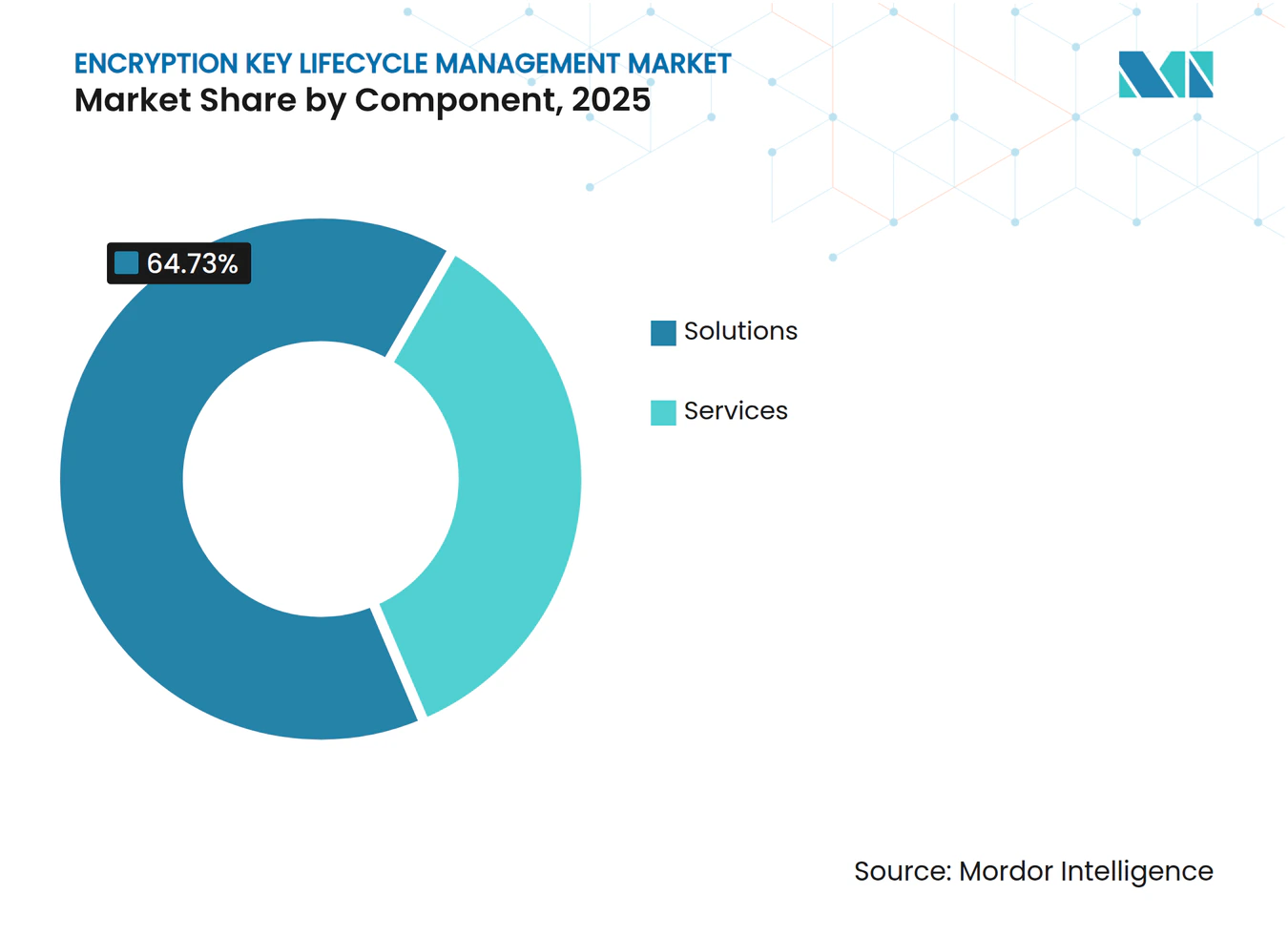
- By component, solutions held 64.73% of revenue in the encryption key lifecycle management market in 2025, while services are projected to expand at a 24.92% CAGR through 2031.
- By deployment mode, cloud accounted for 57.81% of revenue in the encryption key lifecycle management market in 2025 and is projected to grow at a 26.28% CAGR through 2031.
- By organization size, large enterprises held 69.74% of revenue in the encryption key lifecycle management market in 2025, while small and medium-sized enterprises are projected to expand at a 26.54% CAGR through 2031.
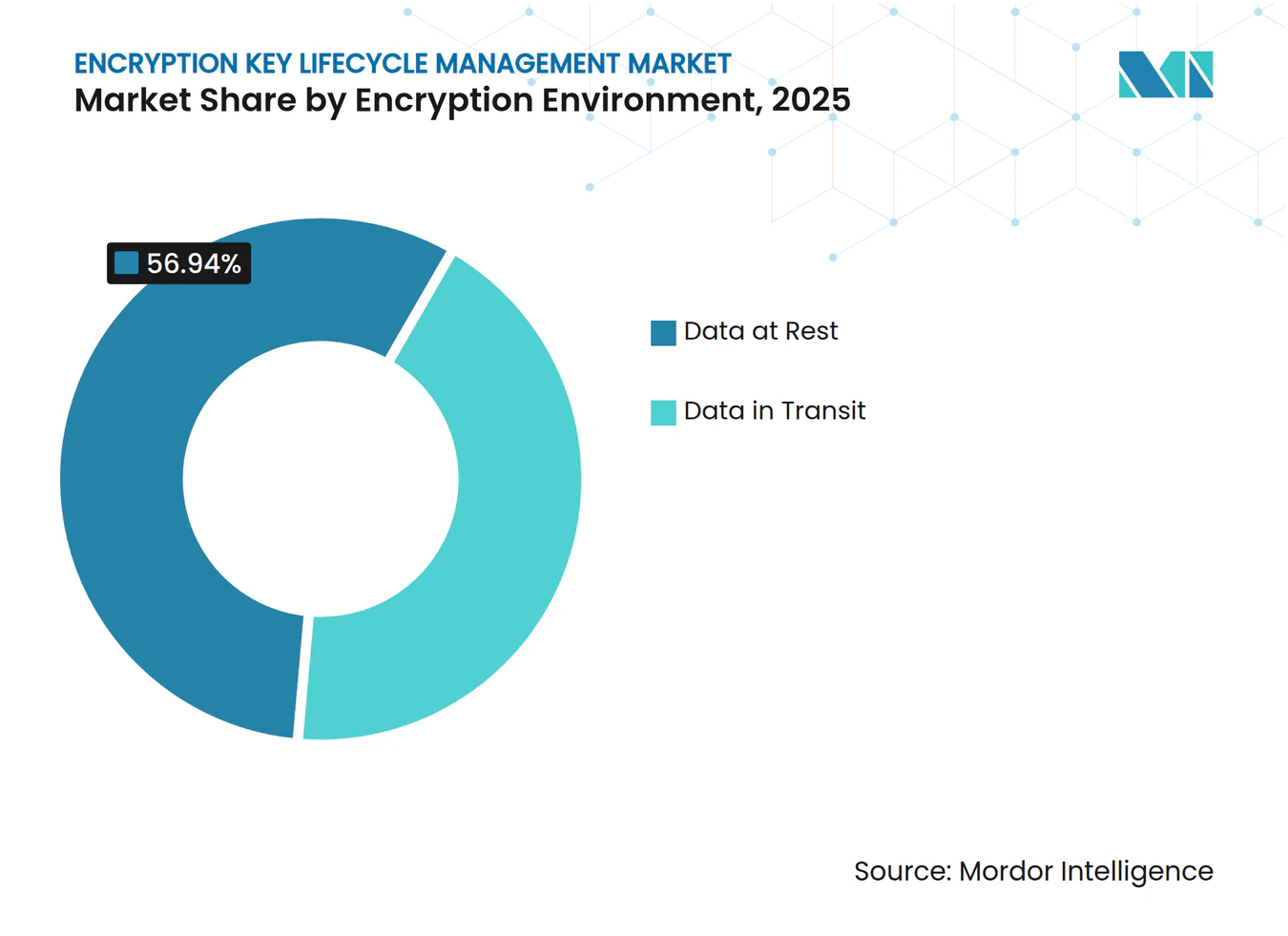
- By encryption environment, data at rest accounted for 56.94% of revenue in the encryption key lifecycle management market in 2025, while data in transit is projected to grow at a 26.32% CAGR through 2031.
- By industry vertical, BFSI accounted for 29.38% of revenue in 2025, while the government and public administration industry is projected to expand at a 27.26% CAGR through 2031.
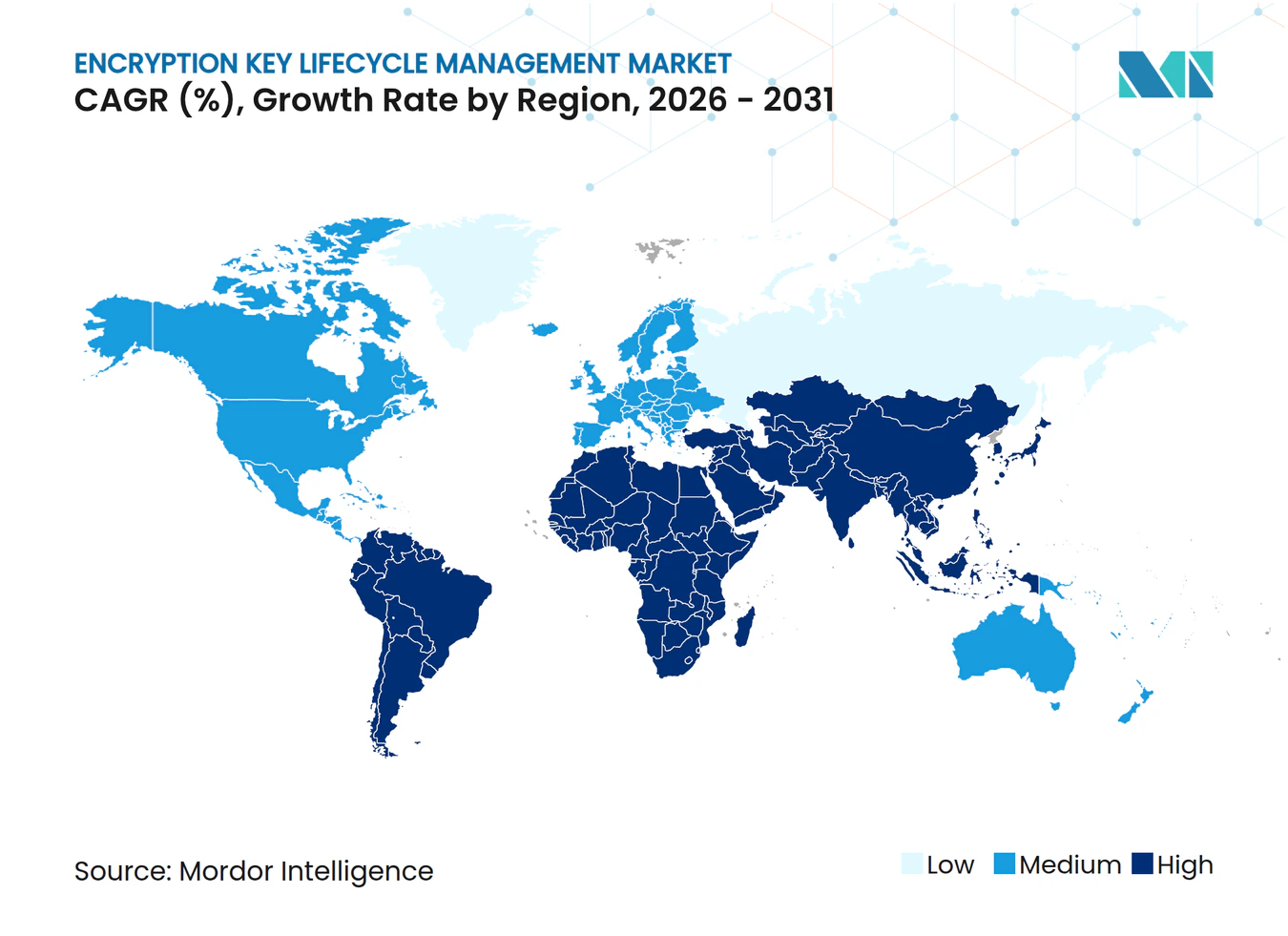
- By geography, North America accounted for 39.28% of the encryption key lifecycle management market in 2025, while Asia-Pacific is projected to expand at a 28.66% CAGR through 2031.
Note: Market size and forecast figures in this report are generated using Mordor Intelligence’s proprietary estimation framework, updated with the latest available data and insights as of January 2026.
Market Trends and Insights
Drivers Impact Analysis of Encryption Key Lifecycle Management Market*
| Driver | (~) % Impact on CAGR Forecast | Geographic Relevance | Impact Timeline |
|---|---|---|---|
| Regulatory Encryption and Data Protection Mandates | +4.8% | Global, with concentrated enforcement in North America and Europe | Medium term (2-4 years) |
| Hybrid and Multi-Cloud Expansion | +3.9% | Global, with highest intensity in North America and Asia-Pacific | Short term (≤ 2 years) |
| Escalating Ransomware and Data Breach Exposure | +3.1% | Global | Short term (≤ 2 years) |
| Post-Quantum Cryptography Readiness | +2.7% | Global, with regulatory leadership in the United States and European Union | Long term (≥ 4 years) |
| Cryptographic Asset Inventory Requirements | +1.9% | North America and Europe, with spillover to Asia-Pacific core | Medium term (2-4 years) |
| Sovereign Key Control Requirements for Cloud Workloads | +1.4% | Europe, Asia-Pacific, and the Middle East | Medium term (2-4 years) |
| Source: Mordor Intelligence | |||
Regulatory Encryption and Data Protection Mandates
PCI DSS v4.0.1 requirements became mandatory on March 31, 2025. They require auditable controls for cipher inventories, manual key operations, and key rotation schedules. The rules have made key lifecycle procedures a formal compliance issue for organizations handling cardholder data. DORA has added a related requirement for tested ICT risk and recovery processes within financial services. China also requires certified commercial cryptography in critical information infrastructure from August 2025.[1] The encryption key lifecycle management market benefits when different legal frameworks require the same evidence of controlled key use and recovery.
Hybrid and Multi-Cloud Expansion
Organizations increasingly run applications across public clouds, private data centers, and edge locations. Each environment can use different key policies, audit logs, and administrative controls. This fragmentation increases demand for centralized governance that works across infrastructure providers. BYOK and KYOK models let customers retain custody of critical key material while using cloud computing services. IBM introduced Cloud Key Protect Dedicated in March 2026 with a single-tenant KYOK design, FIPS 140-3 Level 4 HSMs, and hybrid control options. The encryption key lifecycle management market also benefits from hybrid designs, as customer-controlled HSMs can remain the root of trust for cloud-derived keys.
Escalating Ransomware and Data Breach Exposure
Ransomware incidents have increasingly involved data theft as well as service disruption. This raises the importance of controlling access to the keys that protect stored information. Microsoft documented Storm-0501 activity that abused misconfigured Azure Key Vault access, created customer-managed keys, encrypted storage accounts, and deleted the keys.[2] The case showed that a cloud key management environment can become a target when privileges and monitoring are weak. It also places greater attention on separating provisioning duties from key-access review. The encryption key lifecycle management market is gaining relevance as organizations seek controls to record, restrict, and review sensitive key actions.
Post-Quantum Cryptography Readiness
NIST issued FIPS 203, FIPS 204, and FIPS 205 in August 2024, which established core standards for post-quantum cryptography. NIST selected HQC as an additional backup algorithm in March 2025. Federal Executive Order 14412 set December 31, 2030, as the deadline for the federal key-establishment transition to approved post-quantum standards. It also directed work on a cryptographic bill of materials. Organizations must first identify where keys are generated, stored, and used before they can plan a migration. The encryption key lifecycle management market consequently receives near-term demand from discovery and inventory work, even where deployment of new algorithms will take longer.
Restraints Impact Analysis of Encryption Key Lifecycle Management Market*
| Restraint | (~) % Impact on CAGR Forecast | Geographic Relevance | Impact Timeline |
|---|---|---|---|
| Legacy System Integration Complexity | -3.2% | Global | Short term (≤ 2 years) |
| Shortage of Cryptography and Key Management Specialists | -2.4% | Global | Long term (≥ 4 years) |
| Irreversible Re-Encryption Risk During Key Migration | -1.7% | Global | Medium term (2-4 years) |
| Fragmented Ownership of Keys Across DevOps and Security Teams | -1.2% | Global | Medium term (2-4 years) |
| Source: Mordor Intelligence | |||
Legacy System Integration Complexity
Many large organizations still operate mainframes, proprietary databases, older applications, and hardware appliances. These systems often predate common interfaces for key management. KMIP provides a standard path for connecting different key management environments, but proprietary interfaces may require custom integration.[3] A migration error can make encrypted information inaccessible if re-encryption is not sequenced correctly. This risk makes internal review cycles longer in sectors with critical legacy records. The encryption key lifecycle management market, therefore, progresses more quickly among cloud-native organizations than among enterprises with older technology estates.
Shortage of Cryptography and Key Management Specialists
Modern key management requires knowledge of HSM configuration, cloud interfaces, certificate automation, audit preparation, and post-quantum planning. These capabilities are rarely held by a single internal team. NIST guidance on post-quantum key types and hybrid implementations illustrates the technical care required during migration. Limited specialist capacity slows implementation even when security budgets are available. It also leads organizations to use managed services for operational key lifecycle work. The shortage supports service demand but can limit the pace of adoption of the broader encryption key lifecycle management market.
*Our forecasts treat driver/restraint impacts as directional, not additive. The impact forecasts reflect baseline growth, mix effects, and variable interactions.
Encryption Key Lifecycle Management Market Segment Analysis
By Component:
Managed Services Support Faster AdoptionSolutions accounted for 64.73% of the encryption key lifecycle management market share in 2025. Organizations used these platforms to integrate key generation, storage, policy enforcement, and lifecycle automation into a single governance layer. Integrated platforms reduce the need to manage a separate tool for every cryptographic task. Regulated buyers also seek a root of trust supported by certified hardware. FIPS 140-3 validation remains important where procurement standards require verified cryptographic modules. Thales Trusted Cyber Technologies introduced CipherTrust Manager k160 Mk II in April 2026 for edge deployments. The appliance stored up to 10,000 symmetric keys and used a detachable HSM token for physical control. Such products extend centralized administration to remote and tactical settings. This supports demand for solutions in the encryption key lifecycle management market, where encryption controls must operate beyond a central data center.
Services are projected to expand at a 24.92% CAGR through 2031, the highest rate within the component split. Organizations often lack staff who can manage complex key rotation, certificate renewal, and audit evidence. Managed delivery can provide these functions without building a large specialist team. Entrust and IBM Consulting announced a collaboration in April 2026 for quantum-safe transformation services and the Entrust Cryptographic Security Platform. The offering brought certificates, keys, secrets, and PKI functions into a unified control model. It addressed organizations managing cryptographic assets across legacy, cloud, and development environments. Growing volumes of machine identities from AI agents increase the workload associated with certificate and key operations. This moves some procurement toward recurring managed contracts. The encryption key management industry benefits as services make advanced controls more accessible to organizations with limited internal capacity.


By Deployment Mode:
Cloud Leads While Hybrid Retains a RoleCloud accounted for 57.81% of the encryption key lifecycle management market share in 2025. It is also projected to expand to 26.28% CAGR through 2031. Cloud adoption is creating demand for centralized control rather than simply displacing on-premises tools. Workloads moved to cloud services still require a clear separation between data storage and key custody. Thales added KMIP and CipherTrust Application Key Management for Oracle Transparent Data Encryption to its platform-as-a-service in March 2026. The addition supported centralized management of database encryption keys in a SaaS model. External key store and external key management architectures also support customer-controlled designs in large cloud environments. These tools are relevant when cloud scale must be combined with independent governance.
On-premises and hybrid deployments continue to serve the financial services, defense, and critical infrastructure sectors. These users can face data residency rules, air-gap requirements, or national security obligations. An on-premises HSM can provide the root of trust in a hub-and-spoke design. Cloud control planes can then distribute derived keys to approved workloads. This arrangement allows organizations to retain installed HSM investments while extending services to cloud applications. IBM positioned its dedicated service for high-assurance workloads, including IBM PowerVS AIX and Linux, as well as SAP deployments. The Encryption key lifecycle management market has room for both models because workload sensitivity differs across the same enterprise. Hybrid use can be a practical route where a complete infrastructure transition is not appropriate. It also helps security teams apply existing compliance procedures to newer cloud services.
By Organization Size:
Enterprise Spending Remains Larger as SME Use GrowsLarge enterprises held 69.74% of the encryption key lifecycle management market share in 2025. Their scale creates extensive compliance obligations and complex multi-vendor cloud estates. Many also operate older cryptographic systems that require continued management before replacement. Procurement commonly includes certified vendor contracts, HSM refreshes, and professional services. These requirements increase average contract values for larger organizations. The European Payments Council issued guidance in 2026 on cryptographic algorithms and key management, including post-quantum recommendations for payment service providers.[4] Payment, healthcare, and government buyers are particularly likely to sustain formal compliance programs. Their demand anchors revenue for established suppliers in the encryption key lifecycle management market. Larger organizations also have more systems that need a common policy and audit coverage.
Small and medium-sized enterprises are projected to expand at a 26.54% CAGR through 2031. Cloud-delivered services reduce the need for dedicated hardware and large specialist teams. Entrust launched KeyControl as a Service in August 2024 with automated lifecycle controls, decentralized vaults, and compliance tracking. The model lowers the barrier to entry for regulated small firms. Healthcare providers and financial technology companies can use managed tools without maintaining on-premises HSM infrastructure. Managed security service providers can also package key management as part of broader compliance offerings. This channel reaches buyers who may not be able to assess standalone cryptographic platforms. The Encryption key lifecycle management market is broadening as service delivery aligns security controls with smaller operating budgets. SME growth also makes ease of deployment and support quality more important competitive factors.
By Encryption Environment:
Transit Controls Gain ImportanceData at rest accounted for 56.94% of the encryption key lifecycle management market share in 2025. Disk, database, file, and object storage encryption have become a baseline control in many regulated settings. The segment includes transparent data encryption, column-level encryption, volume protection, and multi-application key management. Together, these applications account for a substantial portion of key volume in large organizations. HSM-based roots of trust remain common for sensitive data at rest. Buyers in regulated sectors often require FIPS 140-3 Level 3 or higher assurance for the relevant hardware. The installed base creates continuing demand for rotation, policy management, and recovery controls. Data-at-rest requirements also remain central during cloud migration. Organizations need to preserve control over keys as records move between storage locations.
Data in transit is projected to expand at 26.32% CAGR through 2031. Zero-trust architecture requires mutual TLS authentication and session-specific key material for service-to-service communications. Germany's BSI guidance identified TLS 1.3 as the preferred standard for affected NIS2 organizations and did not recognize TLS 1.0 or TLS 1.1 as state-of-the-art. API-based services, containers, and AI agents are increasing the volume of encrypted sessions. These environments need automated certificate lifecycle processes because manual renewal does not scale well. The encryption key management industry is responding with tools that automate rotation and control machine credentials. This need can be especially acute in distributed application environments. Transit security also brings key management into closer contact with network, identity, and application teams. Shared controls can reduce the risk of expired certificates and inconsistent session protection.

By Industry Vertical:
BFSI Is Largest While Government AcceleratesBFSI held 29.38% market share in the encryption key lifecycle management market in 2025. The sector has long invested in HSM-backed payment keys, database encryption, and certificate infrastructure. PCI DSS requires documented processes for generating, distributing, storing, rotating, and retiring keys used with cardholder data. This produces regular spending by merchants, acquirers, processors, and financial institutions. DORA added operational resilience requirements for cryptographic recovery in European financial services. MiCA rules also reinforce the protection of private keys used in crypto-asset custody. Specialized suppliers continue to support payment encryption use cases such as ATM and point-of-sale key injection. Those use cases require certified and sometimes air-gapped hardware. The sector's established security obligations support its leading revenue position.
The government and public administration industry is projected to expand at a 27.26% CAGR through 2031. Sovereign key-control requirements are becoming enforceable rules in several jurisdictions. China's critical information infrastructure rules require approved cryptographic algorithms, products, and key mechanisms. The country also issued technical requirements for key management in quantum key distribution networks in 2026.[5] These measures favor procurement that meets local certification and sovereignty requirements. Healthcare, manufacturing, telecommunications, energy, utilities, and retail also contribute to demand. Their needs range from health data protection to operational technology segmentation and payment tokenization. The Encryption key lifecycle management market extends across these sectors as encryption becomes a standard element of cloud procurement. Government demand is likely to remain especially important where national security and critical infrastructure requirements apply.
Geography Analysis
North America Encryption Key Lifecycle Management Market
North America accounted for 39.28% of the Encryption key lifecycle management market share in 2025. The region combines dense cloud infrastructure with mature financial services compliance spending. Federal requirements under FISMA, FedRAMP, and defense information assurance shape procurement standards. Executive Order 14412 required federal agencies to transition key-establishment mechanisms to approved post-quantum standards by December 31, 2030. It also established a related deadline for covered contractors through a proposed FAR amendment. Canada adds demand through financial institutions supervised under cybersecurity frameworks aligned with NIST-oriented controls. Mexico supports regional demand as encryption obligations develop for digital payment platforms.
Europe Encryption Key Lifecycle Management Market
Europe held the second-largest regional position in 2025. GDPR, DORA, and NIS2 have placed encryption and cryptographic policy within a broader set of operational risk requirements. DORA became applicable on January 17, 2025. Germany's BSI provides technical guidance on transport encryption and algorithm selection for affected organizations. Germany, France, and the United Kingdom remain important national markets. Data sovereignty requirements support BYOK and HYOK designs that keep key custody with the customer. European specialists compete through local support, audit documentation, and data residency controls.
APAC, MEA and South America Encryption Key Lifecycle Management Market
Asia-Pacific is projected to expand at 28.66% CAGR through 2031. China is a major contributor because its rules require certification for commercial cryptography used in critical infrastructure. It's the 2026 quantum key distribution standard, broadening requirements for quantum communication infrastructure. India has documented work on a domestic quantum-safe ecosystem. Japan is also strengthening encryption expectations for classified data transmission. South America, the Middle East, and Africa remain smaller regional contributors. Brazil's LGPD supports investment in encryption, while the United Arab Emirates and Saudi Arabia are pursuing sovereign data strategies for government cloud workloads.
Competitive Landscape
Market Concentration
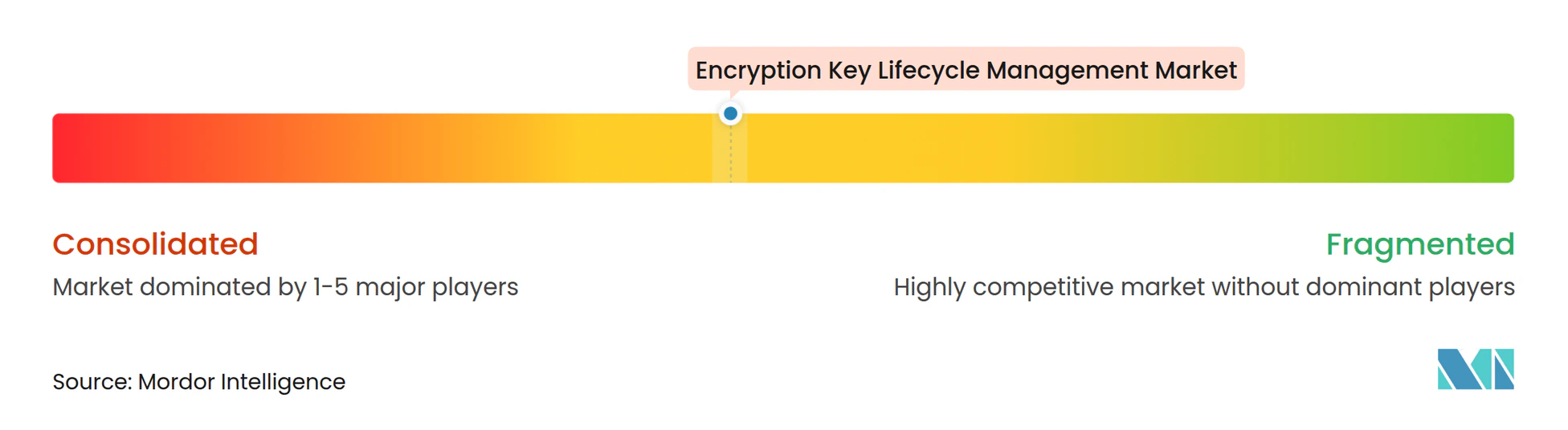
The encryption key lifecycle management market is moderately consolidated among large technology and security suppliers. Thales Group, IBM Corporation, AWS, Microsoft Corporation, and Google combine cloud integrations, HSM offerings, and enterprise compliance relationships. Entrust, Fortanix, Keyfactor, CyberArk, Utimaco, and Securosys provide specialist cryptographic capabilities and multi-cloud support. Competition increasingly centers on a unified platform for PKI, certificates, secrets, machine identities, and encryption keys. Keyfactor introduced its Trust Control Plane in June 2026 to centralize machine identity management and cryptographic governance.[6] This approach aims to reduce operational fragmentation across security teams. Incumbents have an advantage where existing compliance contracts and validated hardware create switching costs.
Thales expanded its CipherTrust platform-as-a-service in March 2026 to include KMIP and Oracle Transparent Data Encryption key management capabilities. IBM released Cloud Key Protect Dedicated in March 2026 for high-assurance cloud workloads. Entrust and IBM Consulting also combined quantum-safe transformation services with a common cryptographic control platform in April 2026. These moves show that suppliers are linking product, service, and compliance capability. The Encryption key lifecycle management market offers room for managed services, post-quantum migration support, and automated governance of cryptographic inventories. Providers that can simplify operations across legacy and cloud environments may be better positioned with regulated buyers. FIPS 140-3 validation remains a major qualification in government and regulated procurement.
Specialized providers target needs in the encryption key lifecycle management market that broad cloud platforms may underserve. StorMagic focuses on virtualized edge key management, while Crypto4A Technologies develops quantum-safe HSM architectures. ManageEngine Key Manager Plus is designed for mid-sized organizations that need simpler administration. These suppliers can compete where large appliances are too costly or cloud-native tools are difficult to adapt. Crypto-agility is another point of differentiation because it allows algorithms, protocols, and key types to change with fewer application changes. This is important as post-quantum standards enter the implementation planning phase. The encryption key management industry remains competitive because customer requirements vary by workload, jurisdiction, and assurance level. No combined share for the leading suppliers was provided, so the report does not characterize the market as highly concentrated.
Encryption Key Lifecycle Management Industry Leaders
-
Thales Group
-
International Business Machines Corporation
-
Amazon Web Services, Inc.
-
Microsoft Corporation
-
Google LLC
- *Disclaimer: Major Players sorted in no particular order
Encryption Key Lifecycle Management Market Companies Covered in this Report
- Thales Group
- International Business Machines Corporation
- Amazon Web Services, Inc.
- Microsoft Corporation
- Google LLC
- Fortanix, Inc.
- Entrust Corporation
- Oracle Corporation
- Broadcom Inc.
- Dell Technologies Inc.
- Hewlett Packard Enterprise Company
- Keyfactor, Inc.
- CyberArk Software Ltd.
- HashiCorp, Inc.
- Futurex, LP
- Utimaco GmbH
- Securosys SA
- SSH Communications Security Corporation
- WinMagic Inc.
- Virtru Corporation
- Townsend Security, Inc.
- StorMagic Limited
- OpenText Corporation
- ManageEngine, a division of Zoho Corporation Pvt. Ltd.
- Cryptomathic A/S
- Crypto4A Technologies Inc.
Recent Industry Developments in Encryption Key Lifecycle Management Market
- June 2026: The U.S. Federal Register published Executive Order 14412, “Securing the Nation Against Advanced Cryptographic Attacks,” signed June 22, 2026, mandating that federal agencies transition key-establishment protocols to NIST-approved PQC FIPS by December 31, 2030, and directing the FAR Council to extend the same deadline to covered federal contractors. The order simultaneously requires CISA and NIST to publish minimum requirements for a cryptographic bill of materials within 270 days, creating immediate demand for cryptographic asset discovery and inventory platforms.
- June 2026: Keyfactor launched the Trust Control Plane on June 9, 2026, a unified operating model consolidating machine identity management, cryptographic governance, and PKI automation into a single system with an Observe-Analyze-Provision-Orchestrate-Govern operational loop. The product targets the certificate-outage, quantum-readiness, and audit-preparedness segments and is positioned to support every machine, workload, and AI agent identity within an enterprise.
- April 2026: Entrust Corporation announced a collaboration with IBM Consulting on April 29, 2026, combining IBM Consulting's Quantum Safe Transformation Services with the Entrust Cryptographic Security Platform as a joint offering for enterprise PQC migration. The partnership delivers a unified control plane across PKI, certificates, keys, and secrets, anchored in post-quantum-compliant HSMs, and targets regulated enterprises managing cryptographic sprawl across legacy, cloud, and DevOps environments.
- April 2026: Thales Trusted Cyber Technologies launched CipherTrust Manager k160 Mk II on April 20, 2026, a compact cryptographic key management appliance for tactical edge deployments, storing up to 10,000 symmetric keys with a detachable HSM token that functions as a physical kill switch to protect mission-critical data during high-risk operations. The device integrates with the CipherTrust Data Security Platform for centralized enterprise-wide key governance.
- March 2026: Thales added KMIP and CipherTrust Application Key Management for Oracle Transparent Data Encryption to its CipherTrust Data Security Platform as a Service on March 30, 2026, allowing enterprises to centralize Oracle database encryption key management in a SaaS model that reduces operational costs and enforces compliance with GDPR, PCI DSS, and HIPAA through automated key lifecycle controls.
Global Encryption Key Lifecycle Management Market Report Scope
The encryption key lifecycle management market encompasses solutions that manage the complete lifecycle of cryptographic keys used to protect data at rest, in transit, and in use, from generation through distribution, rotation, revocation, and secure destruction. This market includes hardware security modules (HSMs), cloud key management services (KMS), and software-based key management platforms that generate cryptographically strong keys, securely store and distribute them to authorized systems, enforce automated rotation schedules, manage key versions and access policies, audit key usage, and securely retire or destroy keys when no longer needed. Solutions ensure compliance with FIPS 140-2/140-3, PCI-DSS, and other cryptographic standards; prevent key exposure and misuse; enable bring-your-own-key (BYOK) and hold-your-own-key (HYOK) models for cloud encryption; and provide centralized visibility into encryption key posture across hybrid and multi-cloud environments.
The Encryption Key Lifecycle Management Market Report is Segmented by Component (Solutions, and Services), Deployment Mode (Cloud, On-Premises, and Hybrid), Organization Size (Large Enterprises, and Small and Medium-Sized Enterprises), Encryption Environment (Data at Rest, and Data in Transit), Industry Vertical (Government and Public Administration, Industrial Manufacturing, Retail and E-Commerce, Transportation and Logistics, Energy and Utilities, Oil and Gas, IT and Telecommunication, Media and Entertainment, Education and Research Institutions, Healthcare and Life Sciences, Banking, Financial Services, and Insurance (BFSI), and Other Industry Verticals), and Geography (North America, South America, Europe, Asia-Pacific, and Middle East and Africa). The Market Forecasts are Provided in Terms of Value (USD).
Segmentation Overview
| Solutions |
| Services |
| Cloud |
| On-Premises |
| Hybrid |
| Large Enterprises |
| Small and Medium-Sized Enterprises |
| Data at Rest |
| Data in Transit |
| Government and Public Administration |
| Industrial Manufacturing |
| Retail and E-Commerce |
| Transportation and Logistics |
| Energy and Utilities |
| Oil and Gas |
| IT and Telecommunication |
| Media and Entertainment |
| Education and Research Institutions |
| Healthcare and Life Sciences |
| Banking, Financial Services, and Insurance (BFSI) |
| Other Industry Verticals |
| North America | United States | |
| Canada | ||
| South America | Brazil | |
| Argentina | ||
| Mexico | ||
| Rest of South America | ||
| Europe | Germany | |
| United Kingdom | ||
| France | ||
| Italy | ||
| BENELUX | ||
| Rest of Europe | ||
| Asia-Pacific | China | |
| Japan | ||
| India | ||
| South Korea | ||
| Australia | ||
| Rest of Asia-Pacific | ||
| Middle East and Africa | Middle East | United Arab Emirates |
| Saudi Arabia | ||
| Rest of Middle East | ||
| Africa | South Africa | |
| Nigeria | ||
| Egypt | ||
| Rest of Africa | ||
| By Component | Solutions | ||
| Services | |||
| By Deployment Mode | Cloud | ||
| On-Premises | |||
| Hybrid | |||
| By Organization Size | Large Enterprises | ||
| Small and Medium-Sized Enterprises | |||
| By Encryption Environment | Data at Rest | ||
| Data in Transit | |||
| By Industry Vertical | Government and Public Administration | ||
| Industrial Manufacturing | |||
| Retail and E-Commerce | |||
| Transportation and Logistics | |||
| Energy and Utilities | |||
| Oil and Gas | |||
| IT and Telecommunication | |||
| Media and Entertainment | |||
| Education and Research Institutions | |||
| Healthcare and Life Sciences | |||
| Banking, Financial Services, and Insurance (BFSI) | |||
| Other Industry Verticals | |||
| By Geography | North America | United States | |
| Canada | |||
| South America | Brazil | ||
| Argentina | |||
| Mexico | |||
| Rest of South America | |||
| Europe | Germany | ||
| United Kingdom | |||
| France | |||
| Italy | |||
| BENELUX | |||
| Rest of Europe | |||
| Asia-Pacific | China | ||
| Japan | |||
| India | |||
| South Korea | |||
| Australia | |||
| Rest of Asia-Pacific | |||
| Middle East and Africa | Middle East | United Arab Emirates | |
| Saudi Arabia | |||
| Rest of Middle East | |||
| Africa | South Africa | ||
| Nigeria | |||
| Egypt | |||
| Rest of Africa | |||
Key Questions Answered in the Report
What is the 2026 size of the encryption key lifecycle management market?
The encryption key lifecycle management market size is expected to increase from USD 2.96 billion in 2025 to USD 3.51 billion in 2026 and reach USD 9.26 billion by 2031, growing at a CAGR of 21.41% over 2026-2031.
What is driving demand for encryption key lifecycle management platforms?
Regulatory requirements, multi-cloud operations, ransomware exposure, and post-quantum migration planning are increasing demand for centralized controls.
Which deployment approach is growing fastest?
Cloud deployment held 57.81% of revenue in 2025 and is projected to grow at a 26.28% CAGR through 2031.
Which organizations are adopting key management services most quickly?
Small and medium-sized enterprises are projected to grow at a 26.54% CAGR as cloud-delivered services reduce hardware and staffing barriers.
Why are post-quantum standards relevant to enterprise key management?
Organizations need a full inventory of keys and cryptographic dependencies before they can migrate to NIST-approved post-quantum standards.
Which region is forecast to grow fastest through 2031?
Asia-Pacific is projected to expand at a 28.66% CAGR, supported by regulatory action and sovereign cryptography requirements.