
Employers' Liability Insurance Market Size and Share
Market Overview
| Study Period | 2020 - 2031 |
|---|---|
| Market Size (2026) | USD 13.90 Billion |
| Market Size (2031) | USD 18.10 Billion |
| Growth Rate (2026 - 2031) | 5.40 % |
| Fastest Growing Market | Asia-Pacific |
| Largest Market | Europe |
| Market Concentration | Low |
Major Players *Disclaimer: Major Players sorted in no particular order Image © Mordor Intelligence. Reuse requires attribution under CC BY 4.0. | |
Employers' Liability Insurance Market Analysis by Mordor Intelligence
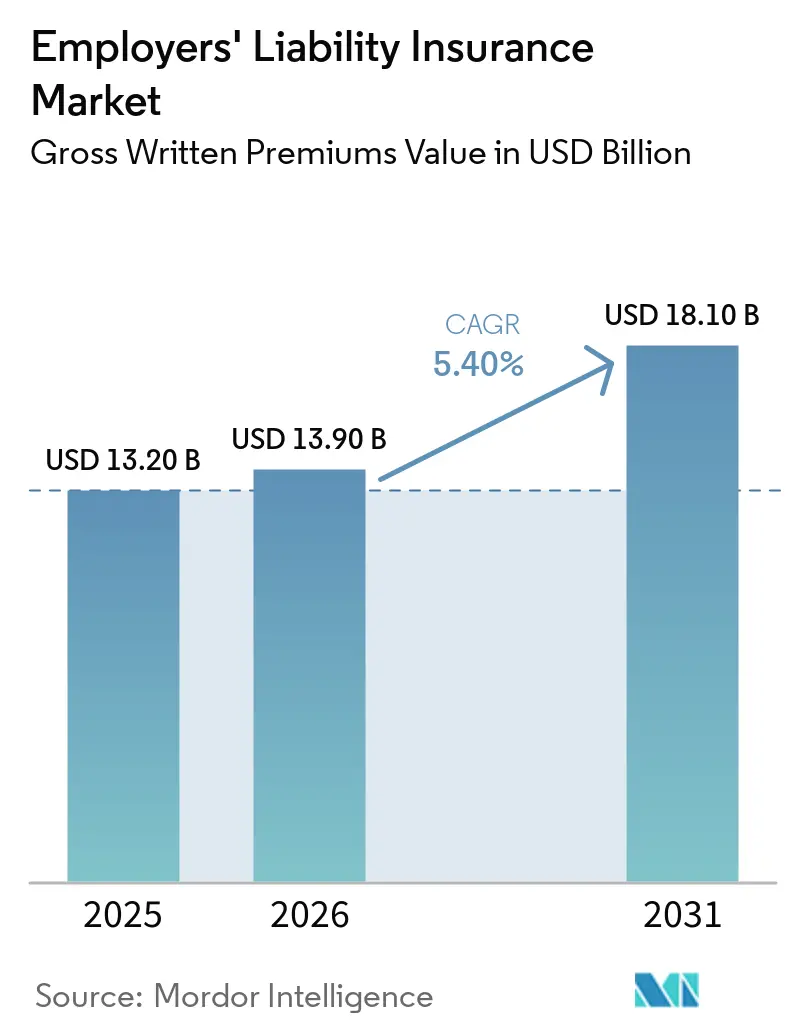
The employers' liability insurance market size was valued at USD 13.2 billion in 2025 and estimated to grow from USD 13.9 billion in 2026 to reach USD 18.1 billion by 2031, at a CAGR of 5.4% during the forecast period (2026-2031).
Mandatory cover, workplace injury exposure, and a wider formal workforce continue to support demand across established and developing economies. Employers increasingly treat this coverage as a core operating requirement rather than a discretionary purchase. The International Labour Organization estimates that 395 million workers experience nonfatal work injuries each year, which maintains a substantial underlying exposure for insurers. The United States Bureau of Labor Statistics recorded 5,070 fatal work-related injuries in the United States in 2024, showing the continuing severity of occupational risk. The employers' liability insurance market also faces higher claim costs, which encourage careful underwriting and more selective capacity deployment.
Key Report Takeaways
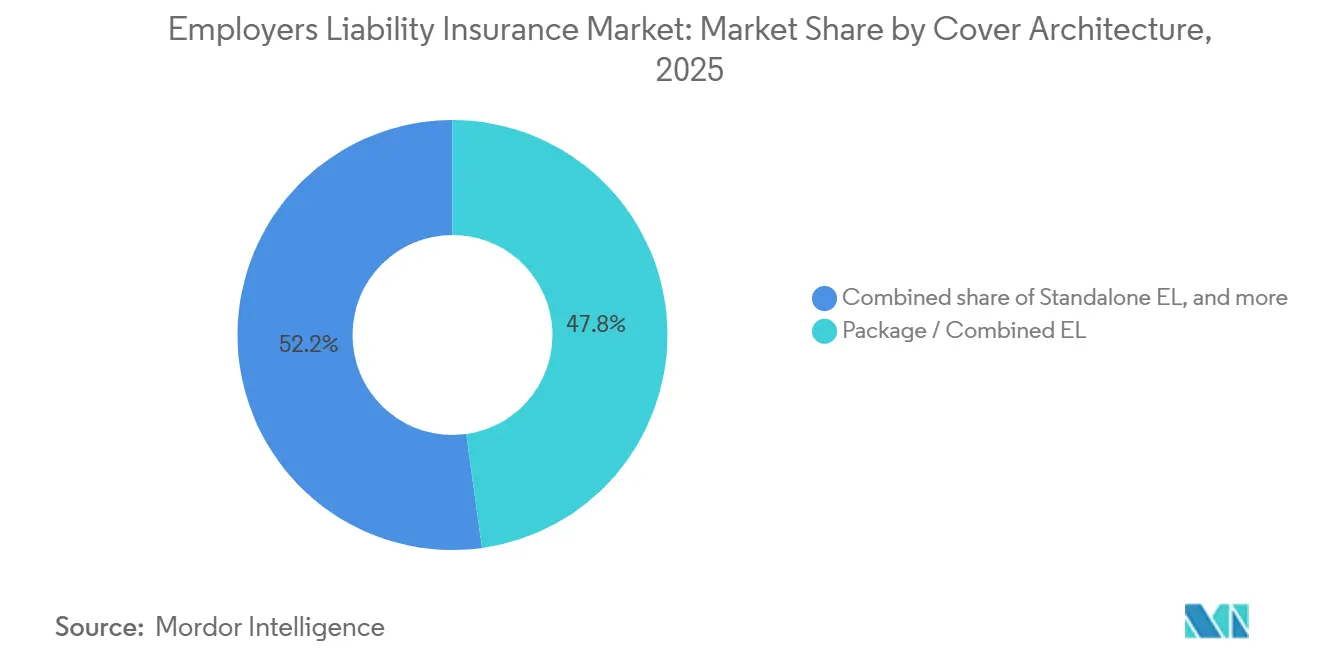
- By cover architecture, package, and combined EL captured 47.8% of the employers' liability insurance market share in 2025, while dual-trigger and stop-gap structures are projected to grow at a 7.1% CAGR through 2031.
- By insurance obligation, compulsory-insured accounts held 60.5% of the employers' liability insurance market share in 2025, while voluntary-insured accounts recorded the highest projected CAGR at 6.8% through 2031.
- By employer sector, private-sector employers accounted for 88.4% of the employers' liability insurance market share in 2025, while public-sector accounts are forecast to expand at a 6.2% CAGR through 2031.
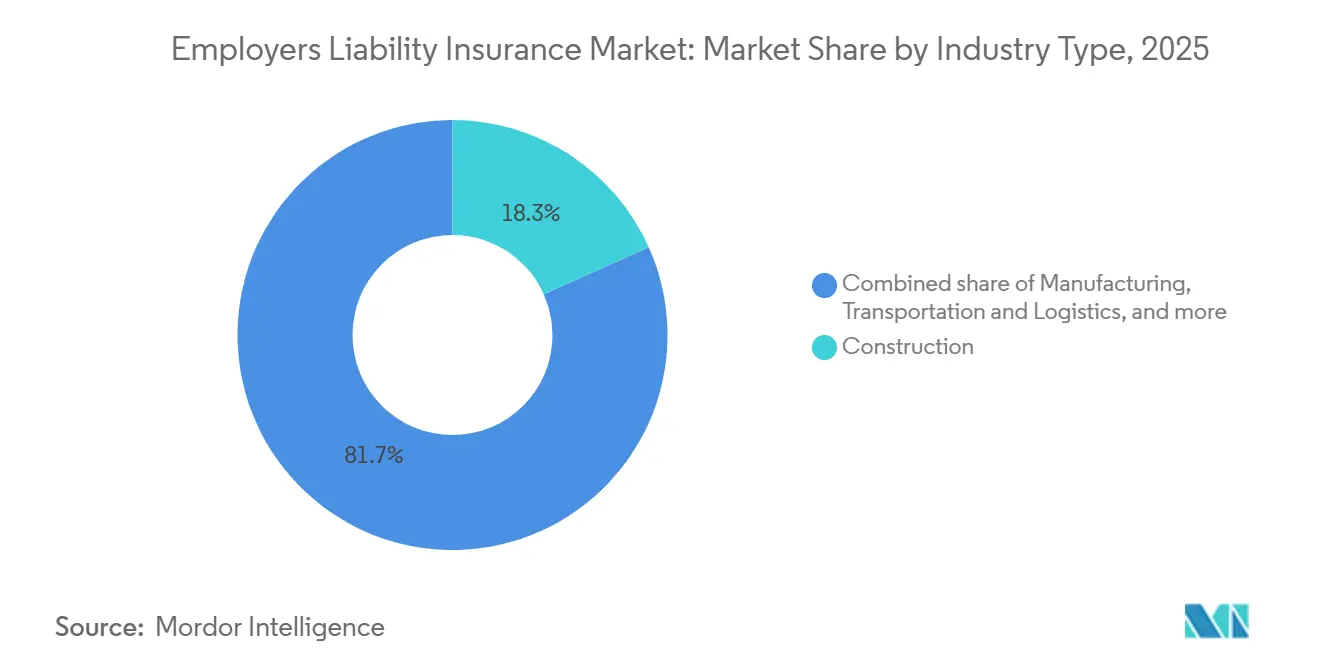
- By industry, construction held 18.3% of the employers' liability insurance market share in 2025, while healthcare and social services are projected to grow at a 7.4% CAGR through 2031.
- By customer size, large corporates accounted for 54.9% of the employers' liability insurance market share in 2025, while small and medium-sized enterprises are expected to grow at a 6.0% CAGR through 2031.
- By geography, Europe held 42.7% of the employers' liability insurance market share in 2025, while Asia-Pacific is forecast to grow at a 6.6% CAGR through 2031.
Note: Market size and forecast figures in this report are generated using Mordor Intelligence’s proprietary estimation framework, updated with the latest available data and insights as of January 2026.
Global Employers' Liability Insurance Market Trends and Insights
Drivers Impact Analysis*
| Driver | (~) % Impact on CAGR Forecast | Geographic Relevance | Impact Timeline |
|---|---|---|---|
| Mandatory Employers’ Liability Cover and Enforcement | +1.2% | Global, with concentrated enforcement in the United Kingdom, the European Union, Japan, and Australia | Short term (≤ 2 years) |
| Workplace Injury and Occupational Disease Exposure | +0.9% | Global, with high exposure in construction-heavy Asia-Pacific and industrial North America | Medium term (2-4 years) |
| Workforce Growth in Higher-Risk Sectors | +0.7% | Asia-Pacific, Middle East and Africa, and North American healthcare | Medium term (2-4 years) |
| Stronger Safety, Compensation, and Worker-Protection Rules | +0.5% | India, China, Southeast Asia, and Western Europe | Long term (≥ 4 years) |
| Higher Injury and Occupational Disease Claim Severity | +0.6% | North America, the United Kingdom, Australia, and continental Europe | Medium term (2-4 years) |
| Growth in Non-Standard and Distributed Workforces | +0.4% | Global, especially the United States, the United Kingdom, and China | Long term (≥ 4 years) |
| Source: Mordor Intelligence | |||
Mandatory Employers’ Liability Coverage and Regulatory Enforcement
Compulsory insurance laws create a direct and durable base of demand for the employers' liability insurance market. The United Kingdom Employers’ Liability (Compulsory Insurance) Act 1969 requires most employers to maintain at least GBP 5 million (USD 6.7 million) of approved cover. Employers that do not comply can face fines of GBP 2,500 (USD 3,333.3) each day. These rules cover a compliance requirement for qualifying businesses, rather than a product purchased only when risk awareness is high. Rules linked to workplace compensation and employee protection can also broaden the formal insured population over time. New entrants may have weaker safety practices, so early growth in premium volume can place pressure on margins until their claims experience develops.
Workplace Injury, Occupational Disease, and Claim Severity
Workplace injuries and occupational disease claims remain an important source of demand in the employers' liability insurance market. The Health and Safety Executive recorded 126 worker fatalities in Great Britain during 2025/26, and construction and agriculture represented more than one third of these fatalities[1]. The same source reported 2,146 mesothelioma deaths in Great Britain in 2024, leaving insurers exposed to claims associated with historical policies. In the United States, private industry reported 2,488,400 nonfatal workplace injuries in 2024, including 888,100 cases involving days away from work. Total workers’ compensation claim costs increased by an average of 6% annually from 2022 to 2025 in the median Workers Compensation Research Institute study state[2]. Higher medical payments, indemnity benefits, and claim administration expenses raise reserve needs and reinforce the need for accurate pricing.
Higher-Risk Employment and Changing Workforce Structures
Workforce expansion in construction, manufacturing, transportation, healthcare, and other higher-risk activities supports the employers' liability insurance market. These sectors combine physical work, operational pressure, and potential injury severity, which can increase the value of liability protection. Healthcare adds a separate pressure because patient handling, fatigue, and workplace violence can create both physical and psychological claims. Non-standard work arrangements also create coverage gaps when workers perform employee-like duties without a conventional employment relationship. RAND noted that people in non-standard employment may retain access to tort pathways while lacking insurance, expected to respond to those claims[3]. Product forms such as pay-as-you-go cover, occupational accident protection, and portable benefits can extend coverage to these groups, even when the premium per worker is lower than for a conventional employee group.
Safety, Compensation, and Employee-Protection Requirements
Stronger safety, compensation, and employee-protection requirements support the long-term development of the employers' liability insurance market. They raise the cost of inadequate workplace controls and place more attention on formal insurance arrangements. The International Labour Organization framework continues to connect safety management with employer responsibility for work-related harm[4]. Japan requires labor insurance for businesses with 1 or more employees, including workers’ accident compensation and employment insurance. Employers that strengthen safety systems can improve their risk profile, while insurers can use safety practices as part of underwriting decisions. This creates room for policies that recognize documented controls without reducing attention to long-tail claim exposure.
Restraints Impact Analysis*
| Restraint | (~) % Impact on CAGR Forecast | Geographic Relevance | Impact Timeline |
|---|---|---|---|
| Regulatory and Coverage Fragmentation | -0.7% | Global, particularly multinational employers across the European Union, Asia-Pacific, and North America | Long term (≥ 4 years) |
| Medical, Legal, and Compensation-Cost Inflation | -0.5% | North America, the United Kingdom, and Australia | Medium term (2-4 years) |
| Long-Tail Disease Claims and Reserve Uncertainty | -0.4% | The United Kingdom, Europe, and Australia | Long term (≥ 4 years) |
| Informal Employment, Coverage Gaps, and Weak Enforcement | -0.6% | South Asia, Southeast Asia, Sub-Saharan Africa, and parts of Latin America | Medium term (2-4 years) |
| Source: Mordor Intelligence | |||
Regulatory and Coverage Fragmentation
Regulatory fragmentation can limit the pace at which the employers' liability insurance market develops across borders. A multinational employer may face different triggers, benefits, distribution rules, and dispute processes in each jurisdiction. Japan’s compulsory labor insurance requirements illustrate the detailed local rules that employers and carriers must meet. The United States adds complexity because its workers’ compensation framework is administered through 50 distinct state systems. Insurers must therefore adapt policy design and compliance processes to local conditions instead of relying on a single global structure. Approval requirements and administration costs can slow the introduction of cross-border policy forms and limit product innovation.
Medical, Legal, Compensation Costs, and Long-Tail Uncertainty
Rising claim costs are a restraint because additional premiums can be offset by medical, legal, compensation, and reserve expenses. The California Workers’ Compensation Insurance Rating Bureau reported that medical service costs per claim increased 5% in 2025. It also reported that medical-legal costs represented 17% of total medical payments and rose 47% from 2021 to 2025. Sedgwick reported a 5.3% increase in overall claims costs during calendar year 2025, including a 6.3% increase in disability daily rates. Long-tail occupational disease claims add uncertainty because losses can emerge many years after the original exposure. Smaller carriers may reduce participation when reserves need strengthening, while larger and better-capitalized insurers can gain share.
*Our forecasts treat driver/restraint impacts as directional, not additive. The impact forecasts reflect baseline growth, mix effects, and variable interactions.
Segment Analysis
By Cover Architecture: Package Policies Lead, Dual-Trigger Structures Gain Ground
Package and combined policies held 47.8% of premiums in 2025. Mid-market and large corporate buyers use these policies to manage several liability lines within a more coordinated structure. A combined approach can reduce administrative burden and simplify policy oversight across business locations. Standalone cover retains a meaningful role in the United Kingdom and Commonwealth markets, where employers’ liability is often treated as a distinct coverage class. This structure also helps employers demonstrate compliance when a separate form of evidence is expected. The employers' liability insurance market continues to retain both bundled and standalone structures because employers' needs vary by regulation, workforce profile, and existing insurance arrangements.
Dual-trigger and stop-gap employers’ liability products remain the smallest cover architecture category by premium volume. However, their employers' liability insurance market size is projected to grow at a 7.1% CAGR through 2031. Stop-gap cover responds to gaps that can arise where United States employers self-insure or operate across jurisdictions with different workers’ compensation requirements. Dual-trigger designs are also intended to address emerging exposure from occupational stress, long-COVID work-related disability, and AI-mediated employment decisions. The United States Equal Employment Opportunity Commission recorded 88,531 charges in fiscal year 2024, a 9.2% increase, including matters linked to AI-driven hiring. Carriers that establish clear wording early may be better positioned before these policy designs become more widely standardized.
By Insurance Obligation: Voluntary Uptake Expands Beyond Compulsory Floors
Compulsory-insured accounts represented 60.5% of the 2025 premiums in the employers' liability insurance market. This position reflects statutory requirements across Europe, Japan, Australia, and parts of Latin America. The mandatory framework gives insurers a stable base of qualifying employers. The United Kingdom remains an important example because most employers must maintain legally approved cover. Japan similarly requires labor insurance for businesses employing 1 or more workers. Compulsory cover, therefore, remains central to the employers' liability insurance industry because statutory obligations determine a large share of addressable demand.
Voluntary-insured accounts are smaller but are forecast to expand at a 6.8% CAGR through 2031. Multinational employers can extend coverage terms to local workforces even where employers’ liability cover is not compulsory. These decisions are linked to governance, workforce consistency, and reputational considerations. Voluntary buyers often purchase higher limits than the minimum required by law. They can also place greater emphasis on risk management practices, which may support lower loss ratios. This portion of the employers' liability insurance industry gives carriers an opportunity to offer differentiated cover rather than compete only on statutory minimum requirements.
By Employer Sector: Private-Sector Dominance Holds, Public-Sector Demand Advances
Private-sector employers accounted for 88.4% of 2025 premiums in the employers' liability insurance market. Commercial enterprises employ much of the formal workforce across the regions covered by this assessment. Manufacturing, construction, transportation, and healthcare are largely private-sector activities with meaningful claim frequency and severity. Their payroll size and operational exposure sustain private-sector premium generation. Private employers also have varied insurance needs because they operate across different facilities, occupations, and legal environments. This broad exposure base keeps private-sector accounts central to underwriting portfolios.
Public-sector accounts are forecast to grow at a 6.2% CAGR through 2031. Government entities can be self-insured, which does not create a commercial premium, or they can place risk in the commercial market. The distinction is important for local governments and state enterprises with limited self-insurance capacity. Brazil, South Africa, and Indonesia were identified as markets where this distinction can affect commercial demand. Governments in emerging economies are also expanding employee compensation arrangements. The employers' liability insurance market may therefore gain public-sector volume where commercial placement becomes part of broader workforce protection requirements.
By Industry: Construction Anchors Premium, Healthcare Changes the Growth Mix
Construction held 18.3% of 2025 premiums and remained the largest employer sector within the employers' liability insurance market. The sector has elevated physical injury exposure that continues despite improvements in safety practice. The Health and Safety Executive recorded 25 fatal injuries in the United Kingdom construction industry during 2025/26. In the United States, 1,034 private-sector construction workers died at work in 2024. Nearly half of private-industry fatal falls occurred in construction. These conditions maintain the sector’s importance for insurers even as underwriting becomes more selective.
Healthcare and social services are forecast to expand at a 7.4% CAGR through 2031. The employers' liability insurance market size for this segment is supported by patient-handling injuries, occupational disease exposure, and labor shortages. Health care and social assistance reported 3.4 injury and illness cases per 100 full-time equivalent workers in 2024. Overexertion related to patient handling was identified as a major contributor to lost-time claims in this field. Reduced staffing can increase injury severity because fatigue affects workers performing demanding tasks. Claims connected with post-traumatic stress disorder and workplace violence add further exposure for carriers serving healthcare employers.
By Customer Size: Large Corporates Lead, Small and Medium-Sized Enterprises Add Growth
Large corporates held 54.9% of 2025 premiums in the employers' liability insurance market. Their leading position is tied primarily to payroll size and the resulting premium base. Businesses with annual revenue above USD 50 million were used broadly to define this customer group. Large employers can operate across multiple sites and jurisdictions, which can require more complex coverage programs. These companies also seek higher limits and coordinated policy management. Their scale makes them a core revenue source for insurers serving commercial liability risks.
Small and medium-sized enterprises are forecast to grow at a 6.0% CAGR through 2031. Hiscox found that 74% of surveyed small businesses worldwide were underinsured, while 55% may have had a protection gap involving missing core covers, including employers’ liability. The finding was based on responses from 6,250 business owners in the United Kingdom, the United States, France, Germany, Spain, and Portugal. Simplified modular policies can help address the administrative complexity facing smaller employers. Digital brokers and payroll or human resources platforms may also improve distribution for this group. The employers' liability insurance market has an opportunity to reach these buyers when policy design and access are easier to understand.
Geography Analysis
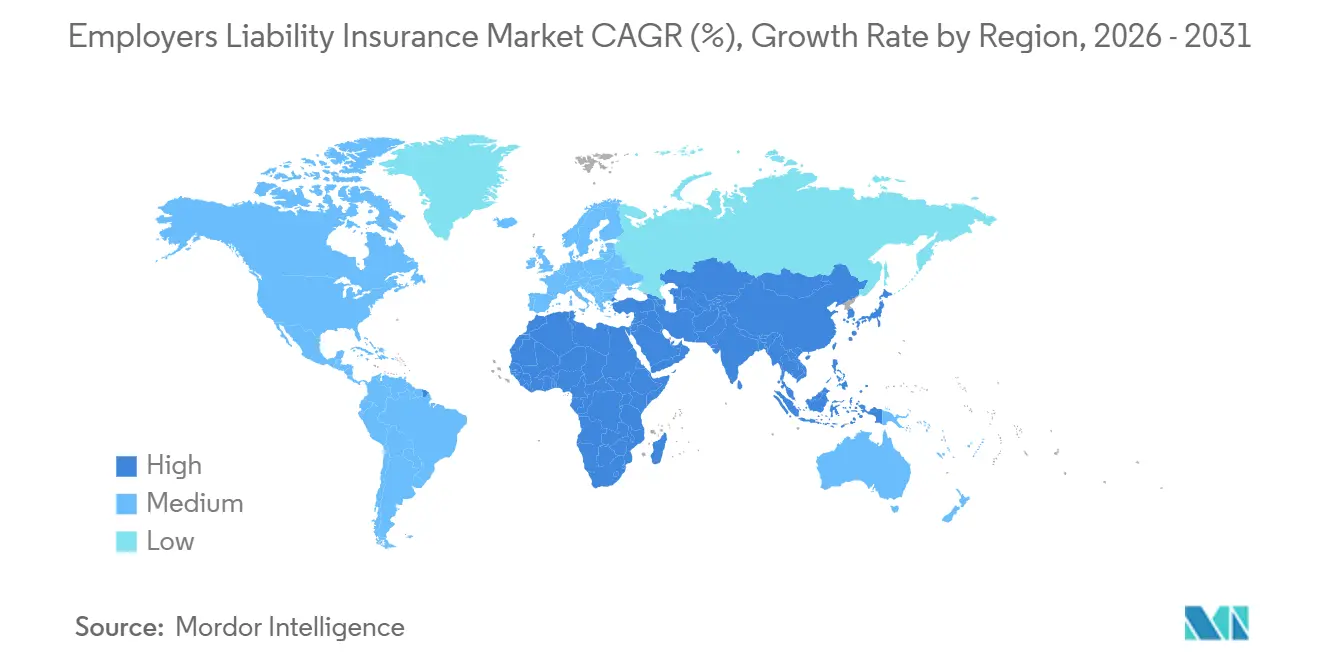
Europe held 42.7% of global premiums in 2025, giving it the largest regional share. The United Kingdom’s compulsory framework, Germany’s statutory accident insurance system, and France’s workers’ compensation arrangements provide a firm regional base. The United Kingdom Employers’ Liability (Compulsory Insurance) Act 1969 and the Health and Safety at Work etc. Act 1974 define important aspects of employer responsibility and insurance expectations. The Health and Safety Executive recorded 126 worker fatalities in Great Britain during 2025/26, and construction and agriculture accounted for more than one third of them. Germany, France, Italy, Spain, and Central and Eastern European countries add regional premium volume through comparable worker-protection systems.
Europe also faces continuing long-tail exposure from historic asbestos-related claims, with Great Britain recording 2,146 mesothelioma deaths in 2024. These claims can remain attached to older employers’ liability policies for many years. North America is the second-largest region and has the most litigious operating environment in the employers' liability insurance market. The United States reported 2,488,400 nonfatal private-industry workplace injuries in 2024, and its 50 separate state workers’ compensation systems create complex benefit, medical-fee, and dispute-resolution requirements. Canada uses comparable compulsory structures by province, while Mexico’s expanding manufacturing base supports additional demand.
Asia-Pacific is projected to grow at a 6.6% CAGR through 2031, giving the region the fastest growth rate. Its employers' liability insurance market size is supported by labor-law formalization, industrial workforce growth, and stronger enforcement. Japan requires labor insurance for businesses with 1 or more employees. Australia, Singapore, and South Korea maintain developed compulsory systems, while Vietnam, Indonesia, Thailand, and Malaysia are tightening enforcement. The Middle East and Africa hold the smallest regional share, with Saudi Arabia, the United Arab Emirates, Turkey, South Africa, and Egypt identified as key countries, and workforce protection obligations linked to economic diversification support its longer-term potential.
Competitive Landscape
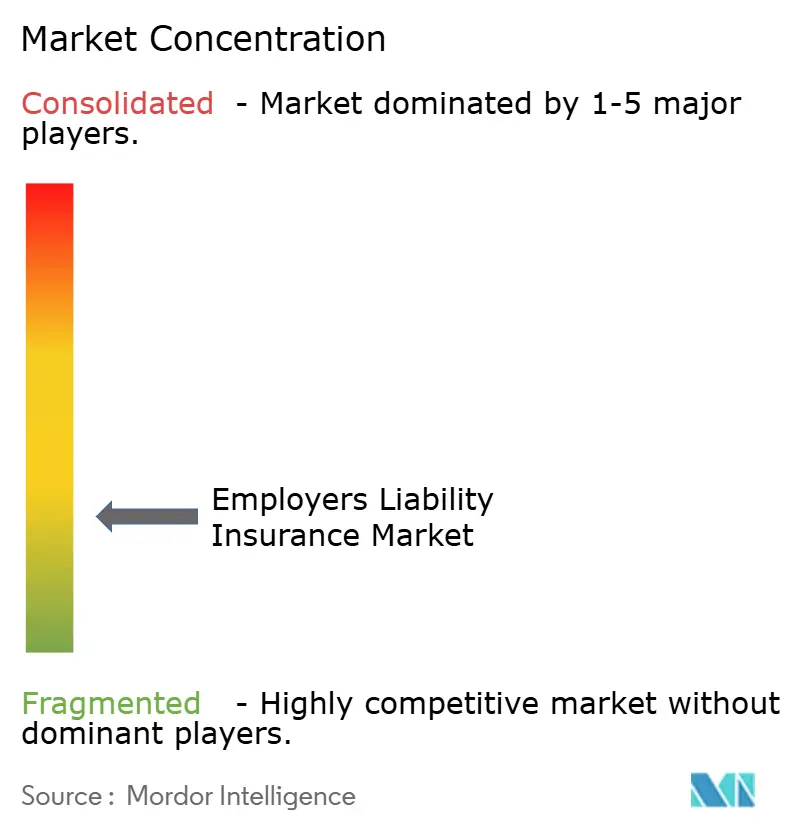
The employers' liability insurance market is fragmented among multinational insurers and a wider group of regional specialists. Chubb, Zurich Insurance Group, AXA, Allianz, Liberty Mutual, and The Travelers Companies hold important positions in compulsory and regulated insurance markets. Lloyd’s syndicates and domestic insurers remain competitive in individual geographies and employer sectors. The market includes direct insurers as well as reinsurers that provide capacity and loss transfer. Munich Reinsurance Company is relevant as a reinsurer because its role can influence pricing and risk transfer, while Markel Group, Hiscox, and AmTrust provide relevant specialty capacity for construction, small and medium-sized enterprises, and non-standard risks.
Carrier strategies in 2025 and 2026 focus on capacity, underwriting capability, and specialty expansion. In May 2025, Chubb, Zurich North America, and National Indemnity introduced a joint excess casualty facility with up to USD 100 million of lead excess casualty capacity per risk. The facility was designed to offer stable high-limit capacity while litigation volatility affects buyers and insurers. Chubb stated that litigation cost inflation was raising insurance costs by 7% to 9% annually in 2025, which encourages carriers to collaborate on higher-limit risk while retaining discipline on individual accounts. The employers' liability insurance market is therefore shaped by both the need for capacity and the need to control exposure to severe losses.
Technology is improving underwriting precision rather than replacing human judgment in the employers' liability insurance market. Shepherd and Brickeye announced a June 2026 partnership to incorporate real-time job-site data into underwriting models for construction risks. The arrangement supports physical risk assessment and can link better premium terms with documented risk controls. Allianz Commercial appointed Mary Ann Stewart as Regional Head of Liability for North America in September 2025. Insurers are also using ISO 45001 and International Labour Organization occupational safety frameworks as indicators of risk quality, supporting safety-linked pricing for lower-frequency and lower-severity employers.
Employers' Liability Insurance Industry Leaders
-
Chubb Limited
-
American International Group, Inc.
-
Zurich Insurance Group Ltd.
-
Allianz SE
-
AXA SA
- *Disclaimer: Major Players sorted in no particular order
Recent Industry Developments
- March 2026: The United Kingdom Health and Safety Executive’s provisional statistics for 2025/26 recorded 126 fatal injuries to workers and 13,000 estimated annual deaths attributable to occupational lung disease and cancer. The data continues to underscore the long-tail liability burden on employers' liability insurers with historic books in Great Britain’s industrial sectors, particularly construction and manufacturing.
- November 2025: Hiscox published its first Global Protection Gap Report, drawing on responses from 6,250 business owners across 6 countries, which found that 74% of small and medium-sized enterprises worldwide remain underinsured and 55% may have a protection gap, including employers' liability cover. The report identified limited understanding of coverage requirements and infrequent policy reviews as the primary drivers of underinsurance, findings with direct implications for product design and digital distribution strategies in the employers' liability insurance market, small and medium-sized enterprise segment.
- September 2025: Allianz Commercial appointed Mary Ann Stewart as Regional Head of Liability, North America, effective September 22, 2025, signaling a strategic reallocation of senior underwriting leadership toward casualty and employers' liability lines amid rising claim severity in the United States.
- May 2025: Chubb, Zurich North America, and National Indemnity jointly launched a new excess casualty insurance facility capable of providing up to USD 100 million in lead excess casualty capacity on a claims-made basis for large national and multinational companies. The facility was created to address market demand for stable, high-limit excess coverage amid ongoing social inflation and litigation volatility in North American liability markets.
Global Employers' Liability Insurance Market Report Scope
| Standalone EL |
| Package / Combined EL |
| Dual-Trigger and Stop-Gap EL |
| Compulsory Insured |
| Voluntary Insured |
| Private-Sector Employers |
| Public-Sector Employers |
| Construction |
| Manufacturing |
| Transportation and Logistics |
| Healthcare and Social Services |
| Wholesale and Retail Trade |
| Professional, Scientific, and Technical Services |
| Information and Communications |
| Administrative and Support Services |
| Education |
| Financial and Insurance Services |
| Real Estate, Utilities, and Other Industries |
| SMEs |
| Large Corporates |
| North America | United States |
| Canada | |
| Mexico | |
| South America | Brazil |
| Argentina | |
| Rest of South America | |
| Europe | United Kingdom |
| Germany | |
| France | |
| Italy | |
| Spain | |
| Rest of Europe | |
| Asia-Pacific | China |
| Japan | |
| India | |
| South Korea | |
| Australia | |
| Indonesia | |
| Thailand | |
| Malaysia | |
| Singapore | |
| Vietnam | |
| Rest of Asia-Pacific | |
| Middle East and Africa | Saudi Arabia |
| United Arab Emirates | |
| Turkey | |
| South Africa | |
| Egypt | |
| Rest of Middle East and Africa |
| By Cover Architecture | Standalone EL | |
| Package / Combined EL | ||
| Dual-Trigger and Stop-Gap EL | ||
| By Insurance Obligation | Compulsory Insured | |
| Voluntary Insured | ||
| By Employer Sector | Private-Sector Employers | |
| Public-Sector Employers | ||
| By Industry Type | Construction | |
| Manufacturing | ||
| Transportation and Logistics | ||
| Healthcare and Social Services | ||
| Wholesale and Retail Trade | ||
| Professional, Scientific, and Technical Services | ||
| Information and Communications | ||
| Administrative and Support Services | ||
| Education | ||
| Financial and Insurance Services | ||
| Real Estate, Utilities, and Other Industries | ||
| By Customer Size | SMEs | |
| Large Corporates | ||
| By Geography | North America | United States |
| Canada | ||
| Mexico | ||
| South America | Brazil | |
| Argentina | ||
| Rest of South America | ||
| Europe | United Kingdom | |
| Germany | ||
| France | ||
| Italy | ||
| Spain | ||
| Rest of Europe | ||
| Asia-Pacific | China | |
| Japan | ||
| India | ||
| South Korea | ||
| Australia | ||
| Indonesia | ||
| Thailand | ||
| Malaysia | ||
| Singapore | ||
| Vietnam | ||
| Rest of Asia-Pacific | ||
| Middle East and Africa | Saudi Arabia | |
| United Arab Emirates | ||
| Turkey | ||
| South Africa | ||
| Egypt | ||
| Rest of Middle East and Africa | ||
Key Questions Answered in the Report
What is the projected value of the employers liability insurance market by 2031?
The market is forecast to reach USD 18.1 billion by 2031, from USD 13.9 billion in 2026, at a 5.4% CAGR.
Which cover architecture leads global premiums?
Package and combined policies led with 47.8% of 2025 premiums, while dual-trigger and stop-gap structures are forecast to grow at 7.1% CAGR through 2031.
Why is Europe important for employers’ liability cover?
Europe held 42.7% of global premiums in 2025, supported by compulsory insurance and established worker-protection frameworks.
Which region is growing fastest through 2031?
Asia-Pacific is expected to record the fastest regional growth at a 6.6% CAGR through 2031.
Which employer sector is the largest buyer of employers’ liability cover?
Private-sector employers accounted for 88.4% of global premiums in 2025 because commercial enterprises employ much of the formal workforce.
What is driving small and medium-sized enterprise demand?
Small and medium-sized enterprises are forecast to grow at 6.0% CAGR, supported by underinsurance gaps and the need for simpler policy distribution.