
Electronic Hydrofluoric Acid Market Size and Share
Market Overview
| Study Period | 2022 - 2032 |
|---|---|
| Market Size (2027) | USD 1.55 Billion |
| Market Size (2032) | USD 2.08 Billion |
| Growth Rate (2027 - 2032) | 6.12 % |
| Fastest Growing Market | Asia-Pacific |
| Largest Market | Asia-Pacific |
| Market Concentration | Medium |
Major Players *Disclaimer: Major Players sorted in no particular order Image © Mordor Intelligence. Reuse requires attribution under CC BY 4.0. | |
Electronic Hydrofluoric Acid Market Analysis by Mordor Intelligence
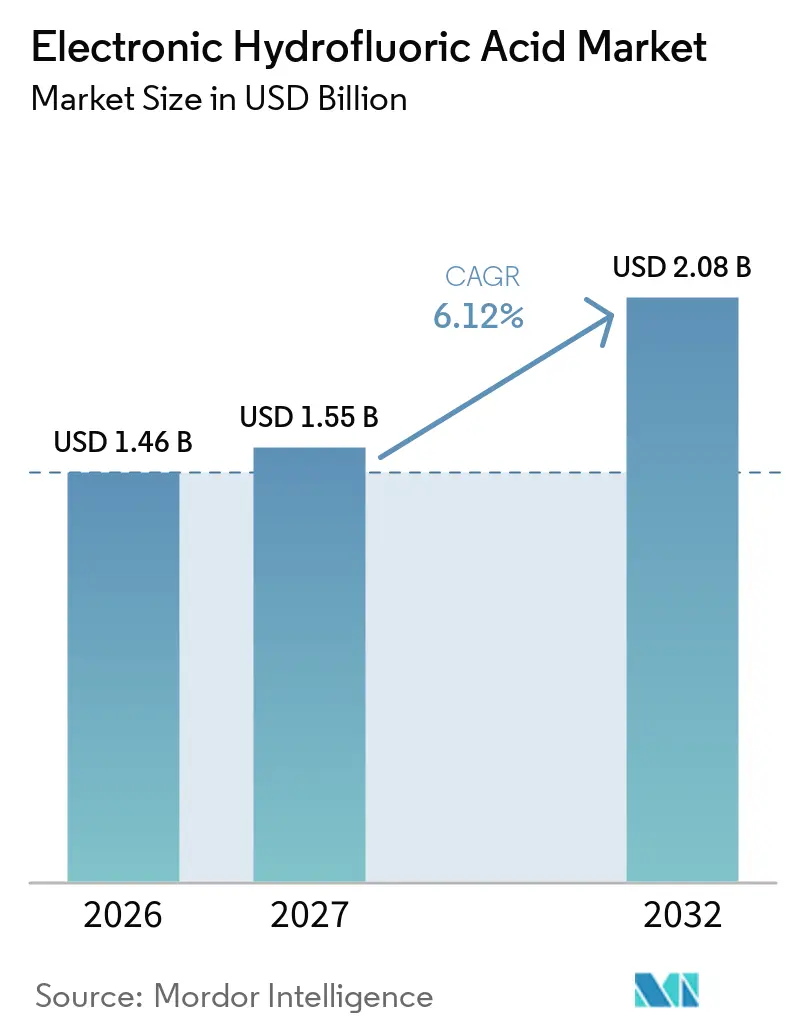
The electronic hydrofluoric acid market size was valued at USD 1.46 billion in 2026 and is estimated to grow from USD 1.55 billion in 2027 to USD 2.08 billion by 2032, at a CAGR of 6.12% during the forecast period (2027-2032). Investment in front-end wafer fabrication is expanding the electronic hydrofluoric acid market, as each wafer start requires qualified process chemicals for repeated cleaning, etching, and surface preparation operations within tightly controlled manufacturing lines. Solar cell and display production further support market growth, where cleaner silicon surfaces raise chemical specifications and increase the importance of purification, packaging, transport, and supplier approval for plant operators, particularly when equipment yields depend on repeatable surface preparation. Manufacturers require chemical suppliers that can maintain quality through growing production output, varied operating conditions, and increasingly detailed customer quality reviews. Supply decisions are increasingly shaped by raw material exposure, lengthy customer qualification processes, and the need to locate purification capacity closer to fabrication facilities, as customers seek dependable supply, lower logistics exposure, stronger process control, and a clear path to recycle fluorine-containing materials after use. The distinction between established high-purity suppliers and firms serving lower-grade applications remains significant, as customer approval depends on repeated evidence of chemical consistency rather than stated expansion plans or installed nameplate capacity alone.
Key Report Takeaways
- By grade, Ultra-Pure Super Special Grade held 33.45% of the electronic hydrofluoric acid market share in 2026, while Ultra-Pure Super Special-Special Grade is forecast to expand at a 6.56% CAGR through 2032.
- By type, Fluorite-Based production accounted for 70.13% of the electronic hydrofluoric acid market share in 2026 and is forecast to expand at a 6.83% CAGR through 2032.
- By application, Semiconductor Wafers captured 59.21% of the electronic hydrofluoric acid market share in 2026 and are forecast to expand at a 7.11% CAGR through 2032.
- By geography, Asia-Pacific held 63.78% of the electronic hydrofluoric acid market share in 2026 and is forecast to grow at a 6.89% CAGR through 2032.
Note: Market numbers in this report are based on Mordor Intelligence's proprietary estimation framework, which combines nine months of actuals with Q4 projections for base year 2026.
Global Electronic Hydrofluoric Acid Market Trends and Insights
Drivers Impact Analysis*
| Drivers | (~) % Impact on CAGR Forecast | Geographic Relevance | Impact Timeline |
|---|---|---|---|
| Semiconductor Fab Capacity Expansion | +2.10% | Global, with concentrated gains in Taiwan, South Korea, Japan, China, and the Americas | Short term (≤ 2 years) |
| Migration to Sub-3 Nanometer and 3D Device Architectures | +1.50% | Asia-Pacific core, including Taiwan, South Korea, and Japan, with spillover to the United States | Medium term (2-4 years) |
| Photovoltaic Wafer Efficiency and Capacity Expansion | +0.90% | China, Southeast Asia, India, and the United States | Short term (≤ 2 years) |
| Localization of Strategic Electronic Chemicals | +0.80% | North America, Europe, Japan, and early gains in India | Long term (≥ 4 years) |
| Fab-Adjacent Purification and Closed-Loop Recovery | +0.60% | Global, initially Asia-Pacific, and expanding to Western fabs | Medium term (2-4 years) |
| Source: Mordor Intelligence | |||
Semiconductor Fab Capacity Expansion
Global fab construction provides the electronic hydrofluoric acid market with a stable demand base, as fabs qualify specific chemical suppliers for individual processes. SEMI identified 18 new fab projects expected to start construction in 2025, including 3 facilities using 200 mm wafers and 15 using 300 mm wafers. Most of these sites were expected to begin operations in 2026 and 2027, linking construction activity to future chemical consumption. SEMI also projected advanced-node capacity at 7 nm and below to grow 16.00% in 2025, adding more than 300,000 wafers per month of capacity. This capacity requires chemical suppliers to maintain consistent purity and delivery performance over long production cycles, as any change in chemical quality can disrupt a process already validated for a specific device generation.
The geographic distribution of new projects is expanding chemical demand beyond its historical concentration in East Asia. SEMI recorded 4 planned construction starts in the Americas, 4 in Japan, 3 in China, 3 in Europe and the Middle East, 2 in Taiwan, 1 in Korea, and 1 in Southeast Asia during 2025. The electronic hydrofluoric acid market, therefore, faces growing requirements for specialist transport, localized storage, and responsive purification near emerging fab clusters. Suppliers must protect material integrity from the production site through delivery, storage, final handling, and use in highly sensitive manufacturing equipment. Domestic-content requirements under national chip programs strengthen the position of producers located close to semiconductor customers, particularly where chemical deliveries must meet local safety regulations, stringent handling practices, and customer-specific purity specifications.
Migration to Sub-3 Nanometer and 3D Device Architectures
Sub-3 nm logic and high-layer-count 3D NAND raise purity requirements because trace-metal contamination can reduce yields across a production batch. SEMI projected investment in logic and micro equipment to reach USD 52 billion in 2025 and USD 59 billion in 2026, as 2 nm technologies and backside power delivery entered production. The electronic hydrofluoric acid market benefits from this shift, as advanced device structures require additional cleaning and etching steps. Tokyo Electron identified demanding etch requirements in 3D NAND, DRAM, and logic, including high aspect ratios, precise process control, and low-damage processing. These requirements favor suppliers that can hold tight contamination specifications at commercial scale while demonstrating reproducible batch quality, secure container management, and continuity during extended qualification periods. Leading fabs evaluate material properties under different production conditions before approving a chemical for a manufacturing line and continue to review its performance as product designs, process steps, and capacity utilization change over time.
Cryo-etching represents an additional application for ultra-high-purity hydrogen fluoride (HF) gas. Central Glass began selling improved HF gas for cryo-etching at a purity above 99.999% in January 2025. The company stated that several semiconductor manufacturers in Japan and overseas had adopted cryo-etching for mass production and that demand was expected to rise quickly by 2026[1]. Central Glass planned to more than double HF gas production capacity at its Ube Plant to several hundred tons. This expands the addressable demand pool while reinforcing the value of high-purity fluorine chemistry, particularly for suppliers capable of developing, producing, and delivering specialized gases alongside established liquid chemical products.
Photovoltaic Wafer Efficiency and Capacity Expansion
Higher-efficiency photovoltaic architectures require cleaner silicon surface preparation than conventional Passivated Emitter and Rear Cell (PERC) cells. Tunnel Oxide Passivated Contact (TOPCon), heterojunction technology, and emerging perovskite-silicon tandem designs consequently support demand for better-controlled hydrofluoric acid in wafer texturing and cleaning. Heterojunction cells depend on very clean surface passivation to achieve their intended efficiency performance. This creates a solar demand profile that increasingly favors higher purity grades over standard process chemical inputs, as surface preparation becomes more closely tied to device performance when manufacturers adopt more complex cell architectures. The electronic hydrofluoric acid market benefits where solar manufacturers increase both capacity and process sophistication, as greater attention to wafer texture, cleaning quality, and surface passivation makes acid purity a more significant element of process control than in earlier cell designs.
N-type wafer technologies, including TOPCon, Heterojunction Technology (HJT), and back-contact cells, are displacing P-type technologies in the solar equipment mix, supporting greater attention to surface conditions during cell manufacturing. China remains the main center of solar manufacturing, making domestic HF supply decisions important for global photovoltaic chemical demand and giving local producers a key role in the availability of lower- and mid-purity grades. This concentration also means that changes in cell technology, factory utilization, and procurement practices can quickly influence the balance between domestic supply, imports, and demand for more tightly specified chemical grades.
Localization of Strategic Electronic Chemicals
Ultra-high-purity hydrofluoric acid has become a supply chain security concern for chipmakers and governments. New fab locations require reliable access to process chemicals with stable quality, secure logistics, and customer-approved specifications. The electronic hydrofluoric acid market is affected by the distance between Asian supply bases and newer semiconductor sites in North America and Europe. Programs such as the CHIPS and Science Act and the EU Chips Act encourage local manufacturing and can support chemical suppliers that establish nearby operations. Localization also leads customers to assess purification and recovery capabilities alongside delivered product quality, as long-distance transport poses risks for a hazardous chemical whose final specification must remain stable upon reaching the fab.
At SEMICON Taiwan 2025, GlobalWafers identified critical materials as a priority alongside capacity and process technology. This aligns with the broader need to secure materials for advanced semiconductor production. These efforts create opportunities for qualified regional suppliers. However, long qualification cycles remain a barrier to fast supply substitution, as semiconductor customers must validate purity, consistency, logistics, safety controls, and process performance before approving a new source.
Restraints Impact Analysis*
| Restraints | (~) % Impact on CAGR Forecast | Geographic Relevance | Impact Timeline |
|---|---|---|---|
| Extreme Toxicity, Corrosivity, and Compliance Cost | -1.20% | Global, most acute in North America and Europe, with strict OSHA and EPCRA requirements | Short term (≤ 2 years) |
| Fluorspar Availability and Export-Control Exposure | -1.00% | Global upstream, most acute for non-Chinese producers without integrated fluorspar access | Medium term (2-4 years) |
| High Purification, Packaging, and Qualification Cost | -0.70% | Global, with a disproportionate effect in the Americas and Europe, where operating costs exceed Asia-Pacific levels | Long term (≥ 4 years) |
| Source: Mordor Intelligence | |||
Extreme Toxicity, Corrosivity, and Compliance Cost
Hydrofluoric acid safety requirements create an ongoing compliance burden for producers, transporters, and fab operators. Hydrogen fluoride is subject to reporting and emergency-planning obligations in the United States under the Emergency Planning and Community Right-to-Know Act (EPCRA). The electronic hydrofluoric acid market must account for specialist handling, protective systems, training, transport controls, and emergency response. In 2025, the U.S. Chemical Safety and Hazard Investigation Board released its final report on three serious hydrogen fluoride incidents at Honeywell Performance Materials and Technologies in Geismar, Louisiana. The incidents occurred between October 2021 and June 2024 and revealed systemic safety failures at the facility[2].
OSHA issued updated semiconductor hazard guidance in January 2025, noting that exposure limits for some process chemicals may be outdated or inadequate. This regulatory environment raises the cost of operating high-purity HF facilities, particularly in North America and Europe, where emergency response planning, worker protection, equipment integrity, and detailed reporting can become significant parts of the operating model. Producers must maintain systems that protect workers, nearby communities, and customers throughout chemical handling activities. Smaller firms face a heavier compliance cost burden because compliance systems do not scale easily. Each facility still requires trained personnel, documented procedures, specialized equipment, monitoring systems, transport safeguards, and a credible plan for responding to a release or handling incident. These costs can restrict entry into the highest-purity tiers and slow efforts to broaden supply beyond established Asian sources. Safety capability, therefore, remains part of supplier qualification, not simply a site-level operating requirement.
Fluorspar Availability and Export-Control Exposure
Acid-grade fluorspar is the primary raw material for anhydrous hydrofluoric acid (HF) and remains a central supply risk for the electronic hydrofluoric acid market. Fluorspar supply remains geographically concentrated, while domestic demand from fluoropolymers, new-energy materials, and semiconductor chemicals continues to grow. Domestic requirements can absorb a growing share of available fluorspar supply, adding uncertainty for producers that depend on external sources. This creates input-cost uncertainty for producers without stable access to high-quality fluorspar and makes contract planning more difficult for customers that need secure quantities of advanced electronic chemicals over multiple years. The risk is particularly relevant in advanced applications, where alternative chemical sources cannot be substituted quickly without a fresh program of testing and qualification at the customer site. Even when another producer has sufficient capacity, chemical performance must be verified on the customer's equipment, under process conditions, and against yield requirements before the replacement can become a dependable part of routine high-volume production.
*Our forecasts treat driver/restraint impacts as directional, not additive. The impact forecasts reflect baseline growth, mix effects, and variable interactions.
Segment Analysis
By Grade: Ultra-Pure Super Special Grade Anchors Advanced-Node Economics
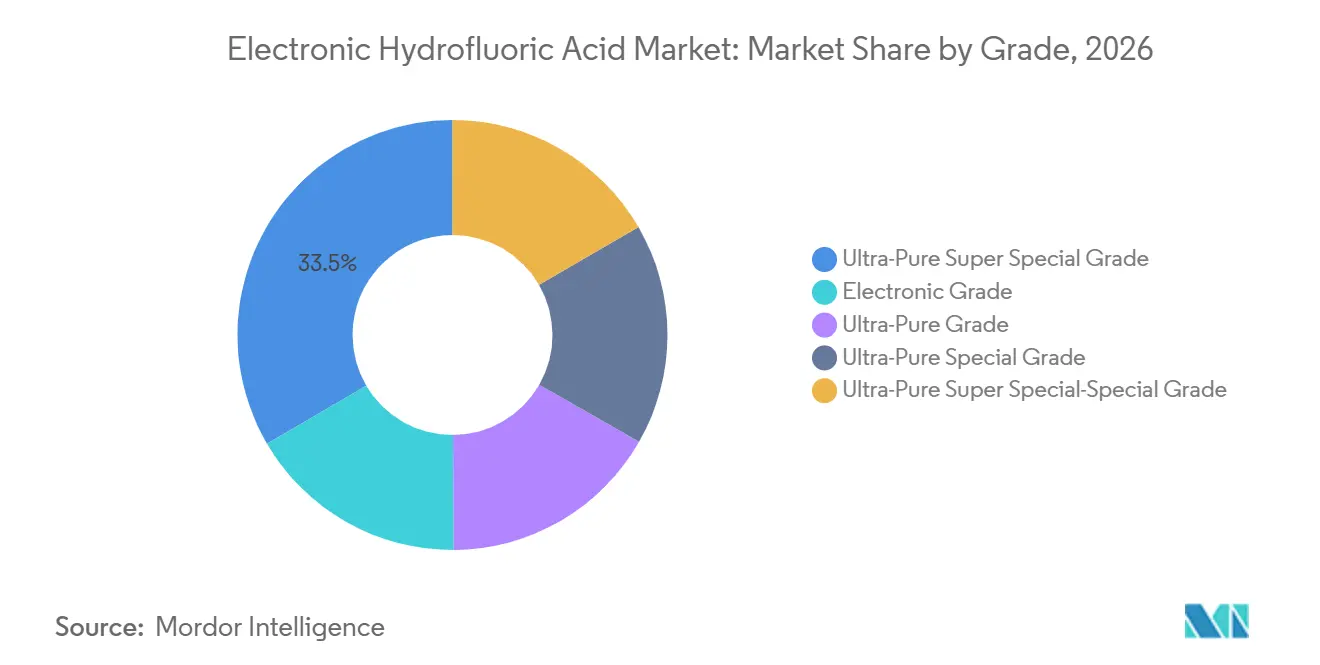
Ultra-Pure Super Special Grade held 33.45% of the electronic hydrofluoric acid market share in 2026. Grade categories align with device generations, as each higher tier addresses stricter defectivity and contamination requirements. Electronic Grade and Ultra-Pure Grade serve older nodes and less critical applications. Ultra-Pure Special, Ultra-Pure Super Special, and Ultra-Pure Super Special-Special grades support progressively more demanding process conditions. The 2026 position of Ultra-Pure Super Special Grade reflects its use in high-volume wafer production across mainstream 7-14 nm logic, 1z and 1α DRAM, and 128-232-layer 3D NAND.
Ultra-Pure Super Special-Special Grade is the fastest-growing grade, with the electronic hydrofluoric acid market size for this segment projected to grow at a 6.56% CAGR from 2027 to 2032. Sub-3 nm logic and next-generation DRAM require metallic impurities at levels below 1 part per trillion, which only a limited number of suppliers can consistently deliver at scale. Electronic Grade remains relevant for solar wafers and non-critical cleaning applications. Chinese producers have added substantial G3-and-below capacity, increasing price pressure in lower-grade categories.

By Type: Fluorite-Based Processes Dominate Across Purity Tiers
Fluorite-Based production captured 70.13% of the electronic hydrofluoric acid market share in 2026. This route reacts acid-grade fluorspar with concentrated sulfuric acid. It delivers the purity levels required by advanced semiconductor fabs, where impurities can compromise process control and pose yield risks at very small device dimensions. It is the commercially established route for the highest-purity grades, and its dominant position reflects the importance of feedstock quality and purification control in electronic applications. The Fluorosilicic Acid-Based route uses a by-product from phosphate fertilizer production and is more relevant to lower-grade and solar applications.
Fluorite-Based production is also the fastest-growing type, with the electronic hydrofluoric acid market size for this segment projected to expand at a 6.83% CAGR during 2027-2032. This combination of current scale and growth reflects a sustained purity advantage rather than a temporary transition, as the production route continues to serve applications where contamination standards, feedstock quality, and purification capability are more important than the lower initial cost of alternative pathways. The Fluorosilicic Acid-Based route can offer lower input costs, but silicon and phosphorus impurities add purification complexity at the highest grades. Both routes can support supply resilience; however, Fluorite-Based production retains a quality advantage for advanced-node demand, as its feedstock and purification pathway better support the most restrictive contamination targets used by leading semiconductor manufacturers.
By Application: Semiconductor Wafer Cleaning and Etching Shape Demand
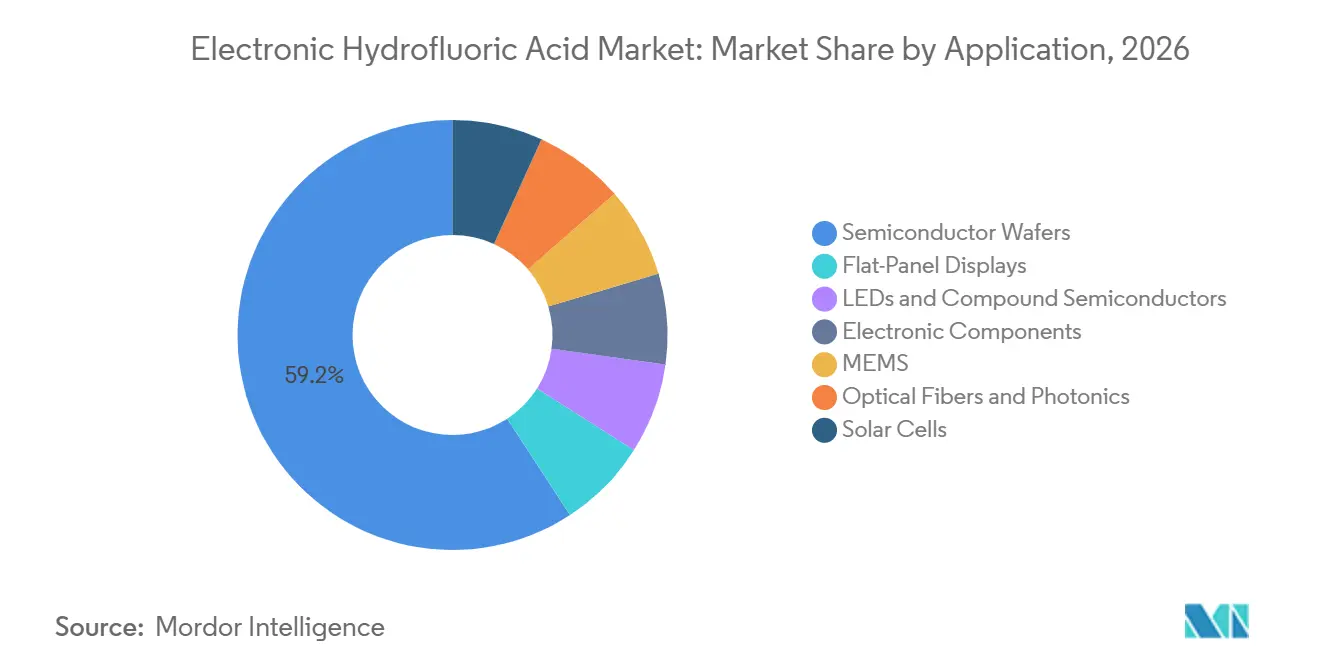
Semiconductor Wafers held 59.21% of the electronic hydrofluoric acid market share in 2026 and are also projected to grow at a 7.11% CAGR during 2027-2032. This growth rate reflects concentrated demand in processes that require repeated surface treatment, precise oxide removal, and consistent chemical performance as the number of fabrication steps increases. The combined lead in scale and growth reflects rising acid intensity per wafer as device complexity increases. Advanced nodes add etching and cleaning steps, while 3D DRAM, 3D NAND, and gate-all-around designs require tighter control of oxide removal. Tokyo Electron Limited (TEL) identifies high-aspect-ratio etching, precise control, and low-damage processing as key requirements for advanced memory and logic devices.
Solar Cells form the next major demand cluster, as Heterojunction Technology (HJT) and Tunnel Oxide Passivated Contact (TOPCon) designs require cleaner surfaces than conventional Passivated Emitter and Rear Cell (PERC) cells. China accounts for more than 70% of global solar manufacturing capacity, so its domestic HF supply choices influence application volumes. Flat-Panel Displays, LEDs, and Compound Semiconductors represent a meaningful middle tier of consumption. Generation-8.6 OLED lines in China and MEMS-integrated micro-LED designs are raising purity requirements for display chemicals. Micro-Electro-Mechanical Systems (MEMS) uses HF vapor-phase etching to release delicate structures. At the same time, Optical Fibers and Photonics remain smaller applications with growing relevance in silicon photonics for artificial intelligence data-center interconnects.
Geography Analysis
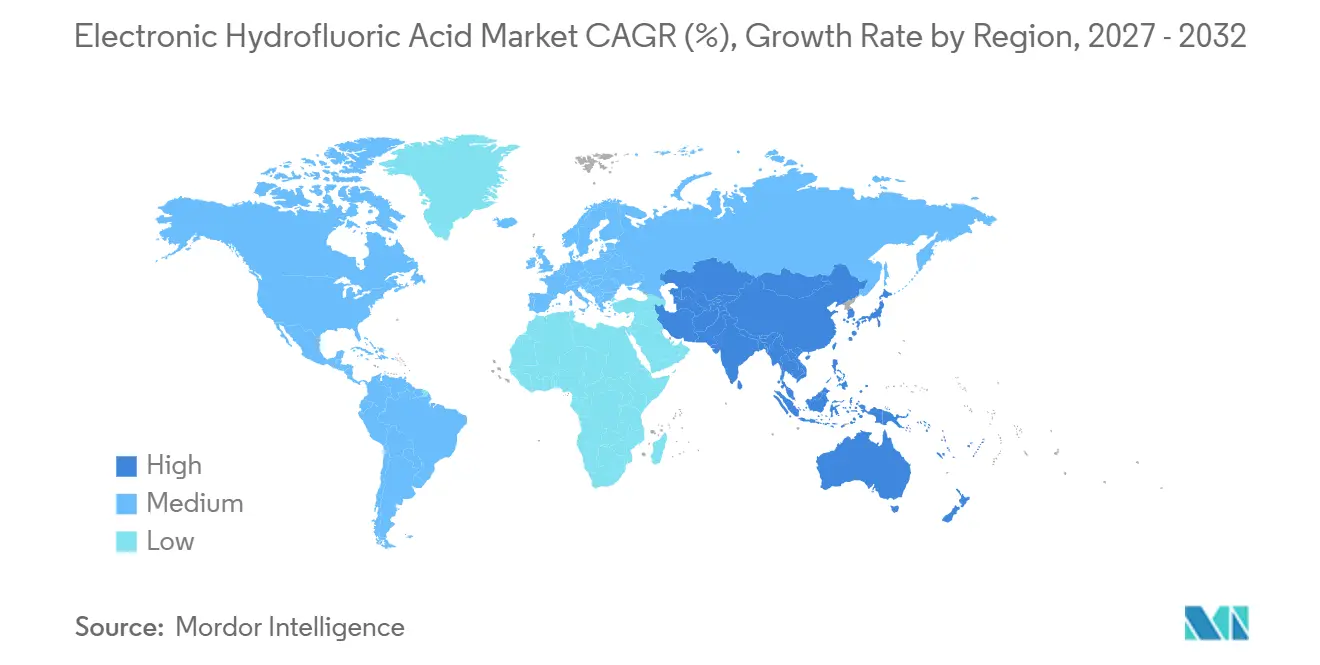
Asia-Pacific held 63.78% of the electronic hydrofluoric acid market share in 2026 and is forecast to grow at a 6.89% CAGR through 2032. The region combines advanced logic, memory, display, and solar cell manufacturing across China, South Korea, Taiwan, Japan, and ASEAN. SEMI expected South Korean fab equipment investment to rise to USD 21.5 billion in 2025 and USD 27 billion in 2026, as chipmakers expand capacity and upgrade technology to meet demand for AI-driven memory. China is adding large quantities of mid-purity HF for solar and display applications, while imports from Japan and South Korea continue to support advanced fabs. This split means regional growth does not produce the same outcome for every domestic supplier, as capacity additions aimed at solar and display applications do not automatically provide the quality record needed for advanced semiconductor supply.
Japan remains a source of the highest-purity electronic HF, supported by long-standing customer qualifications and production experience. Its role illustrates how the most demanding segment depends on an operating record that can be demonstrated across many batches, production cycles, and customer process conditions. SEMI recorded 4 planned fab construction starts in Japan during 2025. These developments indicate that supply chains are gradually becoming more regional within Asia-Pacific, with local producers seeking to serve nearby electronics and solar customers. At the same time, established suppliers remain relevant in applications with the highest purity requirements.
North America is the second-largest regional market and is being reshaped by the CHIPS and Science Act-led fab investment. SEMI recorded 4 planned construction starts in the Americas during 2025. Taiwan Semiconductor Manufacturing Company (TSMC) began production of 4 nm chips at its Arizona fab in 2025, creating demand for imported UPSS-grade acid before local purification capacity develops. Europe is also building its semiconductor chemical base, with BASF investing in a new semiconductor-grade sulfuric acid facility at Ludwigshafen, expected to start operations by 2027. Meanwhile, South America, the Middle East, and Africa remain nascent markets with early electronics ambitions but limited near-term chemical volumes.
Competitive Landscape
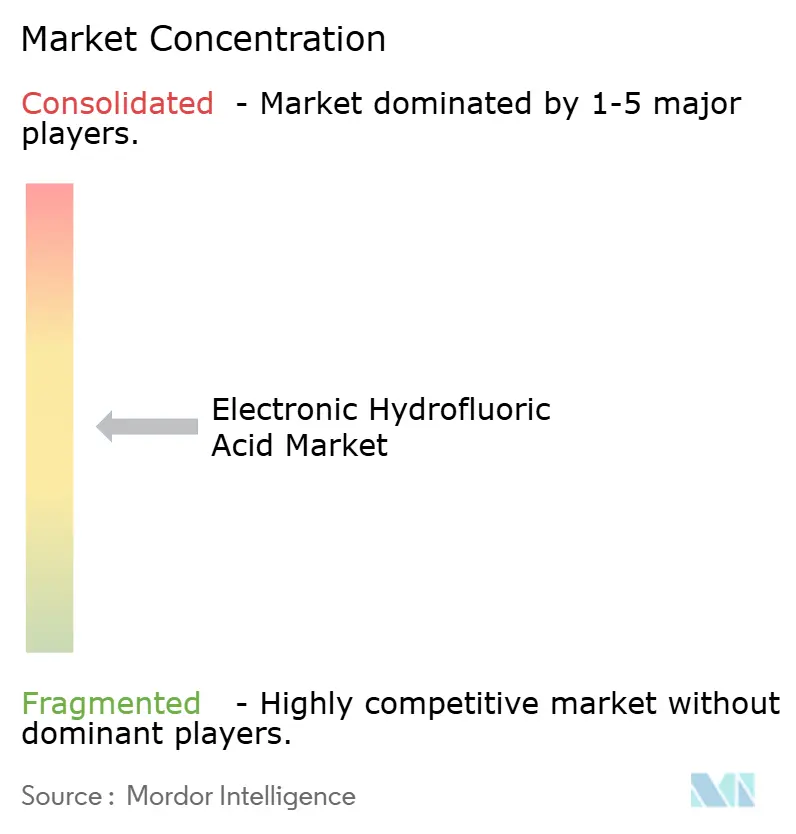
The electronic hydrofluoric acid market is moderately fragmented. This structure reflects the high technical barriers to entry, as suppliers must consistently meet stringent contamination requirements for advanced semiconductor production. Stella Chemifa and Morita Chemical Industries hold a near-duopoly in 12-nines-purity material, with impurity concentrations down to 1 part per trillion. Their position is supported by accumulated production expertise and long-standing customer qualifications. Honeywell, Solvay, Daikin Industries, Soulbrain, and KANTO KAGAKU compete across middle and high-purity grades with varying regional footprints. Solvay operates in China, Thailand, Germany, and the United States, supporting a broad supply chain presence. Soulbrain's vertically integrated operations in South Korea enable rapid response to domestic fab qualification cycles. Central Glass began selling improved HF gas for cryo-etching in January 2025 and has plans to more than double capacity at its Ube Plant. BASF's 2025 investment in semiconductor-grade sulfuric acid at Ludwigshafen also reflects the importance of proximate, high-purity chemical supply for European fabs.
Electronic Hydrofluoric Acid Industry Leaders
-
Stella Chemifa Corporation
-
Honeywell International Inc
-
Solvay
-
SUNLIT FLUO & CHEMICAL CO., LTD.
-
Soulbrain Co., Ltd.
- *Disclaimer: Major Players sorted in no particular order
Recent Industry Developments
- October 2026: Multiple Fluoride Industries Corporation and Yihua Group broke ground on a fluorochemical industrial park in Yichang, integrating upstream fluorspar resources with electronic-grade HF production to target semiconductor supply.
- January 2025: Central Glass Co., Ltd. commercially launched ultra-high-purity electronic hydrofluoric acid (greater than 99.999% purity) for cryo-etching applications and committed to more than doubling production capacity at its Ube Plant in Yamaguchi Prefecture, targeting several hundred metric tons per year by 2026. Multiple semiconductor manufacturers in Japan and overseas have confirmed the adoption of mass production for cryo-etching.
Global Electronic Hydrofluoric Acid Market Report Scope
Electronic Hydrofluoric Acid is an ultra-pure formulation of hydrogen fluoride (HF) in water, manufactured specifically for microelectronics and semiconductor manufacturing. It is produced under stringent quality controls to meet the purity requirements of semiconductor fabrication processes, where even trace contaminants can compromise device performance and yield.
The electronic hydrofluoric acid market is segmented by grade, type, application, and geography. By grade, the market is segmented into electronic grade, ultra-pure grade, ultra-pure special grade, ultra-pure super special grade, and ultra-pure super special-special grade. By type, the market is segmented into fluorosilicic acid-based and fluorite-based. By application, the market is segmented into semiconductor wafers, solar cells, flat-panel displays, LEDs and compound semiconductors, electronic components, MEMS, and optical fibers and photonics. The report also covers market sizes and forecasts for the electronic hydrofluoric acid across 15 countries in major regions. The market sizes and forecasts are provided in terms of value (USD).
| Electronic Grade |
| Ultra-Pure Grade |
| Ultra-Pure Special Grade |
| Ultra-Pure Super Special Grade |
| Ultra-Pure Super Special-Special Grade |
| Fluorosilicic Acid-Based |
| Fluorite-Based |
| Semiconductor Wafers |
| Solar Cells |
| Flat-Panel Displays |
| LEDs and Compound Semiconductors |
| Electronic Components |
| MEMS |
| Optical Fibers and Photonics |
| Asia-Pacific | China |
| India | |
| Japan | |
| South Korea | |
| ASEAN Countries | |
| Rest of Asia-Pacific | |
| North America | United States |
| Canada | |
| Mexico | |
| Europe | Germany |
| United Kingdom | |
| France | |
| Italy | |
| NORDIC Countries | |
| Rest of Europe | |
| South America | Brazil |
| Argentina | |
| Rest of South America | |
| Middle East and Africa | Saudi Arabia |
| South Africa | |
| Rest of Middle East and Africa |
| By Grade | Electronic Grade | |
| Ultra-Pure Grade | ||
| Ultra-Pure Special Grade | ||
| Ultra-Pure Super Special Grade | ||
| Ultra-Pure Super Special-Special Grade | ||
| By Type | Fluorosilicic Acid-Based | |
| Fluorite-Based | ||
| By Application | Semiconductor Wafers | |
| Solar Cells | ||
| Flat-Panel Displays | ||
| LEDs and Compound Semiconductors | ||
| Electronic Components | ||
| MEMS | ||
| Optical Fibers and Photonics | ||
| By Geography | Asia-Pacific | China |
| India | ||
| Japan | ||
| South Korea | ||
| ASEAN Countries | ||
| Rest of Asia-Pacific | ||
| North America | United States | |
| Canada | ||
| Mexico | ||
| Europe | Germany | |
| United Kingdom | ||
| France | ||
| Italy | ||
| NORDIC Countries | ||
| Rest of Europe | ||
| South America | Brazil | |
| Argentina | ||
| Rest of South America | ||
| Middle East and Africa | Saudi Arabia | |
| South Africa | ||
| Rest of Middle East and Africa | ||
Key Questions Answered in the Report
What is current market size of Electronic Hydrofluoric Acid Market?
The electronic hydrofluoric acid market size was valued at USD 1.46 billion in 2026 and is estimated to grow from USD 1.55 billion in 2027 to USD 2.08 billion by 2032, at a CAGR of 6.12% during the forecast period (2027-2032).
Which production method yields the electronic hydrofluoric acid supply?
Fluorite-Based production leads with a 70.13% share in 2026 and is projected to grow at a 6.83% CAGR through 2032.
Which application drives demand for electronic hydrofluoric acid?
Semiconductor Wafers lead applications with a 59.21% share in 2026 and the fastest projected growth at a 7.11% CAGR through 2032.
Which region leads demand for electronic hydrofluoric acid?
Asia-Pacific leads with a 63.78% share in 2026 and is forecast to expand at a 6.89% CAGR through 2032.