
Electrical Wiring Accessories Market Size and Share
Market Overview
| Study Period | 2022 - 2032 |
|---|---|
| Market Size (2027) | USD 73.76 Billion |
| Market Size (2032) | USD 95.32 Billion |
| Growth Rate (2027 - 2032) | 5.26 % |
| Fastest Growing Market | Asia-Pacific |
| Largest Market | Asia-Pacific |
| Market Concentration | Medium |
Major Players *Disclaimer: Major Players sorted in no particular order Image © Mordor Intelligence. Reuse requires attribution under CC BY 4.0. | |
Electrical Wiring Accessories Market Analysis by Mordor Intelligence
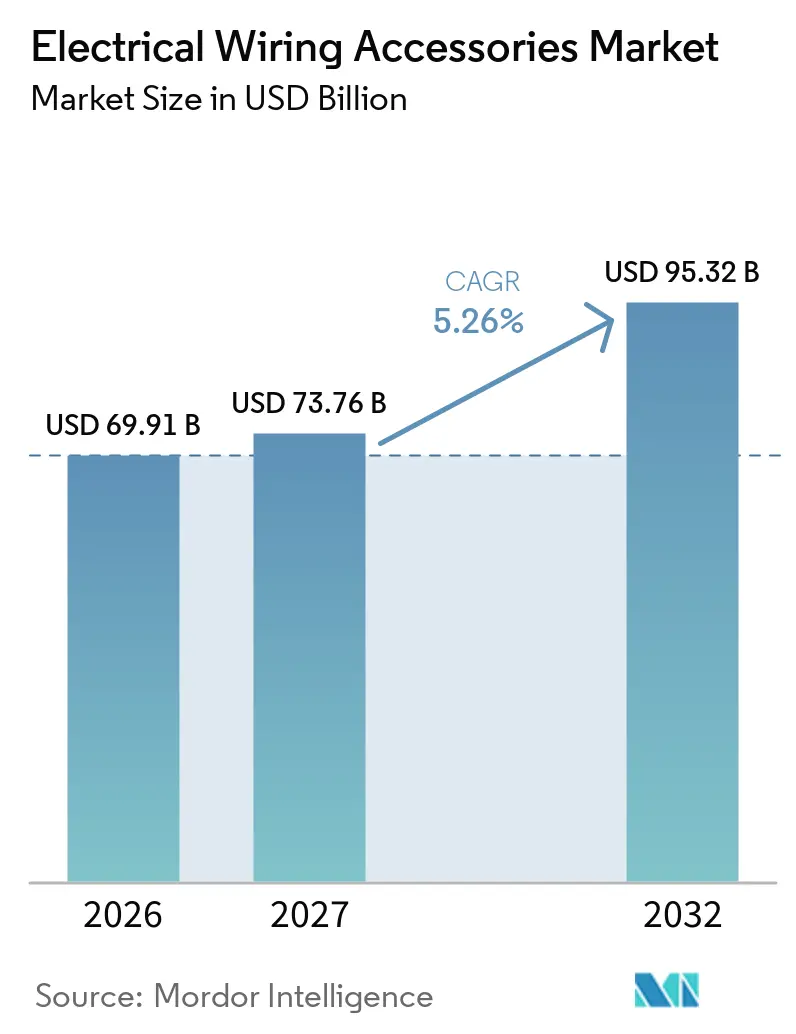
The Electrical Wiring Accessories Market size is expected to grow from USD 69.91 billion in 2026 to USD 73.76 billion in 2027 and is forecast to reach USD 95.32 billion by 2032 at 5.26% CAGR over 2027-2032. The electrical wiring accessories market draws demand from building renovation, new construction, data center power systems, and EV charging installations. Energy-performance rules in Europe are turning electrical upgrades into scheduled capital projects. Smart controls and energy monitoring are increasing the value of devices used in homes and commercial buildings. Asia-Pacific combines the largest revenue base with the strongest regional growth, supported by construction and grid investment. The electrical wiring accessories market also faces uneven material costs, different national socket standards, and slower construction cycles in mature economies.
Key Report Takeaways
- By product type, switches held 21.3% of revenue in 2026, while switch-socket combinations are forecast to expand at a 5.9% CAGR through 2032.
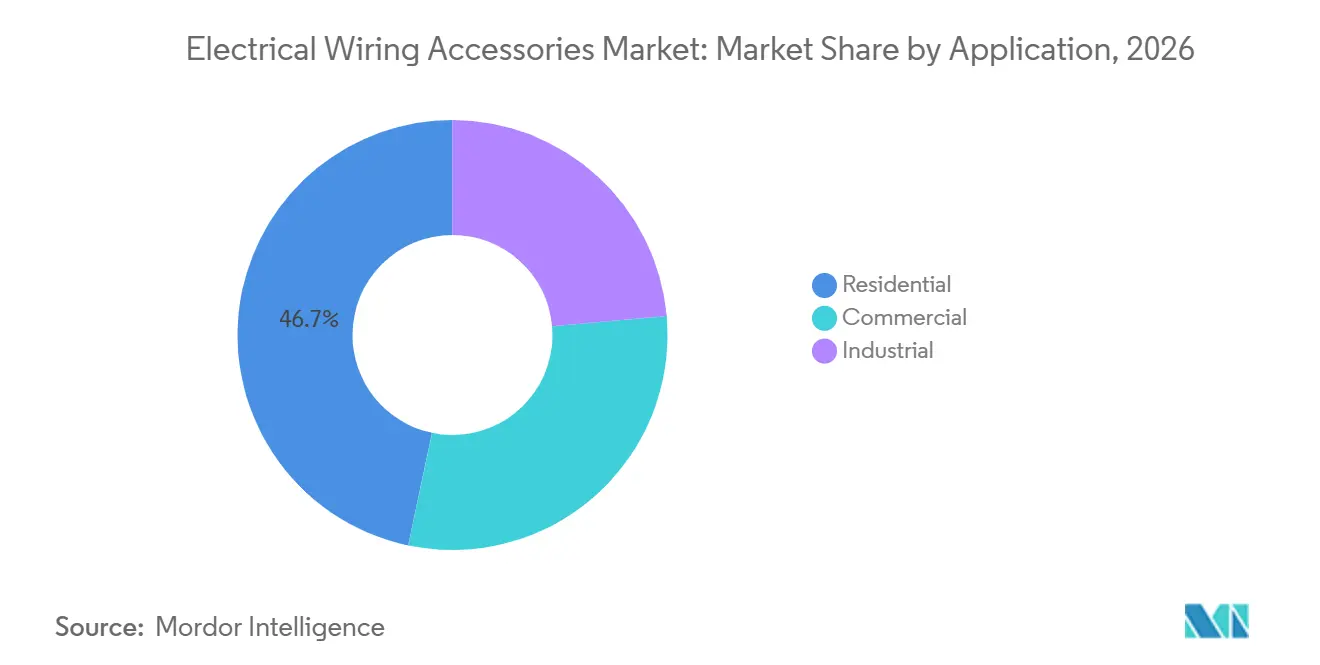
- By application, residential held 46.7% of revenue in 2026, while commercial is forecast to grow at a 5.7% CAGR through 2032.
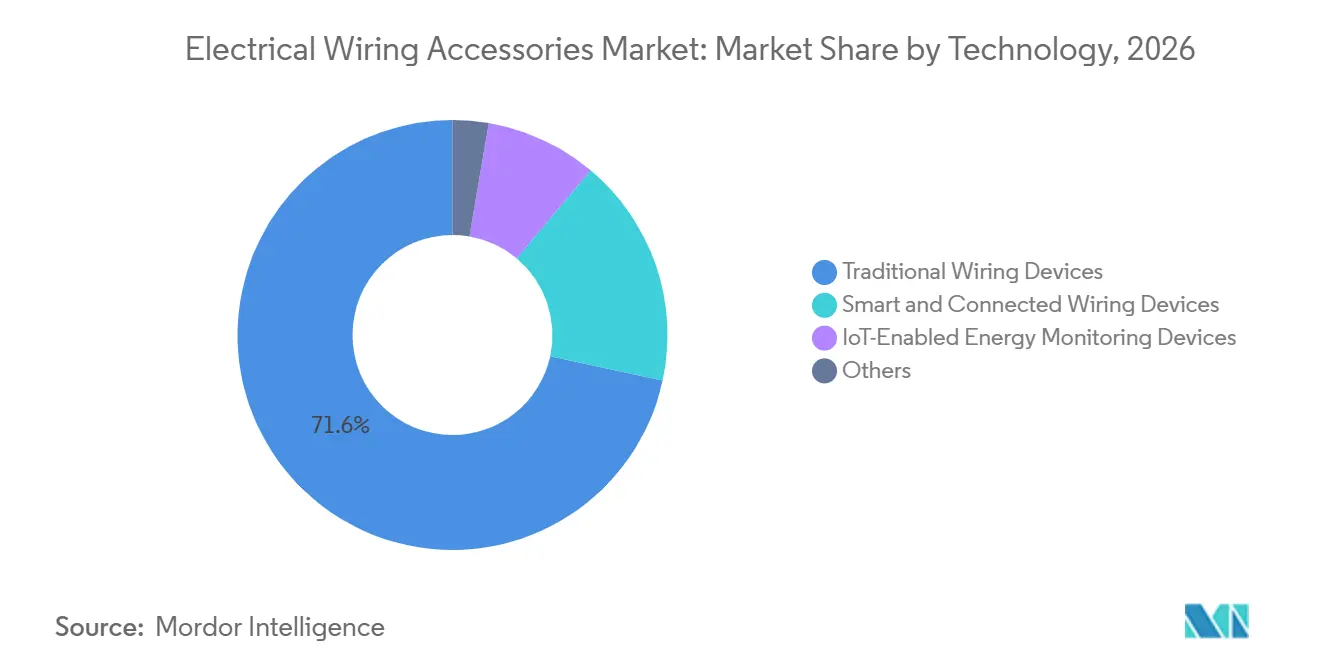
- By technology, traditional wiring devices held 71.6% of revenue in 2026, while smart and connected wiring devices are forecast to grow at an 8.6% CAGR through 2032.
- By geography, Asia-Pacific held 41.4% of revenue in 2026 and is forecast to grow at a 6.5% CAGR through 2032.
Note: Market numbers in this report are based on Mordor Intelligence's proprietary estimation framework, which combines nine months of actuals with Q4 projections for base year 2026.
Market Trends and Insights
Drivers Impact Analysis of Electrical Wiring Accessories Market*
| Driver | (~) % Impact on CAGR Forecast | Geographic Relevance | Impact Timeline |
|---|---|---|---|
| Electrification and Building Renovation | +1.20% | Global; highest intensity in Europe and Asia-Pacific | Long term (≥ 4 years) |
| Smart Home and Building Automation Adoption | +1.00% | Global; highest adoption in North America, Western Europe, and urban APAC | Medium term (2–4 years) |
| Renewable Energy and EV Charging Infrastructure | +0.90% | Global; core in China, Europe, and North America | Medium term (2–4 years) |
| Data-Center Power-Density Retrofits | +0.70% | North America and Europe primary; APAC accelerating | Short term (≤ 2 years) |
| Installer-Shortage-Led Modular Adoption | +0.40% | Europe and North America predominantly | Medium term (2–4 years) |
| Premiumization Through USB-C, Energy Monitoring, and Connected Controls | +0.50% | Global; led by North America, Western Europe, and Tier-1 APAC cities | Medium term (2–4 years) |
| Source: Mordor Intelligence | |||
Electrification and Building Renovation Establish a Structural Demand Floor
The revised Energy Performance of Buildings Directive requires member states to renovate 16% of their least efficient nonresidential buildings by 2030. The target rises to 26% by 2033 under the directive’s renovation pathway. The European Commission states that 85% of EU buildings were built before 2000, while 75% have poor energy performance[1]. This building base creates recurring demand for replacement switches, sockets, cable management, and protection devices. National Building Renovation Plans give contractors and distributors clearer schedules for electrical work. The electrical wiring accessories market benefits because renovation requirements make some upgrades less dependent on discretionary spending.
Smart Home and Building Automation Adoption Shift the Market’s Value Architecture
Smart controls are moving from optional residential features into commercial energy management systems. The International Energy Agency reports that digital building controls can reduce energy use in commercial buildings by 20% to 30%, supporting the case for monitored and connected devices. Matter compatibility is reducing interoperability barriers between devices from different brands. This change supports faster adoption in mid-priced building projects, where proprietary systems previously limited buyer choice. Installer shortages also support modular products that reduce wiring time and simplify upgrades. The electrical wiring accessories market is gaining products that can raise value per installation without depending only on unit volumes.
Renewable Energy and EV Charging Infrastructure Expand the Installation Addressable Market
The global public charging network added nearly 1.8 million chargepoints in 2025, reaching more than 7 million units worldwide[2]. China held more than 65% of public chargepoints, making its charging buildout a major source of accessory demand. Each installation uses conduits, cable glands, weatherproof connectors, switches, and protection devices. The EU’s Alternative Fuels Infrastructure Regulation calls for charging stations with at least 150 kW capacity every 60 km on major road corridors. The electrical wiring accessories market is therefore supported by infrastructure projects that do not follow normal building construction cycles. Renewable generation and storage projects create a similar need for protected connections and cable routing equipment.
Data Center Power-Density Retrofits Open a High-Margin Accessory Subsegment
AI workloads are raising the power specification needed inside data centers. Schneider Electric estimates that global data center power demand is 132 GW in 2026 and could reach 290 GW by 2030[3]. Higher rack density requires purpose-built distribution units, high-amperage connectors, and prefabricated cable assemblies. These products must meet more demanding thermal, safety, and reliability requirements than standard commercial devices. Suppliers certified for environments above 200A can earn higher unit prices and strengthen relationships with project owners. The electrical wiring accessories market gains a higher-value demand stream as operators retrofit legacy facilities and add AI capacity.
Restraints Impact Analysis of Electrical Wiring Accessories Market*
| Restraint | (~) % Impact on CAGR Forecast | Geographic Relevance | Impact Timeline |
|---|---|---|---|
| Copper, Polymer, and Electronic Component Cost Volatility | -0.80% | Global; most acute for North American and European manufacturers | Short term (≤ 2 years) |
| Construction Cyclicality and Mature-Market Replacement Dependence | -0.60% | Europe and North America predominantly | Long term (≥ 4 years) |
| Socket, Plug, and Certification Fragmentation | -0.30% | Global; most acute in multi-country supply chains | Medium term (2–4 years) |
| Counterfeit Traceability and Installation Liability | -0.20% | Emerging markets in Asia-Pacific and MEA | Medium term (2–4 years) |
| Source: Mordor Intelligence | |||
Copper and Component Cost Volatility Compress Manufacturer Margins
Copper is a major input cost for switches, connectors, cables, and other electrical components. Copper prices rose more than 13% during 2025, increasing pressure on suppliers with fixed-price commitments. The 50% Section 232 tariff on U.S. copper imports, effective in August 2025, added a policy risk that is not fully addressed through commodity hedging. Polymer costs and shortages of modules used in Wi-Fi, Zigbee, and Matter devices create added procurement pressure. Smaller producers may have less ability to pass cost increases through distributor contracts. The electrical wiring accessories market can therefore see margin pressure even when installation demand remains stable.
Construction Cyclicality and Mature-Market Replacement Dependence Introduce Revenue Floor Volatility
Replacement purchases provide a stable demand base in Western Europe and parts of North America. They do not, however, offer the same volume growth as new building projects. Germany faced construction pressure in 2024 and 2025 as high interest rates and material costs reduced housing starts. Commercial renovation plans can also be delayed when project costs rise or financing becomes less available. Socket standards and certification requirements further increase product adaptation costs for suppliers selling across borders. In the electrical wiring accessories market, counterfeit products can add traceability concerns and installation liability for established brands.
*Our forecasts treat driver/restraint impacts as directional, not additive. The impact forecasts reflect baseline growth, mix effects, and variable interactions.
Electrical Wiring Accessories Market Segment Analysis
By Product Type:
Combination Formats Narrow the Gap with Incumbent SwitchesSwitches held 21.3% of the electrical wiring accessories market share in 2026, supported by their use in residential, commercial, and light industrial sites. Switch-socket combinations are forecast to grow at a 5.9% CAGR through 2032. Space-constrained projects use these combined formats to reduce junction-box requirements and installation labor. Sockets and receptacles form the second-largest revenue pool because they are needed in nearly every occupied space. Connectors, terminals, cable glands, and conduit systems remain essential for projects with strict cable-management specifications.
The electrical wiring accessories market benefits as demand for supporting products rises with renewable energy, EV charging, and data center activity. Compact RCBO designs respond to installer needs where electrical panel space is limited. Hubbell introduced 50A and 60A High Amp Straight Blade Connectors in June 2026 for RV, generator, and commercial uses[4]. Plugs and adapters remain affected by Type A through G standards, which restrict product standardization across markets. IEC 60884 and IEC 60947 requirements also make tested products more attractive for customers who prioritize certification and safety.
By Application:
Residential Anchors Volume as Commercial Adoption AcceleratesResidential applications held 46.7% of the electrical wiring accessories market size in 2026. The segment is supported by a large installed base and recurring renovation demand. European renovation rules create demand for upgrades inside older homes and multifamily properties. New housing activity in India, Vietnam, Indonesia, and parts of Africa supports product volumes. Industrial projects use higher-value explosion-proof connectors and cable glands designed for hazardous locations.
Commercial applications are forecast to grow at a 5.7% CAGR through 2032. Building certification systems increasingly reward connected controls and energy monitoring in commercial upgrades. Data centers also require more accessory spending per square meter than conventional office projects. This creates a widening difference between premium commercial specifications and cost-sensitive residential projects. The electrical wiring accessories market gains from commercial projects where device performance affects energy use, uptime, and operating approvals.
By Technology:
Smart Wiring Devices Challenge Traditional Segment’s Dominant ShareTraditional wiring devices held 71.6% of revenue in 2026. Their position reflects replacement demand, cost-sensitive construction, and continued use in utility and industrial environments. Smart and connected wiring devices are forecast to expand at an 8.6% CAGR through 2032. Smart devices support energy monitoring, automated settings, and integration with building control systems. The electrical wiring accessories market size for connected products is supported by commercial retrofit projects and higher-value residential installations.
IoT-enabled energy monitoring devices are becoming more relevant for customers tracking circuit-level electricity use. Legrand launched the INSPYRA collection in Australia during August 2026 with USB-C connectivity, IoT smart controls, and 80% recycled plastic construction. ABB introduced ReliaHome Flex as a modular home energy management system for the North American residential sector. The electrical wiring accessories market requires continued spending on interoperability, cybersecurity, and certification to compete in this area. Traditional devices will remain necessary where installed systems, budgets, or operating conditions do not support connected equipment.
Geography Analysis
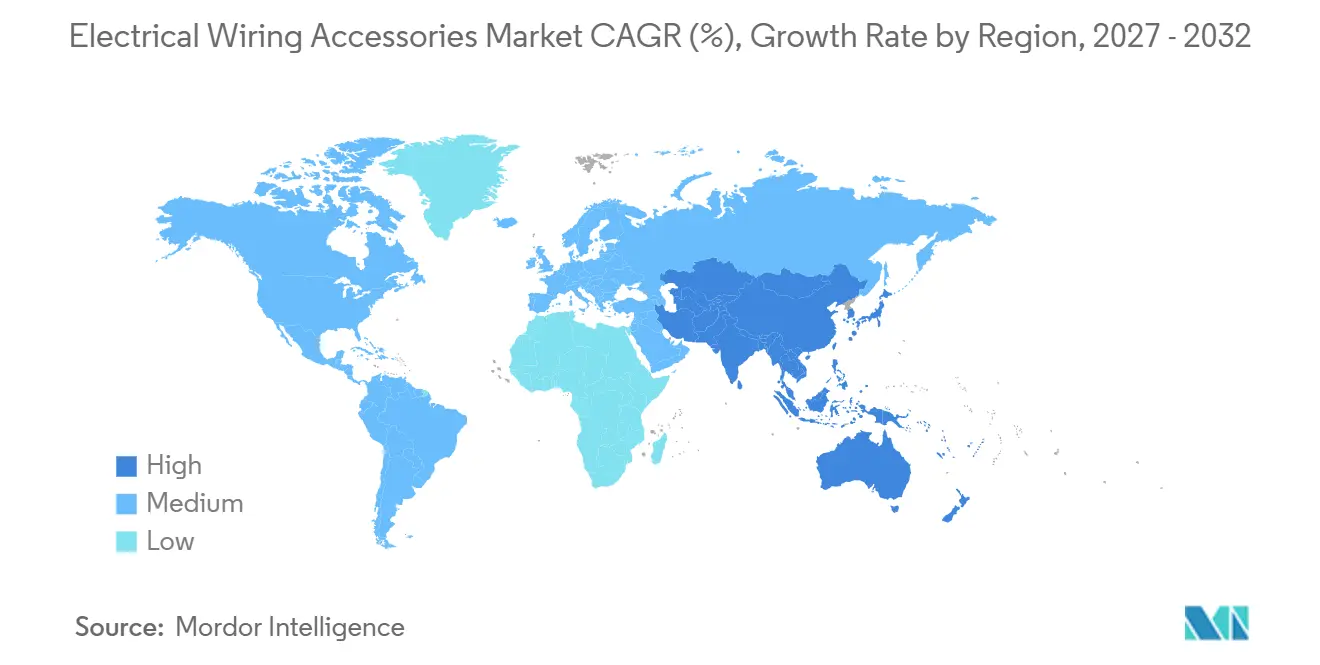
APAC Electrical Wiring Accessories Market
Asia-Pacific held 41.4% of the electrical wiring accessories market share in 2026 and is forecast to grow at a 6.5% CAGR through 2032. China is the region’s largest national market, supported by smart-grid investment and rapid charging deployment. China’s 2025 to 2027 charging plan targets 28 million total chargepoints by the end of 2027. India offers long-term growth through urban housing, commercial construction, and premium home upgrades. Southeast Asian markets add demand through construction activity and electrical infrastructure investment.
Europe Electrical Wiring Accessories Market
Europe is the second-largest regional demand center for the electrical wiring accessories market. Germany, France, Italy, the United Kingdom, Spain, and Poland lead regional consumption. The EPBD’s renovation requirements support electrical upgrade work across older building stock. Retrofit projects favor compact protection devices and modular solutions because available panel and wall space can be limited. Poland and other Central and Eastern European countries offer a secondary growth path as electrical infrastructure is modernized.
The Americas and MEA Electrical Wiring Accessories Market
North America is shaped by data center construction, residential electrification, and EV charging needs. Leviton launched a 50A smart switch and 60A controller in August 2026 for loads including EV chargers and heat pumps. South America and Middle East and Africa remain smaller but expanding areas of the electrical wiring accessories market. Brazil provides regional volume in South America, while Saudi Arabia and the United Arab Emirates support commercial projects.
Competitive Landscape
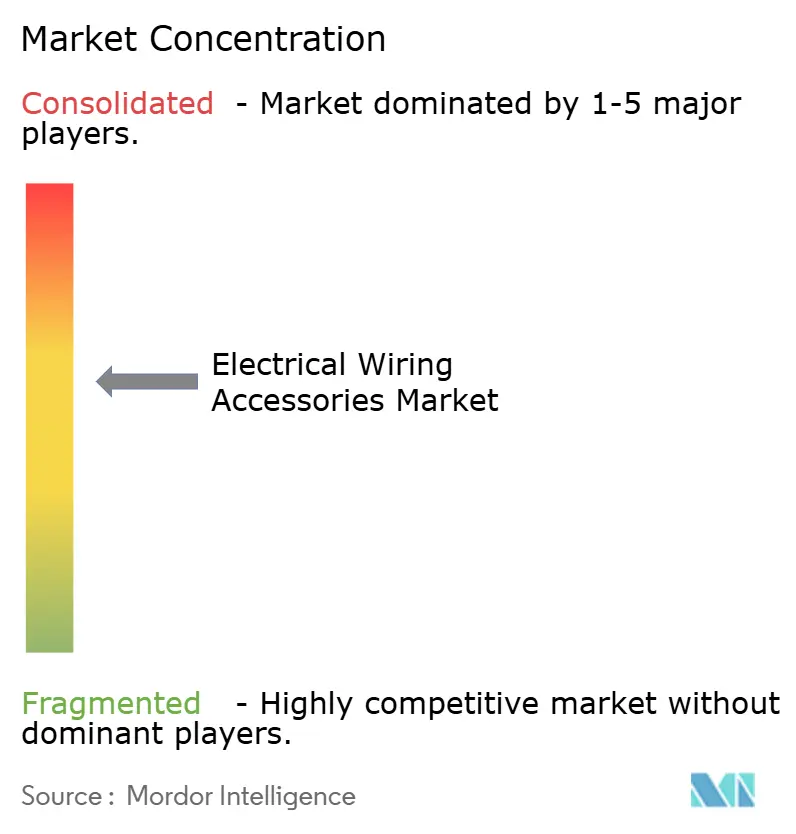
The electrical wiring accessories market is moderately consolidated among large multinational suppliers. Schneider Electric, Legrand, ABB, and Eaton have broad portfolios across major regions. Havells India, Hubbell, Hager, Vimar, Gewiss, Simon, JUNG, and WAGO hold strong positions in national or product-specific categories. Large suppliers are moving beyond individual devices toward integrated offers for smart buildings, charging sites, and data centers. This strategy combines switches, power distribution, controls, enclosures, and monitoring products.
Legrand acquired Kratos Industries and invested in Accelsius in February 2026 to build its position in data center power and liquid cooling. The company then acquired Keydak in China and TES in the United Kingdom in March 2026. Eaton announced a USD 242 million Arkansas facility in September 2026 for customized electrical enclosures used in data center, utility, and communications projects. Hubbell received a U.S. patent in March 2026 for screwless connection terminals, supporting faster installation.
Chinese companies, including Bull Group and CHINT, are gaining relevance in smart accessory categories through local ecosystems and distribution channels. Weatherproof EV connectors, retrofit controls, and wiring systems rated above 200A remain open areas for product development. IEC, BIS, KEMA-KEUR, and UL requirements remain meaningful barriers for companies seeking to serve certified premium applications. The electrical wiring accessories market remains competitive on product breadth, approvals, distributor reach, and project support. No combined market share for the leading companies was provided, so a concentration score cannot be assigned on the requested methodology.
Electrical Wiring Accessories Industry Leaders
-
Schneider Electric SE
-
Legrand SA
-
Siemens AG
-
ABB Ltd.
-
Eaton Corporation plc
- *Disclaimer: Major Players sorted in no particular order
Electrical Wiring Accessories Market Companies Covered in this Report
- ABB Ltd.
- Eaton Corporation plc
- Emerson Electric Co.
- Gewiss S.p.A.
- Hager SE
- Havells India Limited
- HellermannTyton
- Honeywell International Inc.
- Hubbell Incorporated
- JUNG GmbH & Co. KG
- Legrand SA
- Leviton Manufacturing Co., Inc.
- Luceco plc
- Lutron Electronics Co., Inc.
- Panasonic Holdings Corporation
- Schneider Electric SE
- Siemens AG
- Simon S.A.
- Vimar S.p.A.
- WAGO GmbH & Co. KG
Recent Industry Developments in Electrical Wiring Accessories Market
- September 2026: Eaton announced a USD 242 million investment in a new North Little Rock, Arkansas, facility targeting 1,200 jobs, doubling U.S. capacity for customized electrical enclosures serving data center, utility, and digital communications markets.
- August 2026: Legrand unveiled the INSPYRA® wiring device collection across Australia and New Zealand, featuring integrated USB-C connectivity, IoT smart controls, 80% recycled plastic construction, and Australia's first paper-based packaging for this category, with over 60% of the range manufactured locally.
- May 2026: Legrand acquired SRS Power Engineering in Malaysia, a specialist in low- and medium-voltage power protection for data centers, extending Legrand's APAC critical power footprint.
- February 2026: Legrand acquired Kratos Industries, low- and medium-voltage electrical equipment for data centers, and invested in Accelsius, a two-phase direct-to-chip liquid cooling pioneer for gigawatt-class AI data center deployments.
Global Electrical Wiring Accessories Market Report Scope
Electrical wiring accessories are components used to connect, control, protect, terminate, route, and distribute electrical wiring and power within residential, commercial, industrial, and other buildings or installations. They enable the safe and efficient connection of electrical circuits to power sources and end-use equipment.
The Global Electrical Wiring Accessories Market is segmented by product type, application, technology, and geography. By product type, the market is segmented into switches, sockets, plugs, switch-socket combinations, connectors, cable glands, conduits, extension leads, and other wiring accessories. By application, the market is segmented into residential, commercial, and industrial. By technology, the market is segmented into traditional, smart and connected, IoT-enabled, and other technologies. The report also covers the market size and forecasts for the global electrical wiring accessories market across 26 countries in key regions. For each segment, the market sizing and forecasts have been provided on the basis of value (USD).
Segmentation Overview
| Switches |
| Sockets and Receptacles |
| Plugs and Adapters |
| Switch-Socket Combinations |
| Connectors and Terminals |
| Cable Glands and Cable Fittings |
| Conduits and Conduit Fittings |
| Extension Leads and Power Strips |
| Other Wiring Accessories |
| Residential |
| Commercial |
| Industrial |
| Traditional Wiring Devices |
| Smart and Connected Wiring Devices |
| IoT-Enabled Energy Monitoring Devices |
| Others |
| North America | United States |
| Canada | |
| Mexico | |
| Europe | Germany |
| France | |
| Italy | |
| Spain | |
| United Kingdom | |
| Poland | |
| Russia | |
| Rest of Europe | |
| Asia-Pacific | China |
| India | |
| Japan | |
| South Korea | |
| Australia | |
| Indonesia | |
| Vietnam | |
| Thailand | |
| Rest of Asia-Pacific | |
| South America | Brazil |
| Argentina | |
| Chile | |
| Rest of South America | |
| Middle East and Africa | Saudi Arabia |
| United Arab Emirates | |
| Egypt | |
| South Africa | |
| Morocco | |
| Rest of Middle East and Africa |
| By Product Type | Switches | |
| Sockets and Receptacles | ||
| Plugs and Adapters | ||
| Switch-Socket Combinations | ||
| Connectors and Terminals | ||
| Cable Glands and Cable Fittings | ||
| Conduits and Conduit Fittings | ||
| Extension Leads and Power Strips | ||
| Other Wiring Accessories | ||
| By Application | Residential | |
| Commercial | ||
| Industrial | ||
| By Technology | Traditional Wiring Devices | |
| Smart and Connected Wiring Devices | ||
| IoT-Enabled Energy Monitoring Devices | ||
| Others | ||
| By Geography | North America | United States |
| Canada | ||
| Mexico | ||
| Europe | Germany | |
| France | ||
| Italy | ||
| Spain | ||
| United Kingdom | ||
| Poland | ||
| Russia | ||
| Rest of Europe | ||
| Asia-Pacific | China | |
| India | ||
| Japan | ||
| South Korea | ||
| Australia | ||
| Indonesia | ||
| Vietnam | ||
| Thailand | ||
| Rest of Asia-Pacific | ||
| South America | Brazil | |
| Argentina | ||
| Chile | ||
| Rest of South America | ||
| Middle East and Africa | Saudi Arabia | |
| United Arab Emirates | ||
| Egypt | ||
| South Africa | ||
| Morocco | ||
| Rest of Middle East and Africa | ||
Key Questions Answered in the Report
What is the projected value of electrical wiring accessories by 2032?
The electrical wiring accessories market is forecast to reach USD 95.32 billion by 2032, from USD 69.91 1billion in 2026, at a 5.26% CAGR. Europe’s building upgrades, China’s charging rollout, and data center power retrofits diversify demand for the electrical wiring accessories market beyond conventional construction.
Which product category leads electrical wiring accessories revenue?
Switches led product revenue with a 21.3% share in 2026, while switch-socket combinations are projected to grow at a 5.9% CAGR through 2032. The electrical wiring accessories market also relies on connectors, cable glands, and conduits in specialist installations.
Which application is growing fastest for wiring accessories?
Commercial applications are forecast to grow at a 5.7% CAGR through 2032, supported by smart building upgrades and data center projects. Residential demand still provides broad replacement volume across existing homes.
Are smart wiring devices growing faster than traditional devices?
Yes. Smart and connected wiring devices are projected to grow at an 8.6% CAGR through 2032, while traditional devices held 71.6% of 2026 revenue. Connected controls also support energy monitoring and automated building operation.
Which region has the strongest growth outlook?
Asia-Pacific held 41.4% of global revenue in 2026 and is forecast to grow at a 6.5% CAGR through 2032. China’s charging buildout and India’s construction activity support the electrical wiring accessories market in the region.
What factors constrain suppliers of electrical accessories?
Copper and component cost volatility, construction cycles, national standards, and counterfeit-product liability can pressure margins and limit product scalability. Smaller producers can face greater difficulty absorbing rapid cost increases, certification expenses, distributor requirements, and shifting demand across several project types and national installation standards.