
Electrical Inspection Thermography Systems Market Size and Share
Market Overview
| Study Period | 2020 - 2031 |
|---|---|
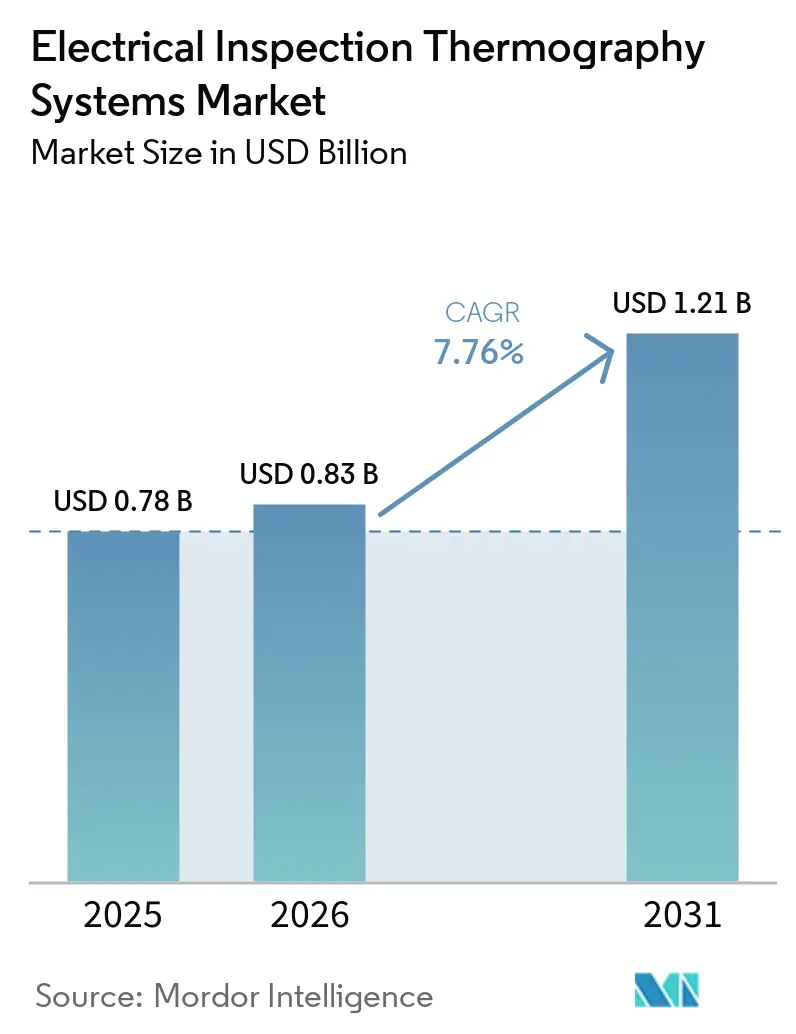
| Market Size (2026) | USD 0.83 Billion |
| Market Size (2031) | USD 1.21 Billion |
| Growth Rate (2026 - 2031) | 7.76 % |
| Fastest Growing Market | Asia-Pacific |
| Largest Market | Asia-Pacific |
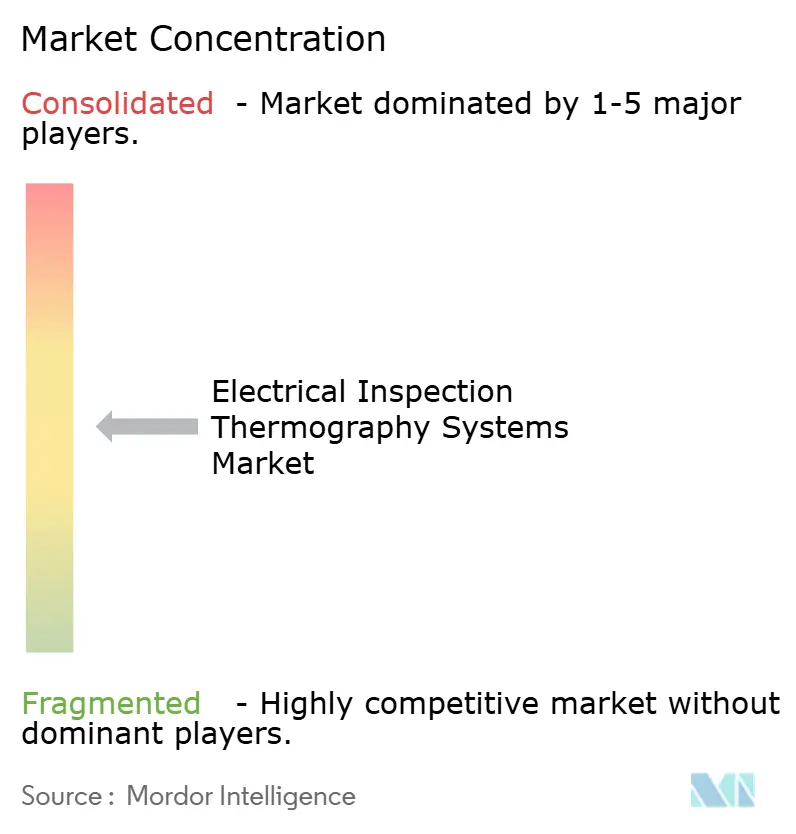
| Market Concentration | Medium |
Major Players *Disclaimer: Major Players sorted in no particular order Image © Mordor Intelligence. Reuse requires attribution under CC BY 4.0. | |
Electrical Inspection Thermography Systems Market Analysis by Mordor Intelligence
The Electrical Inspection Thermography Systems Market size is projected to expand from USD 0.78 billion in 2025 to USD 0.83 billion in 2026, and to USD 1.21 billion by 2031, registering a CAGR of 7.76% between 2026 and 2031. The Electrical inspection thermography systems market is being shaped by mandatory preventive maintenance requirements and the need to maintain continuity across an expanding portfolio of electrical assets. Annual inspection obligations make thermal inspection a more regular operating requirement for many facilities. Data center construction also adds new switchgear, uninterruptible power systems, busbars, and cooling connections that require inspection. Edge-based analysis and aerial platforms are making it easier to review larger asset portfolios with fewer manual steps. Competition is shifting toward lower-cost hardware, software integration, calibration support, and procurement compliance, while the limited pool of qualified thermographers remains a constraint on service capacity.
Key Report Takeaways
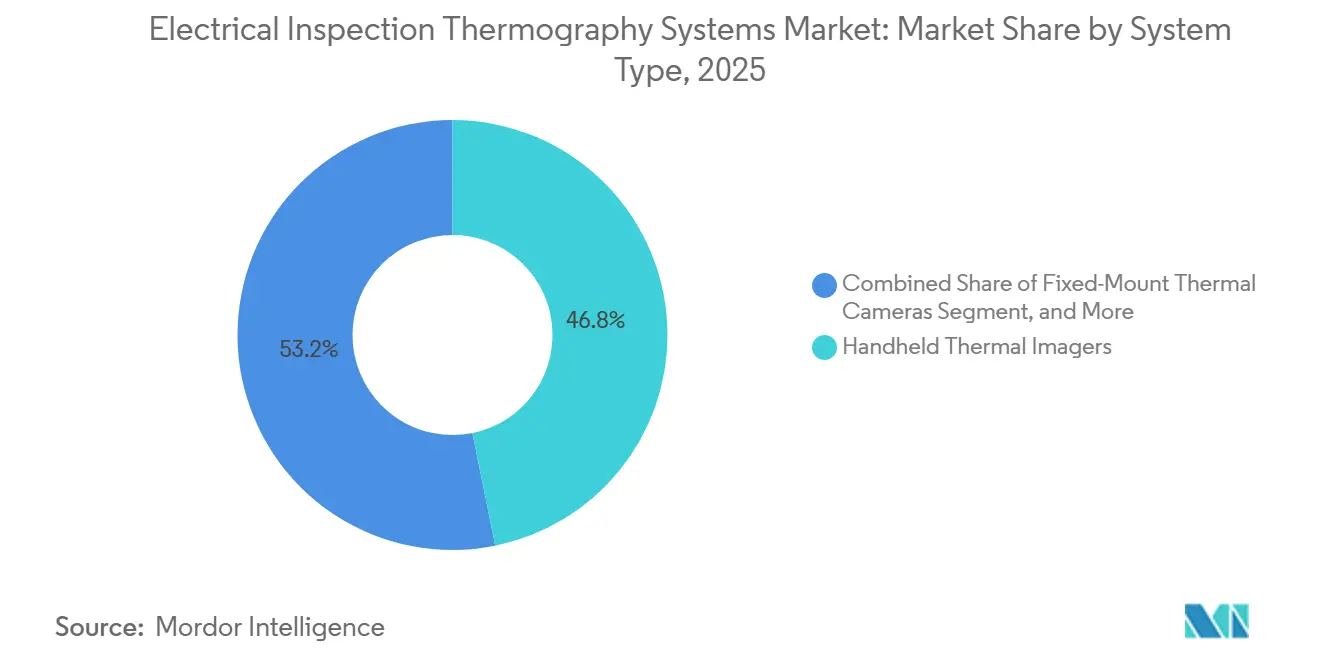
- By system type, handheld thermal imagers held 46.81% of the electrical inspection thermography systems market share in 2025, while drone-mounted systems are projected to expand at a CAGR of 10.43% through 2031.
- By detector technology, uncooled infrared detectors held 87.41% of the electrical inspection thermography systems market share in 2025, while multispectral and hyperspectral detectors are projected to expand at a CAGR of 10.69% through 2031.
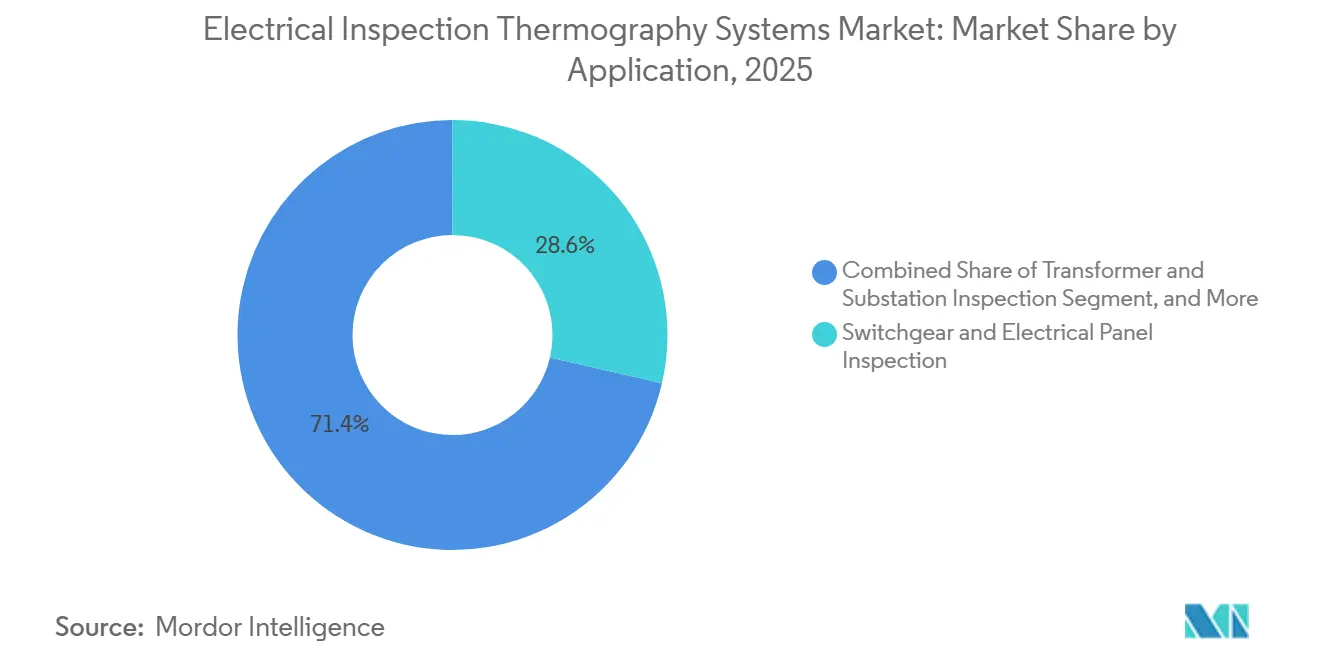
- By application, switchgear and electrical panel inspection accounted for 28.61% of the electrical inspection thermography systems market size in 2025, while solar PV and battery storage inspection is projected to expand at a CAGR of 10.87% through 2031.
- By end-user industry, electric utilities accounted for 31.71% of the electrical inspection thermography systems market in 2025, while renewable energy operators are projected to grow at a 10.95% CAGR through 2031.
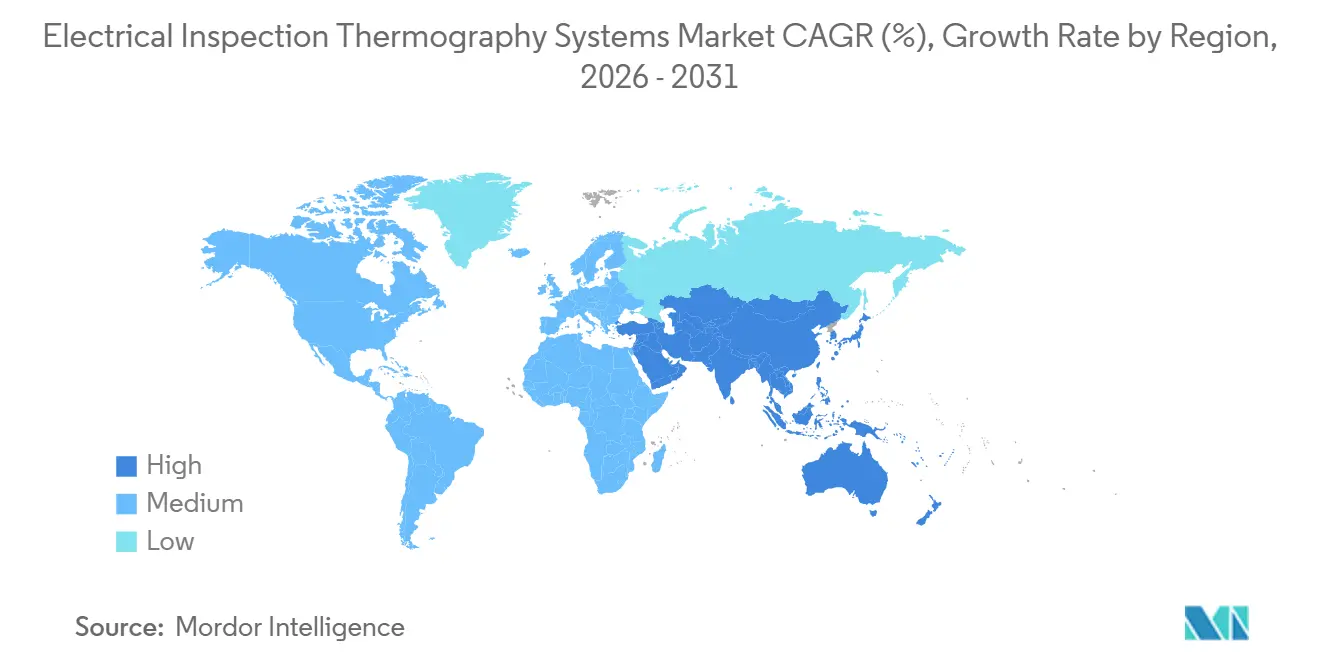
- By geography, Asia-Pacific held 37.81% of the electrical inspection thermography systems market share in 2025 and is projected to expand at a CAGR of 9.13% through 2031.
Note: Market size and forecast figures in this report are generated using Mordor Intelligence’s proprietary estimation framework, updated with the latest available data and insights as of January 2026.
Global Electrical Inspection Thermography Systems Market Trends and Insights
Drivers Impact Analysis*
| Driver | (~) % Impact on CAGR Forecast | Geographic Relevance | Impact Timeline |
|---|---|---|---|
| Mandatory Electrical Preventive Maintenance and Thermography Programs | +2.1% | Global, with primary compliance activity in North America, Europe, and developed Asia-Pacific | Short term (≤ 2 years) |
| Predictive Maintenance for Aging Power Distribution Assets | +1.5% | North America and Europe, with secondary relevance in Japan and Australia | Medium term (2-4 years) |
| Electricity Demand From Data Centers and Industrial Electrification | +1.3% | Global, concentrated in North America, Europe, and East Asia | Short term (≤ 2 years) |
| Renewable Generation and Distributed Energy Asset Expansion | +0.9% | Asia-Pacific, Europe, North America, and Middle East and Africa | Medium term (2-4 years) |
| Edge AI and Automated Thermal Anomaly Detection | +0.8% | Global | Medium term (2-4 years) |
| Drone and Robotic Inspection of Inaccessible Energized Assets | +0.7% | Asia-Pacific, with relevance in North America and Europe | Long term (≥ 4 years) |
| Source: Mordor Intelligence | |||
Mandatory Electrical Preventive Maintenance and Thermography Programs
NFPA 70B made infrared thermographic inspection an obligation in its 2023 edition for covered electrical equipment. The standard requires at least annual surveys for Condition 1 and 2 assets. It requires semiannual surveys for Condition 3 equipment, including assets that missed 2 consecutive maintenance cycles or had earlier anomaly alerts.[1]National Fire Protection Association, “NFPA 70B: Standard for Electrical Equipment Maintenance, 2026 Edition,” National Fire Protection Association, nfpa.org. The 2026 edition recognized permanently installed temperature-measurement devices as a means to meet periodic survey requirements. This recognition supports demand for fixed-mount cameras and wireless monitoring systems in the Electrical inspection thermography systems market. The requirement is recurring because each covered asset must be inspected on a defined schedule rather than only during a broad facility review.
Predictive Maintenance for Aging Power Distribution Assets
The American Society of Civil Engineers assigned the US power grid a D+ grade in its 2025 Infrastructure Report Card. It reported that 70% of large power transformers were more than 25 years old. It also reported that 92% of outages originated on the distribution system, where instrumentation levels were low. These conditions support planned inspection programs for energized assets that cannot be easily taken out of service. A 2026 study covering 142,267 substation assets across 18 countries found that 38%-43% of Spanish and Italian substations had an estimated time to critical condition of less than 15 years. The study found that condition-based maintenance reduced lifecycle costs by a median of 19% compared with age-based replacement, supporting the role of non-contact thermal diagnostics in the Electrical inspection thermography systems market.
Electricity Demand From Data Centers and Industrial Electrification
New hyperscale campuses add switchgear rooms, uninterruptible power systems, busbar networks, and cooling interconnections that need periodic inspection. NFPA 70B Table 9.3.2 includes inspection requirements for relevant electrical equipment. The International Energy Agency estimated global data center electricity consumption at 415 TWh in 2024. It projected consumption to reach 945 TWh by 2030. EPRI estimated US data center electricity use at 177-192 TWh in 2024 and projected 380-790 TWh by 2030. Battery factories, EV charging assets, and electrified manufacturing facilities have similar inspection needs because they place many energized terminations into service without prior inspection records.
Edge AI and Automated Thermal Anomaly Detection
On-device analysis reduces the time required to interpret thermal images during an inspection. A 2026 study on abnormal heating detection in switchgear reported edge inference in less than 20 milliseconds using embedded hardware. The result supports real-time anomaly identification without sending images to the cloud. It also supports permanent installations where continuous local analysis is needed. Automated classification can help less-experienced technicians identify conditions that require further review by qualified personnel. This capability may reduce inspection time and lower the effective cost per inspected asset. The Electrical inspection thermography systems market, therefore, has a path to higher inspection throughput without removing the need for trained decision makers.
Restraints Impact Analysis*
| Restraint | (~) % Impact on CAGR Forecast | Geographic Relevance | Impact Timeline |
|---|---|---|---|
| High Cost of High-Resolution and Cooled Systems | -1.2% | Global, most acute for small and medium-sized enterprises in Asia-Pacific, Middle East and Africa, and South America | Short term (≤ 2 years) |
| Shortage of Certified Thermographers and Interpretation Skills | -0.8% | Global, most pronounced in North America and Europe | Medium term (2-4 years) |
| Measurement Uncertainty From Emissivity, Load, and Weather Conditions | -0.5% | Global | Long term (≥ 4 years) |
| Cybersecurity and Data Sovereignty Risk in Connected Monitoring | -0.4% | Global, with highest sensitivity in critical infrastructure sectors | Medium term (2-4 years) |
| Source: Mordor Intelligence | |||
High Cost of High-Resolution and Cooled Systems
The gap between entry-level uncooled devices and high-resolution cooled platforms creates different purchasing options for different operators. Cooled systems that use mercury cadmium telluride or indium antimonide detectors can cost more than USD 30,000 per unit. Fixed continuous-monitoring arrays for 1 switchgear room can require capital commitments exceeding USD 100,000. IEEE 2969-2025 covers continuous thermal monitoring of switchgear and motor control centers up to 52 kV. The standard has supported interest in continuous monitoring, but it does not remove the cost barrier for smaller building owners and mid-sized operators. The Electrical inspection thermography systems market remains more accessible at the handheld level, while fixed and cooled systems continue to have narrower adoption in cost-sensitive locations.
Shortage of Certified Thermographers and Interpretation Skills
Inspection capacity depends on the availability of qualified personnel and equipment. The ASNT Foundation reported that 42% of the US nondestructive testing workforce was 45 or older. It also reported that 37% of nuclear-sector nondestructive evaluation professionals surveyed in 2024 planned to retire by 2030.[2]American Society for Nondestructive Testing, “A Plan to Rebuild the NDT Pipeline,” Materials Evaluation, asnt.org. New Level II certifications declined 15% in 2024, even though commercial electrical infrared surveys commonly require that qualification. Required field-experience hours under ANSI/ASNT CP-189 cannot be replaced by classroom training alone. Training offered through the ASNT and IRISS collaboration supports the supply pipeline, but the experience requirement means workforce availability will take several years to respond.
*Our forecasts treat driver/restraint impacts as directional, not additive. The impact forecasts reflect baseline growth, mix effects, and variable interactions.
Segment Analysis
By System Type: Handheld Tools Support Core Facility Inspections, While Drone Platforms Extend Coverage
Handheld thermal imagers held 46.81% of the Electrical inspection thermography systems market share in 2025. Their position reflects the installed base and the practical fit of compact devices for many scheduled switchgear inspections. Commercial buildings, light industrial sites, and data centers entering structured maintenance programs can adopt handheld units with lower initial spending. This makes handheld equipment relevant for first-time compliance buyers. Smartphone-attachable imagers can support electricians who prefer a multifunction device. Their limited radiometric resolution restricts their role to qualitative screening rather than detailed diagnosis.
Drone-mounted systems are projected to expand at a CAGR of 10.43% from 2026 to 2031. Utilities use these systems to move from manual patrols to larger-scale thermal surveys of transmission and distribution infrastructure. Fixed-mount cameras support continuous monitoring for equipment that requires repeated observation. Automated and robotic systems serve confined spaces and locations that need recurring scans. These platforms can create a continuing record of asset condition rather than a single inspection result. Other system types remain relevant for specialized deployments where access, safety, or equipment layout limits conventional inspection methods.



By Detector Technology: Uncooled Systems Form the Base, While Spectral Tools Support Specialized Diagnostics
Uncooled infrared detectors accounted for 87.41% of the Electrical inspection thermography systems market in 2025. Microbolometer manufacturing has supported thermal sensitivity below 50 mK in mid-tier commercial products. These detectors operate at ambient temperature and do not require cooling maintenance. Their lower operating complexity supports use in handheld tools and drone-mounted utility systems. Broad availability of supplies also supports their use in common electrical inspection tasks. Cooled detectors are used when the required sensitivity and standoff distance exceed the capability of uncooled devices.
Multispectral and hyperspectral detectors are projected to expand at a CAGR of 10.69% from 2026 to 2031. Solar PV and battery storage operators use them when they need cell-level spectral fault discrimination beyond what broadband uncooled imaging provides. A 2026 study of grid-connected PV systems reported 96.88% fault-segmentation precision and a mean intersection-over-union of 77.83% through infrared thermography and advanced signal processing. IEC/TS 62446-3 sets requirements for outdoor infrared thermography of photovoltaic systems. The standard’s measurement conditions and procedures favor the use of calibrated detector systems for high-value PV inspection work. Teledyne FLIR introduced the A6450 Long-Life Cooled MWIR camera in February 2026 for continuous industrial process control and nondestructive testing.
By Application: Electrical Panels Supply the Largest Volume, While Solar PV and Battery Storage Advance Faster
Switchgear and electrical panel inspection accounted for 28.61% of the Electrical inspection thermography systems market size in 2025. The application is relevant across utilities, commercial sites, manufacturing plants, and data centers. NFPA 70B Table 9.3.2 establishes panel-related inspection requirements for covered electrical equipment. Transformer and substation inspection is another major application because utilities need to preserve high-value power assets. IEEE 2969-2025 also addresses continuous thermal monitoring for relevant distribution equipment. Motor control and industrial equipment inspection support predictive maintenance programs in process and manufacturing facilities.
Solar PV and battery storage inspection is projected to expand at a CAGR of 10.87% from 2026 to 2031. Thermal imaging can detect localized overheating in lithium-ion battery banks before conditions worsen. The application also serves PV systems where performance losses can be associated with detectable temperature patterns. A 2026 PV study showed that infrared imaging, combined with signal processing, can enable detailed fault segmentation. IEC/TS 62446-3 provides a formal reference point for outdoor thermographic inspection of PV systems. These requirements strengthen the case for calibrated inspection procedures within renewable energy portfolios.
By End-User Industry: Utilities Provide the Largest Demand Base, While Renewable Operators Set the Faster Pace
Electric utilities held 31.71% market share in the electrical inspection thermography systems market in 2025. Their large asset portfolios have made thermography a long-standing part of maintenance activity. Utility buyers often require drone-mounted and fixed-mount systems, enterprise reporting software, and support across multiple sites. These needs place greater weight on high-value equipment and contracted service programs. Industrial manufacturing and process industries are the second-largest end-user group. They use thermography on motor control centers, process heaters, and high-current distribution boards as part of established maintenance programs.
Renewable energy operators are projected to expand at a CAGR of 10.95% from 2026 to 2031. Their demand tracks additions of solar and wind capacity and the maintenance needs of expanding portfolios. IEC/TS 62446-3 is increasingly referenced in PV asset-management agreements and insurance conditions. Commercial buildings and data centers also represent an expanding area of demand as scheduled maintenance requirements are applied to newly built facilities. Oil, gas, and petrochemical operators require equipment for hazardous areas that meet ATEX or IECEx requirements. Government, defense, and public infrastructure users provide a steady demand for high-specification equipment, with procurement conditions favoring compliant hardware.
Geography Analysis
Asia-Pacific held 37.81% of the Electrical inspection thermography systems market share in 2025 and is projected to expand at a CAGR of 9.13% through 2031. China’s grid investment program and operating-scale drone inspection activity support demand across transmission lines, substations, and distribution networks. India’s National Electricity Plan adds electrical infrastructure that needs inspection. Japan’s aging nuclear and thermal fleet supports predictive maintenance activity. HIKMICRO, Guide Sensmart, FOTRIC, ULIRVISION, and DALI Technology support a competitive regional equipment supply base.
North America is the second-largest regional area in the Electrical inspection thermography systems market. The US compliance cycle is creating structured demand among commercial and industrial facilities that previously treated infrared inspection as discretionary. EPRI projected US data center electricity use to rise from 177-192 TWh in 2024 to 380-790 TWh by 2030. This expansion supports commissioning activity across electrical infrastructure at hyperscale campuses. Canada and Mexico add demand through grid-reliability investment and maintenance activity in resource-extraction industries.
Europe is the third-largest region, supported by maintenance standards and the energy transition agenda. Offshore wind operators in Germany and the North Sea need aerial thermographic inspection for large marine asset portfolios. The Middle East and Africa benefit from utility expansion in Gulf Cooperation Council countries. South America follows utility capital program cycles, with Brazil and Argentina offering the largest near-term volumes.

Competitive Landscape
The Electrical inspection thermography systems market is moderately fragmented. Teledyne FLIR and Fluke hold leading positions through brand recognition, calibration ecosystems, and enterprise software integration. HIKMICRO, Guide Sensmart, and FOTRIC have reduced the feature gap in mid-tier handheld equipment since 2024. Their products use high-resolution uncooled detectors and on-device analysis at lower price points than many Western alternatives. Established suppliers retain an advantage where buyers need calibration support, software integration, and reliable technical service.
Teledyne FLIR OEM introduced the Lepton XDS in February 2026 for integration into infrastructure monitoring, robotics, and unmanned platforms. FLIR introduced the A6450 Long-Life Cooled MWIR cameras in February 2026 for continuous industrial process control and nondestructive testing.[3]FLIR, “FLIR Launches A6450 Long-Life Cooled MWIR Cameras,” FLIR, flir.com. These releases show investment in embedded modules and permanent monitoring systems. Western vendors also emphasize NDAA compliance and data sovereignty in government and critical infrastructure procurement. This focus helps them address requirements that extend beyond camera performance.
Opportunities remain in fixed-mount monitoring for data center electrical rooms and drone-based utility services. Software that converts thermal images into audit-ready inspection records can add value for customers. Workswell, InfraTec, and Optris focus on fixed-mount and scientific-grade applications. A 2026 IEEE publication reported infrared equipment detection in substations at 118.2 frames per second on edge hardware.
Electrical Inspection Thermography Systems Industry Leaders
Teledyne FLIR LLC
Fluke Corporation
Hangzhou Microimage Software Co., Ltd.
Testo SE & Co. KGaA
Guide Sensmart Tech Co., Ltd.
- *Disclaimer: Major Players sorted in no particular order

Recent Industry Developments
- March 2026: Endesa’s e-distribución deployed 17 long-range FuVeX drones, authorized to operate up to 10 kilometers, for thermographic and digital inspection of more than 320,000 kilometers of power lines in Spain. The deployment integrates thermal, visual, and LiDAR data into aligned 3D models.
- February 2026: FLIR, a Teledyne Technologies company, launched the A6450 Long-Life Cooled MWIR Cameras for continuous industrial process control and nondestructive testing. The cameras have an extended cooler lifetime for permanent electrical and industrial monitoring installations.
- February 2026: Teledyne FLIR OEM launched the Lepton XDS, a compact ITAR-free dual thermal-visible camera module with patented MSX technology for OEM integration into infrastructure monitoring, EV battery management, and unmanned platforms. Cumulative Lepton module shipments exceeded 4 million units from FLIR’s high-volume manufacturing facility.
- January 2026: ANSI/NETA EMW-2026 received formal approval. The standard establishes minimum training and experience requirements for technicians performing electrical thermographic inspections under NFPA 70B.


Global Electrical Inspection Thermography Systems Market Report Scope
The electrical inspection thermography systems market comprises the sale of thermal imaging systems, equipment, and associated hardware used to detect, visualize, measure, and analyze infrared radiation and temperature variations in electrical equipment and infrastructure for the purpose of identifying abnormal heat patterns, electrical faults, component degradation, overloads, loose connections, insulation problems, and other potential failure conditions. These systems enable non-contact and, in many cases, non-destructive inspection of energized electrical assets and support preventive maintenance, condition monitoring, asset management, and electrical safety programs.
The Electrical Inspection Thermography Systems Market Report is Segmented by System Type (Handheld Thermal Imagers, Smartphone-Attachable Thermal Imagers, Fixed-Mount Thermal Cameras, Automated and Robotic Thermal Inspection Systems, Drone-Mounted Thermal Imaging Systems, and Other System Types), Detector Technology (Uncooled Infrared Detectors, Cooled Infrared Detectors, and Multispectral and Hyperspectral Detectors), Application (Switchgear and Electrical Panel Inspection, Transformer and Substation Inspection, Transmission and Distribution Line Inspection, Solar PV and Battery Storage Inspection, Motor Control and Industrial Electrical Equipment Inspection, and Other Applications), End-User Industry End-User Industry (Electric Utilities, Industrial Manufacturing and Process Industries, Oil and Gas and Petrochemicals, Commercial Buildings and Data Centers, Renewable Energy Operators, Government, Defense, and Public Infrastructure, and Other End-User Industries), and Geography (North America, South America, Europe, Asia-Pacific, and Middle East and Africa). The Market Forecasts are Provided in Terms of Value (USD).
| Handheld Thermal Imagers |
| Smartphone-Attachable Thermal Imagers |
| Fixed-Mount Thermal Cameras |
| Automated and Robotic Thermal Inspection Systems |
| Drone-Mounted Thermal Imaging Systems |
| Other System Types |
| Uncooled Infrared Detectors |
| Cooled Infrared Detectors |
| Multispectral and Hyperspectral Detectors |
| Switchgear and Electrical Panel Inspection |
| Transformer and Substation Inspection |
| Transmission and Distribution Line Inspection |
| Solar PV and Battery Storage Inspection |
| Motor Control and Industrial Electrical Equipment Inspection |
| Other Applications |
| Electric Utilities |
| Industrial Manufacturing and Process Industries |
| Oil and Gas and Petrochemicals |
| Commercial Buildings and Data Centers |
| Renewable Energy Operators |
| Government, Defense, and Public Infrastructure |
| Other End-User Industries |
| North America | United States | |
| Canada | ||
| Mexico | ||
| South America | Brazil | |
| Argentina | ||
| Rest of South America | ||
| Europe | Germany | |
| United Kingdom | ||
| France | ||
| Italy | ||
| Spain | ||
| Rest of Europe | ||
| Asia-Pacific | China | |
| Japan | ||
| India | ||
| South Korea | ||
| ASEAN | ||
| Rest of Asia-Pacific | ||
| Middle East and Africa | Middle East | Saudi Arabia |
| United Arab Emirates | ||
| Turkey | ||
| Rest of the Middle East | ||
| Africa | South Africa | |
| Nigeria | ||
| Rest of Africa | ||
| By System Type | Handheld Thermal Imagers | ||
| Smartphone-Attachable Thermal Imagers | |||
| Fixed-Mount Thermal Cameras | |||
| Automated and Robotic Thermal Inspection Systems | |||
| Drone-Mounted Thermal Imaging Systems | |||
| Other System Types | |||
| By Detector Technology | Uncooled Infrared Detectors | ||
| Cooled Infrared Detectors | |||
| Multispectral and Hyperspectral Detectors | |||
| By Application | Switchgear and Electrical Panel Inspection | ||
| Transformer and Substation Inspection | |||
| Transmission and Distribution Line Inspection | |||
| Solar PV and Battery Storage Inspection | |||
| Motor Control and Industrial Electrical Equipment Inspection | |||
| Other Applications | |||
| By End-User Industry | Electric Utilities | ||
| Industrial Manufacturing and Process Industries | |||
| Oil and Gas and Petrochemicals | |||
| Commercial Buildings and Data Centers | |||
| Renewable Energy Operators | |||
| Government, Defense, and Public Infrastructure | |||
| Other End-User Industries | |||
| By Geography | North America | United States | |
| Canada | |||
| Mexico | |||
| South America | Brazil | ||
| Argentina | |||
| Rest of South America | |||
| Europe | Germany | ||
| United Kingdom | |||
| France | |||
| Italy | |||
| Spain | |||
| Rest of Europe | |||
| Asia-Pacific | China | ||
| Japan | |||
| India | |||
| South Korea | |||
| ASEAN | |||
| Rest of Asia-Pacific | |||
| Middle East and Africa | Middle East | Saudi Arabia | |
| United Arab Emirates | |||
| Turkey | |||
| Rest of the Middle East | |||
| Africa | South Africa | ||
| Nigeria | |||
| Rest of Africa | |||


Key Questions Answered in the Report
What is the electrical inspection thermography systems market size?
The Electrical inspection thermography systems market size is projected to be USD 0.83 billion in 2026 and USD 1.21 billion by 2031, at a CAGR of 7.76%. The forecast reflects greater use of scheduled thermal inspection across electrical equipment in the Electrical inspection thermography systems market.
What is driving demand for electrical thermography systems?
NFPA 70B inspection requirements, aging grid assets, data center electricity demand, industrial electrification, and renewable asset expansion are supporting demand. These factors increase the number of electrical assets that need planned condition assessment in the Electrical inspection thermography systems market.
Which electrical inspection system type is expanding the fastest?
Drone-mounted systems are projected to expand at a CAGR of 10.43% from 2026 to 2031. Utilities use them to survey transmission and distribution assets over larger areas than a conventional walk-up inspection can cover in the Electrical inspection thermography systems market.
Why are uncooled infrared detectors used most often?
Uncooled detectors held 87.41% share in 2025 because they operate at ambient temperature and require no cooling maintenance. They are used in handheld and drone-mounted equipment across routine applications in the Electrical inspection thermography systems market.
Which application has the fastest projected expansion?
Solar PV and battery storage inspection is projected to expand at a CAGR of 10.87% through 2031. Thermography can identify heat patterns in PV systems and localized overheating in lithium-ion battery banks.
Which region is expected to lead demand?
Asia-Pacific held 37.81% share in 2025 and is projected to expand at a CAGR of 9.13% through 2031. Grid investment, renewable assets, and a substantial equipment supply base support the region’s position.
Page last updated on:


 Your data is secure and never sold or shared.


