
Electric Ranges Market Size and Share
Market Overview
| Study Period | 2020 - 2031 |
|---|---|
| Market Size (2026) | USD 17.35 Billion |
| Market Size (2031) | USD 22.48 Billion |
| Growth Rate (2026 - 2031) | 5.31 % |
| Fastest Growing Market | Asia-Pacific |
| Largest Market | North America |
| Market Concentration | Medium |
Major Players *Disclaimer: Major Players sorted in no particular order Image © Mordor Intelligence. Reuse requires attribution under CC BY 4.0. | |
Electric Ranges Market Analysis by Mordor Intelligence
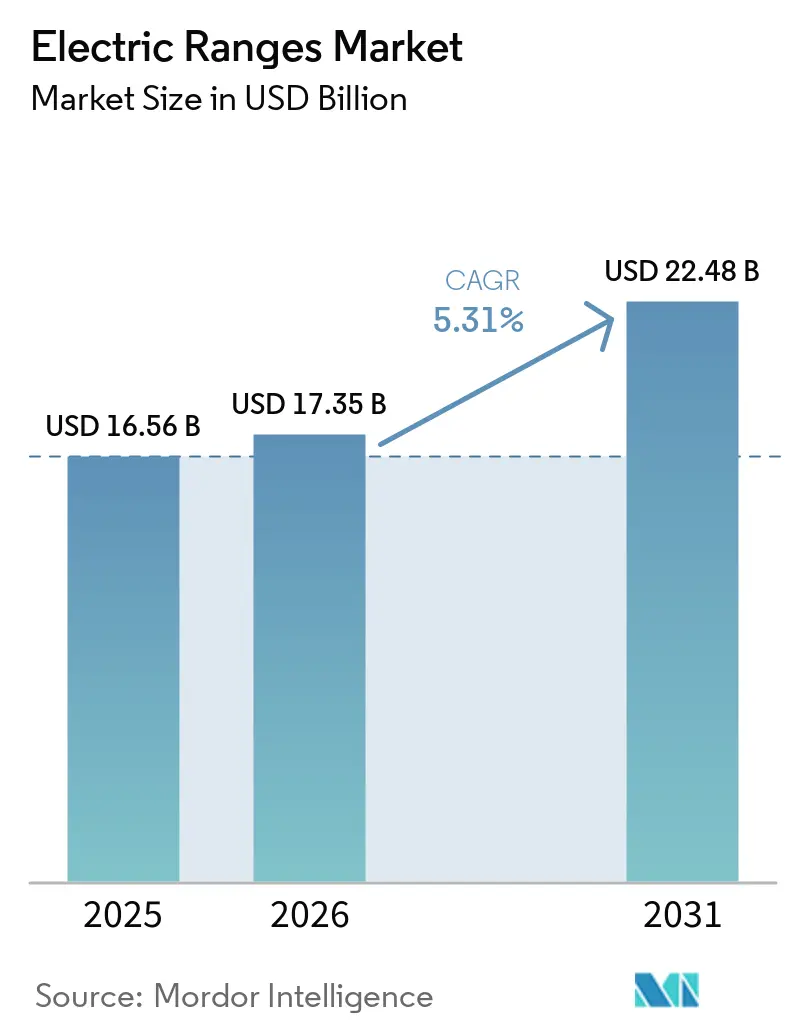
The electric ranges market size is projected to expand from USD 16.6 billion in 2025 and USD 17.4 billion in 2026 to USD 22.5 billion by 2031, registering a CAGR of 5.3% between 2026 and 2031. Building electrification requirements are changing kitchen specifications in new construction and retrofit work across North America and Europe. Energy price volatility also keeps attention on the operating costs of gas and electric cooking appliances. Apartment construction in Asia-Pacific gives developers a practical reason to specify electric ranges before gas infrastructure is installed. Battery-equipped 120V induction products widen the replacement opportunity in older multifamily buildings that lack dedicated high-voltage circuits. Competition is becoming more demanding in the mid-price tier as Chinese manufacturers expand internationally and established brands rely on connected product platforms and manufacturing partnerships.
Key Report Takeaways
- By product type, freestanding electric ranges held 59.1% of revenue in 2025, while slide-in electric ranges are forecast to grow at a 7.1% CAGR through 2031.
- By cooking technology, smooth-top radiant products held 53.3% of revenue in 2025, while induction is forecast to grow at an 8.8% CAGR through 2031.
- By oven configuration, single-oven electric ranges held 73.3% of revenue in 2025, while steam-enabled electric ranges are forecast to grow at a 7.4% CAGR through 2031.
- By end-user, residential customers held 84.3% of revenue in 2025, while commercial users are forecast to grow at a 7.7% CAGR through 2031.
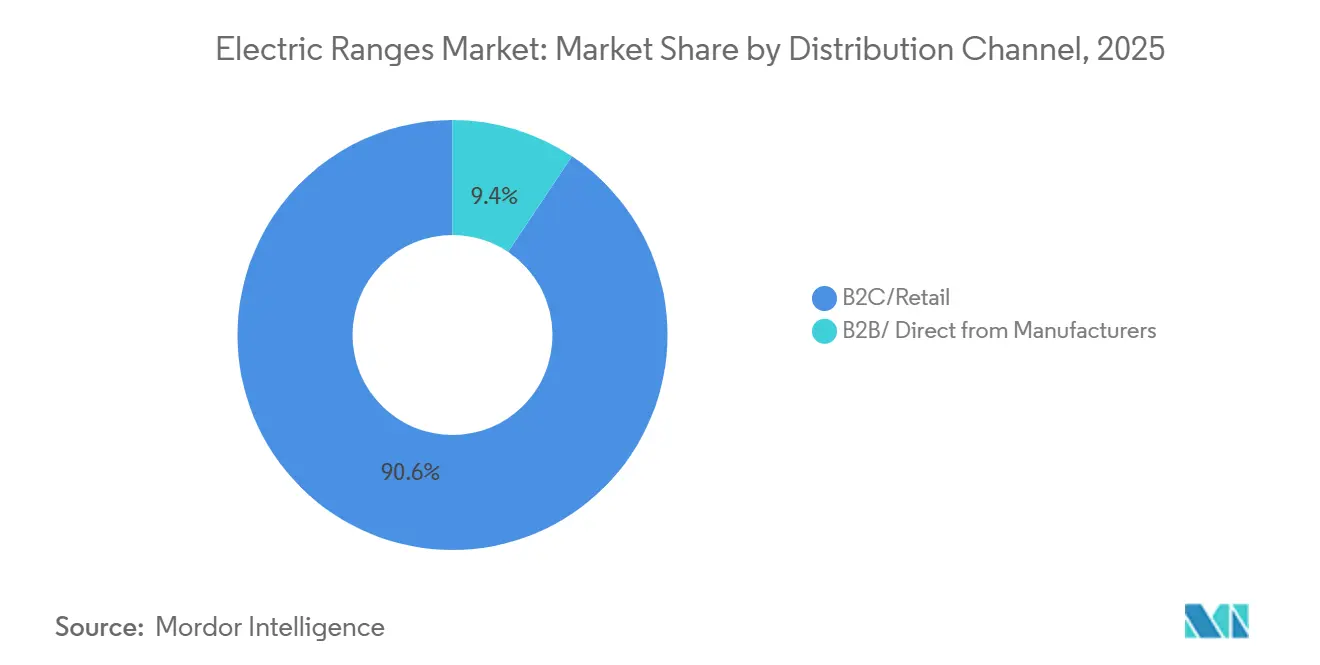
- By distribution channel, B2C and retail channels held 90.6% of revenue in 2025 and are forecast to grow at a 6.8% CAGR through 2031.
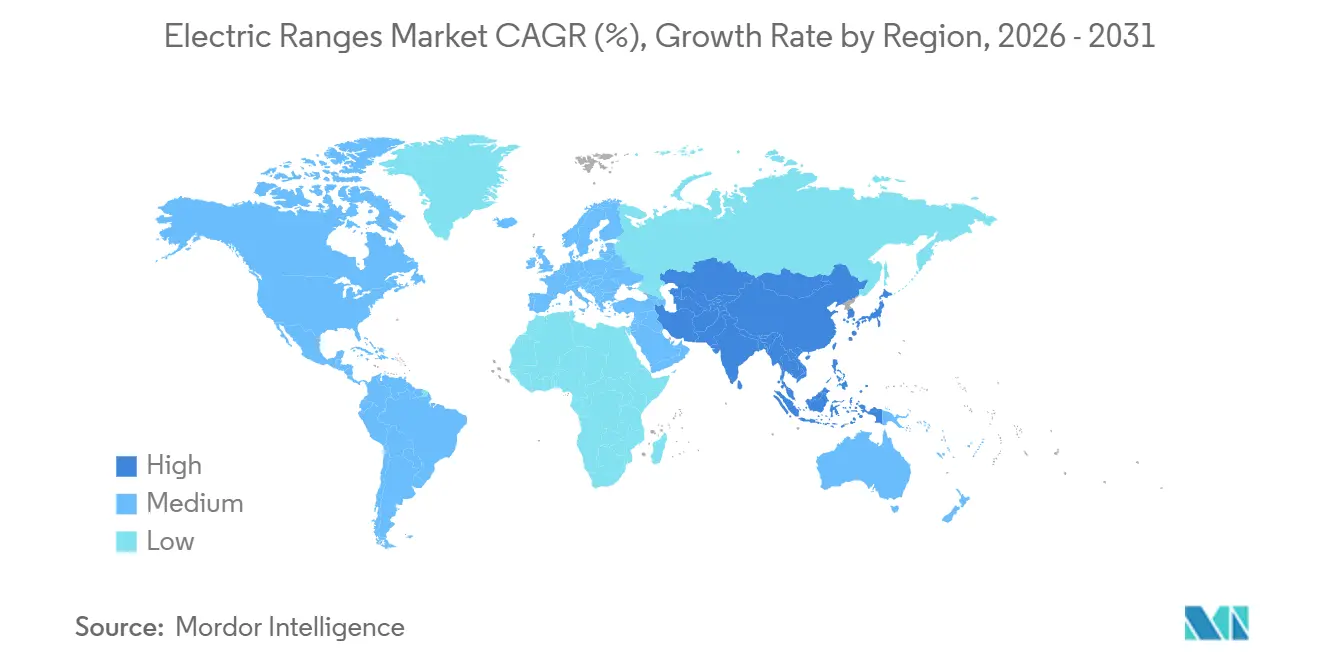
- By geography, North America held 38.3% of revenue in 2025, while Asia-Pacific is forecast to grow at a 7.9% CAGR through 2031.
Note: Market size and forecast figures in this report are generated using Mordor Intelligence’s proprietary estimation framework, updated with the latest available data and insights as of January 2026.
Market Trends and Insights
Drivers Impact Analysis of Electric Ranges Market*
| Driver | (~) % Impact on CAGR Forecast | Geographic Relevance | Impact Timeline |
|---|---|---|---|
| Gas-to-Electric Cooking Transition | +1.4% | North America, Europe, Urban Asia | Short term (≤ 2 years) |
| Induction Efficiency and Precision Advantages | +1.1% | Global | Medium term (2-4 years) |
| Connected Cooking and Battery-Ready Induction Deployment | +1.2% | North America, Europe, East Asia | Medium term (2-4 years) |
| Urban Apartment Development, Replacement Demand, and Commercial Electrification | +1.2% | Asia-Pacific, South America, North America, Europe | Long term (≥ 4 years) |
| Commercial Kitchen Electrification and Ventilation Savings | +0.5% | North America, Europe | Medium term (2-4 years) |
| Battery-Ready and 120-Volt Induction Deployment | +0.4% | North America, Europe | Short term (≤ 2 years) |
| Source: Mordor Intelligence | |||
Gas-to-Electric Cooking Transition
Municipal building codes and state energy mandates are shifting new construction and retrofit activity toward electric cooking. This change supports replacement demand that does not depend only on household preference cycles. A February 2026 CalMTA field study reported that 70% of California households cooked with gas appliances, showing the scale of the possible transition [1]. Global Action Plan’s 2025 social-housing pilot in Greater Manchester replaced gas hobs with induction-topped electric ranges in 10 homes and used before-and-after indoor-air monitoring. An IISD policy brief published in February 2026 identified electric cooking as a priority alternative to LPG dependence in urban India, where electricity distribution reforms improve practical adoption conditions [2]. New York City’s Local Law 97 also makes building operators more attentive to equipment choices that can help reduce future compliance costs.
Induction Efficiency and Precision Advantages
Induction technology provides a clear operating benefit because it directs heat to cookware rather than heating the surrounding surface and air. CalMTA’s product assessment reported laboratory efficiency of 84.8% for induction, compared with 77.4% for resistance cooking and 31.9% for gas cooking. A Michigan field study by Slipstream found that gas-to-induction retrofits reduced total cooking energy use by 45%, or 1,350 kBTU per household each year. Lower heat released into kitchens can also reduce cooling needs in warm climates, which strengthens the case for commercial and institutional buyers. The United States Environmental Protection Agency recognized residential induction cooking tops through its ENERGY STAR Emerging Technology Award, giving retailers a federal efficiency reference. These benefits help buyers weigh a higher purchase price against lower energy use, improved temperature control, and a more comfortable kitchen environment.
Connected Cooking and Battery-Ready Induction Deployment
Connected appliances are making ecosystem compatibility more relevant when households choose a new electric range. Samsung’s 2026 Bespoke AI kitchen lineup includes slide-in electric ranges with Auto Connectivity, which activates compatible ventilation equipment when the cooktop begins operating. LG is offering a 2-year smart warranty on eligible ThinQ-connected products purchased through December 2026, which encourages use of its connected platform. Battery-equipped 120V induction products address the dedicated-circuit barrier in some older apartments, although their current pricing limits broad near-term use. CalMTA’s February 2026 field report showed that such products could support 99.98% of 6,175 cooking events across 32 multifamily apartments. Together, connected features and circuit-flexible products give larger brands more ways to serve renovation buyers and multifamily operators.
Urban Apartment Development, Replacement Demand, and Commercial Electrification
High-density construction in India, China, and Southeast Asia often places electric ranges in new apartments before gas connections become part of building design. The IISD’s February 2026 brief linked India’s urban electric-cooking potential to power-distribution reforms and a growing need to reduce LPG dependence. North American renovation demand supports a separate replacement cycle, particularly where households move from basic freestanding coil units to connected slide-in products. Commercial buyers also consider electric kitchens because lower waste heat can reduce ventilation needs and improve staff comfort. FCSI reported that all-electric commercial kitchens can provide more comfortable working conditions and support staff retention. These different demand sources give the electric ranges market support from construction, renovation, hospitality, and institutional procurement rather than from a single housing cycle.
Restraints Impact Analysis of Electric Ranges Market*
| Restraint | (~) % Impact on CAGR Forecast | Geographic Relevance | Impact Timeline |
|---|---|---|---|
| High Upfront Cost of Induction Ranges | -0.7% | North America, Europe, Emerging Markets | Short term (≤ 2 years) |
| Electrical Panel and Circuit Upgrade Requirements | -0.6% | North America, Europe | Medium term (2-4 years) |
| Cookware Compatibility and Consumer Learning Curve | -0.4% | Global | Short term (≤ 2 years) |
| Semiconductor, Power-Electronics, and Critical-Material Exposure | -0.3% | Global | Medium term (2-4 years) |
| Source: Mordor Intelligence | |||
High Upfront Cost of Induction Ranges
Premium induction ranges typically retailed for USD 1,500-5,000, compared with USD 600-1,200 for entry-level smooth-top radiant models. The initial price gap can delay adoption in value-sensitive households and smaller commercial kitchens. Existing aluminum and copper cookware may not work with induction, which can add USD 75-450 to a household’s switching cost. Manufacturers are introducing lower-priced induction products in some emerging markets, but lower prices can limit the resources available for connected features and steam functions. San Mateo County’s 2025 commercial-kitchen study found that the transition cost was likely too high for many small businesses to bear without support [3].
Electrical Panel and Circuit Upgrade Requirements
Most freestanding electric and induction ranges require a dedicated 240V circuit with 40-50 amp capacity. Older residential buildings can require panel upgrades before residents can replace a gas range with a standard electric model. CalMTA’s February 2026 multifamily study connected this infrastructure obstacle with the continued use of gas cooking in California homes. Battery-equipped 120V induction ranges reduce this constraint for some apartments, but their current prices make them more accessible to higher-income purchasers or subsidized projects. Rewiring America notes that major service upgrades can become costly when a property also needs utility-side work or changes to underground wiring. Wider product availability and lower costs could reduce the constraint over time, but electrical infrastructure remains an important hurdle through 2028.
*Our forecasts treat driver/restraint impacts as directional, not additive. The impact forecasts reflect baseline growth, mix effects, and variable interactions.
Electric Ranges Market Segment Analysis
By Product Type:
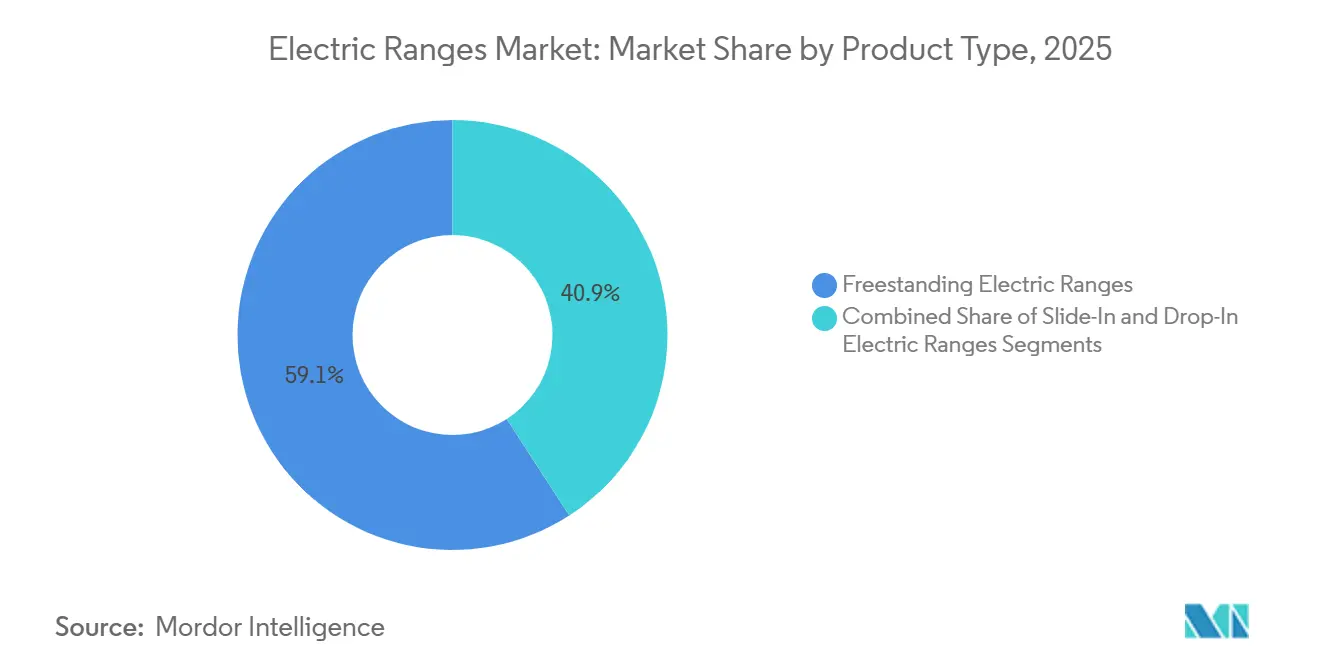
Freestanding Formats, Anchor Volume as Slide-Ins, Gain Renovation DemandFreestanding electric ranges held 59.1% of the electric ranges market share in 2025, reflecting their fit across rental homes, first-time purchases, and kitchens without custom cabinetry. Their practical installation requirements support broad demand in the Asia-Pacific and South America. Slide-in electric ranges are forecast to grow at a 7.1% CAGR through 2031 as renovation projects favor a countertop-flush appearance. Samsung’s 2026 Bespoke slide-in models start at USD 1,349 and include pro-style handles, soft-close doors, and Air Fry Max features [4]. LG’s connected slide-in offerings pair InstaView, ProBake Convection, and ThinQ controls in products aimed at buyers seeking a more integrated kitchen layout. The format is therefore moving from an installation preference toward a product choice shaped by features, finishes, and connected capability.
Drop-in electric ranges occupy a smaller niche centered on replacement demand in custom kitchens. Their built-in countertop opening makes a like-for-like replacement more likely when the original unit reaches the end of service. This installation pattern supports established brands that have showroom relationships with cabinet retailers and kitchen designers. It also makes the segment less dependent on the higher unit volumes seen in freestanding formats. Slide-in ranges benefit from renovation budgets because they offer a built-in appearance without requiring the full cost of a custom drop-in design. The electric ranges market continues to need freestanding products for accessible volume, while slide-ins give manufacturers a way to capture premium renovation spending.

By Cooking Technology:
Smooth-Top Radiant Leads as Induction ExpandsSmooth-top radiant products accounted for 53.3% of the electric ranges market size in 2025, supported by a visible upgrade from coil models at a moderate price premium. The format avoids the cookware compatibility concerns that can delay induction purchases. Induction is the fastest-growing cooking technology and is forecast to expand at an 8.8% CAGR through 2031. Its strong efficiency and precise control support the premium value proposition for both residential and commercial customers. The EPA’s ENERGY STAR program recognized residential induction cooking tops through its Emerging Technology Award. This recognition gives product sellers an established reference when explaining why induction differs from conventional resistance cooking.
Electric coil ranges remain relevant where durability, simple repair, and low purchase cost matter more than precision or design. This is especially important in parts of South Asia and Sub-Saharan Africa. Hybrid formats combine radiant and induction elements, allowing households to use some existing cookware while trying induction technology. Hisense introduced its Smart Induction Range at CES 2026 with a ConnectLife AI Cooking Agent, a tri-element preheating system, and bridge-capable cooking zones. These features address meal planning, preheating, and cookware flexibility, which are common concerns for first-time buyers. The electric ranges market size for induction products is supported by efficiency, but adoption still depends on cost, compatible cookware, and consumer familiarity.
By Oven Configuration:
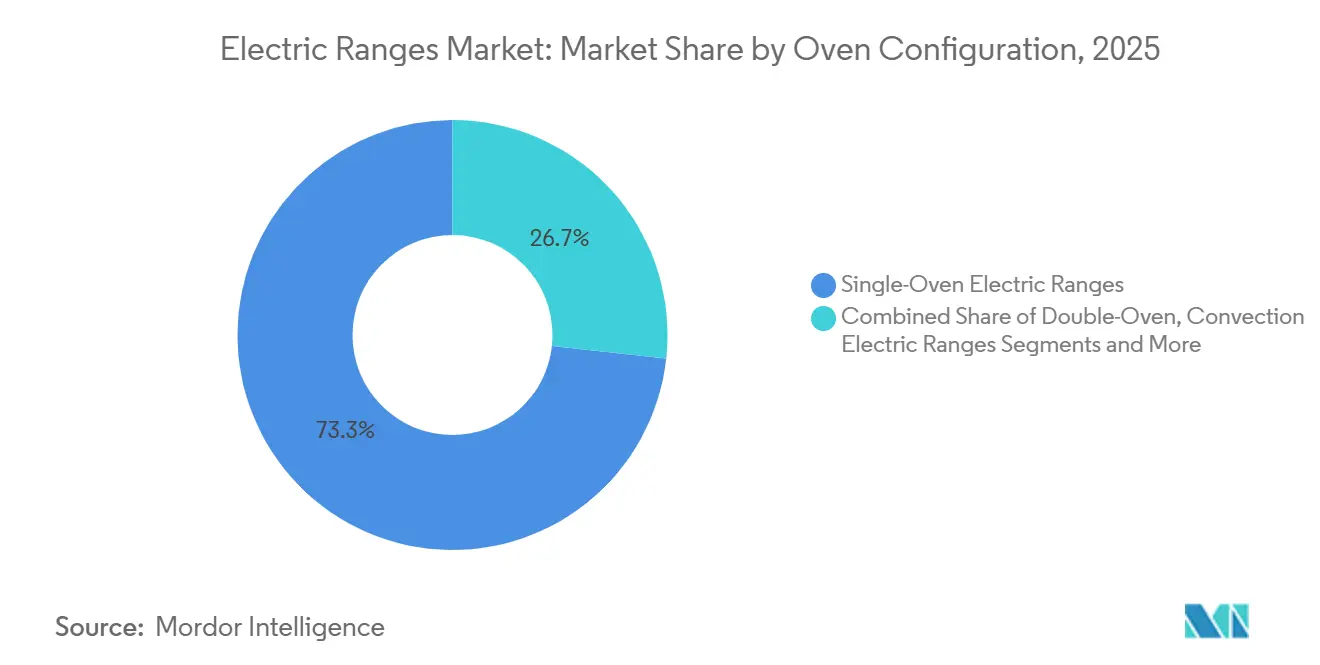
Single Ovens Lead as Steam Features Move Beyond Premium KitchensSingle-oven electric ranges held 73.3% of revenue in 2025 because standard kitchen dimensions favor this practical configuration. The format suits a broad range of household sizes and income levels. Steam-enabled electric ranges are forecast to grow at a 7.4% CAGR through 2031. Demand is linked to interest in lower-oil cooking and the ability to manage food preparation more efficiently. Commercial users also value steam functionality for reducing cook times and food waste. Steam features, therefore, offer manufacturers a route to differentiate premium and upper-midrange products without changing the appliance’s basic role in the kitchen.
Double-oven models appeal to larger North American households that want to cook dishes at different temperatures. Their added height, cost, and installation footprint constrain use in smaller kitchens. Convection ranges are increasingly standard in midrange products as manufacturers move fan-assisted cooking features into more accessible price tiers. Brands including Miele and BSH’s Siemens and Gaggenau lines have helped move steam-combi cooking from professional catering into residential premium kitchens. Steam and speed ovens were identified as prominent cooking categories in 2026 appliance coverage, but no external growth figure is used here. The electric ranges industry can use this feature migration to support product upgrades, particularly when steam functions become available below USD 1,500.
By End-User:
Residential Volume Supports a Faster Commercial TransitionResidential users accounted for 84.3% of revenue in 2025 and remained the central source of unit volume. North American and European homeowners generally support higher value per unit through renovation-driven upgrades. Asia-Pacific volumes are supported by developers specifying midrange electric ranges for large new apartment projects. The commercial segment is forecast to grow at a 7.7% CAGR through 2031. HoReCa operators, institutional cafeterias, and fast-casual restaurants are considering electrification to reduce ventilation requirements and meet urban emissions standards. The commercial electric ranges market size, therefore, depends on both equipment demand and the financial support available for kitchen conversion.
San Mateo County’s 2025 review of 10 food-service establishments documented the capital requirements that can complicate commercial kitchen electrification. Utility incentives and policy programs can help operators address these costs. FCSI noted that all-electric kitchens may create more comfortable work areas and help with staff retention. Within commercial demand, HoReCa is the largest sub-segment. Institutional kitchens in hospitals, universities, and government facilities present a longer-term opportunity for larger contract orders. This mix gives suppliers an opportunity to sell both individual appliances and coordinated kitchen solutions.
By Distribution Channel:
Retail Leads While Digital Channels Change Product DiscoveryB2C and retail channels accounted for 90.6% of revenue in 2025 and are forecast to grow at a 6.8% CAGR through 2031. The high share reflects the household focus of the category and the continuing importance of consumer retail. Online retail is growing within B2C because buyers can compare burner power, oven capacity, finish choices, and connectivity features before visiting a store. Digital research is useful for an appliance purchase that requires buyers to assess several technical and design specifications. Multi-brand retailers and brand outlets remain important where a live demonstration can clarify induction and steam-oven benefits. The electric ranges market relies on both digital comparison and physical selling environments for higher-consideration purchases.
B2B and direct manufacturer channels represent less than 10% of value, but they influence builder specifications and commercial procurement contracts. A single developer or housing authority decision can place hundreds of units. This makes direct relationships strategically important even when they represent a smaller share of annual sales. Supplier access to builders, kitchen consultants, and public housing programs can shape the equipment installed in new projects. Retail networks remain decisive for replacement demand, while direct sales matter more for planned construction and institutional upgrades. The channel structure favors manufacturers that can support store sales, online discovery, and complex project requirements at the same time.
Geography Analysis
North America Electric Ranges Market
North America held 38.3% of global revenue in 2025 and is forecast to grow at a 5.6% CAGR through 2031. The region benefits from the United States residential replacement cycle and renovation activity in suburban single-family homes. Commercial electrification demand is concentrated in California, New York, and other high-density coastal markets. New York State committed USD 32 million to electrify cooking appliances in public housing. At the same time, New York City completed its first full-building battery-equipped induction installation in a Bronx affordable-housing building in March 2026. Federal guidance ending fuel-switching rebates adds friction to residential retrofit demand, but local electric-ready building codes and multifamily construction continue to support activity. Canada adds a replacement cycle that broadly follows the United States, while Mexico offers a developing commercial opportunity connected with hotel and hospitality construction.
South America, APAC and Oceania Electric Ranges Market
South America is forecast to grow at a 5.2% CAGR through 2031. Brazil and Chile support first-time electric range adoption through apartment construction and the gradual expansion of organized retail. Asia-Pacific is the fastest-growing regional electric ranges market at a 7.9% CAGR through 2031. Urbanization, rising middle-class incomes, and China’s premium appliance demand support the region’s growth. India’s electric-cooking momentum is supported by power-distribution reforms and the need for alternatives to LPG use in urban settings. Japan and South Korea support technology upgrade demand for connected and AI-assisted cooking products, while Australia leads Oceania’s 5.4% CAGR as preferences shift toward induction products.
EMEA Electric Ranges Market
Europe is forecast to grow at a 5.4% CAGR through 2031 as the United Kingdom shifts toward electric cooking and EU efficiency rules raise appliance performance requirements. The April 2024 Whirlpool-Arçelik transaction created Beko Europe B.V., with Arçelik holding 75% and Whirlpool holding 25%. Nordic countries are moving from initial induction adoption toward connected-product upgrades. Western Asia is forecast to grow at a 5% CAGR because hospitality expansion in the UAE and Saudi Arabia supports commercial kitchen purchases. Africa is forecast to grow at a 4.7% CAGR, with affordability and infrastructure constraints limiting near-term residential adoption. North African cities provide a more accessible near-term channel than many Sub-Saharan markets.
Competitive Landscape
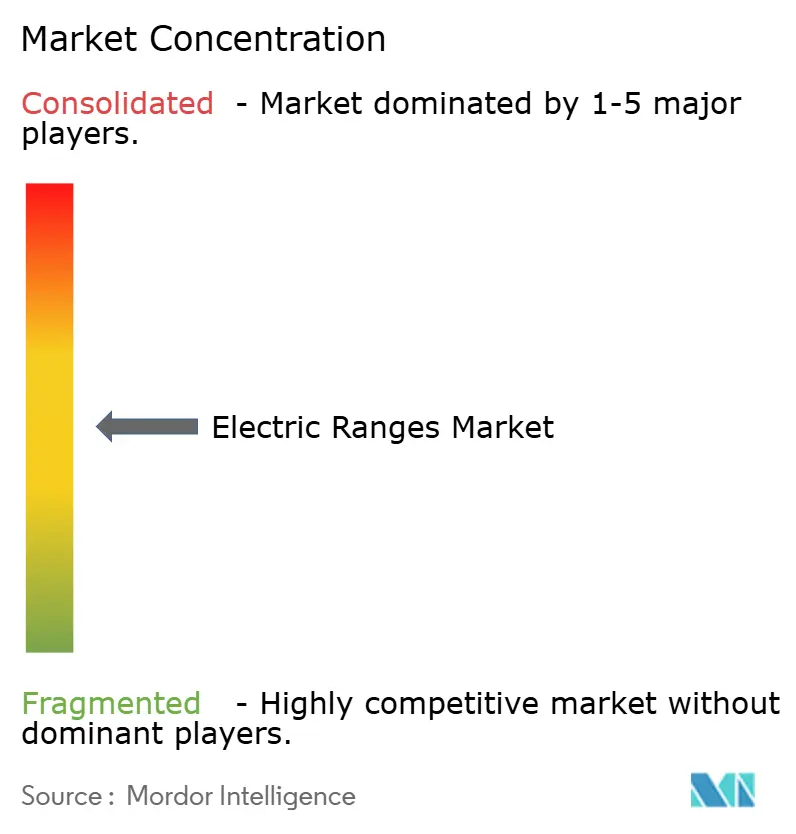
The global electric ranges market is moderately concentrated because the top 5 manufacturers held 47%-52% of revenue in 2025. This structure leaves room for regional and specialist suppliers, while still allowing major brands to influence feature development and pricing. Whirlpool, Samsung, LG, GE Appliances, and Electrolux compete through connected platforms and broader kitchen appliance portfolios. A Wi-Fi-enabled range connected to a proprietary application can encourage repeat purchases across a household’s kitchen. Samsung’s 2026 Bespoke Auto Connectivity system links a compatible slide-in electric range and over-the-range microwave to activate ventilation when cooking starts. This approach makes connectivity a practical feature rather than only a product specification.
Electrolux Group and Midea Group announced a long-term North American manufacturing and sales partnership in April 2026, with joint-venture operations expected to begin in the third quarter of 2026. This partnership reflects the need for established brands to manage manufacturing costs while maintaining product development. Midea, Haier, and Hisense are also building their presence through premium connected products and wider international distribution. Hisense’s 2026 Smart Induction Range introduced AI-supported meal planning and flexible cooking zones for North American buyers. Mid-price competition is therefore becoming more difficult, while established Western brands place more emphasis on connected features, product ecosystems, and supply-chain partnerships.
Bertazzoni, Smeg, Viking, Miele, and Fisher & Paykel compete in premium categories through design, culinary heritage, and professional-style performance. Their positioning is less dependent on manufacturing efficiency than value-oriented product lines. Battery-equipped 120V induction suppliers also represent a separate product category that established range manufacturers have not widely entered. Copper closed a USD 28 million Series A round in August 2025 and announced an agreement with the New York City Housing Authority for 10,000 units. The product can serve multifamily buildings that cannot easily install 240V circuits, although its current cost limits broader adoption. The electric ranges market is consequently shaped by established appliance brands, premium specialists, and newer suppliers addressing electrical constraints.
Electric Ranges Industry Leaders
-
Whirlpool Corporation
-
Samsung Electronics Co., Ltd.
-
LG Electronics Inc.
-
GE Appliances, a Haier company
-
Electrolux AB
- *Disclaimer: Major Players sorted in no particular order
Electric Ranges Market Companies Covered in this Report
- Whirlpool Corporation
- Samsung Electronics Co., Ltd.
- LG Electronics Inc.
- GE Appliances, a Haier company
- Electrolux AB
- BSH Hausgeräte GmbH
- Haier Smart Home Co., Ltd.
- Midea Group Co., Ltd.
- Teka Group
- Miele & Cie. KG
- Arçelik A.Ş.
- Beko plc
- Hisense Group
- Smeg S.p.A.
- Fisher & Paykel Appliances Ltd.
- Bertazzoni S.p.A.
- Viking Range, LLC
- Sub-Zero Group, Inc.
- AGA Rangemaster Group
- Brown Stove Works, Inc.
Recent Industry Developments in Electric Ranges Market
- March 2026: SEBCO Development Inc. completed New York City's first full-building battery-equipped induction-stove installation in a Bronx affordable-housing building, deploying Copper's 120V ranges under New York State's USD 32 million electric cooking commitment.
- February 2026: Samsung launched its 2026 Bespoke AI kitchen appliance lineup in the United States market, including Bespoke Smart Slide-in Electric Ranges with Auto Connectivity, Air Fry Max, and pro-style design, priced from USD 1,349.
- February 2026: Hisense launched its Smart Induction Range at CES 2026, featuring a ConnectLife AI Cooking Agent with step-by-step meal-planning capability, a tri-element algorithm for rapid preheating, and bridge-capable cooking zones accommodating a variety of cookware sizes.
- August 2025: Copper closed a USD 28 million Series A financing round to scale production of its battery-equipped 120V induction range and expand into new markets. The financing was accompanied by an announced deal with the New York City Housing Authority for 10,000 units.
Global Electric Ranges Market Report Scope
The global electric ranges report is segmented by product type, cooking technology, oven configuration, end-user, distribution channel, and geography. Product types include freestanding, slide-in, and drop-in electric ranges. Cooking technologies include coil, smooth-top radiant, induction, and hybrid products. Oven configurations include single-oven, double-oven, convection, and steam-enabled electric ranges. The report covers residential and commercial end-users, along with B2B and B2C or retail distribution channels. Geographic coverage includes North America, South America, Europe, Asia-Pacific, and the Middle East and Africa. The report provides forecasts in value terms in USD.
Segmentation Overview
| Freestanding Electric Ranges |
| Slide-In Electric Ranges |
| Drop-In Electric Ranges |
| Electric Coil |
| Smooth-Top Radiant |
| Induction |
| Hybrid and Other Electric Technologies |
| Single-Oven Electric Ranges |
| Double-Oven Electric Ranges |
| Convection Electric Ranges |
| Steam-Enabled Electric Ranges |
| Residential | |
| Commercial | HoReCa (Hotels, Restaurants & Cafés/Catering) |
| Institutional Kitchens | |
| Other Commercial Applications |
| B2B/ Direct from Manufacturers | |
| B2C/Retail | Multi-Brand Stores |
| Exclusive Brand Outlets | |
| Online / E-commerce | |
| Other Retail Channels |
| North America | Canada |
| United States | |
| Mexico | |
| South America | Brazil |
| Peru | |
| Chile | |
| Argentina | |
| Rest of South America | |
| Europe | United Kingdom |
| Germany | |
| France | |
| Spain | |
| Italy | |
| BENELUX (Belgium, Netherlands, and Luxembourg) | |
| NORDICS (Denmark, Finland, Iceland, Norway, and Sweden) | |
| Rest of Europe | |
| Asia-Pacific | India |
| China | |
| Japan | |
| Australia | |
| South Korea | |
| South East Asia (Singapore, Malaysia, Thailand, Indonesia, Vietnam, and the Philippines) | |
| Rest of Asia-Pacific | |
| Middle East and Africa | United Arab Emirates |
| Saudi Arabia | |
| South Africa | |
| Nigeria | |
| Rest of the Middle East and Africa |
| By Product Type | Freestanding Electric Ranges | |
| Slide-In Electric Ranges | ||
| Drop-In Electric Ranges | ||
| By Cooking Technology | Electric Coil | |
| Smooth-Top Radiant | ||
| Induction | ||
| Hybrid and Other Electric Technologies | ||
| By Oven Configuration | Single-Oven Electric Ranges | |
| Double-Oven Electric Ranges | ||
| Convection Electric Ranges | ||
| Steam-Enabled Electric Ranges | ||
| By End-User | Residential | |
| Commercial | HoReCa (Hotels, Restaurants & Cafés/Catering) | |
| Institutional Kitchens | ||
| Other Commercial Applications | ||
| By Distribution Channel | B2B/ Direct from Manufacturers | |
| B2C/Retail | Multi-Brand Stores | |
| Exclusive Brand Outlets | ||
| Online / E-commerce | ||
| Other Retail Channels | ||
| By Geography | North America | Canada |
| United States | ||
| Mexico | ||
| South America | Brazil | |
| Peru | ||
| Chile | ||
| Argentina | ||
| Rest of South America | ||
| Europe | United Kingdom | |
| Germany | ||
| France | ||
| Spain | ||
| Italy | ||
| BENELUX (Belgium, Netherlands, and Luxembourg) | ||
| NORDICS (Denmark, Finland, Iceland, Norway, and Sweden) | ||
| Rest of Europe | ||
| Asia-Pacific | India | |
| China | ||
| Japan | ||
| Australia | ||
| South Korea | ||
| South East Asia (Singapore, Malaysia, Thailand, Indonesia, Vietnam, and the Philippines) | ||
| Rest of Asia-Pacific | ||
| Middle East and Africa | United Arab Emirates | |
| Saudi Arabia | ||
| South Africa | ||
| Nigeria | ||
| Rest of the Middle East and Africa | ||
Key Questions Answered in the Report
What is driving demand for electric ranges through 2031?
Building electrification rules, apartment construction, renovation activity, and the efficiency benefits of induction support demand through 2031.
Which electric range format is growing fastest?
Slide-in electric ranges are forecast to grow at a 7.1% CAGR through 2031, supported by kitchen renovation demand.
Why are induction ranges gaining adoption?
Induction offers strong efficiency and precise heat control, although purchase price, cookware compatibility, and circuit requirements can delay adoption.
Which buyer group is expanding fastest?
Commercial buyers are forecast to grow at a 7.7% CAGR through 2031 as operators pursue lower ventilation needs and emissions compliance.
Which region has the strongest projected growth?
Asia-Pacific is forecast to grow at a 7.9% CAGR through 2031, supported by urbanization and demand for new apartment appliances.
How concentrated is the electric ranges sector?
The sector is moderately concentrated because the top 5 manufacturers held 47%-52% of global revenue in 2025.