
Electric Parking Brake Market Size and Share
Market Overview
| Study Period | 2020 - 2032 |
|---|---|
| Market Size (2027) | USD 5.34 Billion |
| Market Size (2032) | USD 7.82 Billion |
| Growth Rate (2027 - 2032) | 7.93 % |
| Fastest Growing Market | Asia-Pacific |
| Largest Market | Asia-Pacific |
| Market Concentration | Medium |
Major Players *Disclaimer: Major Players sorted in no particular order Image © Mordor Intelligence. Reuse requires attribution under CC BY 4.0. | |
Electric Parking Brake Market Analysis by Mordor Intelligence
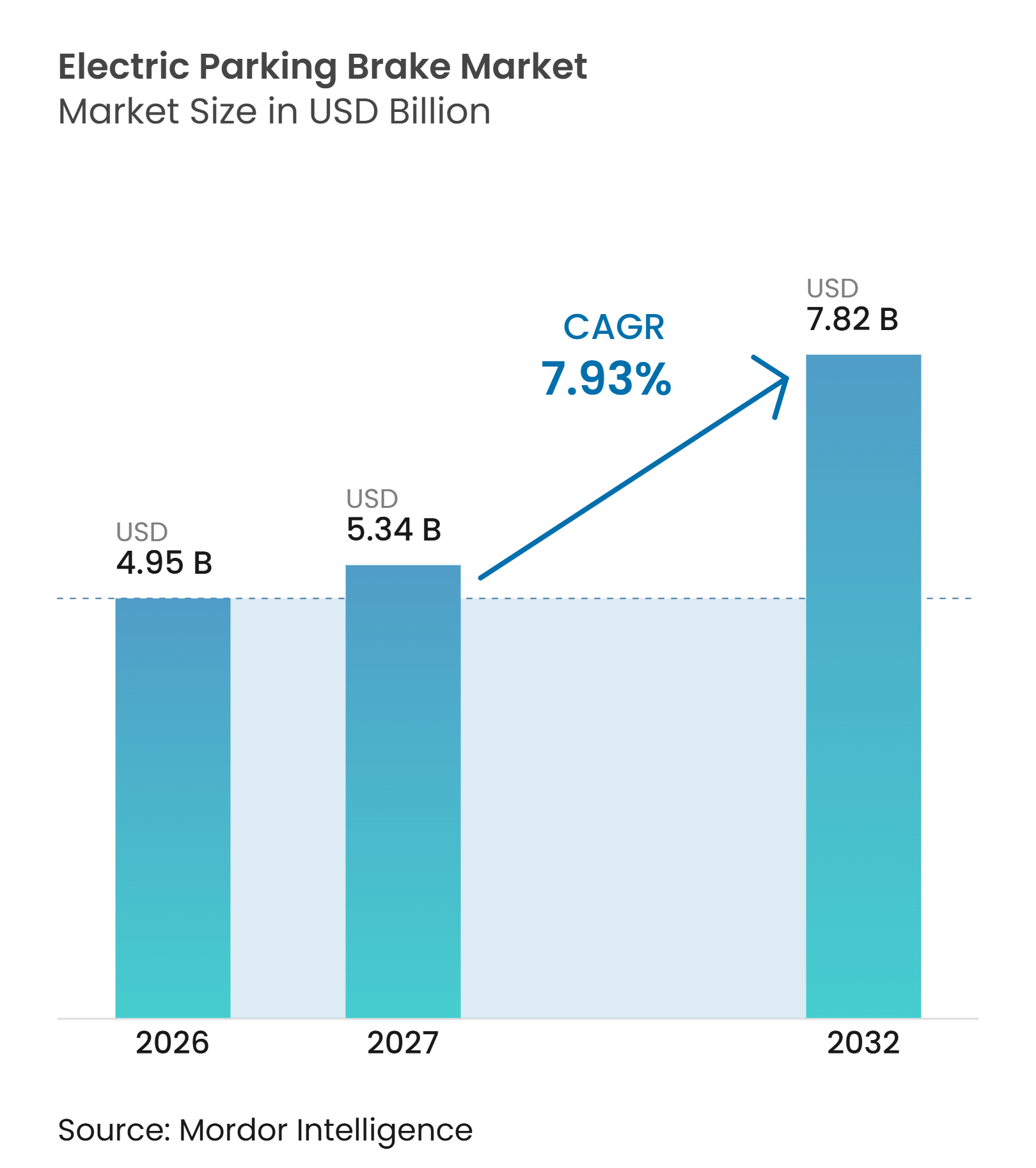
The electric parking brake market size was valued at USD 4.95 billion in 2026 and is expected to grow from USD 5.34 billion in 2027 to USD 7.82 billion by 2032, at a CAGR of 7.93% during 2027-2032. The electric parking brake market is moving from mechanical handbrakes toward electronically controlled braking as vehicle platforms adopt more integrated electrical systems. New vehicle programs increasingly specify electronic actuation early in development, which makes the supplier relationship harder to replace once production begins. Safety rules, electrification, and software-based vehicle functions are reinforcing this change across passenger cars and light commercial vehicles. The electric parking brake market also has an expanding replacement opportunity as the installed base of electronically equipped vehicles enters a more active service period. Competition is increasingly based on safety validation, software integration, and the ability to support global vehicle programs.
Key Report Takeaways
- By type, caliper-integrated systems held a 72.00% share in 2026 and are projected to grow at an 8.91% CAGR through 2032.
- By component, actuator/motor units held a 78.18% share in 2026, while ECUs are projected to grow at a 9.04% CAGR through 2032.
- By vehicle type, passenger cars held an 88.00% share in 2026, while light commercial vehicles are projected to grow at a 9.06% CAGR through 2032.
- By propulsion, ICE vehicles held an 83.14% share in 2026, while battery electric vehicles are projected to grow at a 12.50% CAGR through 2032.
- By sales channel, OEMs held an 87.17% share in 2026, while the aftermarket is projected to grow at a 9.15% CAGR through 2032.
- By geography, Asia-Pacific held a 46.00% share in 2026 and is projected to grow at a 9.18% CAGR through 2032.
Note: Market numbers in this report are based on Mordor Intelligence's proprietary estimation framework, which combines nine months of actuals with Q4 projections for base year 2026.
Market Trends and Insights
Drivers Impact Analysis of Electric Parking Brake Market*
| Driver | (~) % Impact on CAGR Forecast | Geographic Relevance | Impact Timeline |
|---|---|---|---|
| OEM Adoption of Caliper-Integrated EPB Systems | +1.8% | Global, led by North America, Europe, and China | Medium term (2–4 years) |
| Integration With ADAS, Auto-Hold, and Hill-Start Assist | +1.5% | Global, with intensity in North America and Asia-Pacific | Medium term (2–4 years) |
| Vehicle Electrification and Electronic Chassis Architectures | +1.3% | Asia-Pacific core, spill-over to North America and Europe | Long term (≥ 4 years) |
| Global Vehicle Safety and Rollaway-Prevention Requirements | +0.8% | Global; strongest in Europe and China | Short term (≤ 2 years) |
| Rear-Axle Packaging and Flat-Floor Cabin Optimization | +0.5% | Europe and Asia-Pacific, driven by BEV platform designs | Long term (≥ 4 years) |
| Common Software Platforms Across EPB, ESC, and Brake-by-Wire Systems | +0.4% | Global, particularly in markets with centralized vehicle software architectures | Long term (≥ 4 years) |
| Source: Mordor Intelligence | |||
OEM Adoption of Caliper-Integrated EPB Systems
The electric parking brake market is shifting toward caliper-integrated systems because new passenger vehicle programs increasingly select this architecture before production starts. The motor is mounted directly on the caliper, removing separate cable routing and a rear-axle actuator housing. This layout supports battery and thermal management packaging on electric vehicle platforms. ZF stated that it had deployed more than 250 million EPB calipers globally and opened a dedicated EPB production line in Oragadam, India, in January 2026 with peak annual capacity of 800,000 units [1]. The Indian investment indicates that local vehicle programs can move directly to newer EPB architectures rather than extending cable-pull designs. ISO 26262 safety requirements also favor suppliers with established development and validation processes [2].
Integration With ADAS, Auto-Hold, and Hill-Start Assist
Electronic parking brakes support auto-hold, hill-start assistance, adaptive cruise control, and automated braking functions. These functions allow the braking system to participate in comfort and safety features rather than serving only as a parking device. Toyota received a U.S. patent in September 2025 for an automated driving system that uses the electric parking brake as a standstill actuator. The patent shows how electronic parking functions can become part of a broader vehicle control system. The electric parking brake market benefits when OEMs add these functions to mainstream vehicles because electronic actuation is a necessary foundation. Suppliers that can coordinate EPB controls with electronic stability control and driver-assistance systems are better placed in new platform decisions.
Vehicle Electrification and Electronic Chassis Architectures
Battery electric vehicles use electronic braking controls to manage regenerative and friction braking in a coordinated manner. Their packaging needs also make compact rear-axle designs more valuable. China produced 6.968 million new energy vehicles in the first half of 2025, a year-over-year increase of 41.4%, according to the China Association of Automobile Manufacturers. This production base creates a large pool of platforms that can use electronic parking brake systems. Research on brake-by-wire systems for new energy vehicles identifies accurate actuator control as important to braking and energy recovery performance. The electric parking brake market therefore gains from both vehicle electrification and the move toward electronic chassis controls.
Global Vehicle Safety and Rollaway-Prevention Requirements
Regulatory requirements reduce the ability of OEMs to treat parking-brake design as a simple trim choice. In March 2026, the UNECE World Forum (WP.29) adopted supplements to UN Regulation No. 13-H that allow the emergency stop signal to be generated through electric parking brake control and require real-time reading of electrical transmission brake values during periodic technical inspections [3]. These requirements raise the validation burden for electronically controlled brakes. They also encourage OEMs to use common designs across vehicle lines where regulations have similar safety expectations. The electric parking brake market gains because electronic rollaway prevention and holding-force controls are increasingly part of wider braking-system compliance.
Restraints Impact Analysis of Electric Parking Brake Market*
| Restraint | (~) % Impact on CAGR Forecast | Geographic Relevance | Impact Timeline |
|---|---|---|---|
| Higher System Cost Than Cable-Operated Parking Brakes | -1.1% | Developing markets: India, Southeast Asia, South America, and the Middle East and Africa | Medium term (2–4 years) |
| Functional-Safety and Cybersecurity Validation Complexity | -0.7% | Global; most pronounced in Europe and North America under UNECE R155 and R156 | Long term (≥ 4 years) |
| Regional Certification and Vehicle-Electrical Architecture Fragmentation | -0.4% | Asia-Pacific, Middle East and Africa | Medium term (2–4 years) |
| Low-Voltage Power Dependence and Actuator Failure Exposure | -0.3% | Global; elevated in extreme climates (Middle East and Africa, Northern Europe) | Medium term (2–4 years) |
| Source: Mordor Intelligence | |||
Higher System Cost Than Cable-Operated Parking Brakes
An EPB system adds bill-of-materials cost compared with a conventional cable-pull mechanical parking brake, and this difference is more difficult to absorb in entry-level vehicles in price-sensitive markets. The constraint is most evident in entry-level models in India, Indonesia, and Brazil. Suppliers are responding with drum-integrated systems and shared ECU designs that combine EPB control with the ESC module. Vehicle families that use common modules across several models can spread development costs over greater production volumes. The electric parking brake market remains exposed to cost pressure until lower-cost designs gain wider scale in entry-level programs.
Functional-Safety and Cybersecurity Validation Complexity
EPB systems that connect with ESC, ABS, ADAS, and over-the-air updates must meet functional-safety and cybersecurity requirements. ISO 26262 covers functional safety, while ISO/SAE 21434 addresses cybersecurity engineering for road vehicles. A peer-reviewed study found that safety and cybersecurity assessments can create competing design requirements that must be resolved during system engineering. For example, security controls for brake communication can add delay that must be considered against braking response needs. These demands lengthen validation work and favor suppliers with mature, certified development organizations. The electric parking brake market has a higher barrier to entry as a result, especially for safety-critical, software-integrated systems.
*Our forecasts treat driver/restraint impacts as directional, not additive. The impact forecasts reflect baseline growth, mix effects, and variable interactions.
Electric Parking Brake Market Segment Analysis
By Type:
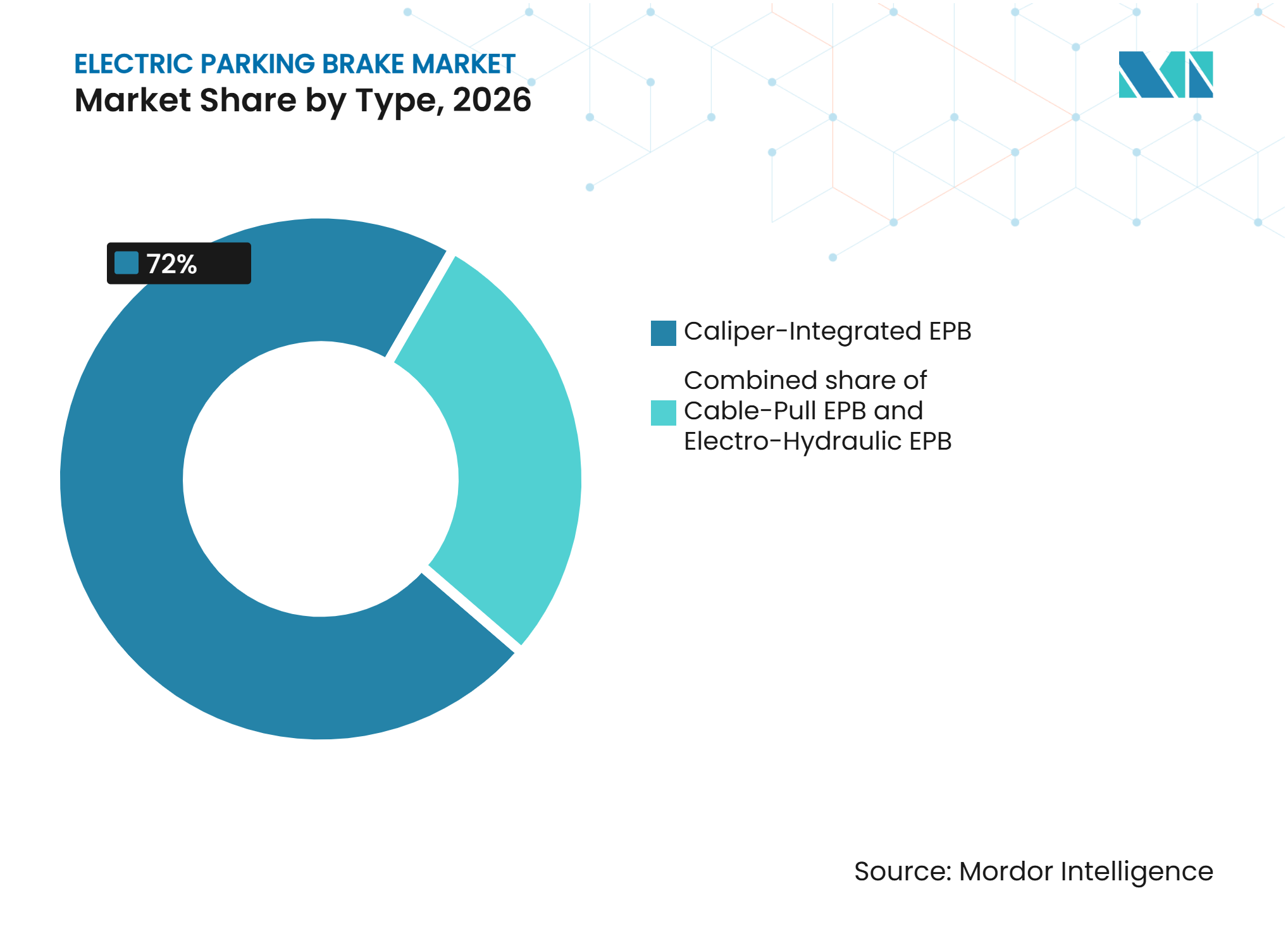
Caliper-Integrated Architecture Changes Platform Award EconomicsCaliper-integrated systems held a 72.00% share of the electric parking brake market in 2026 and are projected to expand at an 8.91% CAGR through 2032, as new electric and hybrid platforms favor compact packaging. Cable-pull systems held an 18.00% share, reflecting earlier sourcing choices in mid-range programs across Europe, North America, and China, where cable-based systems were often the cost-optimal choice. ZF began supplying EPB systems in July 2025 for a leading Indian OEM’s all-electric passenger vehicle platform, showing that suppliers are supporting local electric vehicle programs. This shift makes future platform awards more relevant than the current installed base when assessing architecture demand.
Caliper-integrated systems remove cable routing and reduce packaging demands around the rear axle. That advantage matters for flat-floor battery designs and thermal management layouts. Electro-hydraulic EPB systems serve smaller commercial and performance applications that need higher clamping force. In January 2025, ZF announced an order to supply a hybrid brake-by-wire system, combining rear electromechanical brakes with front electro-hydraulic braking, for about five million vehicles. Regulation No. 13-H requires defined braking performance and energy-reserve provisions for relevant light vehicles. The electric parking brake market is therefore progressing toward more integrated braking designs while cable-pull systems continue to serve the installed base.



By Component:
Actuators Hold Value While ECUs Gain ImportanceActuator/motor units held a 78.18% share of the electric parking brake market in 2026. Their value reflects precision electromechanical engineering, safety-rated materials, specialized manufacturing, and the need for reliable clamping force over the life of a vehicle. ECUs are projected to grow at a 9.04% CAGR through 2032 because they manage clamping-force controls, auto-hold functions, and software compatibility. The ECU role expands as OEMs move more braking functions into centralized electronic control domains. This change places greater importance on software development and system validation.
Integrated ECU designs can place EPB control within the ESC module, which reduces part count and wiring complexity. Such designs also enable coordinated braking logic across EPB, ABS, and stability-control functions. Switches remain relevant to interior design and user interaction, especially in urban SUVs. Sensors can gain value where connected-vehicle systems use maintenance information. ISO 26262 failure analysis shapes the redundancy approach across these component groups. The electric parking brake market increasingly rewards component suppliers that can combine robust hardware with validated control software.
By Vehicle Type:
Passenger Cars Lead While Light Commercial Vehicles ExpandPassenger cars held an 88.00% share of the electric parking brake market in 2026. Premium and mid-range passenger vehicle programs have broadly adopted EPB systems from manufacturers such as Volkswagen, BMW, Hyundai, Toyota, and BYD. Light commercial vehicles are projected to grow at a 9.06% CAGR through 2032. Fleet operators value auto-hold functions in dense urban delivery work, where drivers make frequent stops and starts. Electric commercial vehicle designs also favor electronic braking layouts because of drivetrain packaging needs.
Electric LCVs from Stellantis, Renault, and Ford demonstrate the broader move toward electronically managed braking in delivery fleets. Their vehicle architectures make conventional mechanical parking-brake routing less suitable. Heavy commercial vehicles remain a smaller but relevant opportunity for electro-pneumatic parking brakes. UNECE provisions for electrical transmission braking systems also cover the broader direction of commercial vehicle braking integration. The electric parking brake market can extend into commercial fleets as electronic controls become more closely tied to safety and operating efficiency. This opportunity is expected to develop at a different pace from passenger cars because commercial platforms have separate braking requirements.
By Propulsion:
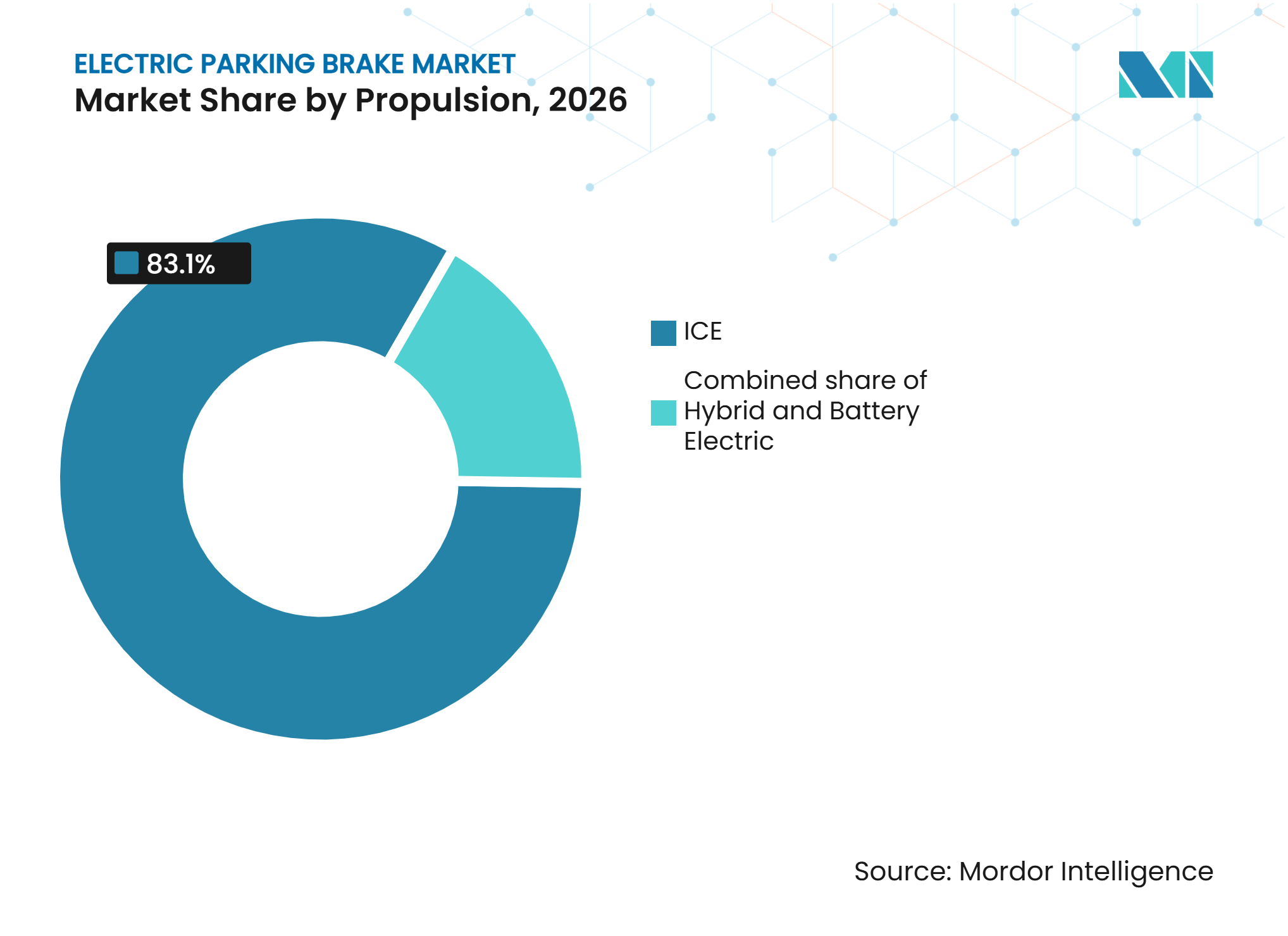
ICE Provides Scale While Battery Electric Vehicles Grow FasterICE vehicles held an 83.14% share of the electric parking brake market in 2026 because they still represented most vehicle production. This share does not indicate that combustion vehicles have a stronger technical fit with EPB systems, since electronic functions are increasingly used across all powertrains. Battery electric vehicles are projected to expand at a 12.50% CAGR through 2032. These vehicles need coordinated regenerative and friction braking, which supports electronic actuation. Their electrical architecture also supports wider integration of vehicle functions.
Research on new energy vehicle brake-by-wire systems notes the role of actuator control in managing energy recovery and braking performance. Hybrid vehicles have intermediate demand because regenerative braking coordination benefits from electronic rear-axle clamping. Toyota, Honda, and Hyundai are relevant examples of vehicle makers with hybrid portfolios that use electronically coordinated systems. The main risk is that ICE volume could decline more quickly than electric-vehicle content gains in price-sensitive segments. Mechanical parking brakes may remain more common in those lower-priced applications. The electric parking brake market is expected to depend on the balance between legacy volume and rising content per electrified vehicle.

By Sales Channel:
OEM Integration Leads, and Aftermarket Demand BuildsOEMs held an 87.17% share of the electric parking brake market in 2026. Vehicle manufacturers and suppliers validate actuators, calipers, and control software during platform development, often before a vehicle reaches series production. This work is difficult to reproduce in a retrofit because the system interacts with safety-critical vehicle controls. ISO 26262 requirements strengthen the OEM channel because modifications require extensive functional-safety consideration. The link between EPB, ESC, and ADAS functions also makes original-equipment integration more valuable.
The aftermarket is projected to grow at a 9.15% CAGR through 2032 as EPB-equipped vehicles enter their first major actuator and caliper replacement cycles. Caliper-motor replacement parts carry a higher value than many conventional mechanical brake components. Original suppliers can retain an advantage where proprietary software calibration is required. This creates a longer revenue stream after the first vehicle sale. The electric parking brake market has an aftermarket opportunity that is linked to both system complexity and the growing installed base. Generic replacement parts may face limits where electronic calibration and system safety validation are required.
Geography Analysis
North America
North America held a 22.00% share of the electric parking brake market in 2026. The regional vehicle mix includes SUVs, crossovers, and light trucks, where EPB fitment has become common. Federal Motor Vehicle Safety Standards 105 and 135 establish brake-system requirements that shape vehicle engineering and testing. Ford, General Motors, and Stellantis can apply common rear-brake designs across related vehicle lines. This approach supports wider use of EPB modules within shared platforms, while NHTSA requirements remain relevant as pickup trucks move toward more electronic brake architectures.
Asia-Pacific
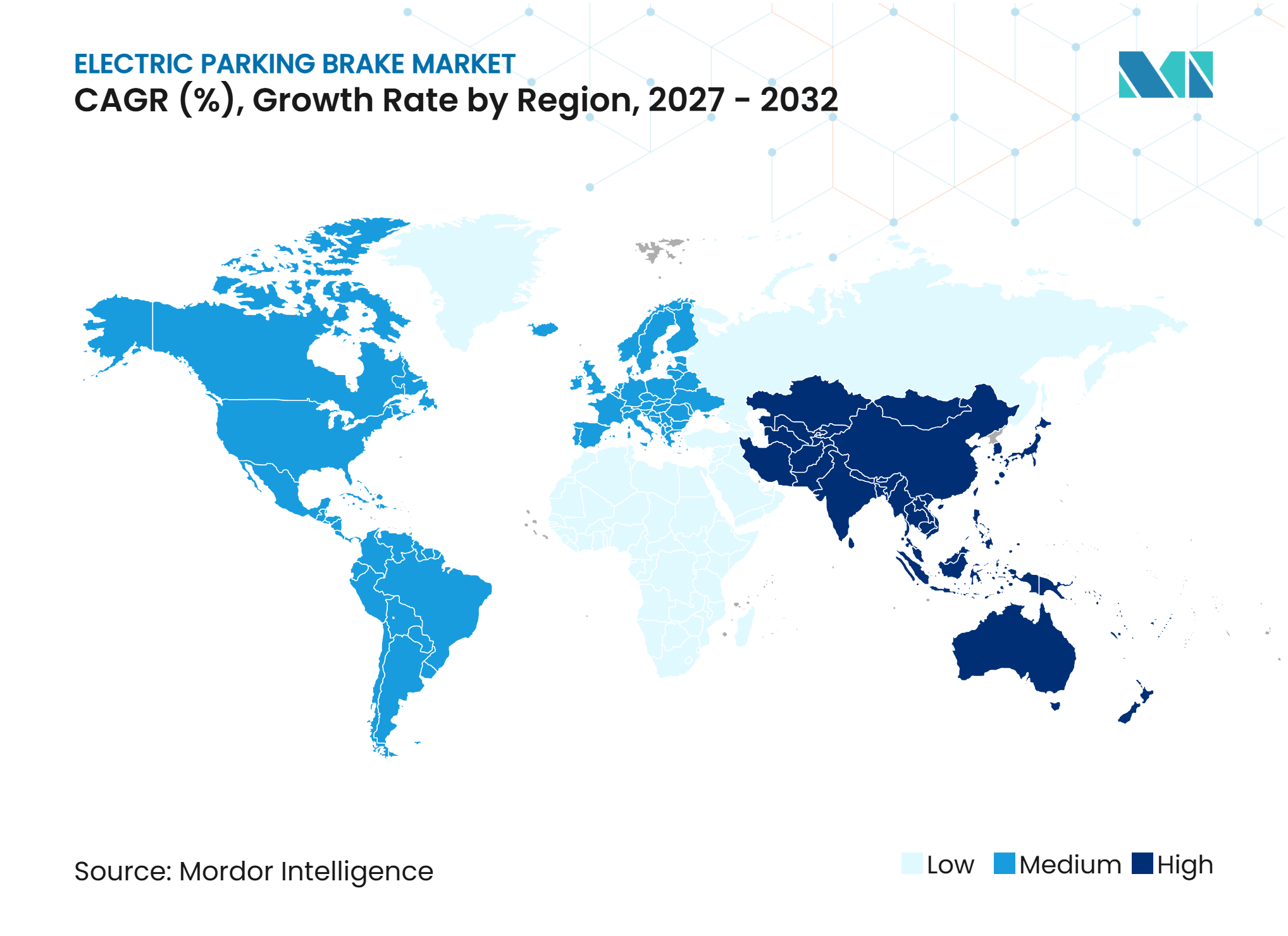
Asia-Pacific held a 46.00% share of the electric parking brake market in 2026, the largest of any region, and is projected to grow at a 9.18% CAGR through 2032. China is moving from cable-pull designs toward caliper-integrated systems, while India is adopting EPB systems on electric passenger vehicles from an earlier base. China’s first-half 2025 new energy vehicle output reached 6.968 million units, supporting demand for electronic braking content. ZF inaugurated an EPB production line near Chennai in 2026, reflecting the localization of braking-system manufacturing for Indian vehicle programs. Japan’s hybrid fleet and South Korean modular EPB development for Hyundai-Kia electric vehicles add further demand and supply capacity.
Europe, South America, and Middle East and Africa
Europe is supported by UNECE Regulation No. 13-H requirements and Euro NCAP safety expectations. Germany, France, and the United Kingdom remain important production locations for Volkswagen Group, Stellantis, BMW, and Renault. UNECE’s 2025 brake-by-wire provisions provide a regulatory direction for future type approval. South America is at an earlier stage, with mid-range SUV fitment emerging in Brazil and Argentina. Saudi Vision 2030 and UAE EV targets point to a changing vehicle policy environment, although the current fleet remains weighted toward larger ICE SUVs. Heat exposure also increases the importance of actuator reliability in some Middle East and African markets. Market growth in these regions is expected to depend on affordability, vehicle mix, local electrification, and compliance needs.
Competitive Landscape
Market Concentration

The electric parking brake market is moderately concentrated. ZF Friedrichshafen, AUMOVIO, Robert Bosch, Brembo, and Astemo have established positions through long OEM relationships, certified engineering processes, and international manufacturing footprints across China, India, North America, and Europe. Their ability to support safety-critical development is a significant barrier to newer suppliers that lack comparable testing, manufacturing, and program-management capacity. ISO 26262 is relevant because EPB systems are part of vehicle braking controls and need structured functional-safety development. Competition is moving beyond hardware toward system-level integration with ESC, ADAS, and brake-by-wire controls, where suppliers must demonstrate reliable interaction across several vehicle functions.
Brembo announced in May 2026 that its Sensify intelligent braking platform entered large-scale series production for a global vehicle manufacturer and that additional contracts target hundreds of thousands of units per year. The same month, Brembo announced a joint venture with Ningbo Huaxiang Electronic to support the localization of Sensify technology in China. ZF expanded its electric parking brake manufacturing support for Indian electric passenger vehicle programs, using a modular approach that can serve compact passenger cars and light commercial vehicles. These moves combine technology development with local production, which can improve support for vehicle programs with country-specific supply requirements. Domestic Chinese suppliers remain relevant in lower-cost vehicle programs where response time and affordability can influence sourcing.
Cable-pull suppliers face a challenge as platform renewals favor caliper-integrated and brake-by-wire designs. However, cable-pull systems retain importance because of their installed base, familiar service needs, and cost position in price-sensitive vehicles. Opportunities remain in lower-cost EPB systems for India and Southeast Asia, fleet-focused products for urban delivery vehicles, and integrated regenerative-braking controls for electric vehicles. These areas require suppliers to balance component cost, safety validation, software capability, and the needs of regional OEM manufacturing programs.
Electric Parking Brake Industry Leaders
-
ZF Friedrichshafen AG
-
AUMOVIO SE
-
Robert Bosch GmbH
-
Brembo N.V.
-
Astemo, Ltd.
- *Disclaimer: Major Players sorted in no particular order
Electric Parking Brake Market Companies Covered in this Report
- ZF Friedrichshafen AG
- AUMOVIO SE
- Robert Bosch GmbH
- Brembo N.V.
- Astemo, Ltd.
- HL Mando Corp.
- Hyundai Mobis Co., Ltd.
- Aisin Corporation
- Küster Holding GmbH
- DURA Automotive Systems LLC
- Akebono Brake Industry Co., Ltd.
- Wanxiang Qianchao Co., Ltd.
- Zhejiang Asia-Pacific Mechanical & Electronic Co., Ltd.
- Knorr-Bremse AG
- Bethel Automotive Safety Systems Co., Ltd.
- Valeo SE
- Huayu Automotive Systems Co., Ltd.
- INFAC Corporation
- Keyang Electric Machinery Co., Ltd.
- Brakes India Private Limited
Recent Industry Developments in Electric Parking Brake Market
- May 2026: Brembo signed joint venture agreements with Ningbo Huaxiang Electronic to localize its Sensify brake-by-wire platform, which includes electronically actuated rear braking, in China.
- May 2026: Brembo started large-scale series production of its Sensify intelligent braking platform, fitted as standard across a global automaker’s vehicle program, and signed further contracts for hundreds of thousands of units a year.
- January 2026: ZF inaugurated an electric park brake production line at Oragadam, Tamil Nadu, India, with a peak capacity of 800,000 units a year.
- July 2025: ZF began production of its electric park brake system in India for a leading Indian OEM’s all-electric passenger vehicle platform.
Global Electric Parking Brake Market Report Scope
The Electric Parking Brake Market Report is Segmented by Type (Cable-Pull EPB, Caliper-Integrated (Motor-on-Caliper) EPB, and Electro-Hydraulic EPB), Component (Actuator/Motor, ECU, Switch, Caliper, and Sensors), Vehicle Type (Passenger Cars, Light Commercial Vehicles, and Heavy Commercial Vehicles), Propulsion (ICE, Hybrid, and Battery Electric), Sales Channel (OEM and Aftermarket), and Geography (North America (United States, Canada, and Mexico), Europe (Germany, France, Italy, Spain, United Kingdom, Russia, Poland, Czech Republic, and Rest of Europe), Asia-Pacific (China, Japan, India, South Korea, Australia, Thailand, Indonesia, and Rest of Asia-Pacific), South America (Brazil, Argentina, Colombia, Chile, Peru, and Rest of South America), and Middle East and Africa (Saudi Arabia, United Arab Emirates, Israel, Turkey, Iran, South Africa, Egypt, Morocco, and Rest of Middle East and Africa)). Electro-pneumatic parking brakes for heavy commercial vehicles are included under Electro-Hydraulic EPB. The Market Forecasts are Provided in Terms of Value (USD) and Volume (Units).
Segmentation Overview
| Cable-Pull EPB |
| Caliper-Integrated (Motor-on-Caliper) EPB |
| Electro-Hydraulic EPB |
| Actuator/Motor |
| ECU |
| Switch |
| Caliper |
| Sensors |
| Passenger Cars |
| Light Commercial Vehicles |
| Heavy Commercial Vehicles |
| ICE |
| Hybrid |
| Battery Electric |
| OEM |
| Aftermarket |
| North America | United States |
| Canada | |
| Mexico | |
| Europe | Germany |
| France | |
| Italy | |
| Spain | |
| United Kingdom | |
| Russia | |
| Poland | |
| Czech Republic | |
| Rest of Europe | |
| Asia-Pacific | China |
| Japan | |
| India | |
| South Korea | |
| Australia | |
| Thailand | |
| Indonesia | |
| Rest of Asia-Pacific | |
| South America | Brazil |
| Argentina | |
| Colombia | |
| Chile | |
| Peru | |
| Rest of South America | |
| Middle East and Africa | Saudi Arabia |
| United Arab Emirates | |
| Israel | |
| Turkey | |
| Iran | |
| South Africa | |
| Egypt | |
| Morocco | |
| Rest of Middle East and Africa |
| By Type | Cable-Pull EPB | |
| Caliper-Integrated (Motor-on-Caliper) EPB | ||
| Electro-Hydraulic EPB | ||
| By Component | Actuator/Motor | |
| ECU | ||
| Switch | ||
| Caliper | ||
| Sensors | ||
| By Vehicle Type | Passenger Cars | |
| Light Commercial Vehicles | ||
| Heavy Commercial Vehicles | ||
| By Propulsion | ICE | |
| Hybrid | ||
| Battery Electric | ||
| By Sales Channel | OEM | |
| Aftermarket | ||
| By Geography | North America | United States |
| Canada | ||
| Mexico | ||
| Europe | Germany | |
| France | ||
| Italy | ||
| Spain | ||
| United Kingdom | ||
| Russia | ||
| Poland | ||
| Czech Republic | ||
| Rest of Europe | ||
| Asia-Pacific | China | |
| Japan | ||
| India | ||
| South Korea | ||
| Australia | ||
| Thailand | ||
| Indonesia | ||
| Rest of Asia-Pacific | ||
| South America | Brazil | |
| Argentina | ||
| Colombia | ||
| Chile | ||
| Peru | ||
| Rest of South America | ||
| Middle East and Africa | Saudi Arabia | |
| United Arab Emirates | ||
| Israel | ||
| Turkey | ||
| Iran | ||
| South Africa | ||
| Egypt | ||
| Morocco | ||
| Rest of Middle East and Africa | ||
Key Questions Answered in the Report
What is the forecast for electric parking brake demand through 2032?
The electric parking brake market is projected to reach USD 7.82 billion by 2032, growing at a 7.93% CAGR during 2027-2032. Growth reflects wider use of electronic braking across vehicle platforms and service demand from the installed base, including replacement of actuators and calipers.
Why are caliper-integrated EPB systems growing faster than cable-pull systems?
They are projected to grow at an 8.91% CAGR because their compact layout supports electric and hybrid vehicle packaging. New platform specifications favor this layout because it removes cable routing and separate rear-axle actuator housings.
Which vehicle category creates the largest opportunity for EPB suppliers?
Passenger cars held an 88.00% share in 2026, while light commercial vehicles have the fastest forecast growth, at a 9.06% CAGR. Delivery fleets can use auto-hold functions, while electric commercial platforms benefit from simpler braking-system packaging.
How does vehicle electrification affect electronic parking brakes?
Battery electric vehicles are projected to grow at a 12.50% CAGR because electronic braking supports regenerative-braking coordination and compact packaging. Electronic actuation also fits the wider move toward vehicle software and integrated chassis controls.
Why do OEMs account for most electric parking brake sales?
OEMs held an 87.17% share in 2026 because EPB systems require platform-level engineering and safety validation. The link to ESC, ADAS, and vehicle software makes post-sale modification more difficult than installation of a conventional mechanical brake.
Which region is expanding fastest for electronic parking brakes?
Asia-Pacific, the largest region with a 46.00% share in 2026, is projected to grow at a 9.18% CAGR through 2032, supported by China’s new energy vehicle output and wider regional electrification. Local manufacturing investment, Japan’s hybrid vehicle base, and the move toward caliper-integrated systems across China and India support the region’s growth outlook and deepen its role in the global supply base.