
Egypt Prefabricated Buildings Market Size and Share
Market Overview
| Study Period | 2021 - 2032 |
|---|---|
| Forecast Data Period | 2027 - 2032 |
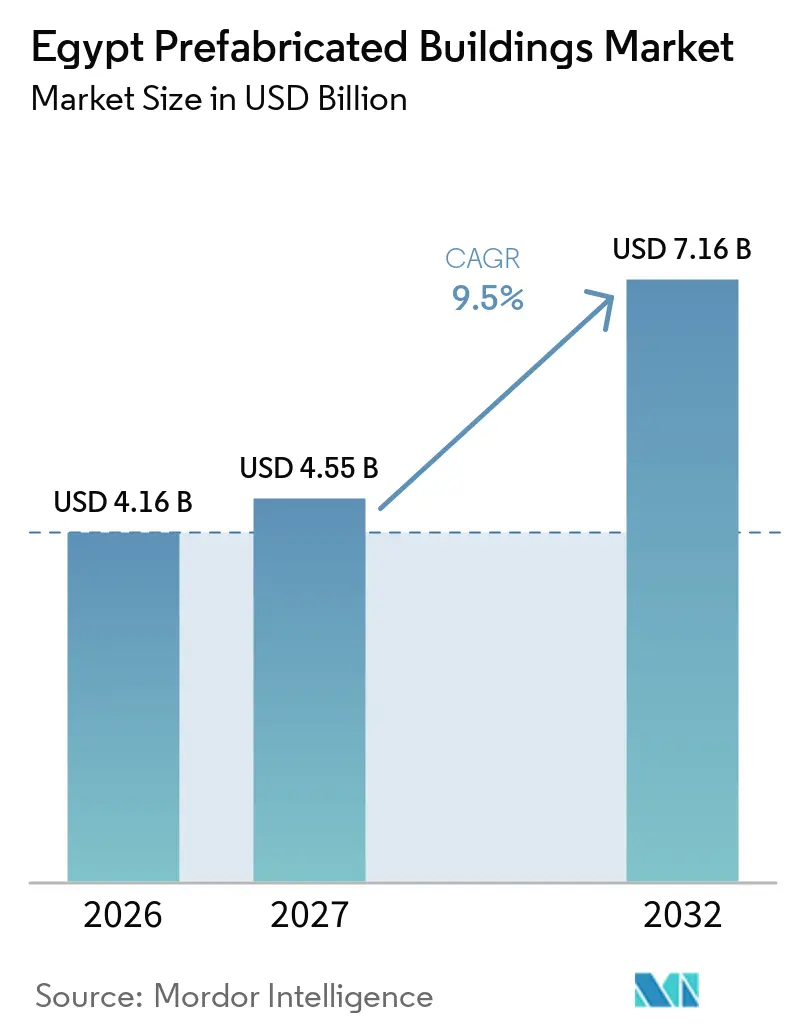
| Base Year Market Size (2026) | USD 4.16 Billion |
| Market Size (2027) | USD 4.55 Billion |
| Market Size (2032) | USD 7.16 Billion |
| Growth Rate (2027 - 2032) | 9.50 % |
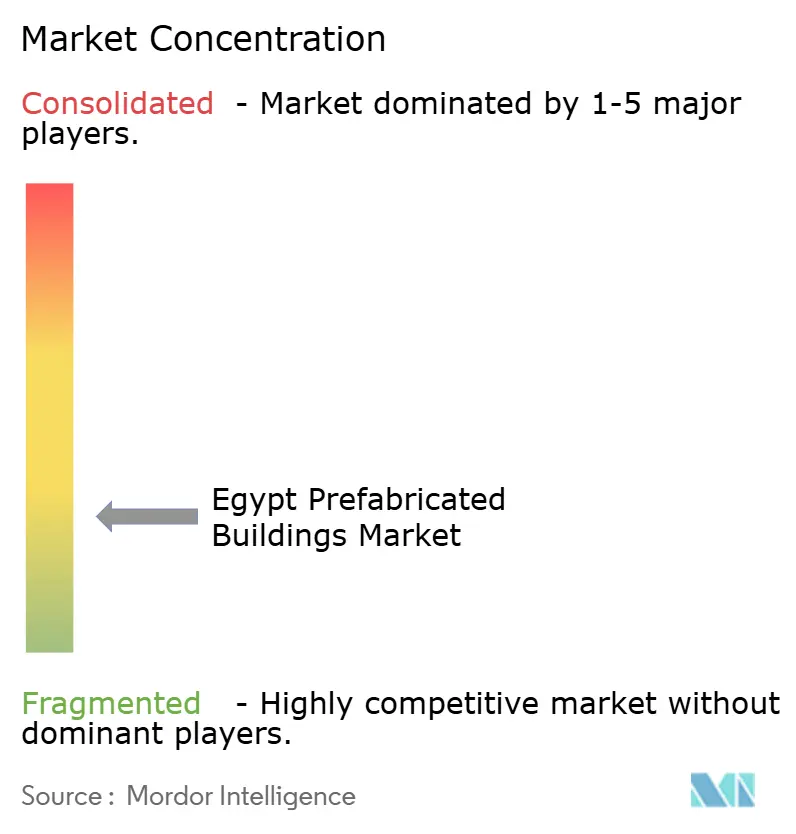
| Market Concentration | Low |
Major Players *Disclaimer: Major Players sorted in no particular order Image © Mordor Intelligence. Reuse requires attribution under CC BY 4.0. | |
Egypt Prefabricated Buildings Market Analysis by Mordor Intelligence
The Egypt Prefabricated Buildings Market size was valued at USD 4.16 billion in 2026 and is estimated to grow from USD 4.55 billion in 2027 to reach USD 7.16 billion by 2032, at a CAGR of 9.5% during the forecast period (2027-2032).
Government housing programs, new-city construction, industrial investments, and transport projects support demand for factory-built structures across Egypt. The Egypt prefabricated buildings market benefits from developers’ need for repeatable building components and shorter on-site construction timelines. Demand is expanding beyond conventional housing to include logistics facilities, factories, rail-related assets, and hospitality projects. However, currency volatility, high costs of imported inputs, and limited financing can delay private investment, even when project demand remains strong. Suppliers with adequate factory capacity, robust quality controls, and the ability to serve multiple construction applications are better positioned as procurement requirements become increasingly formalized.
Key Report Takeaways
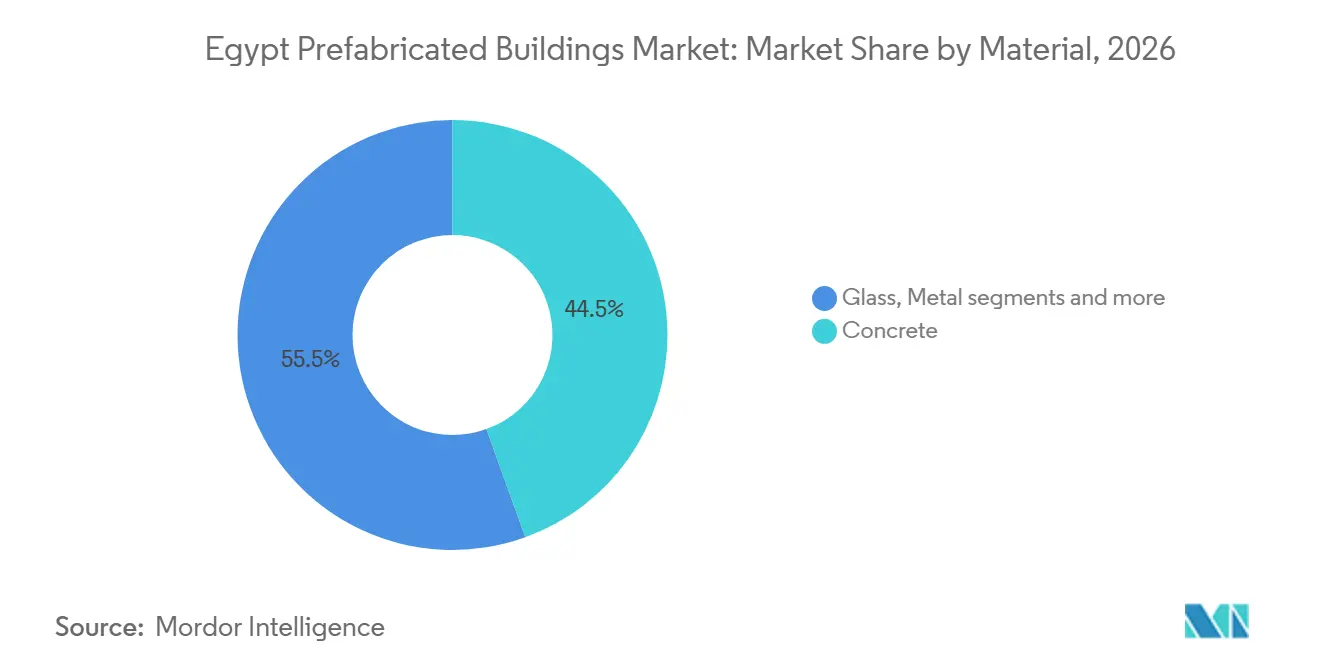
- By material, concrete held 44.5% of the Egypt prefabricated buildings market share in 2026, while metal is forecast to grow at a CAGR of 10.21% through 2032.
- By application, residential accounted for 47.7% of the Egypt prefabricated buildings market size in 2026, while other applications are forecast to expand at a CAGR of 10.42% through 2032.
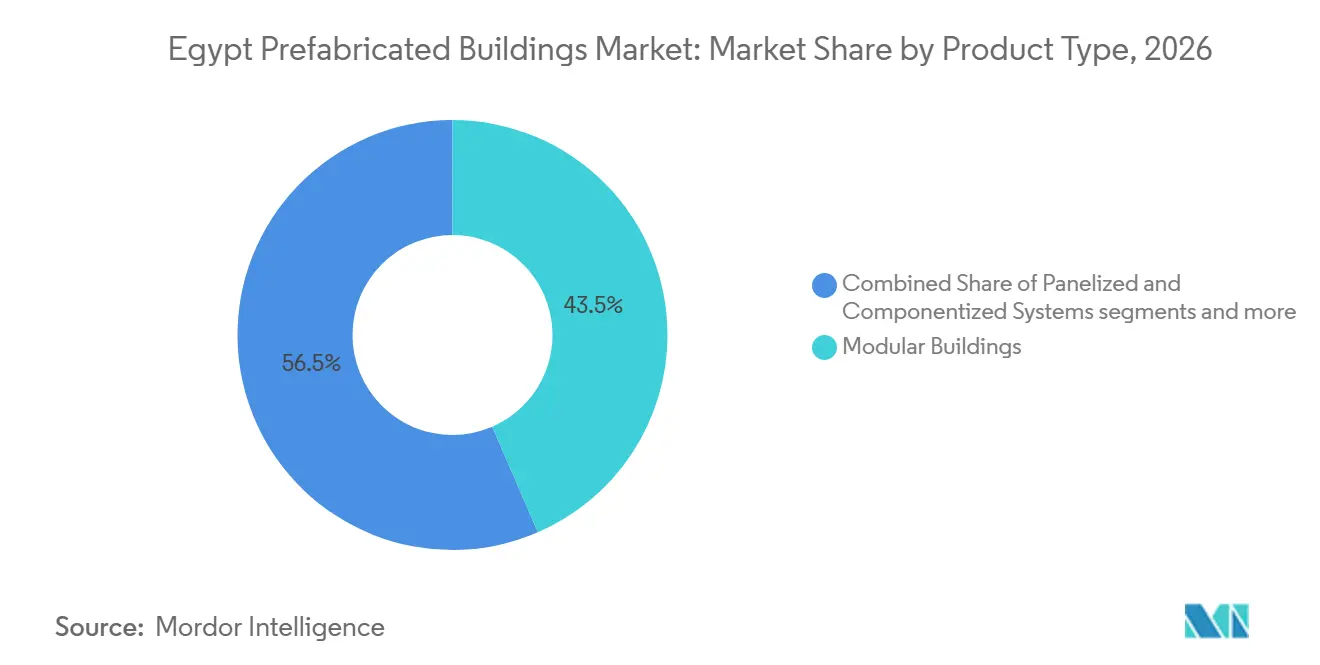
- By product type, modular buildings accounted for 43.5% of the Egypt prefabricated buildings market share in 2026, while panelized and componentized systems are projected to grow at a CAGR of 10.62% through 2032.
- By geography, Cairo accounted for 39.7% of the Egypt prefabricated buildings market share in 2026, while the rest of Egypt is projected to grow at a CAGR of 10.88% through 2032.
Note: Market numbers in this report are based on Mordor Intelligence's proprietary estimation framework, which combines nine months of actuals with Q4 projections for base year 2026.
Market Trends and Insights
Drivers Impact Analysis of Egypt Prefabricated Buildings Market*
| Drivers | (~) % Impact on CAGR Forecast | Geographic Relevance | Impact Timeline |
|---|---|---|---|
| Government-Backed Affordable Housing Programs | +2.5% | National, concentrated in Greater Cairo, the New Administrative Capital, and new urban communities. | Short term (≤ 2 years) |
| Expansion of Industrial Zones | +2.0% | Suez Canal Economic Zone, Ain Sokhna, Borg El Arab, Sadat City, and Upper Egypt industrial clusters | Medium term (2-4 years) |
| Development of New Administrative and Urban Centers | +1.8% | Greater Cairo, New Administrative Capital, New Alamein City, and new coastal and inland communities | Short term (≤ 2 years) |
| Demand for Faster Project Completion | +1.7% | National, with early gains in Cairo, Alexandria, Suez Canal Economic Zone rail, and coastal corridors | Short term (≤ 2 years) |
| Growing Requirements for Temporary Workforce Accommodation | +0.5% | Suez Canal Economic Zone industrial zones, Western Desert clusters, and Red Sea coast projects | Medium term (2-4 years) |
| Emphasis on Building Energy Efficiency | +0.3% | National, concentrated in residential and commercial segments in new administrative cities. | Long term (≥ 4 years) |
| Source: Mordor Intelligence | |||
Government-Backed Affordable Housing Programs
Egypt’s prefabricated buildings market benefits from public housing and urban expansion programs that require large-scale project delivery. These developments drive demand for standardized building formats that can be replicated across multiple sites. Factory-produced concrete components enable authorities to manage repetitive designs and meet compressed project schedules. The New Administrative Capital remains a major construction hub, further supporting demand for standardized structural systems. In addition, Egypt’s 2025 building regulation amendments establish a clearer compliance framework for formal construction projects.
Expansion of Industrial Zones
Industrial investment is expanding the addressable base for steel frames, insulated panels, and prefabricated service buildings. The Ministry of Planning has identified manufacturing as a priority investment area for fiscal year 2025–2026, underscoring the importance of industrial activity[1]. Logistics, port, factory, and energy projects often require large enclosed spaces that can be erected rapidly. Zamil Steel Egypt is expected to ship 10,000 metric tons in July 2026, a monthly output milestone for its pre-engineered building operations, according to the company. Consequently, the Egypt prefabricated buildings market has a growing industrial customer base in addition to its traditional public housing base. Local panel production can also reduce lead times when imported envelope materials are less accessible.
Development of New Administrative and Urban Centers
Large infrastructure programs favor methods that bring structural work forward into controlled factory settings. Rail, metro, bridge, tunnel, and depot projects require repeated elements, making precast production relevant beyond conventional buildings. E.I. for Civil Works manufactures prestressed concrete sleepers for Egypt’s rail construction program, demonstrating the local use of industrialized concrete production[2]. Zamil Steel has also reported supplying pre-engineered buildings for a high-speed rail maintenance depot. These projects develop factory skills, supplier networks, and installation experience that can support broader adoption in the Egypt prefabricated buildings market. The resulting capability can be transferred to warehouses, service buildings, worker accommodation, and public facilities.
Demand for Faster Project Completion
Population growth and urban concentration continue to place pressure on housing delivery across the Nile Valley corridor. Egypt’s population reached 118.4 million in 2025, while Cairo had 25.6 million residents and is projected to reach 32.4 million by 2050. Developers require housing formats that can serve densely populated urban areas and new settlements outside the capital. The Egypt prefabricated buildings market can address this need by using standardized units and components to reduce on-site labor requirements. The large number of vacant units alongside unmet housing needs indicates that location, affordability, and access remain critical challenges. Consequently, lower-cost, targeted prefabricated systems remain relevant in governorates that conventional housing supply does not adequately serve.
Restraints Impact Analysis of Egypt Prefabricated Buildings Market*
| Restraints | (~) % Impact on CAGR Forecast | Geographic Relevance | Impact Timeline |
|---|---|---|---|
| Exchange-Rate Volatility and Imported Components | -2.0% | National, with exposure in steel, glass, and electromechanical component procurement | Medium term (2-4 years) |
| High Upfront Investment in Manufacturing Facilities | -1.5% | National, particularly secondary cities and Upper Egypt | Long term (≥ 4 years) |
| Project-Specific Design Customization | -1.0% | National, especially custom commercial, coastal hospitality, and institutional projects | Long term (≥ 4 years) |
| Transportation and Heavy-Lifting Requirements | -0.8% | Cairo, Giza, Alexandria, and Nile Valley corridors | Medium term (2-4 years) |
| Source: Mordor Intelligence | |||
Exchange-Rate Volatility and Imported Components
Reliance on imported steel, glass, and specialized fastening systems exposes manufacturers to exchange-rate fluctuations and higher procurement costs. Currency depreciation can increase material expenses, disrupt procurement budgets, and reduce profit margins, particularly for projects with fixed-price contracts. Limited domestic availability of specialized components may sustain import dependence, making costs less predictable for manufacturers in the Egypt prefabricated buildings market.
High Upfront Investment in Manufacturing Facilities
Dedicated prefabrication plants require substantial upfront investment before manufacturers can generate project revenue. Land, cranes, molds, machinery, quality systems, and skilled personnel create significant barriers to entry. Premco Precast operates a 67,000 m² plant in 6th of October City, demonstrating the scale of infrastructure required for a dedicated precast operation. Smaller firms may struggle to finance comparable facilities without a committed project pipeline or support from a larger corporate partner[3]. These investment requirements favor established suppliers and may constrain new capacity development in less-developed regions.
*Our forecasts treat driver/restraint impacts as directional, not additive. The impact forecasts reflect baseline growth, mix effects, and variable interactions.
Egypt Prefabricated Buildings Market Segment Analysis
By Material:
Concrete’s Scale Advantage Coexists with Metal’s Industrial MomentumConcrete accounted for 44.5% of the Egypt prefabricated buildings market in 2026, supported by established precast capacity and the continued use of structural concrete in housing and public-sector projects. Local production expertise and the suitability of precast elements for repetitive foundations, walls, floors, and civil structures support the segment’s scale. ECPC’s long-standing operations in Egypt show how established precast suppliers support transport and infrastructure projects. The revised Egyptian Concrete Code, ECP 203-2025, placed greater emphasis on formal material specifications and consistent quality management. These requirements favor suppliers that can document product performance and maintain controlled production processes.
Metal is projected to be the fastest-growing material segment, registering a CAGR of 10.21% through 2032. Industrial buildings, logistics facilities, and rail-support infrastructure create strong demand for pre-engineered steel systems, which provide large clear spans and enable rapid building enclosure. Glass remains relevant for commercial and hospitality developments. At the same time, timber and other materials represent smaller categories due to limited local supply. The Egypt prefabricated buildings market is expected to use concrete and steel in parallel, with each material serving distinct structural and project requirements.

By Application:
Residential Demand Provides the Base, While Other Uses Grow FasterResidential applications accounted for 47.7% of the Egypt prefabricated buildings market in 2026. Public housing programs and new urban communities provide a stable demand base for standardized residential components. Residential projects use precast walls, stairs, slabs, and modular service units, particularly where designs are replicated across multiple buildings. This approach supports planned factory schedules, more consistent utilization of installed production capacity, and the distribution of fixed costs across larger orders.
Other applications, including industrial, institutional, infrastructure, and energy uses, are forecast to grow at a CAGR of 10.42% through 2032. These projects are often located across large sites or in remote areas, where rapid installation and predictable quality offer significant advantages. Manufacturing investments and infrastructure development are increasing demand for workshops, maintenance facilities, control rooms, warehouses, and service structures. Commercial construction also supports demand for retail, office, and hospitality buildings in expanding urban areas. Consequently, the Egypt prefabricated buildings market is becoming less dependent on a single end-use application, although residential construction remains the largest application segment.
By Product Type:
Modular Buildings Lead While Panelized and Componentized Systems Gain GroundModular buildings held a 43.5% share of the Egypt prefabricated buildings market in 2026. Volumetric units are well suited for worker accommodations, temporary offices, rapid-deployment facilities, and selected housing applications. Their value lies in enabling manufacturers to complete a larger share of finishing work in a factory before delivering units to the project site. This capability is particularly relevant for projects that require usable space quickly or face challenging site conditions. Modular formats also suit certain coastal developments, where operators require repeatable accommodation and service units.
Panelized and componentized systems represent the fastest-growing product category, with a forecast CAGR of 10.62% through 2032. These systems offer greater design flexibility than fully volumetric modules, as developers can combine walls, roofs, insulated envelopes, and structural components according to site-specific requirements. In the Egypt prefabricated buildings market, this approach supports industrial enclosures, warehouses, commercial buildings, and other projects requiring customized footprints. Domestic production of insulated panels supports this category by improving the availability of core envelope materials within Egypt. Flat-pack, hybrid, and temporary solutions remain relevant for site support and short-term applications; however, they do not command the same market share or reported growth rate as the leading formats.
Geography Analysis
Cairo accounted for 39.7% of the Egypt prefabricated buildings market in 2026, driven by the New Administrative Capital, metro projects, and a substantial residential and commercial construction pipeline. The capital region also benefits from established manufacturing facilities in 6th of October City and 10th of Ramadan City, which reduce the distance between production sites and major projects. Public-sector activity and ongoing ministry relocations continue to support demand for office, residential, and service buildings. Cairo’s leading position reflects the concentration of construction expenditure and the availability of suppliers capable of meeting formal project requirements.
Alexandria and Giza represent another important demand cluster. Alexandria’s metro conversion requires specialized civil works and supports the local adoption of precast construction methods. Alstom’s approved railway manufacturing complex in Borg El Arab indicates potential future industrial building activity across the wider Alexandria corridor. Dense urban environments in both cities may favor panels and components that are easier to transport and install than large volumetric units.
The rest of Egypt is projected to be the fastest-growing geography, with a forecast CAGR of 10.88% through 2032. Coastal tourism developments, the Suez Canal Economic Zone, and new industrial sites are generating demand beyond the primary Nile Delta markets. In May 2025, AD Ports Group and the Suez Canal Economic Zone signed a 50-year agreement to develop the KEZAD East Port Said Zone, including an initial development phase. These locations require warehouses, factories, support buildings, and accommodation that can be deployed in phases. The Egypt prefabricated buildings market has an opportunity to serve these dispersed project sites; however, logistics and local installation capacity remain key constraints.
Competitive Landscape
The Egypt prefabricated buildings market is fragmented, with integrated manufacturers, single-material specialists, and smaller fabricators serving caravan and lightweight-panel applications. Factory capacity, product range, project credentials, and access to public-sector and industrial customers shape competition. No supplier holds a dominant national market share, while smaller operators typically focus on local and less complex projects. Larger companies compete for complex projects through investments in engineering, certification, procurement, and installation support.
Zamil Steel Egypt and ICON operate across different segments of the fragmented market. Zamil Steel Egypt focuses on pre-engineered buildings for industrial and infrastructure applications, while its July 2026 shipping activities demonstrate its capacity to handle large steel-building orders. ICON focuses on insulated panels and light-gauge steel systems for prefabricated building envelopes. These distinct material capabilities reflect the market's fragmented competitive structure, with companies specializing in different product systems rather than offering a standardized national solution.
Competition is also influenced by quality control, regulatory compliance, and project coordination. The concrete code increased the importance of formal quality-control processes among precast suppliers, while building-regulation amendments benefited companies with expertise in approvals and technical documentation. However, the market remains fragmented in integrated residential modular solutions, particularly among providers capable of combining architecture, engineering, manufacturing, logistics, and installation. This creates opportunities for manufacturers to strengthen their competitive positions by expanding service capabilities while maintaining cost competitiveness.
Egypt Prefabricated Buildings Industry Leaders
-
Arab Contractors
-
Hassan Allam Construction
-
MANCREW
-
ICON Egypt
-
Zamil Steel Egypt
- *Disclaimer: Major Players sorted in no particular order
Egypt Prefabricated Buildings Market Companies Covered in this Report
- Zamil Steel Egypt
- Arab Contractors
- Hassan Allam Construction
- MANCREW
- ICON Egypt
- Cretematic Prefabricated Concrete & Steel Structures - S.A.E
- Al Quds Steel
- EICW
- Dalal Steel Industries
- Karmod Prefabricated Building Technologies
- Ideal Prefab
- SMI Alexandria
- Samcrete Building Systems
- OsmaCom for Steel & Concrete Industries
- Egyptian European Company for Steel Buildings
- Egypt Prefab
- Future Buildings Egypt
- Egyptian Gulf Company
- Nageh Engineering Co. LLC
- Dar Al-Benaa Al-Araby
Recent Industry Developments in Egypt Prefabricated Buildings Market
- September 2026: Egyptian startup Ai BEYOT launched the country's first fully integrated modular and prefabricated building solution, operating from a locally owned manufacturing facility that oversees design, fabrication, delivery, and post-installation maintenance. With more than 50 base designs spanning space capsules, smart caravans, and foldable multi-room units, and production cycles of 45–75 days, the company established itself as a domestic competitor in the rapid-deployment modular segment.
- August 2026: Premco Precast Egypt launched a new hollow-core slab production line at its 67,000 m² facility in 6th of October City, expanding its precast portfolio to include floor slabs for faster residential and industrial construction. The addition strengthened its integrated precast structural solutions for new-city and industrial developments.
- August 2026: Zamil Steel Egypt completed the supply and erection of pre-engineered buildings (PEBs) for the Strategic Medical Warehouses Project, with a total steel weight exceeding 2,500 metric tons. The national project established an integrated storage system for medicines and medical supplies in line with international standards and Egypt Vision 2030 objectives.
Egypt Prefabricated Buildings Market Report Scope
Segmentation Overview
| Concrete |
| Glass |
| Metal |
| Timber |
| Other Materials |
| Residential |
| Commercial |
| Others, Including Industrial, Institutional, Infrastructure, and Energy |
| Modular Buildings |
| Panelized and Componentized Systems |
| Other Prefab Types |
| Cairo |
| Alexandria |
| Giza |
| Rest of Egypt |
| By Material | Concrete |
| Glass | |
| Metal | |
| Timber | |
| Other Materials | |
| By Application | Residential |
| Commercial | |
| Others, Including Industrial, Institutional, Infrastructure, and Energy | |
| By Product Type | Modular Buildings |
| Panelized and Componentized Systems | |
| Other Prefab Types | |
| By Region | Cairo |
| Alexandria | |
| Giza | |
| Rest of Egypt |
Key Questions Answered in the Report
What is the forecast value of Egypt’s prefabricated buildings sector by 2032?
The sector is projected to reach USD 7.16 billion by 2032, expanding at a 9.50% CAGR from 2027 to 2032.
Which material has the largest share in Egypt’s prefabricated buildings sector?
Concrete is the largest material category, with a 44.50% share in 2026.
Which application is expanding fastest in Egypt’s prefabricated buildings sector?
Other applications, including industrial, institutional, infrastructure, and energy uses, are forecast to grow at a 10.42% CAGR through 2032.
Why is demand for factory-built structures rising in Egypt?
Housing programs, industrial investment, infrastructure construction, and coastal development are increasing demand for faster and more standardized building delivery.
Which region is growing fastest for prefabricated buildings in Egypt?
The rest of Egypt is forecast to grow at a 10.88% CAGR through 2032, supported by tourism, industrial zones, and logistics development.
What limits wider use of prefabricated buildings in Egypt?
High plant investment, fragmented coordination, difficult transport, and limited technical expertise can delay adoption.