
Market Overview
| Study Period | 2020 - 2031 |
|---|---|
| Forecast Data Period | 2026 - 2031 |
| Base Year Market Size (2025) | USD 662.35 Million |
| Market Size (2026) | USD 689.16 Million |
| Market Size (2031) | USD 840.99 Million |
| Growth Rate (2026 - 2031) | 4.05 % |
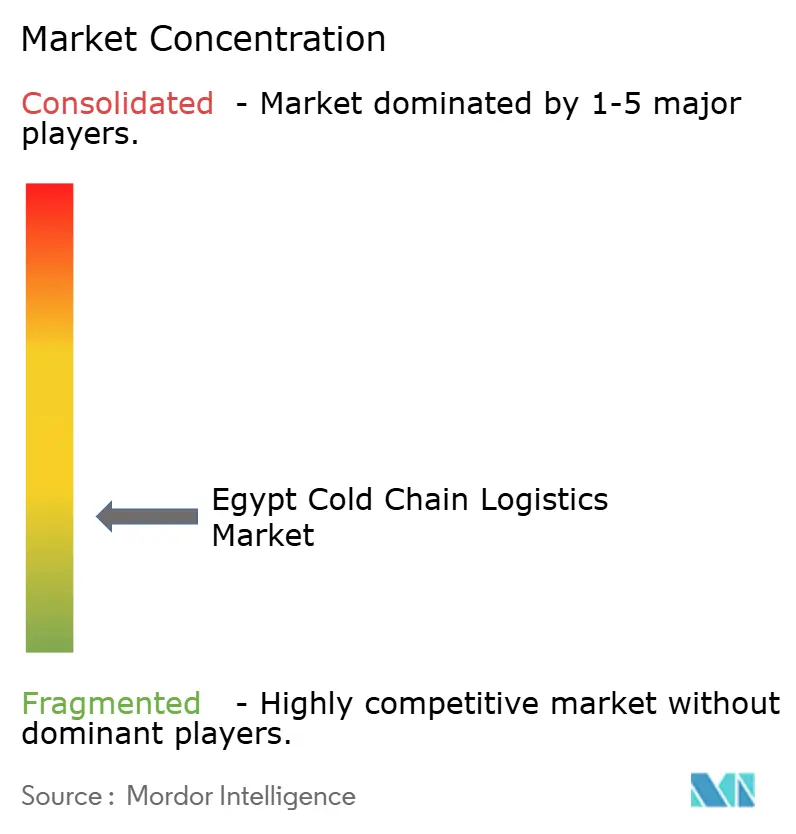
| Market Concentration | Low |
Major Players *Disclaimer: Major Players sorted in no particular order Image © Mordor Intelligence. Reuse requires attribution under CC BY 4.0. | |
Egypt Cold Chain Logistics Market Analysis by Mordor Intelligence
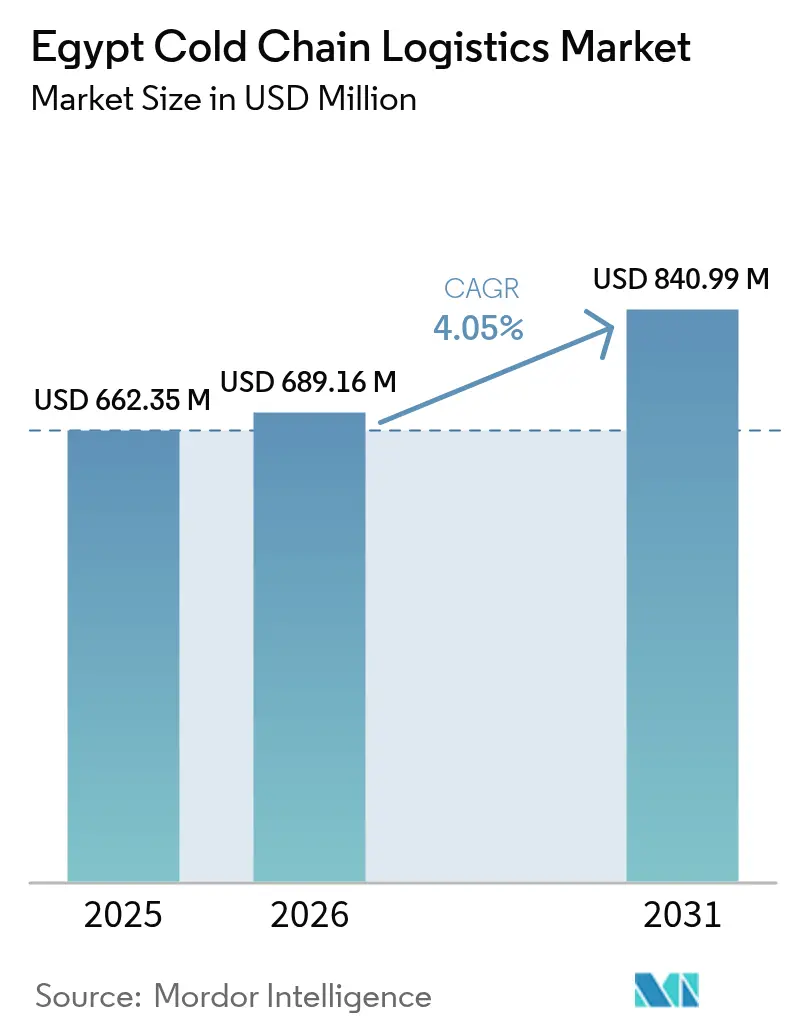
Egypt cold chain logistics market size in 2026 is estimated at USD 689.16 million, growing from 2025 value of USD 662.35 million with 2031 projections showing USD 840.99 million, growing at 4.05% CAGR over 2026-2031. This market size growth is powered by record processed-food exports, double-digit expansion in pharmaceuticals, and steady government investment in logistics corridors that connect Africa, Europe, and Asia. Egypt’s position on the Suez Canal, combined with the National Single Window for Foreign Trade Facilitation (Nafeza) that now covers 95% of imports and exports, shortens customs clearance times and attracts global logistics players[1]English Ahram, “President Sisi directs government to turn Egypt into int'l logistics hub,” Ahram.org.eg. Private operators are rapidly adding Grade-A refrigerated space, while adoption of IoT temperature-monitoring systems is driving real-time quality control and reducing spoilage rates. However, Red Sea disruptions that lowered Suez Canal revenues by 60% in 2024, volatile energy prices, and foreign-exchange shortages affecting imported refrigeration equipment temper the overall momentum.
Key Report Takeaways
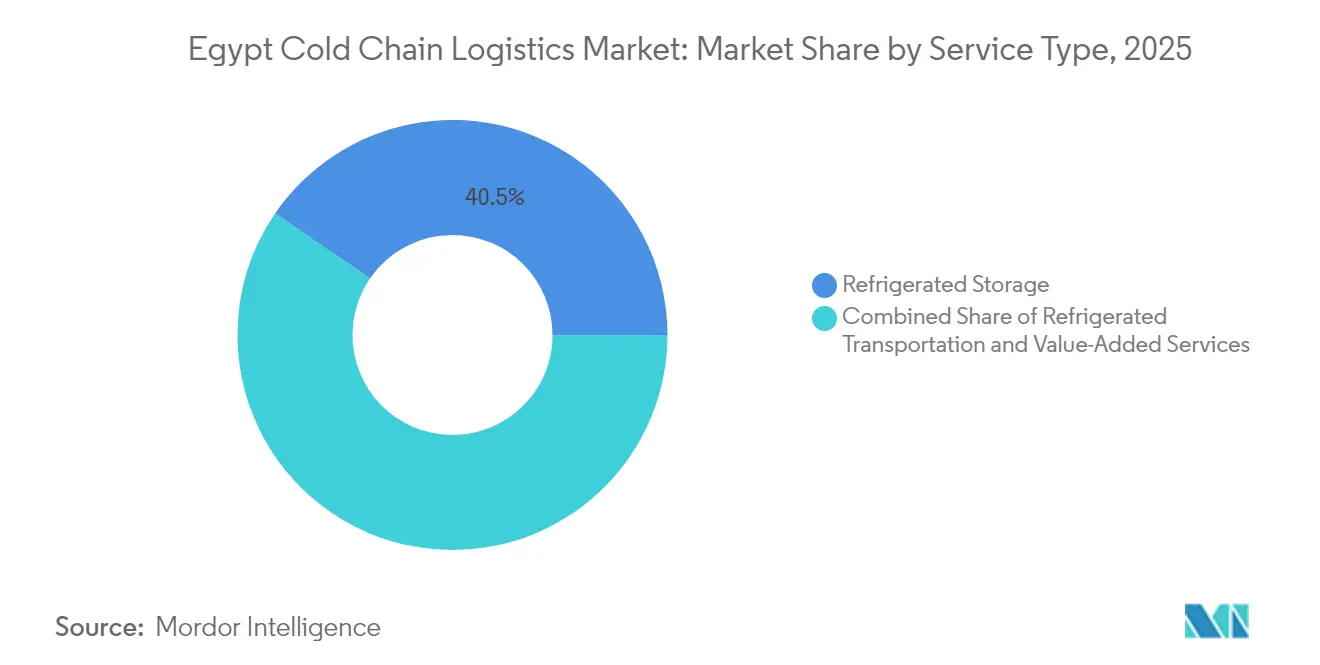
- By service type, refrigerated storage led with 40.45% of Egypt cold chain logistics market share in 2025, while value-added services are projected to register a 4.12% CAGR to 2031.
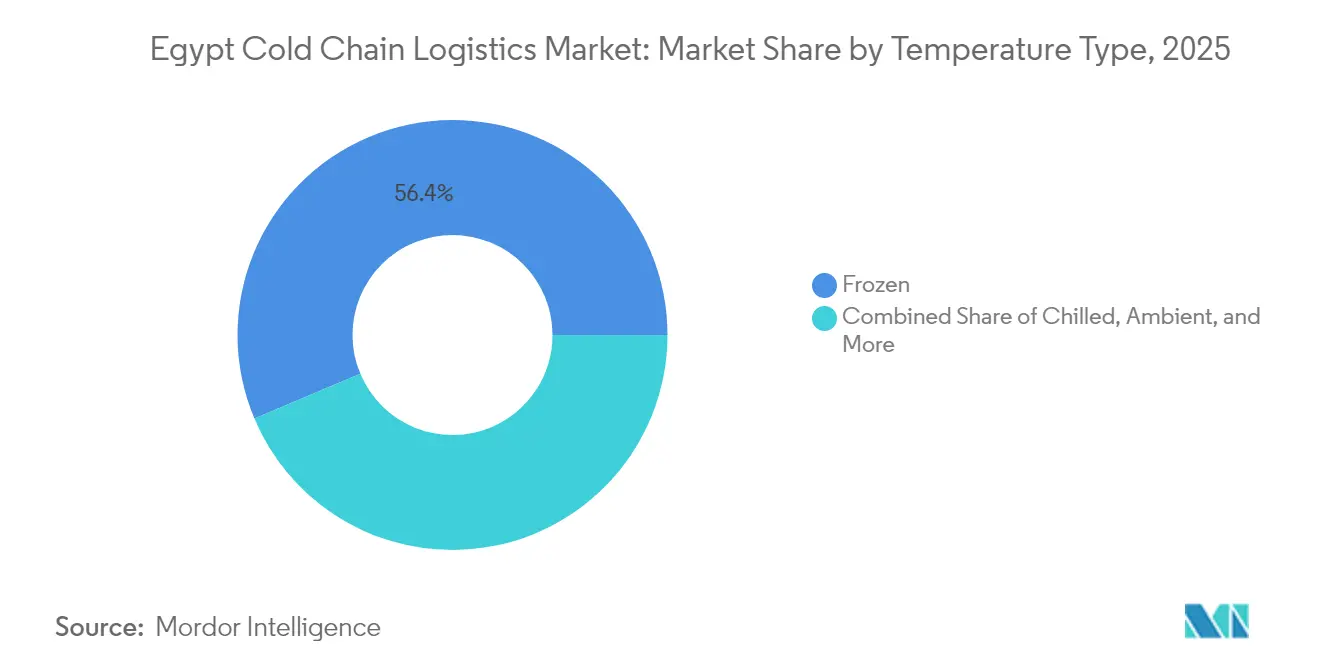
- By temperature type, the frozen (-18 °C to 0 °C) segment accounted for 56.35% of Egypt cold chain logistics market size in 2025; chilled (0 °C to 5 °C) applications are forecast to expand at a 4.88% CAGR through 2031.
- By application, meat & poultry held 27.45% of Egypt cold chain logistics market share in 2025; ready-to-eat meals are expected to post the quickest growth at a 4.11% CAGR between 2026 and 2031.
Note: Market size and forecast figures in this report are generated using Mordor Intelligence’s proprietary estimation framework, updated with the latest available data and insights as of 2026.
Egypt Cold Chain Logistics Market Trends and Insights
Drivers Impact Analysis*
| Driver | (~) % Impact on CAGR Forecast | Geographic Relevance | Impact Timeline |
|---|---|---|---|
| Evolving consumer preference for fresh & frozen foods | +0.8% | National—Cairo, Alexandria, Giza | Medium term (2-4 years) |
| Accelerating pharmaceutical cold-chain demand | +1.2% | Cairo and Alexandria | Short term (≤ 2 years) |
| Government investments in logistics corridors & inland ports | +0.9% | Suez Canal Economic Zone, Port Said | Long term (≥ 4 years) |
| Adoption of IoT-enabled temperature-monitoring systems | +0.6% | Major cities | Medium term (2-4 years) |
| Suez Canal Free-zone push to be MENA re-export hub | +0.7% | Suez Canal Economic Zone | Long term (≥ 4 years) |
| Surge in processed-food exports | +1.0% | Coastal export hubs | Medium term (2-4 years) |
| Source: Mordor Intelligence | |||
Evolving Consumer Preference for Fresh & Frozen Foods
Processed-food exports climbed to USD 6.1 billion in 2024, a 21% annual increase that underscores Egypt’s growing role as a food-processing hub. Frozen potato shipments alone surged 923%, demonstrating the reliability of the Egypt cold chain logistics market in meeting stringent quality standards. Arab countries absorb 54% of outbound volumes, while the European Union and the United States represent high-margin destinations. The “Future of Egypt” agricultural initiative is equipping new grain silos with cooling stages, signaling policy support for temperature-controlled infrastructure[2]State Information Service, “President El-Sisi Inaugurates 2024 Harvest Season of ‘Egypt’s Future’,” Sis.gov.eg. Urban consumers are also shifting toward convenience products with longer shelf lives, spurring demand for chilled and frozen distribution networks across secondary cities.
Accelerating Pharmaceutical Cold-Chain Demand
Pharmaceutical sales rose 42% year-on-year to EGP 292 billion (USD 5.7 billion) in 2024, aided by Egyptian Drug Authority price approvals and reduced drug shortages. Good Distribution Practice requirements mandate continuous temperature tracking for biologics and vaccines, elevating service standards within the Egypt cold chain logistics market. CACC Cargolinx secured IATA CEIV Pharma certification for its 10,000 m² terminal at Cairo International Airport, setting a benchmark for GDP-compliant facilities. DHL Group’s EUR 2 billion (USD 2.08 billion) global healthcare logistics plan earmarks new GDP hubs and temperature-controlled fleets that will boost local capacity. Rising biologics volumes and Egypt’s regional export ambitions are therefore translating into premium contract opportunities for specialized cold-chain operators.
Government Investments in Logistics Corridors & Inland Ports
The state allocated USD 153 million to develop grain handling and 20 high-capacity silos inside the Suez Canal Economic Zone, reinforcing its strategy to become a regional trans-shipment center. Hutchison Ports committed USD 700 million to new terminals at Sokhna and Alexandria, with Sokhna alone adding 1.7 million TEU of annual capacity. DP World is finalizing a USD 80 million logistics hub expected to streamline multimodal flows along the Red Sea corridor. These projects, combined with Nafeza’s end-to-end digital customs clearance, shorten dwell times for temperature-sensitive cargo and expand total Egypt cold chain logistics market capacity.
Adoption of IoT-Enabled Temperature-Monitoring Systems
Cloud-connected sensors now achieve 98.35% upload success and 0.64-second data latency, enabling real-time intervention when excursions occur[3]MDPI Authors, “Blockchain-Based Mobile IoT System with Configurable Sensor Modules,” Mdpi.com. Deep-learning algorithms executed on low-power microcontrollers deliver 92% accuracy in spotting cold-room anomalies that could threaten vaccine potency[4]Frontiers Researchers, “Real-time temperature anomaly detection in vaccine refrigeration systems,” Frontiersin.org. Cairo-based ReNile offers modular IoT platforms for agriculture and industry, proving domestic capability in high-tech monitoring solutions. Blockchain integration guarantees tamper-proof logs, satisfying regulator demands for traceability across the Egypt cold chain logistics market. These technologies are indispensable in a climate where summer temperatures frequently exceed 40 °C.
Restraints Impact Analysis*
| Restraint | (~) % Impact on CAGR Forecast | Geographic Relevance | Impact Timeline |
|---|---|---|---|
| Limited Grade-A cold-storage capacity in secondary cities | -0.7% | Upper Egypt & emerging urban centers | Medium term (2-4 years) |
| High electricity tariffs & diesel price volatility | -0.9% | National | Short term (≤ 2 years) |
| FX shortages inflating refrigerant & equipment costs | -1.1% | National | Short term (≤ 2 years) |
| Fragmented biosafety regulations for biologics | -0.5% | Pharmaceutical clusters | Long term (≥ 4 years) |
| Source: Mordor Intelligence | |||
Limited Grade-A Cold-Storage Capacity in Secondary Cities
Refrigeration assets cluster around Greater Cairo and Alexandria, forcing distributors to operate costly hub-and-spoke routes to underserved governorates. Capacity shortages in Upper Egypt raise last-mile costs, prolong transit times, and heighten temperature-excursion risk. Although private projects—such as Sharp Corporation’s joint venture that will add 400,000 refrigerator units annually from March 2026—address the gap, new facilities will not come online fast enough to fully satisfy emerging demand. The imbalance constrains the Egypt cold chain logistics market from realizing its full national footprint.
High Electricity Tariffs & Diesel Price Volatility
Rolling power cuts and LNG import needs highlight systemic energy stress. Diesel shortages have produced fuel queues and black-market premiums, lifting refrigerated-transport costs and eroding operator margins. Egypt aims to lift renewable-energy contribution to 42% by 2030, yet capital outlays during the transition could inflate tariffs. Continuous refrigeration loads limit providers’ ability to defer consumption, making the Egypt cold chain logistics market highly sensitive to utility pricing swings.
*Our forecasts treat driver/restraint impacts as directional, not additive. The impact forecasts reflect baseline growth, mix effects, and variable interactions.
Segment Analysis
By Service Type: Storage Dominates Infrastructure Investment
Refrigerated storage accounted for 40.45% of Egypt cold chain logistics market size in 2025, reflecting sustained capital flows into large, multi-temperature facilities positioned near ports and agro-processing clusters. Logistica’s 50,000 m² warehouse capable of –30 °C to +25 °C operations illustrates the scale of current assets. Operators leverage these hubs to consolidate seafood, meat, and pharma cargo before re-export through the Suez axis. Refrigerated transportation ranks second, supported by a road network spanning 30,000 km and strategic proximity to Mediterranean and Red Sea routes that allow multimodal hand-offs.
Value-added services—ranging from kitting and blast-freezing to GDP audit support—are projected to grow at a 4.12% CAGR (2026-2031), outpacing core storage and transport. Uptake of IoT track-and-trace, repacking for export, and quality-control analytics positions this niche as a profit center within the broader Egypt cold chain logistics market. Certified air-cargo handlers such as CACC Cargolinx use pharmaceutical handling accreditation to differentiate in a fragmented field. Small and midsize shippers increasingly outsource complex compliance tasks, deepening demand for bundled services.



By Temperature Type: Frozen Segment Leads Market Share
The frozen band (-18 °C to 0 °C) commanded 56.35% of Egypt cold chain logistics market share in 2025 on the back of robust poultry processing and the 923% jump in frozen potato exports. Frozen proteins ship to Gulf Cooperation Council countries with transit times under five days, requiring high-efficiency blast freezers and insulated trucks. Ultra-low (below –20 °C) demand is modest yet rising, led by cell-therapy inputs and mRNA-based vaccine research that require –70 °C or colder storage.
Chilled cargo is forecast to post a 4.88% CAGR (2026-2031), the fastest among temperature bands, as urban consumers favor fresh dairy, cut vegetables, and premium ready-to-eat meals. IoT anomaly detection that offers 92% predictive accuracy is critical for safeguarding chilled goods, which are more susceptible to short-term thermal shocks. Ambient storage retains strategic importance for packaging and buffer inventory, but contributes limited revenue to the total Egypt cold chain logistics market size.
By Application: Meat & Poultry Drives Volume Demand
Meat & poultry generated 27.45% of 2025 revenue, supported by expanded domestic livestock operations and regional export routes to North Africa and the Gulf. The “Future of Egypt” initiative earmarks modern slaughterhouses and feedlots, ensuring steady throughput for cold-chain nodes. Fish & seafood volumes are climbing as the Al Fayrouz aquaculture project ramps production to 150,000 tons annually, much of which requires frozen or chilled carriage.
Ready-to-eat meals are on track for a 4.11% CAGR (2026-2031). Growing middle-class employment, longer commutes, and the rise of e-grocery platforms are reshaping purchase habits toward convenience SKUs that rely on reliable chilled distribution to store shelves and homes. Pharmaceutical and biologics shipments, though smaller in tonnage, command premium yields and stringent compliance, reinforcing their strategic value inside the Egypt cold chain logistics market.
Geography Analysis
Greater Cairo, Alexandria, and the Suez Canal Economic Zone capture the lion’s share of Egypt cold chain logistics market size thanks to port connectivity, population density, and proximity to processing clusters. A USD 153 million grain hub with 20 silos in East Port Said strengthens northern corridor capacity and will hold up to 6 million tons of cereals annually. Despite the 2024 Red Sea crisis that shaved USD 7 billion from Suez Canal receipts, the Economic Zone still reported 38% revenue growth in 2025, proving resilience.
Coastal governorates, including Port Said and Suez, are focal points for export-oriented processors seeking fast maritime links to Europe and the Middle East. AD Ports Group’s 50-year concession to develop KEZAD East Port Said underscores long-term investor confidence in Egypt’s logistics throughput potential. Together, these geographic nodes reinforce Egypt’s role as a gateway for temperature-sensitive trade between three continents.
Regulatory Landscape
Egypt's cold chain compliance for food is anchored by the National Food Safety Authority (NFSA), which requires food business operators to maintain temperature control across storage and transportation, supported by traceability systems commonly aligned with HACCP. For product and process standards, operators typically follow Egyptian Organization for Standardization and Quality (EOS) requirements. Where specific local standards are not available, recognized international standards such as Codex Alimentarius and ISO are used as reference points, particularly by export-facing operators.
On trade and border processes, Egypt's customs digitization through the National Single Window for Foreign Trade Facilitation (Nafeza), which covers 95% of imports and exports, supports documentation and clearance workflows that are critical for time- and temperature-sensitive cargo. For pharmaceuticals and biologics, Good Distribution Practice-style controls and continuous temperature tracking elevate facility and fleet requirements. Certified nodes at Cairo International Airport, including CACC Cargolinx with IATA CEIV Pharma accreditation, reinforce these service expectations.
Value Chain Analysis
The Egypt cold chain value chain starts with producers and processors in food (meat, poultry, seafood, fruits and vegetables, and processed foods) and high-value pharma and biologics shippers, then moves into pre-cooling, packhouses, and export packaging before transfer to temperature-controlled logistics. Core logistics participants include cold storage operators (multi-temperature warehouses near Greater Cairo, Alexandria, and the Suez axis), refrigerated transport providers (primarily road), airport handlers for pharma and perishables (for example, CEIV Pharma-accredited handlers at Cairo International Airport), and ocean freight and terminal operators that connect refrigerated cargo to Mediterranean and Red Sea gateways.
The most value-sensitive links are domestic linehaul and last-mile distribution, where aging refrigerated fleets, inconsistent telematics adoption, and fuel and power volatility raise excursion risk and costs. Investment-led nodes are expanding through integrated logistics parks and industrial city projects that bundle cold storage with value-added services (sorting, packing, labeling, and compliance support), including government-backed strategic food warehouses across multiple governorates and private-sector facilities such as Sullex's SulleX-TRC in Giza and DP World-linked cold storage projects in 6th of October City.
Competitive Landscape
Domestic specialists, multinational integrators, and niche technology vendors collectively shape a moderately fragmented Egypt cold chain logistics market. Logistica dominates large-scale storage through its 50,000 m² multi-temperature complex outside Cairo, catering to FMCG and pharma clients alike. CACC Cargolinx differentiates through IATA CEIV Pharma certification, granting preferred-carrier status for vaccine imports and exports.
Global heavyweights are injecting capital and know-how. DHL Group earmarked EUR 2 billion (USD 2.08 billion) for health-care logistics upgrades that include GDP-certified hubs and an expanded fleet of dual-temperature vehicles. Kuehne + Nagel posted 19% turnover growth in Q3 2024 as Egyptian shippers sought flexible routings during Suez disruptions. These players couple global networks with local partnerships to secure end-to-end control across ocean, air, and last-mile modes.
Technology adoption is an emerging battleground. IoT sensors with blockchain-verified data are gaining traction among compliance-intensive pharmaceutical clients. Local start-up ReNile supplies customizable IoT modules, giving smaller operators an affordable entry to digital monitoring. In secondary cities where capacity lags, regional operators with first-mover cold storage have the potential to cement strongholds before global entrants scale inland.
Egypt Cold Chain Logistics Industry Leaders
Logistica
Logistics for Storage Services (S.A.E)
Custom Storage Company (CSC)
SulleX
EPx Logistics
- *Disclaimer: Major Players sorted in no particular order

Market Opportunities and Future Outlook
White space is most visible outside the Cairo-Alexandria corridor, where limited Grade-A cold storage in secondary cities increases hub-and-spoke inefficiencies and makes pre-cooling and consolidation capacity scarce for perishables. New capacity announcements and corridor programs provide concrete entry points for developers and operators, including the government's Strategic Warehouses for Food Products program (seven facilities across governorates with cold and frozen storage components) and the Future of Egypt Industrial City, which includes a 90,000-ton refrigeration unit integrated with automated sorting and packaging for export-grade produce.
Integrated port-adjacent logistics and multimodal corridors are expanding the addressable cold-chain footprint for exporters and pharma shippers. In July 2026, DP World launched an integrated Logistics Distribution Centre at Sokhna Logistics Park that combines warehousing and cold-chain capabilities, while commercial trial operations began at the Noatum Ports Safaga Terminal under a 30-year concession, supporting Red Sea throughput options. The April 2026 start of construction for a 603-feddan logistics zone in Arish, with dedicated cold storage under the Arish-Taba corridor project, and the May 2026 reporting of 3.7 million tons of agricultural exports (including 1.7 million tons of citrus) highlight demand for compliant, temperature-controlled handling tied to export standards rather than purely domestic consumption.
Recent Industry Developments
- July 2026: DP World launched an integrated Logistics Distribution Centre at Sokhna Logistics Park, combining warehousing and end-to-end supply chain services with cold chain integration. The opening strengthens a port-adjacent option for temperature-controlled cargo consolidation and distribution along the Suez corridor, supporting faster handoffs between sea freight, storage, and domestic delivery.
- November 2025: Raya Logistics and Midea Egypt launched a Regional Distribution Center in Assiut to improve warehousing and transportation efficiency for Upper Egypt. The facility adds a more localized node for inventory positioning and distribution, helping reduce reliance on long-haul routes from Greater Cairo and improving service levels in underserved governorates.
- February 2024: SulleX commenced development of SulleX-TRC in Giza Governorate as a USD 150 million integrated temperature-controlled logistics and industrial city spanning about 510,000 square meters. With planned smart cold warehouses and chilled and frozen food industrial services, the project expands the ecosystem for combined storage, processing, and value-added logistics in one location.


Research Methodology Framework and Report Scope
Market Definition and Coverage
For this report, the market is defined as revenue earned from temperature-controlled logistics services inside Egypt, where products are kept within required temperature bands during storage, handling, and transportation.
Scope exclusions: This sizing does not include ambient (non-refrigerated) logistics, in-house captive distribution run by manufacturers, or the value of refrigerated equipment sold as standalone products.
Segmentation Overview
- By Service Type
- Refrigerated Storage
- Public Warehousing
- Private Warehousing
- Refrigerated Transportation
- Road
- Rail
- Sea
- Air
- Value-Added Services
- Refrigerated Storage
- By Temperature Type
- Chilled (0–5 °C)
- Frozen (-18–0 °C)
- Ambient
- Deep-Frozen / Ultra-Low (less than-20 °C)
- By Application
- Fruits & Vegetables
- Meat & Poultry
- Fish & Seafood
- Dairy & Frozen Desserts
- Bakery & Confectionery
- Ready-to-Eat Meals
- Pharmaceuticals & Biologics
- Vaccines & Clinical Trial Materials
- Chemicals & Specialty Materials
- Other Application
Data Sources, Market Sizing, and Validation
Desk Research
Desk research was used to set the Egypt context and to build practical volume signals for cold chain demand. We referred to public sources such as CAPMAS releases, Central Bank of Egypt indicators for inflation and FX, UN Comtrade trade flows for perishables, FAOSTAT for agriculture output, and WHO or UNICEF pages for vaccine cold chain handling needs.
On top of this, we also reviewed annual reports and investor presentations of logistics operators, food producers, and pharma distributors that disclose capacity additions, service mix, or utilization signals. Paid database subscriptions were used selectively for company financials and news screening, and for shipment-level import and export checks to spot step changes in perishables movement. These references are illustrative, and there were many other sources used during data collection, validation, and research clarification.
Primary Interviews and Surveys
Primary work focused on validating what drives priced cold chain activity in Egypt and where constraints sit across warehousing, first-mile pickup, and line-haul reefer moves. We spoke with a mix of cold storage operators, transport fleet owners, freight forwarders, and large shippers in food and pharmaceuticals so assumptions like utilization, loss rates, and typical contract structures could be confirmed.
To avoid relying on a single viewpoint, feedback was balanced across commercial and operations roles, and we followed up with cross-checks from importers, exporters, and retail supply teams that manage daily temperature compliance.
Distribution of primary research fieldwork respondents
| Company type | Respondent position |
|---|---|
| Top tier: 39% | CXOs: 18% |
| Mid tier: 41% | Functional/Unit leaders: 33% |
| Smaller Players: 20% | Managers: 49% |
Market-Sizing & Forecasting
The main sizing logic combines a top-down build from Egypt's addressable cold volumes with a service-intensity filter, and then it is pressure-tested using selective bottom-up checks from capacity and price signals. We start from temperature-sensitive demand pools such as chilled and frozen food flows and regulated pharma distribution needs, and then apply realistic penetration rates for outsourced cold logistics versus captive movement.
Key inputs used in the model include cold storage capacity additions (square meters and pallet positions where available), reefer fleet availability and typical utilization, import and export volumes for perishable categories, pharma distribution and vaccination logistics requirements, and rate movement linked to fuel, power, and currency shifts. When data is missing for smaller operators, gaps are handled through representative utilization and pricing ranges derived from interviews, and then tuned through channel checks so totals stay consistent.
For forecasting, scenario analysis was applied so the base case reflects expected demand growth along with practical constraints such as power reliability, port and road improvements, and the pace of new warehouse commissioning. Assumptions were refreshed with expert feedback, and outputs were compared against near-term signals such as announced capacity expansions and changes in reefer availability.
Data Validation & Update Cycle
Validation was done through multiple passes of triangulation, where model totals were compared with independent signals such as cold storage capacity growth, perishable trade trends, and the pace of modern retail and pharma distribution activity. Any sharp jumps were reviewed at line-item level, and follow-up calls were triggered when a single input, like utilization or FX timing, could move the outcome materially.
Before sign-off, variance checks were run across years and across demand indicators, and then a second analyst review was completed to confirm arithmetic, logic, and consistency with the stated scope. Reports are refreshed annually, with interim updates for material events such as major currency moves, policy changes affecting food and pharma handling, or large warehouse commissioning. Right before delivery, an analyst performs a final freshness pass so clients receive the latest updated view.
Mordor Intelligence's Egypt Cold Chain Logistics Market Sizing Compared With Other Published Estimates
Published market values for Egypt cold chain logistics often disagree because authors are not always counting the same revenue streams, and they also apply different currency timing and growth assumptions. Differences usually show up when warehousing and transport are mixed with adjacent activities, or when informal and captive movement is treated as paid logistics.
Refrigeration equipment sales and installation revenue often gets blended into some estimates, and that item sits outside Mordor Intelligence's scope because only third-party cold logistics service revenue from storage and temperature-controlled transport is counted. Other gaps come from using aggressive utilization rates for new warehouses, applying straight-line price inflation without checking Egypt-specific reefer rate behavior, and not re-validating FX conversion timing against the same base year.
Benchmark comparison
| Source | Market Size | Gaps in Research Methodology |
|---|---|---|
| Mordor Intelligence | USD 662.35 M (2025) | |
| Trade Journal A | USD 498.43 M (2025) | Uses a narrower demand proxy that can undercount modern retail and pharma distribution, and it appears to apply lower utilization assumptions for cold stores and reefer fleets. |
| Industry Publisher B | USD 1.14 B (2025) | Expands the scope to include broader cold chain activities and indirect revenues, and it may also assume faster ASP progression without checking Egypt-specific power and fuel cost pass-through. |
The spread in the table is mainly explained by what gets included and how pricing and utilization are treated in the base year. By keeping the build traceable to capacity, trade flows, and service pricing checks, the final number stays practical to repeat and update when conditions change.


Key Questions Answered in the Report
How big is the Egypt cold chain logistics market in 2026?
The market stands at USD 689.16 million in 2026 and is projected to grow at a 4.05% CAGR through 2031.
Which service segment leads revenue?
Refrigerated storage accounts for 40.45% of 2025 revenue due to heavy investment in multi-temperature warehouses.
What temperature range is expanding fastest?
Chilled cargo (0 °C–5 °C) is forecast to grow at 4.88% annually, driven by fresh-food and biologics demand.
How are Red Sea disruptions affecting operators?
Suez Canal revenue declines have lengthened transit loops, prompting carriers to reroute and raising freight costs.
Which application segment offers the highest growth?
Ready-to-eat meals will advance at a 4.11% CAGR as urban consumers favor convenience foods requiring reliable cold chains.
What technology is most transformative?
IoT sensors with blockchain-backed data provide real-time temperature tracking, reducing spoilage and supporting GDP compliance.
Page last updated on:





