
Market Overview
| Study Period | 2020 - 2031 |
|---|---|
| Forecast Data Period | 2026 - 2031 |
| Base Year Market Size (2025) | 219.22 Million liters |
| Market Volume (2026) | 209.01 Million liters |
| Market Volume (2031) | 262.23 Million liters |
| Growth Rate (2026 - 2031) | 3.03 % |
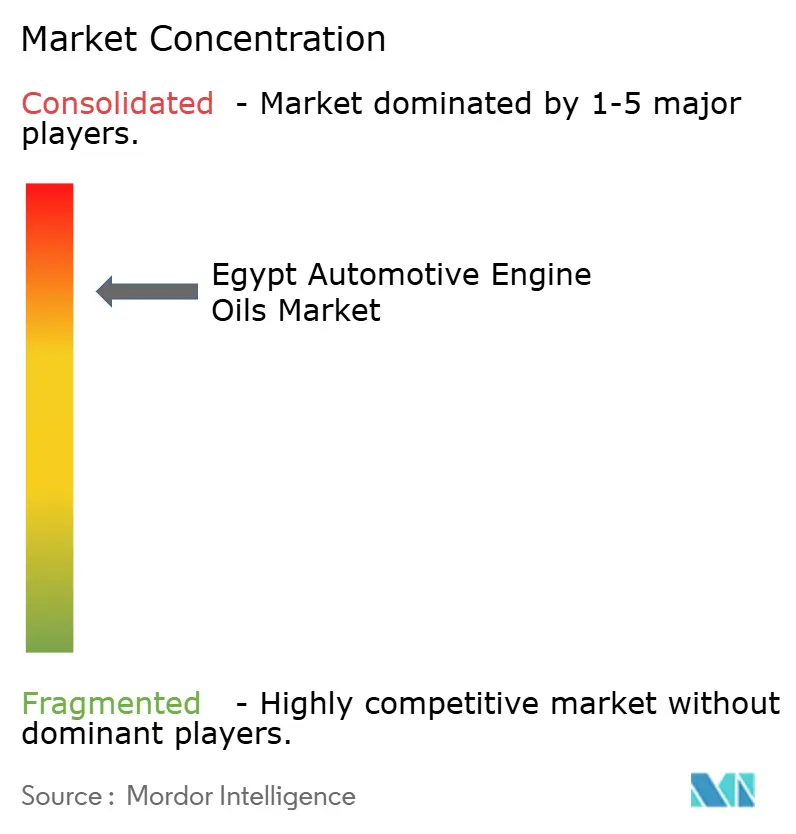
| Market Concentration | High |
Major Players *Disclaimer: Major Players sorted in no particular order Image © Mordor Intelligence. Reuse requires attribution under CC BY 4.0. | |
Egypt Automotive Engine Oils Market Analysis by Mordor Intelligence
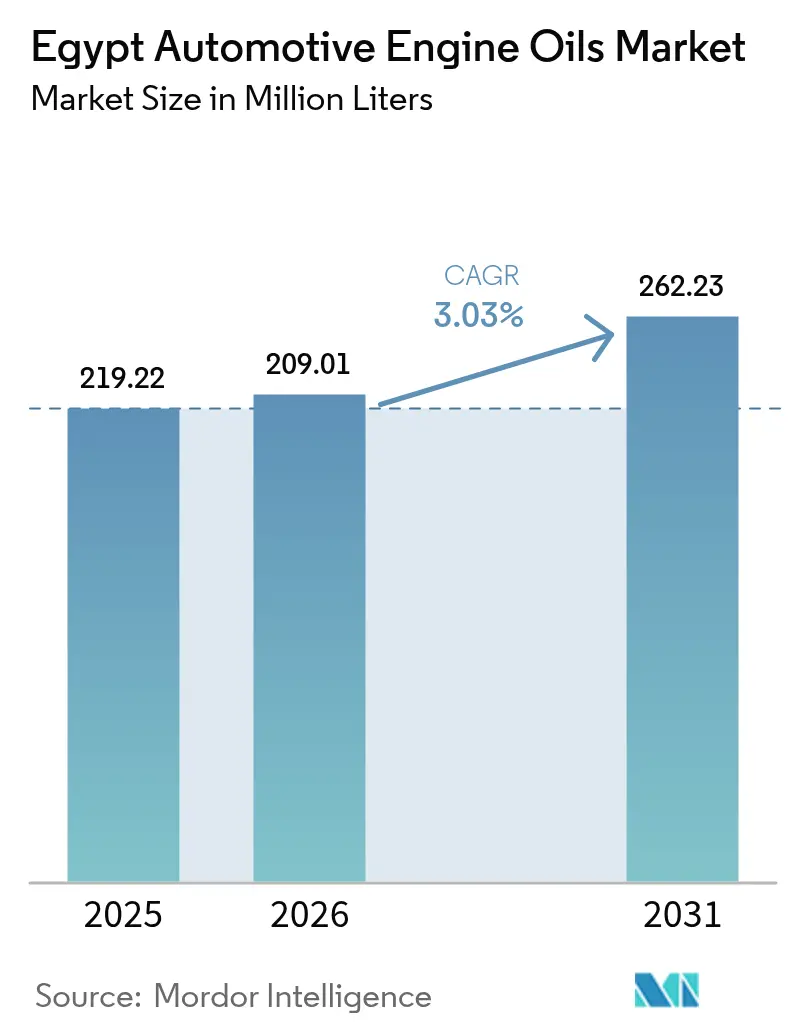
The Egypt Automotive Engine Oils Market size is projected to be 219.22 Million liters in 2025, 209.01 Million liters in 2026, and reach 262.23 Million liters by 2031, growing at a CAGR of 3.03% from 2026 to 2031. The egypt automotive engine oils market is expanding because economic activity is rebounding, infrastructure spending is rising, and the country is investing in alternative-fuel programs that keep internal-combustion vehicles in circulation. Market growth is also tied to local refinery upgrades that secure base-oil supply, the steady renewal of Egypt’s large passenger-car fleet, and increasing demand from commercial vehicles that undergo more frequent service cycles. Competitive pressure has intensified as multinational and regional formulators add synthetic and semi-synthetic grades tailored for hot-climate performance while guarding against counterfeit products. Currency volatility and additive import restrictions temper near-term volume growth, yet investment in quality control and domestic blending capacity shields the egypt automotive engine oils market from severe supply shocks. The industry’s evolving product mix and supportive energy policy framework create measured opportunities for premium lubricants through 2030.
Key Report Takeaways
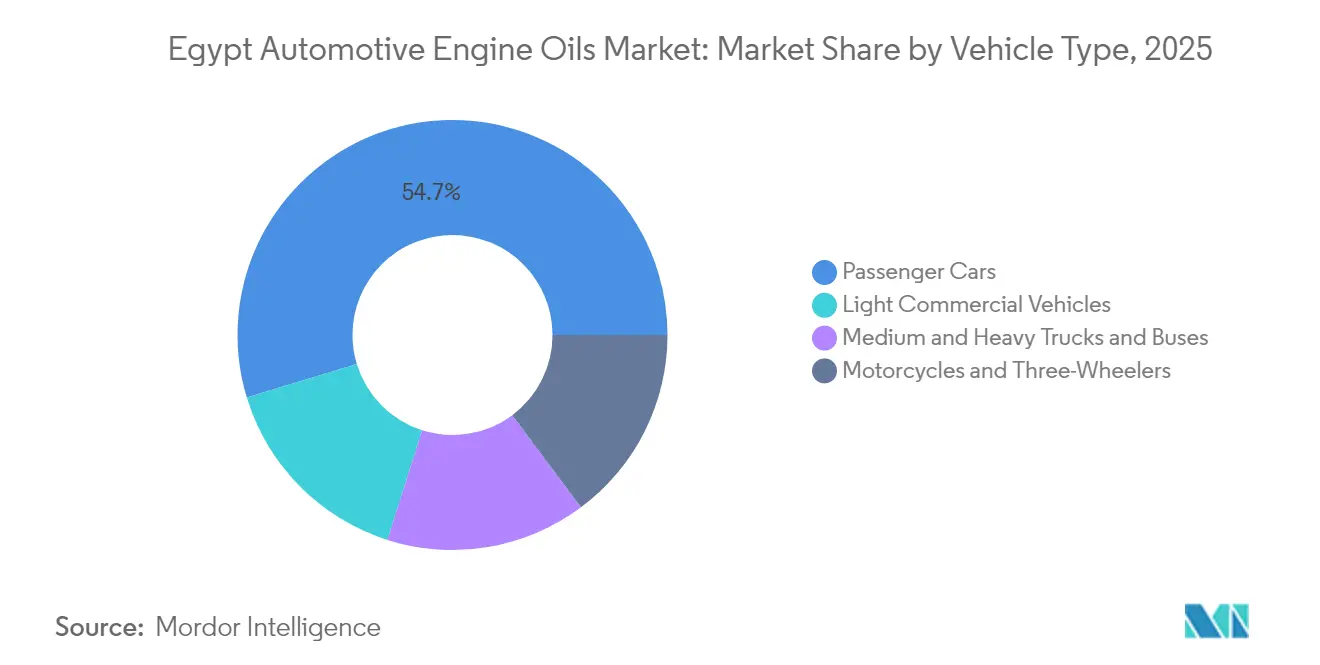
- By vehicle type, passenger cars held 54.70% of the egypt automotive engine oils market share in 2025, whereas light commercial vehicles are projected to expand at a 3.47% CAGR through 2031.
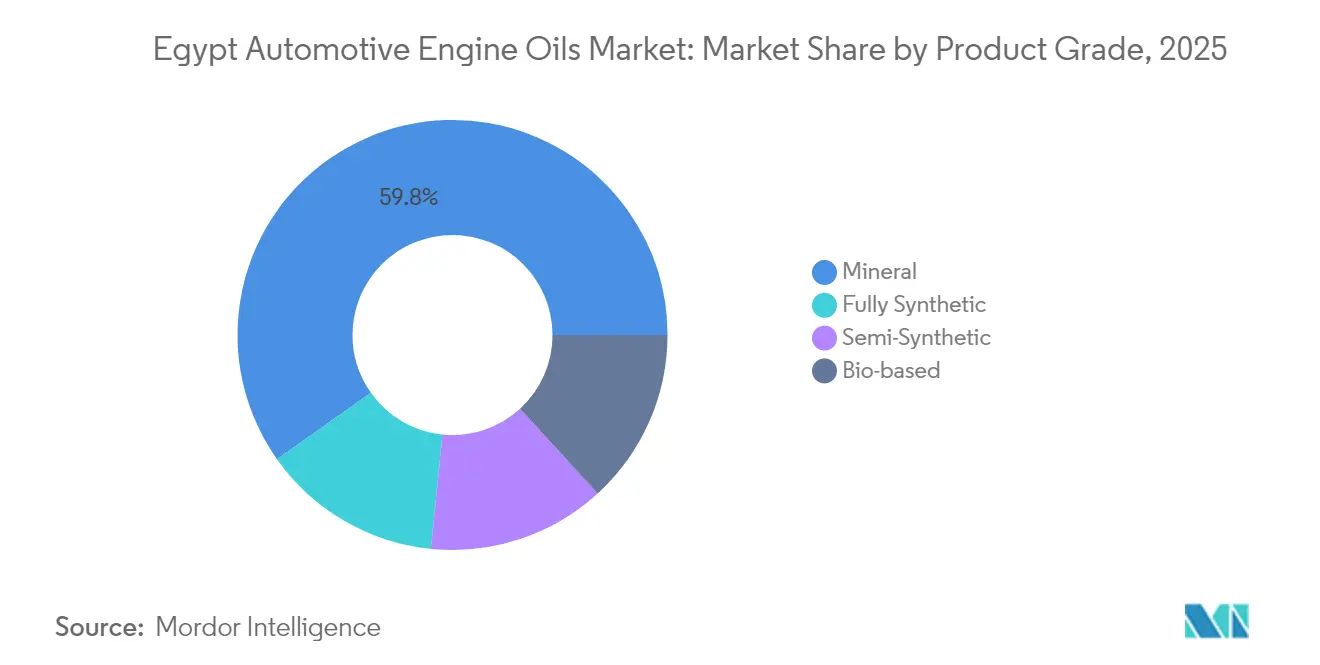
- By product grade, mineral accounted for 59.80% of the egypt automotive engine oils market size in 2025, and fully synthetic is advancing at a 3.55% CAGR during the same horizon.
Note: Market size and forecast figures in this report are generated using Mordor Intelligence’s proprietary estimation framework, updated with the latest available data and insights as of 2026.
Egypt Automotive Engine Oils Market Trends and Insights
Drivers Impact Analysis*
| Driver | (~) % Impact on CAGR Forecast | Geographic Relevance | Impact Timeline |
|---|---|---|---|
| Rapid Expansion of Vehicle Parc | +0.8% | National, concentrated in Greater Cairo and Alexandria | Medium term (2-4 years) |
| Rising Penetration of Synthetic and Semi-Synthetic Oils | +0.6% | Urban centers with newer vehicle concentrations | Long term (≥ 4 years) |
| Government CNG-Conversion Targets Boosting Oil Change Frequency | +0.4% | National rollout with priority corridors | Short term (≤ 2 years) |
| Local Refinery Upgrades Enabling Higher-Quality Base-Oil Supply | +0.3% | National supply chain benefits | Medium term (2-4 years) |
| Nano-Additive R&D for Hot-Climate Performance | +0.2% | Desert regions and high-temperature applications | Long term (≥ 4 years) |
| Source: Mordor Intelligence | |||
Rapid Expansion of Vehicle Parc
Egypt’s registered private-car fleet reached 5.23 million in 2023, and fleet growth parallels a 7.1% rise in manufacturing output that lifts commercial transport demand. Public investment of EGP 115 billion in green transportation has multiplied vehicle kilometers traveled across highways, bus corridors, and ride-hailing services. Higher urbanization and a 104 million population unlock sustained car ownership, which raises lubricant demand per maintenance cycle. Fleet expansion also drives service-network density, prompting distributors to increase egypt automotive engine oils market coverage in secondary cities.
Rising Penetration of Synthetic and Semi-Synthetic Oils
Fully synthetic grades grow faster than the overall egypt automotive engine oils market because late-model engines need tighter viscosity stability and extended drain intervals. Local research shows nano-additive packages that improve thermal conductivity by 10.4%, which addresses Egypt’s high-ambient temperatures. Assembly plants that partner with global OEMs are publishing service-fill specifications that elevate end-user preference for premium oils, while semi-synthetics offer a cost bridge for older vehicles making the transition[1]MDPI, “Thermal Conductivity Enhancement of Engine Oils with Carbon-Nanotube Additives,” mdpi.com .
Government CNG-Conversion Targets Boosting Oil-Change Frequency
A national program finances 80,000 vehicle conversions at a 3% fixed interest rate, backed by the build-out of 1,000 CNG stations. Dual-fuel engines require shorter oil-change intervals to mitigate fuel dilution, increasing per-vehicle lubricant consumption even as gasoline usage decelerates. Taxi and delivery fleets dominate early adoption, reinforcing engine-oil volumes among high-mileage units in the egypt automotive engine oils market.
Local Refinery Upgrades Enabling Higher-Quality Base-Oil Supply
Alexandria Mineral Oils Company lifted quarterly output to 335,000 tons, while the Mostorod refinery adds 4.7 million t/y of finished products that include Group I/II base stocks. Reduced dependence on imports stabilizes blending margins and supports locally tailored formulations. Domestic supply also insulates the egypt automotive engine oils industry from global freight disruptions.
Restraints Impact Analysis*
| Restraint | (~) % Impact on CAGR Forecast | Geographic Relevance | Impact Timeline |
|---|---|---|---|
| FX Volatility and Import Restrictions on Additives/Base Oils | -0.5% | National supply chain impacts | Short term (≤ 2 years) |
| Proliferation of Low-Grade/Re-Refined Counterfeit Oils | -0.3% | Urban markets with price-sensitive segments | Medium term (2-4 years) |
| Gradual EV and Hybrid Uptake Reducing Long-Term Demand | -0.2% | Urban centers with early EV adoption | Long term (≥ 4 years) |
| Source: Mordor Intelligence | |||
FX Volatility and Import Restrictions on Additives/Base Oils
Exchange-rate swings widened raw-material costs and created letter-of-credit delays worth USD 7-8 billion before mid-2024 reforms. Blenders face higher working-capital demands when sourcing specialty antioxidants and viscosity improvers. Price jumps ripple through retailers, delaying synthetic-grade adoption in the egypt automotive engine oils market[2]International Monetary Fund, “Arab Republic of Egypt Article IV Consultation 2024,” imf.org.
Proliferation of Low-Grade/Re-Refined Counterfeit Oils
Counterfeit volumes undercut authentic brands by 20-40% in retail price and can damage engines, eroding consumer trust. Color, odor, and tamper-evidence-seal checks are adopted as counter-measures, yet distribution reach of informal sellers remains extensive. Substandard products squeeze legitimate suppliers’ market share and constrain the premiumization trajectory.
*Our forecasts treat driver/restraint impacts as directional, not additive. The impact forecasts reflect baseline growth, mix effects, and variable interactions.
Segment Analysis
By Vehicle Type: Commercial Fleets Drive Service Intensity
Light commercial vehicles posted a 3.47% CAGR, pacing ahead of passenger cars because freight, construction, and last-mile delivery sectors surged after private investment jumped 30% to EGP 133.1 billion. The egypt automotive engine oils market size for commercial fleets will approach 101.2 million liters by 2031, fueled by higher mileage accumulation per unit. Commercial buyers contract bulk supplies, which encourages synthetic formulations that lower downtime, while CNG conversions magnify change-frequency multipliers. Passenger cars keep a 54.70% egypt automotive engine oils market share but record slower expansion owing to an aging parc and tighter household budgets. Still, population growth keeps absolute volumes rising, securing a baseline for aftermarket sales and service workshops.
In motorcycles and three-wheelers, a policy that bans fully built-unit imports sustains localized assembly lines and contains category growth. Heavy trucks and buses benefit from the USD 3.6 billion savings in fuel imports after natural-gas production recovered, which redirects government spending toward road-fleet renewal. Fleet owners adopt long-drain interval oils with higher TBN values to minimize workshop visits—an emerging niche that multinational formulators address through CK-4 and FA-4 viscosity grades. Combined, these interactions ensure a broad, durable customer base across all vehicle categories, maintaining a resilient foundation for the egypt automotive engine oils market through 2031.



By Product Grade: Premium Shift Amid Mineral Dominance
Mineral oils retain a 59.80% share because over half the national fleet is more than 12 years old and favors low-cost 20W-50 viscosity. The segment, totaling 179.9 million liters in 2025, grows below the market average. Meanwhile, fully synthetic volumes expand at 3.55% CAGR, pushing the egypt automotive engine oils market size for synthetics to nearly 48 million liters by 2031. High-temperature shear-stability and detergency benefits meet OEM warranty requirements for turbocharged gasoline direct-injection engines. Semi-synthetics bridge price gaps and help modernize lube bays, while high-mileage blends with seal conditioners tap the 1.4 million vehicles above 200,000 kilometers.
Nano-additive R&D supports a local premium pivot. Prototype SN Plus 5W-30 products using dispersed graphene platelets cut wear by 17% in dynamometer tests under 45 °C ambient conditions. Domestic blenders exploit upgraded base-oil streams from Mostorod and AMOC refineries, ensuring shorter lead times and lower landed cost relative to imports. The premium shift improves gross margins and encourages multinational licensors to approve Egyptian blend plants, broadening the range of specification-compliant oils in retail channels. Overall, a steady climb in quality grades keeps the egypt automotive engine oils market balanced between affordability and performance.
Geography Analysis
Economic output is heavily concentrated in Greater Cairo and Alexandria, which together account for nearly half of registered vehicles and anchor distribution warehousing for imported additives and packaging. The egypt automotive engine oils market size in these metro regions exceeds 152.7 million liters in 2025. Dense traffic and ridesharing platforms escalate drain intervals, feeding brisk demand for fast-fit centers. Alexandria’s seaport throughput sustains logistics fleets and marine-adjacent workshops that favor bulk containers and metered dispensing systems.
Secondary cities—such as Mansoura, Tanta, and Assiut—gain share as industrial corridors expand. A USD 10 billion solar-manufacturing hub in the New Administrative Capital and the 1,000-km highway revamp drive lubricant needs for construction machinery and transport fleets. Distribution companies respond with regional depots and digital ordering portals that cut delivery times to 48 hours. Rural highways experience higher dust loading, steering fleet operators toward higher-viscosity, high-TBN oils with superior particulate suspension capacity.
Desert and Red Sea governorates register low volumes but premium per-unit revenue, because mining and petroleum service vehicles operate in 50 °C ambient conditions that necessitate synthetic 10W-60 or 5W-40 formulations. Seasonal tourism peaks also draw long-haul buses along the Red Sea corridor, enlarging Q3 lubricant sales. Enhanced logistics corridors through Suez and Port Said continue to improve supply resilience, supporting a nationwide footprint for the egypt automotive engine oils market.
Regulatory Landscape
Egypts automotive engine oils market operates under a standards-and-approval framework anchored by the Egyptian Organization for Standardization and Quality (EOS), with oversight from the Egyptian General Petroleum Corporation (EGPC). EOS maintains lubricant-related standards under ICS 75.100, including national specifications covering lubricating oils and regenerated (re-refined) lubricants (for example, ES 1082), which shape blending, labeling, and quality verification practices in retail and workshop channels.
On trade and compliance, import and export of petroleum products, including lubricating oils, requires EGPC approvals under Decree 770/2005. The General Organization for Export and Import Control (GOEIC) enforces inspection and conformity checks for goods cleared through customs. Government-led petrochemical expansion initiatives aimed at localization reinforce the role of domestic production and testing infrastructure in reducing counterfeit and substandard engine oils.
Value Chain Analysis
The value chain starts with base oils and additives, where domestic refinery and petrochemical availability is complemented by imported additive packages that are sensitive to trade clearance and working-capital constraints. Blending and packaging are carried out by multinational marketers and domestic producers, with state-affiliated players such as Misr Petroleum participating in lubricant blending alongside international brands that use local toll blending or in-country manufacturing.
Route-to-market runs through bulk channels for fleets and industrial buyers, and packaged retail via service stations, fast-fit centers, independent workshops, and authorized distributors. A clear localization pathway is the May 2025 ADNOC Distribution and TotalEnergies Marketing Egypt launch of ADNOC Voyager products, manufactured at TEMEs blending facility in Borg El Arab. This ties international brand portfolios to Egyptian blending capacity and established distribution networks, while EOS standards, GOEIC inspections, and anti-counterfeit measures increasingly influence procurement, packaging security features, and distributor selection across Greater Cairo, Alexandria, and expanding secondary-city networks.
Competitive Landscape
Global suppliers such as Shell, ExxonMobil, BP, Chevron, and TotalEnergies dominate branded shelf space, yet face growing rivalry from Saudi and Emirati portfolio entrants that seize upstream integration advantages. Shell leverages technical partnerships with OEM aftersales networks to maintain product approval lists, while ExxonMobil expands franchise-workshop packages for independent garages. BP’s possible divestiture of Castrol could realign supply contracts and open white-label gaps for regional blenders.
Domestic manufacturers use refinery proximity to launch competitive SKUs. AMOC markets Group II-based blends under its Delta brand, offering 15-40% lower ex-gate prices than imports. Counterfeit risk compels leading brands to embed QR code traceability. Some distributors pilot subscription models bundling oil changes with roadside assistance, stimulating customer stickiness in the egypt automotive engine oils market.
Strategic investments focus on environmental stewardship. TotalEnergies pilots closed-loop used-oil collection with cement kilns for energy valorization, and Castrol’s MoreCircular program coordinates with Safety-Kleen to re-refine waste oil. LabWare’s LIMS deployment at EGPC labs raises test throughput by 25%, improving quality audits. Nano-additive R&D alliances between Cairo University and local blenders promise performance differentiation. Competitive intensity will remain moderate as scale economies balance with growing niche specialization.
Egypt Automotive Engine Oils Industry Leaders
ExxonMobil Corporation
Misr Petroleum
TotalEnergies
Shell plc
BP plc (Castrol)
- *Disclaimer: Major Players sorted in no particular order

Market Opportunities and Future Outlook
Premiumization and the formalization of distribution remain key whitespace areas. Newer engines and OEM service-fill requirements continue to push demand toward higher-spec oils, even as the market still has a large mineral-oil base. Evidence of active portfolio upgrades includes Shell Lubricants Egypts February 2026 introduction of a revamped line-up showcased with products aligned to the 2025 API SQ performance standard, which supports workshop adoption of higher-performance grades and clearer product segmentation at point of sale.
Localization and compliance-led restructuring also create room for domestic blending, quality assurance, and supply continuity. The March 2026 requirement for a Certificate of Conformity for clearance of specific chemical and engineering goods, including lubricants, raises the bar for importers and strengthens the case for in-country manufacturing and controlled channels. In parallel, route-to-market expansion by major brands, including Castrol Egypt signing three distributor agreements in April 2026, and investment discussions around expanding premium lubricant and synthetic grease manufacturing capacity in Alexandria and 10th of Ramadan City, point to broader geographic coverage and a larger addressable base of authenticated products beyond core metro areas.
Recent Industry Developments
- May 2026: ExxonMobil executives met Egypts Minister of Petroleum and Mineral Resources to discuss expanding investments in high-performance synthetic greases and premium lubricants, building on existing manufacturing footprints in Alexandria and 10th of Ramadan City. The discussions indicate deeper localization of higher-value formulations and efforts to strengthen domestic supply and distribution capabilities.
- April 2026: Castrol Egypt signed three distributor agreements with Nacita Mobility, Qebaa Trading & Distribution, and Al Mansour for Trading & Distribution to widen nationwide coverage across key regions. This strengthens channel control and service availability, supporting brand protection and more consistent product availability in retail and workshop networks.
- May 2025: ADNOC Distribution partnered with TotalEnergies Marketing Egypt to launch ADNOC Voyager lubricants in Egypt, with selected products manufactured at TEMEs blending facility in Borg El Arab. Local manufacturing shortens lead times and reduces reliance on imported finished lubricants, improving supply resilience for branded engine oils.


Research Methodology Framework and Report Scope
Market Definition and Coverage
For this report, the market covers finished automotive engine oils sold and used in Egypt for on-road vehicles, measured as demand from oil changes and fleet maintenance in the country.
Scope exclusions: This scope excludes non-engine automotive lubricants (such as transmission fluids, greases, brake fluids, and coolants) and industrial oils used outside vehicles.
Segmentation Overview
- By Vehicle Type
- Passenger Cars
- Light Commercial Vehicles
- Medium and Heavy Trucks and Buses
- Motorcycles and Three-Wheelers
- By Product Grade
- Mineral
- Semi-Synthetic
- Fully Synthetic
- Bio-based
Data Sources, Market Sizing, and Validation
Desk Research
Desk work started with building the vehicle and maintenance demand base in Egypt, and then aligning it with engine oil usage patterns and lubricant trade flows. We referred to public sources such as CAPMAS releases, Central Bank of Egypt macro series, the Ministry of Petroleum and Mineral Resources updates, and Egypt Customs and UN Comtrade trade statistics for lubricant and base oil related imports.
To keep assumptions realistic, we also used sources like vehicle registration and parc-style statistics where available through official channels, technical publications on engine oil drain intervals and viscosity trends, and product specification information published by standards bodies (for example SAE and API documentation). Company filings, distributor announcements, and reputable press were used to check pricing direction and channel activity, and a paid subscription database for company financials and a shipment-level trade database were used selectively to validate supplier scale and import dependence. The sources listed are illustrative, and many other public and paid references were also consulted to fill gaps, cross-check, and clarify details.
Primary Interviews and Surveys
Primary calls and surveys were used to validate how often different vehicle groups change oil, which grades are actually preferred in workshops, and how pricing and pack size mix is shifting in the market. We spoke with a mix of lubricant blenders, importers, distributors, service workshops, fleet maintenance managers, and industry advisors across the main demand centers, and then reconciled differences before finalizing inputs.
Distribution of primary research fieldwork respondents
| Company type | Respondent position |
|---|---|
| Top tier: 29% | CXOs: 20% |
| Mid tier: 49% | Functional/Unit leaders: 39% |
| Smaller Players: 22% | Managers: 41% |
Market-Sizing & Forecasting
Sizing followed a top-down and bottom-up workflow, where the demand pool was reconstructed from Egypt's on-road vehicle parc by segment, typical annual mileage, and average drain intervals, then converted into liters per change by engine size and oil grade mix. Once the demand volume was built, it was translated into value using an average selling price ladder that reflects pack sizes, channel mix, and the share of mineral, semi-synthetic, and fully synthetic oils.
To keep totals grounded, selective bottom-up checks were run using supplier and importer roll-ups from trade and financial signals, along with channel checks on workshop throughput and retailer movement. Where direct data was missing (for example, informal service activity and cross-border leakage), conservative adjustment factors were applied and then re-tested in expert calls so we did not overstate consumption.
For forecasting, scenario analysis was used because the market is sensitive to variables that do not move in a straight line, especially vehicle parc growth, used vehicle inflows, inflation and currency movement, and the pace of shift toward higher specification oils. Key inputs used in the forward view include vehicle parc by type, average kilometers driven, change interval behavior, the grade mix shift, and observed import and local blending availability, which are then reviewed with primary respondents before the final forecast is locked.
Data Validation & Update Cycle
Model outputs were checked against independent signals such as lubricant import trends, workshop service activity feedback, and consistency across vehicle parc and oil change logic. When a variance looked too large, the assumption behind it was re-tested, and respondents were re-contacted if the gap could not be explained by seasonality, channel shifts, or product mix changes.
Before sign-off, the full set of calculations goes through a multi-step analyst review so arithmetic, unit conversions, and key drivers are verified, and then the narrative is aligned with the numbers. Reports are refreshed annually, and interim updates are made when material events occur, such as major price resets, policy changes that affect vehicle inflows, or sharp movements in import availability. Right before delivery, we do a final pass so clients receive the most current view possible.
Mordor Intelligence's Egypt Automotive Engine Oils Market Size Measured Against Other Published Estimates
Published market sizes can look far apart even when they talk about the same country, because the product boundary, the unit of measure (liters versus USD), and the way pricing is averaged over channels are not handled the same way.
The table points to the biggest driver of spread, which is that Mordor Intelligence's model stays focused on finished automotive engine oils only and sizes demand from oil change cycles by vehicle type and grade, while other sources often roll engine oils into wider automotive lubricants or apply broad value-per-vehicle assumptions without testing drain intervals and pack mix.
Benchmark comparison
| Source | Market Size | Gaps in Research Methodology |
|---|---|---|
| Mordor Intelligence | USD 0.22 B (2025) | |
| Industry Newsletter A | USD 0.59 B (2024) | This figure is for Egypt automotive lubricants in value terms, where engine oils are combined with other lubricant types and the year is different, which lifts the total and changes the pricing base. |
| Regional Consultancy B | USD 0.48 B (2030) | This estimate appears to be a forward-year value number, and it likely uses an aggressive price escalation and a broad aftermarket demand proxy rather than liters linked to parc and drain intervals, which can inflate the implied current market. |
Taken together, the comparison shows that most gaps come from scope expansion beyond engine oils, different base years, and how price is carried from liters to USD. By keeping the demand build tied to vehicle parc, kilometers driven, and service intervals, we can explain each step and adjust assumptions transparently when the market shifts.


Key Questions Answered in the Report
What is the forecast volume for egypt automotive engine oils by 2031?
The market is projected to reach 262.23 million liters by 2031, growing at a 3.03% CAGR.
Which vehicle category is growing fastest in egypt automotive engine oils consumption?
Light commercial vehicles lead with a 3.47% CAGR thanks to higher mileage and CNG conversion incentives.
Which product grade is gaining share in Egypt’s lubricant sector?
Fully synthetic oils expand at a 3.55% CAGR as OEMs demand premium performance in newer engines.
How do CNG conversions affect engine-oil demand in Egypt?
Dual-fuel engines require more frequent oil changes, adding incremental volume on top of fleet growth.
Page last updated on:





