
Size and Share of Dyes and Organic Pigment Dispersions Market For Paper, Packaging and Tissue Industry
Market Overview
| Study Period | 2022 - 2032 |
|---|---|
| Market Size (2027) | USD 1.51 Billion |
| Market Size (2032) | USD 1.93 Billion |
| Growth Rate (2027 - 2032) | 5.03 % |
| Fastest Growing Market | Asia-Pacific |
| Largest Market | Asia-Pacific |
| Market Concentration | Medium |
Major Players *Disclaimer: Major Players sorted in no particular order Image © Mordor Intelligence. Reuse requires attribution under CC BY 4.0. | |
Analysis of Dyes and Organic Pigment Dispersions Market For Paper, Packaging and Tissue Industry by Mordor Intelligence
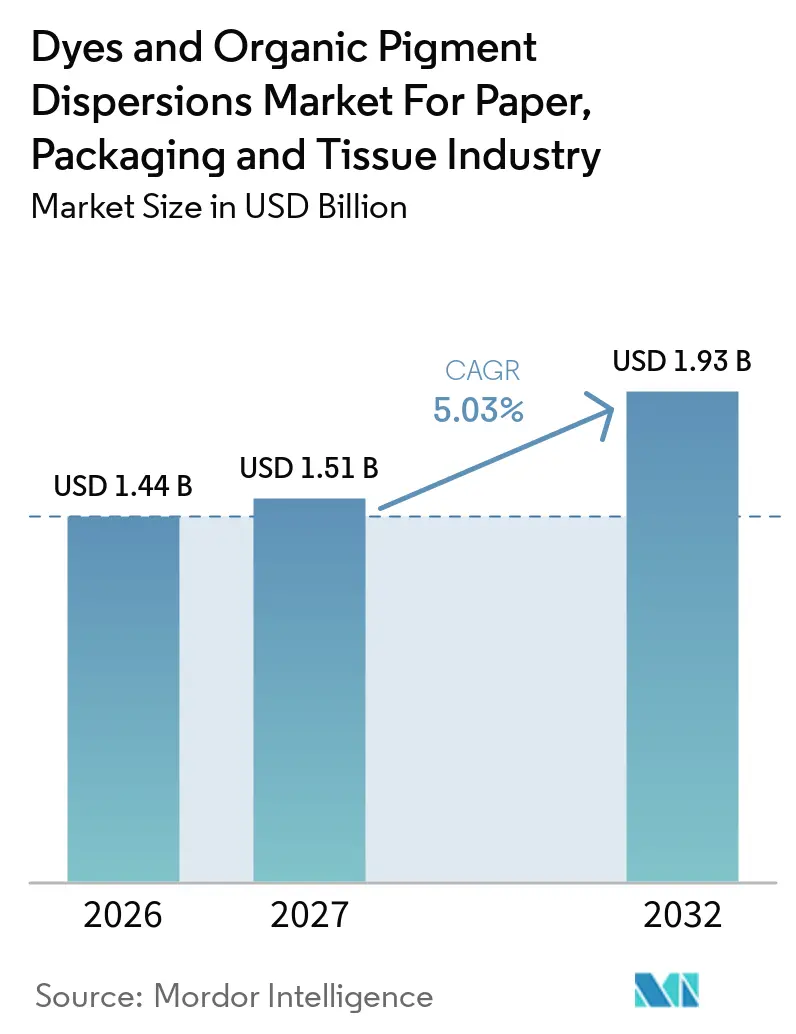
The Dyes and organic pigment dispersions market for the paper, packaging, and tissue industry was valued at USD 1.44 billion in 2026 and is estimated to grow from USD 1.51 billion in 2027 to USD 1.93 billion by 2032, at a CAGR of 5.03% during the forecast period (2027-2032). The shift from plastic packaging to fiber-based formats is expanding the addressable market for paper-compatible dyes and dispersions. Each conversion requires colorant qualification for the new substrate, which can support demand for specialty products even when output does not grow at the same pace. Regulatory requirements on recyclability and food contact are moving formulation decisions earlier in the packaging development process. Larger suppliers that combine dye chemistry, dispersion engineering, testing, and application support strengthen their position with converters and paper mills. The dyes and organic pigment dispersions market for the paper, packaging, and tissue industries also faces pressure from weaker demand for graphic paper, tighter restricted-substance rules, and volatile input costs.
Key Report Takeaways
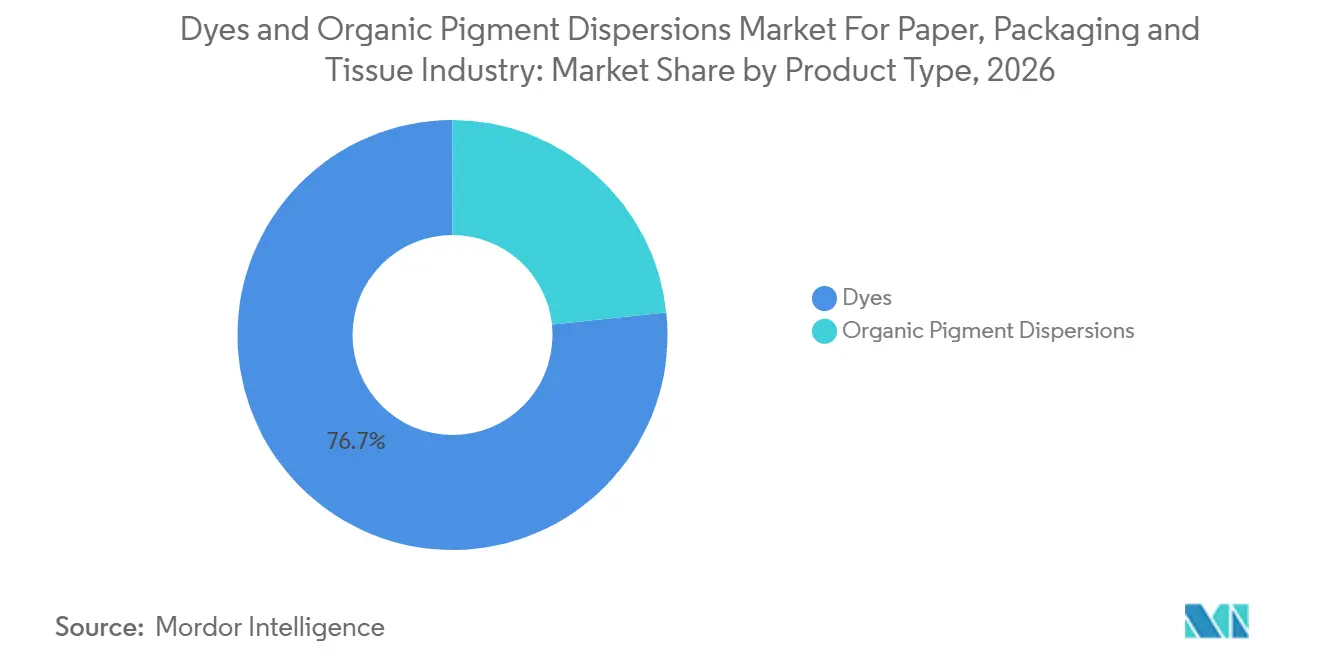
- By product type, dyes held 76.67% market share in 2026, while organic pigment dispersions are forecast to grow at a 5.45% CAGR through 2032.
- By color type, black held 35.23% of market share in 2026, while blue is forecast to grow at a 5.63% CAGR through 2032.
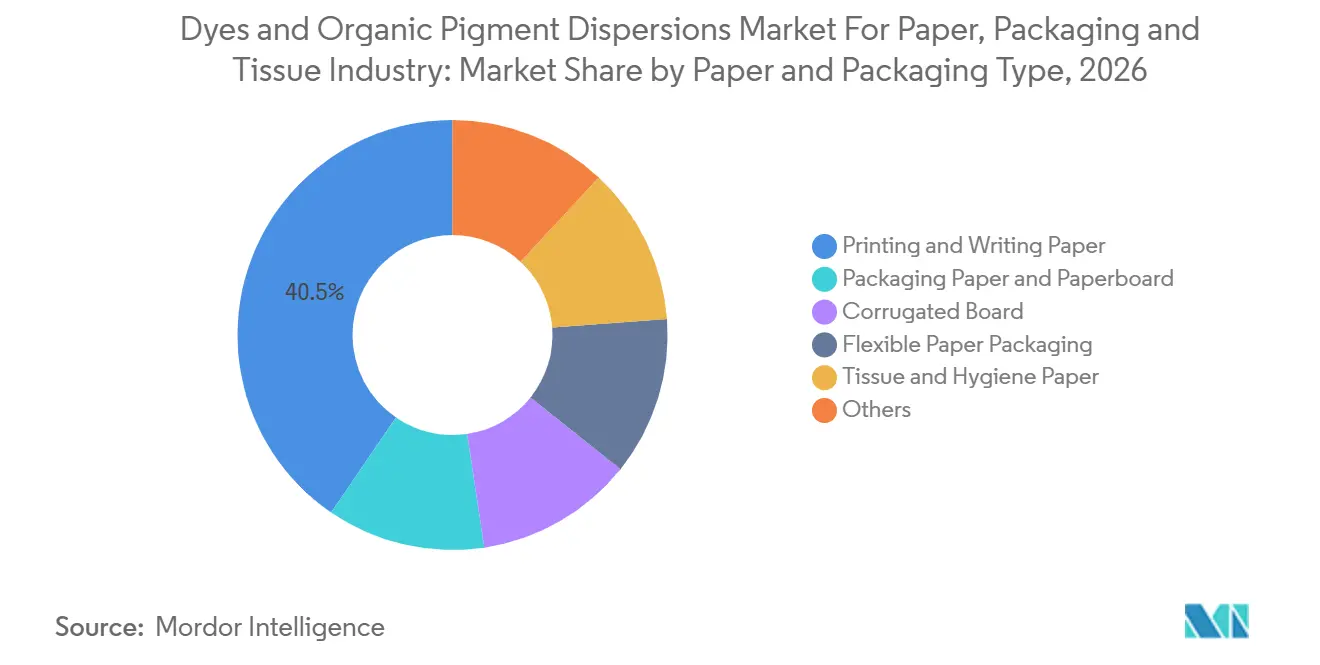
- By paper and packaging type, packaging paper and paperboard held 40.45% of the market share in 2026, while corrugated board is forecast to grow at a CAGR of 6.19% through 2032.
- By geography, Asia-Pacific held 42.77% of the market share in 2026 and is forecast to grow at a CAGR of 5.77% through 2032.
Note: Market numbers in this report are based on Mordor Intelligence's proprietary estimation framework, which combines nine months of actuals with Q4 projections for base year 2026.
Insights and Trends of Dyes and Organic Pigment Dispersions Market For Paper, Packaging and Tissue Industry
Drivers Impact Analysis*
| Drivers | (~) % Impact on CAGR Forecast | Geographic Relevance | Impact Timeline |
|---|---|---|---|
| Migration From Plastic to Fiber-Based Packaging | +1.8% | Global, concentrated in Europe and Asia-Pacific (APAC), where regulatory mandates are most advanced | Short term (≤ 2 years) |
| E-Commerce Corrugated and Mailer Demand | +1.2% | Global, with APAC and North America as the highest-volume markets | Medium term (2-4 years) |
| Food-Contact-Safe and Recyclable Coloration Requirements | +0.7% | EU and North America, with spillover to ASEAN and South Korea | Medium term (2-4 years) |
| Recycled-Fiber Variability Increasing Demand for Retention-Controlled Dispersions | +0.6% | Global, with early gains in North America and APAC core mill systems | Medium term (2-4 years) |
| Inline Digital Printing and Variable-Data Packaging | +0.5% | North America, Europe, and APAC | Long term (≥ 4 years) |
| Source: Mordor Intelligence | |||
Migration From Plastic to Fiber-Based Packaging
Regulation (EU) 2025/40 entered into force on February 11, 2025, and applies broadly from August 2026. It increases the importance of recyclable packaging formats across the European Union. Fiber-based packaging requires colorants designed for pulp or paper surfaces rather than plastic substrates. A shift from plastic to fiber can therefore require a new qualification cycle for wet-end dyes, pigment dispersions, coatings, and related application systems. The dyes and organic pigment dispersions market for the paper, packaging, and tissue industries benefits when converters require color consistency, recyclability, and suitable performance on new substrates. Paper and board packaging achieved an 82% recycling rate in Europe, supporting the commercial case for fiber formats. Sun Chemical's September 2026 partnership with Archipelago Technology Group links liquid barrier and resistant coatings with paper-based substrates as brands seek alternatives to plastic and composite structures.
E-Commerce Corrugated and Mailer Demand
E-commerce is increasing demand for corrugated liners, mailers, and printed delivery packaging. These applications require stable performance through fulfillment handling, varying humidity, and exposure during delivery. The requirements differ from retail shelf packaging because the package may experience more abrasion and handling before reaching the customer. The dyes and organic pigment dispersions market for the paper, packaging, and tissue industry can benefit from these performance requirements when mills and converters specify colorants for corrugated grades. Canon introduced the corrPRESS iB17 in October 2025 for industrial-scale printing of corrugated packaging using water-based pigment inks. The press is designed for direct printing on corrugated board and reflects a broader need for pigment systems compatible with industrial digital printing equipment. This development also increases the importance of printhead compatibility, color stability, and water-based formulation capability for suppliers.
Food-Contact-Safe and Recyclable Coloration Requirements
Food-contact compliance is becoming a product design requirement for paper packaging colorants. The European Commission's food-contact material framework covers materials that come into contact with food and sets the legal basis for safety controls[1]. EuPIA issued Good Manufacturing Practice (GMP) 5.0 in April 2026, incorporating Failure Mode and Effects Analysis (FMEA) and Hazard Analysis and Critical Control Points (HACCP) principles into the manufacture of inks used on food-contact materials. Suppliers serving food packaging may need separate formulations for food-contact and non-food-contact applications. This increases the value of established testing, documentation, and regulatory capabilities. The dyes and organic pigment dispersions market for the paper, packaging, and tissue industries is therefore more favorable to suppliers that can support customers with formulation selection and compliance reviews. Smaller formulators face a higher cost burden when multiple export markets require separate clearance processes.
Recycled-Fiber Variability Increasing Demand for Retention-Controlled Dispersions
Recycled old corrugated containers and mixed office waste can introduce residual ink and higher anionic material into the papermaking wet end. These conditions make colorant retention more difficult than in virgin-fiber systems. A 2025 study found that cationic retention agents can improve drainage and formation in recycled paper systems, but dosage requires careful optimization as it can affect sheet properties. As recycled fiber content rises, mills require greater control over particle size, charge, retention, and final shade. This creates a role for pigment dispersions designed for specific furnishes and process conditions. The dyes and organic pigment dispersions market for the paper, packaging, and tissue industry can generate higher value where suppliers combine colorant supply with wet-end technical support. Commodity offerings are less suited to addressing these mill-specific operating needs.
Restraints Impact Analysis*
| Restraints | (~) % Impact on CAGR Forecast | Geographic Relevance | Impact Timeline |
|---|---|---|---|
| Digital Substitution of Graphic Paper | -1.0% | North America and Europe, where printing and writing paper volumes are in structural decline | Medium term (2-4 years) |
| Restricted-Substance Compliance and Migration Testing Costs | -0.6% | EU and North America, progressively extending to South Korea and Japan | Medium term (2-4 years) |
| Pigment and Dye Raw-Material Price Volatility | -0.4% | Global | Short term (≤ 2 years) |
| Source: Mordor Intelligence | |||
Digital Substitution of Graphic Paper
Digital communication has continued to reduce paper use for printing and writing in offices, schools, and publishing. This affects demand for direct and acid dyes that have historically served these grades. The decline is difficult for suppliers with dedicated manufacturing assets built around standardized, high-volume graphic paper chemistry. Redirecting capacity into packaging, corrugated, or tissue grades often requires new product development and food-contact compliance work. The dyes and organic pigment dispersions market for the paper, packaging, and tissue industries offers stronger opportunities in packaging than in graphic paper, but capacity cannot be redirected without incurring costs. The decline is structural, as it is tied to changes in how documents are created and used. Suppliers must manage utilization pressure while building more specialized application portfolios.
Restricted-Substance Compliance and Migration Testing Costs
Food-contact colorants require testing for migration, heavy metals, primary aromatic amines, color fastness, and other relevant parameters. The European Commission framework establishes core rules for materials that come into contact with food. Export suppliers can face separate customer and jurisdictional requirements for a single formulation. Laboratory infrastructure, documentation, and regulatory expertise are costly for smaller formulators to maintain. The dyes and organic pigment dispersions market for the paper, packaging, and tissue industry becomes more concentrated when smaller firms cannot sustain parallel product lines. Requalification can also delay product changes when rules or customer specifications are updated. Larger suppliers have an advantage because compliance functions are already integrated into their product development systems.
*Our forecasts treat driver/restraint impacts as directional, not additive. The impact forecasts reflect baseline growth, mix effects, and variable interactions.
Segment Analysis
By Product Type: Dyes Lead by Share, Dispersions Capture Higher Value
Dyes accounted for 76.67% of the dyes and organic pigment dispersions market for the paper, packaging, and tissue industry in 2026. Their position reflects established use in wet-end papermaking, where direct, acid, and basic dye chemistries color cellulose fiber without a separate coating process. This route remains relevant for tissue, hygiene paper, and other consumer-facing paper products that require stable shade control. Dyes are also familiar to mills because they fit existing process equipment and operating practices. DyStar reported progress in its Levacel liquid direct dye range for tissue and packaging, with a focus on migration control and compatibility with modern retention systems. Liquid dyes can integrate with automated dosing systems and support more consistent color application. The shift from powders to liquids also reflects customer interest in lower material-handling complexity and reduced process variability.
Organic pigment dispersions are forecast to grow at a CAGR of 5.45% from 2027 to 2032. They are used where food-contact certification, lightfastness, surface application, or digital-print compatibility is important, requirements that are more difficult to meet with direct dyes alone. Their value proposition is strongest in coated board, premium packaging, and printing systems that require consistent performance on the paper surface. The market has room for dispersions that meet technical and compliance requirements in a single formulation. Water-based systems also align with the shift toward lower-emission processing and paper-based packaging formats. This demand supports more specialized product development and increases competition among suppliers capable of delivering qualified water-based technologies.

By Color Type: Black Leads by Share, Blue Records Faster Growth
Black held 35.23% of market revenue in 2026. Corrugated linerboard printing supports this position, as logistics marks, text, barcodes, and transport graphics remain common on shipping cartons. Carbon black dispersions are valued for color depth and stability in export and outdoor-exposed packaging. Demand is closely linked to corrugated board production and the printing needs of distribution systems. White and other colors serve more specialized uses, including opaque tissue, light-blocking packaging, security papers, and tailored board applications. These categories are smaller but can require stricter performance specifications. The market continues to rely on black for high-quantity packaging applications, while specialty colors provide differentiation in selected end uses.
Blue is projected to record a CAGR of 5.63% from 2027 to 2032. Premium retail packaging, health and beauty cartons, and colored tissue support this demand. A 2025 scientific publication described molecularly anchored blue hybrid pigments for packaging composites with multifunctional performance, reflecting continuing development in blue pigment chemistry for packaging materials. Blue is also relevant in extended-gamut digital printing, where color control is important for brand presentation. Brand investment in distinctive packaging designs can support demand for blue-spectrum colorant systems, creating an opportunity for suppliers that combine color accuracy with compatibility for water-based and digital printing processes.
By Paper and Packaging Type: Packaging Dominates, Corrugated Accelerates
Packaging paper and paperboard accounted for 40.45% of the dyes and organic pigment dispersions market for the paper, packaging, and tissue industry in 2026. This segment encompasses food-safety requirements, packaging design needs, and demand for primary and secondary packaging. Brand owners often require accurate and repeatable color on coated paperboard, which can favor surface-applied pigment dispersions over basic commodity dye applications. Fiber-based packaging also requires colorant systems compatible with recycling and compliance expectations. The segment benefits when brands shift away from plastic or composite structures and introduce paper-based alternatives. Suppliers that help converters meet both visual and functional specifications can capture added value in this segment.
Corrugated board is projected to expand at a CAGR of 6.19% from 2027 to 2032. E-commerce and direct-to-consumer shipping underpin demand for printed shipping cartons, mailers, and delivery packaging. This segment requires colorants that remain effective during handling, humidity changes, and transport. Tissue and hygiene paper provide a stable demand, as consumer products require shade consistency and suitable wet-rub performance. Flexible paper packaging is emerging as coated paper formats replace some multilayer plastic pouches, driven by extended producer responsibility incentives. Security paper and molded fiber trays remain smaller applications but may require tailored, higher-value colorant solutions. The market benefits from the breadth of these fiber-based end uses, although technical requirements differ across applications.
Geography Analysis
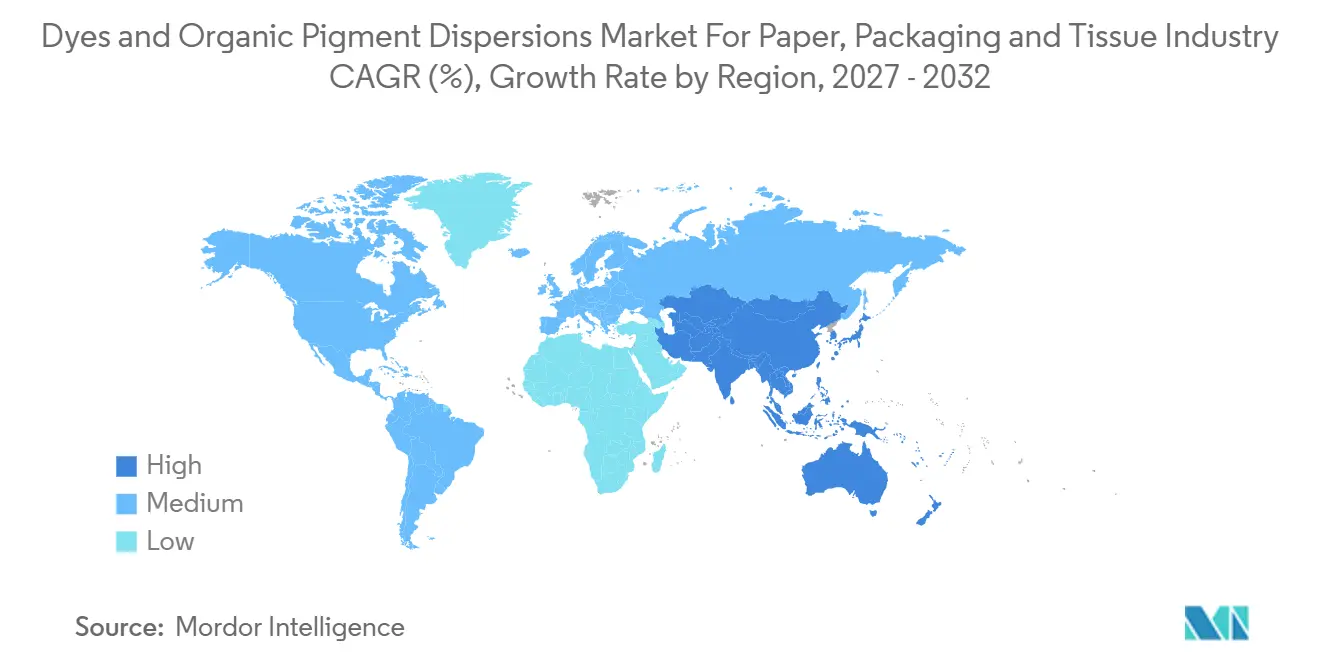
Asia-Pacific held 42.77% of the dyes and organic pigment dispersions market share for the paper, packaging, and tissue industry in 2026 and is forecast to grow at a CAGR of 5.77% through 2032. China's scale in organic pigment production gives the region a strong manufacturing base for colorant supply. Its shift toward water-based formulations reflects tighter emissions requirements and export standards. India is expanding packaging board capacity for FMCG and pharmaceutical applications. Sudarshan Chemical Industries completed its acquisition of Heubach Group in March 2025, creating a company with 19 manufacturing sites across 4 continents[2]. This gives an Indian-headquartered company broader pigment technology capabilities and global manufacturing reach.
North America holds the second-largest regional position, supported by U.S. e-commerce growth, FMCG packaging demand, and food-contact requirements. Canon's corrPRESS iB17 indicates that industrial digital corrugated printing is advancing in the region. Canada and Mexico contribute additional demand for folding carton and corrugated grades. Europe continues to be shaped by the use of premium-coated paperboard and by recycling requirements. The European Commission's food-contact materials regulations influence product selection for packaging applications. Germany's Printing Ink Ordinance further raises compliance requirements for suppliers serving German packaging converters. These conditions favor suppliers that can document formulation suitability and provide technical support across multiple paper grades.
South America is supported by Brazil's eucalyptus-based pulp and paper industry and its exports to European converters. These exports expose Brazilian mills to European colorant requirements ahead of the wider implementation of the Packaging and Packaging Waste Regulation (PPWR). Argentina and other South American markets remain more cost-sensitive and rely more heavily on locally available direct dyes. The Middle East and Africa represent an emerging demand base for colorant-qualified packaging. Food-processing investment in Saudi Arabia is generating additional demand for packaging materials, while South Africa serves as a distribution hub for regional converters.
Competitive Landscape
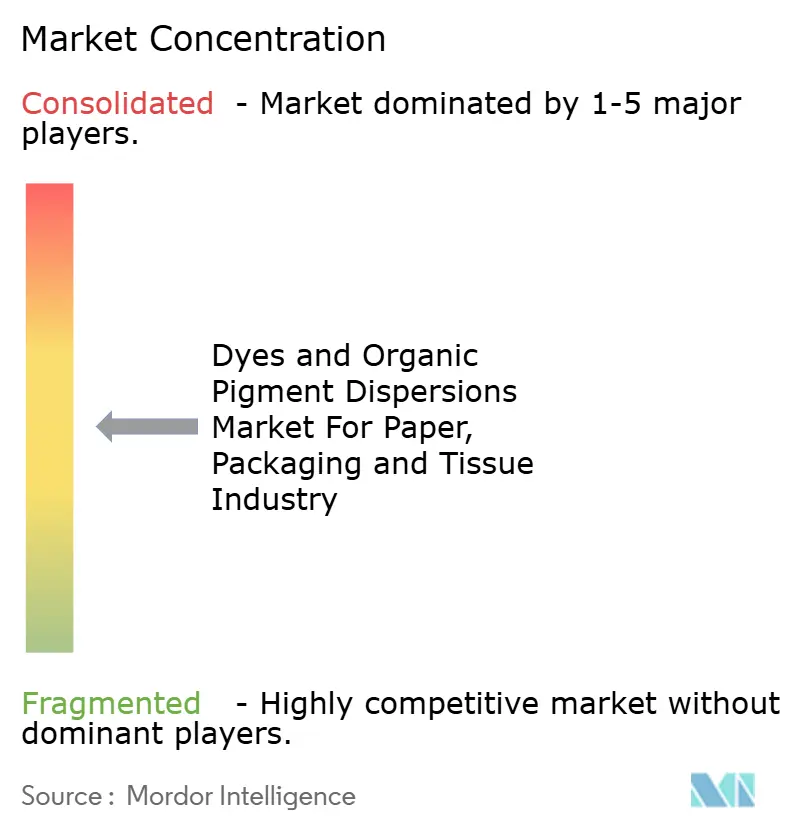
The dyes and organic pigment dispersions market for the paper, packaging, and tissue industry is moderately fragmented. BASF, DIC Corporation, Sudarshan Chemical Industries, Archroma, and DyStar hold portfolios spanning colorant chemistry, dispersion formulation, and application development. This breadth allows them to serve paper mills, packaging converters, and printing customers across multiple product lines. The March 2025 Sudarshan-Heubach transaction combined manufacturing and pigment capabilities that separate businesses had previously held. Consolidation is relevant because food-contact testing, regulatory documentation, and global supply capability require long-term investment. There's a competitive opportunity in retention-controlled dispersions for high-recycled-content furnishes, an area that requires close control of process chemistry and may be less accessible to commodity suppliers.
BASF launched reduced-carbon-footprint paper-coating dispersions in September 2026. The company states that the products provide 20% to 45% lower cradle-to-gate emissions than conventional alternatives and are designed as drop-in options. This development reflects how carbon footprint data is becoming part of supplier qualification for paper-coating customers. DIC began the global rollout of ECOVART gravure ink in October 2026, stating that the ink reduces solvent use by at least 50% in internal testing. These actions meet customer demand for lower solvent use and emissions, more efficient production, and higher performance standards for suppliers seeking to enter established converter accounts.
Archroma received an ICIS Innovation Award in 2026 for FiberColors sulfur dyes made from pre-consumer wool waste, demonstrating its efforts to use alternative feedstocks in colorant development. Suppliers also face food-contact obligations and ink manufacturing practices that restrict market access for unqualified formulations. EuPIA Good Manufacturing Practice (GMP) 5.0 emphasizes systematic manufacturing controls for inks used on food-contact materials, and suppliers with established regulatory and testing capabilities are better positioned to meet these requirements. The dyes and organic pigment dispersions market for the paper, packaging, and tissue industry is competitive because product performance, compliance, supply continuity, and application support must be delivered together. Regional entrants can compete in standard products but face higher barriers to entry in food-contact, recycled-fiber, and industrial digital-printing applications.
Leaders of Dyes and Organic Pigment Dispersions Market For Paper, Packaging and Tissue Industry
-
Archroma
-
BASF
-
DIC Corporation
-
Sudarshan Chemical Industries Limited
-
Solenis
- *Disclaimer: Major Players sorted in no particular order
Recent Industry Developments
- September 2026: BASF launched reduced-PCF paper-coating dispersions with a product carbon footprint 20% to 45% lower. Manufactured at the Ludwigshafen Verbund site using low-PCF raw materials and renewable-source electricity under a mass-balance approach, the dispersions are drop-in products that require no customer requalification. Carbon footprint calculations are certified by TÜV Rheinland in conformance with Together for Sustainability (TfS) guidance.
- September 2026: Sun Chemical entered a partnership with Archipelago Technology Group for fiber-based packaging barrier coatings. The agreement combines Archipelago's Powerdrop non-contact coater with Sun Chemical's liquid barrier and resistance coatings for paper-based substrates, providing consumer brands with alternatives to plastic and composite structures while supporting compliance with Packaging and Packaging Waste Regulation (PPWR) and Extended Producer Responsibility (EPR).
Scope of Report on Dyes and Organic Pigment Dispersions Market For Paper, Packaging and Tissue Industry
Dyes and organic pigment dispersions are specialized colorant systems used to impart color to liquids, coatings, plastics, and inks. They are distinguished primarily by whether the colorant dissolves into the medium or remains as a finely suspended solid particle.
The dyes and organic pigment dispersions market is segmented by product type, color type, paper and packaging type, and geography. By product type, the market is segmented into dyes and organic pigment dispersions. By color type, the market is segmented into black, white, blue, and others. By paper and packaging type, the market is segmented into printing and writing paper, packaging paper and paperboard, corrugated board, flexible paper packaging, tissue and hygiene paper, and others. The report also covers market sizes and forecasts for the global dyes and organic pigment dispersions across 15 countries in major regions. The market sizes and forecasts are provided in terms of value (USD).
| Dyes |
| Organic Pigment Dispersions |
| Black |
| White |
| Blue |
| Others |
| Printing and Writing Paper |
| Packaging Paper and Paperboard |
| Corrugated Board |
| Flexible Paper Packaging |
| Tissue and Hygiene Paper |
| Others |
| Asia-Pacific | China |
| India | |
| Japan | |
| South Korea | |
| ASEAN Countries | |
| Rest of Asia-Pacific | |
| North America | United States |
| Canada | |
| Mexico | |
| Europe | Germany |
| United Kingdom | |
| France | |
| Italy | |
| NORDIC Countries | |
| Rest of Europe | |
| South America | Brazil |
| Argentina | |
| Rest of South America | |
| Middle East and Africa | Saudi Arabia |
| South Africa | |
| Rest of Middle East and Africa |
| By Product Type | Dyes | |
| Organic Pigment Dispersions | ||
| By Color Type | Black | |
| White | ||
| Blue | ||
| Others | ||
| By Paper and Packaging Type | Printing and Writing Paper | |
| Packaging Paper and Paperboard | ||
| Corrugated Board | ||
| Flexible Paper Packaging | ||
| Tissue and Hygiene Paper | ||
| Others | ||
| By Geography | Asia-Pacific | China |
| India | ||
| Japan | ||
| South Korea | ||
| ASEAN Countries | ||
| Rest of Asia-Pacific | ||
| North America | United States | |
| Canada | ||
| Mexico | ||
| Europe | Germany | |
| United Kingdom | ||
| France | ||
| Italy | ||
| NORDIC Countries | ||
| Rest of Europe | ||
| South America | Brazil | |
| Argentina | ||
| Rest of South America | ||
| Middle East and Africa | Saudi Arabia | |
| South Africa | ||
| Rest of Middle East and Africa | ||
Key Questions Answered in the Report
What is current market size of Dyes and Organic Pigment Dispersions Market for Paper, Packaging and Tissue Industry Market?
The Dyes and organic pigment dispersions market for the paper, packaging, and tissue industry was valued at USD 1.44 billion in 2026 and is estimated to grow from USD 1.51 billion in 2027 to USD 1.93 billion by 2032, at a CAGR of 5.03% during the forecast period (2027-2032).
Which product type is expected to grow the fastest?
Organic pigment dispersions are forecast to grow at a CAGR of 5.45% from 2026 to 2032, supported by food-contact, lightfastness, and digital-printing needs.
Which paper and packaging application grows the fastest?
Corrugated board has the highest forecast CAGR at 6.19% through 2032, supported by e-commerce and direct-to-consumer shipping.
Which region leads demand?
Asia-Pacific leads with a 42.77% revenue share in 2026 and the highest regional CAGR of 5.77% through 2032.