
Dumpsters Market Size and Share
Market Overview
| Study Period | 2021 - 2032 |
|---|---|
| Market Size (2027) | USD 7.62 Billion |
| Market Size (2032) | USD 9.65 Billion |
| Growth Rate (2027 - 2032) | 4.84 % |
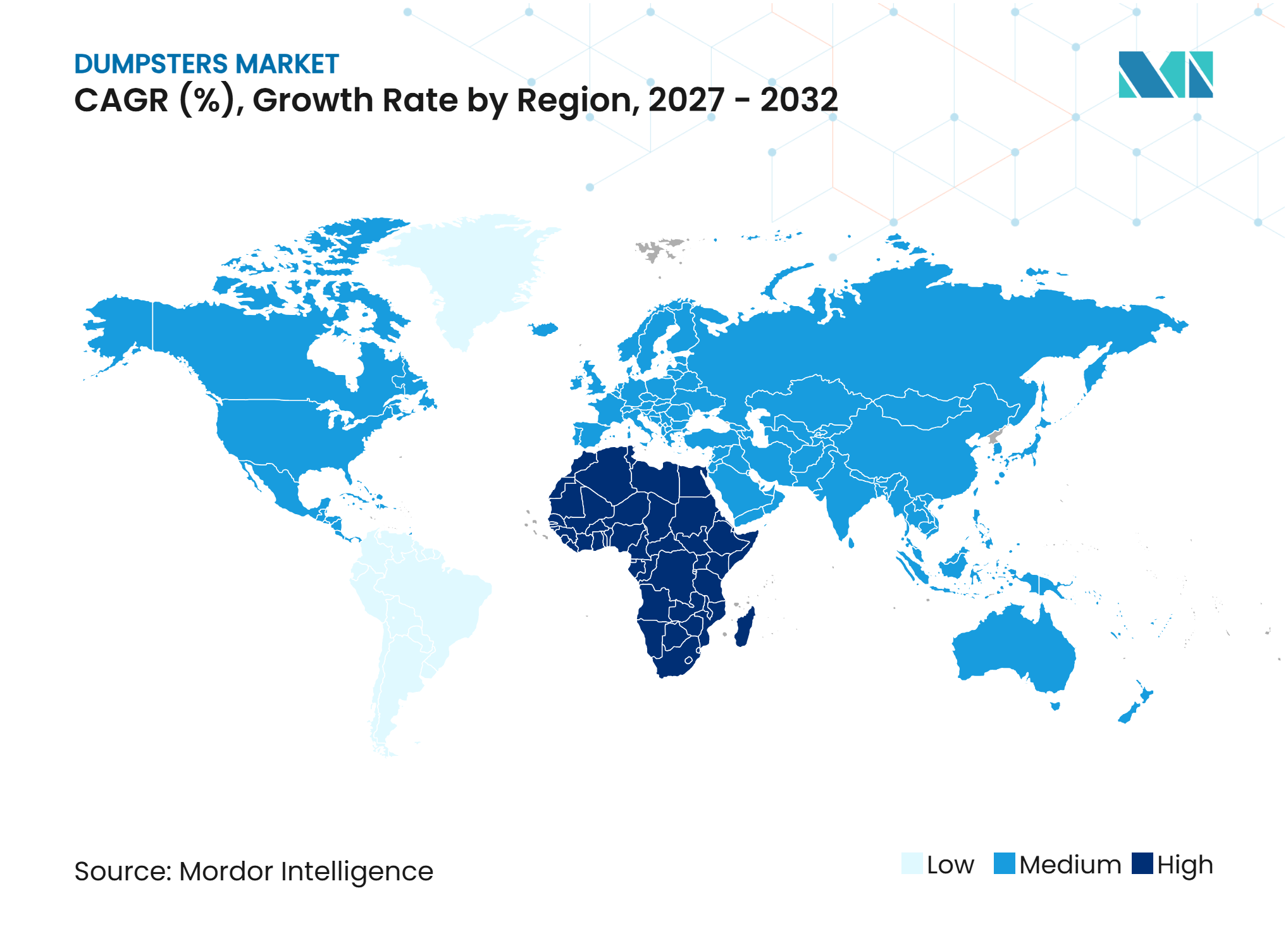
| Fastest Growing Market | Middle East and Africa |
| Largest Market | Europe |
| Market Concentration | Medium |
Major Players *Disclaimer: Major Players sorted in no particular order Image © Mordor Intelligence. Reuse requires attribution under CC BY 4.0. | |
Dumpsters Market Analysis by Mordor Intelligence
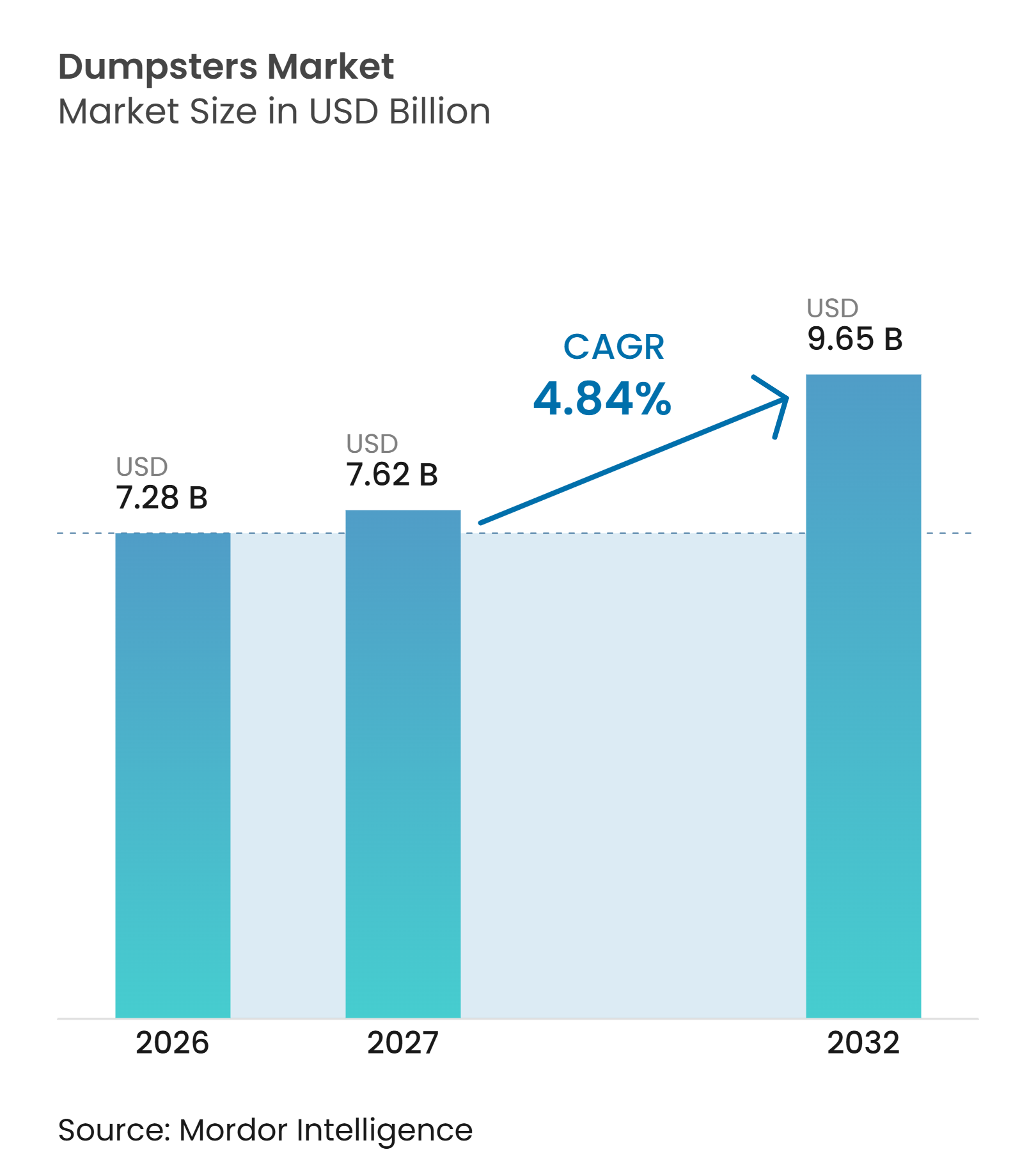
The Dumpsters Market size is expected to grow from USD 7.28 billion in 2026 to USD 7.62 billion in 2027 and is forecast to reach USD 9.65 billion by 2032 at 4.84% CAGR over 2027-2032.
Construction, demolition, municipal modernization, and replacement of aging container fleets support demand because waste collection remains an essential service. The dumpsters market also benefits when collection rules require separate containers for food, recycling, and mixed waste, rather than a replacement of one general-purpose unit with another. Larger manufacturers can improve delivery reliability through regional production, while local fabricators retain an advantage where freight costs make long-distance supply uneconomic. Steel price movements and long replacement cycles can limit near-term purchasing, especially when supply contracts do not allow manufacturers to pass through higher input costs. Regulatory requirements in Europe and North America also raise the value of compliant containers and make product compatibility a meaningful purchasing factor.
Key Report Takeaways
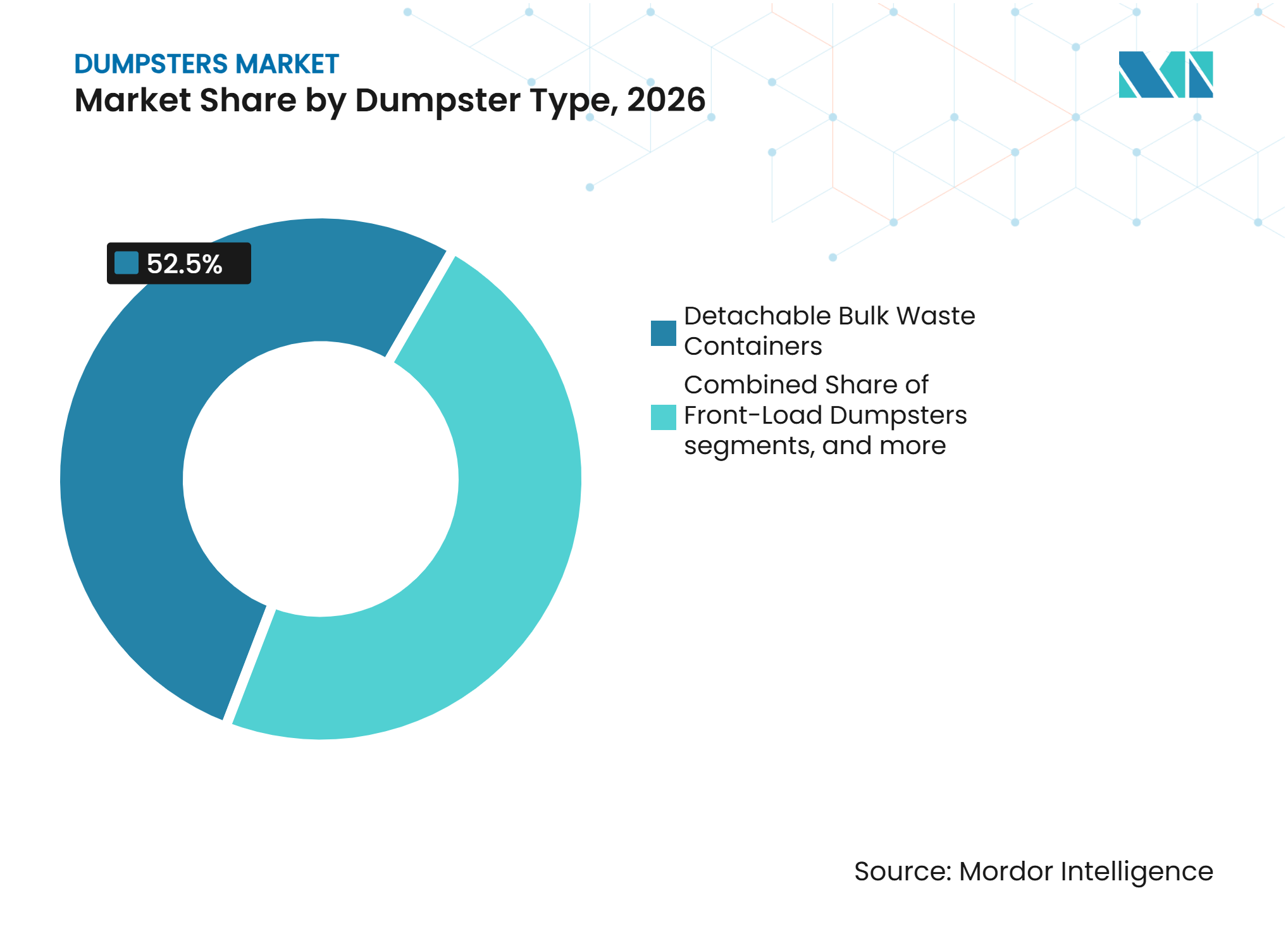
- By dumpster type, detachable bulk waste containers held 52.5% of the dumpsters market size in 2026 demand and are expected to expand at a 5.2% CAGR through 2032.
- By end-user, waste collection and hauling companies accounted for 38.9% of the dumpsters market share in 2026 demand, while construction, demolition, and infrastructure contractors are projected to expand at a 5.3% CAGR through 2032.
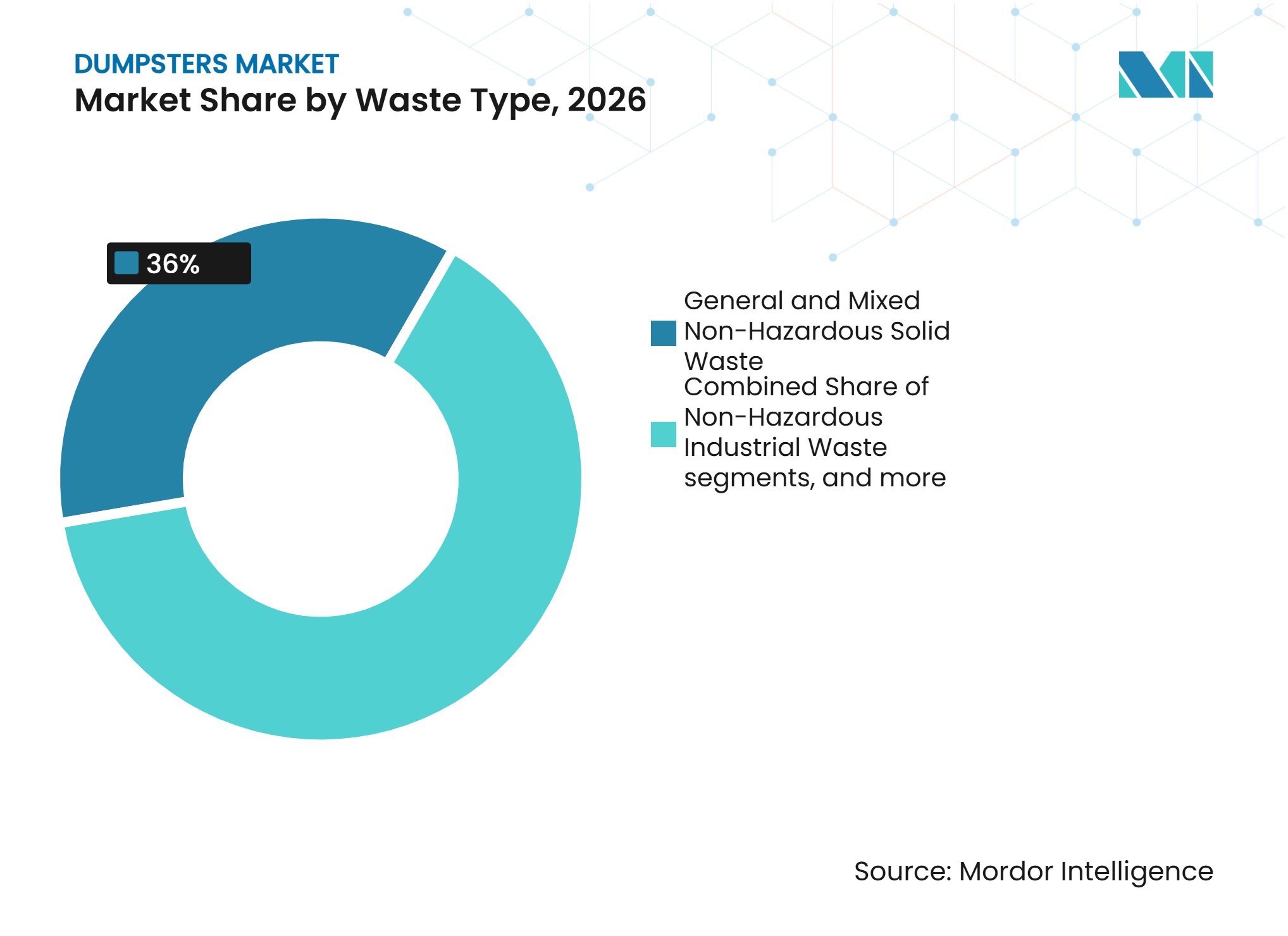
- By waste type, general and mixed non-hazardous solid waste held 36.0% of 2026 demand, while organic and green waste is projected to grow at a 6.6% CAGR through 2032.
- By bin size, containers up to 3 cubic yards accounted for 23.5% of 2026 demand, while containers above 40 cubic yards are projected to grow at a 5.2% CAGR through 2032.
- By geography, Europe accounted for 30.5% of 2026 demand, while the Middle East and Africa are projected to expand at a 6.9% CAGR through 2032.
Note: Market numbers in this report are based on Mordor Intelligence's proprietary estimation framework, which combines nine months of actuals with Q4 projections for base year 2026.
Market Trends and Insights
Drivers Impact Analysis of Dumpsters Market*
| Driver | (~) % Impact on CAGR Forecast | Geographic Relevance | Impact Timeline |
|---|---|---|---|
| Growth in Construction, Demolition, and Infrastructure Waste | +1.1% | Global, concentrated in Asia-Pacific, Middle East, and North America | Short term (≤ 2 years) |
| Expansion of Commercial and Industrial Waste Collection Networks | +1.0% | North America and EU core, expanding to Asia-Pacific and Middle East and Africa. | Medium term (2-4 years) |
| Waste Hauler Fleet Expansion and Container Replacement Demand | +0.8% | North America, EU, and Australia | Short term (≤ 2 years) |
| Rapid Urbanization and Population-Driven Municipal Waste Volume Growth | +0.7% | Asia-Pacific, Middle East and Africa, and Latin America | Long term (≥ 4 years) |
| Municipal Solid Waste Collection Modernization | +0.6% | Global, with early gains in the Middle East, Southeast Asia, and Eastern Europe | Medium term (2-4 years) |
| Increasing Source Segregation and Recycling Container Requirements | +0.4% | EU core and North America, expanding to Asia-Pacific | Medium term (2-4 years) |
| Source: Mordor Intelligence | |||
Growth in Construction, Demolition, and Infrastructure Waste
Construction, demolition, and infrastructure projects create recurring demand for roll-off, hook-lift, and other detachable containers because debris must be collected at the work site. The dumpsters market gains from repeat placements during a project, even when a contractor does not increase the waste generated by each activity. Modular construction, prefabrication, and faster demolition schedules can increase the frequency of container deployment across a site. Separate sorting requirements for materials such as concrete, metal, glass, plastic, and wood support demand for multi-stream and compartmentalized configurations. The revised EU Waste Framework Directive reinforces separate collection requirements and keeps material segregation central to waste management planning.[1] Construction-related demand therefore extends beyond container volume to the specifications needed for different debris streams.[2]
Expansion of Commercial and Industrial Waste Collection Networks
Commercial waste franchising and zone-based licensing concentrate procurement with operators that must invest in long-term collection capacity, creating recurring demand for dumpsters across municipal and commercial waste networks. Dedicated food-waste service can add a separate container where a customer previously used one general-waste dumpster, increasing the number of bins required at restaurants, supermarkets, hotels, and food-processing facilities. Manufacturing and processing zones in Southeast Asia also support industrial collection needs through longer-term concession arrangements, particularly where waste generation is continuous and requires scheduled collection. These arrangements encourage waste management operators to maintain standardized container fleets, replace damaged or ageing dumpsters, and expand capacity as new commercial and industrial customers are added. The adoption of separate containers for recyclable materials, organic waste, and general refuse further increases demand for specialized dumpster configurations.
Waste Hauler Fleet Expansion and Container Replacement Demand
Container replacement commonly follows fleet renewal because new collection trucks must operate safely with compatible lifting interfaces. KDEB Waste Management announced in April 2025 that it would allocate MYR 400 million (USD 98.7 million) to replace more than 1,400 roll-off and compactor trucks with Euro 5-compliant vehicles. The program covers service areas including Selayang, Kajang, Petaling Jaya, and Sepang, where compatible container procurement is expected to proceed alongside the vehicle replacement program. The City of Savannah authorized a contract of up to USD 977,200 for four roll-off container trucks in December 2025 as part of its sanitation equipment replacement plan.[3] Electric and lower-emission vehicle programs can shorten the practical container replacement cycle when lifting equipment changes. This relationship supports demand in established hauling networks even where the number of collection routes grows slowly.
Rapid Urbanization and Population-Driven Municipal Waste Volume Growth
Cities held 45% of the global population of 8.2 billion in 2025, and urban growth is strongest in Asia-Pacific, Sub-Saharan Africa, and the Middle East. Municipal collection coverage remained lower in Sub-Saharan Africa and Southeast Asia, at 62.63% and 64.65%, respectively, in the UN assessment covering 4,383 cities through 2024. These conditions leave room for formal collection systems to add containers as service coverage improves. Population growth and rising incomes can raise the volume and variety of waste that municipalities must collect. The dumpsters market is therefore supported by the expansion of collection infrastructure from a comparatively low starting point in developing urban areas. Manufacturers with local distribution and service capability are better placed to address this demand than suppliers relying only on long-distance shipments.
Restraints Impact Analysis of Dumpsters Market*
| Restraint | (~) % Impact on CAGR Forecast | Geographic Relevance | Impact Timeline |
|---|---|---|---|
| Steel Price Volatility and Fabrication Cost Pressures | -0.4% | Global, most acute in North America and EU | Short term (≤ 2 years) |
| High Transportation and Distribution Costs for Bulky Containers | -0.3% | North America, Asia-Pacific, and Middle East and Africa long-haul corridors | Medium term (2-4 years) |
| Long Equipment Replacement Cycles and Refurbishment Competition | -0.2% | North America and EU | Long term (≥ 4 years) |
| Fragmented Regional Manufacturing and Price-Based Competition | -0.1% | Asia-Pacific, Latin America, and Eastern Europe | Long term (≥ 4 years) |
| Source: Mordor Intelligence | |||
Steel Price Volatility and Fabrication Cost Pressures
Steel remains a major cost input in dumpster fabrication so that input volatility can reduce manufacturer margins on fixed-price supply agreements. The Associated General Contractors of America reported that the producer price index for steel mill products increased 13.1% in the 12 months through August 2025, citing the United States Bureau of Labor Statistics. Multi-year contracts with waste haulers and municipalities may not allow a quick adjustment in per-unit prices. Smaller fabricators are more exposed when they lack purchasing scale or long-term supply arrangements. DIN 30720, DIN 30722, and the EN 12574 series can add fabrication and compliance costs, particularly for regional suppliers that serve regulated procurement programs. Cost pressure can encourage consolidation, but it can also delay procurement when buyers extend the life of existing equipment.
High Transportation and Distribution Costs for Bulky Containers
Dumpsters occupy substantial trailer space relative to their shipment value, which makes freight a persistent cost in the product category. A 40-cubic-yard roll-off container can occupy a full flatbed load, limiting the revenue earned on a delivery trip. This constraint limits the economically practical delivery radius for most manufacturers. It also preserves the role of regional production and local fabricators in the dumpsters market. Imported containers may struggle to compete in parts of Southeast Asia and Sub-Saharan Africa when transport costs exceed the price advantage of lower-cost production. Long equipment replacement cycles and refurbishment options add a further constraint because customers can defer new purchases when existing containers remain serviceable.
*Our forecasts treat driver/restraint impacts as directional, not additive. The impact forecasts reflect baseline growth, mix effects, and variable interactions.
Dumpsters Market Segment Analysis
By Dumpster Type:
Detachable Containers Anchor Market VolumeDetachable bulk waste containers held 52.5% of the dumpsters market share in 2026 and are expected to record the highest capacity-category CAGR at 5.2% through 2032, reflecting their use in construction, demolition, and industrial settings. Cable-hoist roll-off, hook-lift, and skip-lift designs generally carry a higher unit value than compact front-load or rear-load units. Their use in project work also supports repeated short-term placements across the life of a contract. The dumpsters market size for detachable units benefits when contractors need frequent debris removal rather than permanent collection points. Wastequip introduced its Ultimate Container roll-off design in 2026 with reinforced top-cap construction, corner gussets, a narrower width for door-on shipping, and hook-lift integration. The product focus shows the importance of logistics efficiency and compatibility with more than one collection system. European suppliers also use lifting interfaces and safety components to meet applicable engineering and operational requirements.
Front-load dumpsters remain embedded in commercial collection networks in the United States and Canada because they work with automated front-loading vehicles. Rear-load formats serve dense urban locations where access conditions or building layouts restrict front-load collection. The District of Columbia CLEAN Collections Amendment Act took effect in March 2025 and requires multifamily properties to provide waste, recycling, and composting services under its phased requirements. These rules can create demand for parallel sets of containers without requiring the full replacement of an existing fleet. Container design is increasingly tied to the service vehicle, space available at the customer site, and the number of waste streams collected. This pattern gives manufacturers opportunities to offer compatible formats rather than relying on one standard container type. The dumpsters market continues to require both high-capacity detachable formats and compact collection formats.



By End-User:
Waste Collection and Hauling Contractors Drive the Next Growth PhaseWaste collection and hauling companies held 38.9% of demand in 2026 and remain the largest buyer group. The growth difference indicates that project-linked placements are rising faster than permanent fleet additions. Rental and leasing companies increase container use by placing units with contractors, commercial customers, and event operators under short-term agreements. This can lead to more frequent replacement purchasing than occurs for permanently installed units. The dumpsters market size for contractor demand is supported by infrastructure activity in the Gulf states, India, and the Americas. It also depends on the need to match capacity, lifting system, and pickup frequency to the project site.
Construction, demolition, and infrastructure contractors are projected to grow at a 5.3% CAGR from 2027 to 2032, faster than other end-user groups. Municipalities and public waste authorities provide stable demand through structured procurement programs. The City of Visalia awarded Wastequip a four-year, USD 2.6 million commercial solid-waste container supply contract through the Sourcewell cooperative purchasing framework in July 2025. Such arrangements reduce procurement friction and favor suppliers with broad distribution capability. Commercial and institutional establishments support continuing demand for front-load and rear-load containers through waste service contracts. Industrial and manufacturing companies require heavy-duty designs suited to their waste streams, while recycling and material recovery operators may need open-top or multi-compartment units. The dumpsters industry serves these buyers through differentiated container designs rather than one standardized product. Their varied requirements spread demand across permanent collection, project work, rental fleets, and material recovery operations.
By Waste Type:
Organic Streams Gain Ground on Residual VolumesGeneral and mixed non-hazardous solid waste held 36.0% of demand in 2026, giving it the largest waste-type share in the dumpsters market. This position is sustained as municipalities and commercial customers continue to rely mainly on mixed-waste collection. Construction and demolition waste remains a high-value category because its container needs are linked to project pipelines and large detachable formats. Recyclable waste containers serve paper, cardboard, plastics, glass, and metals as separate collection requirements expand. Non-hazardous industrial waste and bulky waste often require large-format or detachable equipment. The transition toward source separation does not immediately remove the need for residual waste containers, especially where collection systems are still changing. It instead creates a broader mix of container specifications and more collection points for each customer location.
Organic and green waste is projected to be the fastest-growing waste-type segment, at a 6.6% CAGR from 2027 to 2032. Separate collection rules support demand for covered, odor-sealing, and corrosion-resistant containers rather than simple additions to general-waste capacity. The EU revised Waste Framework Directive entered into force in October 2025 and strengthens the policy basis for separate collection. Regulation (EU) 2025/40, which entered into force in February 2025, established packaging and packaging waste rules that reinforce the need for separate materials management. In Lugo, Spain, EcoLugo committed to deploy 200 additional brown organic-waste containers as part of a network expansion from 3,700 to 4,200 containers. The example shows how municipal source-separation requirements can translate into unit-level container demand. Organic waste requirements favor designs that address containment, cleaning, and collection frequency.

By Bin Size:
Ultra-Large Formats Outpace Compact SegmentsContainers up to 3 cubic yards held 23.5% of demand in 2026 and remain the largest capacity range. They serve dense urban commercial zones, multifamily buildings, and collection points where larger units are difficult to place. The 3-to-6 and 6-to-10 cubic-yard ranges support retail, hospitality, office, and institutional customers. The 10-to-20 cubic-yard range is widely used in rental deployments and industrial sites with moderate, continuous non-hazardous waste. North American compatibility and safety expectations influence the design of every size class and help compliant suppliers differentiate their products. Smaller containers remain essential to the dumpsters market because frequency, access, and vehicle compatibility can be more important than simple volume. The capacity mix is therefore shaped by the physical collection environment as much as by total waste generation.
Containers above 40 cubic yards are projected to grow at a 5.2% CAGR from 2027 to 2032. Demolition, land development, and infrastructure work in Gulf states, India, and Southeast Asia support demand for high-capacity units. Larger formats can reduce the number of truck movements needed when debris volumes exceed the practical capacity of standard roll-off containers. The dumpsters market size for these units grows when project managers prioritize fewer exchanges and lower site disruption. The shift reflects the scale of certain projects, not a replacement of every smaller container. High-capacity containers must still fit lifting equipment, route conditions, and permitted loads. Manufacturers therefore need to balance volume, structural strength, and transport practicality.
Geography Analysis
Europe
Europe held 30.5% of the dumpster market share in 2026, supported by established municipal collection networks and high container penetration in commercial and residential areas. The EN 12574 series supports interoperability between containers and collection vehicles across European markets, while also setting design and material expectations. These compliance factors support pricing for containers that meet regulated procurement requirements. Regulation (EU) 2025/40 entered into force in February 2025 and adds pressure for packaging and material separation. The dumpsters market in Europe gains when commercial and multifamily sites need parallel collection streams for residual, recyclable, and organic material. Mature infrastructure means demand is often tied to specification upgrades, replacement cycles, and new stream-level additions. The revised EU Waste Framework Directive also reinforces separate collection requirements across the region. European manufacturers can use compliance expertise and vehicle compatibility to compete against suppliers that focus only on price.
Middle East and Africa
Middle East and Africa is projected to grow at a 6.9% CAGR from 2027 to 2032, the fastest regional rate in the dumpsters market. The dumpsters market in the region has an unmet need for formal collection infrastructure as urban populations and waste volumes increase. The World Bank reported that the MENA region generates more than 155 million tons of waste annually and recycles or composts less than 10% of it. The same assessment identified annual waste-management investment of USD 7.7 billion against USD 11.6 billion required to meet SDG 11.6 objectives. The gap points to continuing requirements for collection equipment, transfer systems, and containers. In Lagos, material recovery facilities and transfer loading stations show how investment in downstream infrastructure can support upstream containerized collection. This transition creates a longer-term opportunity for specification-grade containers, not just basic bins.
Infrastructure and Regulation Shape Remaining Markets
North America remains a high-value dumpsters market region because private hauling networks, cooperative procurement arrangements, and fleet replacement programs support recurring purchases. The City of Savannah's December 2025 roll-off truck procurement demonstrates the relationship between fleet investment and compatible collection assets. Asia-Pacific has wide variation, with Australia, Japan, and South Korea operating more mature collection systems than many emerging markets in the region. India, ASEAN economies, and Pacific Island nations are expanding formal containerized collection as urban services develop. China remains an important source of demand for bulk containers used in construction and demolition work. Malaysia's KDEB program shows that fleet modernization can lead to associated container upgrades in mid-tier Asia-Pacific markets. South American cities, including those in Brazil and Argentina, are developing more formal commercial collection networks that need standardized front-load and detachable equipment. Across these markets, local production and distribution are strategically important because bulky containers are costly to transport over long distances.
Competitive Landscape
Market Concentration
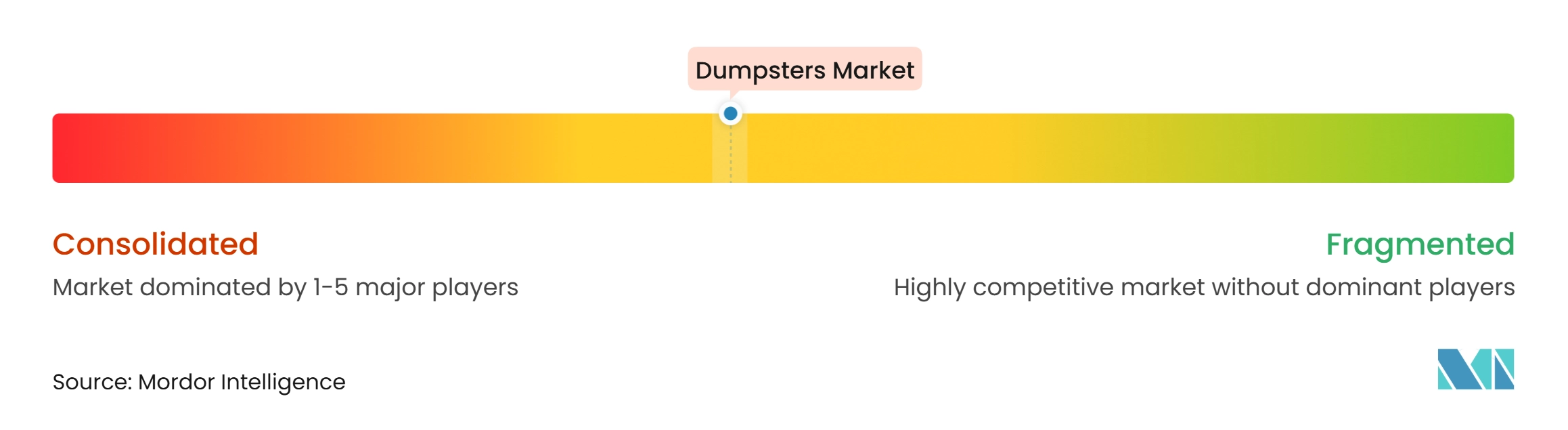
The dumpsters market exhibits a medium level of market concentration. Wastequip operates across container, compactor, cart, and truck categories through brands that include Galbreath, Amrep, and Toter. Regional fabricators compete through delivery speed, local design adaptation, and proximity to the customer. Wastequip opened a 43,000-square-foot steel manufacturing facility in Salisbury, North Carolina, in June 2026 to produce front-load dumpsters, roll-off containers, and compactors for East Coast demand. The move addresses freight cost and lead-time constraints that influence customer purchasing. Larger manufacturers can use regional production to improve service while protecting their position in logistics-sensitive markets.
European manufacturers compete through engineering quality, compliance, and compatibility with local collection systems. Decker-Containerbau presented a dual-side tipper with Bordmatik technology at Bauma 2025 and confirmed a Berlin location to broaden its service reach. The company also has a replaceable lifting bracket design that can reduce container downtime and repair costs. DIN 30720, DIN 30722, ANSI, and EN 12574 requirements can make compliance a practical barrier in municipal and hauler procurements. These requirements reduce the ability of price-only suppliers to qualify for premium contracts. They also support the value of products that offer safe interfaces and long service life.
Sensor-ready and digitally traceable containers remain an open area for product differentiation, especially for haulers managing dispersed fleets. Wastequip acquired Foster Hydraulics in June 2025, strengthening vertical integration in its trucks division and supporting its East Coast expansion. The dumpsters market also shows how smaller suppliers face pressure from steel costs while larger competitors use scale purchasing and vertical capabilities. Freight costs also prevent a fully centralized manufacturing model, leaving room for local fabricators. Competition therefore remains active at the regional level even as established firms broaden their manufacturing and distribution reach. Buyers continue to weigh purchase price against delivery, safety compliance, repairability, and compatibility with existing fleets.
Dumpsters Industry Leaders
-
Wastequip LLC
-
Iron Container LLC
-
E-Pak Manufacturing LLC
-
Nedland Industries Inc.
-
Thompson Fabrication
- *Disclaimer: Major Players sorted in no particular order
Dumpsters Market Companies Covered in this Report
- Wastequip LLC
- Iron Container LLC
- E-Pak Manufacturing LLC
- Nedland Industries Inc.
- Thompson Fabrication
- American Made Dumpsters
- North American Manufacturers
- MAC Corporation
- European Manufacturers
- Skip Units Ltd.
- GMS Steel Fabrications Ltd.
- BERINGER GmbH
- Sirch Group
- Decker-Containerbau GmbH & Co. KG
- Pronar Sp. z o.o.
- Asia-Pacific Manufacturers
- Bincorp Equipment
- Skip Factory
- J&S Metal Fabrication Pty Ltd.
- Apollo Fabrications
- Easyquip
- KQuip
- Astech Group
Recent Industry Developments in Dumpsters Market
- June 2026: Wastequip opened a new 43,000 sq ft steel manufacturing facility within its AMREP operation in Salisbury, North Carolina, producing front-load dumpsters, roll-off containers, and compactors to expand East Coast production capacity and improve delivery times across the Southeast and Mid-Atlantic regions.
- May 2025: Meridian Waste acquired Waste Away Dumpster Service LLC in Huntsville, Alabama, adding commercial front-load and roll-off hauling routes and an operational facility across Madison, Limestone, Marshall, and Morgan Counties.
- December 2025: City of Savannah authorized the procurement of four roll-off container trucks from Sansom Equipment Company in a contract not to exceed USD 977,200 for the Sanitation Department's Commercial Refuse Division.
Global Dumpsters Market Report Scope
The Dumpsters Market Report is Segmented by Dumpster Type (Front-Load Dumpsters, Rear-Load Dumpsters, and More), by End-User/Buyer (Waste Collection and Hauling Companies, and More), by Waste Type (General and Mixed Non-Hazardous Solid Waste, and More), by Bin Size (Up To 3 Cubic Yards, 3 To 6 Cubic Yards, and More), and by Geography (North America, Europe, and More). The Market Forecasts are Provided in Terms of Value (USD).
Segmentation Overview
| Front-Load Dumpsters | |
| Rear-Load Dumpsters | |
| Detachable Bulk Waste Containers | Cable-Hoist / Rail Roll-Off Containers |
| Hook-Lift Containers | |
| Skip-Lift / Chain-Lift Containers | |
| Other Detachable Container Configurations | |
| Other Dumpster Types |
| Waste Collection and Hauling Companies | |
| Dumpster Rental and Leasing Companies | |
| Municipalities and Public Waste Authorities | |
| Construction, Demolition and Infrastructure Contractors | |
| Commercial and Institutional Establishments | Retail and Shopping Centers |
| Hospitality, Restaurants and Food Service | |
| Offices and Commercial Buildings | |
| Healthcare and Educational Institutions | |
| Real Estate and Facility Management Companies | |
| Other Commercial and Institutional Establishments | |
| Industrial and Manufacturing Companies | |
| Recycling and Material Recovery Companies | |
| Other Direct Buyers |
| General and Mixed Non-Hazardous Solid Waste |
| Construction and Demolition (C&D) Waste |
| Recyclable Waste (Paper, Cardboard, Plastics, Glass and Metals) |
| Organic and Green Waste (Food, Yard, Landscape and Horticultural Waste) |
| Non-Hazardous Industrial Waste |
| Bulky Waste and Cleanout Materials |
| Other Non-Hazardous Waste |
| Up to 3 Cubic Yards |
| 3 to 6 Cubic Yards |
| 6 to 10 Cubic Yards |
| 10 to 20 Cubic Yards |
| 20 to 30 Cubic Yards |
| 30 to 40 Cubic Yards |
| Above 40 Cubic Yards |
| North America | United States |
| Canada | |
| Mexico | |
| South America | Brazil |
| Argentina | |
| Rest of South America | |
| Europe | United Kingdom |
| Germany | |
| France | |
| Italy | |
| Spain | |
| Russia | |
| BENELUX (Belgium, Netherlands, and Luxembourg) | |
| NORDICS (Denmark, Finland, Iceland, Norway, and Sweden) | |
| Rest of Europe | |
| Asia-Pacific | China |
| India | |
| Japan | |
| South Korea | |
| Australia and New Zealand | |
| ASEAN | |
| Rest of Asia-Pacific | |
| Middle East and Africa | Saudi Arabia |
| United Arab Emirates | |
| Turkey | |
| South Africa | |
| Rest of Middle East | |
| Rest of Africa |
| By Dumpster Type | Front-Load Dumpsters | |
| Rear-Load Dumpsters | ||
| Detachable Bulk Waste Containers | Cable-Hoist / Rail Roll-Off Containers | |
| Hook-Lift Containers | ||
| Skip-Lift / Chain-Lift Containers | ||
| Other Detachable Container Configurations | ||
| Other Dumpster Types | ||
| By End-User/Buyer | Waste Collection and Hauling Companies | |
| Dumpster Rental and Leasing Companies | ||
| Municipalities and Public Waste Authorities | ||
| Construction, Demolition and Infrastructure Contractors | ||
| Commercial and Institutional Establishments | Retail and Shopping Centers | |
| Hospitality, Restaurants and Food Service | ||
| Offices and Commercial Buildings | ||
| Healthcare and Educational Institutions | ||
| Real Estate and Facility Management Companies | ||
| Other Commercial and Institutional Establishments | ||
| Industrial and Manufacturing Companies | ||
| Recycling and Material Recovery Companies | ||
| Other Direct Buyers | ||
| By Waste Type | General and Mixed Non-Hazardous Solid Waste | |
| Construction and Demolition (C&D) Waste | ||
| Recyclable Waste (Paper, Cardboard, Plastics, Glass and Metals) | ||
| Organic and Green Waste (Food, Yard, Landscape and Horticultural Waste) | ||
| Non-Hazardous Industrial Waste | ||
| Bulky Waste and Cleanout Materials | ||
| Other Non-Hazardous Waste | ||
| By Bin Size (Capacity) | Up to 3 Cubic Yards | |
| 3 to 6 Cubic Yards | ||
| 6 to 10 Cubic Yards | ||
| 10 to 20 Cubic Yards | ||
| 20 to 30 Cubic Yards | ||
| 30 to 40 Cubic Yards | ||
| Above 40 Cubic Yards | ||
| By Geography | North America | United States |
| Canada | ||
| Mexico | ||
| South America | Brazil | |
| Argentina | ||
| Rest of South America | ||
| Europe | United Kingdom | |
| Germany | ||
| France | ||
| Italy | ||
| Spain | ||
| Russia | ||
| BENELUX (Belgium, Netherlands, and Luxembourg) | ||
| NORDICS (Denmark, Finland, Iceland, Norway, and Sweden) | ||
| Rest of Europe | ||
| Asia-Pacific | China | |
| India | ||
| Japan | ||
| South Korea | ||
| Australia and New Zealand | ||
| ASEAN | ||
| Rest of Asia-Pacific | ||
| Middle East and Africa | Saudi Arabia | |
| United Arab Emirates | ||
| Turkey | ||
| South Africa | ||
| Rest of Middle East | ||
| Rest of Africa | ||
Key Questions Answered in the Report
What is the expected growth rate for dumpsters through 2032?
The dumpsters market is projected to expand at a 4.8% CAGR from 2027 to 2032, reaching USD 9.65 billion by 2032.
Which dumpster type leads global demand?
Detachable bulk waste containers led with a 52.5% share in 2026, supported by construction, demolition, and industrial applications.
Which end-user group is expanding fastest?
Construction, demolition, and infrastructure contractors are forecast to grow at a 5.3% CAGR through 2032.
Why are organic waste containers growing faster?
Separate collection rules increase the need for covered and odor-sealing containers, supporting a projected 6.6% CAGR for organic and green waste containers.
Which region is forecast to grow fastest?
Middle East and Africa is projected to record a 6.9% CAGR through 2032 as formal waste collection infrastructure expands.
What factors influence container supplier selection?
Buyers weigh delivery lead time, fleet compatibility, safety compliance, repairability, and total freight cost alongside purchase price.