
Dual Fuel Power Engine Market Size and Share
Market Overview
| Study Period | 2022 - 2032 |
|---|---|
| Market Size (2027) | USD 3.95 Billion |
| Market Size (2032) | USD 5.89 Billion |
| Growth Rate (2027 - 2032) | 8.32 % |
| Fastest Growing Market | Europe |
| Largest Market | Asia-Pacific |
| Market Concentration | High |
Major Players *Disclaimer: Major Players sorted in no particular order Image © Mordor Intelligence. Reuse requires attribution under CC BY 4.0. | |
Dual Fuel Power Engine Market Analysis by Mordor Intelligence
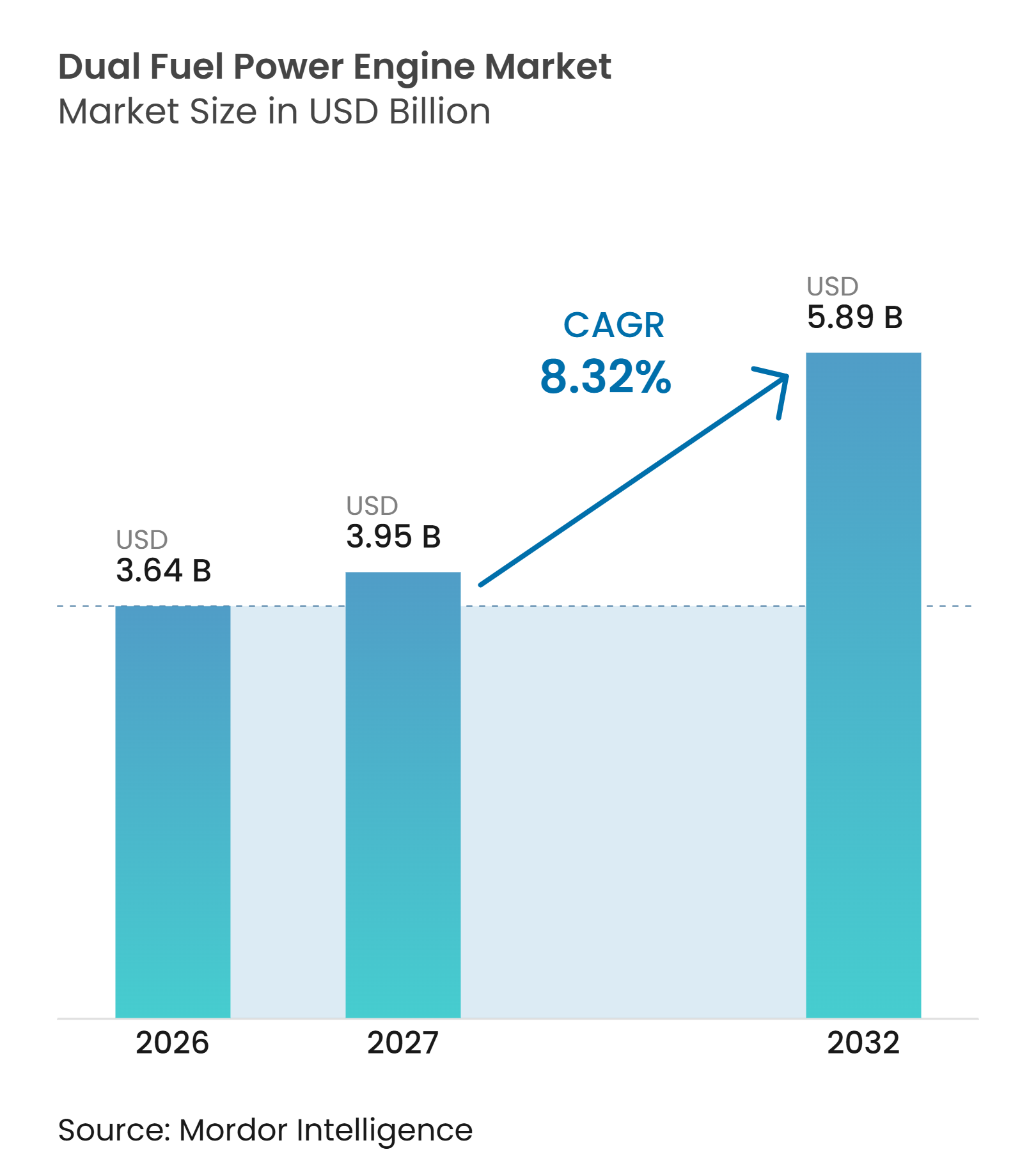
The global dual fuel power engine market size was valued at USD 3.64 billion in 2026 and is estimated to grow from USD 3.95 billion in 2027 to reach USD 5.89 billion by 2032, at a CAGR of 8.32% during the forecast period (2027-2032). The dual-fuel power engine market is supported by buyers who need power assets that can operate on gas or liquid fuel when local supply conditions change. Utilities and industrial operators are placing greater value on equipment that can maintain output during pipeline constraints, severe weather, and fuel-price changes. Natural gas infrastructure, data center electricity demand, and the need for flexible grid capacity are widening the use cases for these engines. Manufacturers are responding with lower-methane-slip designs, multi-fuel capability, and service contracts that support installed assets over time. These product and service changes create opportunities in large plants, remote grids, and critical backup power applications.
Key Report Takeaways
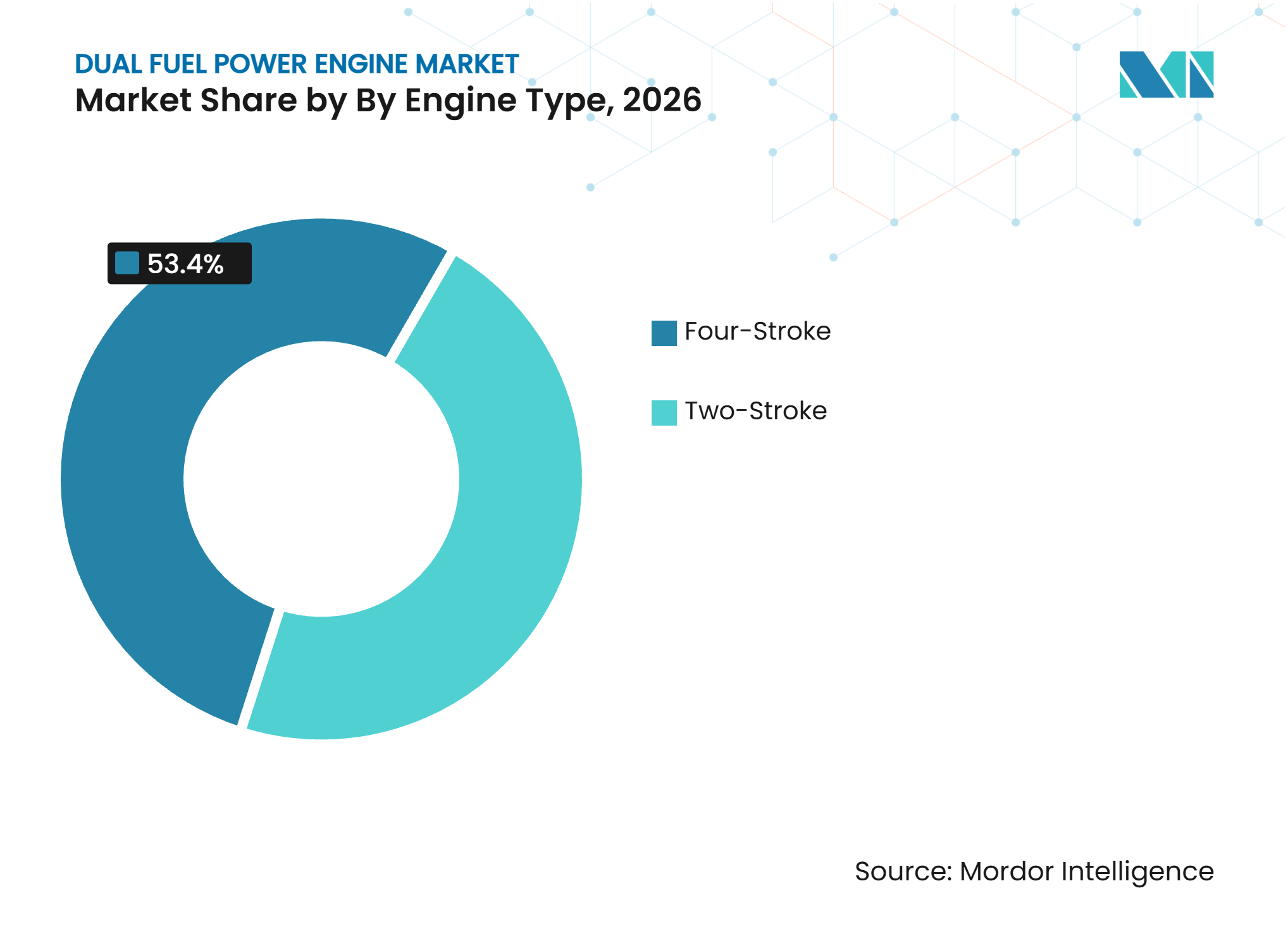
- By engine type, four-stroke engines held 53.4% of the dual fuel power engine market share in 2026, while two-stroke engines are forecast to grow at an 8.6% CAGR through 2032.
- By ignition technology, compression-ignition engines held 79.7% of the dual fuel power engine market share in 2026, while spark-ignition engines are forecast to grow at an 8.5% CAGR through 2032.
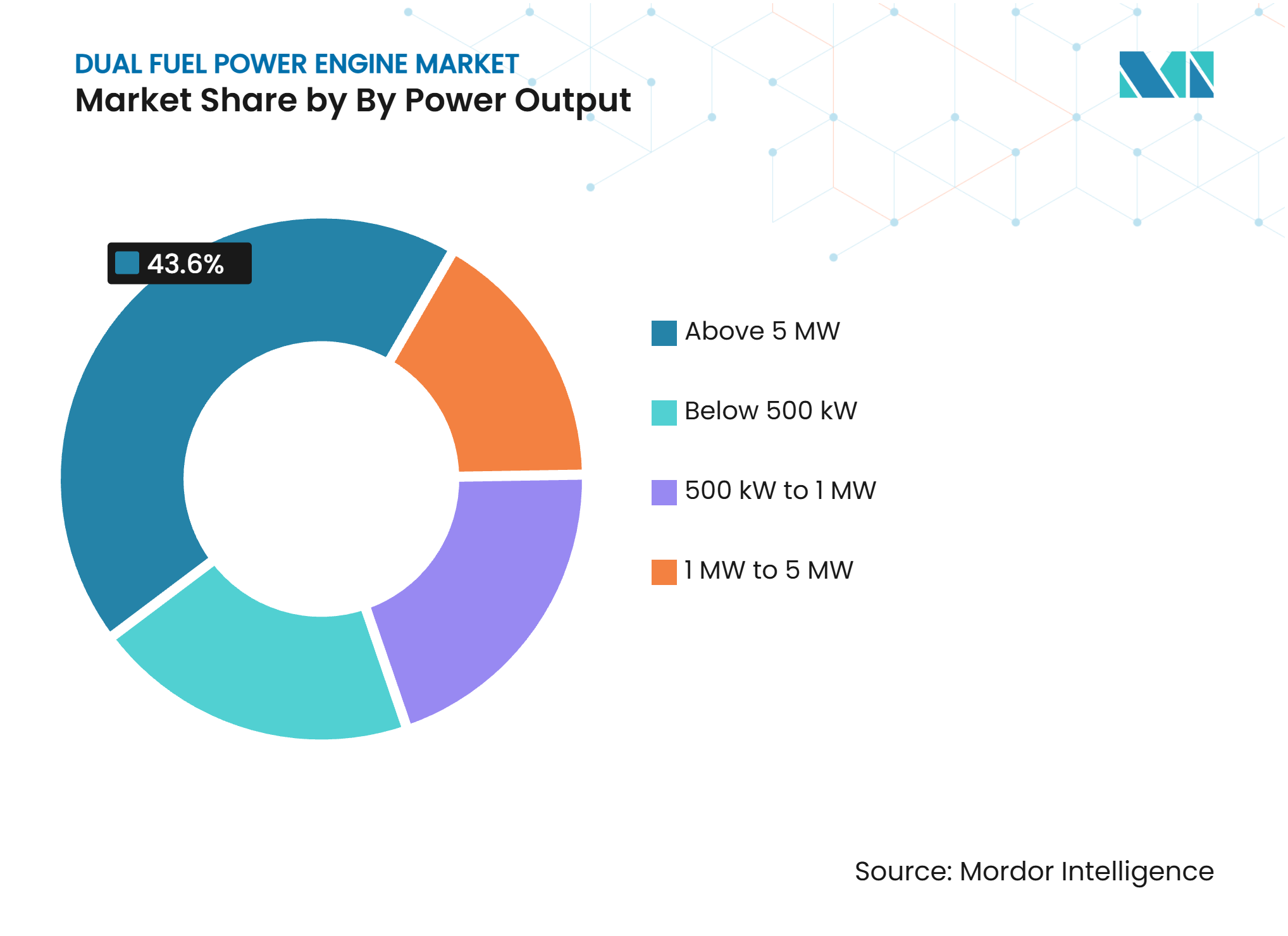
- By power output, above-5-MW engines accounted for 43.6% of the dual fuel power engine market size in 2026 and are forecast to grow at an 8.7% CAGR through 2032.
- By end user, utilities and independent power producers held 44.7% of the dual fuel power engine market share in 2026, while industrial manufacturers are forecast to grow at a 9.3% CAGR through 2032.
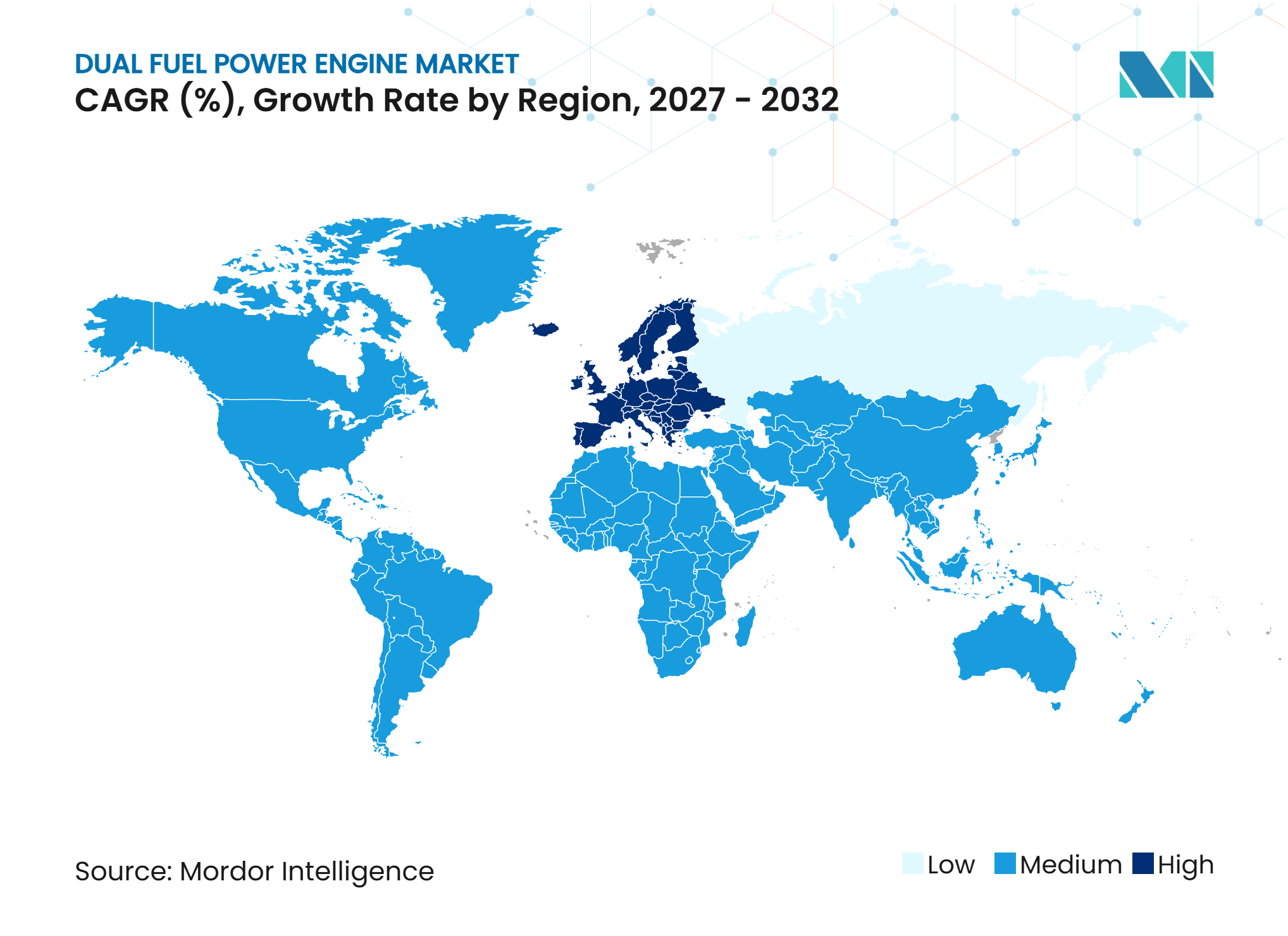
- By geography, Asia-Pacific held 39.4% of the dual fuel power engine market share in 2026, while Europe is forecast to grow at a 9.1% CAGR through 2032.
Note: Market numbers in this report are based on Mordor Intelligence's proprietary estimation framework, which combines nine months of actuals with Q4 projections for base year 2026.
Market Trends and Insights
Drivers Impact Analysis of Dual Fuel Power Engine Market*
| Driver | (~) % Impact on CAGR Forecast | Geographic Relevance | Impact Timeline |
|---|---|---|---|
| Rising Demand for Reliable and Flexible Power Generation | +1.8% | Global | Short term (≤ 2 years) |
| Expansion of Distributed Power Generation and Microgrids | +1.1% | APAC core, spill-over to MEA and South America | Medium term (2–4 years) |
| Increasing Adoption of Natural Gas for Power Generation | +1.5% | Global, with primary gains in APAC and North America | Short term (≤ 2 years) |
| Growth in Alternative-Fuel Readiness Investments | +0.9% | North America & EU | Medium term (2–4 years) |
| Methane-Slip Measurement and Abatement Innovation | +0.6% | Global, EU-first | Medium term (2–4 years) |
| Need for Reliable Backup Power in Data Centers and Critical Infrastructure | +1.2% | North America & APAC | Short term (≤ 2 years) |
| Source: Mordor Intelligence | |||
Rising Demand for Reliable and Flexible Power Generation
Grid failures have raised the cost of unreliable power and changed how buyers specify generation equipment. The dual fuel power engine market benefits because these engines can switch fuel when gas supply is constrained or liquid fuel prices rise. Wärtsilä received an order in August 2025 for 6 Wärtsilä 50DF engines totaling 99.6 MW for Black Hills Energy in Rapid City, South Dakota, where the company cited the risk of disrupted gas supply during severe weather. Nebraska Public Power District also selected 12 Wärtsilä 50DF engines for a 217 MW project scheduled to operate from 2028.[1] These orders show that fuel flexibility is becoming part of power-security planning rather than an optional feature. Replacement of older thermal capacity can therefore sustain demand for fast-start reciprocating engines in North America and Europe.
Increasing Adoption of Natural Gas for Power Generation
The International Energy Agency projects global natural gas consumption at 4,634 billion cubic meters (bcm) in 2030, compared with 4,250 billion cubic meters (bcm) in 2024, with Asia-Pacific accounting for nearly half of the incremental demand.[2] This development supports the dual fuel power engine market in locations that have LNG import capacity but limited pipeline networks. Indonesia, Bangladesh, Pakistan, and several African markets can use imported gas while retaining liquid-fuel capability. MAN Energy Solutions was commissioned in March 2025 to supply 24 18V51/60DF engines for Karpowership barges, with a combined capacity of 500 MW.[3] The order demonstrates the role of floating power plants where permanent fuel and grid infrastructure is incomplete. In these locations, the ability to use more than 1 fuel supports resilience as much as it supports gas use.
Need for Reliable Backup Power in Data Centers and Critical Infrastructure
Data centers have created a distinct demand base for equipment that can respond quickly and operate through longer grid interruptions. Rolls-Royce announced in February 2025 that its MTU Series 4000 L64 20-cylinder gas genset will deliver 2.8 MW in 45 seconds from 2026 for data center emergency and continuous power applications.[4] The company stated that the new unit improves performance by 10% compared with the prior generation. The Engine Technology Forum reported that advanced standby generators are an important part of U.S. data center infrastructure as investment in AI and energy infrastructure expands. This demand can reduce reliance on utility procurement cycles for the dual fuel power engine market. It also raises the value of fast response, high availability, and fuel security in product selection.
Expansion of Distributed Power Generation and Microgrids
Distributed plants and microgrids need generating equipment that can operate when fuel logistics are uncertain. The dual fuel power engine market is relevant to island grids and remote networks because fuel-flexible engines can balance supply security with reliable generation. Wärtsilä signed a 30-month operation and maintenance agreement in October 2025 for a 138 MW dual fuel plant in Lombok, Indonesia, which supplies 60% of the island's grid. A 2025 study in Applied Energy found that fuel-flexible distributed systems can improve cost adaptability when fuel availability changes. Rapid ramping and low stable-load operation also allow these engines to support more variable renewable generation. Demand can build where electricity use grows faster than local transmission and distribution investment.
Restraints Impact Analysis of Dual Fuel Power Engine Market*
| Restraint | (~) % Impact on CAGR Forecast | Geographic Relevance | Impact Timeline |
|---|---|---|---|
| High Capital Cost of Cryogenic Fuel Systems | -1.1% | Global | Long term (≥ 4 years) |
| Limited Availability and Price Volatility of Alternative Fuels | -0.9% | MEA, South America, parts of APAC | Medium term (2–4 years) |
| Methane-Slip and Lifecycle Emission Uncertainty | -0.5% | Europe, Global | Medium term (2–4 years) |
| Crew Training, Safety, and Drydocking Complexity | -0.4% | Global | Short term (≤ 2 years) |
| Source: Mordor Intelligence | |||
High Capital Cost of Cryogenic Fuel Systems
Liquefied Natural Gas (LNG) handling systems can increase the initial cost of dual-fuel installation. Cryogenic tanks, regasification equipment, bunkering facilities, safety systems, and related engineering add costs that can weaken the business case for smaller projects. The issue is more acute for operators that have short contracts or uncertain access to gas. It can also affect emerging-market customers, even if fuel diversity has the strongest operational value. Liquefied Natural Gas (LNG) bunkering and safety requirements add design and compliance work before a project can proceed. Cost reductions from equipment learning and infrastructure development are expected to take time, which keeps the restraint relevant to the dual-fuel power engine market.
Limited Availability and Price Volatility of Alternative Fuels
The case for a dual fuel engine depends on access to both fuels at workable prices. Liquefied Natural Gas (LNG) prices can be volatile in Asian trading hubs, while biogas, renewable natural gas, and hydrogen blends face constrained supply and long-term contracting. Remote mining and industrial sites in Latin America and Sub-Saharan Africa may lack dependable gas-delivery infrastructure. In such settings, the efficiency benefits of dual fuel operation can be difficult to realize. The International Energy Agency (IEA) expects natural gas consumption to grow globally through 2030 but notes uneven regional conditions, including an 8% decline in European gas demand and concentrated Asia-Pacific growth. This local supply uncertainty can increase financing risk because lenders need dependable fuel-cost assumptions.
*Our forecasts treat driver/restraint impacts as directional, not additive. The impact forecasts reflect baseline growth, mix effects, and variable interactions.
Dual Fuel Power Engine Market Segment Analysis
By Engine Type:
Four-Stroke Engines Lead While Two-Stroke Demand BuildsFour-stroke engines held 53.4% of the dual-fuel power engine market share in 2026. Industrial and utility buyers favor these configurations for modular scale, quick start-up, and service support in distributed and semi-baseload duties. Wärtsilä introduced the 46TS engine in February 2025 for renewable-energy balancing and power plant performance. The launch shows how suppliers are positioning four-stroke units alongside wind and solar rather than against them. Their operating flexibility suits applications where maintenance access and response time are important. The dual fuel power engine market, therefore, continues to use four-stroke designs across distributed power, combined-cycle support, and off-grid installations.
Two-stroke engines are forecast to expand at an 8.6% CAGR through 2032. They are gaining use in large-bore stationary systems and offshore-linked installations that operate at high, continuous loads. WinGD reported in March 2025 that its variable compression ratio technology reduced methane emissions by 30% and provided fuel savings of up to 5.8% in shop tests. These results address the historic trade-off between efficiency and emissions in large gas engines. Multi-fuel two-stroke designs that can use Liquefied Natural Gas (LNG), methanol, or ammonia can extend the addressable base beyond established marine applications. This product development gives the dual-fuel power engine market a route into larger continuous-load power applications.



By Ignition Technology:
Compression-Ignition Engines Retain the Larger BaseCompression-ignition engines held 79.7% of the dual-fuel power engine market share in 2026. Their position reflects established diesel-cycle efficiency, compatibility with current infrastructure, and familiarity among plant operators. These engines perform well at high loads, which makes them suitable for utility and large industrial facilities with capacity factors above 60%. MAN Energy Solutions stated in May 2025 that its MAN L35/44DF CD GenSet completed type approval testing with a 16% output advantage over competing products and methane-slip reductions of up to 85% against industry standards. The product illustrates continued technical development within compression-ignition equipment. This installed base provides a stable demand foundation for the dual-fuel power engine market.
Spark-ignition engines are forecast to grow at an 8.5% CAGR through 2032. Their use is increasing in biogas, renewable gas, and projects where lower NOx emissions influence permits. Wärtsilä introduced Spark Gas Conversion technology for the 50DF engine in April 2025, with methane reductions of up to 75% compared with its standard dual-fuel variant. The company developed the solution with Chevron Shipping. Retrofit options can create demand beyond new engine sales. They also give fleet operators a practical pathway to meet tighter emissions requirements.
By Power Output:
Above-5-MW Engines Combine Scale and Faster GrowthAbove-5-MW engines accounted for 43.6% of the dual-fuel power engine market size in 2026 and are forecast to grow at an 8.7% CAGR through 2032. Large engines offer lower installed cost per kilowatt, simpler plant layouts, and stronger fit with combined-cycle configurations. They also meet utility demand for fast deployment, lower minimum load, and good part-load efficiency compared with gas turbines. MAN Energy Solutions reported in April 2025 that its ME-GI two-stroke engine had approached 1,000 orders and exceeded 25 million kW of installed output. This order base confirms the concentration of demand at the upper end of the output range. Utility-scale projects remain a central revenue source for the dual-fuel power engine market.
The 1 MW to 5 MW range supports captive power in cement, chemical, and refinery operations. Engines from 500 kW to 1 MW support microgrids and distributed energy projects in Southeast Asia and Africa. Units below 500 kW serve commercial and light-industrial backup needs, although batteries and fuel cells compete where grid reliability is higher. Fuel specifications can influence design choices in the middle power range because engines must operate with distillate and biofuel blends. Each output band serves a different operating pattern and customer need. Suppliers that cover several ranges can balance exposure between utility-scale orders and distributed installations.

By End User:
Utilities Provide the Largest Base While Industry Grows FasterUtilities and independent power producers held 44.7% of the dual-fuel power engine market share in 2026. These buyers use reciprocating engines for peak demand, grid firming, and replacement of retiring firm capacity. Fuel security matters at a system level when utilities must maintain supply through weather events or gas constraints. The Black Hills Energy and Nebraska projects illustrate this role in U.S. utility procurement. Utilities also value the rapid deployment profile of engines when larger generation projects have longer development timelines. This end-user group anchors installed capacity and long-term service demand.
Industrial manufacturers are forecast to grow at a 9.3% CAGR through 2032. Energy-intensive facilities are looking for on-site generation that can use pipeline gas, process byproduct gas, or flare gas and shift to diesel without stopping production. YANMAR Energy System received a Japanese industrial machinery association environmental award in March 2025 for a dual-fuel biogas system at the Mikasagawa Treatment Center in Fukuoka. The installation has 2,990 kW units and produces electricity equivalent to the annual use of 2,000 households. Oil and gas operators also use engines for field power, Liquefied Natural Gas (LNG) terminals, and pipeline facilities. Mining and other remote users add demand where rugged equipment and fuel flexibility can avoid operational interruption.
Geography Analysis
Asia-Pacific accounted for 39.4% of the dual-fuel power engine market size in 2026. China is a leading buyer for grid stabilization, industrial captive power, and LNG-linked infrastructure. GE Vernova signed a long-term service agreement in 2025 for a hydrogen and natural gas co-fired combined-cycle plant at Guangdong Yudian Daya Bay, which will blend 10% hydrogen with natural gas. India and Indonesia support regional demand through capacity additions and island-grid requirements. Japan is advancing methane-slip control through a New Energy and Industrial Technology Development Organization (NEDO)-backed program in which Kanadevia, Mitsui O.S.K. Lines, and YANMAR reported a 98% reduction in onboard trials during 2025. Malaysia, Singapore, and other Asian markets contribute demand through distributed generation and long-term service agreements.
Europe is forecast to expand at a 9.1% CAGR through 2032. Demand is tied to grid balancing, energy-security measures, and power systems near Liquefied Natural Gas (LNG) terminals rather than broad baseload gas expansion. The International Energy Agency (IEA) forecasts an 8% decline in European gas demand by 2030, which underscores the difference between total gas consumption and demand for flexible generation. FuelEU Maritime entered full application on January 1, 2025, beginning with a 2% greenhouse-gas intensity reduction target for 2025 and increasing to 80% by 2050. The International Maritime Organization approved net-zero regulations in April 2025, with entry into force expected in 2027. Germany, Norway, and the Netherlands lead activity, while Norway benefits from established Liquefied Natural Gas (LNG) bunkering infrastructure. North America remains the second-largest region because utilities are replacing older capacity and data centers need resilient backup generation.
South America has moderate demand from mining and oil and gas operations in Brazil, Colombia, and Argentina. These applications use engines for remote operations and industrial backup where grid stability is limited. The Middle East and Africa are important for floating power and utility privatization projects. Everllence received a contract in September 2025 for a 74 MW dual-fuel plant in Nouakchott, Mauritania, for utility SOMELEC. The project uses 4 18V51/60DF engines rated at 18.5 MW each and is scheduled for commissioning in late 2026. Gulf Cooperation Council markets add demand from industrial zones and desalination facilities near LNG export systems. These regional needs support a broad set of project sizes and business models.
Competitive Landscape
Market Concentration
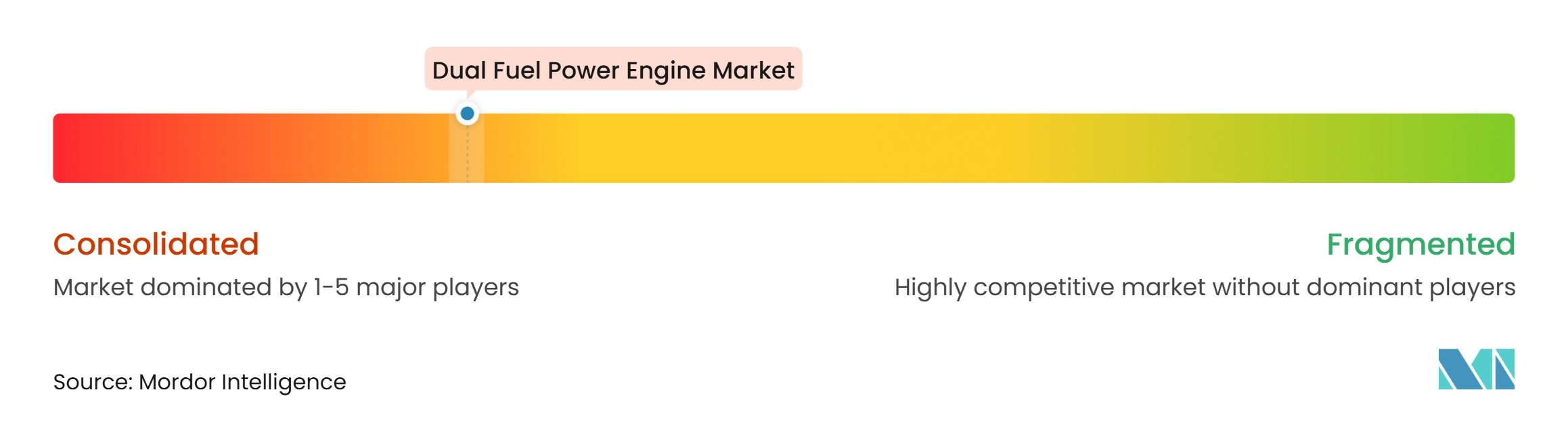
The dual-fuel power engine market is moderately consolidated in high-output equipment. Wärtsilä, MAN Energy Solutions, and WinGD have strong positions in large-bore engines above 5 MW. Caterpillar, Rolls-Royce, Doosan Enerbility, and Kawasaki Heavy Industries compete in utility and industrial applications across the mid-range. Competition increasingly centers on multi-fuel capability, methane-slip reduction, and service coverage. Wärtsilä extended its NextDF technology across the 25DF, 31DF, and 46TS-DF engines in 2025. The company stated that the technology reduces methane emissions to less than 1.4% of fuel use.
Manufacturers are using product development to protect their position as emissions requirements become stricter. MAN Energy Solutions announced in February 2025 that its 7L21/31DF-M methanol GenSet passed type approval testing for the 1 MW to 2 MW range. WinGD unveiled its X-DF-HP high-pressure LNG dual-fuel engine in December 2025, with first deliveries planned for 2028. The engine is available in X82 and X92 bore sizes and meets Tier III requirements in gas and diesel modes through standard SCR. These moves show that suppliers are widening fuel choices while retaining performance in conventional modes. Long-term maintenance agreements remain important because they secure recurring revenue and keep customers within an OEM service network.
The sub-1-MW segment for edge data centers and remote industrial microgrids remains less fully served by large OEM platforms. Retrofit specialists and regional suppliers can compete where local service and deployment speed matter most. Methanol-capable stationary generating sets are also at an early stage of development. Classification approvals and national certification requirements create barriers for new suppliers, especially in alternative-fuel applications. These requirements favor manufacturers with existing testing capability, engineering resources, and service networks. The competitive position of major OEMs is therefore strongest in large projects and regulated applications, while smaller suppliers can compete in more localized demand pockets.
Dual Fuel Power Engine Industry Leaders
-
MAN Energy Solutions SE
-
WinGD Ltd.
-
Wärtsilä Corporation
-
Caterpillar Inc.
-
HD Hyundai Heavy Industries Co., Ltd.
- *Disclaimer: Major Players sorted in no particular order
Dual Fuel Power Engine Market Companies Covered in this Report
- Anglo Belgian Corporation nv
- Bergen Engines AS
- Caterpillar Inc.
- CSSC-MES Diesel Co., Ltd.
- Daihatsu Diesel Co., Ltd.
- DEUTZ AG
- Doosan Enerbility Co., Ltd.
- Fairbanks Morse Defense
- HD Hyundai Heavy Industries Co., Ltd.
- IHI Power Systems Co., Ltd.
- Kawasaki Heavy Industries, Ltd.
- Makita Corporation
- MAN Energy Solutions SE
- Mitsubishi Heavy Industries, Ltd.
- Mitsui E&S Co., Ltd.
- Rolls-Royce Holdings plc
- Wartsila Corporation
- WinGD Ltd.
- YANMAR HOLDINGS CO., LTD.
Recent Industry Developments in Dual Fuel Power Engine Market
- December 2025: WinGD unveils X-DF-HP high-pressure LNG dual-fuel engine for ultra-large container vessels at Marintec China 2025. Available in X82 and X92 bore sizes with first deliveries in 2028, the engine achieves Tier III compliance in both gas and diesel modes using a standard SCR.
- November 2025: JFE Engineering commercializes Japan's first large-scale ammonia co-firing dual-fuel engine exceeding 7 MW at a 50% ammonia co-firing rate, developed in cooperation with Everllence France. Initial sales target isolated island power plants, with marine class certification planned.
- October 2025: Kanadevia, MOL, and YANMAR achieve 98% methane slip reduction in onboard trials aboard LNG-fueled bulk carrier REIMEI, under a NEDO Green Innovation Fund project. Results far exceed the 70% project target, with social implementation planned from fiscal 2027.
- September 2025: Everllence wins contract for a 74 MW dual-fuel power plant in Nouakchott, Mauritania, for national utility SOMELEC. Four 18V51/60DF engines rated at 18.5 MW each are to be commissioned by late 2026.
Global Dual Fuel Power Engine Market Report Scope
Dual fuel power engines are internal combustion engines designed to operate using two different fuels, typically a primary gaseous fuel such as natural gas or biogas combined with a secondary liquid fuel such as diesel. These engines generate mechanical power that can be used to drive electrical generators, industrial equipment, and other power-producing systems. Depending on their design, dual fuel engines operate through compression-ignition or spark-ignition technologies and are available in four-stroke and two-stroke configurations to accommodate different power requirements, operating conditions, and fuel characteristics. They are commonly deployed in power generation facilities, oil and gas operations, industrial manufacturing plants, mining activities, and other applications requiring reliable and flexible power supply. By enabling the substitution of a portion of conventional liquid fuel with gaseous alternatives, dual fuel engines can provide fuel flexibility, support the utilization of locally available gas resources, and potentially reduce fuel costs and certain emissions compared with operation on liquid fuel alone. Actual performance and emissions benefits depend on engine configuration, fuel composition, operating conditions, and the proportion of each fuel used.
The Global Dual Fuel Power Engine Market is segmented by engine type, ignition technology, power output, and end user. By engine type, the market is segmented into four-stroke dual fuel engines and two-stroke dual fuel engines. By ignition technology, the market is segmented into compression-ignition dual-fuel engines and spark-ignition dual-fuel engines. By power output, the market is segmented into below 500 kW, 500 kW to 1 MW, 1 MW to 5 MW, and above 5 MW. By end user, the market is segmented into utilities and independent power producers (IPPs), oil and gas, industrial manufacturers, mining, and other end users. The report also covers the market size and forecasts for the global dual-fuel power engine market across 26 countries in key regions. For each segment, market sizing and forecasts are provided on the basis of value (USD).
Segmentation Overview
| Four-Stroke Dual Fuel Engines |
| Two-Stroke Dual Fuel Engines |
| Compression-Ignition Dual Fuel Engines |
| Spark-Ignition Dual Fuel Engines |
| Below 500 kW |
| 500 kW to 1 MW |
| 1 MW to 5 MW |
| Above 5 MW |
| Utilities and Independent Power Producers (IPPs) |
| Oil and Gas |
| Industrial Manufacturers |
| Mining |
| Other End Users |
| North America | United States |
| Canada | |
| Mexico | |
| Europe | Germany |
| France | |
| Italy | |
| Spain | |
| United Kingdom | |
| Norway | |
| Netherlands | |
| Russia | |
| Rest of Europe | |
| Asia-Pacific | China |
| India | |
| Japan | |
| South Korea | |
| Australia | |
| Indonesia | |
| Malaysia | |
| Singapore | |
| Rest of Asia-Pacific | |
| South America | Brazil |
| Argentina | |
| Colombia | |
| Rest of South America | |
| Middle East and Africa | Saudi Arabia |
| United Arab Emirates | |
| Qatar | |
| Kuwait | |
| Oman | |
| Egypt | |
| Nigeria | |
| Rest of Middle East and Africa |
| By Engine Type | Four-Stroke Dual Fuel Engines | |
| Two-Stroke Dual Fuel Engines | ||
| By Ignition Technology | Compression-Ignition Dual Fuel Engines | |
| Spark-Ignition Dual Fuel Engines | ||
| By Power Output | Below 500 kW | |
| 500 kW to 1 MW | ||
| 1 MW to 5 MW | ||
| Above 5 MW | ||
| By End User | Utilities and Independent Power Producers (IPPs) | |
| Oil and Gas | ||
| Industrial Manufacturers | ||
| Mining | ||
| Other End Users | ||
| By Geography | North America | United States |
| Canada | ||
| Mexico | ||
| Europe | Germany | |
| France | ||
| Italy | ||
| Spain | ||
| United Kingdom | ||
| Norway | ||
| Netherlands | ||
| Russia | ||
| Rest of Europe | ||
| Asia-Pacific | China | |
| India | ||
| Japan | ||
| South Korea | ||
| Australia | ||
| Indonesia | ||
| Malaysia | ||
| Singapore | ||
| Rest of Asia-Pacific | ||
| South America | Brazil | |
| Argentina | ||
| Colombia | ||
| Rest of South America | ||
| Middle East and Africa | Saudi Arabia | |
| United Arab Emirates | ||
| Qatar | ||
| Kuwait | ||
| Oman | ||
| Egypt | ||
| Nigeria | ||
| Rest of Middle East and Africa | ||
Key Questions Answered in the Report
What is the forecast value of the dual fuel power engine market by 2032?
The dual fuel power engine market is forecast to reach USD 5.89 billion by 2032, expanding at an 8.32% CAGR from 2027 to 2032.
Which engine type has the largest share in dual fuel power applications?
Four-stroke engines hold 53.4% of value in 2026 because they offer modular scale, quick starts, and established service support.
Why are dual-fuel engines important for data centers?
They provide fast and resilient backup or continuous power. Rolls-Royce’s mtu Series 4000 L64 is designed to provide 2.8 MW in 45 seconds from 2026.
Which end user is growing fastest for dual-fuel power engines?
Industrial manufacturers are forecast to grow at a 9.3% CAGR through 2032 as they adopt on-site power that can use available gas streams or diesel.
Which region leads to demand for dual-fuel power engines?
Asia-Pacific holds 39.4% of the value in 2026, supported by grid stabilization, industrial power needs, and island-grid applications.
What limits the broader adoption of dual-fuel power systems?
The main barriers are the initial cost of LNG handling equipment and uncertain availability and pricing of gas and other alternative fuels.