
Dual Clutch Transmission Market Size and Share
Market Overview
| Study Period | 2020 - 2032 |
|---|---|
| Market Size (2027) | USD 22.78 Billion |
| Market Size (2032) | USD 28.35 Billion |
| Growth Rate (2027 - 2032) | 4.47 % |
| Fastest Growing Market | Asia-Pacific |
| Largest Market | Asia-Pacific |
| Market Concentration | Medium |
Major Players *Disclaimer: Major Players sorted in no particular order Image © Mordor Intelligence. Reuse requires attribution under CC BY 4.0. | |
Dual Clutch Transmission Market Analysis by Mordor Intelligence
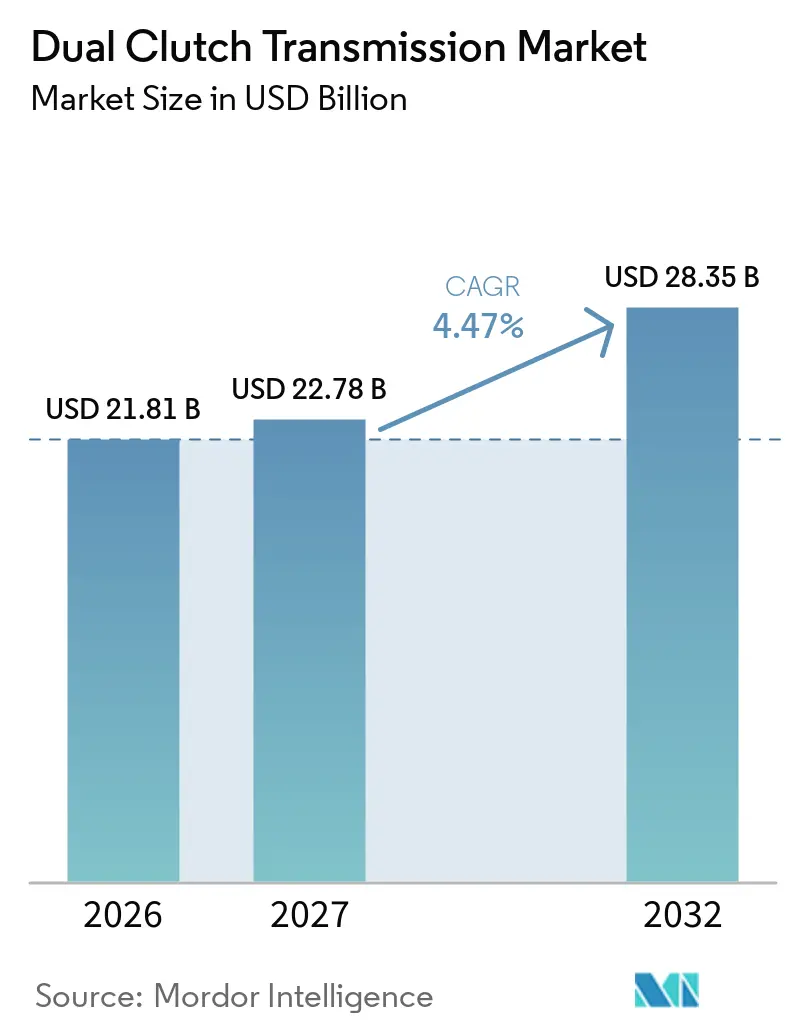
The dual clutch transmission market size was valued at USD 21.81 billion in 2026 and is projected to expand from USD 22.78 billion in 2027 to USD 28.35 billion by 2032, registering a CAGR of 4.47% between 2027 and 2032. The market is being shaped by vehicle makers that must improve fuel use while keeping familiar powertrains in production. Hybrid vehicles are central to this transition because they retain a role for compact, electronically controlled transmissions. Manufacturers are also placing more emphasis on software control, thermal performance, and dependable low-speed behavior. Production is moving closer to large vehicle assembly bases, particularly in Asia-Pacific, which can shorten supply chains and allow calibration work to reflect local driving patterns. The dual clutch transmission market therefore has opportunities in hybrid-ready systems, localized component supply, and service solutions for vehicles already on the road.
Key Report Takeaways
- By clutch type, wet DCT held 58.27% of the dual clutch transmission market share in 2026 and is projected to grow at a 5.08% CAGR through 2032.
- By number of gears, 7-speed held 54.18% of the dual clutch transmission market share in 2026, while 8-speed and above is forecast to grow at a 5.79% CAGR through 2032.
- By component, gear sets held 32.18% of the dual clutch transmission market share in 2026, while mechatronics/TCU is forecast to grow at a 4.91% CAGR through 2032.
- By vehicle type, passenger cars held 94.18% of the dual clutch transmission market share in 2026 and are projected to grow at a 4.87% CAGR through 2032.
- By propulsion, ICE held 76.27% of the dual clutch transmission market share in 2026, while hybrid DHT/hybrid DCT is forecast to grow at an 8.07% CAGR through 2032.
- By sales channel, OEM held 88.63% of the dual clutch transmission market share in 2026 and is projected to grow at a 4.74% CAGR through 2032.
- By geography, Asia-Pacific held 52.18% of the dual clutch transmission market share in 2026 and is projected to grow at a 5.33% CAGR through 2032.
Note: Market numbers in this report are based on Mordor Intelligence's proprietary estimation framework, which combines nine months of actuals with Q4 projections for base year 2026.
Global Dual Clutch Transmission Market Trends and Insights
Drivers Impact Analysis*
| Driver | (~) % Impact on CAGR Forecast | Geographic Relevance | Impact Timeline |
|---|---|---|---|
| Hybridization of Existing ICE Platforms Through eDCT and DHT Architectures | +1.2% | Global, with high intensity in China, Europe, and Japan | Medium term (2–4 years) |
| Tightening Fuel-Economy and CO2 Requirements | +1.0% | EU, China, and North America | Short term (≤ 2 years) |
| High-Volume 7-Speed DCT Deployment in Compact Cars and SUVs | +0.8% | Asia-Pacific core, spill-over to Europe and South America | Short term (≤ 2 years) |
| Regional Localization of DCT and Clutch-Module Production in Asia-Pacific | +0.6% | Asia-Pacific, spill-over to South America and MEA | Medium term (2–4 years) |
| DCT Module Reuse Across ICE, Mild-Hybrid, and Full-Hybrid Variants | +0.4% | Global | Long term (≥ 4 years) |
| Software-Calibrated Shift Quality as a Differentiator in Premium and Performance Vehicles | +0.3% | Europe, North America, and East Asia | Long term (≥ 4 years) |
| Source: Mordor Intelligence | |||
Hybridization of Existing ICE Platforms Through eDCT and DHT Architectures
Hybridization is extending the role of dual-clutch systems because vehicle makers can pair combustion engines with electric motors without abandoning familiar vehicle platforms. Dedicated hybrid transmissions and electrified DCTs provide the mechanical and electronic connection needed to manage these power sources. They can support engine-off driving in some conditions, while still allowing the engine to provide power when it is needed. This approach helps manufacturers improve efficiency without moving every product immediately to a battery-electric architecture. It also places greater emphasis on clutch temperature, motor packaging, hydraulic functions, and software control. Suppliers that can validate these elements as one system are better placed to support new hybrid programs. The opportunity is strongest where manufacturers want to use related transmission designs across conventional, mild-hybrid, and full-hybrid vehicles. That reuse can simplify development planning and support more consistent production across vehicle lines.
Tightening Fuel-Economy and CO2 Requirements
Fuel-economy and CO2 requirements influence transmission choices because vehicle manufacturers must manage emissions across their full product range. The European Union’s fleet-wide standards for new passenger cars give manufacturers a continuing reason to use powertrains that can reduce fuel consumption[1]. Mild hybrids and plug-in hybrids can remain relevant when they help a vehicle portfolio meet these requirements. A DCT can support this strategy by managing engine speed and torque delivery across varied driving conditions. Regulations also affect the timing of product decisions because manufacturers may update established transmission families before committing to entirely new vehicle architectures. This favors systems that have already been tested with engines, motors, batteries, and vehicle controls. Suppliers that can demonstrate dependable integration have a stronger position in discussions with engineering and purchasing teams. The result is sustained interest in hybrid-compatible transmission programs during model refresh cycles.
High-Volume 7-Speed DCT Deployment in Compact Cars and SUVs
Seven-speed DCTs remain relevant to compact cars and sport utility vehicles because they balance performance, package size, and production cost. The layout provides sufficient ratios for many mainstream applications without the added complexity of a higher gear-count design. It can also be adapted across related sedans, hatchbacks, and utility vehicles, which supports common platform strategies. BorgWarner has reported DCT clutch program activity for Chinese vehicle manufacturers, illustrating ongoing supplier participation in high-volume applications. Demand depends on more than drivetrain preference because manufacturers must also assess traffic behavior, fit within the engine bay, and the impact on vehicle affordability. Stable access to components is important when a program serves several vehicle models over multiple years. Local manufacturing can help suppliers coordinate with vehicle plants and respond to changes in program requirements. These factors support continued demand for established 7-speed DCT designs.
Regional Localization of DCT and Clutch-Module Production in Asia-Pacific
Localization is becoming more important as vehicle production expands across Asia-Pacific and manufacturers seek shorter, more reliable supply chains. Regional production can reduce transport exposure and strengthen coordination among transmission, engine, and vehicle engineering teams. It also gives suppliers a closer view of local traffic conditions, climate, and customer expectations, which can guide calibration decisions. India and China are particularly relevant because both combine substantial vehicle demand with growing manufacturing and engineering capability. Localization extends beyond final assembly because it requires access to clutch materials, electronics, gear machining, testing, and trained service personnel. A strong local network can improve launch readiness and help identify drivability issues before they become widespread customer problems. It can also support export programs when locally produced vehicles are shipped to other markets. These conditions make regional production an important part of long-term transmission supply planning.
Restraints Impact Analysis*
| Restraint | (~) % Impact on CAGR Forecast | Geographic Relevance | Impact Timeline |
|---|---|---|---|
| Battery-Electric Vehicle Penetration Reducing Conventional Multi-Speed Demand | -1.2% | Global, concentrated in EU and China | Long term (≥ 4 years) |
| High Thermal-Management and Mechatronics Complexity | -0.8% | Global | Short term (≤ 2 years) |
| High Warranty Exposure From Clutch Wear, Judder, and Low-Speed Drivability | -0.5% | Global, notably in emerging Asia-Pacific markets | Medium term (2–4 years) |
| Limited Repair Infrastructure and Calibration Capability Outside Major Automotive Clusters | -0.3% | South America, MEA, and Southeast Asia | Short term (≤ 2 years) |
| Source: Mordor Intelligence | |||
Battery-Electric Vehicle Penetration Reducing Conventional Multi-Speed Demand
Battery-electric vehicles generally require fewer mechanical transmission elements than vehicles with combustion engines, which can reduce demand for conventional DCT applications over time. The effect is most visible when a manufacturer moves a model line from a combustion platform to a dedicated battery-electric architecture. Hybrid vehicles provide a partial offset because they retain a need to coordinate engine and electric power. However, the pace of change differs by country, vehicle type, charging access, and customer affordability. Some manufacturers are expanding hybrid offerings where battery-electric vehicles remain difficult for many buyers to adopt. Others are developing shared electrical architectures that may reduce the number of distinct powertrain designs in later product cycles. Suppliers must therefore manage a mixed demand outlook rather than assume that one propulsion route will prevail in every region. A broad powertrain portfolio can reduce exposure to a sudden shift away from a single type of transmission.
High Thermal-Management and Mechatronics Complexity
DCT systems require close control of clutch temperature, hydraulic pressure, sensors, and electronic commands, which increases engineering and validation demands. Repeated low-speed operation can place additional stress on clutch engagement, particularly when a hybrid vehicle moves between electric and combustion power. A transmission that performs well in a controlled test may behave differently in dense traffic, steep terrain, or high ambient temperatures. These operating conditions can increase the time needed to calibrate and validate a new program. Mechatronics adds another layer of complexity because the control unit must interpret driver demand and coordinate the engine, clutches, and electric motor where applicable. Minor weaknesses can result in hesitation, judder, or inconsistent response. Addressing them can require software revisions, diagnostic tools, specialist training, and additional testing. These requirements can increase program cost and make it harder for smaller suppliers to compete in advanced DCT applications.
*Our forecasts treat driver/restraint impacts as directional, not additive. The impact forecasts reflect baseline growth, mix effects, and variable interactions.
Segment Analysis
By Clutch Type: Wet DCT Supports Hybrid-Ready Applications
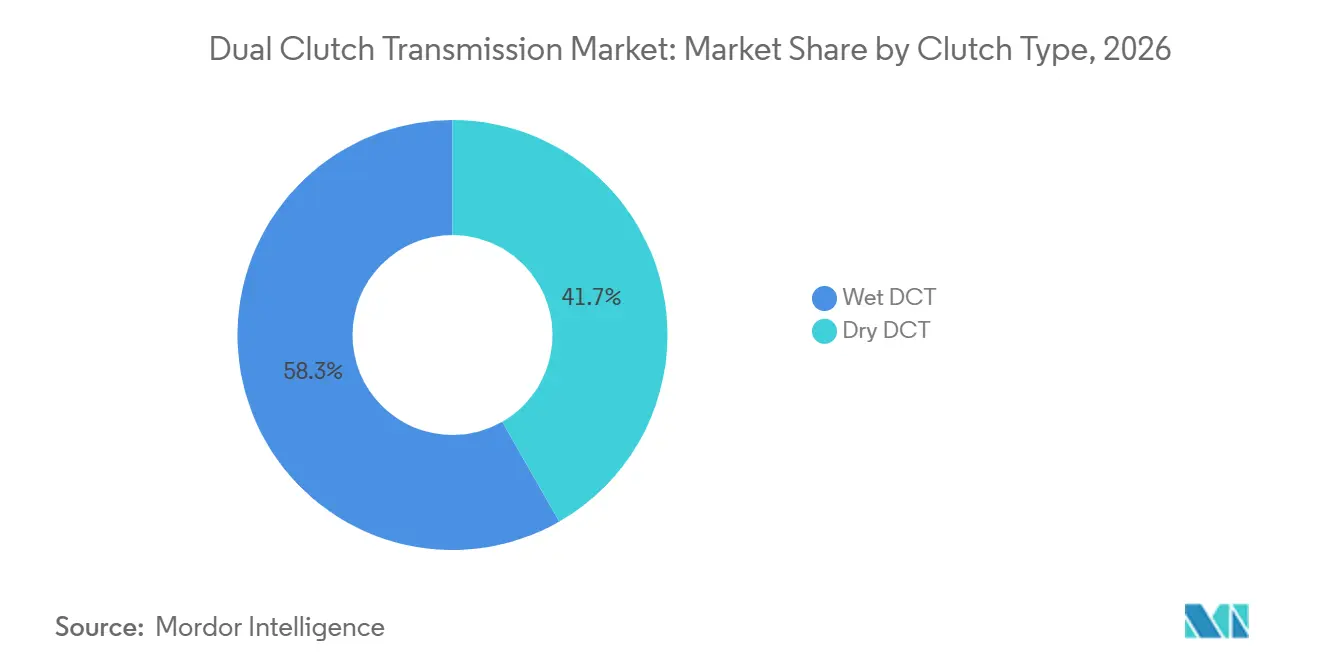
Wet DCT held 58.27% of the dual clutch transmission market share in 2026 and is projected to grow at a 5.08% CAGR through 2032. The design uses fluid to manage heat and support repeated clutch engagement. This makes it suitable for vehicles that face sustained stop-and-go driving or frequent changes between electric and combustion power. Vehicle makers may accept its added system requirements when they want greater thermal control and predictable operation. The dual clutch transmission market is likely to favor wet systems where hybrid use creates more demanding duty cycles.
Dry DCT remains relevant where lower cost, lower mass, and efficient operation are important. It can suit smaller passenger vehicles with less demanding operating conditions. Its commercial position depends heavily on calibration quality and how the vehicle is used in traffic. Manufacturers may continue to select it for value-focused models where a wet system is not necessary. The clutch-type mix in the market will therefore continue to vary by vehicle price, traffic conditions, and hybrid content.
By Number of Gears: Higher Gear Counts Expand in Advanced Vehicle Platforms
7-Speed held 54.18% of the dual clutch transmission market share in 2026, while 8-speed and above is expected to grow at a 5.79% CAGR through 2032. Seven-speed layouts remain widely used because they fit the needs of many compact vehicles and utility vehicles. They offer a familiar balance of performance, cost, and package size. Vehicle makers can apply a common design across several models, which supports production efficiency. This keeps the configuration important to the market.
Higher gear-count systems are more closely associated with premium, performance, and hybrid applications. Extra ratios can give engineers more flexibility to manage engine speed across different road conditions. This may improve power delivery when a combustion engine works alongside an electric motor. The design also requires careful control calibration so that additional gear changes do not compromise smoothness. As a result, the dual clutch transmission market sees higher gear counts as a specialized growth area rather than a direct replacement for every seven-speed system.
By Component: Control Systems Gain Importance Alongside Mechanical Content
Gear sets held 32.18% of the dual clutch transmission market share in 2026, while mechatronics/TCU is forecast to grow at a 4.91% CAGR through 2032. Gear sets remain essential because they transfer torque and determine the available ratios. Their quality depends on machining precision, material durability, and consistent manufacturing. They are a core mechanical element in every DCT design. This supports their continuing role across the dual clutch transmission market.
Mechatronics and transmission control units are receiving greater attention because drivers experience their effects directly through shift response. Software can influence clutch engagement, gear selection, and coordination with a hybrid motor. It can also support diagnostics and updates when vehicle behavior changes over time. The growing importance of control systems increases the value of suppliers that combine software knowledge with hardware validation. That shift changes how value is distributed within the market.
By Vehicle Type: Passenger Cars Remain the Primary Application
Passenger cars held 94.18% of the dual clutch transmission market share in 2026 and are forecast to grow at a 4.87% CAGR through 2032. Passenger vehicles offer the largest base of applications for compact and mid-size DCT designs. Their powertrain needs often focus on efficient daily driving, responsive acceleration, and packaging within limited space. These needs align with the capabilities of many DCT systems. The market consequently remains closely tied to passenger-car model cycles.
Commercial vehicles present a smaller opportunity because their torque loads and operating patterns are different. Some light commercial vehicles can use advanced automated transmissions, especially where fuel efficiency matters. Heavier applications often require other designs that are suited to higher loads and sustained work. Passenger-car demand also creates a dependency on decisions made by a limited number of large vehicle manufacturers. The dual clutch transmission market can therefore change quickly when a high-volume manufacturer revises its transmission strategy.
By Propulsion: Hybrid Applications Create the Strongest Growth Path
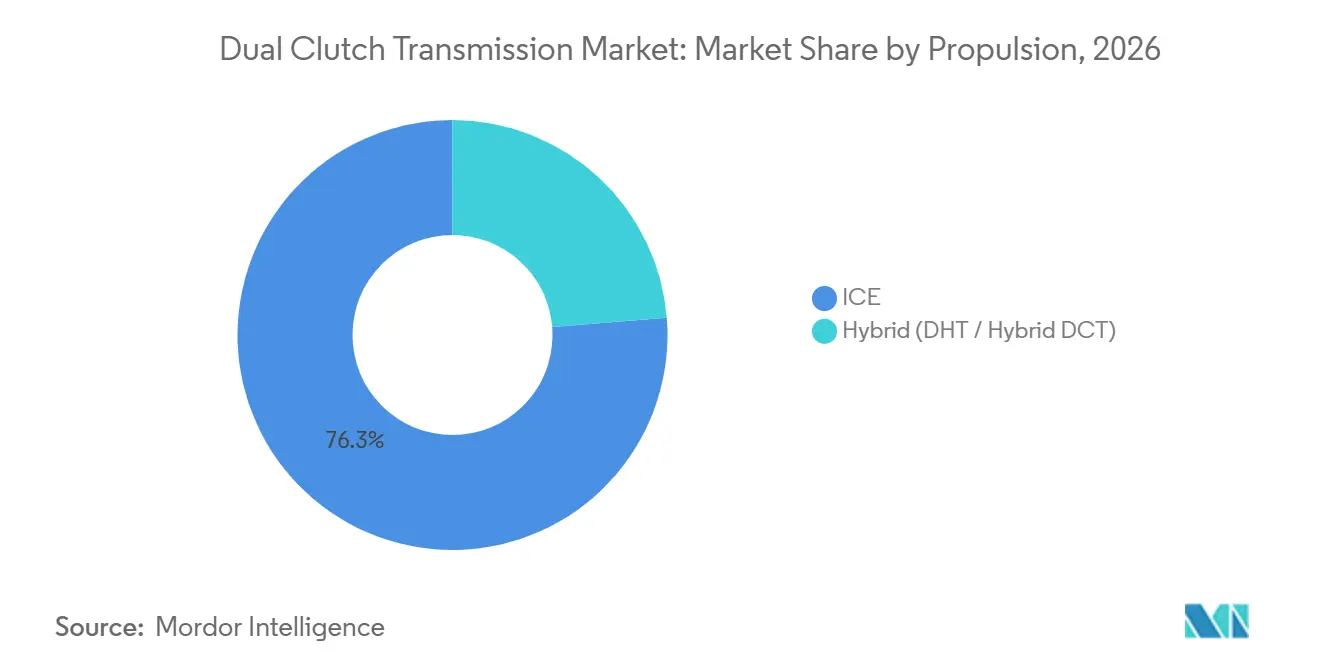
ICE held 76.27% of the dual clutch transmission market share in 2026, while hybrid DHT/hybrid DCT is expected to grow at an 8.07% CAGR through 2032. Internal-combustion vehicles continue to provide a large production base for conventional DCT systems. Many vehicle platforms remain in service because manufacturers need affordable models for varied markets. This existing base supports continuing demand for established transmission designs. The dual clutch transmission market still relies on ICE vehicles for a substantial part of its current volume.
Hybrid applications are forecast to grow faster because they retain a role for the transmission while adding electric drive capability. A dedicated hybrid transmission must manage several power sources without compromising drivability. This creates demand for integrated engineering, including motor packaging, hydraulic control, and software. It also gives suppliers a route to remain relevant as vehicle fleets become more electrified. The market has a clear reason to invest in hybrid-specific systems while maintaining support for conventional programs.

By Sales Channel: OEM Supply Remains Central to Program Success
OEM held 88.63% of the dual clutch transmission market share in 2026 and is projected to grow at a 4.74% CAGR through 2032. DCTs are designed into a vehicle platform long before the vehicle reaches a dealership. Their hardware, software, and cooling arrangements must match the engine and the rest of the powertrain. This makes original-equipment supply the principal route to volume. The market depends on long-term development agreements and dependable production execution.
The aftermarket has a different role because it supports vehicles after the original warranty period. Demand can include clutch modules, flywheels, control components, diagnostic tools, and trained repair work. Schaeffler has introduced a combined repair solution for selected double-clutch applications, indicating the value of matched replacement parts in service work. Independent workshops need clear procedures and reliable component compatibility to deliver consistent repairs. The aftermarket gives the dual clutch transmission market a longer commercial relationship with the installed vehicle base.
Geography Analysis
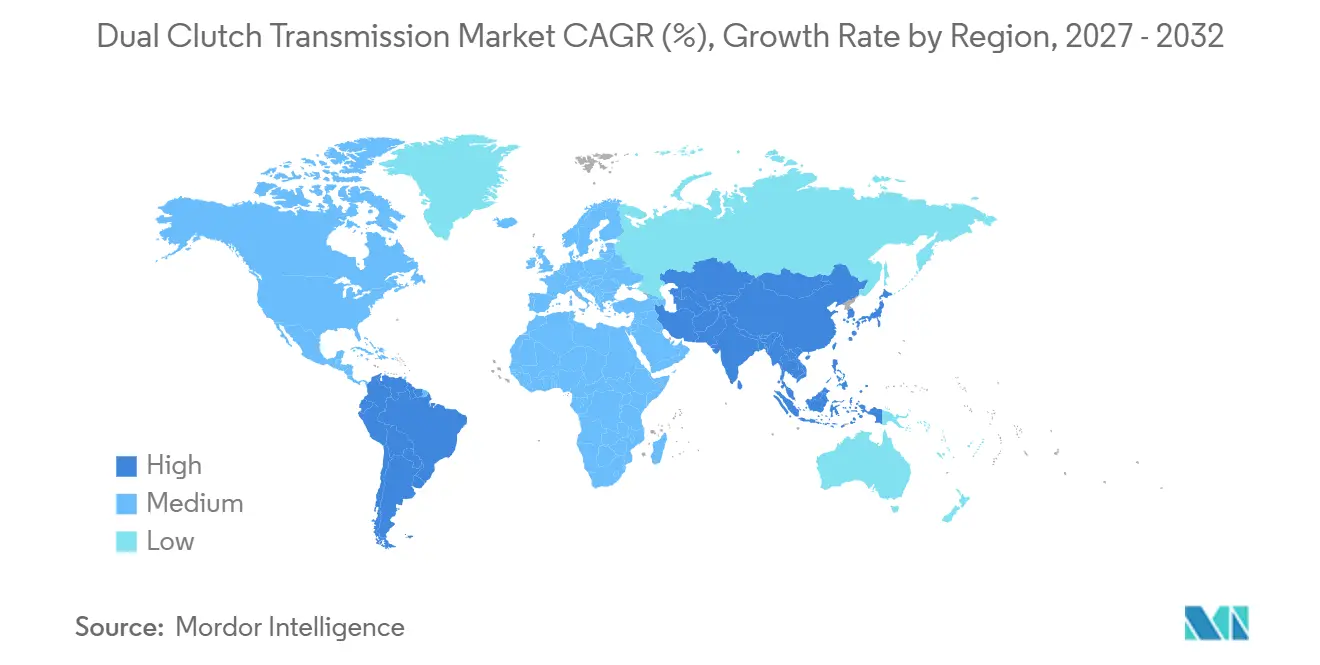
Asia-Pacific held 52.18% of the dual clutch transmission market share in 2026 and is forecast to grow at a 5.33% CAGR through 2032. China is a key center because it combines large-scale vehicle manufacturing with rapid hybrid product development. Local manufacturers and global suppliers are investing in systems that can serve combustion, mild-hybrid, and dedicated-hybrid vehicle programs. Regional production also supports shorter lead times for vehicle plants and closer collaboration on transmission calibration. India is becoming a complementary location as local assembly and component capability develop for passenger-vehicle powertrains.
Europe remains important because fleet emissions rules influence powertrain choices across the region. The European Commission’s passenger-car CO2 framework continues to make efficient hybrid vehicle designs relevant to compliance planning. Manufacturers in the region are managing battery-electric investments while also maintaining hybrid offerings for drivers who need familiar refueling patterns. This supports demand for eDCT and other hybrid-ready transmission systems. Stellantis has taken full control of eDCT production activities in France and Italy, which shows how manufacturers can bring strategic transmission capability closer to their own product plans.
North America has a mixed powertrain environment in which hybrid models remain relevant for consumers seeking fuel savings without relying entirely on public charging. This can support DCT opportunities where manufacturers choose hybrid transmission layouts for new vehicle programs. South America may benefit as vehicle production develops and manufacturers seek efficient systems that suit local cost conditions. The Middle East and Africa face a different constraint because specialist repair capability is concentrated in a smaller number of automotive centers. The dual clutch transmission market will depend on localized engineering, manufacturing, and service support rather than a uniform global demand pattern.
Competitive Landscape
The dual clutch transmission market has a moderate market concentration score because the leading suppliers have meaningful positions, but no single supplier has a decisive disclosed share. BorgWarner, Schaeffler, ZF Friedrichshafen, Magna International, and Aisin are among the established participants. Competition is moving beyond individual mechanical parts toward integrated transmission systems. Suppliers are expected to combine clutches, gears, hydraulic control, electronics, and calibration support. This favors companies with deep vehicle-program relationships and the ability to validate complete systems.
BorgWarner has continued to support DCT programs in China, reflecting the importance of the region’s vehicle manufacturing base and supplier localization. Schaeffler’s repair offering for double-clutch vehicles demonstrates a parallel focus on the vehicle parc and the independent service chain[2]. Stellantis’s decision to take full control of its eDCT production activities illustrates another competitive pressure, which is the willingness of vehicle makers to bring selected transmission capabilities inside their own operations[3]. These actions show that suppliers must compete on system knowledge, service support, and production reliability, not only on component cost. The dual clutch transmission market is also affected by how much technical control a vehicle manufacturer wishes to retain.
Software and calibration are increasingly important competitive factors. Strong shift quality can reduce customer complaints and limit warranty exposure, especially in low-speed traffic. Suppliers that can support updates, diagnostics, and functional-safety work may have an advantage during vehicle development. At the same time, vehicle manufacturers may use internal engineering or joint development to retain control over the powertrain experience. New entrants must demonstrate mechanical durability and electronic competence before they can win major programs. The dual clutch transmission market is therefore competitive, but entry remains difficult where vehicle manufacturers require proven performance across the full life of a model.
Dual Clutch Transmission Industry Leaders
-
BorgWarner Inc.
-
Schaeffler AG
-
ZF Friedrichshafen AG
-
Magna International Inc.
-
Aisin Corporation
- *Disclaimer: Major Players sorted in no particular order

Recent Industry Developments
- October 2026: Hyundai Transys announced an investment of approximately USD 560 million in Georgia, US. The plan includes upgrading two existing plants and building a new facility in West Point to expand hybrid powertrain production, creating approximately 320 jobs.
- September 2026: Kia India added turbo-petrol DCT and diesel automatic variants to more affordable trims of the Carens Clavis, starting at INR 14.67 lakh (~USD 17,580).
- September 2026: Kia India launched the Sorento three-row SUV with a 2.2-liter diesel engine paired with an 8-speed dual-clutch transmission.
- August 2026: BMW India launched the locally produced X1 Long Wheelbase at its Chennai plant, featuring a 156 hp petrol engine and a 7-speed dual-clutch transmission, with bookings open from August 21, 2026.
Global Dual Clutch Transmission Market Report Scope
The Dual Clutch Transmission (DCT) Market is segmented by Clutch Type, Number of Gears, Component, Vehicle Type, Propulsion, Sales Channel, and Geography. By Clutch Type, the market is segmented into Wet DCT and Dry DCT. By Number of Gears, the market is segmented into 6-Speed, 7-Speed, and 8-Speed and Above. By Component, the market is segmented into Clutch Module, Mechatronics / TCU, Gear Sets, and Actuators. By Vehicle Type, the market is segmented into Passenger Cars, Light Commercial Vehicles, and Other Commercial Vehicles. By Propulsion, the market is segmented into ICE and Hybrid (DHT / Hybrid DCT). By Sales Channel, the market is segmented into OEM and Aftermarket. By Geography, the market is segmented into North America (United States, Canada, and Mexico), Europe (Germany, France, Italy, Spain, United Kingdom, Russia, and Rest of Europe), Asia-Pacific (China, Japan, India, South Korea, Thailand, and Rest of Asia-Pacific), South America (Brazil, Argentina, and Rest of South America), and Middle East and Africa (United Arab Emirates, Saudi Arabia, Qatar, Turkey, South Africa, and Rest of Middle East and Africa). Market forecasts are provided in terms of Value (USD) and Volume (Units).
| Wet DCT |
| Dry DCT |
| 6-Speed |
| 7-Speed |
| 8-Speed and Above |
| Clutch Module |
| Mechatronics / TCU |
| Gear Sets |
| Actuators |
| Passenger Cars |
| Light Commercial Vehicles |
| Other Commercial Vehicles |
| ICE |
| Hybrid (DHT / Hybrid DCT) |
| OEM |
| Aftermarket |
| North America | United States |
| Canada | |
| Mexico | |
| Europe | Germany |
| France | |
| Italy | |
| Spain | |
| United Kingdom | |
| Russia | |
| Rest of Europe | |
| Asia-Pacific | China |
| Japan | |
| India | |
| South Korea | |
| Thailand | |
| Rest of Asia-Pacific | |
| South America | Brazil |
| Argentina | |
| Rest of South America | |
| Middle East and Africa | United Arab Emirates |
| Saudi Arabia | |
| Qatar | |
| Turkey | |
| South Africa | |
| Rest of Middle East and Africa |
| By Clutch Type | Wet DCT | |
| Dry DCT | ||
| By Number of Gears | 6-Speed | |
| 7-Speed | ||
| 8-Speed and Above | ||
| By Component | Clutch Module | |
| Mechatronics / TCU | ||
| Gear Sets | ||
| Actuators | ||
| By Vehicle Type | Passenger Cars | |
| Light Commercial Vehicles | ||
| Other Commercial Vehicles | ||
| By Propulsion | ICE | |
| Hybrid (DHT / Hybrid DCT) | ||
| By Sales Channel | OEM | |
| Aftermarket | ||
| By Geography | North America | United States |
| Canada | ||
| Mexico | ||
| Europe | Germany | |
| France | ||
| Italy | ||
| Spain | ||
| United Kingdom | ||
| Russia | ||
| Rest of Europe | ||
| Asia-Pacific | China | |
| Japan | ||
| India | ||
| South Korea | ||
| Thailand | ||
| Rest of Asia-Pacific | ||
| South America | Brazil | |
| Argentina | ||
| Rest of South America | ||
| Middle East and Africa | United Arab Emirates | |
| Saudi Arabia | ||
| Qatar | ||
| Turkey | ||
| South Africa | ||
| Rest of Middle East and Africa | ||
Key Questions Answered in the Report
What is driving demand for dual clutch transmissions?
Hybrid vehicle programs, fuel-efficiency requirements, and demand for responsive passenger-car powertrains are supporting adoption. Vehicle makers also value systems that can be adapted across related models, regional specifications, and different levels of hybrid content.
How large is the dual clutch transmission market?
It is projected to grow from USD 22.78 billion in 2027 to USD 28.35 billion by 2032, at a 4.47% CAGR. These figures reflect the forecast period from 2027 to 2032, when hybrid vehicle programs and continuing passenger-car production support demand.
Which clutch design leads dual clutch transmission demand?
Wet DCT led with 58.27% share in 2026 and is projected to grow at a 5.08% CAGR through 2032. Its thermal control supports hybrid-ready vehicle applications that face frequent clutch engagement in traffic and varied daily operating conditions.
Why are hybrid DCT systems forecast to grow faster than ICE systems?
Hybrid designs retain a transmission role while integrating electric drive, which supports vehicle efficiency and flexible power delivery. They require coordinated mechanical and software design, including careful integration of clutches, electric motors, hydraulic functions, and vehicle controls.