
Dry Ramming Mass Market Size and Share
Market Overview
| Study Period | 2022 - 2032 |
|---|---|
| Market Size (2027) | USD 3.03 Billion |
| Market Size (2032) | USD 4.18 Billion |
| Growth Rate (2027 - 2032) | 6.67 % |
| Fastest Growing Market | Asia-Pacific |
| Largest Market | Asia-Pacific |
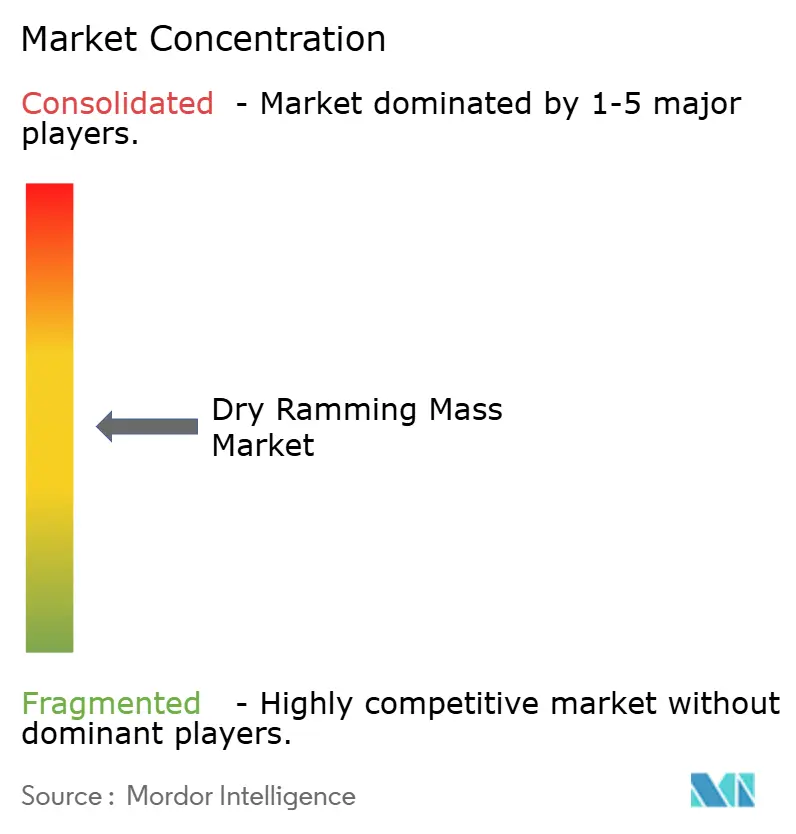
| Market Concentration | Medium |
Major Players *Disclaimer: Major Players sorted in no particular order Image © Mordor Intelligence. Reuse requires attribution under CC BY 4.0. | |
Dry Ramming Mass Market Analysis by Mordor Intelligence
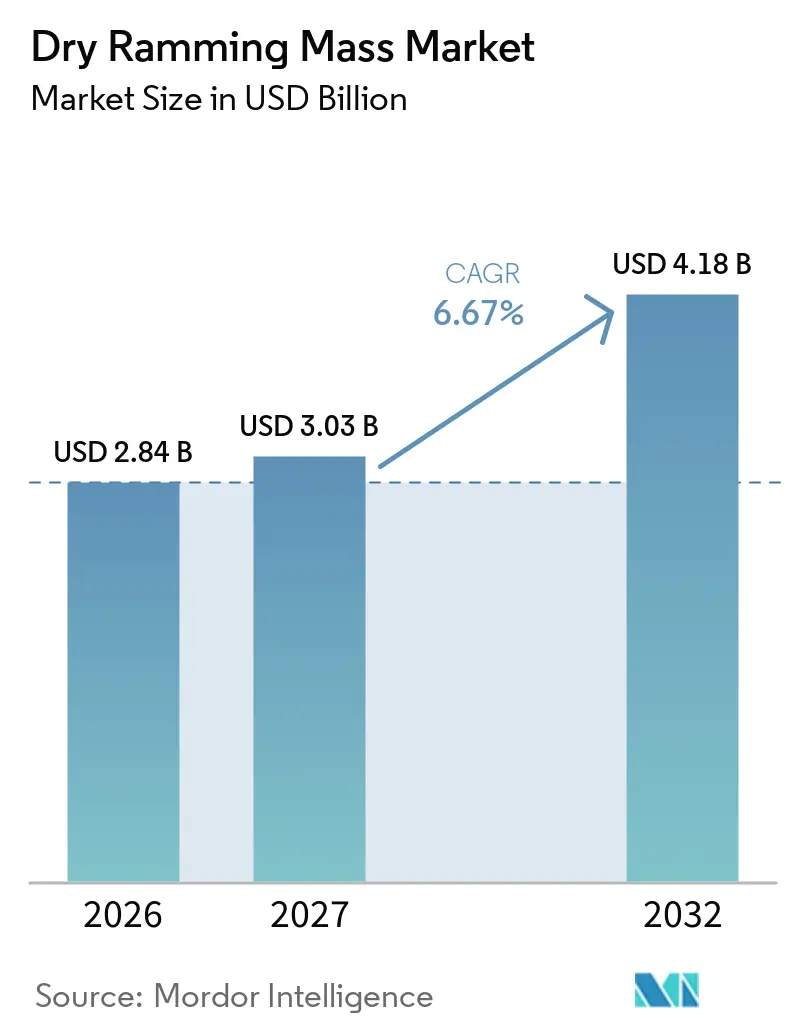
The Dry Ramming Mass Market size was valued at USD 2.84 billion in 2026 and is estimated to grow from USD 3.03 billion in 2027 to USD 4.18 billion by 2032, at a CAGR of 6.67% during the forecast period (2027-2032). The dry ramming mass market is supported by its role as a furnace-lining consumable in steelmaking, foundries, and non-ferrous smelting. Dry installation allows the material to sinter at operating temperatures, creating a dense, seamless lining without adding water. This installation method reduces downtime, which is a priority for operators facing higher energy and operating costs. Capacity expansion, furnace upgrades, and tighter operating cycles are increasing demand for reliable linings across the dry ramming mass market. Suppliers are responding with higher-performance formulations and service models that focus on campaign life, installation quality, and total operating cost.
Key Report Takeaways
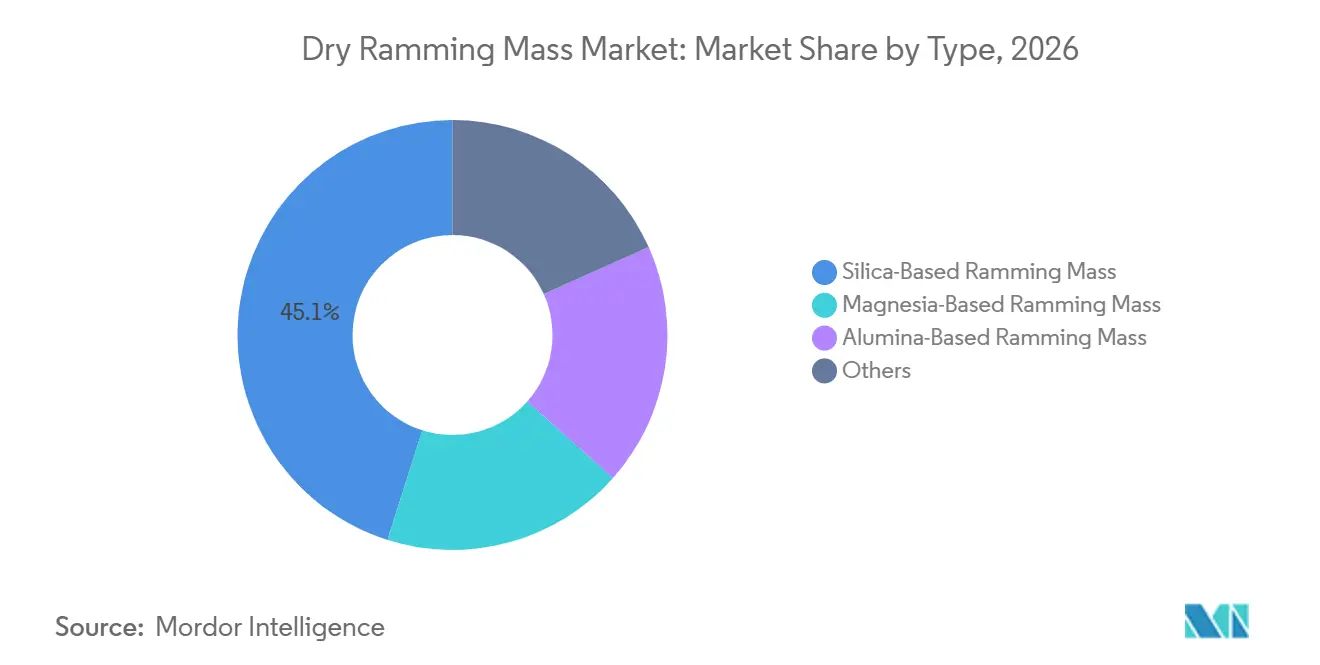
- By type, Silica-Based Ramming Mass held 45.12% of the Dry Ramming Mass Market share in 2026, while Magnesia-Based Ramming Mass is forecast to grow at a CAGR of 6.98% through 2032.
- By function, Lining accounted for 60.34% of the Dry Ramming Mass Market share in 2026 and is projected to expand at a CAGR of 7.14% through 2032.
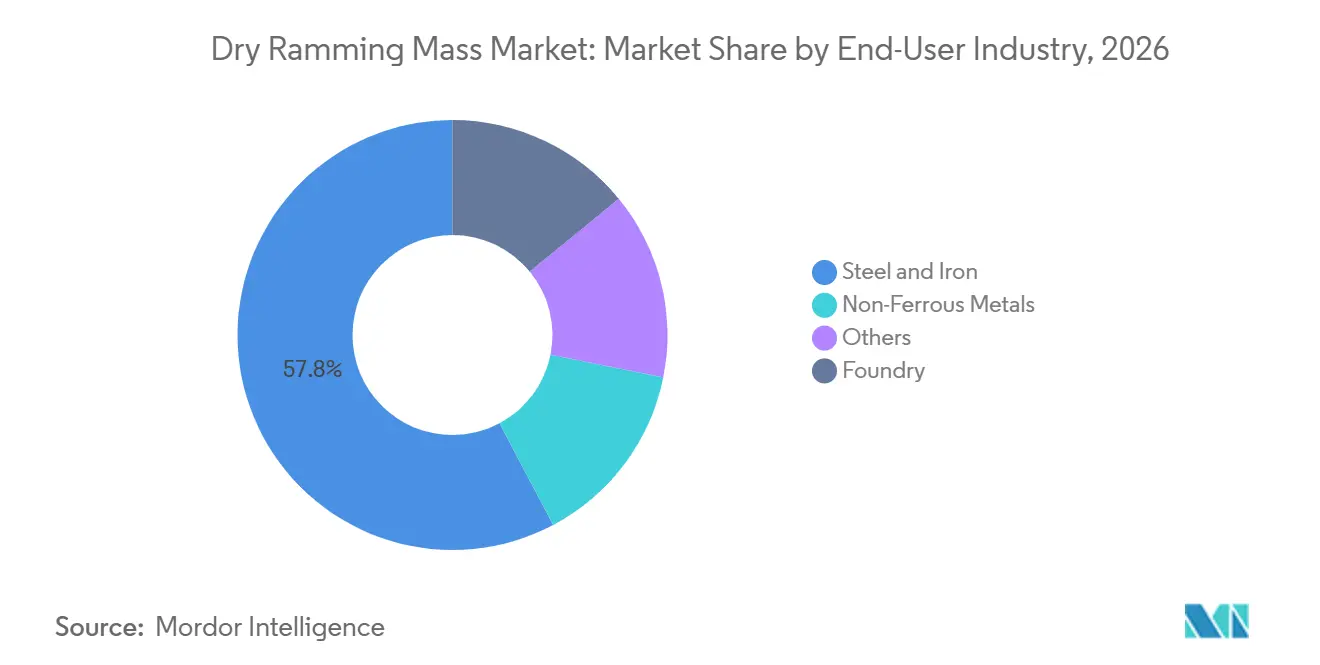
- By end-user industry, Steel and Iron captured 57.77% of the Dry Ramming Mass Market share in 2026, while Non-Ferrous Metals are forecast to grow at a CAGR of 7.45% through 2032.
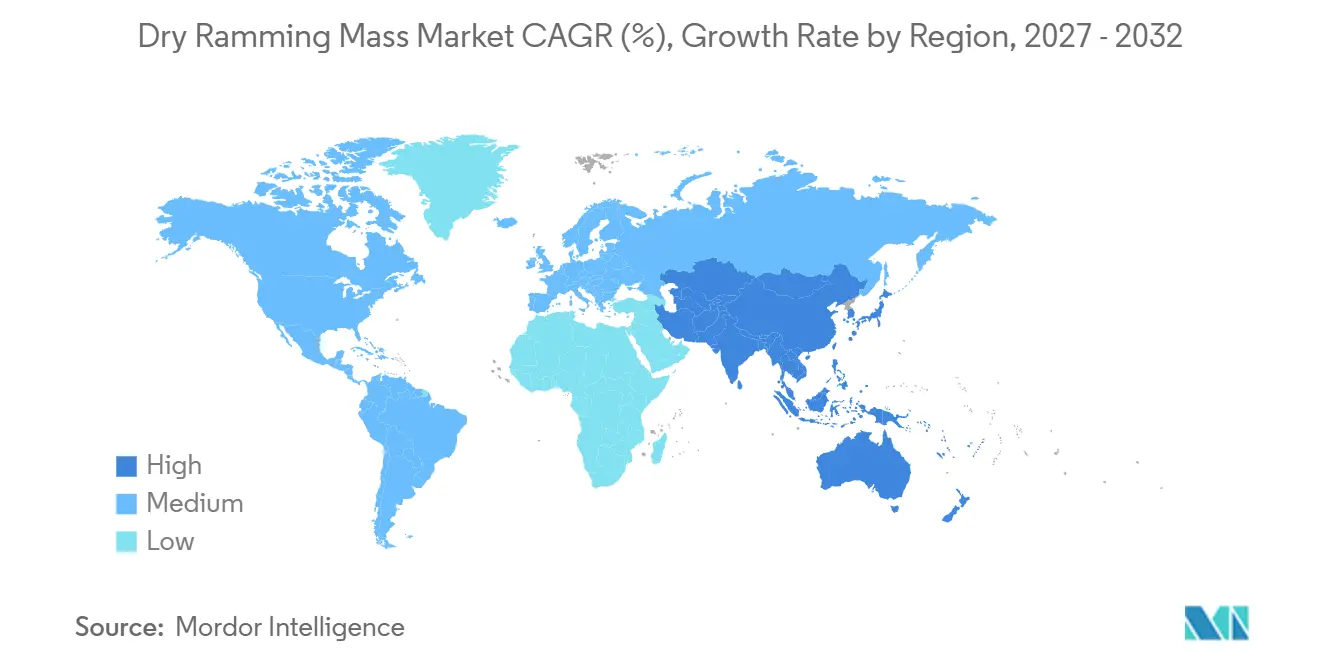
- By geography, Asia-Pacific commanded 47.29% of the Dry Ramming Mass Market share in 2026 and is forecast to advance at a CAGR of 7.33% through 2032.
Note: Market numbers in this report are based on Mordor Intelligence's proprietary estimation framework, which combines nine months of actuals with Q4 projections for base year 2026.
Market Trends and Insights
Drivers Impact Analysis of Dry Ramming Mass Market*
| Drivers | (~) % Impact on CAGR Forecast | Geographic Relevance | Impact Timeline |
|---|---|---|---|
| Steel and Foundry Furnace Expansion | +2.4% | Global, with Asia-Pacific at the core, including India, China, and Southeast Asia, with spillover to the Middle East and Africa | Medium term (2-4 years) |
| Energy-Efficient, Lower-Downtime Furnace Relining | +1.3% | Global, with rapid adoption in North America, Europe, and Japan | Short term (≤ 2 years) |
| Magnesia-Based Mix Adoption in Aggressive Slag Service | +1.0% | Asia-Pacific at the core and spillover into the Middle East and Africa | Medium term (2-4 years) |
| Induction Furnace Density in Secondary Metal Production | +1.4% | South Asia, ASEAN, and South America | Medium term (2-4 years) |
| Furnace-Capacity-Specific Premix Formulations | +0.7% | North America, Europe, and Japan | Long term (≥ 4 years) |
| Source: Mordor Intelligence | |||
Steel and Foundry Furnace Expansion
India and Southeast Asia are significant sources of steel-related demand for the dry ramming mass market during the forecast period. India's crude steel capacity reached 200.33 million tons per annum in fiscal year 2024-25, up from 161.3 million tons per annum in 2022-23, requiring additional furnace linings as capacity was commissioned[1]. The National Steel Policy 2017 targets 300 million tons per annum of crude steel capacity by 2030, creating a sustained pipeline for furnace-lining demand. Vietnam produced 24.7 million tons of crude steel in 2025, an increase of 12.2% from the prior year. Capacity additions in these markets often include mid-sized electric furnaces rather than only integrated blast-furnace and basic-oxygen-furnace plants. This equipment mix supports demand for dry linings because furnace campaigns require both initial installations and recurring replacements.
India's expanding steel capacity also broadens the customer base beyond the largest integrated producers. New plants and secondary steel clusters require a dependable refractory supply when furnaces enter service. This requirement places value on regional production, technical support, and the ability to supply materials without long lead times. The dry ramming mass market benefits because the material is used at the start of a furnace campaign and again when the lining reaches the end of its service period. Higher furnace availability makes replacement timing more important for operators. Suppliers that can support commissioning and subsequent relining work can strengthen their position as capacity expands.
Energy-Efficient, Lower-Downtime Furnace Relining
Furnace operators increasingly assess refractory linings through total cost per ton of metal produced rather than installed material cost alone. This assessment includes relining downtime, energy used during dry-out, and lining campaign length. The result is a stronger demand for fast-sintering formulations that can remain in service for longer periods. Calderys launched its CALDE FD cement-bonded castable range in January 2025 to accelerate dry-out and reduce downtime. In the dry ramming mass market, this purchasing approach favors products that help customers return furnaces to service quickly. It also reduces the advantage held by lower-priced products when they cannot provide comparable operating reliability.
The service life of a lining directly affects a plant's production schedule. A longer campaign can reduce the number of shutdowns and give operators greater certainty over maintenance planning. Faster dry-out also matters where a plant must complete relining work within a limited outage period. These factors shift purchasing decisions toward performance during use rather than price at delivery. The dry ramming mass market, therefore, has room for suppliers that can demonstrate consistent sintering and effective installation support. This is especially relevant in premium applications where a failed lining can disrupt production and create higher operating costs.
Magnesia-Based Mix Adoption in Aggressive Slag Service
Magnesia-based dry ramming mass is gaining use in coreless induction furnaces that melt high-manganese alloys, stainless steel, and high-chromium grades. These applications expose linings to basic slags, which can degrade silica-based materials more quickly. Magnesia remains compatible with basic slag chemistry at temperatures above 1,600 degrees Celsius, making it suitable for demanding furnace conditions and supporting longer lining campaigns. The dry ramming mass market is therefore shifting toward more engineered formulations in applications with aggressive slag service. This shift reflects operating conditions rather than a broad replacement of silica products across all furnace types.
Raw material sourcing affects the economics of these formulations. The European Commission imposed a provisional anti-dumping duty on imports of fused alumina from China in July 2025. This measure changes sourcing decisions for alumina-based variants in Europe and may favor suppliers that can secure alternative raw material supply. It also adds to the importance of formulation design and procurement discipline. Higher-value blends can be more resilient where customers face high switching costs and need dependable furnace performance. The dry ramming mass market can benefit when suppliers combine material availability with formulations suited to specific furnace conditions.
Induction Furnace Density in Secondary Metal Production
Coreless induction furnaces are widely used in secondary steelmaking clusters across India, Southeast Asia, and South America. Their growth supports demand for dry ramming mass, as every furnace campaign requires a working lining. India's secondary steel route accounted for a substantial portion of national crude steel output in fiscal year 2024-25. The installation base is spread among many small and medium producers rather than a limited number of large integrated plants. This creates a large but dispersed customer base for the dry ramming mass market, where supply reliability and local technical assistance can matter as much as purchase price.
The regional spread of induction furnace operators shapes competition. Smaller operators often require frequent deliveries and support during installation because a lengthy interruption can affect their production schedule. This supports regional specialists located near steel and foundry clusters. Global suppliers also have opportunities to offer advanced formulations with practical on-site support. Demand is recurring because the material is consumed as lining campaigns are completed. The dry ramming mass market can therefore grow through both new furnace commissioning and the regular replacement cycle of existing equipment.
Restraints Impact Analysis of Dry Ramming Mass Market*
| Restraints | (~) % Impact on CAGR Forecast | Geographic Relevance | Impact Timeline |
|---|---|---|---|
| Silica, Magnesia, and Alumina Raw-Material Volatility | -1.0% | Global, with the strongest effect in Europe and import-dependent Asia-Pacific markets | Short term (≤ 2 years) |
| Energy- and Carbon-Intensive Mineral Processing | -0.6% | European Union, Japan, South Korea, and growing pressure in China | Medium term (2-4 years) |
| Installation Quality Dependence and Operator Skill Gaps | -0.4% | South Asia, Southeast Asia, the Middle East, and Africa | Medium term (2-4 years) |
| Source: Mordor Intelligence | |||
Silica, Magnesia, and Alumina Raw-Material Volatility
Raw-material cost movements are an immediate restraint on the market, as silica, dead-burned magnesia, and calcined alumina each follow separate price cycles. Their costs are influenced by energy prices, mining policy, and regional logistics, making it difficult for mid-sized producers to protect margins when input costs rise faster than selling prices. Producers with access to mineral resources or established supply arrangements are better positioned to manage this exposure. The dry ramming mass market remains dependent on these minerals, as they determine the performance and cost profile of the main product types. Input uncertainty is particularly relevant in import-dependent markets with limited local access to refractory-grade raw materials.
The European Commission's measures on fused alumina introduce an additional source of cost uncertainty for European producers that use China-sourced alumina. These measures can alter sourcing patterns for mixed formulations and require suppliers to qualify alternative inputs, a process that takes time, given customer expectations for consistent furnace performance. The impact is more significant for producers that lack backward integration or purchasing scale, and it may also widen the price gap between basic products and engineered blends. The dry ramming mass market must therefore balance raw-material flexibility with stable product quality.
Energy- and Carbon-Intensive Mineral Processing
The production of dead-burned magnesia and fused alumina involves energy-intensive mineral processing, which faces increasing scrutiny as carbon pricing and industrial decarbonization policies expand. The European Union's Carbon Border Adjustment Mechanism entered its definitive phase in January 2026, and its application to imported steel and aluminum increases cost pressures across supply chains serving those sectors. The dry ramming mass market is affected because steel and aluminum producers face closer scrutiny of energy and carbon costs, requiring suppliers to demonstrate that improved lining performance can support longer campaigns and lower energy use during operations.
In late 2025, the European Commission proposed a Temporary Decarbonization Fund for energy-intensive industries at risk of carbon leakage, reflecting the challenge of reducing emissions from mineral processing while remaining cost-competitive. In China, the inclusion of steel in the National Carbon Emissions Trading System in 2025 adds operational pressure on steel producers, which can limit maintenance budgets at some plants, even though reliable linings remain essential for safe furnace operations. Under these conditions, demand does not disappear, but expenditure tends to shift toward products with clearly demonstrated operating value. The dry ramming mass market is therefore influenced by both material production costs and the capital discipline of its end users.
*Our forecasts treat driver/restraint impacts as directional, not additive. The impact forecasts reflect baseline growth, mix effects, and variable interactions.
Dry Ramming Mass Market Segment Analysis
By Type:
Magnesia Mixes Gaining Ground on Silica’s StrongholdMagnesia-Based Ramming Mass is projected to grow at a CAGR of 6.98% from 2027 to 2032, making it the fastest-growing type segment. Its use is linked to slag resistance and longer campaign life in coreless induction furnaces and basic oxygen furnace applications. Magnesia maintains structural integrity at temperatures above 1,650 degrees Celsius and resists chemical attack from calcium oxide and manganese oxide-rich slags. This performance is relevant for high-manganese alloys, stainless steel, and high-chromium steel grades. Alumina-Based Ramming Mass has a specialized role in aluminum melting and high-chromium steel applications, while the Others category includes alumina-zirconia-silica blends used in glass tank applications.
The Dry Ramming Mass Market size for magnesia-based products is supported by furnace operators who need material suited to basic slag conditions. The July 2025 European Union duty on fused alumina from China is changing sourcing decisions for alumina-based products. Silica-Based Ramming Mass held 45.12% of the Dry Ramming Mass Market share in 2026 due to its cost advantage, broad availability of raw materials, and established role in acid-service induction furnaces producing carbon and mild steel grades. Imerys extended its Glomel, France, andalusite quarry to 2044 in June 2025, maintaining output at 60,000 tons per year. The product mix is becoming more closely aligned with alloy mix, slag chemistry, operating temperature, and service environment.

By Function:
Lining Operations Drive the Bulk of DemandLining accounted for 60.34% of the Dry Ramming Mass Market share in 2026 and is forecast to expand at a CAGR of 7.14% through 2032. Its large share reflects the requirement for a full working lining before the first furnace heat. Induction furnaces, electric arc furnaces, and foundry crucibles require this initial lining, while replacement cycles drive repeated consumption as the material wears out. Alloy composition, operating temperature, and slag chemistry influence the number of heats achieved. New capacity in South Asia and Southeast Asia adds furnaces that require initial installation and subsequent replacement.
Calderys commissioned new production lines in Odisha, India, and advanced its six-line CAPES facility in 2025. Vesuvius launched its VARG, or Vesuvius Advanced Robotic Gunning, system for basic oxygen furnaces and electric arc furnaces in 2025. The system demonstrates how repair and patching can be incorporated into managed service offerings. The Dry Ramming Mass Market can benefit as operators shift from reactive repairs toward planned maintenance and measured lining performance.
By End-User Industry:
Non-Ferrous Demand Builds Alongside Steel’s LeadNon-Ferrous Metals is projected to grow at a CAGR of 7.45% from 2027 to 2032, the highest rate among end-user segments. Demand comes from induction and resistance furnaces used to recycle aluminum, copper, and specialty metals in China, India, and Southeast Asia. Larger integrated recyclers are standardizing refractory procurement, creating opportunities for suppliers that can provide consistent technical support. The Dry Ramming Mass Market size for non-ferrous applications is supported by the recurring need to replace worn linings. Product design must match the thermal and chemical conditions of each metal process.
Steel and Iron captured 57.77% of the Dry Ramming Mass Market share in 2026 because steel furnace campaigns consume substantial output relative to other metal applications. Foundry operations are the second-largest user category and serve ferrous and non-ferrous casting requirements in automotive, heavy machinery, and infrastructure. Vesuvius reported double-digit growth in its Foundry Division in India during 2025. Large plants may use performance-based service contracts, while smaller operators may prioritize local supply and rapid delivery. The Others category includes cement kilns, glass tanks, and petrochemical reactors that use specialized monolithic applications with dry installation and in-service sintering.
Geography Analysis
Asia-Pacific held 47.29% of the dry ramming mass market share in 2026 and is forecast to grow at a CAGR of 7.33% from 2027 to 2032. China and India account for the largest share of regional demand. China produced 960.8 million tons of crude steel in 2025, supporting substantial replacement demand across integrated and electric steelmaking facilities. India increased crude steel capacity from 179.5 million tons per annum in 2023-24 to 200.3 million tons per annum in 2024-25. The country is progressing toward its 300 million tons per annum target by 2030, which supports new furnace commissioning and recurring lining requirements.
Vietnam produced 24.7 million tons of crude steel in 2025, while Indonesia produced 19.0 million tons. Japan and South Korea generate demand for premium magnesia-based materials in specialty steel and non-ferrous smelting. China's Steel Industry Specifications, 2025 Edition, require the completion of ultra-low-emission transformation by 2026. North America and Europe are mature markets where growth depends more on relining upgrades and product performance than on large-scale deployment of new furnaces. The United States produced 82.0 million tons of crude steel in 2025, a 3.1% increase from the prior year.
South America, the Middle East, and Africa represent smaller but distinct opportunity areas. Brazil produced 33.3 million tons of crude steel in 2025 and has major magnesite operations in Brumado, Bahia. RHI Magnesita commissioned a 200-meter rotary kiln there as part of BRL 541 million (~USD 100.73 million) in recent investment[2]. Saudi Arabia produced 10.8 million tons of steel in 2025, an increase of 12.3%. Calderys partnered with Binzagr in November 2025 to build a refractory facility in Jubail. These developments support local access to refractory products as metal production expands.
Competitive Landscape
The Dry Ramming Mass Market is moderately fragmented, with RHI Magnesita, Vesuvius (including Foseco), Saint-Gobain, Calderys, and Imerys holding significant positions through proprietary formulations, mineral access, and service offerings. Their positions are constrained by regional specialists in India and China who serve secondary steel clusters. Large suppliers compete on product performance, lifecycle service, and access to raw materials, while regional suppliers compete on cost, delivery speed, and proximity to customers. This structure produces a competitive environment in which no single approach is suitable across all applications.
In its 2025 annual report, RHI Magnesita stated that it strengthened its 4PRO performance-based contracts and planned to execute more than 30 additional extensive contracts in 2026. The company also completed the acquisition of Resco Products in January 2025 to expand its North American supply position. Calderys expanded its CAPES facility in India during 2025, including the commissioning of a basic monolithics line. These moves indicate that global suppliers are investing in service capabilities and production capacity near centers of growing demand, and are seeking to integrate into customers' operating models rather than function solely as material vendors.
Indian suppliers, including Dalmia Bharat Refractories, Gita Refractories, Imperial World Trade, Vishva Vishal Refractory, and REFCAST Corporation, serve secondary steel and induction furnace clusters. Their customer relationships depend on practical supply coverage and responsive delivery. Premium magnesia-based products with technical installation support can occupy a position between commodity supply and full-scale multinational service models. Digital sintering monitoring and robotic installation can support differentiation for suppliers serving sophisticated steel and non-ferrous customers. The Dry Ramming Mass Market remains competitive because the customer base includes both large integrated producers and dispersed induction furnace operators.
Dry Ramming Mass Industry Leaders
-
Vesuvius
-
Calderys
-
Saint-Gobain
-
RHI Magnesita
-
Morgan Advanced Materials
- *Disclaimer: Major Players sorted in no particular order
Dry Ramming Mass Market Companies Covered in this Report
- Calderys
- Casco Specialty Products, Inc.
- Dalmia Bharat Refractories Limited
- Dense Refractories Co.,Ltd.
- Foseco
- Gita Refratories (P) Ltd.
- Imerys
- Imperial World Trade Pvt. Ltd.
- Morgan Advanced Materials
- REFCAST CORPORATION
- RHI Magnesita
- Saint-Gobain
- Shenghe Refractories
- Vesuvius
- Vishva Vishal Refractory Limited
Recent Industry Developments in Dry Ramming Mass Market
- September 2026: Raghav Productivity Enhancers Ltd (RPEL) announced a joint venture with TRL Krosaki Refractories (backed by Krosaki Harima Corporation and Nippon Steel Corporation, Japan) to build a 350,000 Metric Tons Per Annum (MTPA) silica dry ramming mass facility in Odisha, India, with an initial investment of approximately INR 100 crore (~USD 12 million).
- November 2025: Calderys and Binzagr announced a partnership to establish a 16,300 square-meter monolithic refractory production facility in Jubail, Saudi Arabia, with production commencing in April 2026. The plant serves the Saudi Arabian refractory market, the largest in the Middle East, with dense and lightweight castables and precast lances.
Global Dry Ramming Mass Market Report Scope
Dry Ramming Mass is a dry, unshaped refractory material made from crushed granular aggregates, such as silica, magnesite, or alumina, blended with a small amount of a chemical binder like boric acid.
The dry ramming mass market is segmented by type, function, end-user industry, and geography. By type, the market is segmented into silica-based ramming mass, magnesia-based ramming mass, alumina-based ramming mass, and others. By function, the market is segmented into lining, patching, repairing, and other functions. By end-user industry, the market is segmented into steel and iron, foundry, non-ferrous metals, and others. The report also covers market sizes and forecasts for the dry ramming mass across 15 countries in major regions. The market sizes and forecasts are provided in terms of value (USD).
Segmentation Overview
| Silica-Based Ramming Mass |
| Magnesia-Based Ramming Mass |
| Alumina-Based Ramming Mass |
| Others |
| Lining |
| Patching |
| Repairing |
| Other Functions |
| Steel and Iron |
| Foundry |
| Non-Ferrous Metals |
| Others |
| Asia-Pacific | China |
| India | |
| Japan | |
| South Korea | |
| ASEAN Countries | |
| Rest of Asia-Pacific | |
| North America | United States |
| Canada | |
| Mexico | |
| Europe | Germany |
| United Kingdom | |
| France | |
| Italy | |
| NORDIC Countries | |
| Rest of Europe | |
| South America | Brazil |
| Argentina | |
| Rest of South America | |
| Middle East and Africa | Saudi Arabia |
| South Africa | |
| Rest of Middle East and Africa |
| By Type | Silica-Based Ramming Mass | |
| Magnesia-Based Ramming Mass | ||
| Alumina-Based Ramming Mass | ||
| Others | ||
| By Function | Lining | |
| Patching | ||
| Repairing | ||
| Other Functions | ||
| By End-User Industry | Steel and Iron | |
| Foundry | ||
| Non-Ferrous Metals | ||
| Others | ||
| By Geography | Asia-Pacific | China |
| India | ||
| Japan | ||
| South Korea | ||
| ASEAN Countries | ||
| Rest of Asia-Pacific | ||
| North America | United States | |
| Canada | ||
| Mexico | ||
| Europe | Germany | |
| United Kingdom | ||
| France | ||
| Italy | ||
| NORDIC Countries | ||
| Rest of Europe | ||
| South America | Brazil | |
| Argentina | ||
| Rest of South America | ||
| Middle East and Africa | Saudi Arabia | |
| South Africa | ||
| Rest of Middle East and Africa | ||
Key Questions Answered in the Report
What is current market size of Dry Ramming Mass Market?
The Dry Ramming Mass Market size was valued at USD 2.84 billion in 2026 and is estimated to grow from USD 3.03 billion in 2027 to USD 4.18 billion by 2032, at a CAGR of 6.67% during the forecast period (2027-2032).
Which functional application drives demand for dry ramming mass?
Lining is the leading function, accounting for 60.34% of the market in 2026 and growing at a 7.14% CAGR through 2032.
Which end user has the largest demand for dry ramming mass?
Steel and iron are the largest end-user segments, holding a 57.77% share in 2026.
Which region leads demand for dry ramming mass?
Asia-Pacific leads with a 47.29% share in 2026 and has the fastest regional growth rate at a CAGR of 7.33% through 2032.