
Drone Thermal Inspection Market Size and Share
Market Overview
| Study Period | 2020 - 2031 |
|---|---|
| Market Size (2026) | USD 3.49 Billion |
| Market Size (2031) | USD 8.59 Billion |
| Growth Rate (2026 - 2031) | 19.74 % |
| Fastest Growing Market | Asia-Pacific |
| Largest Market | North America |
| Market Concentration | Medium |
Major Players *Disclaimer: Major Players sorted in no particular order Image © Mordor Intelligence. Reuse requires attribution under CC BY 4.0. | |
Drone Thermal Inspection Market Analysis by Mordor Intelligence
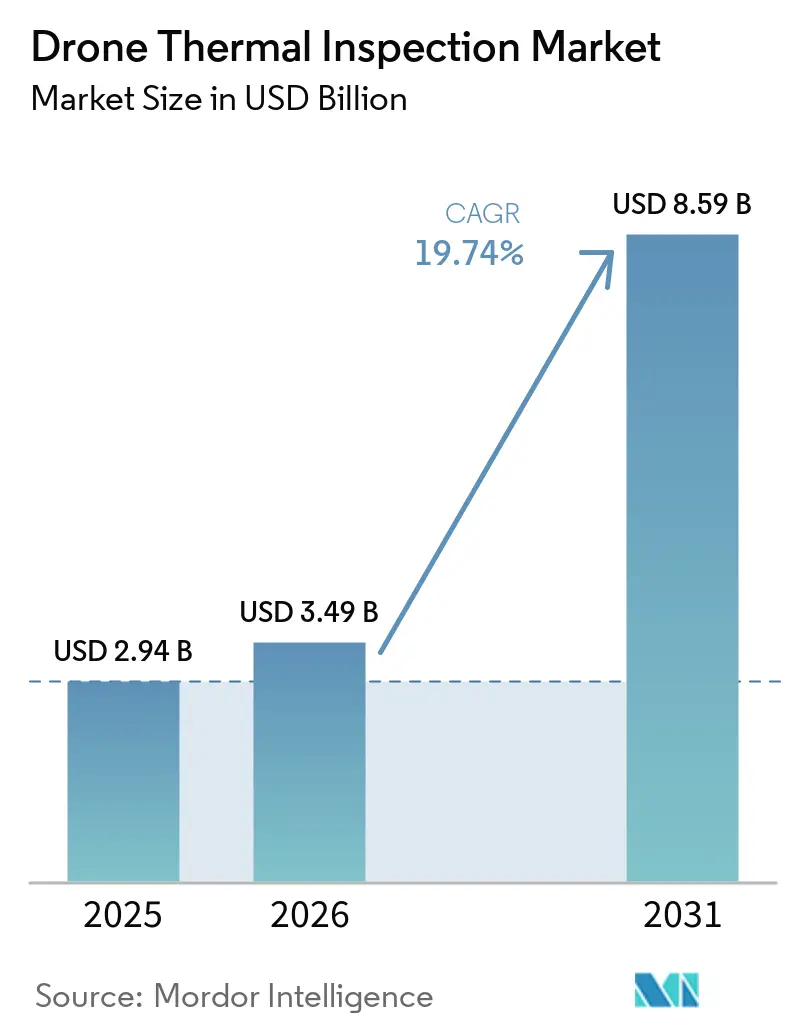
The drone thermal inspection market size was valued at USD 2.94 billion in 2025 and estimated to expand from USD 3.49 billion in 2026 to reach USD 8.59 billion by 2031, at a CAGR of 19.74% during the forecast period (2026-2031). Grid modernization programs are increasing the need for inspections across transmission, distribution, and substation assets. Renewable additions also require regular thermographic surveys for asset records, insurance, and warranty processes. Drone systems reduce the time needed to inspect difficult sites and produce repeatable condition data for maintenance teams. Autonomous docks, edge processing, and connected workflows can make frequent inspections more practical when skilled staff is limited. The drone thermal inspection market, therefore, benefits from both replacement demand for manual inspections and new demand from expanding energy infrastructure.
Key Report Takeaways
- By product type, multirotor drones held 58.47% revenue share in 2025 for the drone thermal inspection market, while hybrid VTOL drones are projected to expand at a 22.63% CAGR through 2031.
- By thermal payload type, radiometric thermal payloads accounted for 52.63% revenue share in 2025, while multisensor thermal payloads are projected to advance at a 22.87% CAGR through 2031.
- By range, short-range/VLOS configurations held 61.38% revenue share in 2025, while long-range/BVLOS configurations are projected to expand at a 21.41% CAGR through 2031.
- By end-user industry, electric utilities accounted for 28.74% of revenue share in 2025, while inspection-service companies are projected to grow at a 22.92% CAGR through 2031 in the drone thermal inspection market.
- By geography, North America held 34.91% revenue share in 2025, while Asia-Pacific is projected to expand at a 22.46% CAGR through 2031.
Note: Market size and forecast figures in this report are generated using Mordor Intelligence’s proprietary estimation framework, updated with the latest available data and insights as of January 2026.
Global Drone Thermal Inspection Market Trends and Insights
Drivers Impact Analysis*
| Driver | (~) % Impact on CAGR Forecast | Geographic Relevance | Impact Timeline |
|---|---|---|---|
| Aging Power and Renewable Energy Infrastructure | +3.8% | Global, concentrated in North America, Europe, and Asia-Pacific | Long term (≥ 4 years) |
| Expansion of Predictive Maintenance Programs | +3.2% | North America and Europe, expanding to Asia-Pacific | Medium term (2-4 years) |
| BVLOS Regulatory Normalization | +2.5% | North America and the European Union, with spillover to Asia-Pacific and the Middle East and Africa | Medium term (2-4 years) |
| AI-Enabled Thermal Anomaly Detection | +2.1% | Global | Short term (≤ 2 years) |
| Thermal Inspection Demand After Extreme Weather Events | +1.6% | North America, Asia-Pacific, and the Middle East and Africa | Short term (≤ 2 years) |
| Insurance and Compliance-Led Thermographic Documentation | +1.2% | Europe and North America, with spillover to Asia-Pacific | Medium term (2-4 years) |
| Source: Mordor Intelligence | |||
Aging Power and Renewable Energy Infrastructure
Electricity networks built from the 1950s through the 1980s require more frequent condition checks as aging components remain in service. Karnataka Power Transmission Corporation Limited used thermal-imaging drones across more than 3,370 km of high-voltage transmission lines in 2025 and identified more than 150,000 technical defects, while reported transmission-related outages fell by 85%. The drone thermal inspection market gains from this requirement because aerial thermal imaging can inspect conductors, connections, substations, and related equipment without routine manual access. The International Energy Agency reported record global renewable capacity additions in 2023 and 2024, adding a larger installed asset base that requires inspection and maintenance.[1]International Energy Agency, “Renewables 2024,” International Energy Agency, iea.org. Drone-based thermal work can provide repeatable visual records for maintenance, insurance, and warranty requirements across dispersed sites. It also helps utilities compare new findings with earlier observations and direct field teams toward assets with repeated temperature differences or visible anomalies.
Expansion of Predictive Maintenance Programs
Utilities, oil and gas operators, and industrial facilities are shifting from fixed inspection schedules toward maintenance based on asset condition. AEP Ohio piloted drone inspections in 2025 across 4% of its distribution system and found more than 150 Tier 1 issues, including thermal anomalies detected by infrared sensors. Repeated flights create a condition history that helps maintenance teams compare the same assets over time. The drone thermal inspection market benefits when these records are incorporated into reliability programs rather than as a separate visual survey. Connected mission planning, data processing, and work-order workflows can reduce the time between a finding and a repair decision. Service providers can support this model with pilots, analysts, reporting processes, and recurring inspections for asset owners that do not want to build every capability internally.
BVLOS Regulatory Normalization
Long-range inspection remains closely linked to the rules governing flights beyond visual line of sight. The Federal Aviation Administration published its proposed rule, Normalizing Unmanned Aircraft Systems Beyond Visual Line of Sight Operations, in August 2025. The proposal outlines a performance-based framework for operations that extend beyond a pilot’s direct visual observation. The drone thermal inspection market can expand more efficiently when recurring corridor missions do not depend on location-specific approvals. Regulatory progress affects investment in aircraft, docks, training, and data systems because operators need confidence that defined routes can be used regularly. A consistent approval pathway would support scheduled inspection of transmission lines, pipelines, railways, and offshore assets where continuous coverage can justify the cost of long-range systems.
AI-Enabled Thermal Anomaly Detection
Thermal imaging produces large volumes of data, and manual review can limit the number of sites an inspection team can process. AI-enabled systems can sort images, identify possible anomalies, and prepare findings for a qualified reviewer. A 2026 Scientific Reports study of the SolarIR-DETR framework reported a mean average precision of 82.82% at IoU 0.5 and 29.5% fewer parameters than benchmark architectures. Percepto launched its next-generation inspection intelligence platform for energy infrastructure in June 2026, combining autonomous aircraft, onboard autonomy, and contextual. The drone thermal inspection market can grow when inspection teams reduce routine image review time and direct qualified analysts toward higher-priority findings. Edge processing can shorten the time between flight and initial classification, while human validation remains necessary for insurance, safety, and maintenance reporting.
Restraints Impact Analysis*
| Restraint | (~) % Impact on CAGR Forecast | Geographic Relevance | Impact Timeline |
|---|---|---|---|
| Fragmented Airspace and BVLOS Approvals | -3.8% | Global, acute in Asia-Pacific and the Middle East and Africa | Medium term (2-4 years) |
| Thermal Data Interpretation and Calibration Requirements | -2.6% | Global | Medium term (2-4 years) |
| Battery-Endurance Limits for Radiometric Payloads | -1.9% | Global, particularly for BVLOS corridor operations | Long term (≥ 4 years) |
| Cybersecurity and Critical-Infrastructure Data Restrictions | -1.4% | Global, acute in North America and Europe | Long term (≥ 4 years) |
| Source: Mordor Intelligence | |||
Fragmented Airspace and BVLOS Approvals
National rules and local authorization practices still limit the scale of long-range drone operations because approval for one route may not apply to nearby infrastructure. The FAA’s proposed framework indicates continued regulatory work, but operations remain subject to existing requirements until a final rule takes effect. This creates uncertainty for firms that need predictable access to long transmission or pipeline corridors and can delay fleet investment. The drone thermal inspection market is affected because aircraft designed for extended routes may not be used to their full technical capacity. Providers must also prepare different procedures across jurisdictions, which extend planning and recovery periods for equipment and training costs. Until approval becomes more stable, short-range and site-based operations are likely to remain the more accessible inspection models.
Thermal Data Interpretation and Calibration Requirements
A thermal image is only useful when the sensor is calibrated and the results are interpreted correctly, since emissivity, reflected temperature, distance, weather, and viewing angle can affect the reading. IEC TS 62446-3 sets conditions and reporting practices for thermographic testing of photovoltaic systems. The drone thermal inspection market must therefore support qualified personnel and documented operating procedures, not only higher-resolution cameras. An incorrect interpretation can create false alarms or leave significant issues unresolved when a report is used in insurance or warranty decisions. The supply of qualified thermographers can limit programs across many locations because a thermal payload does not automatically create an insurance-ready record. Asset owners need comparable survey conditions and defensible review processes across inspection cycles, which raises program requirements but supports recurring work for experienced providers.
*Our forecasts treat driver/restraint impacts as directional, not additive. The impact forecasts reflect baseline growth, mix effects, and variable interactions.
Segment Analysis
By Product Type: Multirotor Platforms Lead Routine Work While Hybrid VTOL Extends Coverage
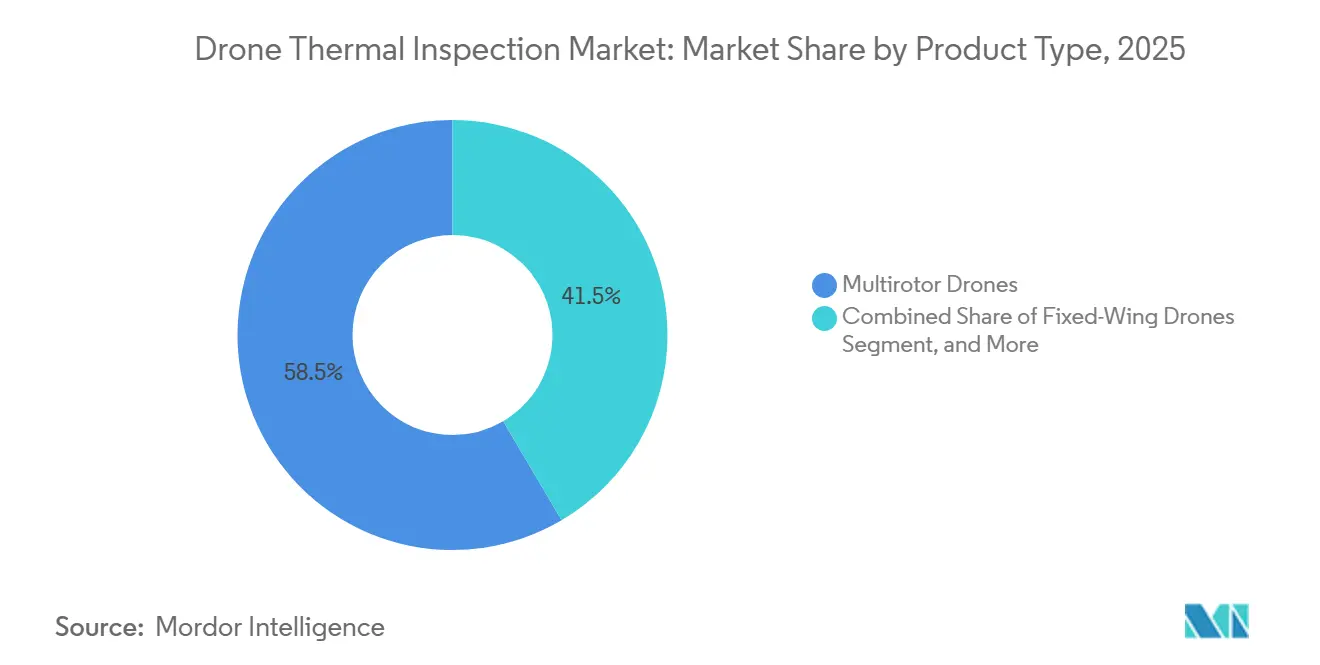
Multirotor drones commanded 58.47% of the drone thermal inspection market revenue in 2025 because they can operate around substations, rooftop solar arrays, industrial facilities, and confined spaces. Their ability to take off vertically and hover near a target makes close inspection of individual components possible. Operators can use them where precise positioning is more important than maximum distance. Their compact design also supports work in places with limited launch space. Compatible radiometric payloads have helped establish these aircraft in routine utility and commercial programs. Fixed-wing drones serve a more focused role where corridor speed and endurance are central to the inspection task. Their inability to hover limits the time available to inspect a single component from several positions. The drone thermal inspection industry most often uses fixed-wing systems when the asset route is long and the inspection objective is broad coverage.
Hybrid VTOL platforms are projected to expand at a 22.63% CAGR through 2031 as operators seek longer range without sacrificing vertical takeoff capability. These aircraft can support inspections of transmission, pipelines, railways, and other linear assets that extend beyond a single site. The FIXAR 007 NG supports flight times exceeding 59 minutes with a thermal payload and distances up to 60 km in a single sortie. This performance illustrates why hybrid aircraft are relevant where multirotor battery limits interrupt corridor work. The drone thermal inspection market can use hybrid VTOL systems more widely when operating approvals permit consistent long-distance routes. Drone-in-a-box systems can also extend the usefulness of multirotors at fixed sites by enabling scheduled flights and recharging. Product selection will continue to depend on the asset layout, the required dwell time, and the operating permissions available to the provider.



By Thermal Payload Type: Radiometric Systems Lead Documentation While Multisensor Systems Advance
Radiometric thermal payloads accounted for 52.63% of the drone thermal inspection market revenue in 2025 because they record temperature information for each pixel. This capability supports inspection records that require more than a visible contrast between hot and cold areas. Operators can use radiometric data to review the severity and location of a possible anomaly. The data is relevant for solar, electrical, and industrial inspections that require documented findings. These payloads are commonly used in inspection programs that require defensible thermal records for maintenance, insurance, or warranty review. Non-radiometric payloads remain relevant for cost-sensitive work that focuses on identifying visible heat differences. Their use is more limited when the operator needs absolute temperature information and controlled reporting conditions. The size of the drone thermal inspection market for radiometric payloads underscores the importance of documented inspection quality in asset-intensive operations.
Multisensor thermal payloads are projected to advance at a 22.87% CAGR through 2031. They combine radiometric thermal sensing, optical zoom, and laser rangefinding in a single gimbal. This configuration can reduce the need to fly separate missions for thermal and visual documentation. An inspection team can view a potential thermal issue and collect contextual visual evidence in the same flight. Larger multirotor and hybrid VTOL aircraft can carry these payloads more easily as their capacity improves. Teledyne FLIR’s focus on uncooled thermal imaging under the US Army DUTCH initiative underscores continued work on size, weight, power, and cost considerations for thermal systems. The drone thermal inspection industry can benefit from payload suppliers that offer modules and software compatible with multiple airframe platforms. This structure allows operators to select an aircraft-payload combination that fits each inspection setting.
By Range: VLOS Supports Current Volumes While BVLOS Changes Corridor Economics
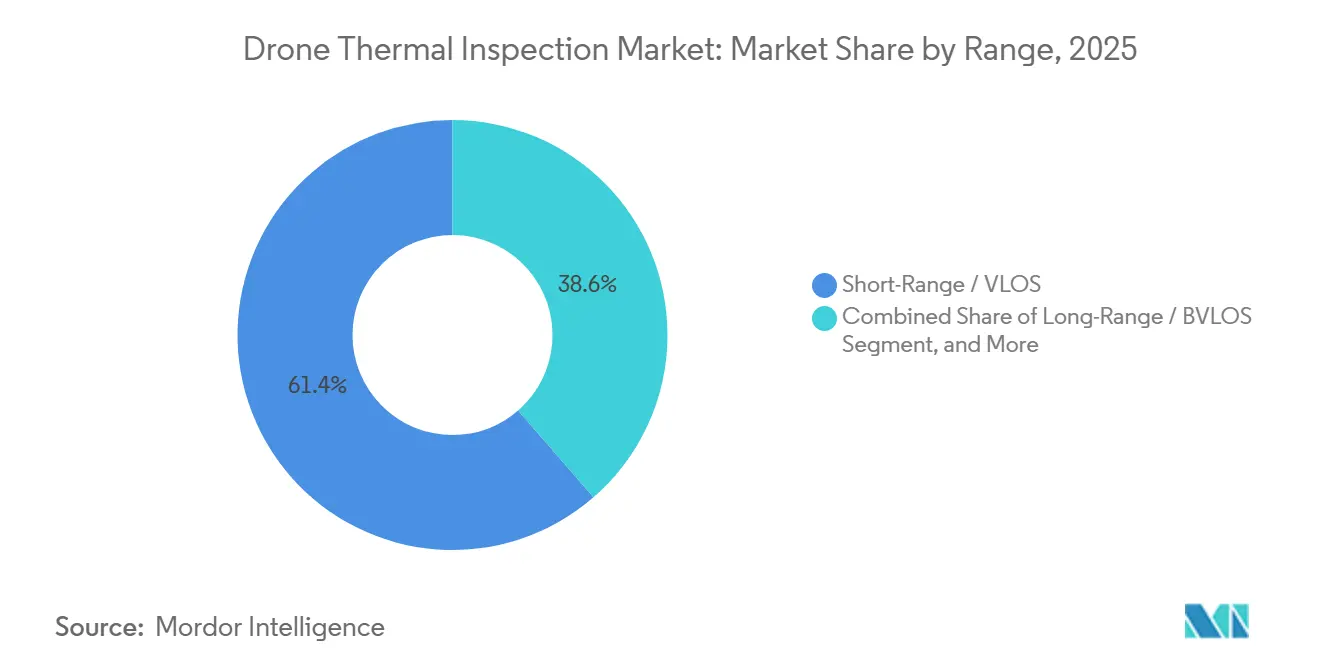
Short-range/VLOS configurations accounted for 61.38% of drone thermal inspection market revenue in 2025, reflecting the installed base of site-based inspection work. Substations, rooftop photovoltaic systems, tank farms, and manufacturing facilities often fit within a defined visual area. These operations can be planned around smaller asset groups and shorter flight paths. VLOS rules are generally more established than long-range operating approvals. This makes short-range systems practical for routine maintenance inspections. They also allow operators to conduct close visual and thermal checks of individual structures or components. Medium-range and extended VLOS operations provide an intermediate option where a spotter network or visual aids can extend coverage. The share of the drone thermal inspection market held by short-range configurations underscores the continued importance of accessible operating models.
Long-range/BVLOS configurations are projected to expand at a 21.41% CAGR through 2031 because linear assets can extend across many kilometers. The shift from VLOS to BVLOS can reduce the need for repeated crew repositioning and separate short flights. It can also support continuous data collection across transmission lines, pipelines, railways, and offshore wind assets. This operating model depends on regulatory approval, reliable communications, and procedures for airspace awareness. Long-range aircraft offer full economic benefit only when operators can consistently fly planned routes. The drone thermal inspection market can gain from this model as approval pathways become more repeatable. At the same time, battery endurance remains a practical constraint for long missions with radiometric payloads. Providers must balance route length, image quality, weather, reserve power, and the need for repeatable data collection.
By End-User Industry: Utilities Lead Demand While Service Providers Support Outsourcing
Electric utilities accounted for 28.74% of the drone thermal inspection market revenue in 2025, making them the largest end-user group. Aging grid equipment, storm hardening, and reliability requirements create a need for systematic condition checks. Thermal imaging can identify unusual heat patterns at electrical connections and other components. Repeated aerial surveys also allow utilities to build a record of inspection results across substations, lines, and distribution assets. Renewable-energy operators are another important customer group because solar and wind installations require maintenance throughout their operating life. Oil and gas companies use thermal inspection for tank roofs, above-ground piping, and critical equipment. Industrial manufacturers, construction companies, real estate owners, governments, and emergency services drive demand for electrical maintenance, building assessment, search and rescue, wildfire mapping, and infrastructure protection. The drone thermal inspection market serves these users through different flight procedures and reporting needs.
Inspection-service companies are projected to expand at a 22.92% CAGR through 2031 as more asset owners seek managed inspection programs. This model provides access to pilots, thermal payloads, analysts, data platforms, and reporting procedures without requiring a customer to build every capability internally. It is especially relevant when an asset owner operates several sites but does not need a full-time drone team at each location. Percepto’s 2026 inspection intelligence platform combines autonomous drones, contextual AI, and remote operations for energy infrastructure customers. Such platforms support outcome-based contracts centered on inspection frequency and useful maintenance findings. The drone thermal inspection industry is also becoming more demanding for smaller providers as customers expect certification, secure data handling, and dependable recurring operations. Service companies that meet these needs can build longer-term customer relationships through repeat inspections.
Geography Analysis
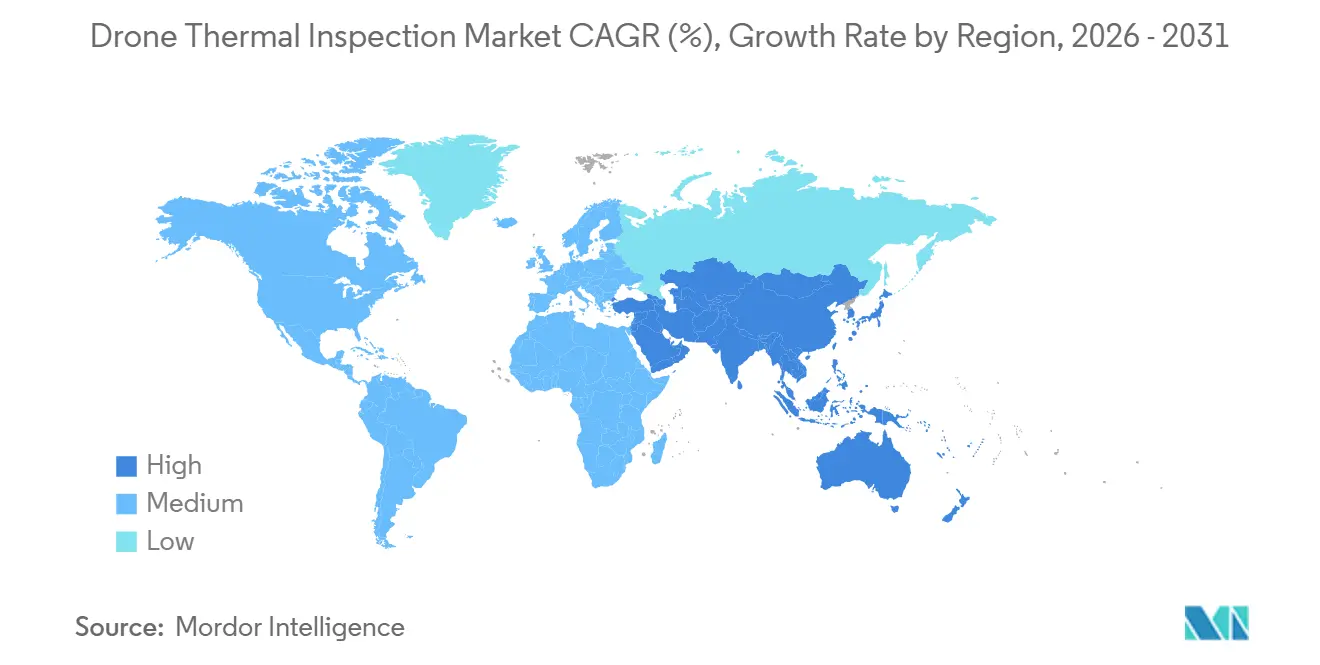
North America accounted for 34.91% of the global drone thermal inspection market revenue in 2025. The region has a large utility customer base, a developed commercial drone services sector, and broad demand for grid and industrial asset inspections. The proposed FAA BVLOS framework can expand the operating area available to approved long-range inspection providers. North American utilities can use thermal drone programs for transmission networks, distribution systems, substations, and high fire-risk areas. Canada adds demand through established utility inspection activity and drone testing conditions. Mexico provides opportunities as power infrastructure expands and service providers seek additional customers. The drone thermal inspection market share in the region reflects its established utility adoption and the availability of specialized service providers.
Asia-Pacific is projected to expand at a 22.46% CAGR through 2031, making it the fastest-growing regional area. China’s grid inspection programs support demand across ultra-high-voltage transmission, urban substations, and distribution networks. DJI Enterprise won State Grid Corporation of China’s first-batch 2026 drone inspection procurement at a bid of CNY 1.83 billion (USD 250 million), covering work across 26 provinces. India also has a large and aging transmission network that requires condition monitoring. Karnataka Power Transmission Corporation Limited’s 2025 deployment demonstrates the operational potential of thermal drone surveys for long-line networks. Japan and South Korea have industrial asset bases capable of supporting inspection demand. Southeast Asian infrastructure development can provide further opportunities as drone rules and operating practices mature.
Europe benefits from established approaches to risk assessment for drone operations and from asset-integrity requirements in the energy sector. National Grid’s centralized autonomous aerial inspection activity in England and Wales demonstrates the use of BVLOS operations for transmission infrastructure.[2]National Grid, “World-First Drone Inspections Help Keep Electricity Flowing,” National Grid, nationalgrid.com. Germany, the United Kingdom, and France have demand linked to offshore wind, aging gas networks, and energy-sector maintenance requirements. DRONE VOLT and SKIPPER NDT signed a 2026 collaboration agreement to integrate AI, geospatial analysis, and electromagnetic detection into drone platforms for pipeline and critical infrastructure inspection. South America remains at an earlier stage, although Brazil’s offshore oil and gas activities and Argentina’s renewable base can create demand. The Middle East and Africa have potential in utility and oil and gas maintenance, as well as photovoltaic inspection associated with large renewable programs. The drone thermal inspection market will develop at different speeds across these regions because regulatory access, service capacity, and asset investment differ by country.

Competitive Landscape
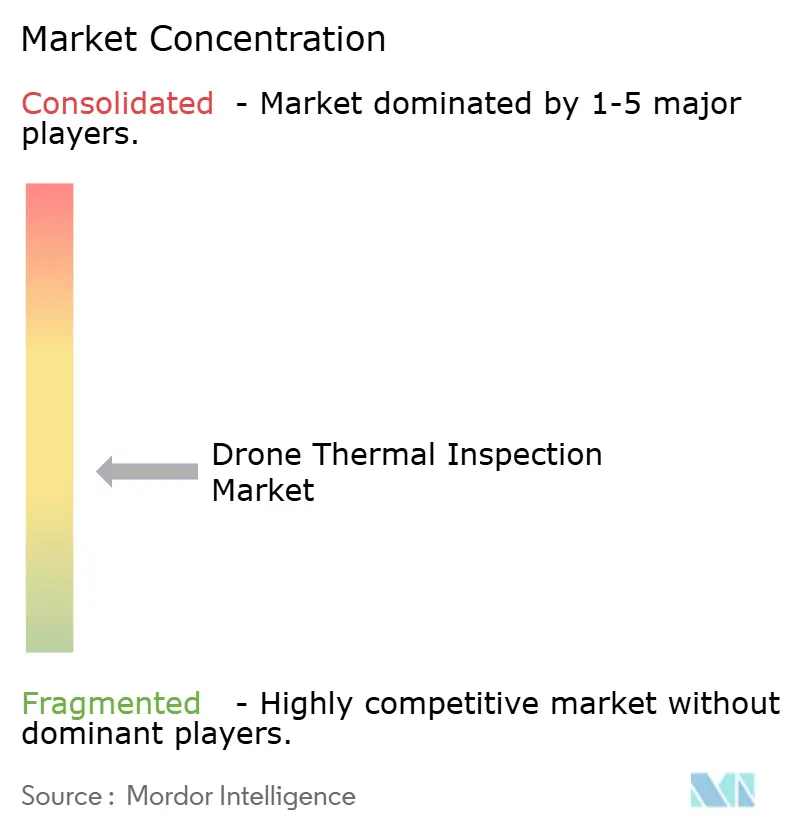
The drone thermal inspection market is moderately fragmented because airframe manufacturers, thermal payload suppliers, autonomy platforms, and service providers address different parts of the inspection workflow. DJI has a prominent position in large utility-related deployments in Asia through thermal-capable platforms and autonomous mission systems. Its 2026 State Grid procurement win covered transmission, substation, and distribution work across 26 Chinese provinces. Hardware-focused companies are adding autonomy and analytics so their systems can support more complete inspection workflows. Software-focused companies are offering remote operations and managed services that can produce recurring revenue. This structure means companies often compete through distinct capabilities rather than identical product lines. Customers can select an airframe, thermal payload, and software platform separately when their operational requirements differ.
Thermal payload specialists remain important because inspection quality depends on sensor performance, calibration, and data handling. Teledyne FLIR ended sales of the SIRAS professional drone in 2025 and refocused on thermal camera modules and embedded software through its Thermal by FLIR program.[3] Teledyne FLIR, “Thermal by FLIR,” Teledyne FLIR, teledyneflir.com. This move illustrates how a supplier can support multiple airframe partners rather than competing directly at every layer of the system. The company’s work on uncooled imaging under the DUTCH initiative also reflects attention to size, weight, power, and cost requirements for unmanned systems. Percepto’s June 2026 platform launch represents a different strategy, combining autonomous aircraft, AI, and managed operations for utility and oil-and-gas customers. The drone thermal inspection market, therefore, includes both component-focused suppliers and companies that offer full inspection services. These approaches can coexist because customers have different preferences for internal ownership and outsourced delivery.
Competitive differentiation increasingly depends on the quality of inspection outcomes rather than only aircraft specifications. Asset-specific AI training data, experienced thermal reviewers, and reporting methods can be important when customers need useful maintenance decisions. DRONE VOLT’s LineDrone, developed with Hydro-Québec, was presented at CIGRE 2026 for work on energized extra-high-voltage lines, including conductor corrosion and joint-condition measurement. This is an example of a company concentrating on a technically demanding inspection setting rather than a general aerial imaging offer. Smaller service providers can also build positions through close operating relationships with maintenance teams and familiarity with local authorization requirements. The drone thermal inspection market can support several specialist approaches because asset classes have different risks, reporting rules, and flight conditions. Buyers are likely to evaluate vendors on the reliability of defect identification, inspection coverage, turnaround time, data security, and the ability to support repeat programs.
Drone Thermal Inspection Industry Leaders
DJI Technology Co., Ltd.
Skydio, Inc.
Teledyne FLIR LLC
Parrot Drones SAS
Autel Robotics Co., Ltd.
- *Disclaimer: Major Players sorted in no particular order

Recent Industry Developments
- September 2026: Teledyne FLIR OEM was selected under the U.S. Army’s Delivering Unmatched Thermal Capability Hastened initiative to advance next-generation uncooled thermal imaging for unmanned aerial systems. The program targets size, weight, power, and cost reductions and domestic uncooled infrared manufacturing capacity, with implications for commercial drone thermal payload performance and supply-chain security.
- September 2026: DRONE VOLT announced a cooperation and investment agreement with Sol.One (Sol1 BV) comprising a 5-year supply commitment worth at least EUR 50 million (USD 54.5 million), under which Sol.One will order propulsion systems and components for the Saboteur UAV.
- July 2026: DJI released Terra 5.3.0, introducing 2D thermal map reconstruction that fuses thermal and visible-light imagery simultaneously, a built-in AI assistant for anomaly classification, and video-based 3D reconstruction. The update embeds thermal analytics into DJI’s standard mission data workflow and allows operators to generate georeferenced thermal anomaly maps without third-party processing software.
- July 2026: The FAA’s proposed Part 108 BVLOS rulemaking advanced to OIRA review on July 10, 2026. This milestone positioned routine commercial BVLOS drone inspections closer to normalized regulatory footing across the U.S. National Airspace System.


Global Drone Thermal Inspection Market Report Scope
The Drone Thermal Inspection Market refers to the market for unmanned aerial systems equipped with thermal imaging cameras and related sensing technologies that are used to detect, measure, and analyze temperature variations in assets, equipment, infrastructure, and operational environments. These solutions combine drones, thermal payloads, data acquisition systems, analytics software, and associated services to enable remote, non-contact, and often automated inspection of assets that may be difficult, hazardous, or costly to access using conventional inspection methods.
The Drone Thermal Inspection Market Report is Segmented by Product Type (Multirotor Drones, Fixed-Wing Drones, and Hybrid VTOL Drones), Thermal Payload (Radiometric Thermal Payloads, Non-Radiometric Thermal Payloads, and Multisensor Thermal Payloads), Range (Short-Range/VLOS, Medium-Range/Extended VLOS, and Long-Range/BVLOS), End-User (Electric Utilities, Renewable Energy Operators, Oil and Gas, Industrial Manufacturers, Construction and Real-Estate Companies, Government and Emergency Services, Inspection Service Companies, and Other End-User Industries), and Geography (North America, South America, Europe, Asia-Pacific, Middle East, and Africa). The Market Forecasts are Provided in Terms of Value (USD).
| Multirotor Drones |
| Fixed-Wing Drones |
| Hybrid VTOL Drones |
| Radiometric Thermal Payloads |
| Non-Radiometric Thermal Payloads |
| Multisensor Thermal Payloads |
| Short-Range / VLOS |
| Medium-Range / Extended VLOS |
| Long-Range / BVLOS |
| Electric Utilities |
| Renewable-Energy Operators |
| Oil and Gas Companies |
| Industrial Manufacturers |
| Construction and Real-Estate Companies |
| Government and Emergency Services |
| Inspection-Service Companies |
| Other End-User Industries |
| North America | United States | |
| Canada | ||
| Mexico | ||
| South America | Brazil | |
| Argentina | ||
| Rest of South America | ||
| Europe | Germany | |
| United Kingdom | ||
| France | ||
| Italy | ||
| Spain | ||
| Rest of Europe | ||
| Asia-Pacific | China | |
| Japan | ||
| India | ||
| South Korea | ||
| ASEAN | ||
| Rest of Asia-Pacific | ||
| Middle East and Africa | Middle East | Saudi Arabia |
| United Arab Emirates | ||
| Turkey | ||
| Rest of the Middle East | ||
| Africa | South Africa | |
| Nigeria | ||
| Rest of Africa | ||
| By Product Type | Multirotor Drones | ||
| Fixed-Wing Drones | |||
| Hybrid VTOL Drones | |||
| By Thermal Payload Type | Radiometric Thermal Payloads | ||
| Non-Radiometric Thermal Payloads | |||
| Multisensor Thermal Payloads | |||
| By Range / Operating Distance | Short-Range / VLOS | ||
| Medium-Range / Extended VLOS | |||
| Long-Range / BVLOS | |||
| By End-User Industry | Electric Utilities | ||
| Renewable-Energy Operators | |||
| Oil and Gas Companies | |||
| Industrial Manufacturers | |||
| Construction and Real-Estate Companies | |||
| Government and Emergency Services | |||
| Inspection-Service Companies | |||
| Other End-User Industries | |||
| By Geography | North America | United States | |
| Canada | |||
| Mexico | |||
| South America | Brazil | ||
| Argentina | |||
| Rest of South America | |||
| Europe | Germany | ||
| United Kingdom | |||
| France | |||
| Italy | |||
| Spain | |||
| Rest of Europe | |||
| Asia-Pacific | China | ||
| Japan | |||
| India | |||
| South Korea | |||
| ASEAN | |||
| Rest of Asia-Pacific | |||
| Middle East and Africa | Middle East | Saudi Arabia | |
| United Arab Emirates | |||
| Turkey | |||
| Rest of the Middle East | |||
| Africa | South Africa | ||
| Nigeria | |||
| Rest of Africa | |||


Key Questions Answered in the Report
What is the drone thermal inspection market size?
The drone thermal inspection market size was USD 3.49 billion in 2026 and is forecast to reach USD 8.59 billion by 2031 at a 19.74% CAGR. The estimate reflects a rising need for scheduled thermal surveys across grid, renewable, industrial, and energy assets. It also reflects the operational value of inspecting dispersed equipment without relying on a separate manual visit for each observation.
What drives demand for drone thermal inspections?
Aging power networks, renewable asset additions, predictive maintenance programs, and demand for documented thermographic surveys support adoption. These conditions make repeatable data collection more useful for maintenance teams managing dispersed assets. The requirement is strongest where an operator needs consistent observations across a large number of components, sites, or routes.
Which drone type leads thermal inspection work?
Multirotor drones led with 58.47% revenue share in 2025 because they can hover and operate effectively around site-based assets. They are well suited to substations, rooftop installations, confined spaces, and other locations that need precise positioning. Their practical role is strongest when close viewing angles and controlled flight paths are more important than route distance.
Why are radiometric thermal payloads important?
Radiometric payloads held 52.63% revenue share in 2025 because they capture per-pixel temperature data for detailed inspection records. This supports reviews where operators need more information than a visual comparison of heat patterns. A documented temperature record can also support follow-up reviews when a team needs to compare the same asset over time.
How does BVLOS capability affect thermal inspections?
BVLOS operations can improve coverage of transmission lines, pipelines, railways, and offshore assets, but they depend on formal operating approvals. Consistent access to long routes can reduce the number of separate flights and crew movements required for a survey. It can also help a provider plan data capture as a connected route instead of a sequence of disconnected local missions.
Which region is expected to expand fastest?
Asia-Pacific is projected to expand at a 22.46% CAGR through 2031, supported by grid inspection programs and renewable deployment. Its demand includes large transmission networks, expanding generating assets, and an increasing need for structured maintenance records. The region also contains varied operating environments where providers must align equipment, field procedures, and approvals with local infrastructure needs.
Page last updated on:





