
Drone Insurance Market Size and Share
Market Overview
| Study Period | 2021 - 2032 |
|---|---|
| Market Size (2027) | USD 1.8 Billion |
| Market Size (2032) | USD 2.9 Billion |
| Growth Rate (2027 - 2032) | 9.90 % |
| Fastest Growing Market | Asia-Pacific |
| Largest Market | North America |
| Market Concentration | Low |
Major Players *Disclaimer: Major Players sorted in no particular order Image © Mordor Intelligence. Reuse requires attribution under CC BY 4.0. | |
Drone Insurance Market Analysis by Mordor Intelligence
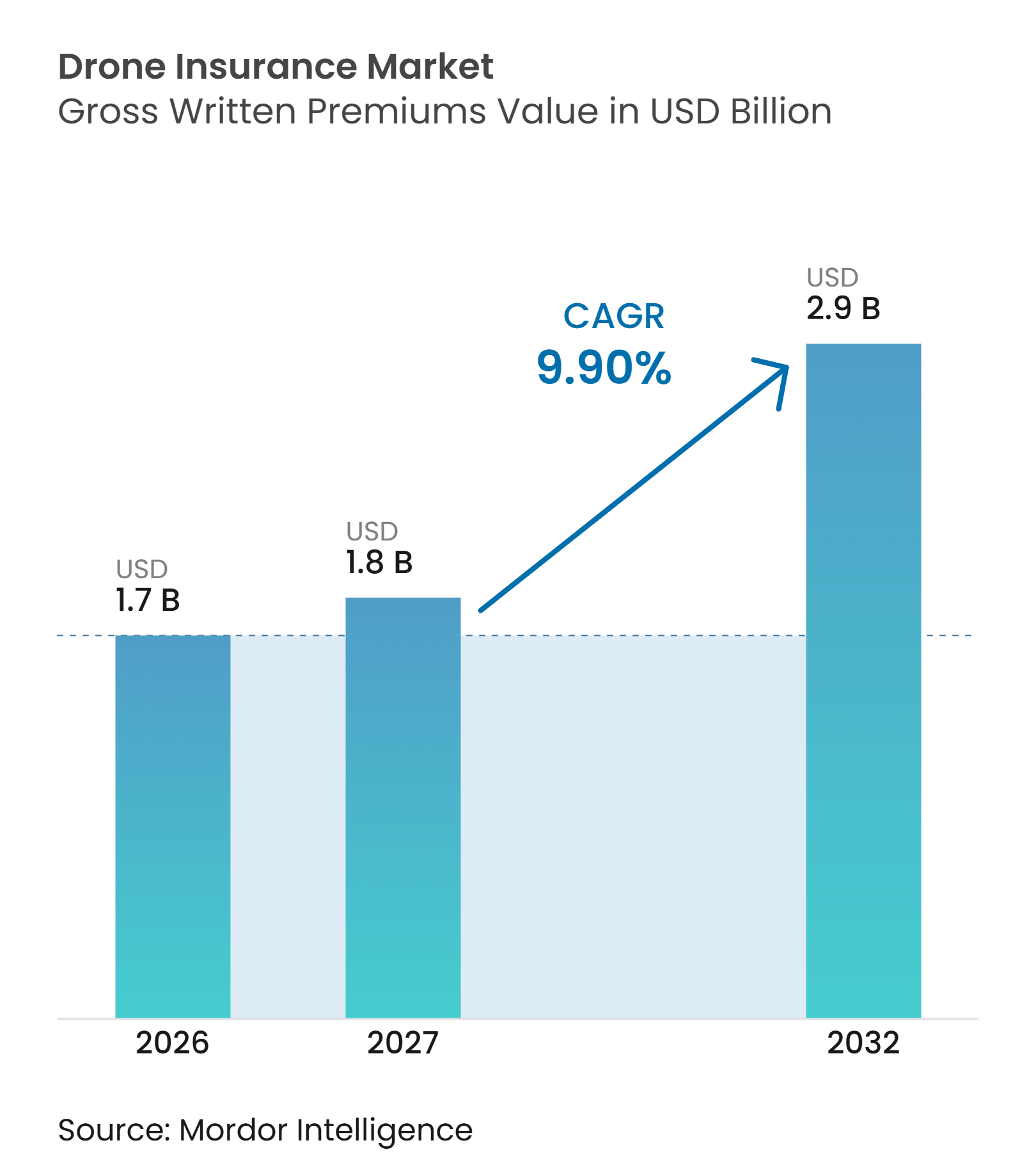
The Drone Insurance Market size in terms of gross written premiums value is expected to grow from USD 1.7 billion in 2026 to USD 1.8 billion in 2027 and is forecast to reach USD 2.9 billion by 2032 at 9.90% CAGR over 2027-2032.
Commercial fleets are becoming part of routine work in construction, energy, agriculture, surveying, and logistics, which increases the value and frequency of insured operations. Coverage is also becoming a procurement requirement because site owners and enterprise clients often require proof of liability protection before approving a flight. Regulations in the United States, China, India, Japan, and Europe are moving insurance from a voluntary risk-management choice toward an operational requirement. Digital platforms are widening access through per-flight policies, while established carriers retain an advantage in higher-value and complex risks. These two models are likely to coexist as the drone insurance industry develops, since fleet operators need broad programs and occasional operators need flexible coverage.
Key Report Takeaways
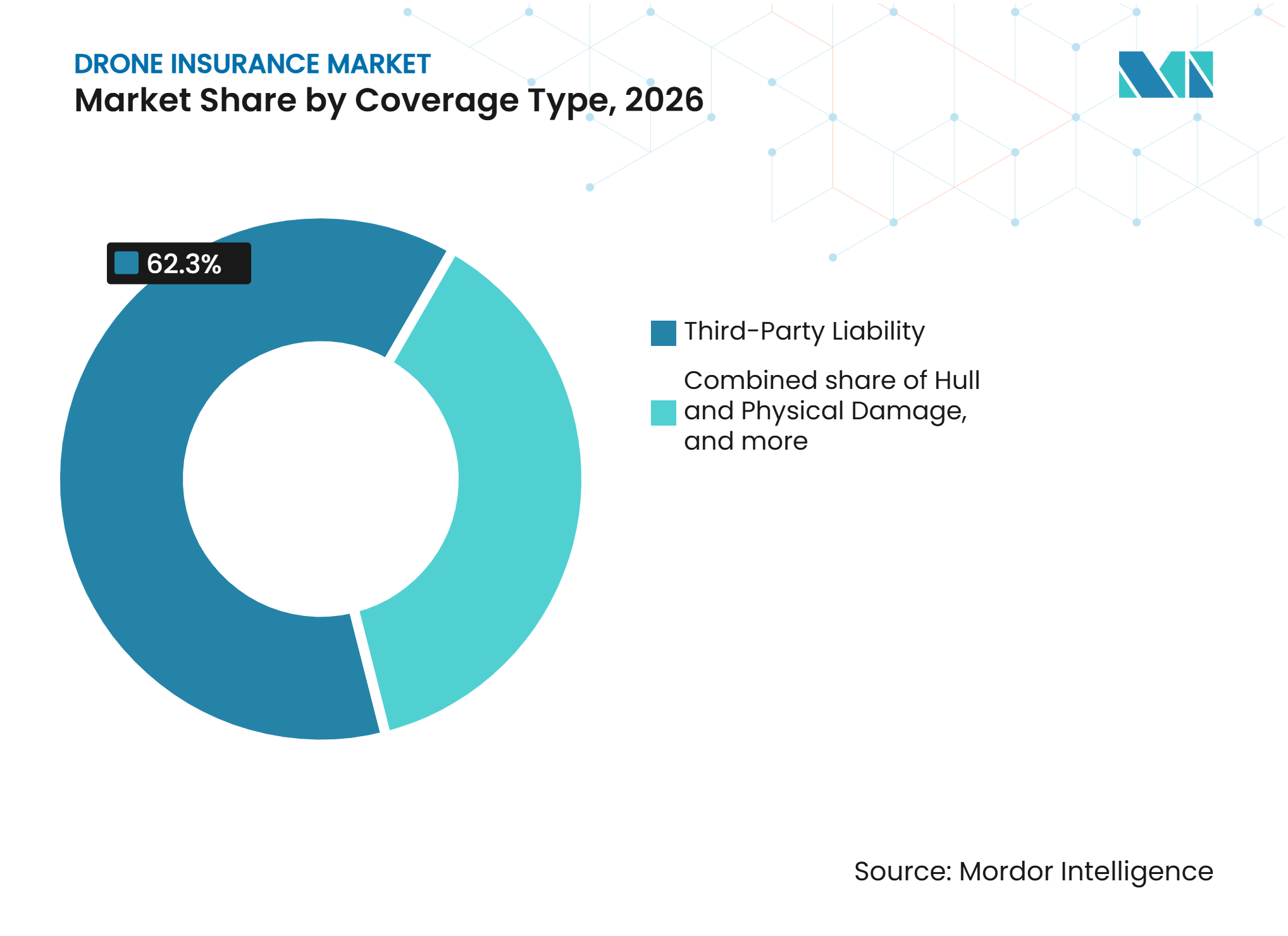
- By coverage type, third-party liability captured 62.3% of the drone insurance market share in 2026, while hull & physical damage is projected to grow at a 10.3% CAGR through 2032
- By policy structure, annual and multi-year policies held 61.8% of the drone insurance market share in 2026, while short-term and on-demand policies are forecast to grow at a 14.8% CAGR through 2032.
- By application, construction, infrastructure & energy accounted for 22.4% of the drone insurance market share in 2026, while logistics & delivery is forecast to grow at a 16.2% CAGR through 2032.
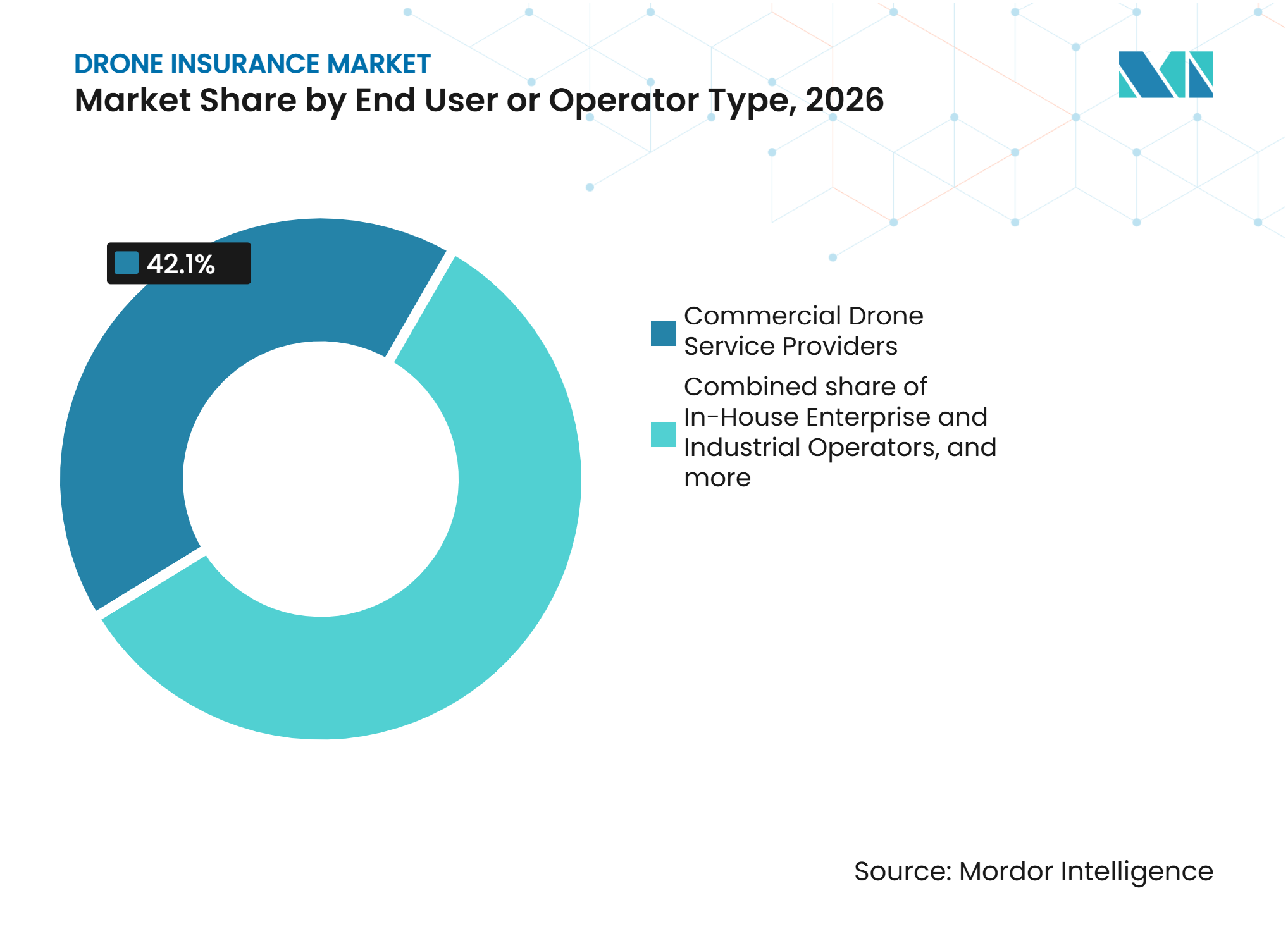
- By end user and operator type, commercial drone service providers accounted for 42.1% of the drone insurance market size in 2026, while in-house enterprise & industrial operators are forecast to grow at a 13.2% CAGR through 2032.
- By drone configuration, multi-rotor drones held 67.7% of the drone insurance market share in 2026, while hybrid and VTOL drones are projected to grow at a 14.8% CAGR through 2032.
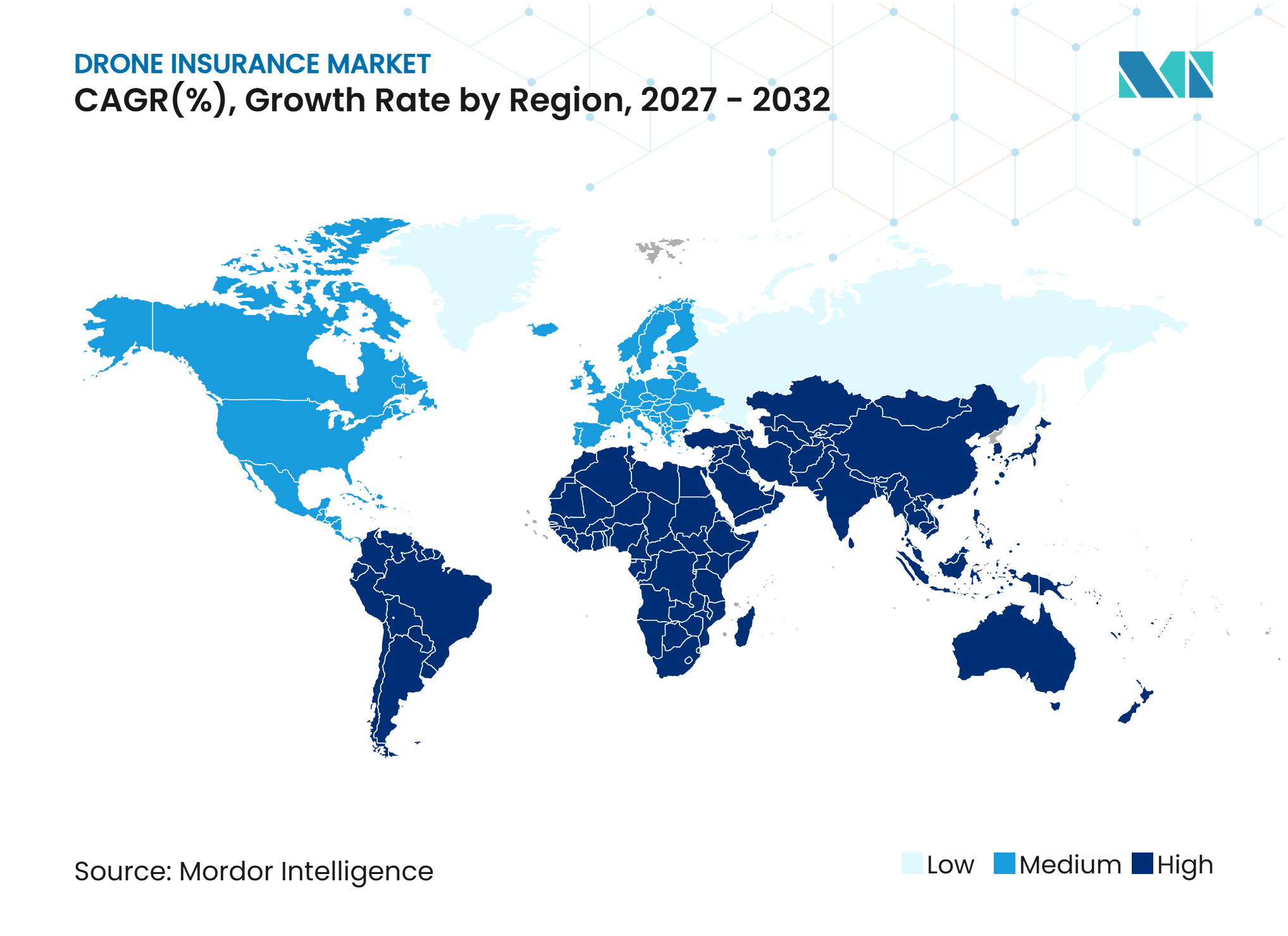
- By geography, North America accounted for 37.2% of the drone insurance industry share in 2026, while Asia-Pacific is forecast to grow at a 12.9% CAGR through 2032.
Note: Market numbers in this report are based on Mordor Intelligence's proprietary estimation framework, which combines nine months of actuals with Q4 projections for base year 2026.
Market Trends and Insights
Drivers Impact Analysis of Drone Insurance Market*
| Driver | (~) % Impact on CAGR Forecast | Geographic Relevance | Impact Timeline |
|---|---|---|---|
| Expansion of Commercial Drone Fleets and Industrial Applications | +2.5% | Global | Medium term (2-4 years) |
| Commercial Drone Liability Coverage Requirements | +1.8% | Global, Europe and Asia-Pacific core | Short term (≤ 2 years) |
| Growth of BVLOS, Autonomous, and Long-Range Missions | +1.6% | North America, Europe and Asia-Pacific | Long term (≥ 4 years) |
| Rising Demand for Hull, Payload, and Third-Party Liability Coverage | +1.2% | Global | Medium term (2-4 years) |
| Embedded, On-Demand, and Usage-Based Drone Insurance | +1.5% | North America and Europe | Medium term (2-4 years) |
| Enterprise and Contractual Requirements for Insured Operations | +0.9% | Global, North America and Europe core | Short term (≤ 2 years) |
| Source: Mordor Intelligence | |||
Expanding Commercial Drone Fleets Broaden the Insurable Asset Base
Commercial drones are increasingly used in energy, agriculture, construction, and inspection work, making them part of core operating activities rather than a specialist tool. The drone insurance market benefits when operators use aircraft for time-sensitive work because missed flights and damaged equipment have clearer financial consequences. InnovateEnergy reported that saving time was the main reason for drone adoption in its 2025 survey, ahead of improving work safety. Enterprise customers and site owners commonly require USD 1 million to USD 5 million in liability coverage before granting flight access[1]. Agricultural operations in China also demonstrate the scale of the opportunity, as the country’s low-altitude economy continues to expand through commercial and public-sector applications. Greater fleet activity expands premium potential but also requires insurers to assess equipment, pilots, locations, and mission types more precisely.
BVLOS and Autonomous Mission Authorizations Expand Underwriting Needs
Beyond visual line of sight operations are creating insurance needs that differ from those of local, pilot-observed flights. The Federal Aviation Administration proposed Part 108 in August 2025 to establish a framework for routine BVLOS operations, including package delivery, agriculture, aerial surveying, and public-safety missions. Insurers must assess operator authority, aircraft acceptance, and the systems used to keep aircraft separated from other airspace users. These requirements shift underwriting toward software reliability, fail-safe design, data-link security, and flight telemetry. The drone insurance industry therefore has room for products designed around system performance rather than only pilot experience. The approach also raises the need for specialist capacity because claims from long-range operations can involve third parties, cargo, equipment, and digital systems at the same time.
On-Demand and Usage-Based Models Reshape Policy Distribution
Per-flight insurance is expanding because many drone assignments are seasonal, project-based, or occasional. Digital platforms use weather conditions, location risk, pilot records, and aircraft telemetry to price a flight instead of relying only on a fixed annual premium. Precision Autonomy states that its pricing model considers more than 400 factors for automated underwriting[2]. Ping An Property & Casualty and China Re Property & Casualty launched Smart Flight Insurance in 2026, with pricing linked to previous flight behavior and real-time risk[3]. These services can make insurance easier to obtain for low-frequency users. This distribution model gives the drone insurance market a path to serve both small operators and larger enterprises without applying a single policy structure to all users.
Contractual and Regulatory Liability Requirements Strengthen Demand
Insurance demand increasingly comes from client contracts, site-access agreements, and government rules. India’s Drone Rules require third-party insurance for aircraft above the Nano category, and the Draft Civil Drone Bill released in 2025 proposes broader requirements for operators. The bill provides INR 250,000 (USD 3,000) for death and INR 100,000 (USD 1,200) for grievous injury[4]. Japan required third-party liability insurance for new Category II authorization applications involving drones weighing 25 kg or more from October 2025. China is also targeting a preliminary mandatory UAV liability insurance system by 2027. These measures make coverage a practical condition of operation, which supports steadier demand than discretionary purchases alone.
Restraints Impact Analysis of Drone Insurance Market*
| Restraint | (~) % Impact on CAGR Forecast | Geographic Relevance | Impact Timeline |
|---|---|---|---|
| High Premiums for Small Operators and High-Risk Missions | -1.9% | Global, especially small-operator markets | Medium term (2-4 years) |
| Limited Loss Data for Autonomous and Emerging Drone Applications | -1.4% | Global | Long term (≥ 4 years) |
| Fragmented Aviation Regulations and Cross-Border Coverage Restrictions | -1.1% | Global, Europe and Asia-Pacific | Long term (≥ 4 years) |
| Cyberattack, Privacy, and Autonomous-System Exclusion Uncertainty | -0.8% | North America and Europe | Long term (≥ 4 years) |
| Source: Mordor Intelligence | |||
Cost Accessibility Constrains Adoption Among Small and High-Risk Operators
Premium affordability remains a constraint for independent operators and businesses with limited flight activity. BWI Aviation Insurance indicates that annual liability coverage of USD 1 million can cost USD 600 to USD 1,200 for operations involving one to two drones. The same provider indicates that larger fleets with broader liability and hull protection can face materially higher annual costs. Higher-risk uses, including infrastructure inspections, flights near crowds, and deliveries over populated areas, may involve higher deductibles and narrower policy terms. Usage-based products can lower the entry cost for occasional operators, but per-flight pricing can remain high for BVLOS and complex-airspace missions. This constraint can limit insurance uptake in the drone insurance market where the cost of coverage appears disproportionate to the revenue generated by a small operation.
Limited Claims History Creates Uncertainty for Autonomous Operations
Autonomous and semi-autonomous systems are entering commercial service faster than long-term claims records can develop. Traditional aviation pricing uses historical loss frequency and severity, but these measures are less established for drone swarms, drone-in-a-box installations, and BVLOS corridors. WTW notes that traditional actuarial models can be difficult to apply to eVTOL and advanced autonomous platforms. Underwriters may instead depend on manufacturer reliability information, engineering assessments, and scenario analysis. This can result in higher deductibles, restricted limits, or exclusions that leave some exposures outside standard coverage. The drone insurance market needs deeper operational evidence before insurers can price complex autonomous risks with the same confidence as more established aviation activities.
*Our forecasts treat driver/restraint impacts as directional, not additive. The impact forecasts reflect baseline growth, mix effects, and variable interactions.
Drone Insurance Market Segment Analysis
By Coverage Type:
Liability Commands the Market, Hull Moves Into FocusThird-party liability held 62.3% of the drone insurance market share in 2026 because it is central to regulatory compliance and client procurement requirements. Liability cover protects operators against third-party injury or property-damage claims arising from a flight. European rules require third-party liability cover for defined drone operations, while India and Japan have also strengthened mandatory requirements. It is usually the first cover type that enterprise clients request when a contractor seeks access to a site. Package policies build on this foundation by combining liability, hull, and payload protection. Specialized covers, including cyber extensions, ground equipment protection, and cargo insurance, are becoming more relevant as missions grow more complex.
Hull and physical damage is forecast to grow at a 10.3% CAGR through 2032 as commercial aircraft and attached equipment become more expensive. High-value agricultural, survey, and inspection drones can carry LiDAR, multispectral cameras, and thermal sensors that cost more than the airframe. This raises the value of payload-specific endorsements alongside traditional hull cover. SkyWatch reported that the average value of insured drones on its platform rose from USD 3,000 in 2018 to more than USD 4,000 in 2022. Enterprise operators also prefer bundled policies because one program can address aircraft, payload, and liability needs. The drone insurance industry is therefore adding premium value per aircraft as well as benefiting from larger fleets. The mix of mandatory liability cover and growing asset values supports continued demand across the coverage spectrum.


By Policy Structure:
Annual Policies Hold Scale, On-Demand Reshapes AcquisitionAnnual and multi-year policies held a 61.8% share in 2026 because professional operators need uninterrupted protection. Service providers with recurring contracts often must show continuous liability coverage to customers and site owners. An annual policy can be economical for operators that fly regularly throughout the year. BWI Aviation Insurance describes annual liability policies for small operations in the USD 600 to USD 1,200 range. Fleet programs also simplify certificate management and combine aircraft, payload, and liability protection. These features support the position of annual programs across the drone insurance market. They are especially important where a lapse in coverage could interrupt contracted operations in the drone insurance market.
Short-term and on-demand policies are forecast to grow at a 14.8% CAGR through 2032. These policies suit seasonal agricultural work, media production, event coverage, and other temporary assignments. Digital distribution platforms can issue evidence of coverage quickly, which reduces delays before a mission begins. Flock built its operating model around real-time risk pricing for commercial fleets before Admiral Group agreed to acquire it in February 2026 for GBP 80 million (USD 109 million). Fleet policies remain a third option for operators with 10 or more aircraft because they offer consolidated underwriting and administration. The drone insurance market can therefore accommodate a spectrum from occasional single flights to high-frequency enterprise operations. Better flight data can improve pricing accuracy across the drone insurance market, but it does not remove the need for broader programs on complex missions.
By Application:
Construction and Energy Anchor Demand, Logistics Drives GrowthConstruction, infrastructure & energy accounted for 22.4% of the drone insurance market size in 2026. These operations use drones for mapping, inspection, progress documentation, and site surveillance. InnovateEnergy reported that mapping and surveying represented 35% of industrial drone use, followed by inspection at 26%. Work near critical assets creates substantial third-party liability exposure and often occurs under contractual insurance requirements. Agriculture and forestry require different pricing because flights are frequent even where individual aircraft values are lower. Surveying, mapping, and mining also need payload protection because they often use expensive sensors over complex terrain. These factors make application-specific underwriting important across the drone insurance market.
Logistics & delivery is forecast to grow at a 16.2% CAGR through 2032 as BVLOS operations expand. Delivery flights over populated areas can require liability limits of USD 5 million to USD 10 million or more per incident. They can also require cargo protection and cover for cyber or data-link events. The Federal Aviation Administration’s proposed Part 108 framework includes package delivery among the activities that could operate routinely under future BVLOS rules. Public safety, emergency services, and media remain established applications, while recreational policies are becoming more standardized. Coverdrone states that it serves more than 250,000 operators across the United Kingdom, Europe, Australia, Canada, and New Zealand. Medical delivery, maritime surveillance, and environmental monitoring add a longer range of specialized use cases.
By End User / Operator Type:
Commercial Providers Lead, In-House Teams AccelerateCommercial drone service providers accounted for a 42.1% share of the drone insurance market in 2026. These businesses include aerial survey firms, inspection providers, and media production companies that need insurance to fulfill contracts. They commonly buy annual or fleet coverage because operations continue across multiple clients and locations. Their underwriting is increasingly informed by flight hours, aircraft type, mission profile, and loss controls. Continuous coverage also allows them to issue certificates when a customer requests proof of insurance. This operating model makes commercial service providers a stable premium base within the drone insurance market and gives insurers recurring underwriting evidence. It also makes their renewal experience sensitive to claims performance and the range of services they offer.
In-house enterprise and industrial operators are forecast to grow at a 13.2% CAGR through 2032. Energy, logistics, agriculture, and construction companies are moving some flight activity inside their own operations. This places drone exposure within the broader corporate insurance program rather than leaving it entirely with external service providers. Enterprise risk managers often seek coverage that integrates aircraft, payload, cyber, liability, and incident reporting needs. Larger accounts can generate premium concentrations that exceed those of individual operators with similar aircraft counts. Government and public-sector operators may self-insure or use specialized public-sector programs, limiting their direct contribution to commercial premium. Individual and recreational users form a large operator base but generally have lower policy values and lower insurance penetration outside mandatory markets.

By Drone Configuration:
Multi-Rotor Dominates Operations, Hybrid and VTOL Change Risk ModelsMulti-rotor drones held a 67.7% share in 2026 because they can hover, fly slowly, and operate in restricted spaces. Their flexibility makes them common in inspections, photography, agriculture, and short-range survey work. SkyWatch reported that DJI multi-rotor brands represented more than 46% of insured drones on its platform. Fixed-wing drones serve long-distance surveying, agricultural monitoring, and maritime patrol missions. Their range and speed can justify a higher purchase cost and more specialized insurance requirements. Launch, recovery, and ground-equipment risks can be important in fixed-wing policies.
Hybrid and VTOL drones are forecast to grow at a 14.8% CAGR through 2032. They combine vertical lift with efficient forward flight, which is useful for BVLOS logistics and long-range inspection work. Their design complexity, high unit costs, and limited claims history can make conventional aviation pricing difficult. WTW identifies the challenge of applying traditional actuarial models to eVTOL and other advanced aircraft. Apollo and Moonrock launched a USD 122.5 million insurance facility in April 2025, offering up to USD 100 million in liability cover and USD 22.5 million in property-damage cover for drone, eVTOL, and aviation innovation risks. The facility illustrates the need for dedicated capacity in complex aircraft risks. It also shows how specialist underwriting partnerships can address limits that smaller providers cannot offer alone.
Geography Analysis
North America accounted for 37.2% of the drone insurance market in 2026. The United States has a large commercial operator base under the Federal Aviation Administration’s Part 107 framework, supported by established brokers, managing general agents, and digital insurance platforms. Enterprise procurement requirements add to demand because many customers require insured UAV services before allowing work on their sites. The proposed Part 108 rule remains a near-term factor because it would establish a path for more routine BVLOS activities. Canada supports the regional market through its own regulatory framework for drone certification and operations. Mexico is smaller and less penetrated, but commercial agriculture and energy inspection offer room for broader coverage use.
Asia-Pacific is projected to grow at a 12.9% CAGR through 2032. China is targeting a preliminary mandatory UAV liability insurance system by 2027 and a broader low-altitude insurance framework by 2030. India’s 2025 draft bill proposes wider third-party insurance requirements and structured compensation for specified injuries. Japan’s insurance requirement for specified Category II applications strengthens the compliance case for coverage. Hong Kong has an active commercial environment for low-altitude insurance products. The region combines large aircraft manufacturing and operating bases with evolving regulatory mandates and digital pricing tools.
Europe remains structurally important because cross-border operations and country-level requirements create demand for specialist coverage. The United Kingdom Civil Aviation Authority requires insurance for commercial UAS operations, while national rules in other European markets can differ by aircraft weight and use case. This variation creates value for brokers serving the drone insurance market across multiple jurisdictions. South America is led by Brazil, where regulation provides a baseline for commercial activity, while Argentina and other countries are at an earlier development stage. The Middle East and Africa include the United Arab Emirates and Saudi Arabia, where infrastructure and energy inspection support commercial use. South Africa also has domestic commercial insurance capacity, although penetration across the wider region remains lower than in more mature markets. The drone insurance market has a longer-term opportunity in these regions as professional operations and compliance frameworks expand.
Competitive Landscape
Market Concentration
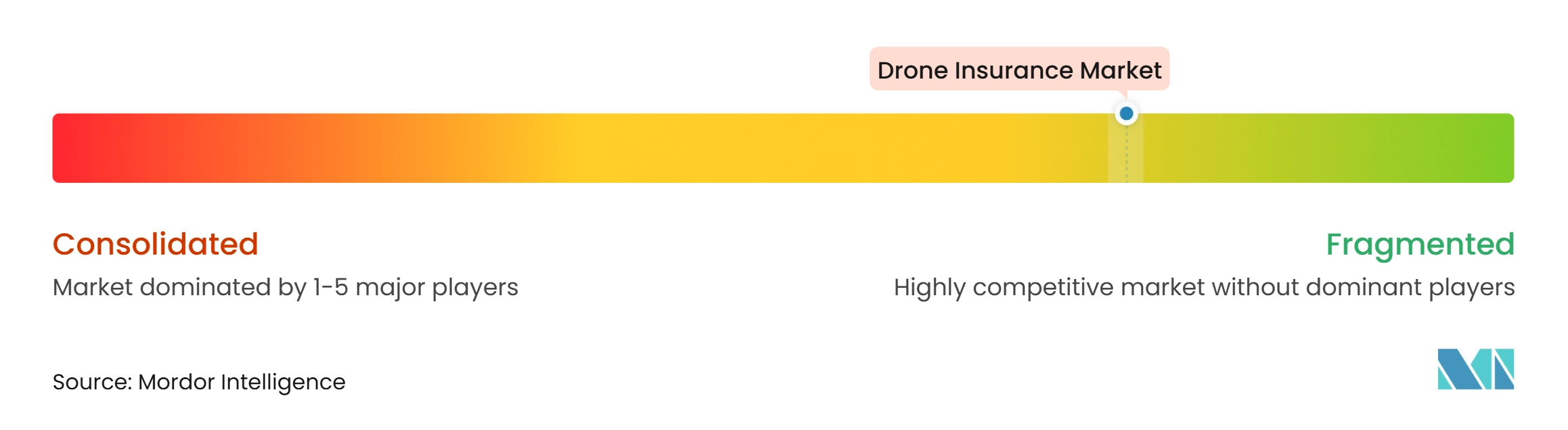
The drone insurance market is fragmented, with specialist digital insurers, aviation underwriters, reinsurers, and large commercial insurance groups competing across different risk categories. Specialist providers such as SkyWatch.AI, Coverdrone, Moonrock Insurance, and Thimble focus on digital distribution, rapid policy issuance, and flexible coverage for individual operators and small fleets. Larger insurance groups, including Munich Re, Allianz, and Global Aerospace, support complex risks that require substantial underwriting capacity, including large commercial fleets, beyond visual line of sight (BVLOS) operations, and electric vertical take-off and landing (eVTOL) aircraft. This diverse provider base limits the dominance of any single competitor across the full range of drone insurance products. Competitive differentiation increasingly depends on combining specialist aviation expertise, reliable insurance capacity, and data-driven underwriting. Cyber exposure, data breaches, autonomous operations, and policy exclusions also create challenges as insurers define coverage boundaries for emerging risks.
Several recent developments illustrate how providers are expanding distribution and underwriting capacity. On 1 June 2026, Admiral Group completed its acquisition of Flock, a digital commercial fleet insurance provider, following regulatory approval. The transaction valued Flock’s equity at GBP 80 million (USD 108 million). Flock’s AI-powered, telemetry-based platform will strengthen Admiral’s fleet insurance capabilities through data-driven risk assessment, pricing, and fleet safety management. In the specialist aviation segment, Apollo and Moonrock's reported insurance facility for drone, eVTOL, and emerging aviation risks illustrates the importance of dedicated capacity for complex operations. Meanwhile, Precision Autonomy uses automated risk analysis and digital quote-bind-issue capabilities to support drone and autonomous-system insurance, demonstrating how technology can improve underwriting efficiency and policy access. These developments highlight the value of partnerships between specialist technology providers and established insurers.
The most competitive areas include affordable liability coverage for individual operators, protection for commercial fleets, cross-border operations, and emerging cyber and autonomous-system exposures. Standard policies may not adequately address every risk associated with GPS spoofing, data breaches, airspace restrictions, or equipment failures, making clear policy wording and tailored underwriting increasingly important. Digital platforms can simplify quotation and policy issuance for routine operations, while specialist underwriters remain essential for complex flight profiles and higher liability limits.
Drone Insurance Industry Leaders
-
Global Aerospace, Inc.
-
Allianz Global Corporate and Specialty SE
-
American International Group, Inc.
-
SkyWatch Space Applications Inc.
-
Coverdrone Limited
- *Disclaimer: Major Players sorted in no particular order
Drone Insurance Market Companies Covered in this Report
- Global Aerospace, Inc.
- SkyWatch Space Applications Inc. (SkyWatch.AI)
- Coverdrone Limited
- BWI Aviation Insurance Agency, Inc.
- Moonrock Insurance
- United States Aircraft Insurance Group (USAIG)
- Flock
- Allianz Global Corporate & Specialty SE (Allianz Commercial)
- American International Group, Inc. (AIG)
- Thimble
- Santam Limited
- Transport Risk Management
- DroneInsurance.com
- Munich Re
- AirModo
- Avalon Risk
- TropoGo
- SPG Canada
- Premier Canada Assurance Managers Ltd.
- Marsh
Recent Industry Developments in Drone Insurance Market
- June 2026: Ping An Property & Casualty Insurance and China Re Property & Casualty Insurance jointly launched “Smart Flight Insurance” at the 10th World Drone Conference in Shenzhen, with pricing based on flight behavior and IoT data. The companies also signed an agreement for the “Re·Energize” low-altitude economy insurance platform.
- June 2026: SkyWatch partnered with Bees360 to integrate drone insurance into Bees360’s property-inspection network, including one-click certificate generation and additional-insured designation.
- June 2026: Admiral Group completed its acquisition of Flock, a digital commercial fleet insurance provider, following regulatory approval. The transaction valued Flock’s equity at GBP 80 million (USD 108 million).
- February 2026: China’s National Development and Reform Commission, National Financial Regulatory Administration, and Civil Aviation Administration of China issued guidelines targeting a preliminary mandatory UAV liability insurance system by 2027 and a complete low-altitude insurance framework by 2030.
Global Drone Insurance Market Report Scope
Segmentation Overview
| Third-Party Liability |
| Hull & Physical Damage |
| Package Policies |
| Other Specialized Covers |
| Annual / Multi-Year Policies |
| Short-Term / On-Demand Policies |
| Fleet Policies |
| Agriculture and Forestry |
| Construction, Infrastructure and Energy |
| Surveying, Mapping and Mining |
| Logistics and Delivery |
| Media and Entertainment |
| Public Safety and Emergency Services |
| Recreational / Hobby |
| Other Applications |
| Commercial Drone Service Providers |
| In-House Enterprise and Industrial Operators |
| Government and Public Sector Operators |
| Individual and Recreational Operators |
| Multi-Rotor |
| Fixed-Wing |
| Hybrid / VTOL |
| Other Configuration |
| North America | United States |
| Canada | |
| Mexico | |
| South America | Brazil |
| Argentina | |
| Rest of South America | |
| Europe | United Kingdom |
| Germany | |
| France | |
| Italy | |
| Spain | |
| Rest of Europe | |
| Asia-Pacific | China |
| Japan | |
| India | |
| South Korea | |
| Australia | |
| Indonesia | |
| Thailand | |
| Malaysia | |
| Singapore | |
| Vietnam | |
| Rest of Asia-Pacific | |
| Middle East and Africa | Saudi Arabia |
| United Arab Emirates | |
| Turkey | |
| South Africa | |
| Egypt | |
| Rest of Middle East and Africa |
| By Coverage Type | Third-Party Liability | |
| Hull & Physical Damage | ||
| Package Policies | ||
| Other Specialized Covers | ||
| By Policy Structure | Annual / Multi-Year Policies | |
| Short-Term / On-Demand Policies | ||
| Fleet Policies | ||
| By Application | Agriculture and Forestry | |
| Construction, Infrastructure and Energy | ||
| Surveying, Mapping and Mining | ||
| Logistics and Delivery | ||
| Media and Entertainment | ||
| Public Safety and Emergency Services | ||
| Recreational / Hobby | ||
| Other Applications | ||
| By End User / Operator Type | Commercial Drone Service Providers | |
| In-House Enterprise and Industrial Operators | ||
| Government and Public Sector Operators | ||
| Individual and Recreational Operators | ||
| By Drone Configuration | Multi-Rotor | |
| Fixed-Wing | ||
| Hybrid / VTOL | ||
| Other Configuration | ||
| By Geography | North America | United States |
| Canada | ||
| Mexico | ||
| South America | Brazil | |
| Argentina | ||
| Rest of South America | ||
| Europe | United Kingdom | |
| Germany | ||
| France | ||
| Italy | ||
| Spain | ||
| Rest of Europe | ||
| Asia-Pacific | China | |
| Japan | ||
| India | ||
| South Korea | ||
| Australia | ||
| Indonesia | ||
| Thailand | ||
| Malaysia | ||
| Singapore | ||
| Vietnam | ||
| Rest of Asia-Pacific | ||
| Middle East and Africa | Saudi Arabia | |
| United Arab Emirates | ||
| Turkey | ||
| South Africa | ||
| Egypt | ||
| Rest of Middle East and Africa | ||
Key Questions Answered in the Report
What is the forecast growth rate for drone insurance through 2032?
The Drone insurance market is forecast to grow at a 9.9% CAGR from 2027 to 2032, reaching USD 2.9 billion by 2032.
Which type of drone coverage has the largest share?
Third-Party Liability held 62.3% share in 2026 because it supports regulatory compliance and contractual eligibility.
Why are on-demand drone policies expanding?
Short-Term and On-Demand Policies are forecast to grow at a 14.8% CAGR because they suit seasonal, occasional, and project-based work.
Which drone applications create the strongest insurance demand?
Construction, Infrastructure & Energy held 22.4% share in 2026, while Logistics & Delivery is forecast to grow at a 16.2% CAGR through 2032.
Which region is growing fastest for drone cover?
Asia-Pacific is forecast to grow at a 12.9% CAGR through 2032, supported by evolving insurance requirements in China, India, and Japan.
How are BVLOS operations affecting insurance needs?
BVLOS operations require underwriting of operator authority, system reliability, airspace tools, data links, liability, and cyber-related risks.