
Drilling Services Market Size and Share
Market Overview
| Study Period | 2022 - 2032 |
|---|---|
| Market Size (2027) | USD 18.62 Billion |
| Market Size (2032) | USD 25.23 Billion |
| Growth Rate (2027 - 2032) | 6.27 % |
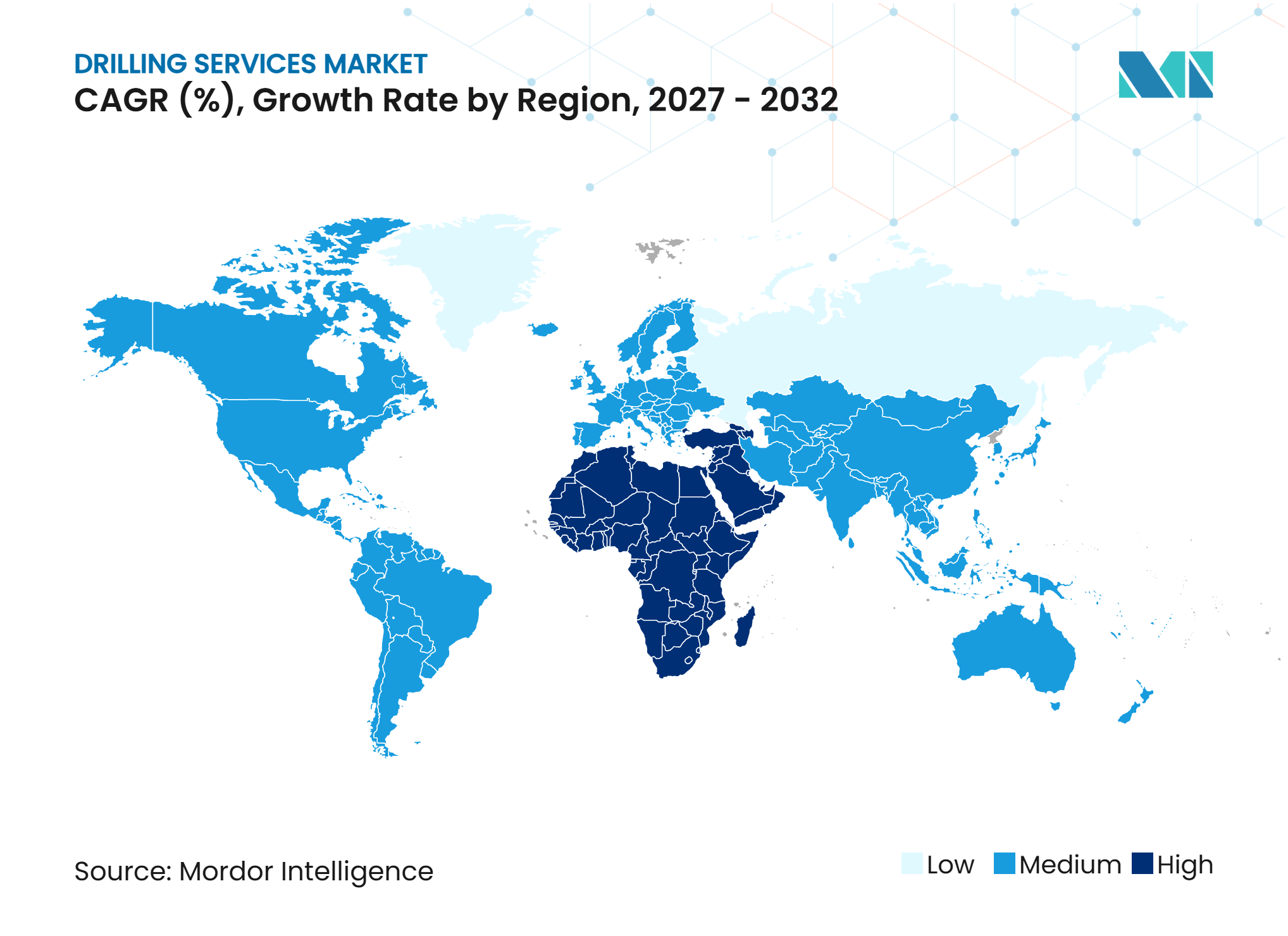
| Fastest Growing Market | Middle East and Africa |
| Largest Market | North America |
| Market Concentration | Medium |
Major Players *Disclaimer: Major Players sorted in no particular order Image © Mordor Intelligence. Reuse requires attribution under CC BY 4.0. | |
Drilling Services Market Analysis by Mordor Intelligence
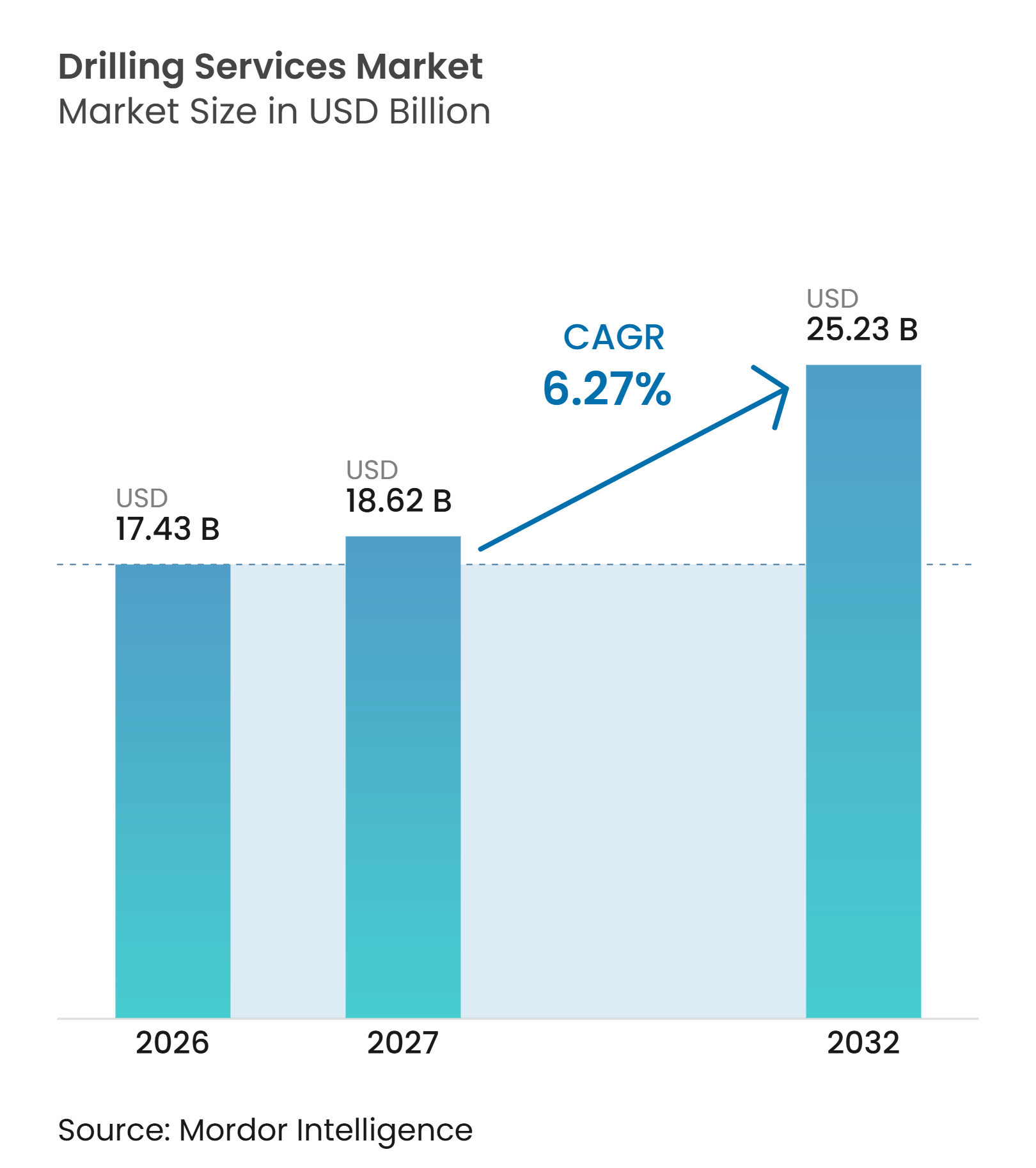
The Drilling Services Market size is projected to expand from USD 17.43 billion in 2026 and USD 18.62 billion in 2027 to USD 25.23 billion by 2032, registering a CAGR of 6.27% between 2027 and 2032. The drilling services market enters this period after reduced activity in Saudi Arabia, Mexico, and Sub-Saharan Africa affected service revenue in 2025. Field decline rates continue to make replacement drilling necessary, even when commodity prices and upstream spending are uneven. The International Energy Agency stated that maintaining global oil and gas output would require annual upstream investment of USD 540 billion through 2050.[1] Recalled Saudi Arabian rigs and Gulf tender activity may support a recovery in Middle East contracting. Demand is separating between cyclical contract drilling and technology-led work, where directional drilling, automation, and integrated well construction can create a different revenue profile.
Key Report Takeaways
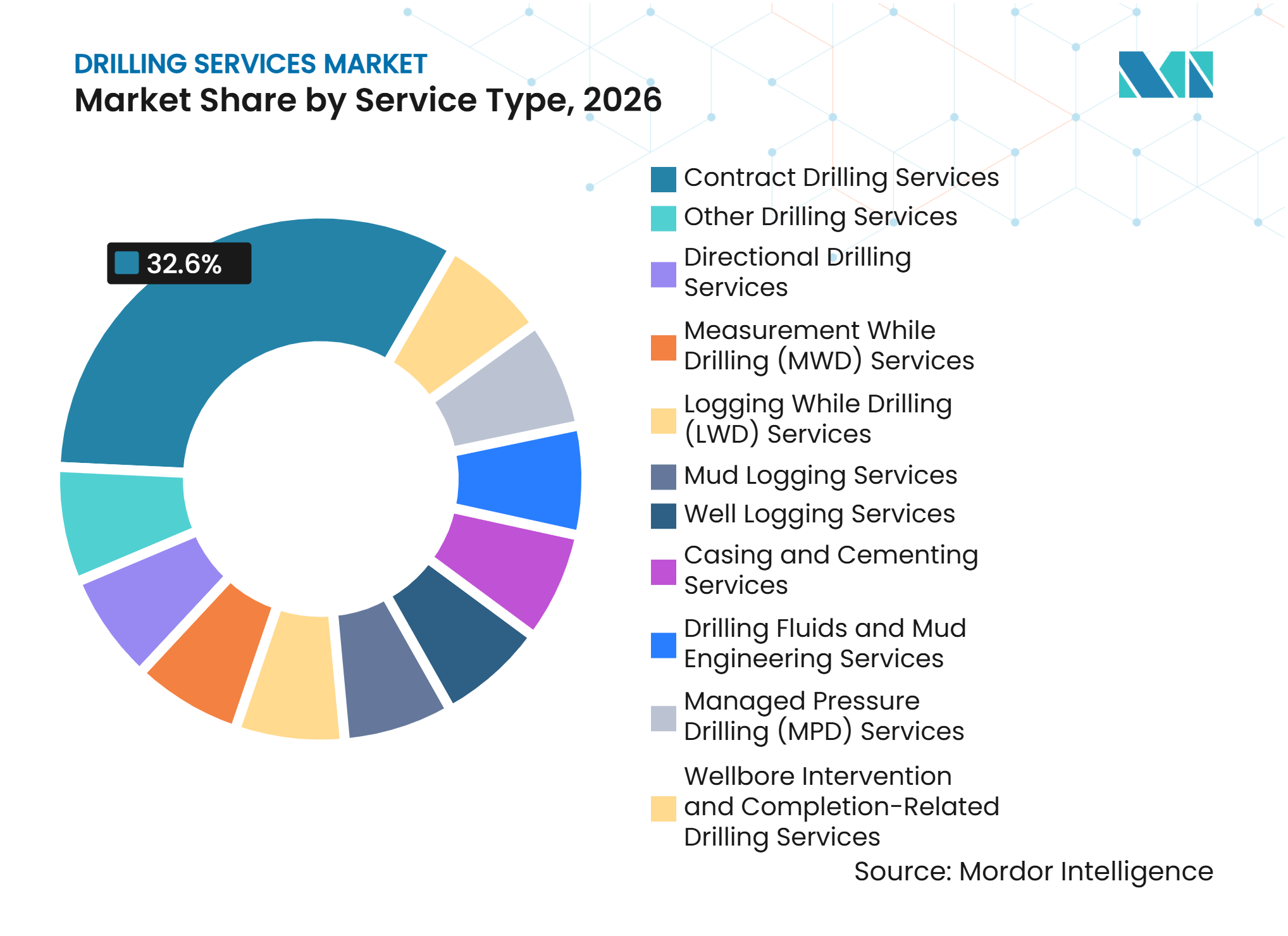
- By service type, Contract Drilling Services held 32.6% of the drilling services market share in 2026, while Directional Drilling Services is projected to grow at a 6.8% CAGR through 2032.
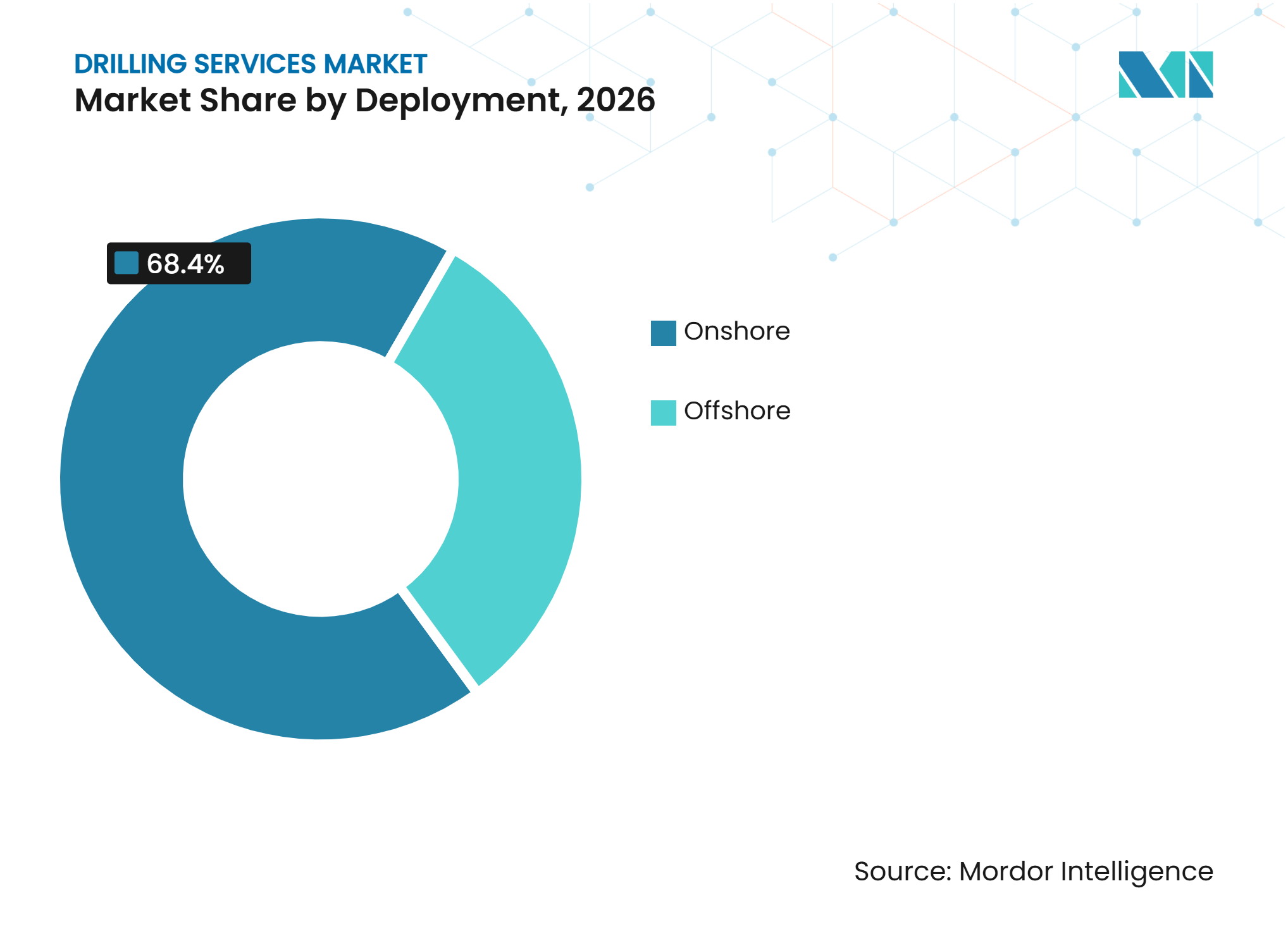
- By deployment, onshore held 68.4% of the drilling services market share in 2026, while offshore is forecast to expand at a 7.2% CAGR through 2032.
- By geography, North America accounted for 26.3% of the market in 2026, while Middle East and Africa is forecast to advance at a 7.4% CAGR through 2032.
Note: Market numbers in this report are based on Mordor Intelligence's proprietary estimation framework, which combines nine months of actuals with Q4 projections for base year 2026.
Market Trends and Insights
Drivers Impact Analysis of Drilling Services Market*
| Driver | (~) % Impact on CAGR Forecast | Geographic Relevance | Impact Timeline |
|---|---|---|---|
| Growth in Directional and Complex Well Construction | +1.4% | Global, led by North America, Middle East, and Asia-Pacific | Medium term (2-4 years) |
| Expansion of Deepwater and Ultra-Deepwater Development | +1.0% | Brazil, West Africa, North Sea, and Gulf of Mexico | Long term (≥ 4 years) |
| Adoption of Automated and Autonomous Drilling Systems | +0.7% | Global, with early adoption in the UAE, Norway, and Saudi Arabia | Medium term (2-4 years) |
| Rising Demand for Unconventional Resource Development | +0.9% | North America, Argentina, and Saudi Arabia | Medium term (2-4 years) |
| Integrated Drilling Services and Performance-Based Contracts | +0.5% | Middle East, North America, and offshore markets | Medium term (2-4 years) |
| National Oil Company Drilling Expansion Programs | +0.9% | Middle East, North Africa, West Africa, and Asia-Pacific | Medium term (2-4 years) |
| Source: Mordor Intelligence | |||
Growth in Directional and Complex Well Construction
Directional drilling is now a standard requirement for a large share of new hydrocarbon wells. The U.S. Energy Information Administration reported that horizontal wells accounted for 94% of onshore oil production and 92% of onshore natural gas production in the United States by late 2024.[2] Rotary steerable systems reached Level 3 downhole trajectory automation in commercial use by 2024. A Society of Petroleum Engineers paper reported that automated kickoff and steering improved the rate of penetration by 25% compared with advisory-mode operations.[3] These systems can reduce the performance gap between experienced crews and more routine operations. The drilling services market therefore benefits as complex well designs spread beyond established unconventional basins into newer developments in Africa and Southeast Asia.
Expansion of Deepwater and Ultra-Deepwater Development
Deepwater activity supports drilling demand because large projects need extensive appraisal, development, and completion programs. Equinor started production at Bacalhau in Brazil in October 2025, where recoverable reserves exceed 1 billion barrels of oil equivalent and production capacity is expected to reach 220,000 barrels per day.[4] BP also announced the Bumerangue discovery in Brazil during August 2025, its largest discovery in 25 years. SLB received a contract from Woodside Energy for 18 ultra-deepwater wells at the Trion development offshore Mexico. The International Energy Agency has noted that production declines from existing oil and gas fields have accelerated. This strengthens the case for new deepwater capacity, although development schedules remain exposed to high equipment and financing costs.
Adoption of Automated and Autonomous Drilling Systems
Automation is becoming a practical part of drilling delivery in several active producing regions. A Society of Petroleum Engineers paper documented an Abu Dhabi unconventional project that combined intelligent advisory systems with closed-loop steering automation. Abu Dhabi National Oil Company (ADNOC) Drilling stated that its Turnwell operations used cluster drilling and automation to achieve efficiency levels comparable with leading U.S. unconventional developments. COSL deployed its internally developed directional rotary steerable system across deepwater and deep-layer formations in the South China Sea. Automation can increase consistency in well delivery and lower the number of directional drillers needed per well. In the drilling services market, this can move value toward providers that control drilling software, sensors, and steering equipment.
Rising Demand for Unconventional Resource Development
Unconventional drilling remains a major source of work for high-specification services. The Energy Information Administration (EIA) reported that Permiantight formations produced 6.0 million barrels per day in December 2025, representing 44% of U.S. crude oil output. U.S. crude oil production reached a record 13.6 million barrels per day in 2025 despite a lower rig count. Longer laterals, pad drilling, and completion improvements have changed the traditional relationship between active rigs and production volumes. This can limit land-rig demand while maintaining work for directional drilling, measurement while drilling, logging while drilling, and drilling fluids providers. The drilling services market is thus gaining more revenue from technically complex wells rather than from a simple increase in rig numbers.
Restraints Impact Analysis of Drilling Services Market*
| Restraint | (~) % Impact on CAGR Forecast | Geographic Relevance | Impact Timeline |
|---|---|---|---|
| Upstream Capital Spending Volatility | -0.8% | Global, concentrated in North America and OPEC-exposed markets | Short term (≤ 2 years) |
| High Cost of High-Specification Rigs and Downhole Tools | -0.3% | Offshore markets, especially Brazil, West Africa, and the Gulf of Mexico | Medium term (2-4 years) |
| Environmental Compliance and Emissions-Reporting Costs | -0.4% | North America, Europe, North Sea, and global offshore markets | Medium term (2-4 years) |
| Shortage of Experienced Directional Drilling Personnel | -0.3% | Global, with pressure in Asia-Pacific, the Middle East, and offshore markets | Medium term (2-4 years) |
| Source: Mordor Intelligence | |||
Upstream Capital Spending Volatility
Upstream spending remains a central constraint on the drilling services market because operators can defer wells when budgets tighten. The International Energy Agency recorded a 6% decline in upstream oil investment in 2025, the first annual decline since the COVID-19 contraction. Spending pressure affects standalone contractors more directly than diversified service companies with broader geographic and product coverage. Halliburton reported that its Drilling and Evaluation revenue fell 3% to USD 9.4 billion in 2025. Baker Hughes reported a 17% year-on-year decline in Well Construction revenue to USD 3.6 billion. U.S. Environmental Protection Agency reporting requirements also add compliance work for operators, including well-level methane reporting under amended Subpart W rules for the 2025 reporting year.
Environmental Compliance and Emissions-Reporting Costs
Environmental requirements are becoming a direct consideration in drilling project economics. The United Kingdom issued guidance in June 2025 requiring downstream Scope 3 emissions to be considered in decisions on new North Sea oil and gas projects. The European Union’s Corporate Sustainability Reporting Directive (CSRD) also extends reporting obligations to qualifying non-EU companies with substantial European operations. Sinopec Oilfield Service Corporation Service Corporation has set a target to electrify 95% of its drilling rig fleet by 2030. These requirements can increase administrative and equipment costs, particularly for smaller drilling programs. They may also favor contractors that can provide lower-emission equipment and stronger reporting systems.
*Our forecasts treat driver/restraint impacts as directional, not additive. The impact forecasts reflect baseline growth, mix effects, and variable interactions.
Drilling Services Market Segment Analysis
By Service Type:
Technology Services Outpace Volume-Driven DrillingContract Drilling Services held 32.6% of service-type value in 2026, making it the largest service category. The segment reflects the scale of land and offshore fleets and the use of longer-term day rate contracts. Its revenue remains closely linked to exploration and production budgets, rig utilization, and customer schedules. Directional Drilling Services is projected to grow at a 6.8% CAGR through 2032. This drilling services market size opportunity reflects the need for extended-reach wells, multilaterals, and complex trajectories in established and emerging basins.
Measurement while drilling and logging while drilling benefit as operators collect more formation data during complex drilling programs. Managed pressure drilling also supports wells that face narrow pressure margins, particularly in deepwater environments. Weatherford has highlighted the expansion of managed pressure drilling across offshore programs. Mud logging, well logging, casing and cementing, drilling fluids, and wellbore intervention remain linked to well count, but their service intensity rises with well complexity. ADNOC Drilling received a USD 1.63 billion integrated drilling services contract in April 2025 covering directional drilling, drilling fluids, cementing, wireline logging, and tubular running services. The drilling services industry is moving toward contracts that combine these capabilities under a single accountable provider.



By Deployment:
Offshore Repricing Accelerates as Supply TightensOnshore accounted for 68.4% of the drilling services market size in 2026 because land activity remains extensive in North America, the Middle East, and China. Nabors marketed 242 active international land rigs in 2025, while Saudi Aramco accounted for nearly 30% of its consolidated revenue through the SANAD joint venture. These customer relationships provide a degree of volume stability in Middle East land drilling. However, productivity improvements mean that fewer rigs can sustain high production levels in mature unconventional regions. This limits volume growth for conventional land drilling while supporting demand for higher-specification well services.
Offshore is expected to grow at a 7.2% CAGR through 2032 as deepwater projects move from sanctioning into execution. Valaris stated that benign-environment floater supply declined from 280 units in 2014 to 150 units at the end of 2025. Saudi Aramco recalled 7 previously suspended jackups for work in 2026, which supported demand expectations in the shallow-water market. Odfjell Drilling reported 96% financial utilization for its 5 Norwegian Continental Shelf semisubmersibles in 2025. American Petroleum Institute (API) standards are widely referenced by regulators, creating a compliance barrier that favors established contractors with capable fleets.

Geography Analysis
North America
North America led with 26.3% of the regional value in 2026. U.S. production reached a record 13.6 million barrels per day in 2025 even as drilling activity became more efficient. The oil-directed rig count had fallen 33% from its December 2022 peak by October 2025.Longer laterals, pad drilling, and tighter completion design are concentrating work around high-specification rigs and complex wells. This supports directional drilling, measurement services, and drilling fluids, even where land-rig volumes do not increase.
Middle East and Africa
Middle East and Africa are projected to grow at a 7.4% CAGR through 2032, the fastest regional rate in the drilling services market. National oil company programs provide multi-year contracting visibility that is less exposed to short-term commodity swings. ADNOC Drilling's 2025 awards extended its backlog visibility through 2040. Saudi Arabia's Jafurah and UAE unconventional programs are broadening demand beyond conventional wells. In Africa, deepwater projects in West Africa and potential Namibian development could increase demand for specialized offshore equipment and integrated services.
Europe, Asia-Pacific, and South America
Europe centers on harsh-environment work in the Norwegian Continental Shelf, where operators need high-specification semisubmersibles. Odfjell Drilling's 2025 results showed that contracted Norwegian units achieved 96% financial utilization. UK North Sea approvals face added compliance factors following the 2025 Scope 3 guidance. Asia-Pacific demand is supported by China, India, Malaysia, and Indonesia, where domestic energy security programs sustain drilling activity. South America combines Brazil's pre-salt development with Argentina's Vaca Muerta activity, while China Oilfield Services Limited (COSL)’s South China Sea deployment illustrates locally developed technology.
Competitive Landscape
Market Concentration
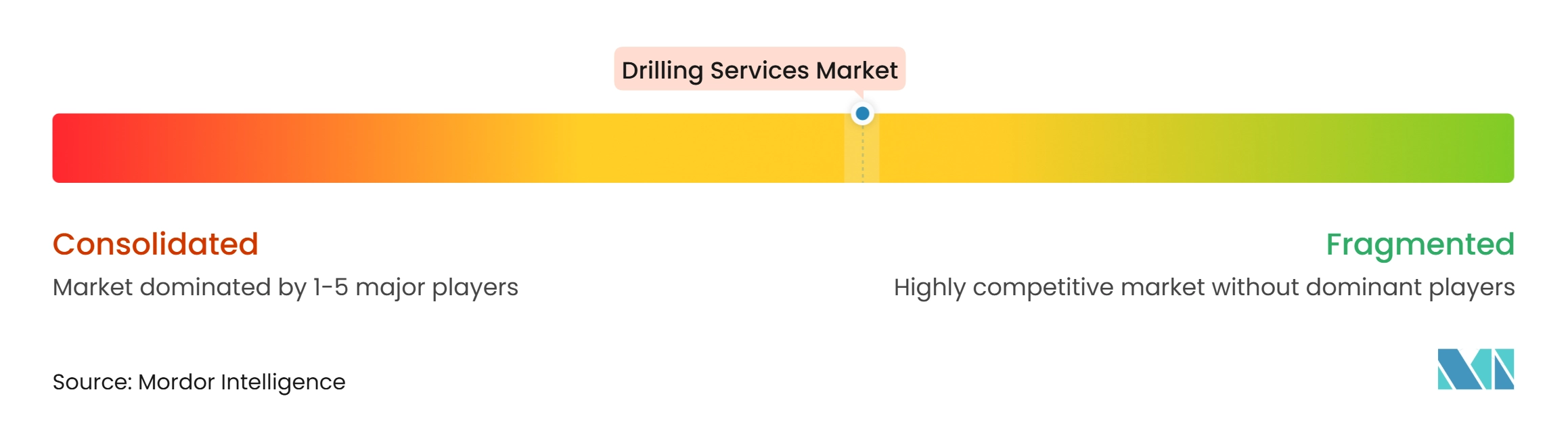
The drilling services market is moderately consolidated SLB, Halliburton, and Baker Hughes hold strong positions in technology-intensive services such as directional drilling, logging, fluids, and integrated well construction. SLB reported USD 11.9 billion in Well Construction revenue in 2025, despite an 11%-year decline. Halliburton is directing its international activity toward directional drilling, unconventional work, well intervention, and artificial lift. Digital drilling tools and performance-based contracts allow these companies to compete on well outcomes rather than simply on rig hours.
Offshore contractors compete more directly on fleet quality, operational performance, and available capacity. Valaris retired 14 benign-environment floaters in 2025 and held additional units for sale, while Transocean's fleet reduced from 34 to 27 units year on year. This fleet rationalization can improve pricing discipline where demand remains firm. The high cost of new construction and limited shipyard capacity also restrict rapid capacity additions. Established contractors with compliant, high-specification assets are better positioned to benefit from these conditions.
Corporate consolidation is changing competitive positions in land and shallow-water drilling. Helmerich & Payne completed its USD 2.0 billion acquisition of KCA Deutag in January 2025, adding international land drilling, offshore management, and BENTEC manufacturing capabilities. ADNOC Drilling also expanded its integrated service position through its April 2025 contract award. SLB's Trion contract combines digital directional services, logging, cementing, completions, and other capabilities under an integrated scope. These moves are changing how companies compete in the drilling services market.
Drilling Services Industry Leaders
-
SLB
-
Halliburton Company
-
Baker Hughes Company
-
Weatherford International plc
-
China Oilfield Services Limited
- *Disclaimer: Major Players sorted in no particular order
Drilling Services Market Companies Covered in this Report
- ADNOC Drilling Company
- Arabian Drilling Company
- Baker Hughes Company
- Borr Drilling Limited
- China Oilfield Services Limited (COSL)
- Dolphin Drilling AS
- Halliburton Company
- Jindal Drilling & Industries Limited
- KCA Deutag
- Nabors Industries Ltd.
- Noble Corporation
- Odfjell Drilling Ltd.
- Saipem S.p.A.
- Seadrill Limited
- Shelf Drilling Ltd.
- Sinopec Oilfield Service Corporation
- SLB (Schlumberger)
- Transocean Ltd.
- Valaris Limited
- Weatherford International plc
Recent Industry Developments in Drilling Services Market
- February 2026: SLB secured multiple offshore drilling services contracts from Mubadala Energy for the Tangkulo deepwater natural gas development in the Andaman Sea, offshore Indonesia. The contracts cover integrated drilling and well services across the well lifecycle, including directional drilling, drilling fluids, cementing, wireline, slickline, coiled tubing, well testing, mud logging, and upper and lower completions. These awards support the development of offshore gas resources, with first gas targeted before the end of 2028.
- September 2025: SLB was awarded a major completions contract by Petrobras for up to 35 ultra-deepwater wells in the Santos Basin's Atapu and Sepia fields, including advanced electric completion technologies and digital production intelligence solutions, with work scheduled to begin mid-2026. The contract reinforces SLB's integrated services positioning in Brazil's pre-salt deepwater.
- May 2025: ADNOC Drilling was awarded a USD 1.15 billion, 15-year contract for two jackup rigs by ADNOC Offshore, securing operations through 2040 and reinforcing the company's offshore fleet expansion that targets 148 rigs by end-2026. The contract follows a USD 1.63 billion, five-year integrated drilling services award from ADNOC Offshore in April 2025 covering directional drilling, cementing, drilling fluids, and wireline services.
- March 2025: SLB was awarded a major drilling contract by Woodside Energy for 18 ultra-deepwater wells at the Trion development offshore Mexico, employing AI-enabled drilling capabilities, digital directional services, LWD, cementing, and completions services under an integrated scope commencing early 2026 and managed through SLB's Performance Live delivery centers.
Global Drilling Services Market Report Scope
Drilling services are specialized industrial operations that create boreholes or wells in the ground using machinery, technical expertise, and engineering protocols.
The drilling services market is segmented into service type, deployment, and geography. By service type, the market is segmented into contract drilling services, directional drilling services, measurement while drilling (MWD) services, logging while drilling (LWD) services, mud logging services, well logging services, casing and cementing services, drilling fluids and mud engineering services, managed pressure drilling (MPD) Services, wellbore intervention and completion-related drilling services, and other drilling services. By deployment, the market is divided into onshore and offshore. The report also covers the market size and forecasts for the global drilling services market across 26 countries in key regions. For each segment, the market sizing and forecasts have been provided on the basis of value (USD).
Segmentation Overview
| Contract Drilling Services |
| Directional Drilling Services |
| Measurement While Drilling (MWD) Services |
| Logging While Drilling (LWD) Services |
| Mud Logging Services |
| Well Logging Services |
| Casing and Cementing Services |
| Drilling Fluids and Mud Engineering Services |
| Managed Pressure Drilling (MPD) Services |
| Wellbore Intervention and Completion-Related Drilling Services |
| Other Drilling Services |
| Onshore |
| Offshore |
| North America | United States |
| Canada | |
| Mexico | |
| Europe | Germany |
| France | |
| Italy | |
| Spain | |
| United Kingdom | |
| Netherlands | |
| Norway | |
| Russia | |
| Rest of Europe | |
| Asia-Pacific | China |
| India | |
| Japan | |
| Australia | |
| Indonesia | |
| Malaysia | |
| Thailand | |
| Rest of Asia-Pacific | |
| South America | Brazil |
| Argentina | |
| Colombia | |
| Rest of South America | |
| Middle East and Africa | Saudi Arabia |
| United Arab Emirates | |
| Egypt | |
| Oman | |
| Nigeria | |
| Rest of Middle East and Africa |
| By Service Type | Contract Drilling Services | |
| Directional Drilling Services | ||
| Measurement While Drilling (MWD) Services | ||
| Logging While Drilling (LWD) Services | ||
| Mud Logging Services | ||
| Well Logging Services | ||
| Casing and Cementing Services | ||
| Drilling Fluids and Mud Engineering Services | ||
| Managed Pressure Drilling (MPD) Services | ||
| Wellbore Intervention and Completion-Related Drilling Services | ||
| Other Drilling Services | ||
| By Deployment | Onshore | |
| Offshore | ||
| By Geography | North America | United States |
| Canada | ||
| Mexico | ||
| Europe | Germany | |
| France | ||
| Italy | ||
| Spain | ||
| United Kingdom | ||
| Netherlands | ||
| Norway | ||
| Russia | ||
| Rest of Europe | ||
| Asia-Pacific | China | |
| India | ||
| Japan | ||
| Australia | ||
| Indonesia | ||
| Malaysia | ||
| Thailand | ||
| Rest of Asia-Pacific | ||
| South America | Brazil | |
| Argentina | ||
| Colombia | ||
| Rest of South America | ||
| Middle East and Africa | Saudi Arabia | |
| United Arab Emirates | ||
| Egypt | ||
| Oman | ||
| Nigeria | ||
| Rest of Middle East and Africa | ||
Key Questions Answered in the Report
What is the projected value of the drilling services market by 2032?
The drilling services market is projected to reach USD 25.23 billion by 2032, growing at a 6.27% CAGR from 2027.
Which service type is growing fastest in drilling services?
Within the drilling services market, Directional Drilling Services is forecast to grow at a 6.8% CAGR through 2032 as complex wells become more common.
Why is offshore drilling services demand increasing?
Offshore activity in the drilling services market is supported by deepwater project execution and tighter availability of modern floaters and jackups.
Which region is expected to grow fastest for drilling services?
Middle East and Africa is forecast to expand at a 7.4% CAGR through 2032, supported by drilling services market demand from national oil company programs and unconventional development.
How does drilling automation affect service providers?
In the drilling services market, automation can improve drilling consistency and reduce field labor requirements, favoring providers with software and steering systems.
What are the main risks for drilling service companies?
In the drilling services market, volatile upstream spending, equipment costs, reporting obligations, and personnel shortages can constrain activity.