
Dried Tomatoes Market Size and Share
Market Overview
| Study Period | 2022 - 2032 |
|---|---|
| Market Size (2027) | USD 1.21 Billion |
| Market Size (2032) | USD 1.65 Billion |
| Growth Rate (2027 - 2032) | 6.35 % |
| Fastest Growing Market | Asia-Pacific |
| Largest Market | Europe |
| Market Concentration | Low |
Major Players *Disclaimer: Major Players sorted in no particular order Image © Mordor Intelligence. Reuse requires attribution under CC BY 4.0. | |
Dried Tomatoes Market Analysis by Mordor Intelligence
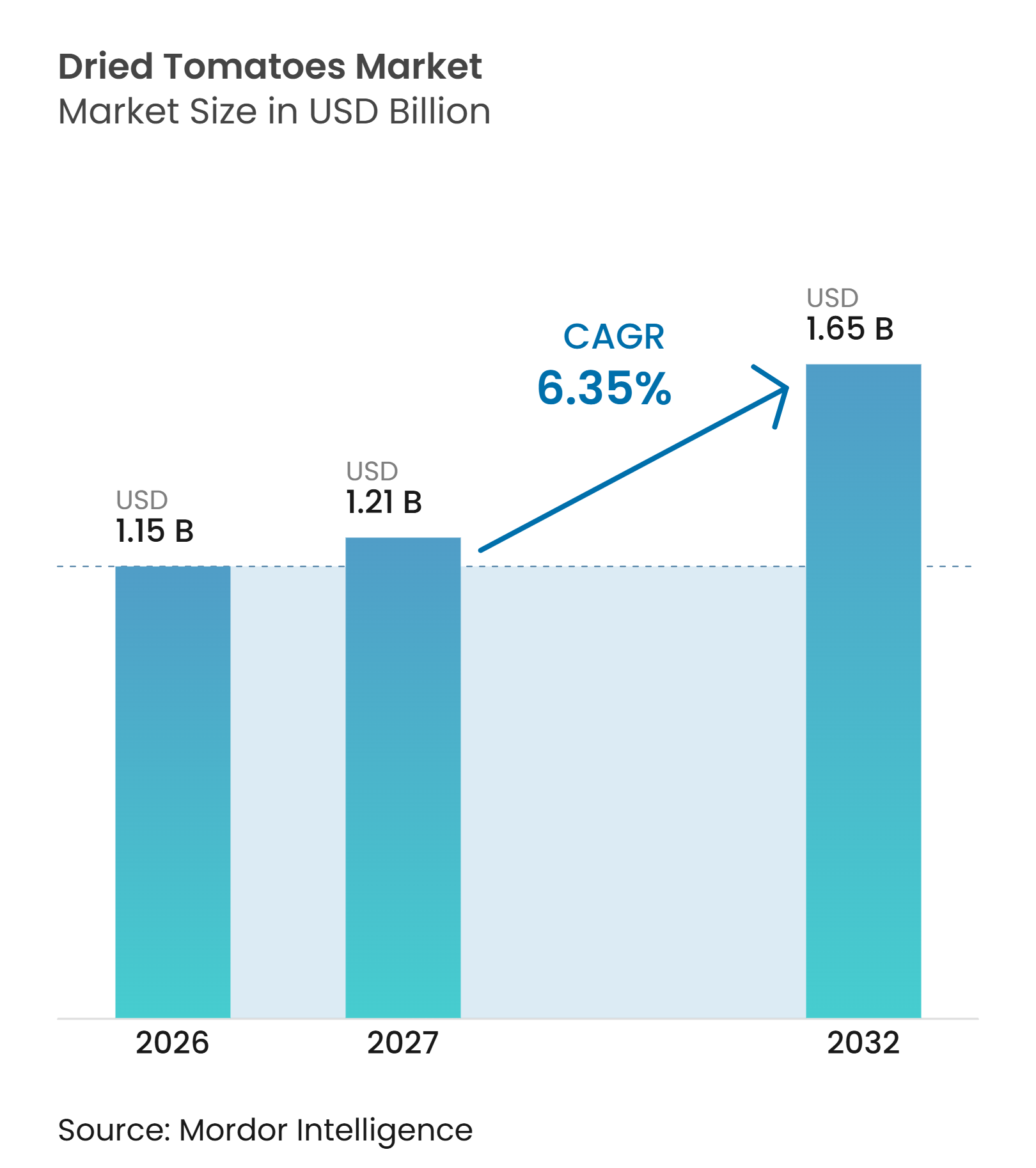
The Dried Tomatoes Market size is projected to expand from USD 1.15 billion in 2026 and USD 1.21 billion in 2027 to USD 1.65 billion by 2032, registering a CAGR of 6.35% between 2027 and 2032. Demand is being supported by the preference for recognizable, shelf-stable plant ingredients and by the wider use of Mediterranean flavors outside their traditional markets. Premium formats, including organic, single-origin, marinated, and ready-to-use products, are helping suppliers compete on more than price. Food manufacturers and foodservice operators are also seeking ingredients that offer concentrated flavor, reliable handling, and storage flexibility. Supply conditions remain important because weather-related crop shortfalls, compliance obligations, and food fraud can disrupt access to raw material. These conditions favor suppliers with traceable sourcing, verified processing systems, and a broader range of formats.
Key Report Takeaways
-
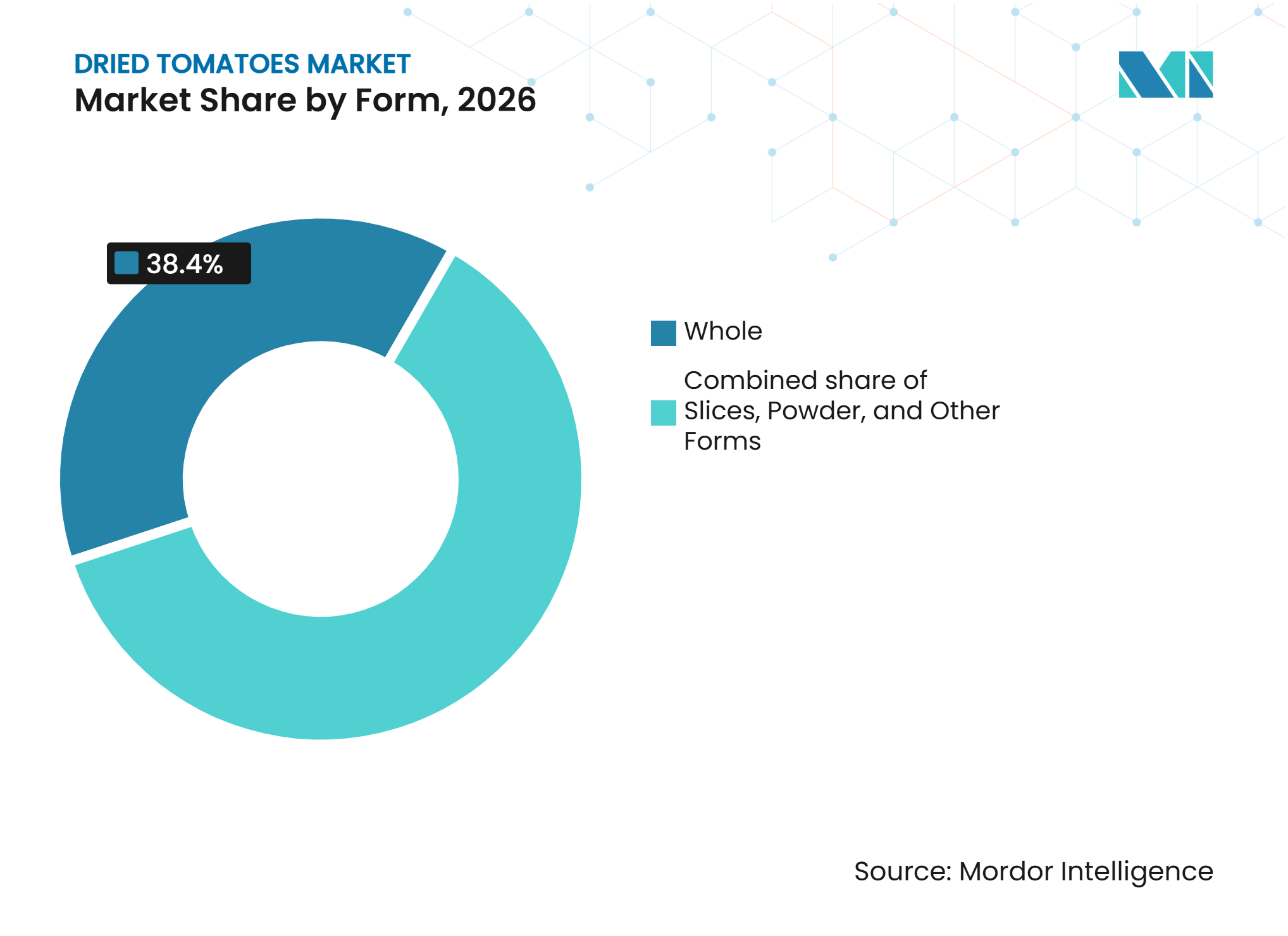
By form, Whole dried tomatoes held 38.4% of the dried tomatoes market share in 2026, while Powder is forecast to grow at a 7.2% CAGR through 2032.
-
By nature, Conventional held 76.2% of the dried tomatoes market share in 2026, while Organic is forecast to grow at an 8.3% CAGR through 2032.
-
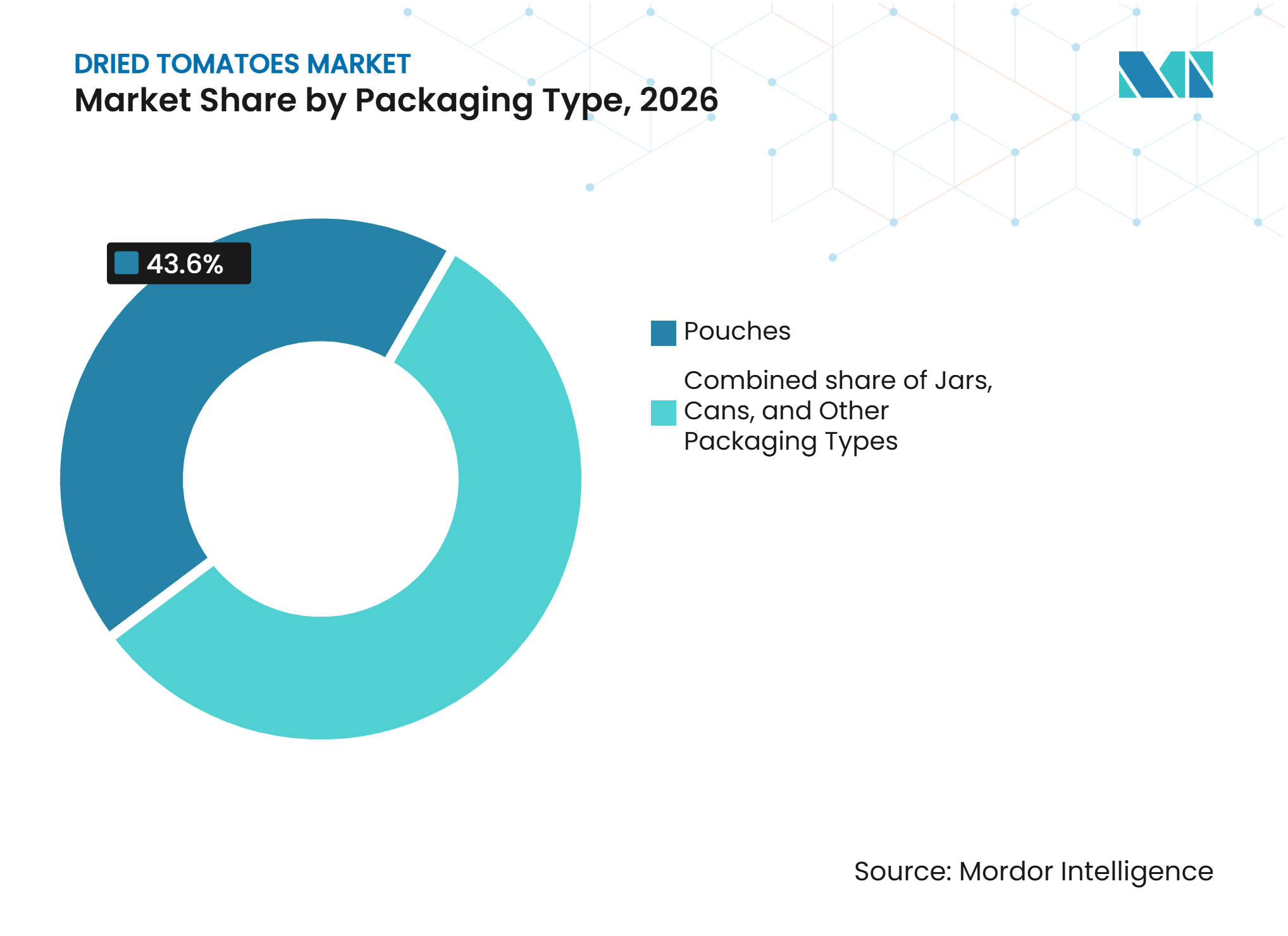
By packaging type, Pouches held 43.6% of the dried tomatoes market share in 2026, while Cans are forecast to grow at a 7.5% CAGR through 2032.
-
By distribution channel, Off-Trade held 73.3% of the dried tomatoes market share in 2026, while On-Trade is forecast to grow at a 7.6% CAGR through 2032.
-
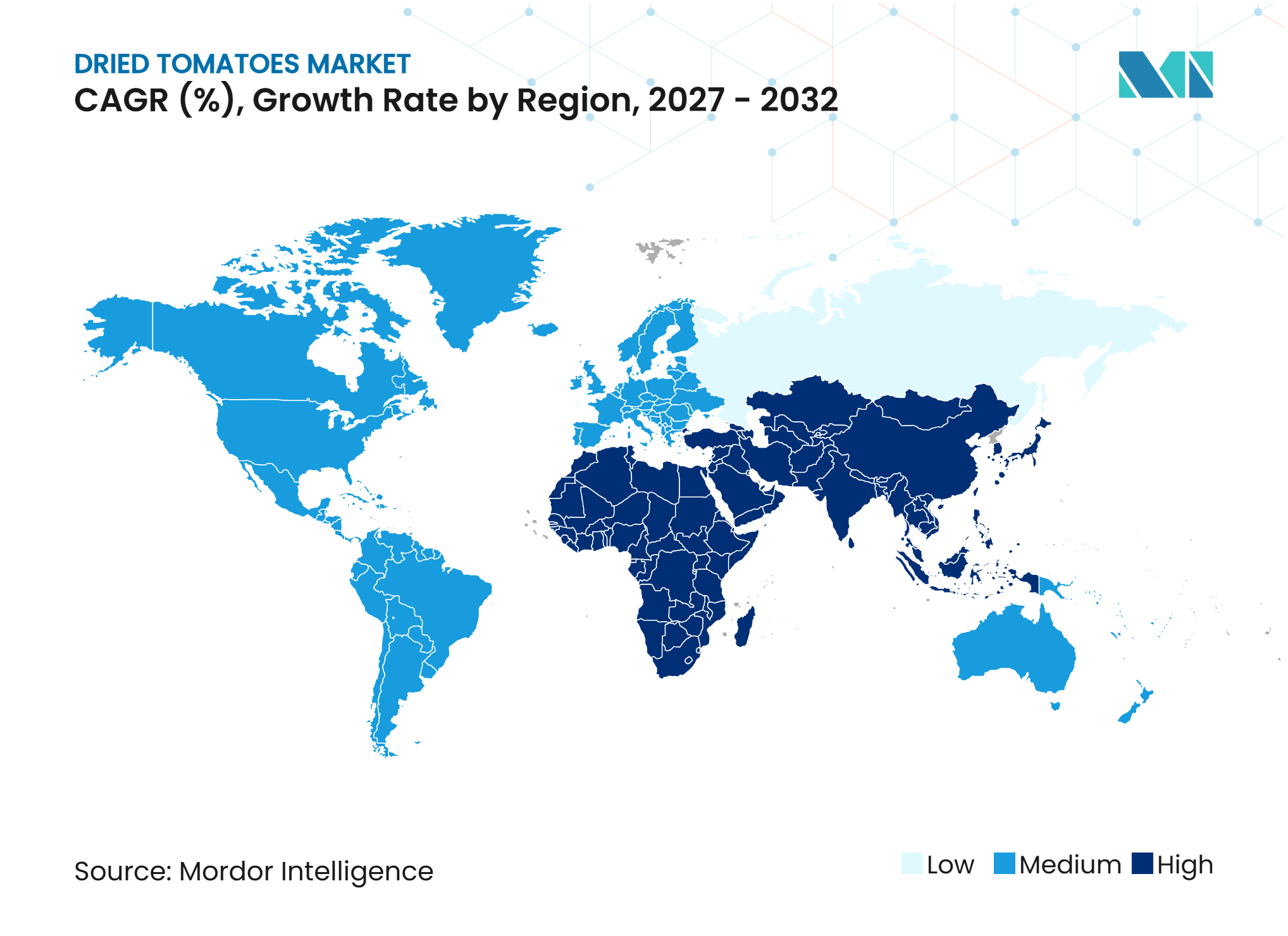
By geography, Europe held 36.7% of the dried tomatoes market share in 2026, while Asia-Pacific is forecast to grow at an 8.1% CAGR through 2032.
Note: Market numbers in this report are based on Mordor Intelligence's proprietary estimation framework, which combines nine months of actuals with Q4 projections for base year 2026.
Market Trends and Insights
Drivers Impact Analysis of Dried Tomatoes Market*
| Driver | (~) % Impact on CAGR Forecast | Geographic Relevance | Impact Timeline |
|---|---|---|---|
| Preference for Clean-Label and Minimally Processed Foods | +1.4% | Global, strongest in North America and Europe | Medium term (2–4 years) |
| Long Shelf Life and Reduced Food Waste | +0.9% | Global, early gains in APAC and MEA where cold chain is limited | Short term (≤ 2 years) |
| Growth of Organic and Non-GMO Products | +1.2% | North America and Europe core, spill-over to APAC and South America | Medium term (2–4 years) |
| Convenience and Ready-To-Use Formats | +0.8% | APAC core, North America, Europe | Short term (≤ 2 years) |
| Sustainable Sourcing and Eco-Friendly Processing | +0.6% | Europe and North America, early traction in APAC | Long term (≥ 4 years) |
| Advancements in Drying and Packaging Technology | +0.7% | Global, industrial adoption concentrated in North America and APAC | Long term (≥ 4 years) |
| Source: Mordor Intelligence | |||
Preference for Clean-Label and Minimally Processed Foods
Dried tomatoes benefit from being a recognizable, single-ingredient food with no need for synthetic additives in their basic form. This position is relevant as buyers look for shelf-stable plant foods with short and familiar ingredient declarations. The Organic Trade Association reported that U.S. sales of dried fruits and vegetables increased 13.6% in 2025, compared with 4.2% growth in total organic grocery sales[1]. The U.S. Food and Drug Administration reopened the comment period for its sanitation-program guidance for low-moisture ready-to-eat foods in 2025, raising the compliance expectations placed on dehydrated-food processors. The dried tomatoes market therefore gives established suppliers an advantage when they can combine a simple product proposition with documented sanitation controls. Smaller processors may face higher operating demands, while verified suppliers can use compliance and traceability as part of their commercial position.
Long Shelf Life and Reduced Food Waste
The dried tomatoes market benefits from the long ambient storage life of dehydrated products compared with fresh tomatoes. This feature helps retailers, distributors, and foodservice buyers manage inventory when cold-chain coverage is limited or when harvest output is uneven. A 2025 study found that properly oven-dried tomato products retained acceptable sensory quality during extended storage, with favorable outcomes for microbial safety and rehydration. Italy’s 2025 campaign produced 5.8 million tonnes of processing tomatoes across 78,695 hectares, while the source material described volumes as below prior expectations and noted increased raw-material costs in some southern basins. These conditions make dehydrated inventory valuable because sales can be less directly tied to the timing of the harvest. Dried formats also allow buyers to hold tomato ingredients for seasonings, snacks, and prepared foods without the same spoilage exposure associated with fresh produce.
Growth of Organic and Non-GMO Products
Organic dried tomatoes hold a smaller base than conventional products, but certification can support premium positioning in retail and export markets. Organic tomatoes carried a 127.5% retail premium over conventional tomatoes in the United States in 2025, the highest premium reported among organic produce categories. The dried tomatoes market can use that willingness to pay where buyers value provenance, residue controls, and certification. The Organic Trade Association reported that U.S. organic food sales reached USD 70.1 billion in 2025 and grew 6.9%, while dried beans, fruits, and vegetables grew 13.6%. Non-GMO verification can serve as an additional trust signal for buyers of natural foods and foodservice ingredients, although the evidence did not provide a dried-tomato-specific adoption figure. Organic JAS requirements also make certification relevant for exporters seeking premium Japanese retail channels.
Convenience and Ready-To-Use Formats
Ready-to-use formats make the dried tomatoes market relevant to buyers that need fewer preparation steps without losing a recognizable tomato profile. Sliced, julienne, minced, and resealable products can reduce handling time in retail kitchens, meal kits, and prepared-food operations. Sun-dried tomatoes appear in 2026 and 2027 restaurant trend materials as a flavor-forward ingredient used with artisan breads and fresh cheeses. These applications help suppliers sell formats that meet convenience needs while maintaining a traditional culinary association. The move also broadens the role of dried tomatoes beyond antipasto and pasta into sandwich, snack, seasoning, and ready-meal applications. For processors, a wider format range can reduce reliance on one end use and can help reach both retail and foodservice customers.
Restraints Impact Analysis of Dried Tomatoes Market*
| Restraint | (~) % Impact on CAGR Forecast | Geographic Relevance | Impact Timeline |
|---|---|---|---|
| Seasonal Availability and Supply Volatility | -1.1% | Global, with acute exposure in Europe (Italy/Turkey supply corridor) | Short to medium term (≤ 4 years) |
| Regulatory Compliance Complexity | -0.5% | Europe (EU Regulation 2023/915) and North America (FDA HARPC) | Medium term (2–4 years) |
| Contamination and Food Safety Risks | -0.5% | Global, RASFF exposure in Europe and FDA scrutiny in North America | Medium term (2–4 years) |
| Counterfeit and Low-Quality Product Risk | -0.4% | Europe and North America most affected; spill-over to APAC and MEA | Long term (≥ 4 years) |
| Source: Mordor Intelligence | |||
Seasonal Availability and Supply Volatility
The dried tomatoes market remains exposed to crop availability because production is linked to a limited number of major tomato-growing areas. Italy and Turkey are important sources for traded dried tomatoes, which creates procurement risk when weather or farm economics weaken output in more than one country. Turkey exported 34,419 tonnes in the first 10 months of 2025, an 11% year-over-year decline in volume, while average export prices increased 12% and export value reached USD 108 million. The source material also described pressure in Tunisia, where lower grower profitability threatened output and added to European supply tightness. Multi-sourcing can reduce exposure to an individual supplier, but simultaneous climate events can limit the benefit when they affect several growing regions. Buyers are likely to favor suppliers that can secure raw material through direct grower relationships, multiple origins, or stock held across seasons.
Regulatory Compliance Complexity
Dried tomato suppliers must manage contamination, traceability, and food-safety requirements across several export markets. The European Union’s contaminant rules require food-business operators to evaluate concentration effects created during drying and maintain supporting controls. The International Nut and Dried Fruit Council reported in 2025 that Codex was considering a code of practice for Ochratoxin A in dried fruits, which indicates greater attention to mycotoxin risk in shelf-stable dried foods[2]. U.S. low-moisture food sanitation guidance adds another compliance consideration for products sold into North America. These requirements can add testing, documentation, and process-control costs, especially for small exporters. They can also make HACCP, ISO 22000, FSSC 22000, BRC, and GlobalG.A.P. credentials more important in buyer selection.
*Our forecasts treat driver/restraint impacts as directional, not additive. The impact forecasts reflect baseline growth, mix effects, and variable interactions.
Dried Tomatoes Market Segment Analysis
By Form:
Powder Adds Ingredient Flexibility Alongside Whole-Format DemandWhole dried tomatoes held 38.4% of the dried tomatoes market share in 2026, driven by steady demand from gourmet retail, antipasto products, charcuterie, and foodservice applications where visible tomato pieces are part of the finished dish. Their familiar appearance makes them suitable for pasta, salads, bakery products, and Mediterranean-style prepared foods. Valley Sun Products operates a sun-drying yard in California exceeding 55 acres, processing more than 3 million pounds per season. Flavor-infused and artisanal whole products command higher unit values due to their visual appeal, while slices serve a broader middle market across pizza, sandwich, and prepared-food applications. Marinated and semi-dried products occupy smaller, premium-oriented segments where texture and flavor take priority over storage life.
Powder is forecast to grow at a 7.2% CAGR through 2032, making it the fastest-growing form in the dried tomatoes market. It serves as both a flavor ingredient and a natural color component in seasoning mixes, snack coatings, soups, sauces, bakery products, and ready meals. A 2025 review highlighted microwave, ultrasound, and infrared-assisted drying methods that improve efficiency and preserve food quality, while smart drying systems using digital monitoring and predictive control further enhance process consistency. Powder also offers food manufacturers a single-origin tomato flavor carrier that supports simplified ingredient declarations, and its low bulk and high tomato-solids density improve logistics efficiency for industrial users.



By Nature:
Conventional Volume Supports the Market While Organic Builds Premium ValueConventional dried tomatoes held 76.2% of the dried tomatoes market share in 2026. This dominance is largely due to the high costs and operational requirements of organic certification across farming, handling, storage, and processing. Restaurant chains, private-label retailers, and ingredient buyers prioritize stable specifications, dependable supply, and competitive prices, making conventional products the standard choice for high-volume channels. Buyers still require quality certifications such as HACCP, ISO 22000, and BRC. Established supply chains linking production in Italy, Turkey, and Chile with buyers in North America, Germany, and the United Kingdom give conventional suppliers a practical advantage in high-volume procurement. The segment covers formats from retail pouches to bulk industrial ingredients, making it relevant where procurement decisions focus on availability, standardized grades, and manageable input costs. Suppliers can differentiate their ranges through cut size, moisture control, source origin, and packaging.
Organic dried tomatoes are forecast to grow at an 8.3% CAGR through 2032, driven by buyers willing to pay for certified origin, traceability, and production standards. The Organic Trade Association reported that organic food sales in the United States reached USD 70.1 billion in 2025, with the dried beans, fruits, and vegetables category increasing 13.6%. Organic tomatoes carried a 127.5% premium over conventional tomatoes in U.S. retail during 2025. USDA Organic, EU Organic, and Organic JAS certifications provide clear commercial signals to retailers and importers. Although the organic segment remains smaller than the conventional base, it benefits from strong pricing power and differentiated positioning. The key challenge is maintaining certified supply while managing higher operating costs. Organic producers need strong grower relationships and clear post-harvest handling procedures to consistently meet buyer expectations and protect the premium their products command in specialist retail and export channels.
By Packaging Type:
Pouches Lead Consumer Sales While Cans Serve Larger UsersPouches held 43.6% of the dried tomatoes market share in 2026, driven by their light weight, resealability, and suitability for small retail pack sizes. They are well suited for products sold through supermarkets, specialty stores, convenience outlets, and online channels, offering a practical option for consumers who use dried tomatoes in small quantities across multiple occasions. The format supports premium visual presentation through printed packs without the breakage concerns associated with glass. In 2026, ProAmpac commercialized its ProActive Intelligence Moisture Protect MP-1000 film, designed to absorb residual moisture in packaged dry products without a desiccant insert, which is particularly relevant for dried tomatoes as moisture changes can affect texture and quality. Jars continue to serve sun-dried tomatoes packed in oil and other gourmet products, while bulk bags remain relevant for industrial buyers purchasing larger volumes for further processing.
Cans are forecast to grow at a 7.5% CAGR through 2032, supported by foodservice demand for durable packaging, extended ambient storage, and standardized handling in commercial kitchens. The format suits larger units used by institutional catering and restaurant buyers, and in areas with unreliable cold-chain infrastructure, ambient-stable canned products offer a practical alternative to chilled or frozen options. Pouches will remain important in consumer retail, while cans serve larger-volume foodservice needs. Suppliers offering multiple formats, including pouches, jars, cans, and bulk packs, can address a broader range of customer requirements, reduce dependence on a single route to market, and support both household and commercial demand from the same processing base.

By Distribution Channel:
Off-Trade Scale Coexists With Faster Foodservice DemandOff-Trade held 73.3% of the dried tomatoes market share in 2026. The segment reaches consumers through supermarkets, hypermarkets, specialty food stores, convenience outlets, and online retailers. These channels carry whole, sliced, marinated, oil-packed, organic, and premium single-origin products. Specialty stores support products that require consumer education or a Mediterranean food context to justify higher prices. Online retail helps brands reach health-conscious buyers who cannot find certified or specialty products in mainstream grocery stores. Private-label products create price pressure in supermarkets and hypermarkets, challenging branded suppliers without clear differentiation. Brands can respond through certification, product origin, flavor variants, and convenient pack formats. Off-Trade will remain the primary volume channel, serving repeated household purchases across multiple store formats.
On-Trade is forecast to grow at a 7.6% CAGR through 2032. Restaurants and foodservice customers use dried tomatoes where flavor concentration and product consistency matter. Sun-dried tomatoes were identified as a resurgent menu ingredient in 2026 and 2027 food trend reports. Larger chains and institutional kitchens are shifting toward contracted purchasing, increasing the value of reliable grade, format, and documentation. Suppliers with HACCP and GlobalG.A.P. credentials are better positioned for these arrangements. Meal-delivery platforms and ghost kitchens further drive demand for ingredients that can be stored and used consistently across sites. Although smaller than Off-Trade, On-Trade has a stronger growth profile, combining menu innovation with professional procurement. Suppliers that offer tailored cuts, pack sizes, and moisture specifications are better placed to build stable relationships with restaurant groups operating across multiple locations.
Geography Analysis
Europe: Production and Consumption Remain Closely Connected
Europe held 36.7% of the dried tomatoes market share in 2026. The region combines established consumption with a large processing base, particularly in Italy, where dried and preserved tomato products are part of the food economy. Italy processed 5.8 million tonnes of tomatoes across 78,695 hectares in its 2025 campaign and moved ahead of China as the second-largest processing-tomato producer after the United States. Supply Chain Italy reported tomato-product export values above EUR 2.8 billion, equal to USD 3.1 billion, for the 2024 and 2025 campaign. Germany, the United Kingdom, and France are important destinations for these products. F.lli Saclà sells into more than 70 countries, and exports account for half of its global revenue, with sun-dried tomatoes its leading product. Turkey’s 8,900-tonne annual European Union quota for dried tomatoes indicates continued demand for imported supply in European markets. European buyers face regulatory influence from contaminant limits, quality systems, and traceability requirements. These compliance factors reinforce the importance of certified production and documented drying controls. The region remains a large outlet for premium, organic, and foodservice-oriented formats.
Asia-Pacific: Processing Capacity Supports Faster Growth
Asia-Pacific is forecast to grow at an 8.1% CAGR through 2032. The dried tomatoes market size in the region is being supported by growth in processed-food manufacturing and by the development of domestic dehydrated-ingredient capacity. Japan remains a premium destination where strict specifications and Organic JAS certification can favor verified exporters. India is developing additional drying capability through work by the Indian Institute of Science’s Centre for Sustainable Technologies, which transferred lower-cost solar biomass drying technology to farming communities. The technology is relevant because it can strengthen local capacity to handle agricultural surplus and support dried-vegetable production. Regional processors can compete through proximity to tomato cultivation, lower logistics needs, and formats tailored to local food manufacturing. The region also presents a chance for suppliers to expand powder and industrial ingredients rather than relying only on imported whole dried tomatoes. Compliance factors are important in Japan, where certification and product specifications influence market access. The pace of new processing capacity may gradually alter the balance between traditional Mediterranean suppliers and regional ingredient producers.
North America, South America, and the Middle East and Africa: Different Routes to Demand
North America has a mature supply base, with California’s 2025 processing-tomato harvest reaching 10.6 million tonnes, 6% above 2024. The region also continues to use Mediterranean imports, as Turkish dried-tomato exports to the United States increased 24% to USD 26.2 million in the first 10 months of 2025. This combination supports premium consumer formats and ingredient demand from large foodservice and packaged-food customers. Food-safety oversight and low-moisture product sanitation guidance are important regulatory influences for suppliers serving the United States. South America offers agricultural supply potential and an opportunity for local processing investment, although non-authentic third-party growth estimates were excluded from this analysis. The Middle East and Africa serve as emerging import destinations where foodservice development and constrained cold-chain infrastructure can favor ambient-stable products. The United Arab Emirates is relevant because an expatriate consumer base and foodservice development support demand for internationally traded food products. Turkey’s export reach across 98 countries, including Brazil and Japan, shows the broader global distribution of dried tomatoes. These mixed regions require suppliers to adapt package size, certification, and product format to local distribution conditions. Their opportunities are distinct, but each benefits from products that can withstand transport and store at ambient temperatures.
Competitive Landscape
Market Concentration
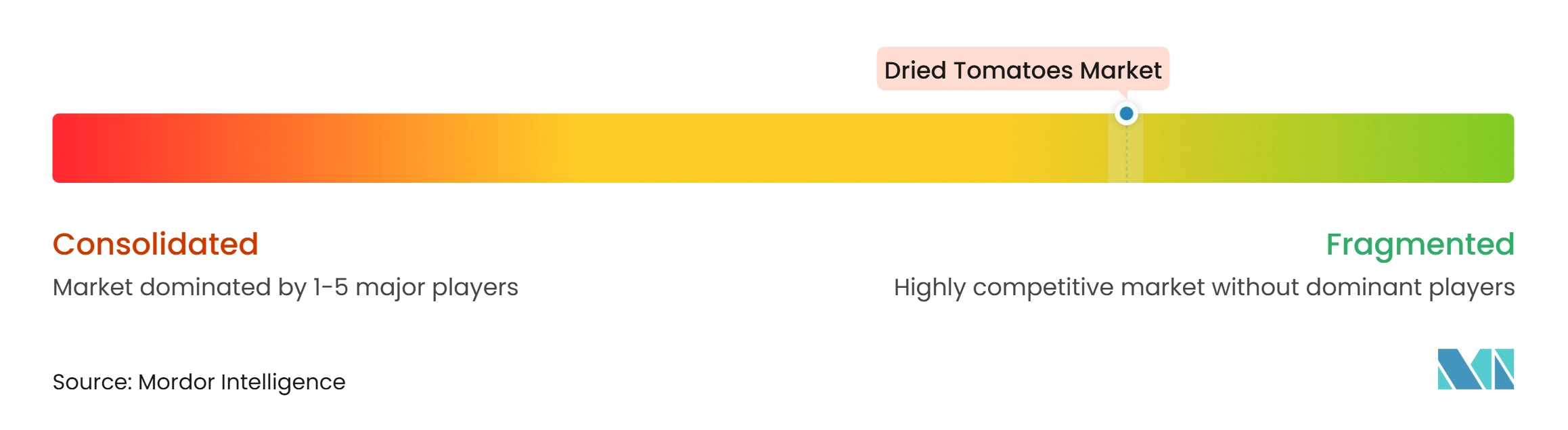
The dried tomatoes market is moderately fragmented, with regional specialists operating alongside larger dehydrated-ingredient suppliers. Key players include Fiordelisi S.r.l. and Conesa Group in southern Europe, Valley Sun Products and BCFoods in North America, Invertec Foods in South America, and Mevive International in South Asia. No single player holds dominant market share. Competition centers on agricultural sourcing, product formats, certifications, and multi-region customer service. Suppliers are expanding beyond sun-dried tomatoes into semi-dried, marinated, powdered, and seasoning-blend formats to serve retail, foodservice, and industrial users. Vertical integration helps reduce raw-material volatility, while traceability is increasingly important for food safety and origin assurance.
BCFoods integrated Culinary Farms into its brand in April 2025, consolidating dried tomatoes, chiles, seasonings, and smoked ingredients into a single global offering and expanding its foodservice and consumer packaged goods coverage. La Doria reported a 43% reduction in water consumption and a 67% reduction in pesticide use in its 2025 sustainability report through IoT-based precision agriculture. Fiordelisi adopted Tosca reusable Active Lock folding crates, gaining capacity for 560 more filled crates per truck, equal to more than 1 additional tonne per journey. These actions reflect competition driven by operational control rather than advertising alone.
Technology adoption is growing in importance across drying, packaging, and logistics. Asia-Pacific suppliers may find growth opportunities in powder and industrial formats by placing processing closer to cultivation zones. European suppliers retain advantages in product reputation and foodservice knowledge. FSSC 22000 and BRC certifications are now key requirements for retail and business-to-business procurement, narrowing the field for suppliers without formal food safety systems. Companies demonstrating consistent moisture levels, grades, and traceability are better positioned to secure contracted supply, while those relying on spot purchasing may struggle as buyers place greater weight on documentation.
Dried Tomatoes Industry Leaders
-
BCFoods Inc.
-
Valley Sun Products, Inc.
-
Mooney Farms
-
Conesa Group
-
Fiordelisi S.r.l.
- *Disclaimer: Major Players sorted in no particular order
Dried Tomatoes Market Companies Covered in this Report
- Valley Sun Products, Inc.
- Mooney Farms
- California Sun Dry Foods
- Fiordelisi S.r.l.
- Borges International Group
- ConAgra Brands
- BCFoods Inc.
- ROHA
- Silva International, Inc.
- Invertec Foods
- Mevive International
- Fitaky Food
- Conesa Group
- Aarkay Food Products Ltd.
- Garlico Industries Ltd.
- Lycored
- Harmony House Foods, Inc.
- Kanegrade Ltd.
- Agusa
- Vegenat S.A.
Recent Industry Developments in Dried Tomatoes Market
- August 2026: Parnassia Food Ingredients (Netherlands) launched a new dried cherry tomato product line targeting industrial and foodservice applications across Europe. The bite-sized format delivers concentrated sweetness and rich tomato flavor for premium ready meals, salads, and bakery manufacturers, addressing limited availability of cherry tomato variants relative to conventional halved dried tomatoes.
- February 2026: BCFoods launched a new global website to consolidate brand identity following the Culinary Farms integration, enhancing customer access to its expanded product portfolio including dried tomatoes, freeze-dried fruits, and specialty dehydrated ingredients.
- April 2025: BCFoods completed the full integration of Culinary Farms into its global brand, absorbing the subsidiary’s premium dried tomato, chile, seasoning, and smoked ingredient portfolio into BCFoods’ consolidated product range. The integration consolidated operations, reinforced sustainability and traceability commitments, and enhanced service capabilities for consumer packaged goods and foodservice customers.
Global Dried Tomatoes Market Report Scope
The Dried Tomatoes Market refers to the market for tomatoes that have undergone moisture-removal processes, such as sun-drying, air-drying, or dehydration, to extend shelf life and concentrate their flavor, making them suitable for use in food preparation, ingredient manufacturing, and culinary applications. By form, the market is segmented into whole, slices, powder, and other forms. By nature, the market is divided into conventional and organic products. By packaging type, the market is segmented into pouches, jars, cans, and other packaging types. By distribution channel, the market is divided into on-trade and off-trade channels, with off-trade further segmented into supermarkets and hypermarkets, convenience stores, specialty food stores, online retail stores, and the rest of distribution channels. Geographically, the market covers North America, Europe, Asia-Pacific, South America, and the Middle East and Africa, with country-level coverage across major markets, including the United States, Canada, Mexico, Germany, the United Kingdom, Italy, France, China, India, Japan, Australia, Brazil, Argentina, Saudi Arabia, and the United Arab Emirates, along with the respective regional rest-of-country categories. Market size and growth forecasts are presented in terms of value (USD).
Segmentation Overview
| Whole |
| Slices |
| Powder |
| Other Forms |
| Conventional |
| Organic |
| Pouches |
| Jars |
| Cans |
| Other Packaging Types |
| On-Trade | |
| Off-Trade | Supermarkets and Hypermarkets |
| Convenience Stores | |
| Specialty Food Stores | |
| Online Retail Stores | |
| Rest of Distribution Channels |
| North America | United States |
| Canada | |
| Mexico | |
| Rest of North America | |
| Europe | Germany |
| United Kingdom | |
| Italy | |
| France | |
| Rest of Europe | |
| Asia-Pacific | China |
| India | |
| Japan | |
| Australia | |
| Rest of Asia-Pacific | |
| South America | Brazil |
| Argentina | |
| Rest of South America | |
| Middle East and Africa | Saudi Arabia |
| United Arab Emirates | |
| Rest of Middle East and Africa |
| By Form | Whole | |
| Slices | ||
| Powder | ||
| Other Forms | ||
| By Nature | Conventional | |
| Organic | ||
| By Packaging Type | Pouches | |
| Jars | ||
| Cans | ||
| Other Packaging Types | ||
| By Distribution Channel | On-Trade | |
| Off-Trade | Supermarkets and Hypermarkets | |
| Convenience Stores | ||
| Specialty Food Stores | ||
| Online Retail Stores | ||
| Rest of Distribution Channels | ||
| By Geography | North America | United States |
| Canada | ||
| Mexico | ||
| Rest of North America | ||
| Europe | Germany | |
| United Kingdom | ||
| Italy | ||
| France | ||
| Rest of Europe | ||
| Asia-Pacific | China | |
| India | ||
| Japan | ||
| Australia | ||
| Rest of Asia-Pacific | ||
| South America | Brazil | |
| Argentina | ||
| Rest of South America | ||
| Middle East and Africa | Saudi Arabia | |
| United Arab Emirates | ||
| Rest of Middle East and Africa | ||
Key Questions Answered in the Report
What is the projected value of dried tomatoes by 2032?
The dried tomatoes market is forecast to reach USD 1.65 billion by 2032, expanding at a 6.35% CAGR from 2027 to 2032. Demand is supported by shelf-stable formats, premium products, and broader foodservice use.
Which dried tomato form is growing fastest?
Powder is the fastest-growing form, with a forecast CAGR of 7.2% through 2032, supported by seasoning, snack, and ready-meal uses. It provides concentrated tomato flavor where visible pieces are not required.
Why are organic dried tomatoes gaining traction?
Organic dried tomatoes are forecast to grow at an 8.3% CAGR through 2032, aided by certification-led premium positioning and growth in organic dried fruits and vegetables. USDA Organic, EU Organic, and Organic JAS credentials can support buyer confidence.
Which packaging format leads sales of dried tomatoes?
Pouches lead packaging with a 43.6% share in 2026 because they are lightweight, resealable, and well suited to retail pack sizes. They also support online and specialty-store product assortments.
Which sales channel is expanding fastest for dried tomatoes?
On-Trade is forecast to grow at a 7.6% CAGR through 2032 as restaurants and institutional kitchens seek consistent, certified ingredients.