
DRAM For Networking and Telecom Equipment Market Size and Share
Market Overview
| Study Period | 2020 - 2031 |
|---|---|
| Market Size (2025) | USD 3.47 Billion |
| Market Size (2031) | USD 5.62 Billion |
| Growth Rate (2026 - 2031) | 10.12 % |
| Fastest Growing Market | Asia-Pacific |
| Largest Market | Asia-Pacific |
| Market Concentration | High |
Major Players *Disclaimer: Major Players sorted in no particular order Image © Mordor Intelligence. Reuse requires attribution under CC BY 4.0. | |
DRAM For Networking and Telecom Equipment Market Analysis by Mordor Intelligence
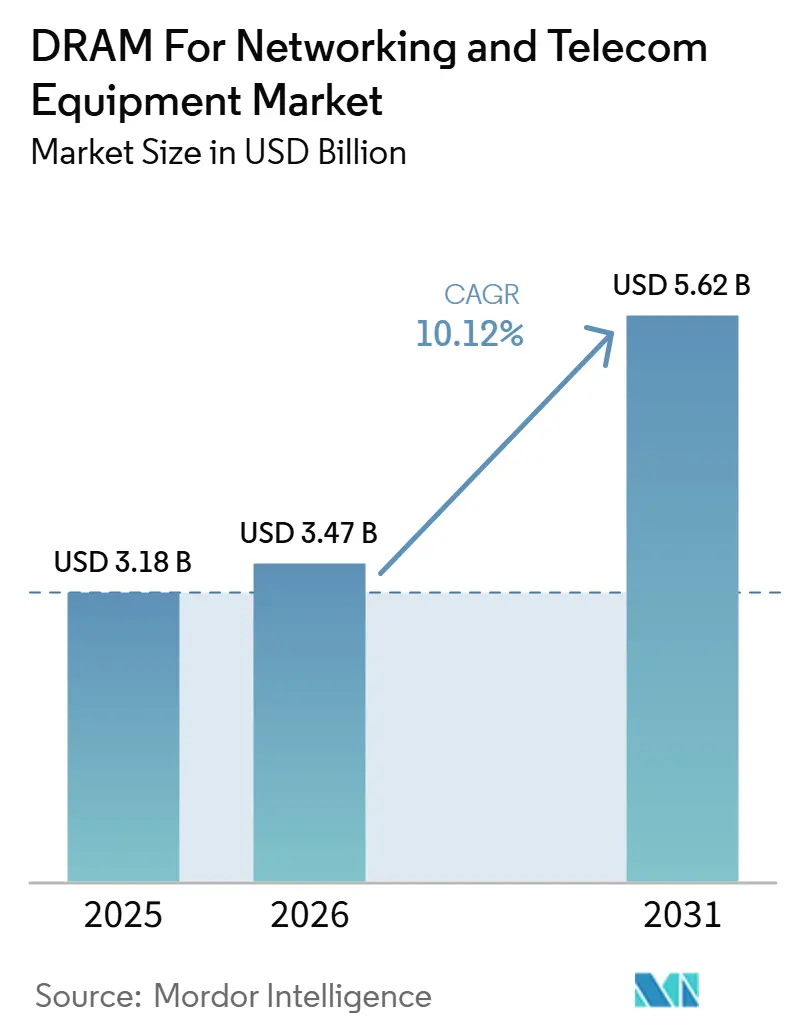
The DRAM for networking and telecom equipment market size is projected to be USD 3.2 billion in 2025, USD 3.5 billion in 2026, and reach USD 5.6 billion by 2031, growing at a CAGR of 10.1% from 2026 to 2031. The DRAM for networking and telecom equipment market is being boosted by 5G expansion, Open RAN adoption, and a broader shift toward software-driven network platforms that require more memory per node than earlier generations. Demand is also rising because routing, switching, and edge processing workloads now carry more traffic management logic, virtualization layers, and local compute functions inside the same hardware envelope. Supplier strategy is shaping the DRAM for networking and telecom equipment market as strongly as end demand, because major manufacturers are balancing conventional DDR products with faster-growing AI memory lines. That mix is keeping procurement conditions tight and increasing the value of suppliers that can support long product cycles, telecom qualification, and stable delivery across several hardware refresh waves. The DRAM for networking and telecom equipment market also has room for module vendors that can serve server-based telecom platforms where carriers want upgrade flexibility, easier qualification, and lower redesign risk over time.
Key Report Takeaways
- By type, DDR4 held 58.2% share in 2025, while DDR5 is forecast to expand at an 11.3% CAGR through 2031 in the DRAM for networking and telecom equipment market.
- By product form, DRAM IC held 74.2% share in 2025, while RDIMM/LRDIMM is projected to grow at a 10.5% CAGR through 2031 in the DRAM for networking and telecom equipment market.
- By form factor, Embedded DRAM captured 76.1% share in 2025, while Memory Modules are advancing at an 11.3% CAGR through 2031 in the DRAM for networking and telecom equipment market.
- By functionality, Standard DRAM accounted for 84.4% share in 2025, while Low-Power DRAM is expected to grow at a 10.9% CAGR through 2031 in the DRAM for networking and telecom equipment market.
- By geography, Asia-Pacific held 48.2% share in 2025 and is expected to record the highest CAGR at 11.3% through 2031 in the DRAM for networking and telecom equipment market.
Note: Market size and forecast figures in this report are generated using Mordor Intelligence’s proprietary estimation framework, updated with the latest available data and insights as of January 2026.
Market Trends and Insights
Drivers Impact Analysis of DRAM For Networking and Telecom Equipment Market*
| Driver | (~) % Impact on CAGR Forecast | Geographic Relevance | Impact Timeline |
|---|---|---|---|
| Growing 5G And Advanced Network Rollouts | +3.5% | Global, highest concentration in Asia-Pacific, North America, and Europe | Short term (≤ 2 years) |
| Rising Memory Density Requirements In Routers And Switches | +2.3% | Global, acute in North America and Asia-Pacific core | Medium term (2-4 years) |
| DDR5 Transition In Telecom Infrastructure Platforms | +1.8% | North America, Europe, Asia-Pacific core, spill-over to Rest of the World | Medium term (2-4 years) |
| AI-Driven Edge And Micro Data Center Expansion | +1.4% | North America and Asia-Pacific core, spill-over to Europe | Medium term (2-4 years) |
| Power Efficiency Pressure In Network Equipment Design | +0.8% | Global | Long term (≥ 4 years) |
| CXL And Memory Pooling For Telecom Edge Architectures | +0.5% | North America and Asia-Pacific core | Long term (≥ 4 years) |
| Source: Mordor Intelligence | |||
Growing 5G And Advanced Network Rollouts
Growing 5G and advanced network rollouts are increasing memory demand across routers, switches, baseband units, and edge compute nodes in the DRAM for networking and telecom equipment market. The change is greater than in earlier mobile generations because Open RAN and virtualized functions rely more heavily on server-style architectures, bringing higher DRAM density into telecom deployments. That shift moves more memory into commercial platforms that must support both software workloads and transport functions simultaneously, which lifts content value even before unit volume fully scales. KDDI completed technical validation of its distributed disaggregated backbone router cluster in February 2025 and began large-scale commercial deployment in 2026, showing how carrier backbone upgrades are increasing memory needs per node. Standards bodies such as 3GPP and ETSI continue to shape platform requirements, and that keeps supplier qualification closely tied to long network investment cycles across the DRAM for networking and telecom equipment market. As operators push wider 5G coverage and more network intelligence, suppliers with telecom-ready DDR4 and DDR5 portfolios are positioned to capture steadier design wins over the forecast period.
Rising Memory Density Requirements In Routers And Switches
Rising memory density requirements in routers and switches are increasing the value of higher-capacity configurations in the DRAM for networking and telecom equipment market. Network equipment now has to handle larger routing tables, more software control functions, and more AI-assisted traffic management inside hardware platforms that still face strict reliability and thermal limits. That pressure is pushing vendors to support multiple DRAM generations simultaneously, because customers still need continuity in fielded systems even as newer platforms move higher in bandwidth and capacity. Broadcom launched its BCM677x family in June 2026, supporting DDR4, DDR5, LPDDR4, and LPDDR5, reflecting the need for flexible memory choices in next-generation routers and 5G fixed wireless access equipment. The DRAM for networking and telecom equipment market is therefore benefiting from both capacity growth and architectural flexibility, rather than from shipment growth alone. Vendors that can qualify denser modules or embedded designs without disrupting field reliability are likely to remain favored in refresh cycles where uptime and compatibility still matter more than headline speed alone.
DDR5 Transition In Telecom Infrastructure Platforms
The DDR5 transition in telecom infrastructure platforms is creating revenue opportunities for DRAM for networking and telecom equipment market, as new platforms need more bandwidth and better power efficiency. DDR4 still anchors much of the installed base, but current design activity is moving toward DDR5, with new carrier and edge systems being qualified for longer product lifespans. SK Hynix completed Intel Data Center Certification for its 256 GB DDR5 RDIMM in December 2025, helping shorten qualification paths for server-based telecom workloads and making high-density deployment easier for OEM planning.[1]SK hynix Inc., “SK Hynix First to Complete Intel Data Center Certification for 32Gb Die-Based 256GB Server DDR5 RDIMM,” SK Hynix Newsroom, news.skhynix.com Micron followed in May 2026 by sampling a 256 GB DDR5 RDIMM built on 1-gamma technology at 9,200 MT/s, which set a higher performance point for ecosystem validation in infrastructure platforms. This transition matters in the DRAM for networking and telecom equipment market because operators want higher throughput and better scaling without a proportional increase in power consumption or board complexity. Suppliers that can support both the existing DDR4 fleet and the newer DDR5 pipeline should keep a strong position through the forecast period, especially where telecom qualification runs longer than standard server refresh cycles.
AI-Driven Edge And Micro Data Center Expansion
AI-driven edge and micro data center expansion is widening the use case for higher-density memory in the DRAM for networking and telecom equipment market. Telecom operators are placing more compute closer to the network edge, which makes memory decisions part of the broader network design rather than a back-end server issue handled later. The shift also favors modular expansion paths because edge sites often need upgrade flexibility without full board redesign, long shutdown windows, or repeated on-site engineering work. Innodisk launched a CXL Add-In Card in February 2026 for micro data centers, 5G networking, and latency-sensitive edge deployments, which shows how memory vendors are addressing telecom-adjacent AI infrastructure with upgrade-friendly products. The DRAM for networking and telecom equipment market is gaining from this trend because edge networks are beginning to consume memory in ways that look closer to compact data center platforms than to legacy fixed-function hardware. Companies that can combine carrier-grade reliability with modular memory expansion should find more opportunities as edge workloads mature and telecom buyers seek practical ways to scale local compute capacity.
Restraints Impact Analysis of DRAM For Networking and Telecom Equipment Market*
| Restraint | (~) % Impact on CAGR Forecast | Geographic Relevance | Impact Timeline |
|---|---|---|---|
| Supply Prioritization Toward HBM And AI Servers | -2.0% | Global | Short term (≤ 2 years) |
| Long Qualification Cycles For Carrier-Grade Memory | -1.5% | Global, highest friction in North America and Europe | Medium term (2-4 years) |
| Legacy DDR4 Installed Base Delaying Migration Cycles | -1.0% | Global, most pronounced in rest of the world and rest of Asia-Pacific | Medium term (2-4 years) |
| Export Controls And Supply Chain Concentration Risk | -0.8% | Asia-Pacific core, spill-over to North America and Europe | Short term (≤ 2 years) |
| Source: Mordor Intelligence | |||
Supply Prioritization Toward HBM And AI Servers
Supply prioritization toward HBM and AI servers is limiting the pace at which the DRAM for networking and telecom equipment market can be served, even though demand fundamentals remain firm. The issue is not weak network spending, but the reallocation of advanced manufacturing attention toward AI memory products that offer stronger pricing and faster near-term growth. Samsung began mass production of HBM4 in February 2026, reinforcing the industry's focus on high-bandwidth memory programs at a time when telecom buyers still needed conventional DRAM lines. [2]Samsung Electronics, “Samsung Ships Industry-First Commercial HBM4 With Ultimate Performance for AI Computing,” Samsung Global Newsroom, news.samsung.com As more leading-edge capacity shifts in that direction, telecom buyers face tighter availability of conventional DDR4 and DDR5 families across the DRAM for networking and telecom equipment market. The result is longer planning cycles, more pressure to secure supply early, and greater dependence on large vendors with broad product roadmaps and stronger allocation control. This restraint matters most for equipment makers that need stable sourcing across several platform generations, because they cannot easily redesign qualified systems every time memory availability tightens.
Long Qualification Cycles For Carrier-Grade Memory
Long qualification cycles for carrier-grade memory are slowing revenue conversion in the DRAM for networking and telecom equipment market, even when new products are already commercially available. Telecom equipment often remains in service for many years, so suppliers must undergo stricter validation for reliability, interoperability, and environmental performance before broader design adoption begins. That makes each memory transition slower than a standard server refresh, giving a clear advantage to vendors with an established approval history and long support records. SK Hynix's Intel certification milestone in December 2025 showed the kind of validation step that telecom OEMs want before broad DDR5 adoption can move forward across mission-critical infrastructure programs. The same pattern supports specialist vendors that focus on controlled bill of materials, lifecycle support, and long product availability in the DRAM for networking and telecom equipment market. Even when demand is present, qualification timing can delay shipment ramps and prevent newer memory generations from scaling quickly, thereby stretching the overlap period between legacy and next-generation platforms.
*Our forecasts treat driver/restraint impacts as directional, not additive. The impact forecasts reflect baseline growth, mix effects, and variable interactions.
DRAM For Networking and Telecom Equipment Market Segment Analysis
By Type:
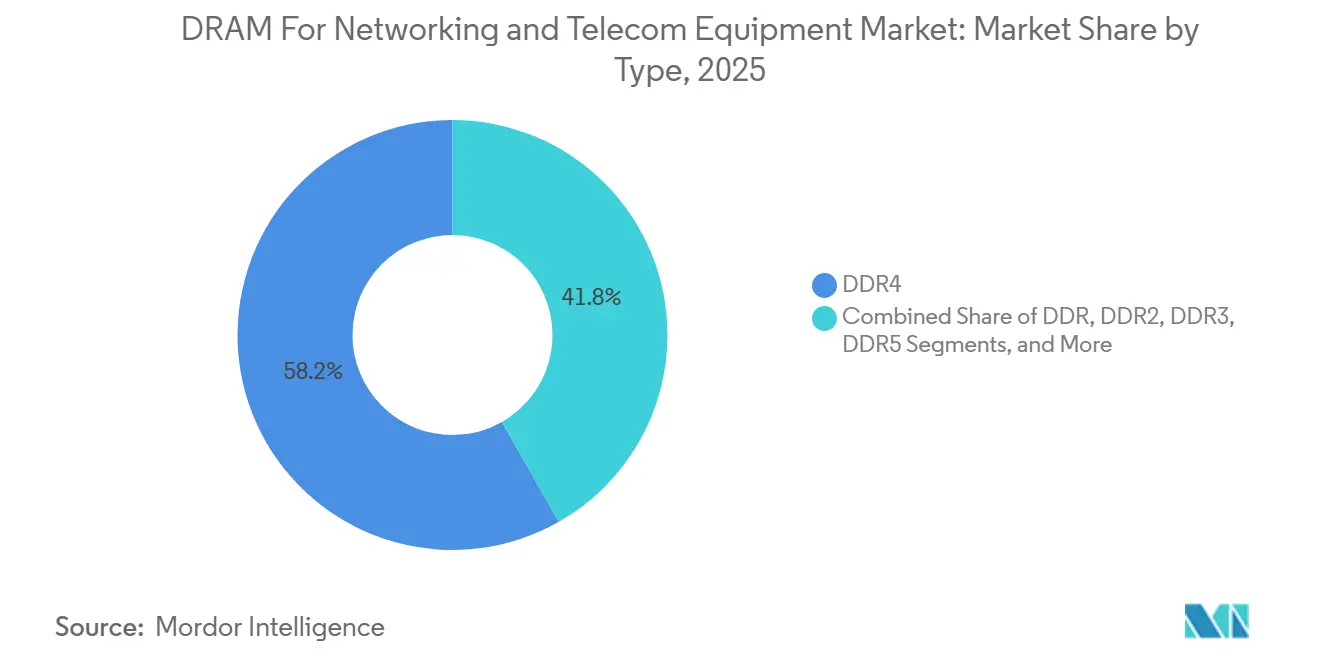
DDR5 Is Rising, While DDR4 Still Anchors The Installed BaseDDR4 held 58.2% of the DRAM for networking and telecom equipment market share in 2025, reflecting the size of the installed base across routers, switches, and base station platforms that were qualified based on DDR4 availability and cost discipline. Its lead remained tied to ecosystem maturity, lower transition risk, and the fact that many carrier platforms still prioritize continuity over aggressive architecture change. Older generations, such as SDRAM, DDR, DDR2, and DDR3, stayed limited to maintenance programs and lifecycle extensions, with little relevance to fresh design wins in 2026 platform planning. DDR5 is forecast to expand at a 11.3% CAGR through 2031, indicating where new product development is heading as vendors prepare for broader software workloads, faster buffering, and richer control functions. The result is a structure where the DRAM for networking and telecom equipment market still earns much of its value from DDR4 volume, even while future design momentum shifts higher.
Micron sampled its 256 GB DDR5 RDIMM at 9,200 MT/s in May 2026, and that release provided equipment designers with a clear reference point for next-generation control-plane and server-based telecom workloads. SK Hynix's certification milestone in December 2025 also supported broader confidence around enterprise-grade DDR5 readiness for telecom-adjacent platforms that need long qualification paths and high-density scaling.[3]SK hynix Inc., “SK Hynix First to Complete Intel Data Center Certification for 32Gb Die-Based 256GB Server DDR5 RDIMM,” SK Hynix Newsroom, news.skhynix.com Even so, the transition is slower here than in hyperscale servers because operators keep equipment in the field longer and test more extensively before a platform shift is approved. That creates a long overlap period in which suppliers that can serve both DDR4 and DDR5 remain best placed in the DRAM for networking and telecom equipment market. It also means type leadership will change more gradually than design activity suggests, because installed hardware and procurement discipline still favor orderly migration over rapid replacement.



By Product Form:
Discrete Chips Lead, While Registered Modules Gain From Server-Based Telecom DesignsDRAM IC commanded a 74.2% share in 2025, indicating that direct chip integration still anchors most hardware designs in the DRAM for networking and telecom equipment market. Those discrete chips fit well in routing ASICs, switching SoCs, and line cards where board layout, latency control, thermal behavior, and long validation cycles remain tightly managed. DRAM Modules held the smaller position, but they became more relevant where telecom functions moved onto commercial server hardware rather than fully custom carrier platforms. RDIMM/LRDIMM is forecast to grow at a 10.5% CAGR through 2031, and that part of the DRAM for networking and telecom equipment market size is tied to Open RAN, NFV, and virtual router deployments. The product-form mix, therefore, shows a clear split between fixed-embedded designs in traditional equipment and modular server memory in newer software-led architectures.
Innodisk showcased DDR5 8000 RDIMM, CUDIMM, CSODIMM, and MRDIMM 12800 at COMPUTEX 2026, signaling a broader module roadmap for edge AI and telecom deployments that require flexible capacity options. Its February 2026 CXL Add-In Card also showed that module-led growth is expanding beyond standard DIMM slots into upgrade-friendly edge formats with fewer platform redesign demands. This gives specialist suppliers more room to differentiate on qualification, lifecycle support, and controlled configurations rather than on wafer scale alone. As server-based telecom architecture spreads, product-form demand should keep shifting from fixed board integration toward more flexible memory arrangements within the DRAM for networking and telecom equipment market. That change should be gradual, but it clearly favors vendors that understand both industrial module design and carrier procurement discipline.
By Form Factor:
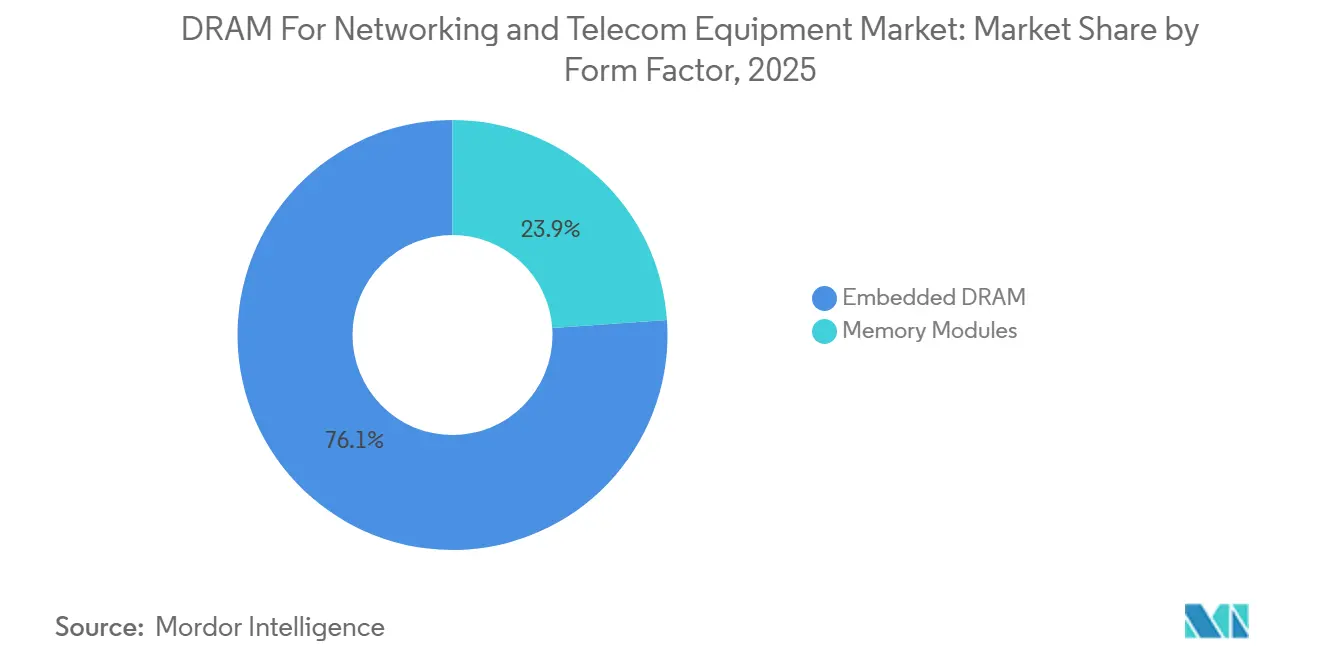
Embedded Designs Dominate Today, While Memory Modules Benefit From DisaggregationEmbedded DRAM held 76.1% share in 2025, so the DRAM for networking and telecom equipment market still leaned heavily on soldered designs inside conventional network hardware. That structure matched the needs of platforms that prioritize latency, compact board design, and tightly controlled signal paths over field replaceability or broad memory choice. Memory Modules accounted for a smaller share of current revenue, but they were the fastest-growing form factor, with a 11.3% CAGR through 2031. This shows how the DRAM for networking and telecom equipment market is opening up as disaggregated networking and white-box systems gain ground in both access and core environments. The form-factor story is therefore less about near-term displacement and more about where new architecture choices are redirecting future investment.
Open RAN deployments are a major part of that change because they use commercial server blades with removable DIMM slots instead of fully proprietary hardware, which naturally supports a bigger role for modular memory. SK Hynix began mass production of its 192 GB SOCAMM2 in April 2026, adding another example of low-power modular memory aimed at AI data center and edge networking applications. For telecom operators, that kind of modularity can support upgrades and serviceability without forcing a board-level redesign every time memory requirements increase. The form-factor mix in the DRAM for networking and telecom equipment market should therefore keep widening as edge platforms demand both field flexibility and carrier-grade reliability. Over time, that widens the addressable space for vendors that can bridge classic embedded designs and newer modular telecom compute platforms.
By Functionality:
Standard DRAM Keeps The Volume Base, While Low-Power DRAM Gains Relevance At The EdgeStandard DRAM accounted for 84.4% share in 2025, which kept it firmly in the lead across the DRAM for networking and telecom equipment market. That position reflected the needs of core routers, high-performance switches, and base station controllers that still prioritize throughput, stable ECC-backed operation, and predictable long-cycle qualification behavior. Low-Power DRAM is projected to grow at a 10.9% CAGR through 2031, indicating a faster role in distributed and power-sensitive deployments. This part of the DRAM market for networking and telecom equipment is benefiting from operators seeking lower energy use across edge nodes, access equipment, and compact network-adjacent compute platforms. The functionality mix, therefore, shows a strong present preference for standard DRAM, but a clear future pull toward lower-power architectures where thermal and energy limits matter more.
Micron shipped samples of its 256 GB LPDRAM SOCAMM2 in March 2026, demonstrating that higher-capacity low-power memory is moving into infrastructure system design rather than remaining limited to mobile-style use cases. SK Hynix's 192 GB SOCAMM2 launch in April 2026 reinforced the same direction by pairing LPDDR5X with modular deployment for edge-oriented platforms that need density and efficiency together. The shift is gradual because many carrier platforms still value established standard DRAM ecosystems and longer qualification history more than early adoption benefits. Even so, low-power functionality should gain a bigger role as the DRAM for networking and telecom equipment market spreads into thermally constrained edge infrastructure and more software-rich access nodes. That leaves standard DRAM in the lead for now, while low-power variants build a stronger base in the next generation of distributed network hardware.
Geography Analysis
APAC DRAM for Networking and Telecom Equipment Market
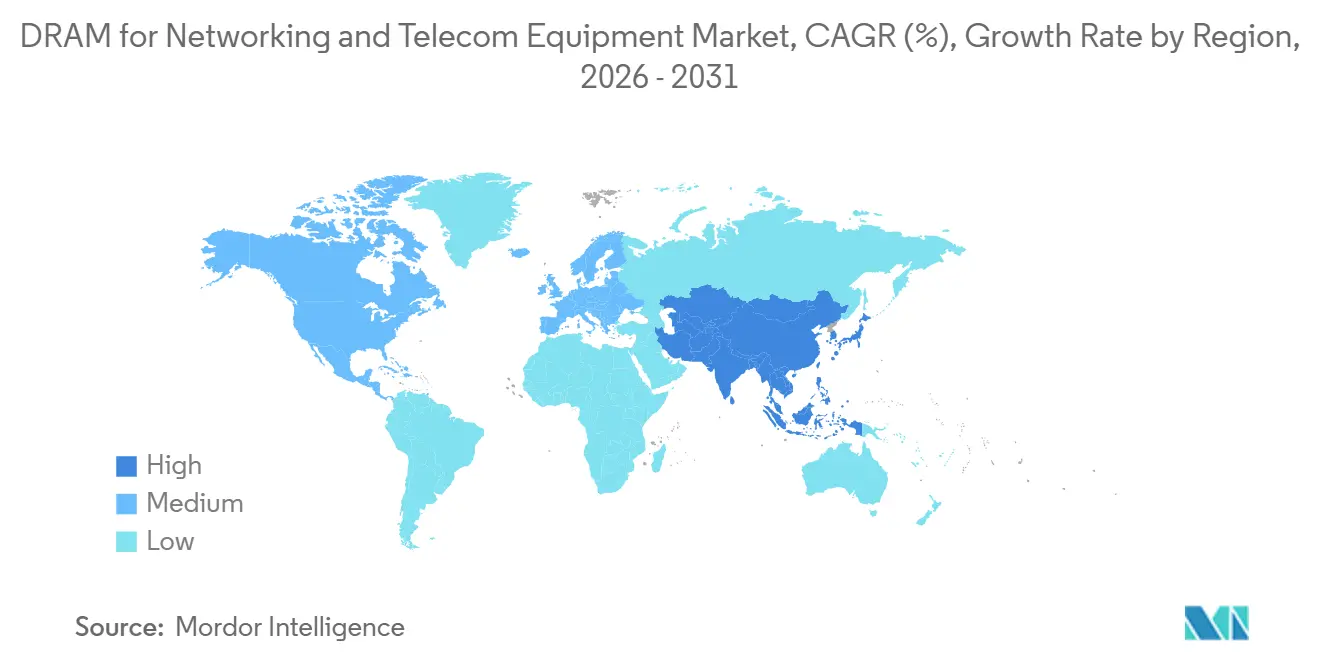
Asia-Pacific held 48.2% of the DRAM for networking and telecom equipment market share in 2025, and it is also expected to post the fastest 11.3% CAGR through 2031. The region combines a strong manufacturing base with large-scale telecom network rollouts, which keeps supply and demand closely linked inside the DRAM for networking and telecom equipment market. South Korea remains central because Samsung and SK Hynix continue to anchor regional memory supply for carrier and edge hardware with broad product portfolios and active technology roadmaps.[4]Samsung Electronics, “Samsung Ships Industry-First Commercial HBM4 With Ultimate Performance for AI Computing,” Samsung Global Newsroom, news.samsung.com Japan also adds demand depth, and KDDI's 2026 rollout of distributed, disaggregated backbone routers shows how advanced carrier upgrades are increasing per-node memory requirements across backbone infrastructure. This combination of local production strength and active network modernization keeps Asia-Pacific at the center of the DRAM for networking and telecom equipment market over the full forecast period.
North America DRAM for Networking and Telecom Equipment Market
North America remained the second-largest regional market, supported by AI-ready network investments and ongoing interest in software-driven telecom architecture that requires denser, faster memory configurations. The region also matters because supply resilience has become a strategic issue for operators and equipment makers that do not want memory allocation risk to delay network rollouts. Micron's 2026 DDR5 RDIMM sampling and LPDRAM SOCAMM2 launch show that North America remains important in product development for infrastructure memory serving networking and edge platforms. Export control discussions and supply continuity concerns are also making regional procurement planning more cautious, which increases the value of long-term supplier relationships in the DRAM for networking and telecom equipment market.
Europe and Global Markets
Europe and the rest of the world remained smaller positions in 2025, but both still matter to the DRAM for networking and telecom equipment market as 5G coverage and enterprise network upgrades continue. European demand is supported by carrier modernization and by large telecom equipment ecosystems that need long-life, qualified memory components rather than short-cycle commodity supply. In the rest of the world, deployments are earlier in the cycle, so demand is more closely tied to cost, supply timing, and project sequencing than to immediate volume scale. That leaves these regions as medium-term opportunities for the DRAM for networking and telecom equipment market, especially as modular and lower-power configurations become easier to qualify and deploy in distributed network settings.

Competitive Landscape
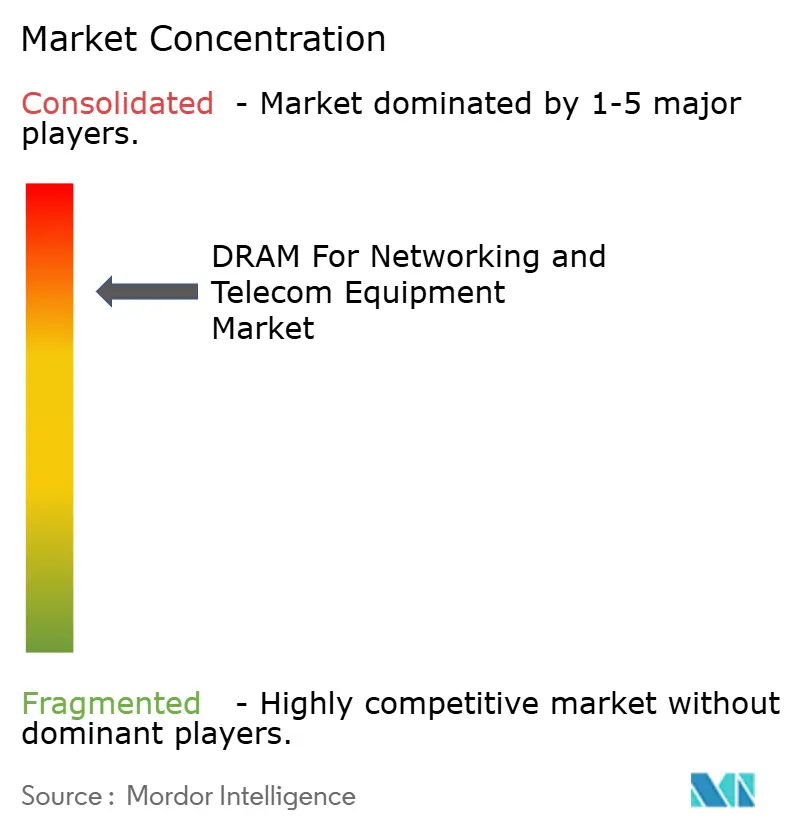
The DRAM for networking and telecom equipment market remained concentrated around Samsung Electronics, SK Hynix, and Micron Technology, while smaller vendors focused on modules and qualification-led niches rather than direct scale competition. The largest manufacturers shaped pricing, allocation, and technology timing because they controlled the transition path between DDR4, DDR5, LPDDR, and HBM programs across the wider memory value chain. That made procurement strategy almost as important as product performance in the DRAM for networking and telecom equipment market, especially for OEMs with long qualification cycles and strict uptime commitments. Module specialists such as Innodisk, Kingston Technology, ATP Electronics, Transcend Information, and Smart Modular Technologies competed more on certification breadth, lifecycle support, and supply assurance than on wafer scale alone.
Samsung's February 2026 move into commercial HBM4 production showed how leading suppliers were prioritizing AI memory programs even as telecom customers still needed conventional DRAM lines for networking hardware. SK Hynix used certifications to strengthen its position, and its December 2025 Intel approval for a 256 GB DDR5 RDIMM helped validate a high-density server module path for telecom workloads. Micron took a similar technology-led approach with its May 2026 256 GB DDR5 RDIMM sampling and its March 2026 LPDRAM SOCAMM2 launch for infrastructure platforms that sit close to networking use cases. These moves show that leadership in the DRAM for networking and telecom equipment market is being defended through platform readiness, qualification support, and memory roadmap depth, not only through output volume.
Outside the largest manufacturers, specialist vendors are using form-factor innovation to stay relevant in the DRAM for networking and telecom equipment market as architecture choices diversify. Innodisk's February 2026 CXL Add-In Card and its June 2026 COMPUTEX showcase of DDR5 8000 RDIMM, CUDIMM, CSODIMM, and MRDIMM 12800 are clear examples of that strategy in telecom-adjacent edge systems. SK Telecom and Panmnesia also moved early on the CXL fabric architecture in March 2026, which pointed to future memory-pooling opportunities for telecom-adjacent AI infrastructure and disaggregated scaling. Competitive pressure is therefore spreading beyond standard DRAM supply to include qualification speed, modular upgrade paths, and low-power, edge-oriented design. The DRAM for networking and telecom equipment market should remain consolidated at the top, but innovation space is still open in modules, CXL-based expansion, and carrier-grade edge memory solutions.
DRAM For Networking and Telecom Equipment Industry Leaders
SK Hynix Inc.
Samsung Electronics Co., Ltd.
Micron Technology, Inc.
Nanya Technology Corporation
Winbond Electronics Corporation
- *Disclaimer: Major Players sorted in no particular order
DRAM For Networking and Telecom Equipment Market Companies Covered in this Report
- Samsung Electronics Co., Ltd.
- SK Hynix Inc.
- Micron Technology, Inc.
- Nanya Technology Corporation
- Winbond Electronics Corporation
- Etron Technology, Inc.
- Kingston Technology Company, Inc.
- Transcend Information, Inc.
- Kingston Technology Corporation
- Integrated Silicon Solution Inc.
- Powerchip Technology Corporation
- ATP Electronics, Inc.
- AP Memory Technology Corporation
- GigaDevice Semiconductor Inc.
- Elite Semiconductor Microelectronics Technology Inc.
- ProMOS Technologies Inc.
- Adata Technology Co., Ltd.
- Team Group Inc.
- Apacer Technology Inc.
- Innodisk Corporation
- Smart Modular Technologies, Inc.

Recent Industry Developments in DRAM For Networking and Telecom Equipment Market
- June 2026: Boadcom launched integrated Wi-Fi 8 SoCs with dual DDR4 and DDR5 support in collaboration with Samsung, and the BCM677x family also supported LPDDR4 and LPDDR5 for next-generation mesh routers and 5G fixed wireless access platforms.
- June 2026: KDDI began large-scale commercial deployment of distributed disaggregated backbone routers, targeting completion across Japan's backbone network by the end of fiscal year 2027.
- May 2026: Micron sampled a 256 GB DDR5 RDIMM at 9,200 MT/s for AI and networking platforms, with more than 40% higher speed and more than 40% lower operating power versus 128 GB DDR5 RDIMMs in volume production.
- April 2026: SK Hynix began mass production of a 192 GB SOCAMM2 LPDDR5X module for edge and AI applications where power-efficient, high-density memory modularity is critical
- March 2026: SK Telecom and Panmnesia partnered to develop a CXL-based disaggregated AI data center architecture with direct relevance for memory pooling in telecom-adjacent compute infrastructure.


Global DRAM For Networking and Telecom Equipment Market Report Scope
The DRAM for Networking and Telecom Equipment Market Report is Segmented by Type (SDRAM, DDR, DDR2, DDR3, DDR4, and DDR5), Product Form (DRAM IC, and DARM Modules (UDIMM, RDIMM/LRDIMM)), Form Factor (Embedded DRAM, and Memory Modules), Functionality (Standard DRAM, and Low-Power DRAM), and Geography (North America, Europe, Asia-Pacific, Rest of the World). The Market Forecasts are Provided in Terms of Value (USD).
| SDRAM |
| DDR |
| DDR2 |
| DDR3 |
| DDR4 |
| DDR5 |
| DRAM IC (Discrete Chips) | |
| DRAM Modules | UDIMM |
| RDIMM/LRDIMM |
| Embedded DRAM |
| Memory Modules |
| Standard DRAM |
| Low-Power DRAM |
| North America | |
| Europe | |
| Asia-Pacific | China |
| Japan | |
| South Korea | |
| Taiwan | |
| Rest of Asia-Pacific | |
| Rest of the World |
| By Type | SDRAM | |
| DDR | ||
| DDR2 | ||
| DDR3 | ||
| DDR4 | ||
| DDR5 | ||
| By Product Form | DRAM IC (Discrete Chips) | |
| DRAM Modules | UDIMM | |
| RDIMM/LRDIMM | ||
| By Form Factor | Embedded DRAM | |
| Memory Modules | ||
| By Functionality | Standard DRAM | |
| Low-Power DRAM | ||
| By Geography | North America | |
| Europe | ||
| Asia-Pacific | China | |
| Japan | ||
| South Korea | ||
| Taiwan | ||
| Rest of Asia-Pacific | ||
| Rest of the World | ||


Key Questions Answered in the Report
What is the 2026 value of DRAM for networking and telecom equipment?
The DRAM for networking and telecom equipment market is valued at USD 3.5 billion in 2026 and is forecast to reach USD 5.6 billion by 2031.
What is driving demand for DRAM in telecom infrastructure?
The main demand drivers are 5G rollout, Open RAN adoption, higher memory needs in routers and switches, and the spread of AI-enabled edge compute.
Which memory type leads current telecom deployments?
DDR4 led in 2025 with a 58.2% share because much of the installed carrier hardware base was designed and qualified around DDR4.
Which segment is growing fastest by form factor?
Memory Modules are the fastest-growing form factor, with an 11.3% CAGR through 2031, supported by disaggregated and server-based telecom architecture.
Why is Asia-Pacific the leading region?
Asia-Pacific led with a 48.2% share in 2025 because it combines major DRAM production capacity with large-scale network modernization and active 5G deployment.
What is the main supply-side risk for telecom memory buyers?
A major risk is the shift of manufacturing attention toward HBM and AI servers, which tightens availability for conventional DDR4 and DDR5 used in telecom equipment.
Page last updated on:





