
Door Insulation Market Size and Share
Market Overview
| Study Period | 2022 - 2032 |
|---|---|
| Market Size (2027) | USD 1.56 Billion |
| Market Size (2032) | USD 2.02 Billion |
| Growth Rate (2027 - 2032) | 5.26 % |
| Fastest Growing Market | Asia-Pacific |
| Largest Market | North America |
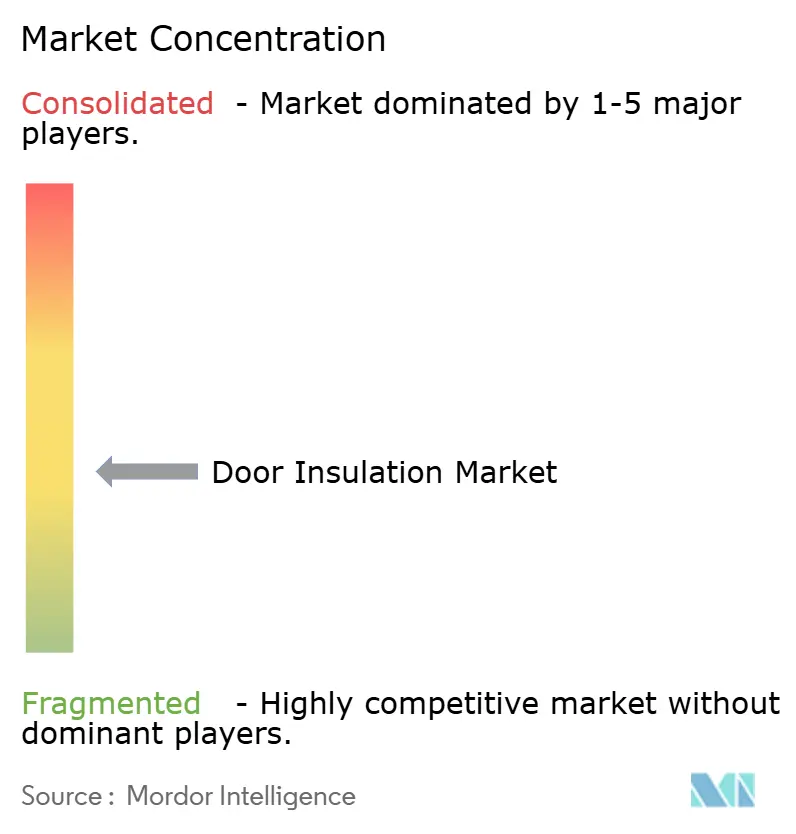
| Market Concentration | Medium |
Major Players *Disclaimer: Major Players sorted in no particular order Image © Mordor Intelligence. Reuse requires attribution under CC BY 4.0. | |
Door Insulation Market Analysis by Mordor Intelligence
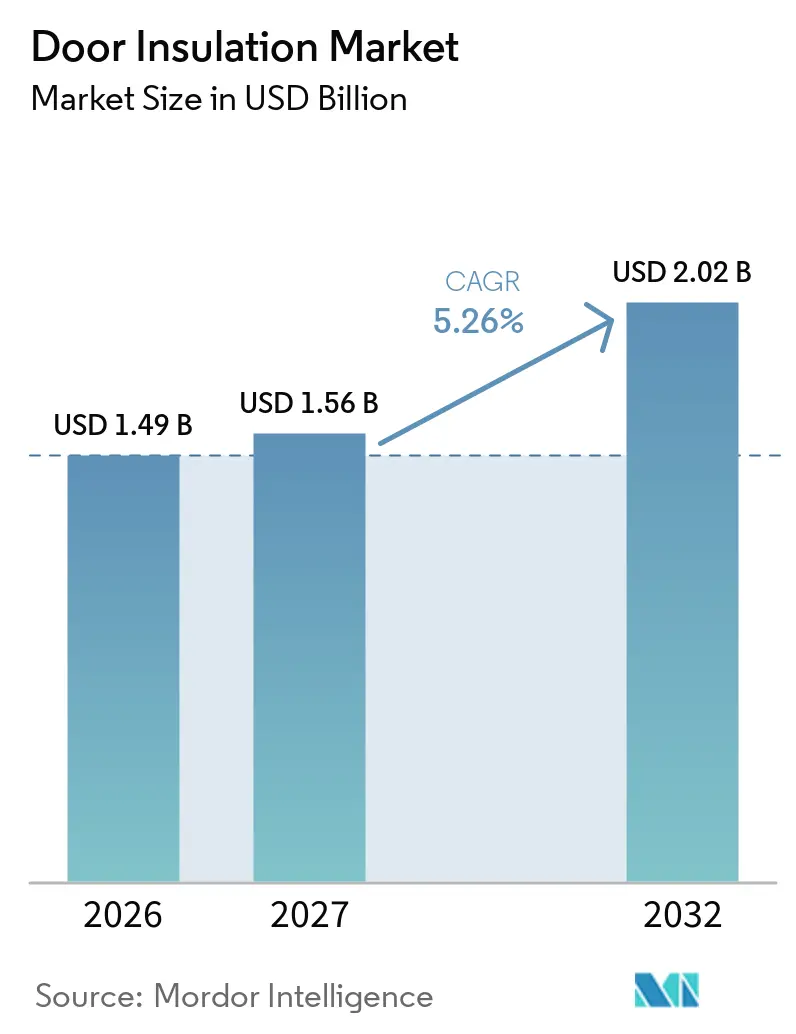
The Door Insulation Market size was valued at USD 1.49 billion in 2026 and is estimated to grow from USD 1.56 billion in 2027 to reach USD 2.02 billion by 2032, at a CAGR of 5.26% during the forecast period (2027-2032). The door insulation market is being shaped by tighter energy codes that raise expectations for thermal performance and air leakage across new construction and renovation projects. Higher cooling and heating bills also strengthen the economic case for replacing poorly insulated doors. Demand comes from residential retrofits, commercial projects, and temperature-controlled facilities, so it is not tied to a single construction cycle. Suppliers are responding with foam cores, mineral wool, and thin vacuum insulation panels that can improve performance where frame dimensions are fixed. Input-cost swings and installation quality remain important limits because they can raise project costs or reduce the performance of an otherwise well-designed door assembly, particularly where installers must prevent thermal bridging around frames, thresholds, and perimeter gaps while meeting more demanding code requirements across residential, commercial, and industrial projects in both mature replacement markets and newer construction markets.
Key Report Takeaways
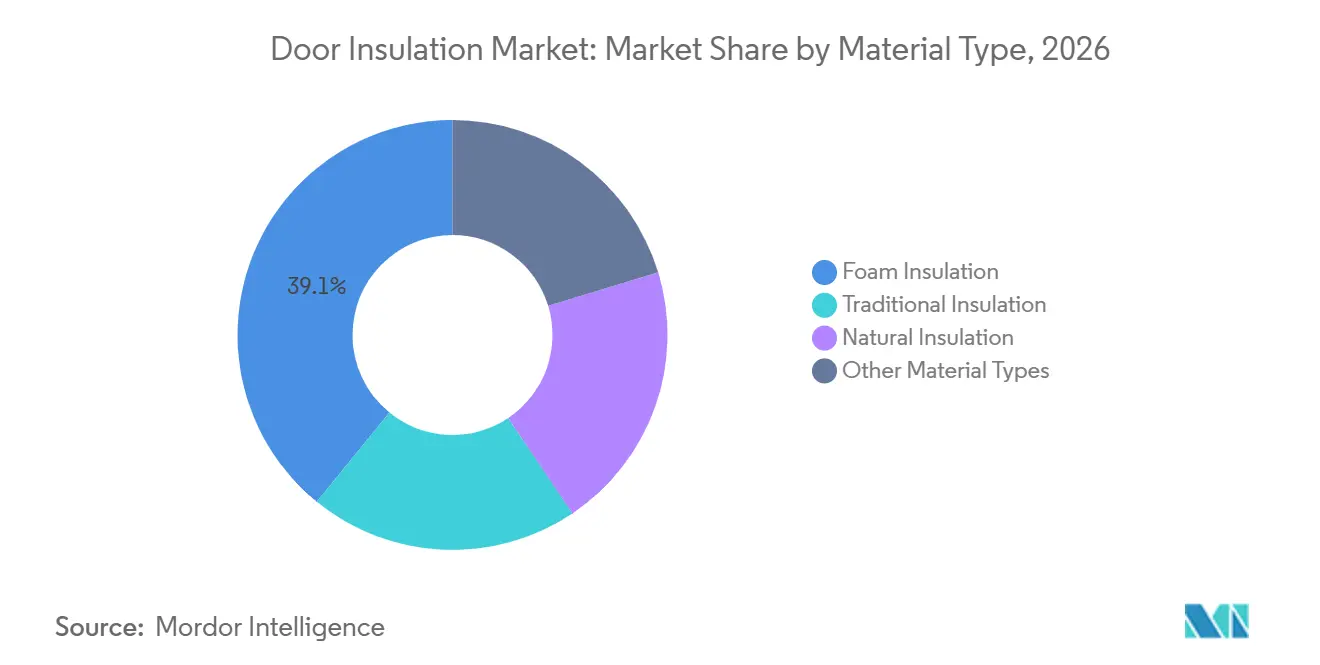
- By material type, foam insulation held 39.13% of the door insulation market share in 2026 and is forecast to advance at a 5.91% CAGR through 2032.
- By insulation function, thermal insulation held 66.56% of the door insulation market share in 2026 and is forecast to advance at a 5.83% CAGR through 2032.
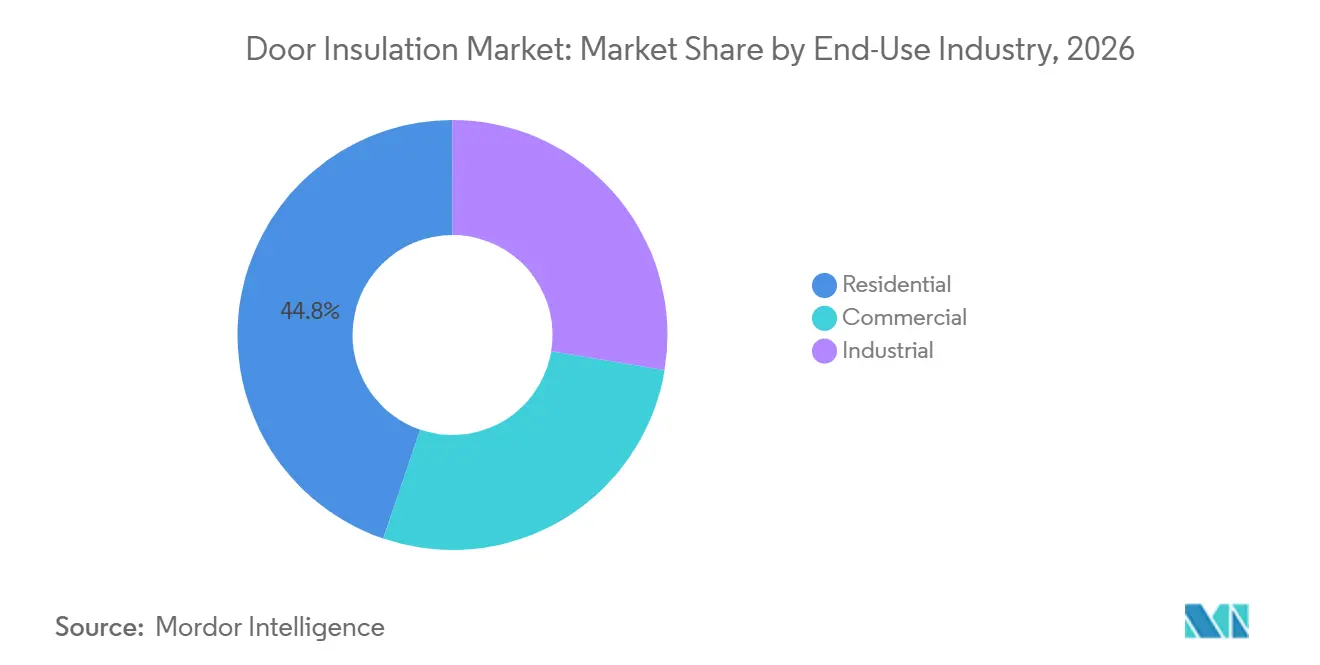
- By end-use industry, residential held 44.78% of the door insulation market share in 2026 and is forecast to advance at a 6.34% CAGR through 2032.
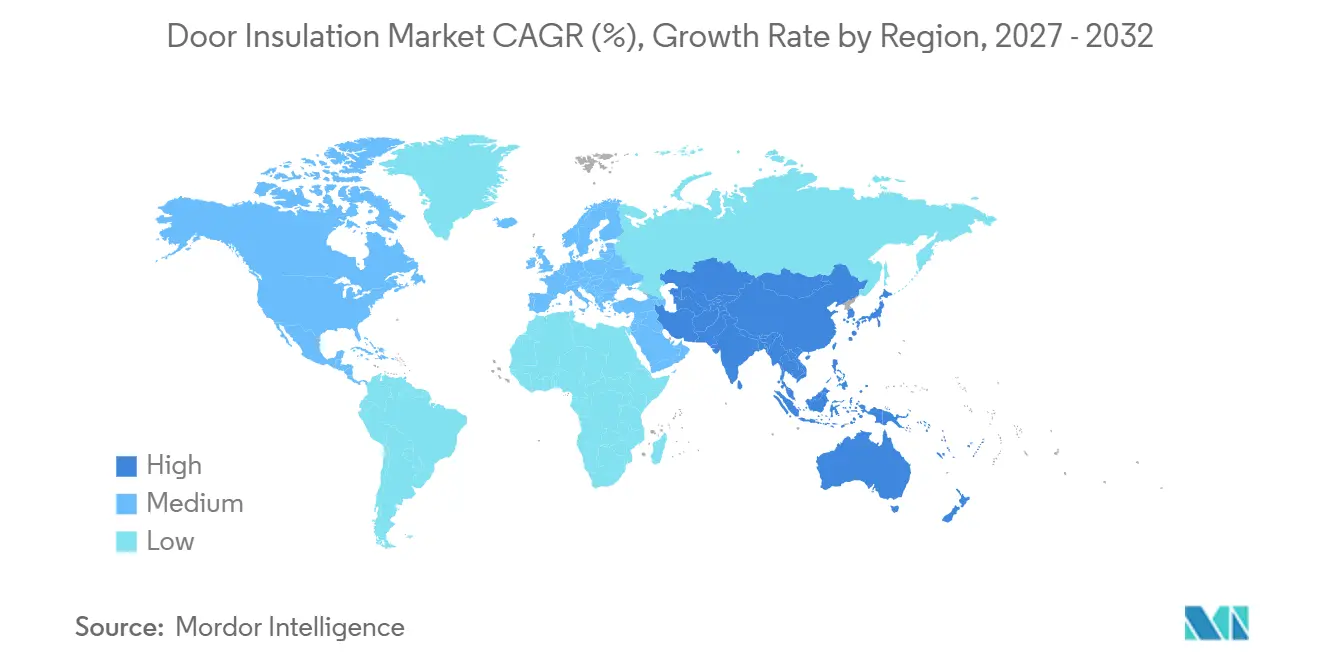
- By geography, North America held 35.47% of the door insulation market share in 2026, while Asia-Pacific is forecast to advance at a 6.22% CAGR through 2032.
Note: Market numbers in this report are based on Mordor Intelligence's proprietary estimation framework, which combines nine months of actuals with Q4 projections for base year 2026.
Market Trends and Insights
Drivers Impact Analysis of Door Insulation Market*
| Driver | (~) % Impact on CAGR Forecast | Geographic Relevance | Impact Timeline |
|---|---|---|---|
| Building-Energy Codes and Green-Building Certification Adoption | +1.4% | Global; core impact in North America, Europe, and East Asia | Long term (≥ 4 years) |
| Rising Cooling and Heating Costs Increasing Payback Visibility | +1.2% | Global; most acute in North America, South/Southeast Asia, and Southern Europe | Medium term (2–4 years) |
| Retrofit Demand from Aging and Leaky Building Envelopes | +0.9% | North America and Europe; spillover to APAC core | Medium term (2–4 years) |
| Growth of Controlled-Environment Logistics and Industrial Facilities | +0.7% | APAC core, North America, spillover to MEA | Short term (≤ 2 years) |
| Thin-Profile High-R-Value Cores for Space-Constrained Retrofit Doors | +0.5% | Global; most immediate in dense urban retrofit markets (Japan, UK, Netherlands) | Medium term (2–4 years) |
| Source: Mordor Intelligence | |||
Building-Energy Codes and Green-Building Certification Adoption
Mandatory energy codes support the door insulation market because they establish minimum R-value, U-factor, and air-leakage requirements for new and substantially renovated door assemblies. Illinois adopted the 2024 International Energy Conservation Code, effective November 30, 2025, and requires new commercial buildings to meet whole-building airtightness testing below 0.40 cubic feet per minute per square foot. Japan made insulation Grade 4 mandatory for newly constructed residences in April 2025, which placed thermal performance at the center of door specifications. The planned move toward Zero Energy Home-equivalent performance by 2030 would require stronger thermal performance from residential door systems. California’s 2025 Building Energy Efficiency Standards take effect on January 1, 2026, and set a 0.3 cubic feet per minute per square foot air-leakage limit for doors in new construction[1]. When several jurisdictions enforce tighter standards at the same time, manufacturers and installers must adjust materials, designs, and testing practices throughout the supply chain.
Rising Cooling and Heating Costs Increasing Payback Visibility
Higher utility expenses make insulated door upgrades easier to justify for households and facility managers. A 2025 peer-reviewed study found that summer air-conditioning costs could increase by 2% to 10% across most United States cities under forward climate scenarios. Buildings with higher air-infiltration rates face the largest exposure to those cost increases. This matters for the door insulation market because a poorly insulated or poorly sealed door can allow heat transfer and air leakage at the same time. The same operating-cost concern applies to stores, warehouses, and other facilities that condition occupied spaces for long periods. In areas with high electricity tariffs, the cost premium for a polyurethane-core door can be recovered more quickly than it could when energy prices were lower.
Retrofit Demand from Aging and Leaky Building Envelopes
Aging homes and commercial properties create a replacement opportunity for the door insulation market. Spain’s Andimac expected 1.9 million building renovations in 2025, including 535,000 homes entering an age range when door and window replacement becomes more likely. The recast Energy Performance of Buildings Directive requires nonresidential buildings to meet minimum energy-performance standards by 2030, which supports envelope upgrades in Europe. A South Korean public building retrofit using vacuum insulation panels reduced monthly electricity consumption by 14.7% in the first post-retrofit year. The result shows how better-performing envelope components can support measurable energy reductions. Replacement work can also avoid the disruption and cost of major structural changes when high-performance cores fit within existing frames. Installer availability remains a constraint because a shortage of qualified workers can delay renovation projects even when materials and incentives are available.
Growth of Controlled-Environment Logistics and Industrial Facilities
Cold storage, pharmaceutical distribution, food processing, and data-center cooling create a specialized demand base for the door insulation market. Cold-chain facilities need to maintain temperatures from -50 °C to +12 °C, depending on the product being stored. Doors that leave gaps at frames can cause energy losses, ice formation, and risks to product integrity. Polyisocyanurate insulation provides high R-values per inch and compressive strength of 16 to 25 pounds per square inch, which can help limit thermal bridging in demanding cold-storage applications. Door systems in these facilities must also withstand frequent opening cycles without compromising the temperature barrier. This demand differs from ordinary housing construction because temperature control is part of facility operations and regulatory compliance. It can therefore provide insulation suppliers with demand that is less dependent on residential construction activity.
Restraints Impact Analysis of Door Insulation Market*
| Restraint | (~) % Impact on CAGR Forecast | Geographic Relevance | Impact Timeline |
|---|---|---|---|
| Upfront Material, Installation, and Compliance Costs | -1.2% | Global; most acute in cost-sensitive markets in South America, MEA, and South/Southeast Asia | Medium term (2–4 years) |
| Volatility in Polymer, Fiberglass, and Mineral-Wool Input Costs | -0.8% | Global; most impactful in Europe and East Asia | Short term (≤ 2 years) |
| Thermal Bridging and Air-Infiltration Risk From Poor Site Installation | -0.4% | Global; most prevalent in markets with low installer certification depth | Long term (≥ 4 years) |
| Source: Mordor Intelligence | |||
Upfront Material, Installation, and Compliance Costs
The initial cost of a high-performance insulated door can delay replacement decisions in price-sensitive locations. A polyurethane-foam-core insulated garage door rated R-12 to R-18 costs USD 1,000 to USD 1,500 installed in the United States, compared with USD 600 to USD 900 for a single-layer uninsulated steel door. The difference requires buyers to see a clear energy-saving or compliance benefit before making the purchase. Sankyo Tateyama introduced the PRONOVA 2 in Japan at JPY 411,800 (approximately USD 2,900) before installation, illustrating the price premium associated with grade 7 thermal performance. Tokyo expanded its thermal-insulation retrofit program in May 2025 with JPY 70.2 billion (approximately USD 491 million) for 70,000 homes. Subsidies can narrow the cost gap, while the absence or exhaustion of programs can keep demand below its potential.
Volatility in Polymer, Fiberglass, and Mineral-Wool Input Costs
Raw-material volatility can affect pricing and margins across the door insulation market. European Toluene Diisocyanate (TDI) prices rose more than 40% in 1 month during July 2025 after production disruptions reduced supply. BASF increased TDI prices by USD 300 per metric ton for South and Southeast Asian markets in January 2025, while Wanhua Chemical raised Methylene Diphenyl Diisocyanate (MDI) prices by USD 200 per metric ton in the Association of Southeast Asian Nations region in December 2025. These changes place pressure on foam fabricators that purchase isocyanates and polyols for rigid-board and injected-core production. When manufacturers cannot fully pass through these increases, margins tighten, and product pricing can become less predictable for door producers. Fiberglass and mineral-wool producers also face energy-intensive melting requirements. ROCKWOOL A/S and Knauf Insulation are investing in electric melting, but such conversions require time and capital
*Our forecasts treat driver/restraint impacts as directional, not additive. The impact forecasts reflect baseline growth, mix effects, and variable interactions.
Door Insulation Market Segment Analysis
By Material Type:
Foam Insulation Supports Thermal Density and Process CompatibilityFoam insulation held 39.13% of the door insulation market share in 2026 and is projected to advance at a 5.91% CAGR through 2032. Its position reflects strong thermal resistance per unit thickness and compatibility with automated production lines used by door manufacturers. Polyurethane foam can deliver R-6 to R-18 per door panel, depending on density and thickness. KraussMaffei Italiana supplies automated polyurethane foaming lines for refrigerator doors and cold-room assemblies, showing the established role of foam processing in high-volume production. Cold-chain expansion and rising polyurethane uptake in Asia-Pacific residential construction support continued demand. BASF tested Neopor F 5 Mcycled, an expanded polystyrene board with 10% mechanically recycled polystyrene, and reported that it met standard quality benchmarks.
Vacuum insulation panels are a premium alternative where door thickness must remain limited. Kingspan Group launched OPTIM-R E in April 2025 with R-34.2 per inch of thermal resistance in a thin panel. This allows the door insulation market to address retrofit doors that need stronger thermal performance, where existing frame dimensions cannot change. Traditional insulation, including mineral wool and fiberglass, remains relevant in acoustic and fire-rated assemblies because noncombustibility can be a required specification. Natural insulation materials, such as cellulose, wood fiber, and cork, serve projects that prioritize lower embodied carbon. Aerogel composites remain a specialized option, and Armacell opened an aerogel facility in Pune in June 2025 that doubled its global aerogel blanket production capacity.

By Insulation Function:
Thermal Insulation Drives Both Scale and GrowthThermal insulation held 66.56% of the door insulation market share in 2026 and is projected to advance at a 5.83% CAGR through 2032. It is used across residential energy upgrades, temperature-controlled logistics, and commercial code-compliance projects. A 2025 study found that common methods can underestimate heat losses through door structures by 17% to 51% when thermal bridging and frame-level air infiltration are considered. That finding supports closer attention to the entire door assembly rather than the core alone. Tighter energy codes in North America, Europe, and Japan are expected to sustain demand for thermal insulation. Japan’s Grade 4 requirement already applies to new residences, creating a broad baseline for insulated-door adoption.
Sankyo Tateyama launched the PRONOVA 2 high-insulation entry door in March 2025. The product achieved a U-value of 0.78 watts per square meter kelvin through an aluminum-resin composite frame and a high-performance insulation core. Acoustic insulation serves offices, multifamily housing, health-care buildings, and hospitality projects where sound control is important. Fire-barrier and moisture-control insulation also remain necessary in industrial and specialized commercial installations. Manufacturers that combine thermal and acoustic functions in one assembly can address several specification needs without requiring separate components. The door insulation industry and the door insulation market, therefore, have room for composite core designs that limit the normal trade-off between acoustic mass and low thermal conductivity.
By End-Use Industry:
Residential Drives Both Scale and GrowthResidential held 44.78% of the door insulation market share in 2026 and is projected to advance at a 6.34% CAGR through 2032. The segment benefits from the scale of housing activity and energy-retrofit programs in mature building markets. Spain recorded 55,473 major building renovation projects in 2024, a 47% increase from the prior year, and its building code and European Union funding supported envelope improvements. Door replacement is often part of those upgrades because it can address both air leakage and thermal transmission. Multifamily and social-housing projects can create large procurement volumes because asset managers make the specification decision for many units. That structure can reduce price sensitivity when the expected operating savings are documented.
Japan also shows how residential demand is moving toward higher-performance options. YKK AP expanded its Innovest D50 high-thermal-insulation entry-door range in April 2025, adding 11 designs and revising prices to narrow the gap with standard insulated products. Commercial demand in the door insulation market comes from offices, retail buildings, hospitality developments, and institutional retrofits that follow energy-performance and sustainability requirements. The industrial segment includes cold storage, pharmaceutical facilities, food processing, and data-center cooling sites. These users require reliable temperature control and can specify insulated doors as an operating necessity.
Geography Analysis
North America Door Insulation Market
North America held 35.47% of the door insulation market share in 2026. The region benefits from a large housing stock, active replacement demand, and layered federal, state, and municipal energy requirements. California’s 2025 standards took effect in 2026 and require doors in new construction to meet a maximum air-leakage rate of 0.3 cubic feet per minute per square foot. New York City’s 2025 Energy Conservation Code extends envelope requirements to existing and historic buildings from March 2026[2]. Canada’s National Energy Code for Buildings 2025 sets door U-factor limits by heating degree-day zone, which favors high-performing cores in colder regions.
APAC Door Insulation Market
Asia-Pacific is projected to advance at a 6.22% CAGR through 2032. China’s urban development and India’s housing construction drive demand in the door insulation market, while Japan’s code upgrades support higher-value specifications. Tokyo committed JPY 70.2 billion (approximately USD 491 million) in May 2025 to expand thermal-insulation retrofits for 70,000 homes, including support for high-insulation windows and doors. South Korean research showed a 14.7% electricity reduction after a public-building envelope retrofit that used vacuum insulation panels. China, India, Japan, and South Korea account for much of the regional demand, while the Association of Southeast Asian Nations (ASEAN) countries are developing energy codes and cold-chain infrastructure.
EMEA and South America Door Insulation Market
Europe’s demand is supported by building-upgrade pathways under the Energy Performance of Buildings Directive. Germany, France, Italy, and the Nordic countries provide substantial demand, with cold-climate requirements favoring advanced insulated assemblies. Spain’s renovation activity supports door insulation market demand for upgraded doors as part of wider envelope work. South America and the Middle East and Africa remain smaller but relevant markets for the door insulation market. Brazil’s cold-chain food distribution and pharmaceutical logistics activity creates industrial demand, while Saudi Arabian commercial and hospitality projects require thermal door systems for energy compliance and occupant comfort. In South Africa and other sub-Saharan markets, adoption is more closely linked to energy costs and developing commercial real estate projects.
Competitive Landscape
The door insulation market is moderately concentrated, with the top five players including BASF, DuPont, Saint-Gobain, Owens Corning, and ROCKWOOL A/S. Armacell, BASF, Covestro AG, Dow, DuPont, Huntsman International LLC, Insulfoam, Johns Manville, Kingspan Group, Knauf Insulation, Owens Corning, ROCKWOOL A/S, Saint-Gobain, Soudal Holding N.V., and Synthos participate across different points in the value chain. BASF, Covestro AG, Dow, and Huntsman International LLC supply polyols, MDI, and TDI inputs that foam fabricators use in boards and injected door cores. Their position in the door insulation market depends on production scale, feedstock logistics, and technical support for original-equipment manufacturers. Kingspan Group, Knauf Insulation, Owens Corning, ROCKWOOL A/S, and Saint-Gobain have integrated insulation operations and established specification and distribution networks. Insulfoam and Synthos compete in polystyrene boards where regional production and cost competitiveness matter greatly.
ROCKWOOL A/S reported 10% revenue growth in the second quarter of 2026, supported by market-share gains in flat-roof and facade projects. Its broad product range supports the door insulation market demand in both renovation and new construction channels. Kingspan Group strengthened its position in thin-profile insulation through the April 2025 launch of OPTIM-R E, which is Underwriters Laboratories listed and provides R-34.2 per inch of thermal resistance. Covestro AG launched the CQ-Configurator in January 2026 to provide real-time carbon dioxide impact and attributed-sustainable material content data for polyurethane foam formulations. These moves show how material performance, compliance evidence, and environmental data can shape supplier differentiation.
Soudal Holding N.V. supplies polyurethane foam sealants and gap fillers used around door perimeters, where installation quality affects door insulation market performance and airtightness. DuPont has positions in specialty building membranes and thermal-barrier materials that can support composite high-performance door assemblies. Covestro AG and Fraunhofer UMSICHT contracted a smart-pyrolysis pilot plant in March 2026 to process 2,000 metric tons per year of end-of-life rigid polyurethane and polyisocyanurate foam from mid-2028. The planned facility may support a more circular supply chain for rigid foam applications. Vacuum insulation panels remain an underdeveloped opportunity in standard door assemblies because larger-scale integration is still limited. The door insulation market, therefore, gives established suppliers room to compete through formulation, processing, distribution, and circular-material capabilities.
Door Insulation Industry Leaders
-
BASF
-
DuPont
-
Saint-Gobain
-
Owens Corning
-
ROCKWOOL A/S
- *Disclaimer: Major Players sorted in no particular order
Door Insulation Market Companies Covered in this Report
- Armacell
- BASF
- Covestro AG
- Dow
- DuPont
- Huntsman International LLC
- Insulfoam
- Johns Manville
- Kingspan Group
- Knauf Insulation
- Owens Corning
- ROCKWOOL A/S
- Saint-Gobain
- Soudal Holding N.V.
- Synthos
Recent Industry Developments in Door Insulation Market
- April 2025: Steel-Line launched Mammoth Modern Insulation for garage doors, using thermally bonded polyester-fiber panels made from recycled plastic bottles. The product offers an R-value of 1.09 and is designed to reduce heat transfer and noise, supporting the door insulation market through retrofit and new-installation solutions for residential garage doors.
- February 2025: Johns Manville announced a Climate Pro blown-wool insulation production line at its Winder, Georgia, facility. The investment supports the door insulation market by expanding the supply of building insulation materials and strengthening manufacturing capacity for thermal-efficiency solutions used in residential and commercial buildings.
Global Door Insulation Market Report Scope
Door insulation refers to materials incorporated into or applied to doors to reduce heat transfer, limit sound transmission, and improve indoor comfort. It helps improve building energy efficiency and supports temperature and noise control across different environments.
The Door Insulation Market is segmented by material type, insulation function, end-use industry, and geography. By material type, the market is segmented into foam insulation, traditional insulation, natural insulation, and other material types. By insulation function, the market is segmented into thermal insulation, acoustic insulation, and other insulation functions. By end-use industry, the market is segmented into residential, commercial, and industrial. The report also covers the market size and forecasts for door insulation across 15 countries. For each segment, the market sizing and forecasts have been done on the basis of value (USD).
Segmentation Overview
| Foam Insulation |
| Traditional Insulation |
| Natural Insulation |
| Other Material Types |
| Thermal Insulation |
| Acoustic Insulation |
| Other Insulation Functions |
| Residential |
| Commercial |
| Industrial |
| Asia-Pacific | China |
| India | |
| Japan | |
| South Korea | |
| ASEAN Countries | |
| Rest of Asia-Pacific | |
| North America | United States |
| Canada | |
| Mexico | |
| Europe | Germany |
| United Kingdom | |
| France | |
| Italy | |
| NORDIC Countries | |
| Rest of Europe | |
| South America | Brazil |
| Argentina | |
| Rest of South America | |
| Middle East and Africa | Saudi Arabia |
| South Africa | |
| Rest of Middle East and Africa |
| By Material Type | Foam Insulation | |
| Traditional Insulation | ||
| Natural Insulation | ||
| Other Material Types | ||
| By Insulation Function | Thermal Insulation | |
| Acoustic Insulation | ||
| Other Insulation Functions | ||
| By End-Use Industry | Residential | |
| Commercial | ||
| Industrial | ||
| By Geography | Asia-Pacific | China |
| India | ||
| Japan | ||
| South Korea | ||
| ASEAN Countries | ||
| Rest of Asia-Pacific | ||
| North America | United States | |
| Canada | ||
| Mexico | ||
| Europe | Germany | |
| United Kingdom | ||
| France | ||
| Italy | ||
| NORDIC Countries | ||
| Rest of Europe | ||
| South America | Brazil | |
| Argentina | ||
| Rest of South America | ||
| Middle East and Africa | Saudi Arabia | |
| South Africa | ||
| Rest of Middle East and Africa | ||
Key Questions Answered in the Report
What is the size of the door insulation market?
The door insulation market size was valued at USD 1.49 billion in 2026 and is estimated to grow from USD 1.56 billion in 2027 to reach USD 2.02 billion by 2032, at a CAGR of 5.26% during the forecast period (2027-2032).
What is driving demand for door insulation?
Stricter energy codes, rising heating and cooling costs, building retrofits, and temperature-controlled logistics are supporting demand.
Which material held the largest share in 2026?
Foam insulation held a 39.13% share in 2026.
Which end-use industry is projected to grow fastest through 2032?
Residential is projected to grow at a 6.34% CAGR through 2032, supported by energy-retrofit programs and housing activity.