
Dominican Republic Residential Real Estate Market Size and Share
Market Overview
| Study Period | 2021 - 2032 |
|---|---|
| Forecast Data Period | 2027 - 2032 |
| Base Year Market Size (2026) | USD 9.96 Billion |
| Market Size (2027) | USD 10.55 Billion |
| Market Size (2032) | USD 14.04 Billion |
| Growth Rate (2027 - 2032) | 5.89 % |
| Market Concentration | Medium |
Major Players *Disclaimer: Major Players sorted in no particular order Image © Mordor Intelligence. Reuse requires attribution under CC BY 4.0. | |
Dominican Republic Residential Real Estate Market Analysis by Mordor Intelligence
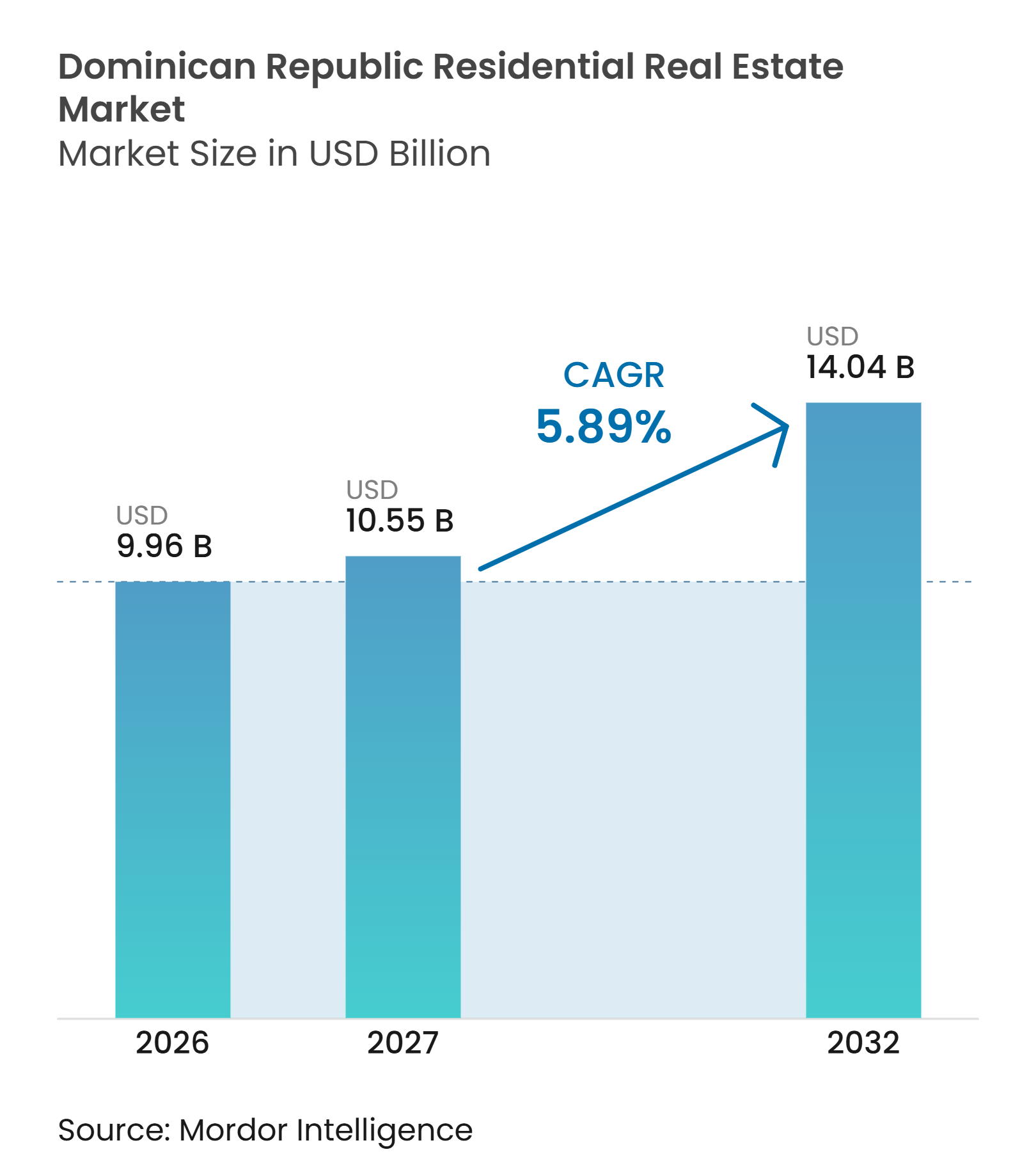
The Dominican Republic Residential Real Estate Market size is projected to expand from USD 9.96 billion in 2026 and USD 10.55 billion in 2027 to USD 14.04 billion by 2032, registering a CAGR of 5.89% between 2027 and 2032.
Tourism activity, remittance inflows, and public housing investment support the Dominican Republic residential real estate market. Tourism-linked projects are attracting capital to coastal locations, particularly where eligible developments can access incentives under the Tourism Incentive Law. Remittances provide many households and diaspora buyers with an additional source of funding for home purchases, including transactions completed without local mortgage financing. Public programs are expanding formal housing delivery beyond established urban districts. However, higher mortgage costs, land-title issues, construction expenses, and climate-related exposure continue to constrain demand and project execution.
Key Report Takeaways
- By property type in sales, apartments and condominiums accounted for a 65.2% Dominican Republic residential real estate market share in 2026, representing the largest segment of the market size, while villas and landed houses are forecast to grow at a 6.31% CAGR through 2032.
- By price band in sales, the mid-market segment accounted for a 51.1% share of the Dominican Republic residential real estate market size in 2026, while the affordable segment is projected to expand at a 6.49% CAGR through 2032.
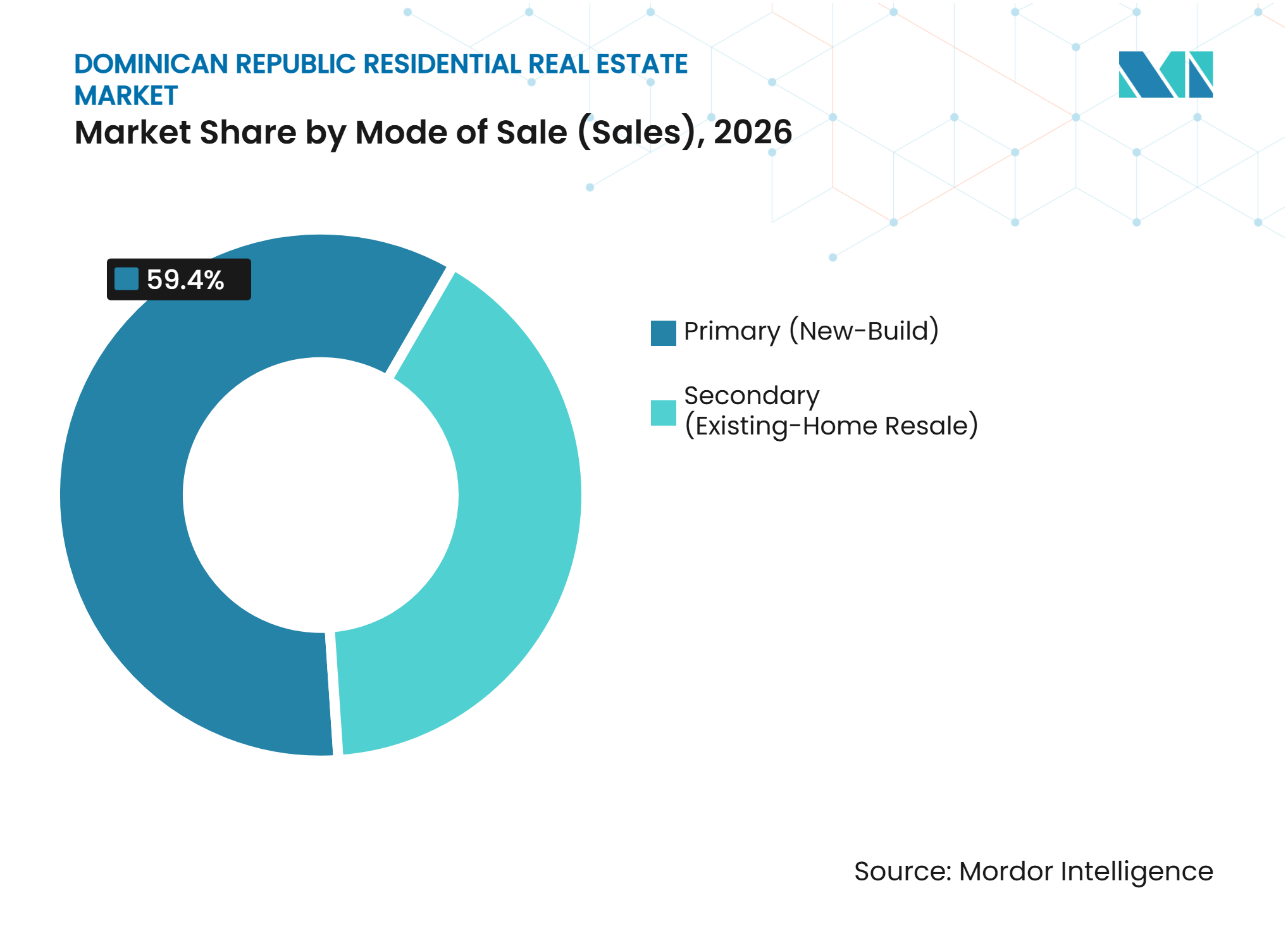
- By mode of sale, primary (new-build) transactions captured a 59.4% share of the Dominican Republic residential real estate market size in 2026 and are forecast to advance at a 6.66% CAGR through 2032.
- By key region in sales, Greater Santo Domingo held a 48.5% share of the Dominican Republic residential real estate market size in 2026, while the Eastern Tourist Corridor is forecast to grow at a 6.91% CAGR through 2032.
- By property type in rentals, apartments and condominiums accounted for a 79.3% share of the Dominican Republic residential real estate market size in 2026, while villas and landed houses are projected to record a 7.11% CAGR through 2032.
Note: Market numbers in this report are based on Mordor Intelligence's proprietary estimation framework, which combines nine months of actuals with Q4 projections for base year 2026.
Market Trends and Insights
Drivers Impact Analysis of Dominican Republic Residential Real Estate Market*
| Drivers | (~) % Impact on CAGR Forecast | Geographic Relevance | Impact Timeline |
|---|---|---|---|
| International Tourism and Resort Residential Demand | +1.4% | Eastern Tourist Corridor, North Coast, Samaná, and Greater Santo Domingo | Short term (≤ 2 years) |
| CONFOTUR Tax Incentives | +1.2% | Punta Cana, Bávaro, Cap Cana, Miches, and Samaná | Medium term (2-4 years) |
| Remittance-Driven Housing Investment | +1.0% | Greater Santo Domingo, Cibao, Santiago, and nationwide | Short term (≤ 2 years) |
| Affordable Housing Programs | +0.8% | Greater Santo Domingo periphery, Cibao, Santiago, and other provinces | Medium term (2-4 years) |
| Urban Employment and Apartment Demand | +0.7% | Greater Santo Domingo, Cibao, and Santiago | Medium term (2-4 years) |
| Transport Infrastructure Expansion | +0.6% | Greater Santo Domingo suburban belt, Santo Domingo Este, and Santo Domingo Norte | Long term (≥ 4 years) |
| Source: Mordor Intelligence | |||
International Tourism Driving Resort-Residential Convergence
Tourism continues to influence pricing and development decisions in the Dominican Republic's coastal residential real estate market. The country received a record 11.68 million visitors in 2025, while arrivals reached 9.24 million during January–September 2026[1]. The Central Bank projects tourism receipts of approximately USD 12.2 billion for 2026, reinforcing the sector's contribution to the economy. Tourism-oriented real estate projects reportedly account for approximately 42% of registered tourism investment, with committed investments exceeding USD 4.5 billion. This investment trend supports demand for resort residences, branded residences, and managed residential developments that combine owner occupancy with short-term rental income opportunities. It also provides developers in the Eastern Tourist Corridor, particularly Punta Cana, with access to international buyers and tourism-linked demand beyond the domestic mortgage market.
CONFOTUR Tax Architecture Reshaping Project Economics
Law 158-01, known as CONFOTUR, grants qualifying first-time buyers in designated tourism zones a 15-year exemption from real estate transfer tax and annual property tax[2]. The exemptions extend for 15 years from the completion of construction and equipment works. Eligible developers also benefit from exemptions on import duties and other applicable taxes on construction materials, machinery, equipment and initial project furnishing. Between 2023 and 2024, CONFOTUR reportedly approved 117 tourism projects valued at approximately USD 5.41 billion, including 76 real estate projects, representing nearly 65% of total approvals. This concentration of approvals highlights the growing importance of residential real estate within tourism-oriented investment, particularly in destinations such as Punta Cana, Bávaro and Samaná. The incentive framework enhances the attractiveness of qualifying developments to investors; however, buyers must verify the project's final classification resolution, construction completion date, and first-transfer eligibility, as these determine the availability and remaining duration of tax exemptions.
Remittances Supporting Housing Investment
Remittances represent an important source of financial support for residential property purchases in the Dominican Republic, particularly among diaspora households. The Central Bank recorded remittance inflows of USD 11.87 billion in 2025, an increase of approximately 9.3% from 2024. Inflows reached USD 9.49 billion during January–September 2026, representing 6.5% year-on-year growth, while the Central Bank projects full-year remittances of approximately USD 12.6 billion. Diaspora participation in housing demand is also evident in government-supported developments: more than 34% of beneficiaries at the Boca Residence project belonged to the Dominican diaspora. This demand encompasses family housing, retirement residences and investment properties, particularly in locations with established family connections and tourism potential. Remittance-backed purchases may also reduce reliance on domestic mortgage financing, supporting demand from overseas Dominican buyers.
Public Housing and Urban Expansion Broadening Demand
The Dominican Republic relaunched its Mi Vivienda programme on December 4, 2025, announcing 8,381 proposed housing units across 33 developer-submitted projects, of which 19 had already qualified[3]. The programme provides government subsidies covering approximately 27–50% of eligible property values, alongside preferential mortgage financing through Banco de Reservas at a fixed interest rate of 8% for seven years. The initiative supports the government's 2022–2032 Decennial Housing Plan, which identifies a housing deficit exceeding 1.4 million units, including a 73% qualitative deficit associated with inadequate housing conditions and limited access to basic services. Proposed developments across Greater Santo Domingo, Santiago, the Cibao region, and other provinces are expected to expand the supply of subsidised formal housing. Meanwhile, employment concentration and improving transport connectivity in major urban centres are supporting demand for apartments and housing in suburban locations.
Restraints Impact Analysis of Dominican Republic Residential Real Estate Market*
| Restraints | (~) % Impact on CAGR Forecast | Geographic Relevance | Impact Timeline |
|---|---|---|---|
| High Mortgage Borrowing Costs | -1.2% | Greater Santo Domingo, Cibao, and Santiago | Short term (≤ 2 years) |
| Construction Material and Land Costs | -0.8% | Nationwide, especially Greater Santo Domingo and the Eastern Tourist Corridor | Short term (≤ 2 years) |
| Property Titling and Land Registration Complexity | -0.5% | Nationwide, especially peripheral and rural areas | Medium term (2-4 years) |
| Hurricane and Flood Exposure | -0.4% | Eastern Tourist Corridor, North Coast, Samaná, and coastal or riverside communities | Long-term (≥ 4 years) |
| Source: Mordor Intelligence | |||
Mortgage Costs Restricting Domestic Affordability
Mortgage borrowing costs remain relatively high in the Dominican Republic despite monetary easing. The average interest rate on housing loans declined to 11.37% in September 2026, compared with 11.71% in March, while the Central Bank's monetary policy rate increased to 5.50% in September and remained unchanged in October. The resulting difference between policy and retail mortgage rates continues to constrain affordability for households dependent on bank financing. Construction activity experienced five consecutive quarterly contractions between Q4 2024 and Q4 2025, reflecting elevated financing costs, construction expenses and administrative delays. However, the sector subsequently recovered, recording 7.9% year-on-year growth in August 2026. Construction credit also expanded by 16.2% year-on-year through August, indicating continued financing support for developers. Despite this recovery, relatively high mortgage costs continue to limit purchasing capacity among credit-dependent households. Consequently, the residential real estate market retains greater resilience in segments supported by cash purchases, diaspora remittances, and government-backed housing programmes.
Development Costs, Title Risk, and Climate Exposure
The Direct Housing Construction Cost Index rose 3.74% during 2025, with labor costs increasing by 7.14%. Higher material, land, labor, and permitting costs continue to weaken the economics of lower-priced housing projects. The United States Department of State (USDOS) reported in its 2025 Investment Climate Statement that approximately 60% of land in the Dominican Republic lacks formal title, increasing legal due diligence requirements and potentially delaying property transactions. Hurricane and flood risks also increase development and insurance considerations in coastal and riverside areas. According to historical estimates cited by the World Bank, natural disasters caused average annual economic losses of approximately USD 420 million during 1961–2014. Meanwhile, the Property Registry's digital services for verifying property legal status can improve transaction transparency and facilitate due diligence.
*Our forecasts treat driver/restraint impacts as directional, not additive. The impact forecasts reflect baseline growth, mix effects, and variable interactions.
Dominican Republic Residential Real Estate Market Segment Analysis
By Property Type in Sales:
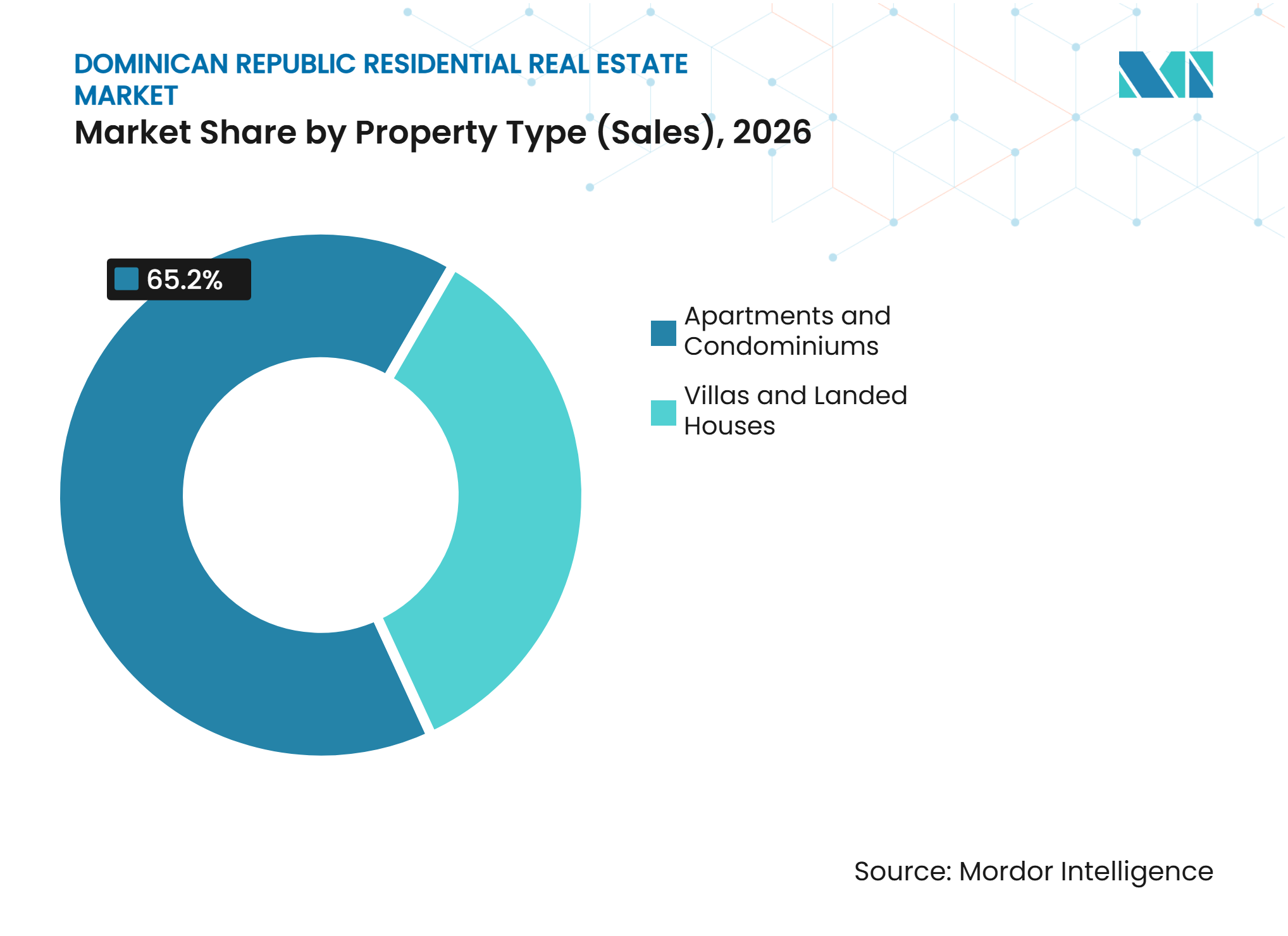
Apartments and Condominiums Lead While Villas and Landed Houses Grow FasterApartments and condominiums are projected to account for 65.2% of the Dominican Republic residential real estate market share in 2026. This position reflects strong demand for vertical housing in Greater Santo Domingo and resort destinations. The National Statistics Office reported that apartments represented 93.2% of units under active construction in the metropolitan area during the second half of 2025. This supply pattern reflects land constraints and the need to serve urban households near employment centers and essential services. It also supports development models that combine residential use with investor-focused rental capacity. The large share of apartments gives builders a strong foundation for designing new projects with compact, professionally managed formats.
Villas and landed houses are forecast to grow at a CAGR of 6.31% from 2027 to 2032. Their appeal is strongest in locations where international visitors seek private accommodations, outdoor space, and resort services. Branded-residence projects are reinforcing this model by combining homes with hotel operations and rental programs. The opening of the St. Regis Cap Cana in May 2025, involving investment exceeding USD 220 million, illustrates the scale of luxury resort-residential development. Developers must continue to align villa supply with local infrastructure, insurance requirements, and seasonal rental patterns. These conditions position apartments as the primary sales anchor, while villas represent a higher-growth property format.


By Price Band in Sales:
Mid-Market Demand Is Broad and Affordable Homes ExpandThe mid-market category accounted for a 51.1% share of the Dominican Republic residential real estate market in 2026, making it the largest price band. Demand comes from households in Greater Santo Domingo and Santiago that need formally built housing near employment and urban services. This segment benefits from urbanization and the gradual expansion of metropolitan neighborhoods. It must also compete with lower-priced projects supported by government programs and with luxury schemes aimed at foreign buyers. The resulting pressure makes site selection, unit design, and financing access particularly important for mid-market developers. It also reinforces the role of apartments within the Dominican Republic residential real estate industry.
The affordable category is forecast to grow at a 6.49% CAGR from 2027 to 2032. Its growth is linked to the Mi Vivienda relaunch and wider public efforts to reduce the housing deficit. Subsidies and preferential financing can bring formal ownership within reach for households that face high market mortgage rates. The program will deliver units across metropolitan and interior provinces, creating opportunities beyond the capital. Affordable housing projects require cost control because material, labor, and land expenses can narrow developer margins. The segment's advance is therefore closely tied to policy delivery and the capacity of private developers to build at qualifying price levels.
By Key Region in Sales:
Greater Santo Domingo Leads and the Eastern Corridor AcceleratesThe Dominican Republic residential real estate market is led by Greater Santo Domingo. Distrito Nacional and the municipalities of Santo Domingo Este, Norte, and Oeste bring together employment, public services, and a large formal housing base. The capital region also receives a substantial share of remittance-supported household demand. Apartment development is extending into peripheral municipalities as land availability and transport needs change. Government road works and metro expansion are intended to improve connections between residential areas and central employment districts. This combination leaves Greater Santo Domingo as the main volume market.
The Eastern Tourist Corridor is forecast to expand at a 6.91% CAGR from 2027 to 2032. Punta Cana, Bávaro, and Cap Cana combine airport access, tourism demand, foreign investment, and tax-eligible development zones. Punta Cana International Airport handled 53% of national air arrivals in the first half of 2026. Cap Cana reported more than USD 3.85 billion invested to date and stated in 2025 that it had 10,000 rooms under development, most of them residential tourism projects. The corridor’s growth depends on continued tourism flows and the ability of developers to deliver well-managed projects. It also faces higher exposure to weather risk and coastal insurance costs.


By Property Type in Rentals:
Apartments and Condominiums Dominate and Villas and Landed Houses Gain Rental DemandApartments and condominiums accounted for 79.3% of rental value in 2026, the largest share across the Dominican Republic residential real estate market rental segment. Long-term urban tenants and visitors using short-stay accommodation both contribute to this pattern. The National Statistics Office recorded an increase in properties designated for rental or self-use from 4,569 to 5,076 in the second half of 2025. Those projects represented 87.6% of active construction activity covered in the survey. The data indicated that a growing part of new supply was intended to generate income or meet owner-occupier needs rather than move directly into resale inventory. This can support rental availability while reducing the number of immediately available resale units.
Villas and landed houses are forecast to grow at a 7.11% CAGR from 2027 to 2032, making them the fastest-growing rental property type. Private accommodation can appeal to leisure travelers who value space and resort access. Hotel-management relationships can give villa owners support with booking, operations, and property standards. Noval Properties opened Reserva Real by Harper in Bávaro-Punta Cana in June 2025, with Archipelago International as its hotel-management partner. The approach shows why developers are using branded arrangements to support rental demand in resort areas. The rental opportunity remains dependent on tourism conditions, reliable operations, and appropriate insurance coverage.
Geography Analysis
Greater Santo Domingo is projected to account for 48.5% of sales in 2026 and remain the center of the Dominican Republic residential real estate market. The region has the country’s largest concentration of formal employment, public services, and internal migration. The National Statistics Office reported an increase in average metropolitan apartment prices between the second half of 2025 and the first half of 2026. Peripheral areas may experience sharper price movements when a limited number of new projects materially alter local supply. Road projects supported by the renegotiated airport contract are expected to improve connectivity between Santo Domingo Oeste, southern areas, and Distrito Nacional. The planned extension of Metro Line 1B toward Villa Mella further strengthens the outlook for northern residential corridors. These investments are expected to support demand beyond the traditional core while preserving the capital region’s position as the anchor for sales volume.
The Eastern Tourist Corridor is projected to grow at a CAGR of 6.91% from 2027 to 2032. Punta Cana, Bávaro, and Cap Cana attract investment because air connectivity and tourism activity expose potential buyers to the region. The St. Regis Cap Cana opened in May 2025, supported by investment exceeding USD 300 million, including USD 132.8 million raised through Dominican capital markets. Punta Cana International Airport handled 53% of national air arrivals during the first six months of 2026. CONFOTUR incentives give qualifying projects an additional advantage by offering favorable tax treatment for first-time purchasers. The region’s residential value proposition depends on sustained visitor flows, project quality, and effective coastal climate-risk management.
Cibao and Santiago benefit from domestic and remittance-supported demand, while the North Coast and Samaná cater to a distinct resort buyer base. The Central Bank reported that the northern region received USD 3.05 billion in remittances during the first nine months of 2025. These inflows can support mid-market housing purchases across the Cibao basin. Puerto Plata also benefits from visitor activity, with cruise passenger volumes increasing by 6% in 2025 to 2,815,732. Samaná and the North Coast offer tourism-oriented projects outside the premium Cap Cana setting. Expanding housing programs across provincial municipalities broadens the Dominican Republic residential real estate market beyond the largest urban and resort corridors.
Competitive Landscape
Market Concentration
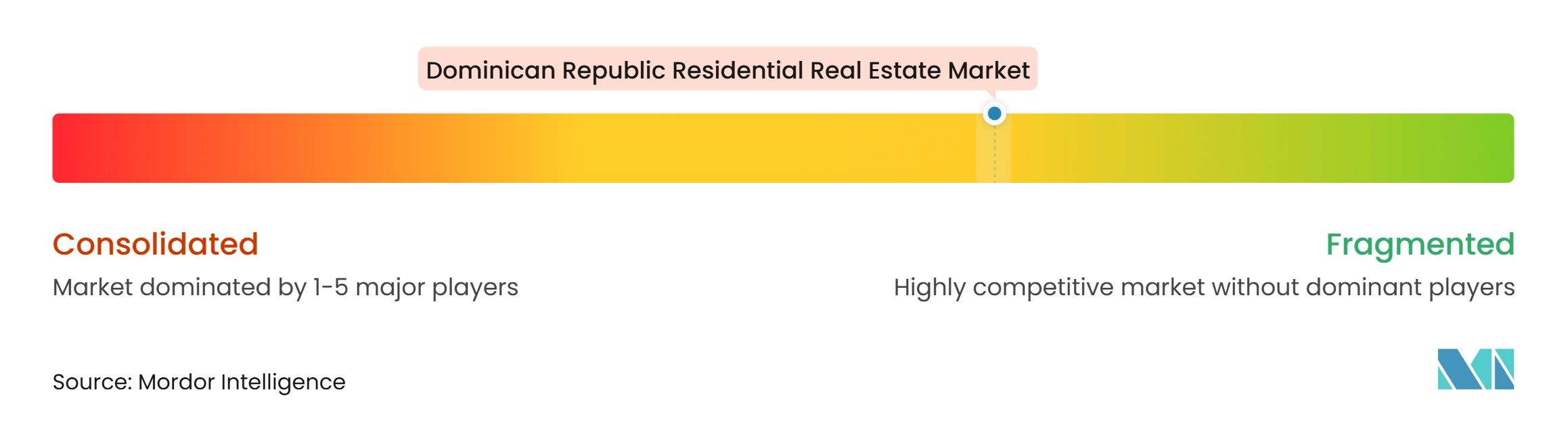
The Dominican Republic residential real estate market is moderately concentrated among major developers. Noval Properties and Cap Cana maintain a strong presence in primary resort-oriented developments, while a broader group of domestic builders serves affordable and mid-market demand. In October 2025, Noval Properties reported that it had delivered more than 3,000 units over 22 years and had 4,108 units under construction. Developers often leverage hotel-brand partnerships to strengthen buyer confidence and support rental operations. This strategy can provide distribution through hotel loyalty networks and ensure professional management standards. Competition is also intensifying in suburban Santo Domingo, Samaná, and Miches, where developers are pursuing land and project opportunities.
Internationally structured capital is increasingly entering high-value projects. In October 2025, Agallas Equities launched its Dominican Republic Real Estate Fund I, targeting USD 400 million in capitalization for tourism, infrastructure, and mixed-use investments. In May 2025, Realty ONE Group International granted master-franchise rights for the Dominican Republic, extending its brokerage model to its 27th country. The entry of institutional investment funds and organized brokerage networks can raise expectations for sales processes, reporting, and buyer support. At the project level, capital-market financing is emerging as an additional funding channel alongside bank lending. The St. Regis Cap Cana financing demonstrates that locally raised capital can support large-scale tourism-related developments.
Several company initiatives illustrate how competition is shifting toward branded and integrated models. In June 2025, Noval Properties opened Reserva Real by Harper with Archipelago International, adding a managed branded-residence format in Bávaro-Punta Cana. In May 2025, the company also announced a supply alliance with Concremax to support concrete deliveries for projects in the eastern Dominican Republic. Cap Cana continues to report a substantial residential tourism development pipeline, supported by international buyers from Argentina, Colombia, Venezuela, and Spain. These developments indicate that leading players compete based on project delivery, hotel affiliations, financing structures, and access to foreign buyers.
Dominican Republic Residential Real Estate Industry Leaders
-
Noval Properties
-
Grupo Puntacana
-
Cap Cana
-
Grupo Therrestra
-
Noriega Group
- *Disclaimer: Major Players sorted in no particular order
Dominican Republic Residential Real Estate Market Companies Covered in this Report
- Noval Properties
- Grupo Puntacana
- Cap Cana
- Grupo Therrestra
- Noriega Group
- Grupo Piñero
- Central Romana Corporation
- Metro Country Club
- Grupo Bonita
- Inversiones Aides
- Pioneer Investment Funds
- Campagna Ricart and Associates
- RE/MAX Dominicana
- Plusval
- Gesproin Group
- SuperCasas
- Century 21 Perdomo
- Agallas Equities
- Fiduciaria La Nacional
- Fiduciaria Reservas
Recent Industry Developments in Dominican Republic Residential Real Estate Market
- September 2026: Banco de Reservas, Fiduciaria Reservas, and the Ministry of Housing and Buildings broke ground on the second phase of Las Acacias III, a 400-unit affordable apartment complex in Santo Domingo Este. The Fideicomiso Inmobiliario de Viviendas de Bajo Costo Paraíso Oriental III supports construction, with financing exceeding USD 11.5 million. Eligible buyers can access the units through Banco de Reservas’ special mortgage terms. This public-private structure combines state-owned land and housing policy with private banking infrastructure to support housing delivery under the 2022–2032 housing plan.
- September 2026: The government announced that pension fund administrators are channeling more than USD 57.4 million through investment funds into residential projects. This funding supports over 13,000 homes across Distrito Nacional, Los Alcarrizos, Santo Domingo Norte, Santo Domingo Este, Santiago, and Higüey. AFI Pioneer and Banco de Ahorro y Crédito Banfondesa also formalized viBIENda, a fixed-rate mortgage product offering terms of up to 25 years for eligible pension fund affiliates. The program establishes a longer-term private financing channel alongside public subsidies, reducing refinancing risk for developers and affordability pressures for buyers.
- May 2026: RBK PRIME International Real Estate and Grupo Noval announced a commercial partnership that gives RBK PRIME’s private clients, institutional investors, and high-net-worth individuals access to Grupo Noval projects across residential, tourism, hospitality, and land segments. The partnership presents the Dominican Republic as a strategic destination in RBK PRIME’s portfolio. Grupo Noval contributes 22 years of local development experience and a record of approximately 3,000 homes delivered. The agreement formalizes a channel for Spanish and wider European capital to reach qualified Dominican Republic projects.
Dominican Republic Residential Real Estate Market Report Scope
Segmentation Overview
| Apartments and Condominiums |
| Villas and Landed Houses |
| By Property Type | Apartments and Condominiums |
| Villas and Landed Houses |
Key Questions Answered in the Report
What is the forecast for residential real estate in the Dominican Republic?
The value is projected to rise from USD 9.96 billion in 2026 to USD 14.04 billion by 2032, at a 5.89% CAGR from 2027 to 2032.
Which property type leads home sales in the Dominican Republic?
Apartments and condominiums lead sales with a 65.2% share in 2026. Villas and landed houses are the fastest-growing sales type at a 6.31% CAGR through 2032.
Which area has the strongest residential growth outlook?
The Eastern Tourist Corridor is projected to grow at a 6.91% CAGR through 2032, supported by tourism, air connectivity, and qualifying incentive-backed projects.
How do CONFOTUR incentives affect home purchases?
Qualifying first purchasers in designated tourism zones can receive a 15-year exemption from specified transfer and annual property taxes under the applicable framework.
What is limiting domestic home buying?
Mortgage rates near 11.71% in early 2026 constrained affordability for households that rely on mortgage finance.
Why are remittances important for housing demand?
Remittances totaled USD 11.87 billion in 2025 and support family housing, retirement purchases, and some investment transactions.