
Distribution Feeder Protection System Market Size and Share
Market Overview
| Study Period | 2022 - 2032 |
|---|---|
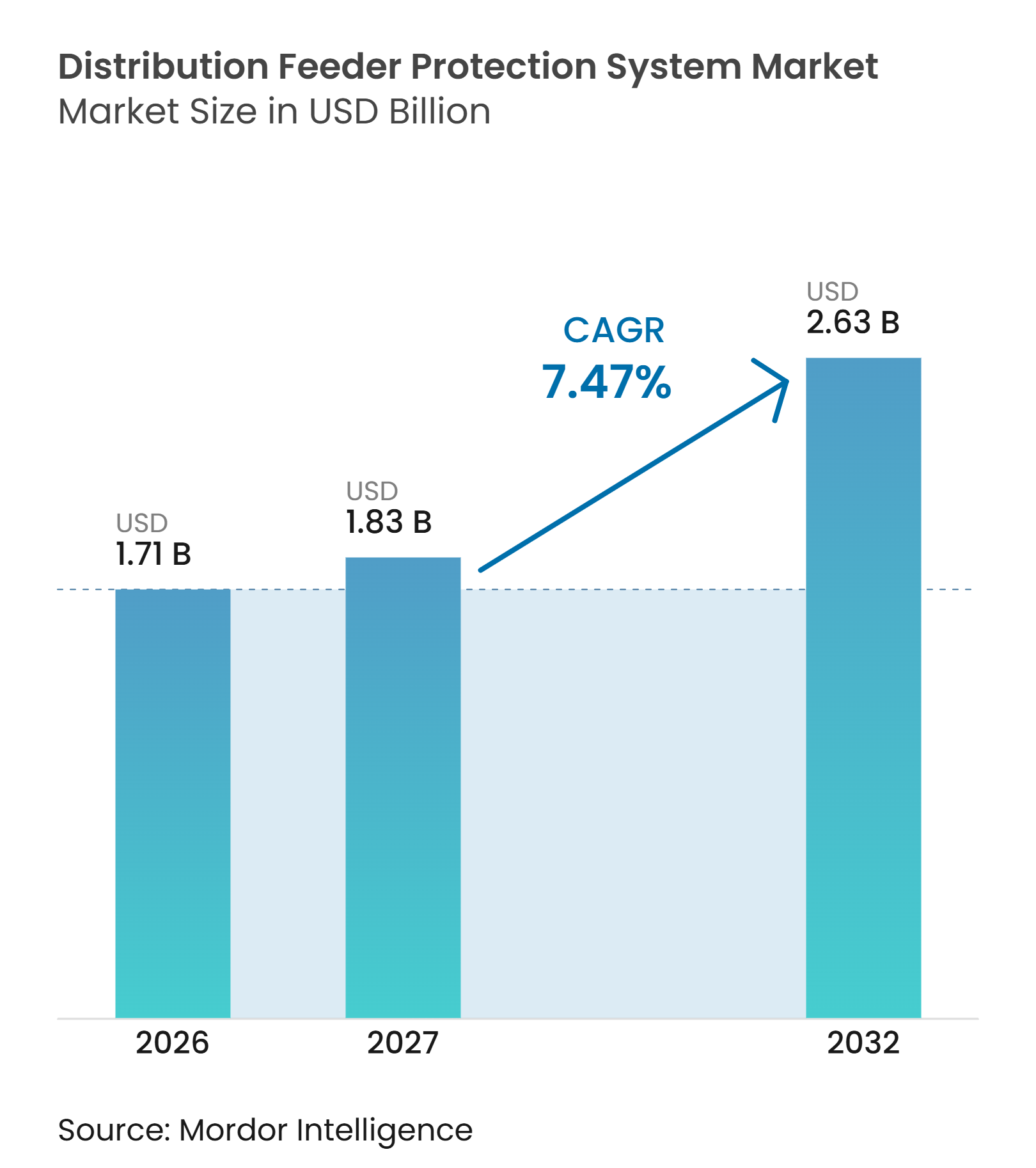
| Market Size (2027) | USD 1.83 Billion |
| Market Size (2032) | USD 2.63 Billion |
| Growth Rate (2027 - 2032) | 7.47 % |
| Fastest Growing Market | Asia-Pacific |
| Largest Market | Asia-Pacific |
| Market Concentration | Medium |
Major Players *Disclaimer: Major Players sorted in no particular order Image © Mordor Intelligence. Reuse requires attribution under CC BY 4.0. | |
Distribution Feeder Protection System Market Analysis by Mordor Intelligence
The Distribution Feeder Protection System Market size is projected to expand from USD 1.71 billion in 2026 and USD 1.83 billion in 2027 to USD 2.63 billion by 2032, registering a CAGR of 7.47% between 2027 and 2032. Structural demand reflects utilities replacing aging distribution equipment, integrating distributed energy resources, and responding to tougher reliability requirements. The distribution feeder protection system market is moving beyond conventional relay replacement because feeder networks now need to manage bidirectional current and changing fault conditions. Grid investment programs are directing funds toward equipment that supports monitoring, automation, and secure communications. The competitive focus is shifting toward integrated protection, control, and software platforms that can reduce field work and support long-term service agreements. These conditions create opportunities for suppliers that can combine protection hardware with interoperable communications and engineering support.
Key Report Takeaways
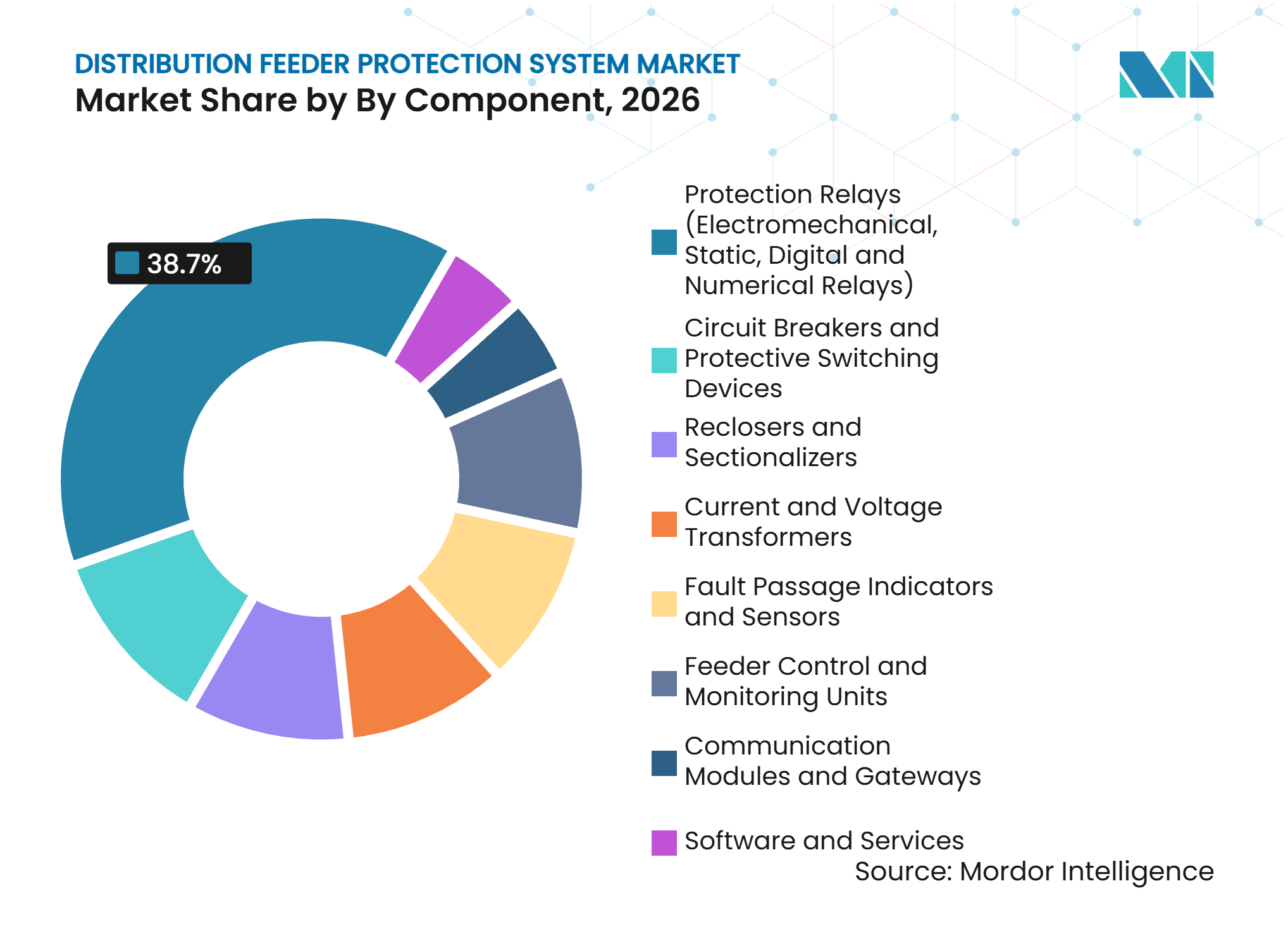
- By component, Protection Relays held 38.7% of the distribution feeder protection system market share in 2026. Communication Modules and Gateways are projected to grow at a 7.7% CAGR through 2032.
- By voltage level, Medium Voltage held 57.2% of the distribution feeder protection system market share in 2026. Low Voltage is projected to grow at a 7.5% CAGR through 2032.
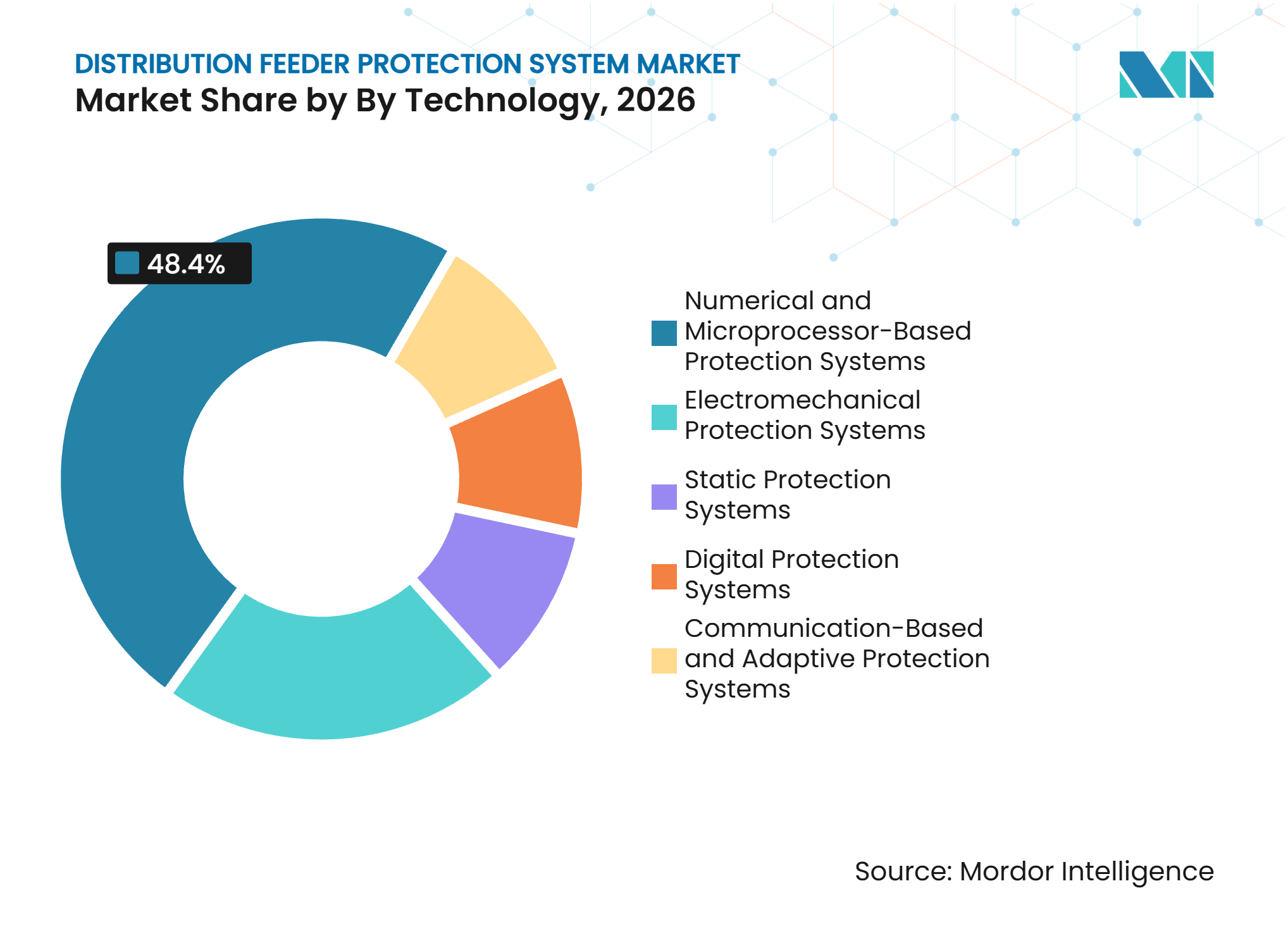
- By technology, Numerical and Microprocessor-Based Protection Systems held 48.4% of the distribution feeder protection system market share in 2026. Communication-Based and Adaptive Protection Systems are projected to grow at an 8.1% CAGR through 2032.
- By end user, Electric Transmission and Distribution Utilities held 46.1% of the distribution feeder protection system market share in 2026. Renewable Energy Operators are projected to grow at a 10.3% CAGR through 2032.
- By geography, Asia-Pacific held a 33.7% revenue share in 2026 and is forecast to grow at an 8.3% CAGR through 2032.
Note: Market numbers in this report are based on Mordor Intelligence's proprietary estimation framework, which combines nine months of actuals with Q4 projections for base year 2026.
Market Trends and Insights
Drivers Impact Analysis of Distribution Feeder Protection System Market*
| Driver | % Impact on CAGR Forecast | Geographic Relevance | Impact Timeline |
|---|---|---|---|
| Aging Distribution Infrastructure Replacement | +2.1% | Global (most acute in North America and Europe) | Medium term (2–4 years) |
| Distributed Energy Resources and Bidirectional Feeder Flows | +1.6% | APAC core, spill-over to North America and Europe | Long term (≥4 years) |
| Distribution Automation, FLISR, and Digital Substations | +1.3% | Global (North America and Europe leading; APAC accelerating) | Medium term (2–4 years) |
| Reliability, Resilience, and SAIDI/SAIFI Mandates | +1.1% | North America and Europe; emerging traction in APAC and MEA | Short term (≤2 years) |
| High-Impedance Fault Detection and Wildfire Mitigation | +0.6% | North America (Western United States), Australia, Southern Europe | Short term (≤2 years) |
| Retrofit-Compatible Edge Intelligence | +0.5% | Global (developed-market retrofit cycles; emerging-market greenfield) | Medium term (2–4 years) |
| Source: Mordor Intelligence | |||
Aging Distribution Infrastructure Replacement
Aging grid equipment has moved from a maintenance issue to a replacement priority for many utilities. The European Parliament reported in 2025 that 40% of European Union distribution infrastructure was more than 40 years old, and the proportion is expected to exceed 50% by 2030.[1] Older electromechanical and early static relays can fall short of current expectations for fault-clearing speed, condition monitoring, and network visibility. This raises the value of digital devices with communications, cybersecurity functions, and configurable protection settings. The European Investment Bank provided EUR 500 million to Dutch operator Stedin in 2025 for medium- and low-voltage infrastructure renewal and automation.[2] The distribution feeder protection system market, therefore, benefits when replacement programs include broader feeder automation work rather than a like-for-like relay exchange. Utilities also use the investment window to standardize device fleets, reduce spare-parts complexity, and improve information available to control rooms.
Distributed Energy Resources and Bidirectional Feeder Flows
Distributed energy resources change the assumptions used in legacy feeder protection settings. A 2025 study in Electric Power Systems Research found that inverter-based distributed generation can alter short-circuit current and introduce bidirectional flows that challenge non-directional overcurrent protection. Protection systems must clear faults without unnecessarily disconnecting generation that is expected to remain connected during specified disturbances. Each solar or wind connection can require utilities to review the coordination of upstream and downstream devices. This creates demand for directional, adaptive, and communication-based protection as well as engineering services. It also makes periodic settings review more important because feeder conditions can vary with generation output, load, and switching configuration. The Asian Development Bank reported in 2025 that grid investment remains central to developing Asia’s energy transition, supporting continued demand for grid integration work.[3]
Distribution Automation, Fault Location, Isolation, and Service Restoration (FLISR), and Digital Substations
Fault Location, Isolation, and Service Restoration programs are increasing demand for communication relays, reclosers, and field gateways. A 2025 case study involving Huntsville Utilities showed that a 46 kV Fault Location, Isolation, and Service Restoration (FLISR) scheme isolated faults and restored service within seconds.[4] These programs place protection devices within a coordinated operating system rather than treating them as stand-alone equipment. Siemens reported in February 2026 that SIPROTEC 5 can consolidate up to 60 hardware devices in one server-based solution, with 25% lower capital expenditure and up to 20% lower lifecycle costs. Digital substation architectures also require secure protocol translation and data aggregation at the feeder edge. GE Vernova introduced GridBeats APS in February 2026 with 27 protection and control application packages on one software-defined platform. The distribution feeder protection system market is consequently seeing greater interest in gateways and centralized protection platforms. Suppliers that can integrate field devices without interrupting service can be better placed in large modernization programs.
Reliability, Resilience, and System Average Interruption Duration Index (SAIDI)/System Average Interruption Frequency Index (SAIFI) Mandates
Reliability rules can turn feeder underperformance into an immediate capital spending decision. Texas amended its electric service reliability provisions in 2025 to allow enforcement action where a feeder’s System Average Interruption Duration Index (SAIDI) or System Average Interruption Frequency Index (SAIFI) average exceeds 200% of the system average for 2 consecutive years. New Jersey’s Board of Public Utilities reinforced reliability levels in 2025 and linked Customer Average Interruption Duration Index (CAIDI) and SAIFI performance to utility revenue mechanisms. Utilities facing these requirements have a stronger reason to prioritize reclosers, intelligent electronic devices, and Fault Location, Isolation, and Service Restoration (FLISR) on poorly performing circuits. Automated isolation and restoration can also provide clear evidence for regulatory discussions. The distribution feeder protection system market gains from this shift because reliability compliance becomes a recurring procurement trigger rather than a discretionary upgrade. Utilities can sequence these investments toward circuits with the highest outage exposure and the clearest regulatory need.
Restraints Impact Analysis of Distribution Feeder Protection System Market*
| Restraint | % Impact on CAGR Forecast | Geographic Relevance | Impact Timeline |
|---|---|---|---|
| High Capital Cost and Rural Feeder Economics | -0.7% | Global (most acute in MEA, South America, and rural North America) | Long term (≥4 years) |
| Legacy Interoperability and Cybersecurity Testing | -0.5% | Global (most significant in North America and Europe due to legacy infrastructure depth) | Medium term (2–4 years) |
| Limited Planned Outage Windows for Settings Migration | -0.3% | North America, Europe, and dense APAC urban networks | Short term (≤2 years) |
| Vendor-Specific Data Models and Protection Skills Scarcity | -0.4% | Global (most acute in emerging markets and utilities with thin engineering teams) | Long term (≥4 years) |
| Source: Mordor Intelligence | |||
High Capital Cost and Rural Feeder Economics
Rural feeder economics remain a constraint for full digital protection upgrades. Low-density circuits can generate insufficient revenue to support the payback period for a complete intelligent electronic device installation. Utilities may therefore extend the service life of legacy assets even when those assets no longer meet the preferred technical standard. The Asian Development Bank identified inadequate financing for grid upgrades as a significant constraint on the energy transition in developing Asia in 2025. This produces a split between advanced installations in urban, industrial, and renewable-adjacent locations and slower modernization in rural systems. Cooperative financing models and public electrification programs can help, but their scale does not remove the gap within the forecast period. Vendors must therefore balance advanced functions with installation models that fit constrained rural capital budgets.
Legacy Interoperability and Cybersecurity Testing
Modern devices must often operate alongside legacy Supervisory Control and Data Acquisition (SCADA) systems, proprietary remote terminal units, and multi-vendor relay fleets. This increases engineering effort and can delay project delivery. IEEE Power and Energy Society reported in 2025 that distribution automation changes can alter relay operating characteristics and coordination requirements. Cybersecurity testing also extends commissioning work when utilities require conformity with data communications and embedded-device security standards. The challenge is more acute for smaller utilities without dedicated protection engineering teams. The distribution feeder protection system market is therefore constrained by the availability of integration services and qualified personnel, not only by equipment budgets. Testing and settings migration must be planned carefully to protect system reliability during the transition.
*Our forecasts treat driver/restraint impacts as directional, not additive. The impact forecasts reflect baseline growth, mix effects, and variable interactions.
Distribution Feeder Protection System Market Segment Analysis
By Component:
Protection Relays Anchor Revenue as Communication Gateways Lead the Next Growth CycleProtection Relays held 38.7% of the distribution feeder protection system market share in 2026. Their installed base spans overhead lines, cable feeders, transformer bays, and busbar protection at primary distribution substations. Replacement demand continues as static and electromechanical equipment reaches end of life, especially where maintenance records show declining reliability or limited access to replacement parts. Modern numerical relays add functions for Fault Location, Isolation, and Service Restoration (FLISR), arc-flash detection, high-impedance fault identification, and cybersecurity, allowing utilities to consolidate functions that were previously delivered by multiple devices. ABB introduced Relion REC615 in May 2025 as a configurable device that combines recloser protection, Fault Location, Isolation, and Service Restoration (FLISR), and multiple earth-fault algorithms.
Communication Modules and Gateways are projected to grow at a 7.7% CAGR in the distribution feeder protection system market through 2032. Each device connected to an IEC 61850 backbone needs functions for protocol translation, data aggregation, or security enforcement, particularly when new equipment must operate with an installed base from several vendors. Gateways can also support edge analytics for fault classification and power-quality monitoring, helping operators identify field issues without relying on repeated data transfers to a central system. Software and services are gaining relevance through remote relay management, firmware subscriptions, and centralized protection engineering tools. RWTH Aachen University’s COMSYS group reported in 2025 that rule-based parameter generation for adaptive distribution protection is technically feasible and reproducible.



By Voltage Level:
Medium Voltage Leads as Low Voltage Smart Grid Deployment IntensifiesMedium Voltage held 57.2% of the distribution feeder protection system market share in 2026. The 1 kV to 36 kV range combines dense utility assets with fault-current conditions that justify full-featured protection, while outages at this level can affect a substantial number of customers. Hitachi Energy's REF650 and Hitachi Energy's REC615 address this portion of the network with digital communication and cybersecurity capabilities. Grid codes and digital-substation requirements are making these functions part of formal specifications in many markets, reducing the scope for utilities to defer digital communication or cybersecurity functions. High-Voltage Distribution Interfaces remain smaller, but they are relevant for substations that connect distribution and sub-transmission networks.
Low Voltage is projected to grow at a 7.5% CAGR in the distribution feeder protection system market through 2032. Smart meters, rooftop solar, electric vehicle chargers, and battery storage extend monitoring and protection needs toward the network edge, where conventional visibility and manual restoration processes are often limited. Zentralverband Elektrotechnik- Und Elektronikindustrie (ZVEI) stated in 2025 that end-to-end digitization of the low-voltage grid is necessary for renewable integration, dynamic tariffs, and lower technical losses. Schneider Electric introduced FeederSeT in August 2025 with digital connectivity, thermal monitoring, and optional cloud integration. These deployments increase the need for devices that combine circuit protection with visibility and data exchange, enabling faster detection of faults and clearer operating information for distribution control teams.
By Technology:
Numerical Systems Dominant as Adaptive Protection Redefines the FrontierNumerical and Microprocessor-Based Protection Systems held 48.4% of the technology segment in 2026. Utilities in developed markets have adopted these systems for event logging, oscillography, and configurable settings, which provide more detailed records after a fault and support more disciplined protection review. They provide functions that electromechanical and static relays cannot offer. However, many are configured offline and cannot respond continuously to changes in feeder topology or distributed generation output, which can make fixed settings less suitable for actively managed networks. Digital systems occupy a middle position, while static and electromechanical systems remain mainly in legacy or rural applications.
Communication-Based and Adaptive Protection Systems are projected to grow at an 8.1% CAGR in the distribution feeder protection system market size through 2032. A 2025 IEEE study found that networked forward-tripping matrices can maintain selectivity in active distribution networks with wind generation and electric vehicle loads. These systems use topology-aware logic where conventional stage-based protection can lose selectivity. GE Vernova’s February 2026 GridBeats APS illustrates the move toward software-defined protection with shared hardware resources. This transition supports recurring revenue from settings management, software licenses, and cybersecurity monitoring alongside equipment sales.

By End User:
Utilities Anchor the Market while Renewable Energy Operators Define the Growth EdgeElectric Transmission and Distribution Utilities held 46.1% of end-user spending in 2026. Their large feeder fleets require periodic settings reviews, maintenance, and replacement as assets age, creating a continuing need for equipment, testing, and field engineering support. Multi-decade capital planning makes utilities the most stable source of demand. Industrial facilities also procure advanced protection where power quality and continuity are important, particularly where an interruption can disrupt sensitive processes or critical onsite loads. Commercial complexes, transport operators, airports, and water utilities maintain dedicated circuits that require dependable fault protection.
Renewable Energy Operators are projected to grow at a 10.3% CAGR in the distribution feeder protection system market size through 2032. A 2025 study in Results in Engineering linked distributed energy resources with sympathetic tripping, reduced substation fault-current contribution, and coordination loss. Adaptive and communication-based schemes are designed to address these operating conditions by adjusting protection behavior as fault contribution, topology, and generation conditions change. Solar parks and wind farms above 10 MW often specify and own substation protection equipment independently from their host utility. This increases the number of direct buyer relationships available to equipment suppliers and makes application engineering an important part of sales to renewable project developers.
Geography Analysis
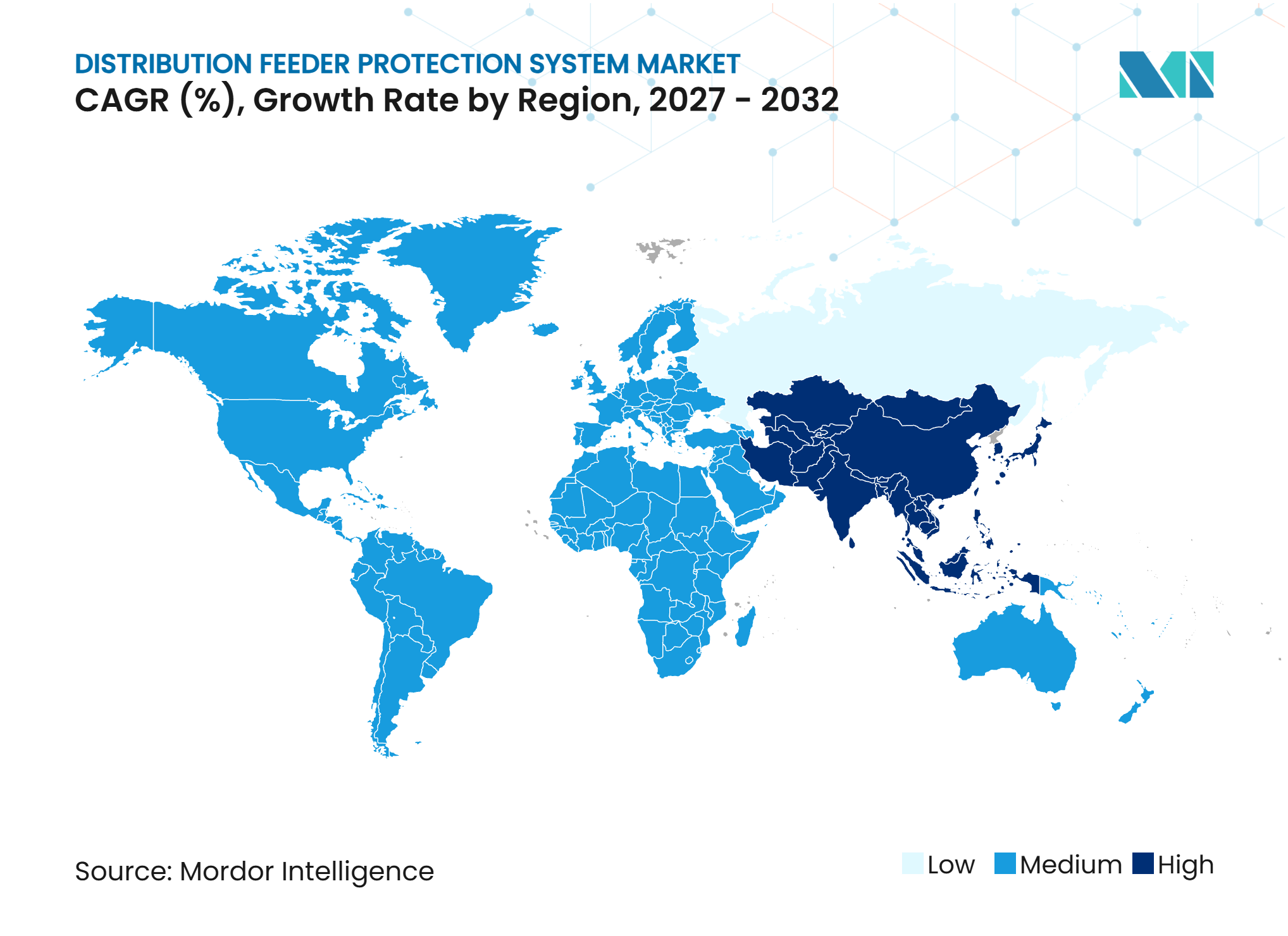
Asia-Pacific held 33.7% of the distribution feeder protection system market share in 2026 and is projected to grow at an 8.3% CAGR through 2032. China is a major driver because its 2025 grid policy established a national direction for a new power system by 2030, supporting investment in the equipment needed to connect and operate a more complex distribution network. India is another large source of demand as grid modernization and feeder telemetry programs expand, creating a need for monitoring and protection equipment that can support distribution-level visibility. Southeast Asian countries offer greenfield opportunities as electrification and renewable integration programs advance, with new networks able to specify digital protection capabilities from the outset. The Asian Development Bank identified insufficient grid investment as a central constraint on the region’s energy transition in 2025.
North America and Europe form the next group of revenue opportunities for the distribution feeder protection system market. In North America, reliability rules and grid modernization funding support procurement of secure and automated feeder equipment. Texas reliability changes in 2025 add a direct regulatory incentive for utilities to improve poorly performing feeders. In Europe, the European Commission set out EUR 730 billion in distribution-grid development needs through 2040 in its 2025 guidance. Aging equipment and decarbonization plans support demand in Germany, France, the Netherlands, Poland, and other active procurement markets, where utilities must add capacity while maintaining reliability and cybersecurity requirements.
South America is led by Brazil and Argentina, where renewable integration and power-sector reform support modernization needs. Colombia and Chile have more developed concession frameworks that can support systematic feeder programs. In the Middle East and Africa, Gulf utilities are investing in high-specification automation and digital substations. This contrast makes deployment timing highly dependent on local utility funding and reliability policy, which can produce uneven demand across neighboring countries and within the same wider region.
Competitive Landscape
Market Concentration
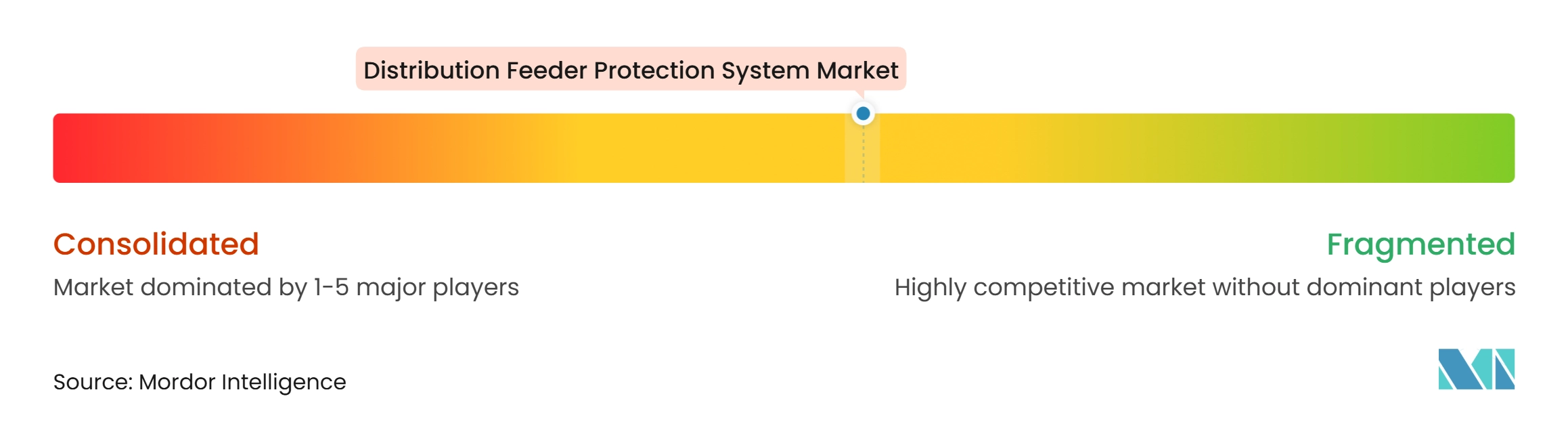
The distribution feeder protection system market is moderately concentrated, although the supplied material does not provide a combined top-player share. ABB, Siemens, Hitachi Energy, Schneider Electric, and GE Vernova compete through integrated offerings that combine protection equipment, SCADA integration, digital substation software, cybersecurity, and long-term services. Specialist suppliers such as Schweitzer Engineering Laboratories, Arcteq, Fanox, and ZIV remain relevant where relay algorithms and configuration flexibility shape tender decisions, especially where utilities require specific applications or compatibility with an existing device base. Siemens introduced SIPROTEC 5 in February 2026, combining up to 60 hardware devices in one server-based system. The product illustrates the growing role of lifecycle cost and compliance in procurement decisions, as utilities compare commissioning effort, space requirements, cyber assurance, and support needs over an asset’s operating life.
Suppliers are extending their offers into software and services as utilities seek coordinated operation across a wider device fleet. GE Vernova launched GridBeats APS in February 2026 with a unified software-defined platform for 27 protection and control application packages. ABB launched REX600 in February 2026 with merging-unit functions, backup protection, and current-based fault-passage indication for digital substations. S&C Electric and Schweitzer Engineering Laboratories also announced an interoperability collaboration in February 2026 for the IntelliRupter PulseCloser and SEL-651RD control. These moves show that suppliers are competing on system integration and retrofit compatibility as well as device performance, because many utilities need improvements that can be installed around equipment already in service.
The market still has openings among mid-tier utilities and cooperatives with large legacy fleets. Firmware updates, communications modules, and cybersecurity overlays can improve existing numerical devices when full replacement is not affordable, offering a staged route toward improved visibility and more secure operations. Chinese suppliers NARI Technology and NR Electric can compete on price in selected markets outside China. Their progress in regulated Western markets is limited by cybersecurity procurement requirements and supply-chain security policies, although the strength of these limits differs between utility systems and national procurement frameworks.
Distribution Feeder Protection System Industry Leaders
-
ABB Ltd.
-
Siemens AG
-
Schneider Electric SE
-
GE Vernova Inc.
-
Eaton Corporation plc
- *Disclaimer: Major Players sorted in no particular order
Distribution Feeder Protection System Market Companies Covered in this Report
- ABB Ltd.
- Arcteq Relays Ltd.
- Basler Electric Company
- CG Power and Industrial Solutions Limited
- Eaton Corporation plc
- Fanox Electronic, S.L.
- GE Vernova Inc.
- Hitachi Energy Ltd.
- Larsen & Toubro Limited
- Littelfuse, Inc.
- Mitsubishi Electric Corporation
- NARI Technology Co., Ltd.
- NR Electric Co., Ltd.
- Rockwell Automation, Inc.
- S&C Electric Company
- Schneider Electric SE
- Schweitzer Engineering Laboratories, Inc.
- Siemens AG
- Toshiba Corporation
- ZIV Aplicaciones y Tecnolog�a, S.A.
Recent Industry Developments in Distribution Feeder Protection System Market
- May 2026: Hitachi Energy deployed Türkiye’s first digital-substation pilot in partnership with transmission system operator TEİAŞ, using IEC 61850 Edition 2.1 process-bus protection and control. The project validates full process-bus architecture for primary distribution and sub-transmission substations and signals commercial readiness for wide deployment across the European and Middle Eastern digital substation market.
- February 2026: Siemens introduced SIPROTEC 5, consolidating the functionality of up to 60 hardware-based SIPROTEC 5 Intelligent Electronic Devices (IEDs) in a single server-based solution for digital substations. The product delivers 25% CAPEX reduction, 45% substation space savings, carbon-emission cuts of up to 50% through elimination of copper cabling, and lifecycle cost savings of up to 20%, materially lowering the barrier to digital substation adoption.
- February 2026: GE Vernova launched GridBeats APS, a unified software-defined platform supporting 27 protection and control application packages, including advanced feeder protection with incipient fault detection and pilot schemes, for both conventional and digital substations. The system is designed to enable utilities to modernize protection architecture without service interruption or complete hardware displacement.
- February 2026: ABB launched REX600, a compact device combining merging-unit functionality, backup protection, and accurate current-based fault-passage indication for digital substations. REX600 is compliant with IEC 62443-4-1 and IEC 62443-4-2 cybersecurity standards and integrates with ABB’s SSC600 centralized and virtualized protection platforms, supporting open-standard multivendor architectures.
Global Distribution Feeder Protection System Market Report Scope
The Global Distribution Feeder Protection System Market comprises the market for protection, monitoring, and control equipment designed to detect, isolate, and manage electrical faults in power distribution feeder networks. These systems safeguard distribution infrastructure, including feeders, transformers, switching equipment, and connected loads, against conditions such as short circuits, overcurrent, earth faults, and abnormal voltage or current variations. Distribution feeder protection systems incorporate protection relays, circuit breakers, reclosers, sectionalizers, current and voltage transformers, fault passage indicators, feeder control units, and communication equipment to enable fault detection, selective isolation, and restoration of power supply. The market includes conventional electromechanical and static protection technologies as well as digital, numerical, microprocessor-based, communication-enabled, and adaptive protection systems. These systems are deployed by electric utilities, industrial facilities, commercial buildings, renewable energy operators, and infrastructure operators to improve distribution network reliability, minimize service interruptions, and support the integration of distributed energy resources.
The Global Distribution Feeder Protection System Market is segmented by Component (Protection Relays, including Electromechanical, Static, Digital and Numerical Relays; Circuit Breakers and Protective Switching Devices; Reclosers and Sectionalizers; Current and Voltage Transformers; Fault Passage Indicators and Sensors; Feeder Control and Monitoring Units; Communication Modules and Gateways; and Software and Services); By Voltage Level (Low Voltage, Medium Voltage, and High-Voltage Distribution Interfaces); By Technology (Electromechanical Protection Systems, Static Protection Systems, Digital Protection Systems, Numerical and Microprocessor-Based Protection Systems, and Communication-Based and Adaptive Protection Systems); and By End User (Electric Transmission and Distribution Utilities, Industrial Facilities, Commercial Buildings and Complexes, Renewable Energy Operators, Infrastructure and Transportation Operators, and Municipal and Cooperative Utilities). The market is also segmented geographically across 26 countries in key regions. For each segment, market sizing and forecasts are provided on the basis of value (USD).
Segmentation Overview
| Protection Relays (Electromechanical, Static, Digital and Numerical Relays) |
| Circuit Breakers and Protective Switching Devices |
| Reclosers and Sectionalizers |
| Current and Voltage Transformers |
| Fault Passage Indicators and Sensors |
| Feeder Control and Monitoring Units |
| Communication Modules and Gateways |
| Software and Services |
| Low Voltage |
| Medium Voltage |
| High-Voltage Distribution Interfaces |
| Electromechanical Protection Systems |
| Static Protection Systems |
| Digital Protection Systems |
| Numerical and Microprocessor-Based Protection Systems |
| Communication-Based and Adaptive Protection Systems |
| Electric Transmission and Distribution Utilities |
| Industrial Facilities |
| Commercial Buildings and Complexes |
| Renewable Energy Operators |
| Infrastructure and Transportation Operators |
| Municipal and Cooperative Utilities |
| North America | United States |
| Canada | |
| Mexico | |
| Europe | Germany |
| France | |
| Italy | |
| Spain | |
| United Kingdom | |
| Poland | |
| Netherlands | |
| Russia | |
| Rest of Europe | |
| Asia-Pacific | China |
| India | |
| Japan | |
| South Korea | |
| Australia | |
| Indonesia | |
| Malaysia | |
| Thailand | |
| Philippines | |
| Rest of Asia-Pacific | |
| South America | Brazil |
| Argentina | |
| Colombia | |
| Rest of South America | |
| Middle East and Africa | Saudi Arabia |
| United Arab Emirates | |
| South Africa | |
| Kenya | |
| Egypt | |
| Nigeria | |
| Rest of Middle East and Africa |
| By Component | Protection Relays (Electromechanical, Static, Digital and Numerical Relays) | |
| Circuit Breakers and Protective Switching Devices | ||
| Reclosers and Sectionalizers | ||
| Current and Voltage Transformers | ||
| Fault Passage Indicators and Sensors | ||
| Feeder Control and Monitoring Units | ||
| Communication Modules and Gateways | ||
| Software and Services | ||
| By Voltage Level | Low Voltage | |
| Medium Voltage | ||
| High-Voltage Distribution Interfaces | ||
| By Technology | Electromechanical Protection Systems | |
| Static Protection Systems | ||
| Digital Protection Systems | ||
| Numerical and Microprocessor-Based Protection Systems | ||
| Communication-Based and Adaptive Protection Systems | ||
| By End User | Electric Transmission and Distribution Utilities | |
| Industrial Facilities | ||
| Commercial Buildings and Complexes | ||
| Renewable Energy Operators | ||
| Infrastructure and Transportation Operators | ||
| Municipal and Cooperative Utilities | ||
| By Geography | North America | United States |
| Canada | ||
| Mexico | ||
| Europe | Germany | |
| France | ||
| Italy | ||
| Spain | ||
| United Kingdom | ||
| Poland | ||
| Netherlands | ||
| Russia | ||
| Rest of Europe | ||
| Asia-Pacific | China | |
| India | ||
| Japan | ||
| South Korea | ||
| Australia | ||
| Indonesia | ||
| Malaysia | ||
| Thailand | ||
| Philippines | ||
| Rest of Asia-Pacific | ||
| South America | Brazil | |
| Argentina | ||
| Colombia | ||
| Rest of South America | ||
| Middle East and Africa | Saudi Arabia | |
| United Arab Emirates | ||
| South Africa | ||
| Kenya | ||
| Egypt | ||
| Nigeria | ||
| Rest of Middle East and Africa | ||
Key Questions Answered in the Report
What is the forecast growth rate for distribution feeder protection systems?
The Distribution Feeder Protection System Market size is projected to expand from USD 1.71 billion in 2026 and USD 1.83 billion in 2027 to USD 2.63 billion by 2032, registering a CAGR of 7.47% between 2027 and 2032.
Which component holds the largest share of feeder protection spending?
Protection Relays held 38.7% of component revenue in 2026, supported by replacement and automation programs.
Why are communication modules and gateways growing quickly?
They are expected to grow at a 7.7% CAGR through 2032 because digital substations require secure data exchange, protocol translation, and edge monitoring.
Which end user has the highest projected growth?
Renewable Energy Operators are projected to grow at a 10.3% CAGR through 2032 as distributed generation creates more complex protection requirements.
Which region is expected to grow fastest?
Asia-Pacific held 33.7% of 2026 revenue and is projected to grow at an 8.3% CAGR through 2032.
What limits deployment on rural feeders?
High capital cost, sparse circuit economics, legacy-system integration, cybersecurity testing, and shortages of protection engineers can delay upgrades.