
Distributed Energy Resources (DER) Technology Market Size and Share
Market Overview
| Study Period | 2022 - 2032 |
|---|---|
| Market Size (2027) | USD 1.11 Billion |
| Market Size (2032) | USD 2.65 Billion |
| Growth Rate (2027 - 2032) | 19.11 % |
| Fastest Growing Market | Asia-Pacific |
| Largest Market | North America |
| Market Concentration | Low |
Major Players *Disclaimer: Major Players sorted in no particular order Image © Mordor Intelligence. Reuse requires attribution under CC BY 4.0. | |
Distributed Energy Resources (DER) Technology Market Analysis by Mordor Intelligence
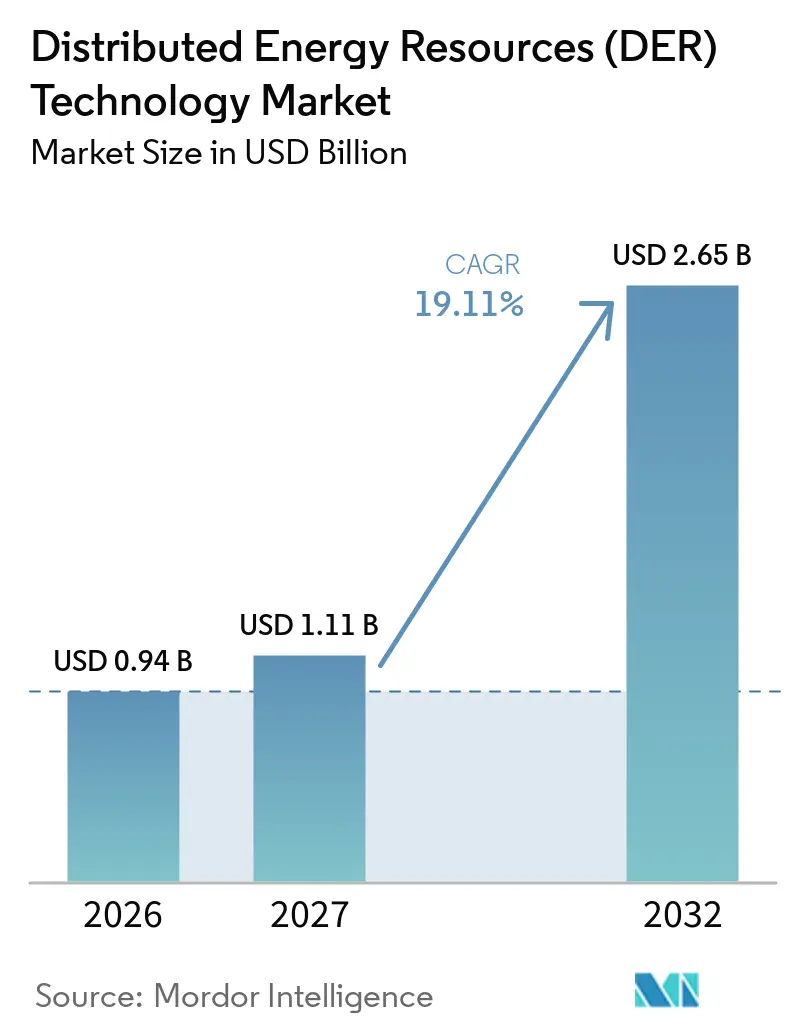
The Distributed Energy Resources Technology Market size is projected to be USD 0.94 billion in 2026, USD 1.11 billion in 2027, and reach USD 2.65 billion by 2032, growing at a CAGR of 19.11% from 2027 to 2032. The distributed energy resources technology market is being shaped by local generation, storage, and flexible demand that can support customers and electricity networks at the same time. Distributed solar systems provide the broadest installed base, while storage, grid controls, and digital platforms are needed to operate a larger number of connected assets. China’s national renewable energy planning supports continued deployment of distributed resources, which should extend demand beyond generation equipment to inverters, batteries, and interconnection systems.[1] Grid investment plans in several regions also create room for suppliers that can help utilities manage voltage, capacity, data, and customer-owned equipment.[2] The distributed energy resources technology market therefore depends on both physical equipment and the software needed to coordinate it across distribution networks.
Key Report Takeaways
- By resource technology, distributed solar PV systems held 33.7% of the distributed energy resources technology market share in 2026, while distributed energy storage systems are forecast to grow at a 22.6% CAGR through 2032.
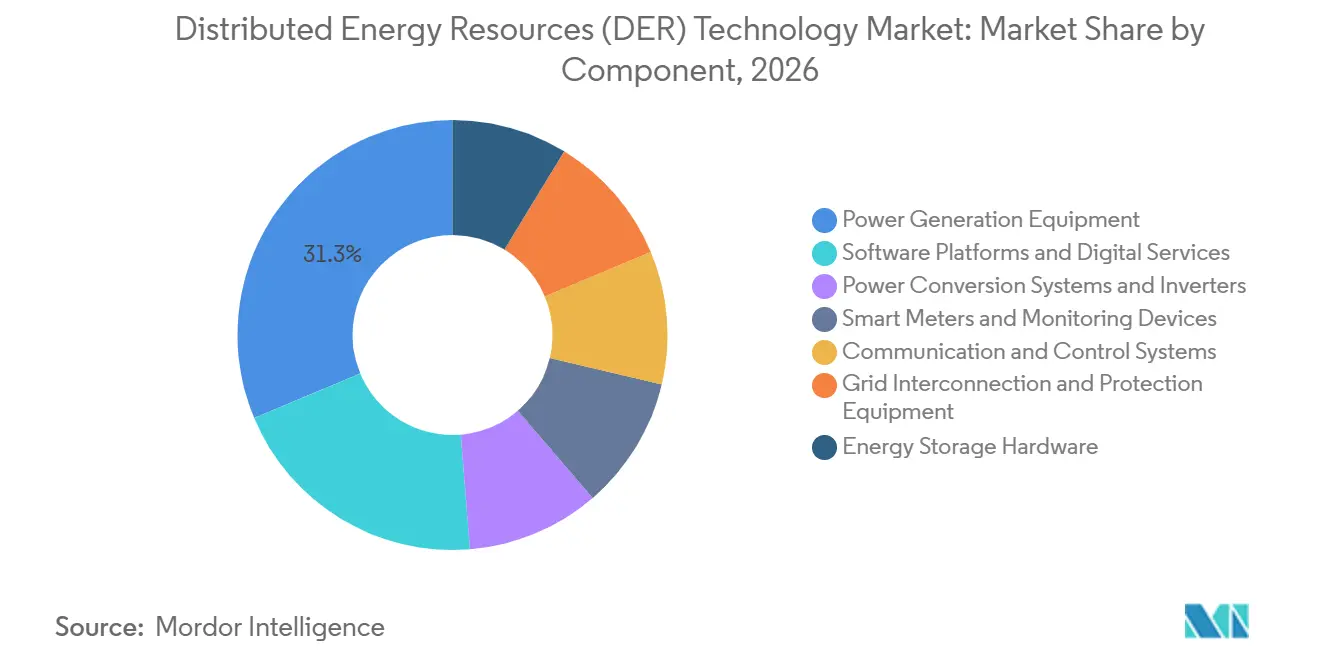
- By component, power generation equipment held 31.3% of the distributed energy resources technology market share in 2026, while software platforms and digital services are forecast to grow at 21.4% CAGR through 2032.
- By technology integration, grid-connected distributed energy systems held a 24.2% revenue share in 2026, while virtual power plants are forecast to grow at a 22.9% CAGR through 2032.
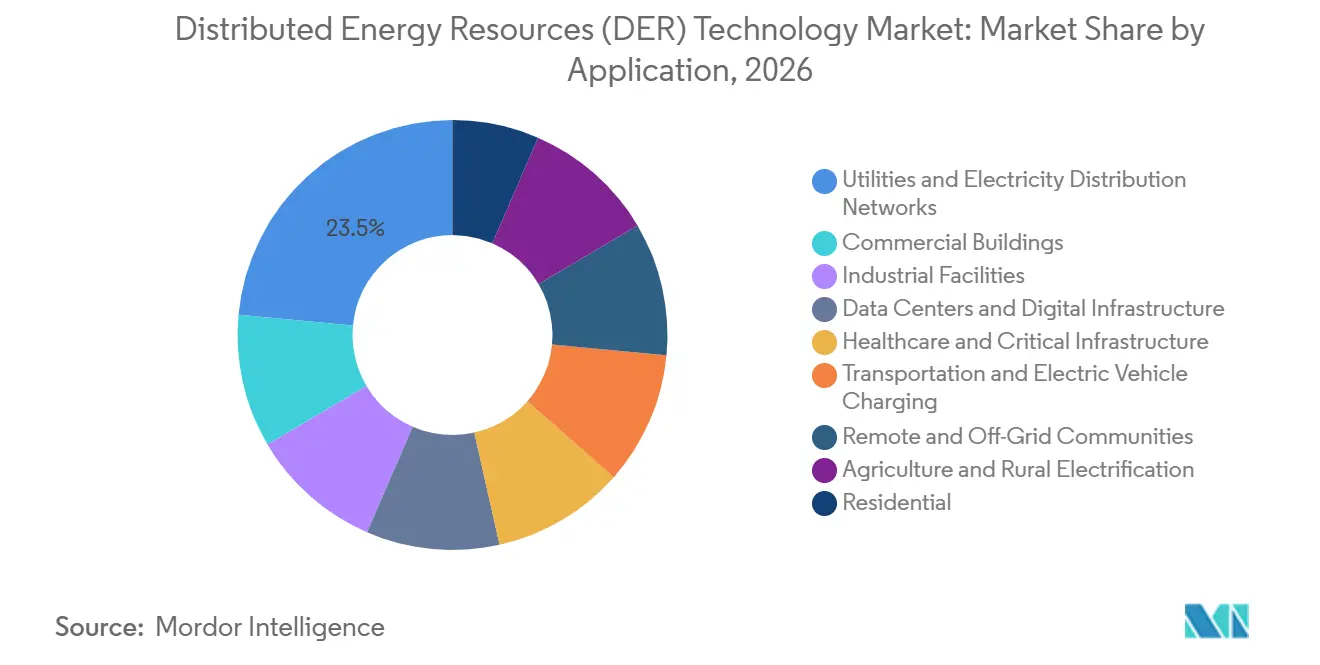
- By application, utilities and electricity distribution networks held a 23.5% revenue share in 2026, while data centers and digital infrastructure are forecast to grow at a 23.6% CAGR through 2032.
- By geography, North America held a 35.7% revenue share in 2026, while Asia-Pacific is forecast to grow at a 19.7% CAGR through 2032.
Note: Market numbers in this report are based on Mordor Intelligence's proprietary estimation framework, which combines nine months of actuals with Q4 projections for base year 2026.
Market Trends and Insights
Drivers Impact Analysis of Distributed Energy Resources (DER) Technology Market*
| Driver | (~) % Impact on CAGR Forecast | Geographic Relevance | Impact Timeline |
|---|---|---|---|
| Renewable Energy and Distributed Generation Expansion | +3.8% | Global, with intensity in APAC and North America | Short term (≤ 2 years) |
| Grid Resilience and Energy Security Requirements | +1.8% | North America, Europe, APAC | Medium term (2–4 years) |
| Grid Modernization and Distribution-System Digitalization | +2.0% | Europe, North America | Medium term (2–4 years) |
| Declining Solar PV and Battery Storage Costs | +2.9% | Global | Short term (≤ 2 years) |
| Electrification of Transport, Buildings, and Industry | +1.7% | North America, Europe | Medium term (2–4 years) |
| Utility Adoption of Flexibility Markets and Virtual Power Plants | +2.3% | North America, Europe, APAC | Long term (≥ 4 years) |
| Source: Mordor Intelligence | |||
Renewable Energy and Distributed Generation Expansion Anchors Demand
Distributed renewable deployment increases the number of assets that must be connected, observed, and managed within local electricity systems. China installed 153 GW of distributed photovoltaic capacity in 2025, taking cumulative distributed photovoltaic capacity to 530 GW.[3] National planning also identifies further distributed renewable additions through 2030, supporting a longer order cycle for project equipment and supporting systems. In Germany, network operators are planning for 425 GW of photovoltaic capacity and a substantial expansion in connected battery storage by 2045.[4] These volumes place more operational responsibility on distribution networks and make monitoring, grid connection, and control capabilities more important. The distributed energy resources technology market benefits when renewable additions create a need for equipment that supports reliable local operation rather than only new generation capacity.
Grid Resilience and Energy Security Requirements Support Local Assets
Grid resilience needs are increasing interest in assets that can maintain service during outages or network constraints. Microgrids, storage systems, and controllable distributed generation can provide local support when centralized capacity or transmission connections are constrained. The US Department of Energy allocated USD 65 million to its Connected Communities 2.0 program to validate grid-edge technologies in real-world microgrids. This work reflects the need to test how customer and community resources perform under actual system conditions. Energy security requirements also favor equipment that can coordinate several resource types rather than relying on a single technology. The distributed energy resources technology market can therefore benefit where resilience plans place a higher value on continuity, local control, and fast response.
Grid Modernization and Distribution-System Digitalization Expand Software Demand
Digital distribution systems convert more devices from passive loads into controllable grid participants. Germany’s network planning process includes rising photovoltaic capacity and battery connections that require improved visibility at the distribution level. Smart meters, communication systems, and control platforms provide the operating data needed to manage these resources. Their value rises when utilities need to understand both electricity flows and the availability of customer-owned flexibility. This favors suppliers that can integrate hardware, software, and network standards in a single operating environment. The distributed energy resources technology market gains from this transition because new installations need coordination tools throughout their operating life.
Utility Adoption of Flexibility Markets and Virtual Power Plants Broadens Use Cases
Virtual power plants bring smaller generation, storage, and flexible demand resources together for coordinated operation. Their use can help utilities respond to local peaks without building all capacity through conventional network expansion. Order 2222 implementation is central to this model because it sets the basis for distributed resource participation in organized wholesale markets. State and regional programs can also create demand for aggregation platforms, customer enrollment tools, and operational controls. The operating model depends on transparent compensation, reliable communications, and a clear route for market participation. The distributed energy resources technology market has a longer-term opportunity where utilities use virtual power plants as a regular resource rather than a limited pilot program.
Restraints Impact Analysis of Distributed Energy Resources (DER) Technology Market*
| Restraint | (~) % Impact on CAGR Forecast | Geographic Relevance | Impact Timeline |
|---|---|---|---|
| Interoperability and Legacy-System Integration Complexity | -0.9% | Global, most acute in North America and Europe | Medium term (2-4 years) |
| Fragmented DER Compensation and Market-Participation Rules | -0.7% | North America, Europe | Long term (≥ 4 years) |
| Cybersecurity and Data-Privacy Exposure Across Grid-Edge Assets | -0.8% | North America, Europe | Medium term (2-4 years) |
| Utility Cost-Recovery Disincentives for Third-Party DER and VPP Investments | -0.6% | North America | Long term (≥ 4 years) |
| Source: Mordor Intelligence | |||
Cybersecurity And Data-Privacy Exposure Across Grid-Edge Assets
Internet-connected generation, batteries, inverters, and control systems expand the number of possible entry points into electricity networks. Department of Energy research identifies remote access and communication practices as important considerations for grid-edge equipment security. FERC approved the CIP-015-1 reliability standard in July 2025, requiring internal network security monitoring for high-impact bulk electric system assets. Compliance duties can lengthen procurement reviews and increase documentation requirements for vendors. Smaller suppliers may face a heavier burden when utility buyers require evidence of secure remote management and device controls. These requirements can delay deployment in the distributed energy resources technology market even when the underlying project economics are attractive.
Fragmented DER Compensation and Market-Participation Rules Limit Revenue Certainty
Distributed resource owners need clear compensation rules before they can commit capital to aggregation and grid-service projects. Order 2222 is intended to improve market access, but implementation differs across US regions and continues to move through regional processes. PJM Interconnection’s (PJM) implementation schedule extends to February 2028, which postpones wholesale revenue access for eligible distributed resource aggregations in that market. Delays make it harder for project developers to support long-term revenue assumptions. The effect is strong for software platforms that depend on access to ancillary-service and capacity revenues. The distributed energy resources technology market may therefore develop unevenly where assets can operate technically but cannot receive consistent payment for their grid services.
*Our forecasts treat driver/restraint impacts as directional, not additive. The impact forecasts reflect baseline growth, mix effects, and variable interactions.
Distributed Energy Resources (DER) Technology Market Segment Analysis
By Resource Technology:
Distributed Storage Gains Wider Use Alongside Solar PVDistributed solar PV systems held a 33.7% revenue share in 2026. This position reflects the wide use of rooftop and commercial solar systems across both established and emerging electricity systems. China’s 530 GW of cumulative distributed photovoltaic capacity at the end of 2025 illustrates the scale of the installed base that requires connection, monitoring, and operating support. Solar installations create recurring demand for inverters, protection equipment, communications, and services that manage output at the local level. Distributed wind, combined heat and power, small hydropower, fuel cells, and diesel or gas generators remain relevant where site conditions or reliability needs differ from solar conditions. Combined heat and power retain a role in industrial and district energy settings where both electricity and thermal output are needed. Diesel and gas generators also continue to serve as resilience resources in areas with weaker grid reliability. These technologies broaden the addressable application base of the distributed energy resources technology market. Their role is likely to remain specific to site needs rather than replace the deployment scale of solar PV. The distributed energy resources technology market benefits when these technologies are matched to local reliability, fuel, and thermal requirements.
Distributed energy storage systems are forecast to grow at 22.6% CAGR through 2032. Storage can shift locally generated electricity, provide backup power, and respond to grid conditions without requiring a new generation asset. Residential storage activity in the United States showed this role clearly, with 647 MW installed in the third quarter of 2025. Storage also serves commercial customers that need continuity of supply and utilities that need flexible local capacity. Bloom Energy reported that 73% of surveyed data center operators were using onsite power strategies in 2026. This widens the use of storage beyond household backup systems. The resource mix will depend on local grid quality, fuel access, renewable output, and customer load profiles. Storage growth can strengthen demand for control systems because batteries produce the greatest value when they are scheduled and dispatched effectively.
By Component:
Software Platforms Become More Important Within DER OperationsPower generation equipment accounted for 31.3% of the distributed energy resources technology market size in 2026. Equipment remains the foundation of every project because it converts sunlight, fuel, wind, or stored electricity into usable power. Generation equipment also sets the technical parameters for later additions such as batteries, inverters, meters, and communications systems. Energy storage hardware and power conversion systems form another significant equipment group because they determine how flexible assets connect to the grid. Grid-forming inverter designs are receiving more attention in systems with a higher share of variable generation. Huawei Digital Power launched its LUTERRA grid-forming energy storage platform in June 2026 for applications requiring frequency and voltage support. Smart meters, control systems, and grid connection equipment provide the practical link between physical assets and system operators. Their importance rises as projects include multiple resource types on the same site. Hardware suppliers must increasingly demonstrate compatibility with the digital systems used by utilities and customers.
Software platforms and digital services are forecast to grow at a 21.4% CAGR through 2032. These systems collect operating data, forecast output, control devices, and support participation in grid-service programs. Their growth reflects the higher operating complexity of systems with distributed generation, storage, flexible demand, and different customer owners. Software does not remove the need for physical equipment, but it can improve how installed equipment is used. Interoperability with utility systems is therefore important for suppliers seeking large deployments. IEC 61850 and IEEE 2030.5 are increasingly relevant in utility-side integration because they support more consistent communication between connected systems. Digital services also need to meet cybersecurity and data management requirements that may differ by jurisdiction. The distributed energy resources technology market will favor vendors that can combine secure operations with simple integration for utilities and asset owners. Software can become a stronger differentiator as core equipment becomes more widely available from several manufacturers. The distributed energy resources technology market rewards platforms that reduce operating complexity for both utilities and customers.
By Technology Integration:
Grid-Connected Systems Lead While VPPs Grow FasterGrid-connected distributed energy systems held a 24.2% revenue share in 2026. These systems allow customers to use locally generated electricity while maintaining access to the wider grid. Within the distributed energy resources technology market, this arrangement supports self-consumption, backup capability, and potential participation in utility programs. It is particularly common for commercial and industrial users that need both energy savings and operational continuity. Grid-connected systems also provide utilities with a possible source of flexibility if suitable communications and compensation rules are in place. Solar-plus-storage configurations are expanding because they pair renewable output with a resource that can respond after solar production falls. Hybrid systems can be useful in regions where diesel displacement is economically relevant. Off-grid systems and microgrids remain important where grid extension is difficult or reliability needs are high. The US Department of Energy’s Connected Communities 2.0 program supports demonstration of these grid-edge applications.
Virtual power plants are forecast to grow at a 22.9% CAGR through 2032. They use software to combine many smaller devices into a resource that can be scheduled for grid needs. This model can include household batteries, smart thermostats, electric vehicles, commercial loads, and other connected equipment. Its success depends on customer enrollment, reliable device controls, and a payment structure that rewards participation. Regional market rules determine whether these resources can earn wholesale or distribution-level revenues. The implementation of FERC Order No. 2222 is an important factor influencing the pace of virtual power plant adoption in the United States. In Illinois, the Clean and Reliable Grid Affordability Act requires qualifying electric utilities to file virtual power plant tariff proposals by December 31, 2027, with regulatory approval targeted by December 31, 2028, followed by implementation. This requirement supports a more visible pipeline for aggregation platforms and utility controls. The distributed energy resources technology market can benefit when virtual power plants move from demonstration programs into regular planning and procurement processes.
By Application:
Utilities Lead Current Spending and Data Centers Expand QuicklyUtilities and electricity distribution networks held a 23.5% revenue share in 2026. They use distributed resources for network management, non-wires alternatives, capacity support, and flexibility programs. Their role is important because utilities set many of the connection and operating requirements that influence project deployment. In July 2025, approximately 70,000 customer-owned batteries in Puerto Rico collectively supplied 48 MW to the grid, helping prevent multiple load-shedding events (The Pew Charitable Trusts, 2026; Clean Energy States Alliance, 2026). The event showed how customer-owned assets can provide system support when aggregation systems are available. Utilities also need better visibility of resources that are installed behind customer meters. This requirement supports investment in meters, communications, data platforms, and operating controls. Distribution networks must balance customer choice with safe and reliable grid operation. The distributed energy resources technology market is supported where utilities treat flexible customer assets as part of their network planning process.
Data centers and digital infrastructure are forecast to grow at a 23.6% CAGR through 2032. Their electricity demand and service continuity needs make onsite generation and storage a relevant operating consideration. The International Energy Agency expects global data center electricity consumption to reach 945 TWh by 2030. This demand can increase the value of local resources that help manage capacity constraints or provide backup power. Health care facilities, industrial sites, commercial buildings, residential users, agricultural users, and remote operations also create demand for distributed systems. Their priorities differ, with some users seeking lower energy costs and others prioritizing uninterrupted electricity supply. This variety prevents one application from defining the entire distributed energy resources technology market. Suppliers need application-specific equipment sizing, controls, service support, and compliance capabilities. Data centers are likely to require more integrated solutions because they combine high load density with stringent reliability requirements.
Geography Analysis
North America Distributed Energy Resources (DER) Technology Market
North America held a 35.7% revenue share in 2026. The region combines a large installed base of customer-owned equipment with utility interest in grid flexibility, storage, and local reliability solutions. Federal Energy Regulatory Commission (FERC) Order 2222 and related regional implementation processes provide an important framework for aggregation and market participation. State policy activity in California, Colorado, Illinois, Massachusetts, and Virginia also supports continued use of virtual power plant programs. North American growth is not uniform because each utility territory has different interconnection rules, retail rates, incentive structures, and market access. This fragmentation can slow deployment but also creates demand for suppliers that understand utility requirements. Canada adds renewable energy and storage opportunities through provincial targets, while Mexico provides additional regional potential through changing energy policy. The United States remains the main source of regional deployment volume and procurement activity.
Europe Distributed Energy Resources (DER) Technology Market
Europe’s distributed energy resources technology market is supported by grid planning, renewable deployment, and a strong policy focused on prosumer participation. Germany’s transmission system operators projected EUR 365 billion to EUR 392 billion of grid investment through their 2037 and 2045 planning work. Distribution network planning also anticipates 425 GW of installed photovoltaic capacity and much larger battery connections by 2045. These plans make distribution-level connection, control, and visibility a central concern for utilities. Poland is developing as a notable project location, and Sungrow and GOLDBECK SOLAR announced a 722 MWp project with a 1 GWh storage pipeline in August 2026. The United Kingdom, France, Italy, and Spain have different levels of market maturity, but each is increasing interest in flexible local resources. European procurement is likely to favor suppliers that can meet technical standards, cybersecurity requirements, and local grid codes. In the distribution technology market, these conditions encourage suppliers to treat compliance and integration as core product capabilities.
APAC, MEA and South America Distributed Energy Resources (DER) Technology Market
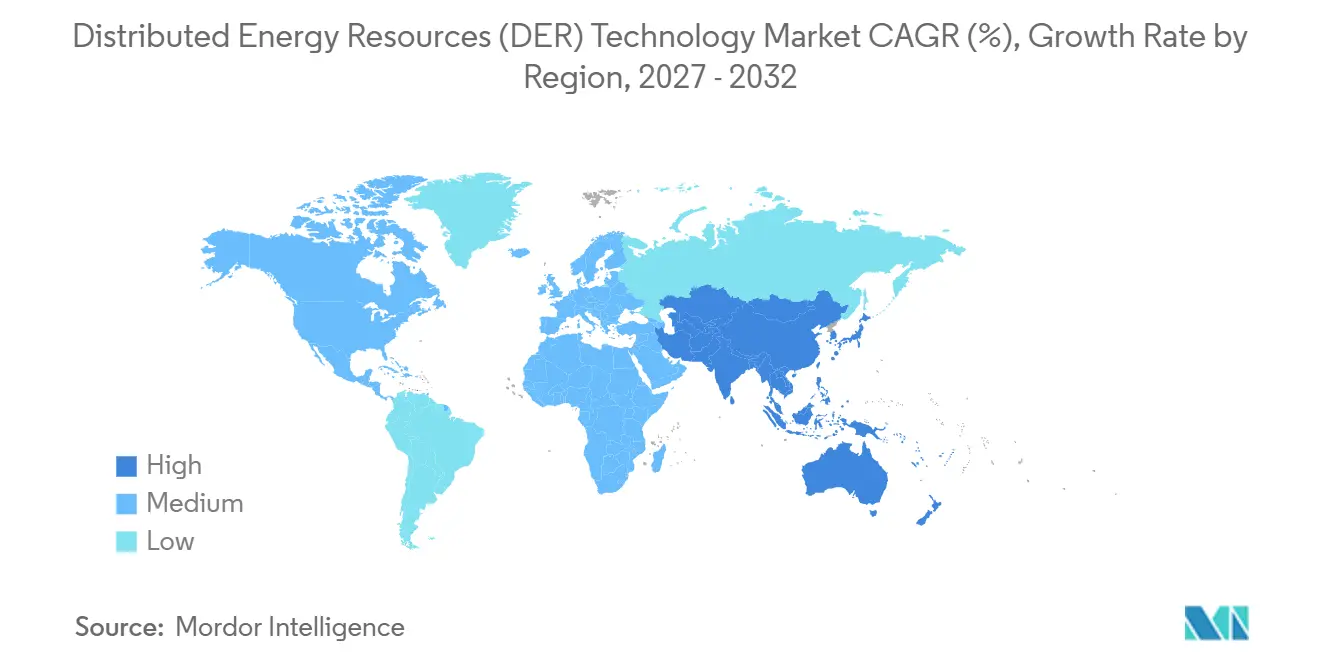
Asia-Pacific is forecast to grow at a 19.7% CAGR through 2032. China is the region’s largest distributed photovoltaic base, and its national renewable energy plans support continued additions through 2030. India’s rooftop solar programs and broader renewable buildout add another source of demand for equipment and operating systems. The region includes both mature electricity systems that need advanced controls and developing systems that need reliable local supply. Australia’s household battery growth and integrated system planning approach provide an example of how consumer assets can become more relevant to system planning. The Middle East and Africa are also using distributed solar and hybrid microgrids for resilience-focused facilities and rural electrification. South America has opportunities in remote and mining applications where grid constraints can support off-grid and microgrid deployments. For the distributed energy resources technology market, geographic diversity makes local partnerships, service coverage, and regulatory understanding important.
Competitive Landscape
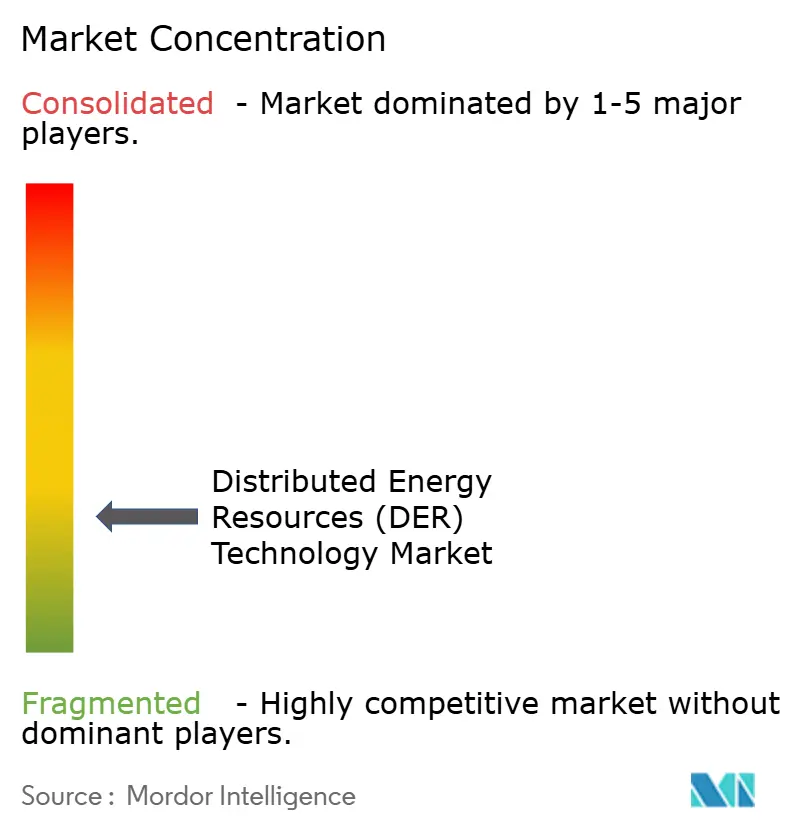
The distributed energy resources technology market is fragmented because competition differs across generation equipment, storage, power conversion, controls, and software. ABB, Siemens, Schneider Electric, GE Vernova, Hitachi Energy, Sungrow, and Huawei Digital Power have broad product portfolios and established utility relationships. Their scale supports participation in larger projects that require equipment supply, engineering, systems integration, and long-term service. Specialist software providers such as AutoGrid and Next Kraftwerke compete with platforms developed by larger technology and energy companies. Tesla, Wärtsilä, and Itron also participate through storage, controls, aggregation, and metering capabilities. Competition is therefore shaped by the ability to connect equipment and software rather than by one product category alone.
GE Vernova reported data center orders of more than USD 5 billion year to date in its second-quarter 2026 results. The company also plans cumulative research and development investment of USD 5 billion from 2025 through 2028, with half directed to long-term innovation, including grid technologies for data centers. These actions show how larger suppliers are aligning grid products with the power needs of digital infrastructure. Huawei Digital Power launched the LUTERRA grid-forming energy storage platform in June 2026. It also launched FusionSolar 9.0 in Europe in April 2026, with more than 10 GW of related projects under construction worldwide. Sungrow’s Poland project announcement shows another strategy focused on combining solar and storage at large scale. These moves indicate that leading suppliers are placing greater emphasis on integrated system offerings.
Software and controls remain important competitive areas because utilities need dependable operations across many asset types and owners. Vendors that support secure dispatch, device communications, grid code compliance, and data management can strengthen their position with utilities and project owners. IEC 61850 and IEEE 2030.5 compatibility are relevant because they reduce integration barriers across connected equipment. Cybersecurity is also becoming part of competitive positioning rather than a separate compliance issue. Providers that cannot demonstrate secure device management may face longer utility approval processes. Smaller firms can still compete in focused applications such as vehicle-to-grid coordination, agricultural microgrids, and local flexibility management. Their challenge is to prove reliability and integration capability at a scale acceptable to utilities. Larger suppliers retain an advantage where customers value global service capacity and broad equipment portfolios. The competitive outcome will depend on operational performance, standards compliance, and the ability to serve both physical asset and digital control needs.
Distributed Energy Resources (DER) Technology Industry Leaders
-
Siemens AG
-
Schneider Electric SE
-
GE Vernova Inc.
-
ABB Ltd.
-
Emerson Electric Co.
- *Disclaimer: Major Players sorted in no particular order
Distributed Energy Resources (DER) Technology Market Companies Covered in this Report
- ABB Ltd.
- AutoGrid Systems, Inc.
- Bloom Energy Corporation
- Cummins Inc.
- Delta Electronics, Inc.
- Eaton Corporation plc
- Emerson Electric Co.
- Fluence Energy, Inc.
- GE Vernova Inc.
- Generac Holdings Inc.
- Hitachi Energy Ltd.
- Huawei Digital Power Technologies Co., Ltd.
- Itron, Inc.
- Next Kraftwerke GmbH
- Schneider Electric SE
- Siemens AG
- SolarEdge Technologies, Inc.
- Sungrow Power Supply Co., Ltd.
- Tesla, Inc.
- Wärtsilä Corporation
Recent Industry Developments in Distributed Energy Resources (DER) Technology Market
- August 2026: Sungrow and GOLDBECK SOLAR signed Europe’s largest PV project, covering 722 MWp of solar in Poland and a 1 GWh battery energy storage pipeline framework.
- July 2026: GE Vernova announced a USD 138 million expansion of its power transmission facility in Charleroi, Pennsylvania, expected to create 275 jobs through 2028.
- June 2026: Huawei Digital Power launched the LUTERRA Smart String Grid-Forming ESS Platform at Intersolar Europe 2026.
- April 2026: Huawei Digital Power launched FusionSolar 9.0 Smart PV Solution across Europe, with more than 10 GW of projects under construction using the solution.
Global Distributed Energy Resources (DER) Technology Market Report Scope
Distributed Energy Resources (DER) technology refers to a decentralized framework of small- to medium-scale energy generation, storage, and management systems typically located close to the point of consumption rather than at a central power plant.
The global distributed energy resource (DER) technology market is segmented by resource technology, component, technology integration, application, and geography. By resource technology, the market is segmented into distributed solar photovoltaic (PV) systems, distributed wind energy systems, distributed energy storage systems, combined heat and power (CHP) systems, fuel cells and distributed hydrogen-based power systems, small-scale hydropower systems, diesel- and gas-based distributed generators, and other distributed generation technologies. By component, the market is segmented into power generation equipment, energy storage hardware, power conversion systems and inverters, smart meters and monitoring devices, communication and control systems, grid interconnection and protection equipment, and software platforms and digital services. By technology integration, the market is segmented into standalone distributed energy resources, solar-plus-storage systems, hybrid renewable energy systems, grid-connected distributed energy systems, off-grid distributed energy systems, microgrids and community energy systems, virtual power plants (VPPs), and integrated DER aggregation and optimization platforms. By application, the market is segmented into residential, commercial buildings, industrial facilities, utilities and electricity distribution networks, data centers and digital infrastructure, healthcare and critical infrastructure, transportation and electric vehicle charging, remote and off-grid communities, and agriculture and rural electrification. The report also covers the market size and forecasts for the global distributed energy resources technology market across 26 countries in key regions. For each segment, the market sizing and forecasts have been provided on the basis of value (USD).
Segmentation Overview
| Distributed Solar Photovoltaic (PV) Systems |
| Distributed Wind Energy Systems |
| Distributed Energy Storage Systems |
| Combined Heat and Power (CHP) Systems |
| Fuel Cells and Distributed Hydrogen-Based Power Systems |
| Small-Scale Hydropower Systems |
| Diesel and Gas-Based Distributed Generators |
| Other Distributed Generation Technologies |
| Power Generation Equipment |
| Energy Storage Hardware |
| Power Conversion Systems and Inverters |
| Smart Meters and Monitoring Devices |
| Communication and Control Systems |
| Grid Interconnection and Protection Equipment |
| Software Platforms and Digital Services |
| Standalone Distributed Energy Resources |
| Solar-Plus-Storage Systems |
| Hybrid Renewable Energy Systems |
| Grid-Connected Distributed Energy Systems |
| Off-Grid Distributed Energy Systems |
| Microgrids and Community Energy Systems |
| Virtual Power Plants (VPPs) |
| Integrated DER Aggregation and Optimization Platforms |
| Residential |
| Commercial Buildings |
| Industrial Facilities |
| Utilities and Electricity Distribution Networks |
| Data Centers and Digital Infrastructure |
| Healthcare and Critical Infrastructure |
| Transportation and Electric Vehicle Charging |
| Remote and Off-Grid Communities |
| Agriculture and Rural Electrification |
| North America | United States |
| Canada | |
| Mexico | |
| Europe | Germany |
| France | |
| Italy | |
| Spain | |
| United Kingdom | |
| Poland | |
| Russia | |
| Rest of Europe | |
| Asia-Pacific | China |
| India | |
| Japan | |
| South Korea | |
| Australia | |
| Indonesia | |
| Vietnam | |
| Thailand | |
| Rest of Asia-Pacific | |
| South America | Brazil |
| Argentina | |
| Chile | |
| Rest of South America | |
| Middle East and Africa | Saudi Arabia |
| United Arab Emirates | |
| Egypt | |
| South Africa | |
| Morocco | |
| Rest of Middle East and Africa |
| By Resource Technology | Distributed Solar Photovoltaic (PV) Systems | |
| Distributed Wind Energy Systems | ||
| Distributed Energy Storage Systems | ||
| Combined Heat and Power (CHP) Systems | ||
| Fuel Cells and Distributed Hydrogen-Based Power Systems | ||
| Small-Scale Hydropower Systems | ||
| Diesel and Gas-Based Distributed Generators | ||
| Other Distributed Generation Technologies | ||
| By Component | Power Generation Equipment | |
| Energy Storage Hardware | ||
| Power Conversion Systems and Inverters | ||
| Smart Meters and Monitoring Devices | ||
| Communication and Control Systems | ||
| Grid Interconnection and Protection Equipment | ||
| Software Platforms and Digital Services | ||
| By Technology Integration | Standalone Distributed Energy Resources | |
| Solar-Plus-Storage Systems | ||
| Hybrid Renewable Energy Systems | ||
| Grid-Connected Distributed Energy Systems | ||
| Off-Grid Distributed Energy Systems | ||
| Microgrids and Community Energy Systems | ||
| Virtual Power Plants (VPPs) | ||
| Integrated DER Aggregation and Optimization Platforms | ||
| By Application | Residential | |
| Commercial Buildings | ||
| Industrial Facilities | ||
| Utilities and Electricity Distribution Networks | ||
| Data Centers and Digital Infrastructure | ||
| Healthcare and Critical Infrastructure | ||
| Transportation and Electric Vehicle Charging | ||
| Remote and Off-Grid Communities | ||
| Agriculture and Rural Electrification | ||
| By Geography | North America | United States |
| Canada | ||
| Mexico | ||
| Europe | Germany | |
| France | ||
| Italy | ||
| Spain | ||
| United Kingdom | ||
| Poland | ||
| Russia | ||
| Rest of Europe | ||
| Asia-Pacific | China | |
| India | ||
| Japan | ||
| South Korea | ||
| Australia | ||
| Indonesia | ||
| Vietnam | ||
| Thailand | ||
| Rest of Asia-Pacific | ||
| South America | Brazil | |
| Argentina | ||
| Chile | ||
| Rest of South America | ||
| Middle East and Africa | Saudi Arabia | |
| United Arab Emirates | ||
| Egypt | ||
| South Africa | ||
| Morocco | ||
| Rest of Middle East and Africa | ||
Key Questions Answered in the Report
How large is the distributed energy resources (DER) technology market in 2026?
The distributed energy resources (DER) technology market size is USD 0.94 billion in 2026and is forecast to reach USD 2.65 billion by 2032 at a 19.11% CAGR.
Which resource technology holds the largest share in 2026?
Distributed solar PV systems hold 33.7% share in 2026, while distributed energy storage is the fastest-growing resource segment at a 22.6% CAGR through 2032. Solar provides the largest installed base, while storage supports flexibility and backup applications.
Why are virtual power plants important?
Virtual power plants combine smaller customer assets into a controllable resource that can support grid operations and, where permitted, market participation. Their growth depends on secure device controls, customer participation, and transparent compensation rules.
Which end use is growing fastest?
Data centers and digital infrastructure are forecast to grow at a 23.6% CAGR through 2032 as electricity demand and continuity requirements rise. Onsite systems can help these facilities manage capacity constraints and maintain operational resilience.
Which region currently leads deployment?
North America holds 35.7% share in 2026, while Asia-Pacific is forecast to have the fastest regional growth at a 19.7% CAGR through 2032. Chinas distributed photovoltaic base and regional renewable deployment are important drivers of Asia-Pacific activity.
What are the major barriers to adoption?
Cybersecurity requirements, integration with legacy systems, fragmented compensation rules, and utility cost-recovery challenges can delay projects. Each issue can increase procurement time and reduce confidence in long-term project revenues.