
Distillers Grains Market Size and Share
Market Overview
| Study Period | 2022 - 2032 |
|---|---|
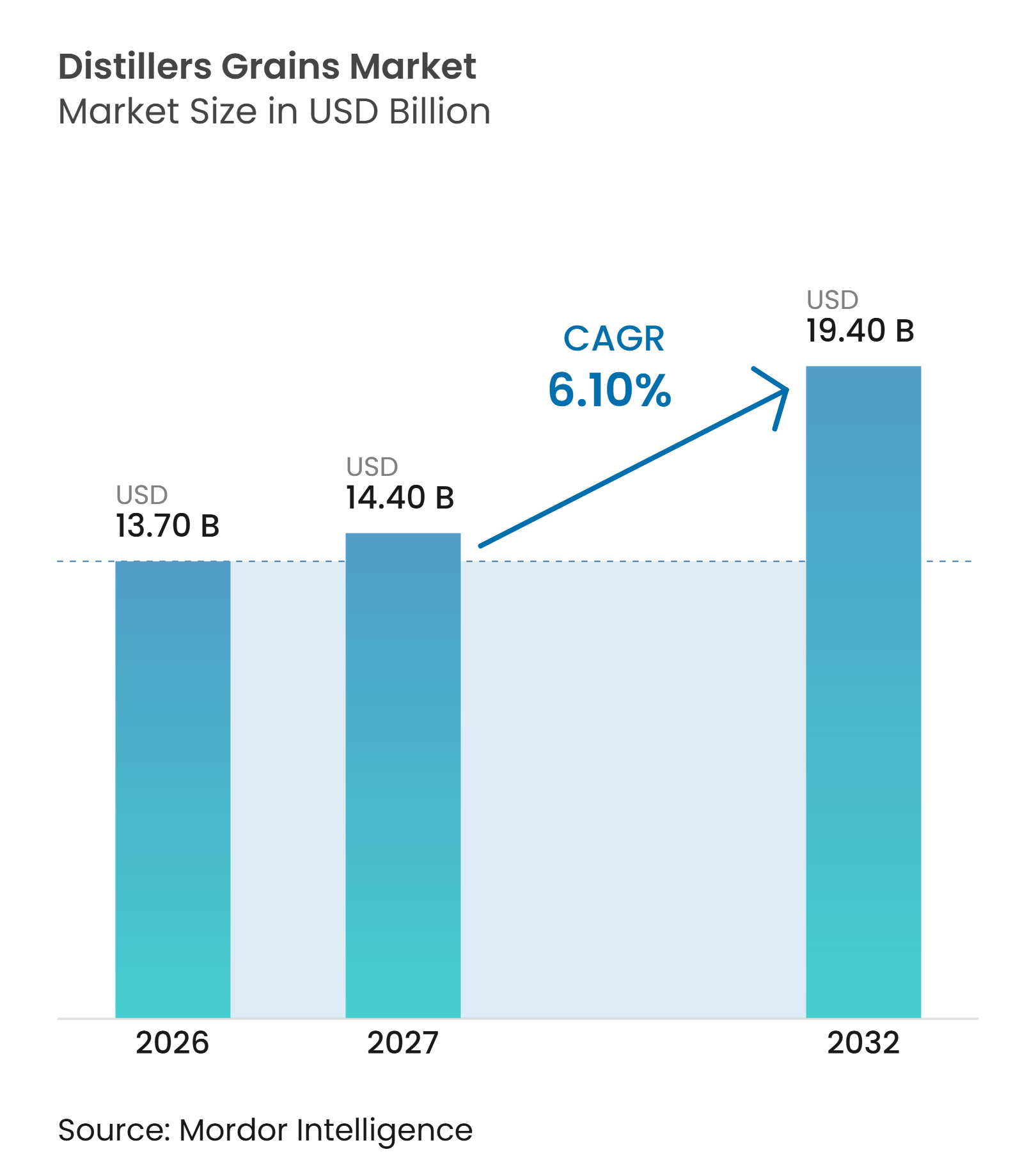
| Market Size (2027) | USD 14.40 Billion |
| Market Size (2032) | USD 19.40 Billion |
| Growth Rate (2027 - 2032) | 6.10 % |
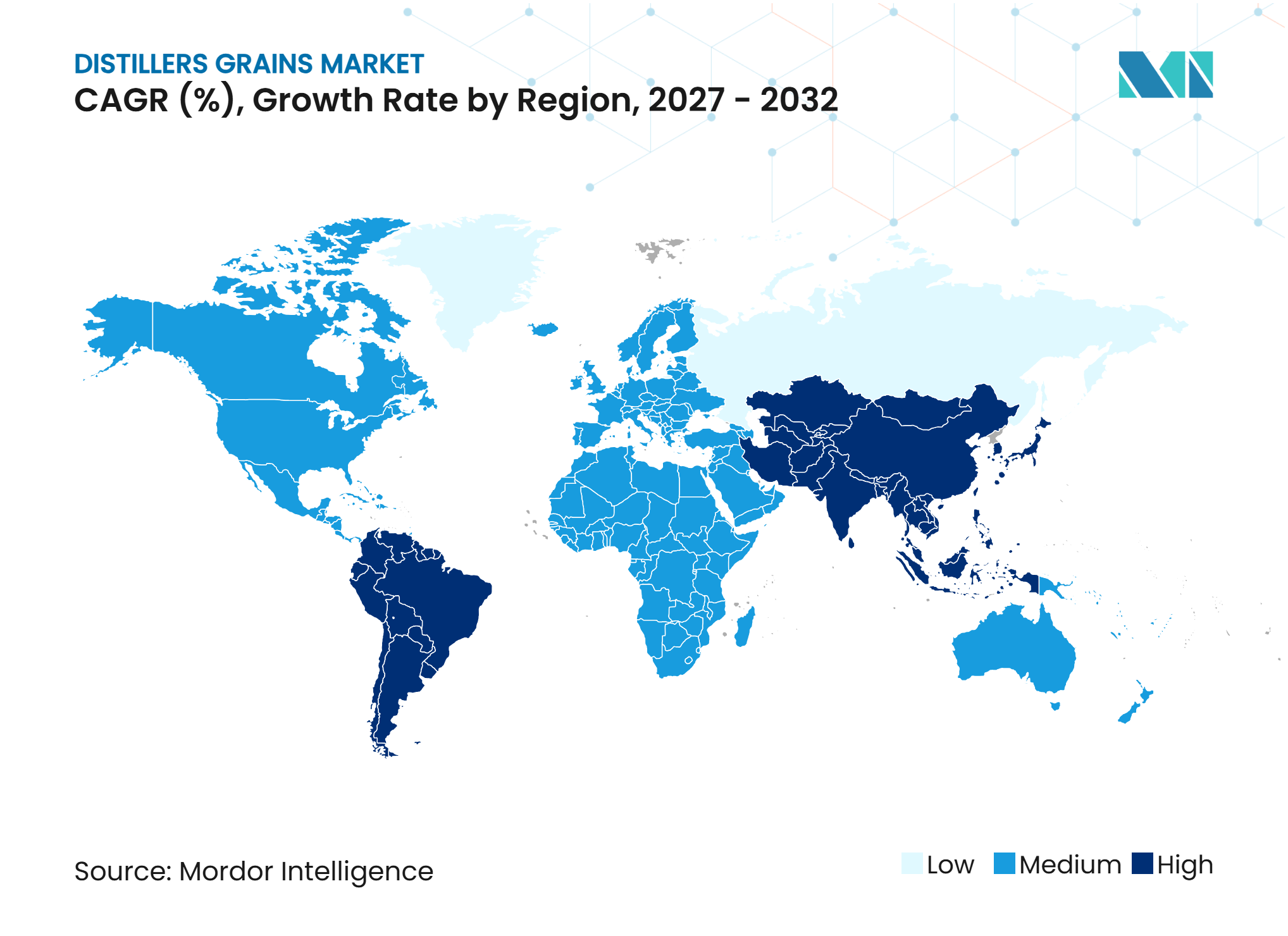
| Fastest Growing Market | Asia-Pacific |
| Largest Market | North America |
| Market Concentration | Medium |
Major Players *Disclaimer: Major Players sorted in no particular order Image © Mordor Intelligence. Reuse requires attribution under CC BY 4.0. | |
Distillers Grains Market Analysis by Mordor Intelligence
The Distillers grains market size was valued at USD 13.7 billion in 2026 and estimated to grow from USD 14.4 billion in 2027 to reach USD 19.4 billion by 2032, at a CAGR of 6.1% during the forecast period (2027-2032). The Distillers grains market is supported by the close link between ethanol production and demand for economical animal feed ingredients. Expanding dry-mill capacity can increase coproduct availability, while livestock producers continue to seek protein and energy inputs that can lower ration costs. Export activity broadens the demand base beyond domestic feedlots and gives producers a route to markets with growing poultry, dairy, swine, and aquaculture output. The Distillers grains market also faces limits from variable nutrient composition, transport requirements for wet products, and exposure to ethanol plant margin cycles. Producers are responding through fractionation, pelletization, lot-level testing, and lower-carbon processing investments that can improve product consistency and export handling.
Key Report Takeaways
-
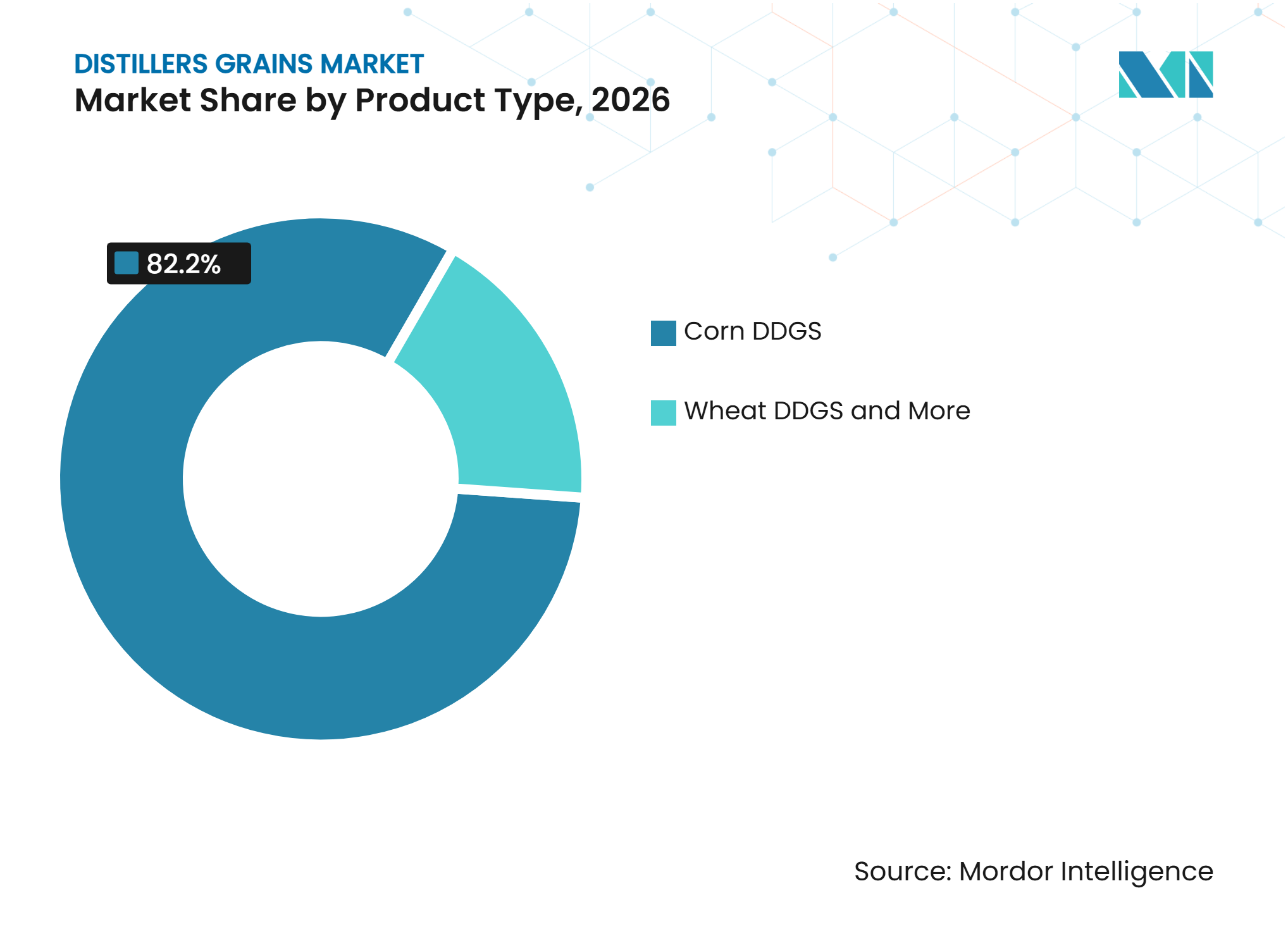
By product type, Corn DDGS led with the largest 82.2% share of the Distillers Grains Market in 2026, while Rice DDGS is projected to witness the fastest growth during the forecast period.
-
By form, Dried Distillers Grains with Solubles led with the largest 56.3% share of the Distillers Grains Market in 2026, while Pelletized and Cubed Distillers Grains are projected to record the fastest growth through 2032.
-
By feed grade, High-Protein Grade led with the largest 78.2% share of the Distillers Grains Market in 2026, while Mid-Protein Grade is anticipated to register the fastest growth during the forecast period.
-
By livestock, Ruminants led with the largest 45.0% share of the Distillers Grains Market in 2026, while Aquaculture is projected to advance at the fastest growth rate through 2032.
-
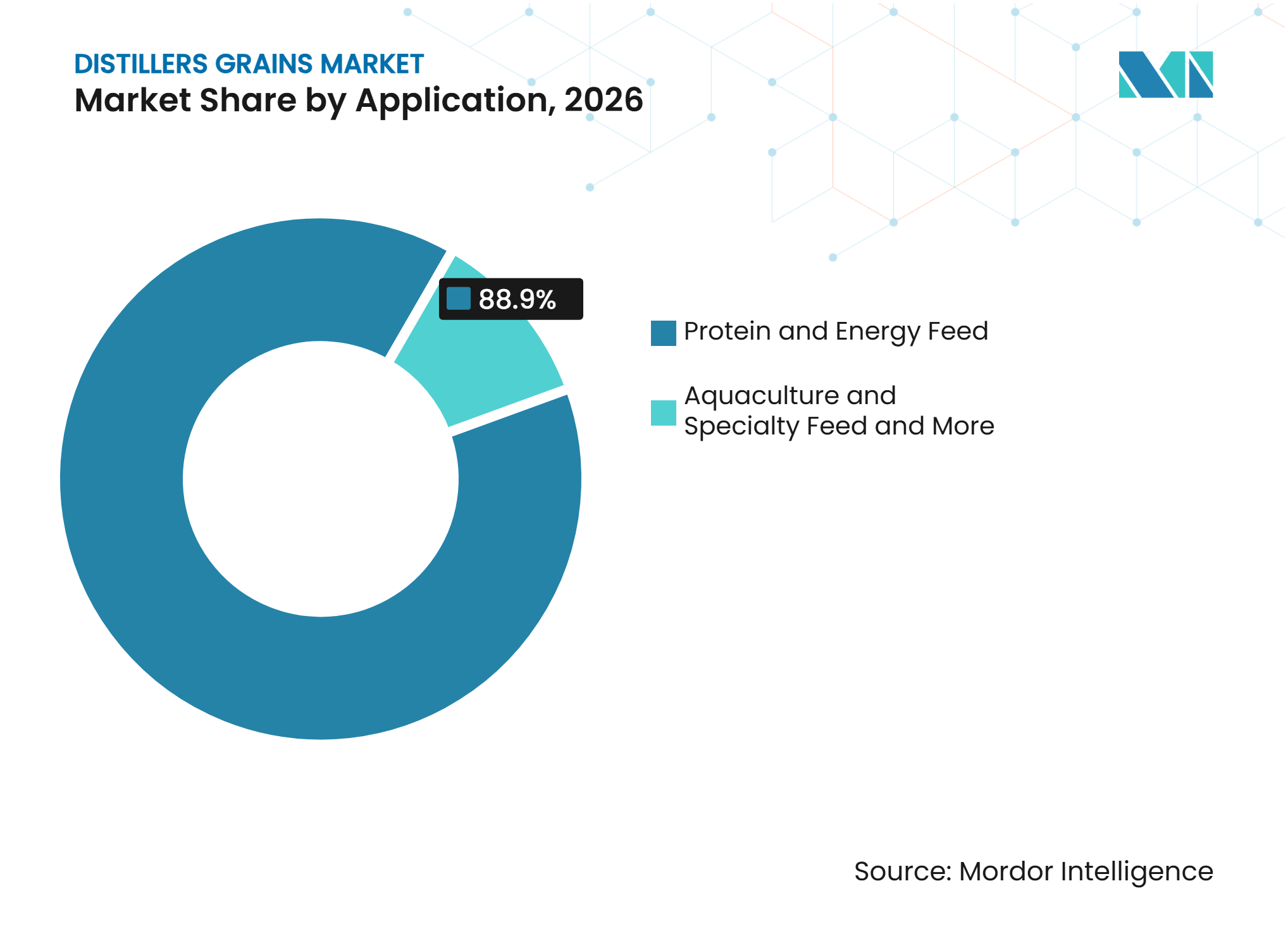
By application, Protein and Energy Feed led with the largest 88.9% share of the Distillers Grains Market in 2026, while Aquaculture and Specialty Feed is projected to record the fastest growth during the forecast period.
-
By processing technology, Dry Milling led with the largest 68.0% share of the Distillers Grains Market in 2026, while Mechanical Fractionation is forecast to witness the fastest growth through 2032.
-
By distribution channel, Direct Ethanol-Plant Sales led with the largest 86.0% share of the Distillers Grains Market in 2026, while Online and Specialty Channels are projected to register the fastest growth during the forecast period.
-
By geography, North America led with the largest 47.2% share of the Distillers Grains Market in 2026, while Asia-Pacific is projected to register the fastest growth, advancing at a CAGR of 7.1% during 2027-2032.
Note: Market numbers in this report are based on Mordor Intelligence's proprietary estimation framework, which combines nine months of actuals with Q4 projections for base year 2026.
Market Trends and Insights
Drivers Impact Analysis of Distillers Grains Market*
| Driver | (~) % Impact on CAGR Forecast | Geographic Relevance | Impact Timeline |
|---|---|---|---|
| Expansion of Dry-Mill Ethanol Capacity | +1.50% | Global, highest in North America and South America | Medium term (2-4 years) |
| Demand for Cost-Effective Protein and Energy Feeds | +1.20% | Global, particularly North America, Asia-Pacific, and Middle East | Short term (≤ 2 years) |
| Growth of Livestock, Dairy, Poultry, and Aquaculture Production | +1.00% | Asia-Pacific core, extending to South America and Middle East | Long term (≥4 years) |
| Export-Lane Diversification and Growing Asia-Pacific Demand | +0.80% | North America and Asia-Pacific | Medium term (2-4 years) |
| Fractionation and High-Protein Product Innovation | +0.70% | North America, with emerging demand in Asia-Pacific and South America | Medium term (2-4 years) |
| Lot-Level Nutritional Data and Digital Ration Formulation | +0.40% | Global, with leading adoption in North America and Asia-Pacific | Long term (≥4 years) |
| Source: Mordor Intelligence | |||
Expansion of Dry-Mill Ethanol Capacity
Each bushel of corn processed in a dry-mill ethanol plant produces 17 to 18 pounds of DDGS. This makes ethanol capacity a direct source of additional supply for the Distillers grains market, where new capacity increases available coproduct volumes. Higher output can improve feed availability for nearby livestock operations and for export channels. It can also place pressure on producers to develop grades with stronger value than commodity DDGS. POET began a USD 203 million expansion at its Shelbyville, Indiana, biorefinery in March 2026. The project is expected to double DDGS output at that plant to 500,000 tons per year when completed in Q4 2027[1].
Demand for Cost-Effective Protein and Energy Feeds
DDGS competes with corn and soybean meal in least-cost ration formulation. Its substitution value can strengthen when its energy-equivalent price remains below the price of soybean meal. A peer-reviewed assessment identifies the DDGS-to-soybean-meal price relationship as an important determinant of feed use. The relationship is not determined by animal nutrition alone because ethanol plant utilization also affects product availability. Lower fuel margins can reduce ethanol production and tighten DDGS supply even when feed demand remains steady. This link requires feed manufacturers to consider commodity prices and ethanol operating conditions when managing procurement.
Growth of Livestock, Dairy, Poultry, and Aquaculture Production
Rising output of animal protein supports demand for protein-rich feed ingredients. The Distillers grains market is exposed to this demand through livestock rations and aquafeed formulations, which connects feed growth with coproduct use. The Food and Agriculture Organization identifies aquaculture as the main incremental source of global aquatic animal food supply. This direction supports demand for cost-competitive proteins used in aquaculture feed. High-protein DDGS fractions can partly meet this need where formulation requirements allow their use. Demand is particularly relevant in Asian markets with expanding shrimp, pangasius, tilapia, and salmon production.
Export-Lane Diversification and Growing Asia-Pacific Demand
The U.S. DDGS export network reaches more than 50 countries. A broad destination base can reduce exposure to demand changes in a single importing country. U.S. DDGS exports totaled 11.6 million metric tons in 2025, with a value of USD 2.8 billion[2]. Mexico, South Korea, Vietnam, and Indonesia accounted for 55% of those shipments. Indonesia imported a record 166,925 metric tons in June 2026, an increase of 22% from the prior period. These flows demonstrate the relevance of poultry expansion and feed-cost management in Asia-Pacific.
Restraints Impact Analysis of Distillers Grains Market*
| Restraint | (~) % Impact on CAGR Forecast | Geographic Relevance | Impact Timeline |
|---|---|---|---|
| Nutrient Variability and Species-Specific Inclusion Limits | -1.2% | Global, particularly Asia-Pacific and North America | Short term (≤ 2 years) |
| Moisture, Storage, and Long-Haul Freight Constraints | -0.9% | Global, highest in South America, Middle East, and Africa | Medium term (2-4 years) |
| Mycotoxin, Sulfur, and Feed-Safety Documentation Requirements | -0.7% | Europe and Asia-Pacific, particularly Germany and China | Medium term (2-4 years) |
| Coproduct Margin Exposure to Ethanol Plant Economics | -0.6% | North America and South America | Long term (≥ 4 years) |
| Source: Mordor Intelligence | |||
Nutrient Variability and Species-Specific Inclusion Limits
DDGS composition varies across plants and production batches. The variability is particularly important for protein, fat, sulfur, and digestible lysine. A peer-reviewed assessment reported that digestible lysine content can vary by more than 30% across DDGS batches. Feed formulators may therefore set conservative inclusion levels for swine and poultry diets. Broiler diets can be limited to 10% to 15% DDGS despite the product's potential substitution value. Ruminants remain less affected because their digestive systems accept higher fiber and sulfur levels.
Mycotoxin, Sulfur, and Feed-Safety Documentation Requirements
Feed buyers require documentation that supports quality and safety review. Mycotoxin and sulfur controls are particularly important when products move across borders or into sensitive animal diets. European markets use a stricter documentation environment for imported corn DDGS than for some locally produced wheat DDGS. This can add testing, administration, and compliance costs for suppliers. Organic procurement also depends on provenance records under the USDA National Organic Program. These requirements can limit the supply of certified product to qualifying ethanol operations in the Distillers grains market.
*Our forecasts treat driver/restraint impacts as directional, not additive. The impact forecasts reflect baseline growth, mix effects, and variable interactions.
Distillers Grains Market Segment Analysis
By Product Type:
Corn Maintains Scale While Rice Supports Regional DiversityCorn DDGS accounted for 82.2% of the Distillers grains market share in 2026. The scale reflects the use of corn as the principal feedstock for dry-mill ethanol in the United States and Brazil. Yellow corn DDGS represents most of the category. Non-GMO and organic variants address buyers seeking identity preservation and verified provenance. White corn DDGS serves a narrower role in Central American feed markets. Wheat DDGS is more common in European and Australian ethanol operations. It can be relevant where corn imports face tariffs or logistics barriers. These product differences link feedstock availability with local ethanol production patterns.
Rice DDGS supports a more diverse product base in India and Southeast Asia. Its role fits areas where rice-based ethanol output can supply existing livestock and aquaculture feed channels. The segment does not displace corn DDGS at global scale. It does reduce the dependence of regional buyers on corn-based supply. Product diversity also gives buyers a choice of nutrient profiles and local sourcing routes. Exporters must still provide clear quality information because feed ingredients from different grains do not have identical composition. Corn is expected to retain its structural role through 2032 because of the installed base of dry-mill plants. Rice-based supply nonetheless broadens the relevance of the Distillers grains industry in Asian feed systems.



By Form:
Dried Products Lead While Pelletization Supports Longer-Distance TradeDried distillers grains with solubles accounted for 56.3% of the Distillers grains market size in 2026. The format is favored for shelf stability and compatibility with established feed mill handling systems. It is used in domestic and export sales where buyers need material that can tolerate storage and transport. Condensed distillers solubles, wet distillers grains with solubles, and modified wet distillers grains with solubles mainly serve local ruminant users. Their moisture content limits the practical sales radius around an ethanol plant. Dried distillers grains without added solubles can be selected where lower fat content is preferred. Form selection therefore depends on animal requirements, distance, and available logistics.
Pelletized and cubed products address the cost of moving protein over longer distances. Densification can improve handling at feed mills and reduce freight cost per unit of protein. It can also support mixed-commodity vessel loading. CHS completed a USD 105 million renovation and expansion of its Myrtle Grove terminal in May 2025. The project increased DDGS export handling capacity by 30% and added a grain-dedicated E-Crane. This infrastructure supports loading arrangements that combine DDGS and soybean meal for overseas buyers. Pelletization becomes more relevant when high freight costs could otherwise reduce the delivered advantage of DDGS.
By Feed Grade:
High-Protein Products Address Premium Feed RequirementsHigh-protein grade held 78.2% share in 2026. Mechanical fractionation supports the production of specialized grades with a higher protein concentration than conventional DDGS. Green Plains stated that its Ultra-High Protein product contains at least 50% protein. The company's Sequence product contains close to 60% protein. These products are directed toward aquaculture, pet food, and livestock applications that value concentrated protein. The approach also separates fiber from protein and can improve corn oil yields. It changes the role of distillers grains from a commodity coproduct to a portfolio of feed ingredients.
Mid-protein grade operates between premium and commodity offerings. It faces pressure from specialized protein products at one end and standard feed grade at the other. Standard feed grade remains important to beef and dairy operations that consume large volumes. High-fiber and specialty grades support narrower uses, including equine feed and specialized livestock diets. Organic grades require documentation that meets USDA National Organic Program conditions. Such requirements restrict supply to certified ethanol plants with documented sourcing. Feed grade selection is therefore shaped by animal species, nutritional targets, certification needs, and price. The Distillers grains market can gain value from specialization, but bulk demand continues to support standard grades.
By Livestock:
Ruminants Provide Volume While Aquaculture Expands Product OptionsRuminants held 45.0% share in 2026. Beef cattle and dairy cattle consume the largest volumes of DDGS across the livestock categories. Their digestive systems can tolerate more fiber and sulfur than swine and poultry. Inclusion can reach 25% to 30% of total dietary dry matter in suitable rations. This flexibility makes ruminants an anchor for commodity DDGS demand. Dairy cattle can use the product's energy density and bypass protein characteristics in high-output herd diets. Large commercial operations in California, Texas, the upper Midwest, India, and Brazil support steady purchasing. The livestock pattern explains why nearby ruminant production remains important for ethanol plant economics.
Aquaculture creates an additional route for concentrated protein products. Shrimp, pangasius, tilapia, and salmon production increase the need for feed formulations that control cost while maintaining nutritional performance. High-protein DDGS can partly substitute for marine meal in some formulations. The opportunity in the Distillers grains market depends on species requirements and consistent nutrient data. Swine and poultry remain substantial users, but their inclusion levels are more sensitive to composition variability. Pet food is another developing use where ingredient transparency and traceable sourcing matter. Green Plains identified aquaculture and pet food as targeted applications for differentiated products. This direction supports a shift toward value-added demand without replacing the ruminant base.
By Application:
Protein and Energy Feed Remains the Core UseProtein and energy feed accounted for 88.9% share in 2026. This use covers routine incorporation of DDGS into commercial rations for ruminants, swine, and poultry. Nutritionists use the ingredient to balance ration cost against commodity price movements. Its role can become more favorable when soybean meal prices rise relative to DDGS. Ration balancing also requires attention to each lot's nutrient profile. Fertilizers and soil amendments remain secondary uses. Bioenergy and industrial uses are also limited when feed channels are accessible. The application profile confirms that animal nutrition remains the foundation of the Distillers grains market.
Aquaculture and specialty feed are linked to improvements in protein quality. Fractionation can raise protein concentration and make DDGS more relevant for formulations that require nutrient density. Marine meal prices can strengthen the cost case for alternative proteins. Pet food has separate purchasing requirements that emphasize ingredient transparency. Upcycled agricultural coproducts also align with the sourcing requirements described for premium pet food. These uses broaden demand beyond bulk commodity channels. They do not eliminate the importance of standard protein and energy feed. Instead, they create higher-value outlets for producers that can offer consistent specifications and traceability.

By Distribution Channel:
Direct Plant Sales Retain the Main ChannelDirect ethanol-plant sales held 86% share in 2026. Producers favor this route because it supports plant-gate sales to established customers. Feedlots, dairies, and feed mills commonly use direct relationships for bulk procurement. The approach reduces the number of intermediaries between the plant and the end user. Feed manufacturers and integrators also purchase DDGS for use in compound feed. Their contracts can reflect seasonal requirements and negotiated volumes. Direct sales are especially practical for wet forms that require local consumption. The distribution structure in the Distillers grains market favors predictable offtake relationships near production sites.
Commodity merchants and distributors combine volumes from multiple producers. They manage rail, barge, and ocean freight for export-oriented trade. Cooperatives such as CHS connect grain origination, logistics, and export handling. CHS assumed operations of a Cahokia, Illinois, facility in January 2026. The facility added a rail-to-barge route to its Center Gulf supply network. Online and specialty channels can support traceable sourcing for certified or differentiated products. Greenfield Global also uses a commercial offtake agreement for its Winnebago, Minnesota, plant to secure international access. These channels add flexibility without displacing direct plant sales.
Geography Analysis
North America: Ethanol Infrastructure Supports Regional Scale
North America held 47.2% of the Distillers grains market share in 2026. The region is supported by the U.S. dry-mill ethanol network and its large supply of feed coproducts. U.S. producers exported DDGS to more than 50 countries in 2025. Mexico was the largest single-country destination and absorbed more than 20% of export volume in that year. Canada has a smaller ethanol sector, but it adds regional feed supply. U.S. E15 adoption programs and state renewable fuel policies continue to support ethanol investment. Plant investments also focus on lower energy use and more differentiated coproduct output. These conditions keep North America central to the Distillers grains market and to global DDGS production and trade.
Asia-Pacific: Feed Demand Supports Faster Regional Growth
Asia-Pacific is projected to grow at a 7.1% CAGR from 2027 to 2032. The Distillers grains market size in the region is supported by expanding aquaculture, poultry, and swine sectors in China, India, Vietnam, and Indonesia. South Korea, Vietnam, and Indonesia ranked among the largest U.S. DDGS destinations in 2025. Vietnam received 1.159 million metric tons, while Indonesia received 994,000 metric tons[3]. India is adding rice-based ethanol capacity and has demand for high-protein corn DDGS in aquaculture formulations. China remains important because of the scale of its swine sector. Import demand in the Distillers grains market can change with feed economics and trade conditions. Buyers in the region place greater value on supply consistency, handling, and documentation as volumes increase.
South America, Europe, Middle East, and Africa: Different Supply and Import Conditions Shape Demand
South America is adding both DDGS production and consumption through corn ethanol growth in Brazil. Cargill completed its acquisition of the remaining 50% of SJC Bioenergia in April 2025 and renamed the business Cargill Bioenergia. The two Goiás plants process sugarcane and additional corn volumes while producing high-protein DDGs. Europe has a mature profile supported by wheat and barley DDGS. Documentation requirements for imported corn DDGS can raise the cost of compliance relative to locally produced wheat DDGS. The Middle East, particularly Turkey and Gulf markets, depends on imports because domestic grain supply is limited. Turkey reached a 13-month high in DDGS imports in October 2025. Africa is shaped by long-haul freight constraints, which increase the value of stable dried products and reliable logistics.
Competitive Landscape
Market Concentration

The Distillers grains market has a moderately concentrated supply structure in North America. Large integrated ethanol producers have scale in production, processing, and logistics. POET operates 35 biorefineries and produces 15 billion pounds of DDGS annually. Its Shelbyville expansion is intended to increase output at that site to 500,000 tons per year in Q4 2027. Archer-Daniels-Midland Company also has production scale and distribution reach. ADM announced phase two of its Columbus, Nebraska, corn dry mill expansion in October 2026. The expansion targets a combined 20 million bushel annual increase in corn grind compared with 2025. These companies compete through throughput, logistics, product quality, and access to export markets.
Green Plains follows a differentiated strategy centered on protein concentration and coproduct value. Its Ultra-High Protein and Sequence products target aquaculture, pet food, and premium livestock uses. The company reported fractionation deployment across multiple biorefineries in its 2025 annual filing. CHS has strengthened its logistics position through the Myrtle Grove terminal upgrade and its Cahokia rail-to-barge connection. These investments support export handling and mixed vessel loading. Cargill expanded its Brazilian ethanol and DDGs platform through full ownership of SJC Bioenergia. Smaller producers use offtake agreements and export partnerships to reach markets beyond their direct distribution systems. Competition consequently includes both plant-scale supply and the ability to assure buyers of reliable delivery.
Lower-carbon operations are becoming a relevant competitive factor. ADM and Tallgrass began operations at their Columbus, Nebraska, carbon capture facility in November 2025. The project can reduce the carbon intensity connected with ethanol production and DDGS drying. The U.S. 45Z Clean Fuel Production Credit links fuel incentives to carbon intensity. Producers with efficient drying, carbon capture, and fractionation can strengthen their cost position under this framework. Other areas of competition include pelletized supply for long-distance trade, lot-level nutrient certification, and ration tools that reduce uncertainty for buyers. These capabilities can help suppliers move beyond undifferentiated commodity sales. The Distillers grains market remains open to regional plants, merchants, and cooperatives even as larger producers control important supply positions.
Distillers Grains Industry Leaders
-
POET, LLC
-
Archer-Daniels-Midland Company
-
Green Plains Inc.
-
Cargill, Incorporated
-
CHS Inc.
- *Disclaimer: Major Players sorted in no particular order
Distillers Grains Market Companies Covered in this Report
- Archer-Daniels-Midland Company
- POET, LLC
- Green Plains Inc.
- Cargill, Incorporated
- Cardinal Ethanol, LLC
- CHS Inc.
- The Andersons, Inc.
- Marquis Energy
- Greenfield Global Inc.
- FS
- Alto Ingredients, Inc.
- Big River Resources, LLC
- White Energy, Inc.
- Aemetis, Inc.
- VERBIO SE
Recent Industry Developments in Distillers Grains Market
- October 2026: Archer-Daniels-Midland Company announced phase two of its Columbus, Nebraska, corn dry mill expansion, targeting a combined 20 million bushel annual corn grind increase versus 2025, with phase two introducing technology to reduce natural gas intensity per ton of dried distillers grain produced in the facility's dryers
- March 2026: POET, LLC broke ground on a USD 203 million expansion at its Shelbyville, Indiana, biorefinery, doubling DDGS output to 500,000 tons per year at that facility and lifting total POET DDGS capacity to 15 billion pounds across its 35 biorefineries when complete in Q4 2027.
- January 2026: CHS Inc. acquired operations of a key grain facility owned by COFCO International in Cahokia, Illinois, adding a direct rail-to-barge DDGS export corridor to the Center Gulf supply chain network. The facility connects to all six of North America's Class I railroads, strengthening throughput capacity from the U.S. Corn Belt to the Myrtle Grove terminal
Global Distillers Grains Market Report Scope
Distillers grains are nutrient-rich coproducts generated during ethanol production and are widely used as protein and energy ingredients in animal feed applications. Products such as dried distillers grains with solubles (DDGS), dried distillers grains (DDG), wet distillers grains with solubles (WDGS), and modified wet distillers grains with solubles (MDGS) are extensively utilized across ruminant, poultry, swine, aquaculture, and pet food sectors. The Distillers Grains Market report includes production analysis, consumption analysis, import and export analysis, trade assessment, pricing analysis, supply-demand evaluation, regulatory framework, value chain analysis, technology assessment, competitive landscape, company profiles, and recent industry developments. The market is segmented by product type, form, feed grade, livestock, application, processing technology, distribution channel, and geography (North America, Europe, Asia-Pacific, South America, Middle East, and Africa). The market forecasts are provided in terms of value (USD).
Segmentation Overview
| Corn DDGS |
| Wheat DDGS |
| Rice DDGS |
| Blended Grains |
| Barley, Sorghum, Oats and Millet DDGS |
| Dried Distillers Grains with Solubles |
| Dried Distillers Grains |
| Modified Wet Distillers Grains with Solubles |
| Wet Distillers Grains with Solubles |
| Condensed Distillers Solubles |
| Pelletized and Cubed Distillers Grains |
| High-Protein Grade |
| Mid-Protein Grade |
| Standard Feed Grade |
| High-Fiber and Specialty Grades |
| Ruminants |
| Swine |
| Poultry |
| Aquaculture |
| Pet Food and Other Animals |
| Protein and Energy Feed |
| Ration Balancing and Feed-Cost Optimization |
| Aquaculture and Specialty Feed |
| Pet Food |
| Fertilizers and Soil Amendments |
| Bioenergy and Industrial Uses |
| Direct Ethanol-Plant Sales |
| Feed Manufacturers and Integrators |
| Commodity Merchants and Distributors |
| Cooperatives |
| Online and Specialty Channels |
| North America |
| Europe |
| Asia-Pacific |
| South America |
| Middle East |
| Africa |
| Product Type | Corn DDGS |
| Wheat DDGS | |
| Rice DDGS | |
| Blended Grains | |
| Barley, Sorghum, Oats and Millet DDGS | |
| Form | Dried Distillers Grains with Solubles |
| Dried Distillers Grains | |
| Modified Wet Distillers Grains with Solubles | |
| Wet Distillers Grains with Solubles | |
| Condensed Distillers Solubles | |
| Pelletized and Cubed Distillers Grains | |
| Feed Grade | High-Protein Grade |
| Mid-Protein Grade | |
| Standard Feed Grade | |
| High-Fiber and Specialty Grades | |
| Livestock | Ruminants |
| Swine | |
| Poultry | |
| Aquaculture | |
| Pet Food and Other Animals | |
| Application | Protein and Energy Feed |
| Ration Balancing and Feed-Cost Optimization | |
| Aquaculture and Specialty Feed | |
| Pet Food | |
| Fertilizers and Soil Amendments | |
| Bioenergy and Industrial Uses | |
| Distribution Channel | Direct Ethanol-Plant Sales |
| Feed Manufacturers and Integrators | |
| Commodity Merchants and Distributors | |
| Cooperatives | |
| Online and Specialty Channels | |
| Geography | North America |
| Europe | |
| Asia-Pacific | |
| South America | |
| Middle East | |
| Africa |
Key Questions Answered in the Report
What is the projected size of the distillers grains market?
The distillers grains market is projected to increase from USD 14.4 billion in 2027 to USD 19.4 billion by 2032, at a 6.1% CAGR.
What is the leading product type in distillers grains?
Corn DDGS led product types with 82.2% share in 2026 because dry-mill ethanol production relies largely on corn feedstock.
Why are ruminants important consumers of DDGS?
Ruminants held 45.0% share in 2026 because they can use higher-fiber feed ingredients at inclusion levels that are less practical for swine and poultry.
Which region is growing fastest for distillers grains?
Asia-Pacific is expected to expand at a 7.1% CAGR through 2032, supported by aquaculture, poultry, and swine feed demand.