
Direct-to-Consumer (D2C) Logistics Market Size and Share
Market Overview
| Study Period | 2021 - 2032 |
|---|---|
| Market Size (2027) | USD 41.76 Billion |
| Market Size (2032) | USD 76.52 Billion |
| Growth Rate (2027 - 2032) | 12.88 % |
| Fastest Growing Market | Asia-Pacific |
| Largest Market | Asia-Pacific |
| Market Concentration | Low |
Major Players *Disclaimer: Major Players sorted in no particular order Image © Mordor Intelligence. Reuse requires attribution under CC BY 4.0. | |
Direct-to-Consumer (D2C) Logistics Market Analysis by Mordor Intelligence
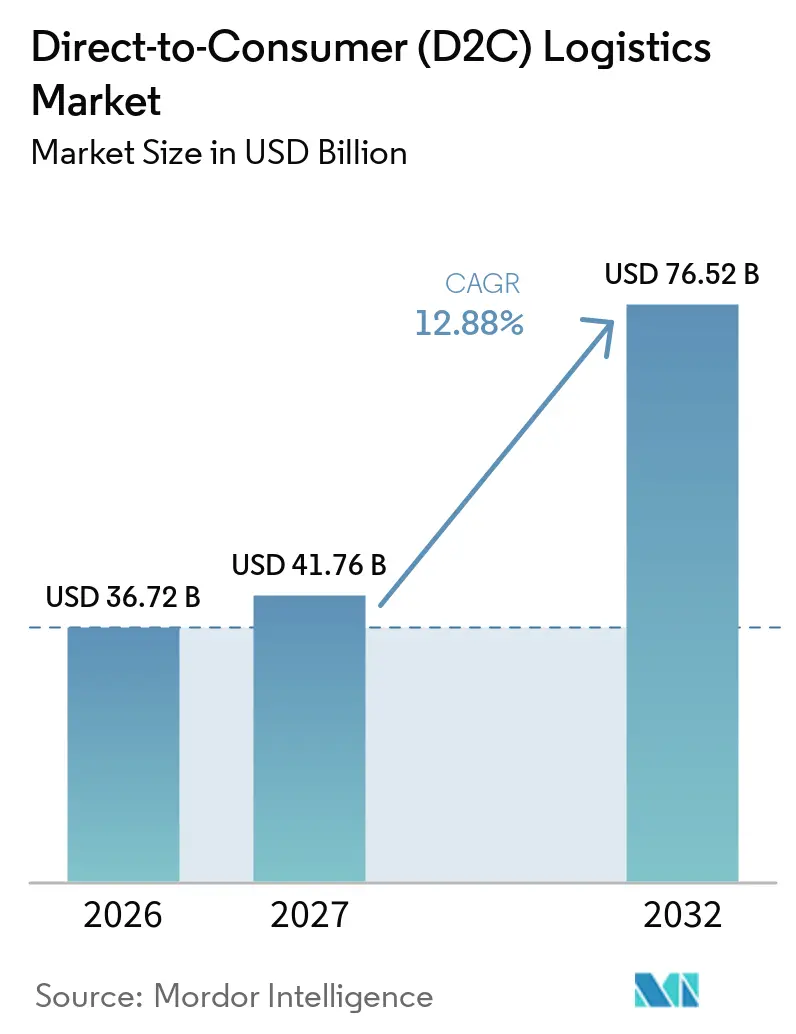
The direct-to-consumer (D2C) logistics market size is valued at USD 36.72 billion in 2026 and is estimated to grow from USD 41.76 billion in 2027 to reach USD 76.52 billion by 2032, at a CAGR of 12.88% during the forecast period (2027-2032).
The move toward brand-owned commerce is making fulfillment, delivery, and returns part of the customer relationship rather than a back-office activity, as customers increasingly judge a brand by the clarity of delivery communication and the ease of solving a post-purchase problem. Brands are using order data to improve inventory decisions, delivery promises, and repeat-purchase programs, especially where product demand changes quickly across channels or cities and when a single product launch creates different demand levels across regions. Logistics providers that combine transportation capacity with technology, returns handling, and branded customer communication are better placed to retain clients, because this reduces the need for brands to coordinate separate vendors after an order is placed. Rising parcel costs, scarce delivery labor, and broader customs and packaging requirements may continue to test margins across the direct-to-consumer (D2C) logistics market over time.
Key Report Takeaways
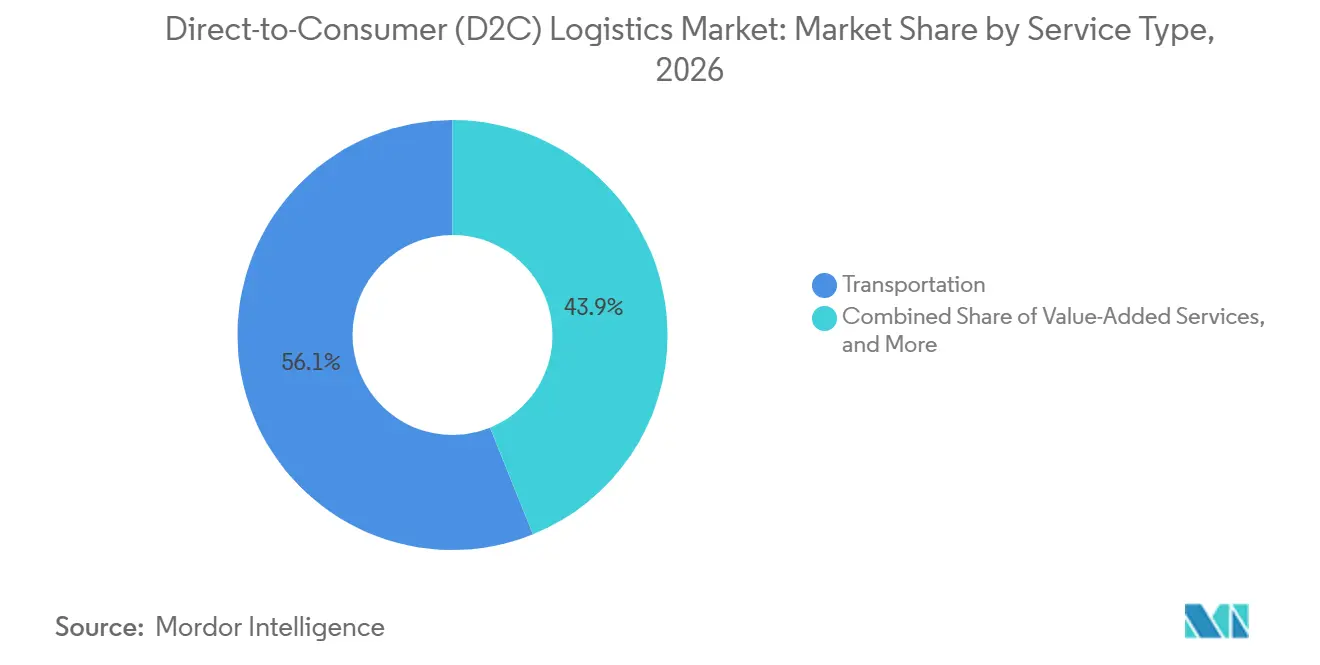
- By service type, transportation held 56.11% of the direct-to-consumer (D2C) logistics market share in 2026, while value-added services are forecast to register a 13.45% CAGR through 2032.
- By enterprise size, large and established D2C brands held 40.73% of the direct-to-consumer (D2C) logistics market size in 2026, while small and emerging D2C brands are forecast to register a 14.60% CAGR through 2032.
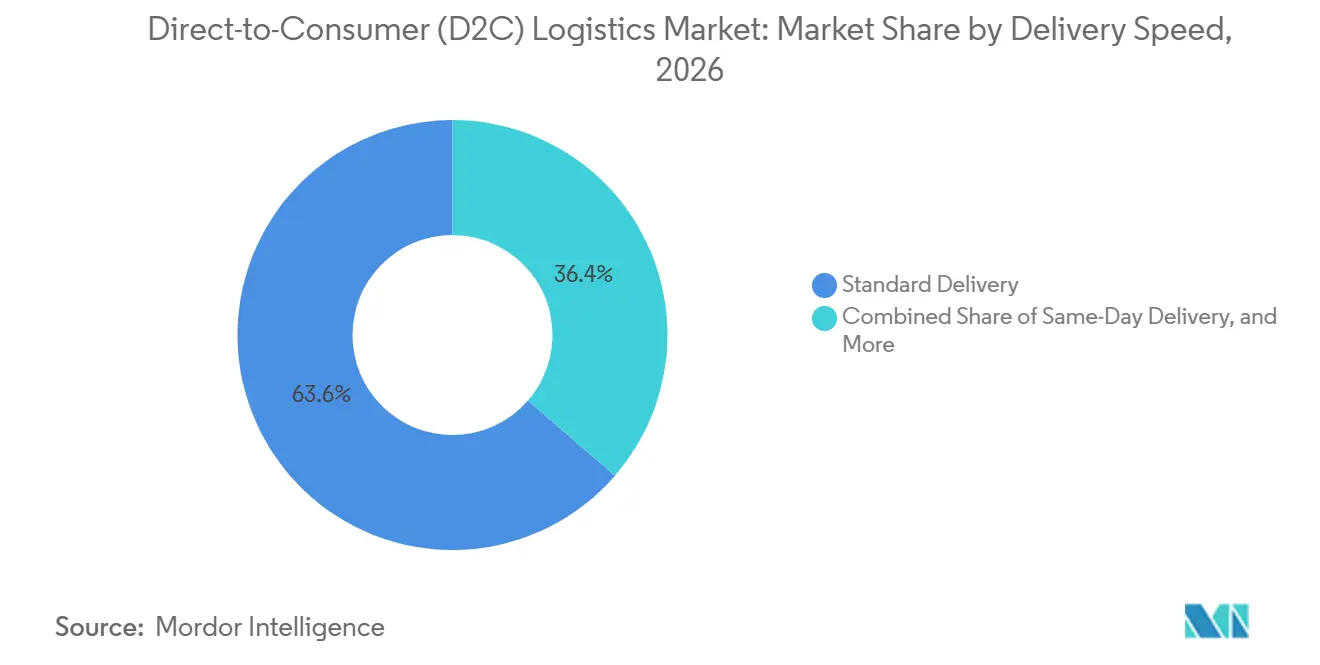
- By delivery speed, Standard delivery held 63.63% of the direct-to-consumer (D2C) logistics market share in 2026, while same-day delivery is forecast to register a 15.16% CAGR through 2032.
- By destination, domestic shipments held 76.72% of the direct-to-consumer (D2C) logistics market size in 2026, while international and cross-border shipments are forecast to register a 13.93% CAGR through 2032.
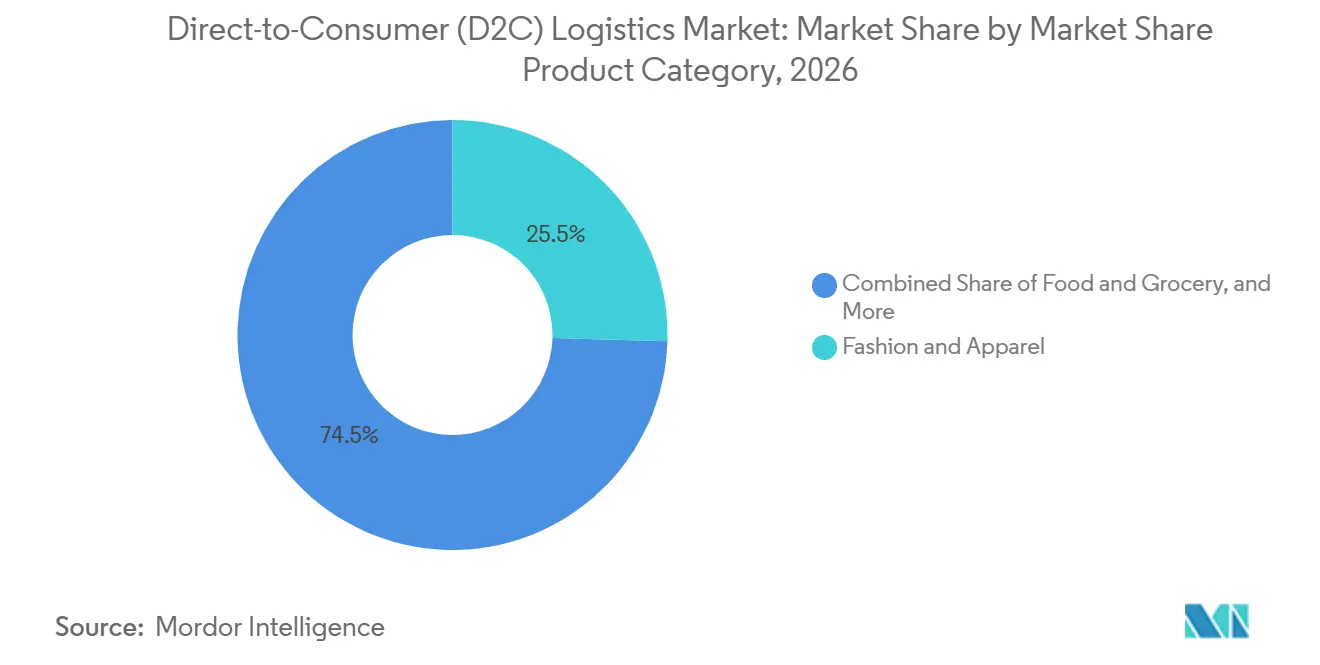
- By product category, fashion and apparel held 25.46% of the direct-to-consumer (D2C) logistics market share in 2026, while food and grocery is forecast to register a 14.56% CAGR through 2032.
- By geography, Asia-Pacific held 34.49% of the direct-to-consumer (D2C) logistics market size in 2026 and is forecast to register a 13.75% CAGR through 2032.
Note: Market numbers in this report are based on Mordor Intelligence's proprietary estimation framework, which combines nine months of actuals with Q4 projections for base year 2026.
Market Trends and Insights
Drivers Impact Analysis of Direct-to-Consumer (D2C) Logistics Market*
| Driver | (~) % Impact on CAGR Forecast | Geographic Relevance | Impact Timeline |
|---|---|---|---|
| First-Party Data and Margin Capture Through Brand-Owned Commerce | +2.8% | Global | Long term (≥ 4 years) |
| Rising Consumer Expectation for Delivery Visibility and Convenience | +2.5% | Global | Short term (≤ 2 years) |
| Social Commerce, Creator Commerce, and Subscription Order Proliferation | +2.2% | APAC core, spill-over to North America and EU | Short term (≤ 2 years) |
| Distributed Inventory and Micro-Fulfillment Adoption | +2.0% | North America and EU | Medium term (2-4 years) |
| Cross-Border D2C Expansion and Digital Customs Enablement | +1.8% | APAC, EU, North America | Medium term (2-4 years) |
| Returns as a Customer-Experience and Resale Infrastructure | +1.5% | North America and EU | Long term (≥ 4 years) |
| Source: Mordor Intelligence | |||
First-Party Data and Margin Capture Through Brand-Owned Commerce
Brand-owned commerce changes logistics from a cost function into a customer-facing capability in the direct-to-consumer (D2C) logistics market. A direct storefront gives a brand information from product discovery through delivery tracking and return initiation, allowing its operations team to connect customer behavior with fulfillment outcomes. That information can improve demand forecasts and inventory placement across fulfillment nodes, which can reduce stockouts in stronger-selling locations and avoid unnecessary stock transfers. It can also support more relevant replenishment offers and delivery communication, giving brands a practical way to use fulfillment events as part of an ongoing relationship rather than a final transaction step. Amazon stated that leading brands are moving creator partnerships toward longer programs measured by customer lifetime value, which increases the need for operations that support retention rather than isolated transactions.
Rising Consumer Expectation for Delivery Visibility and Convenience
Delivery visibility has become a basic service expectation for brands selling directly to consumers. Accurate delivery dates, real-time tracking, and clear exception communication help customers assess whether an order is under control, particularly when weather, capacity limits, or address issues affect a planned delivery. These capabilities require carrier data, inventory availability, and order-routing systems to work together, rather than leaving each system to make decisions independently. Large delivery networks have increased same-day coverage, raising expectations across the wider retail delivery landscape. Smaller brands, therefore, need carrier diversification or fulfillment partners that can provide dependable delivery-date promises.
Social Commerce, Creator Commerce, and Subscription Order Proliferation
Social commerce creates demand spikes that are harder to manage through fixed warehouse plans. A successful creator event can concentrate thousands of orders within a short period and around a limited set of locations, creating sudden pressure on inventory allocation, labor scheduling, and local carrier capacity. The direct-to-consumer (D2C) logistics market needs inventory pools, flexible packing capacity, and routing systems that can respond to those conditions. Amazon notes that longer creator programs can include dedicated inventory, custom packaging inserts, and priority handling around product launches. Subscription orders create a related challenge because predictable volume may still require complex kitting, co-packing, and personalized packing steps that take longer than standard pick-and-pack activity.
Distributed Inventory and Micro-Fulfillment Adoption
Distributed inventory is becoming more important as brands need short delivery windows across several large cities. A multi-node model can reduce transit distance and help brands manage carrier zone charges, while reducing dependence on a single site during local disruption or seasonal peaks. It also gives operators more options when a local demand peak affects a single warehouse. The direct-to-consumer (D2C) logistics market is increasingly supported by systems that show inventory across nodes and route an order to the most suitable location, based on stock availability, service requirements, and delivery cost. This lowers the operational barrier for growing brands that cannot build their own national warehouse network, while still requiring clear inventory rules and service-level agreements with their logistics partners, particularly when demand patterns change and inventory need to be reallocated between sites.
Restraints Impact Analysis of Direct-to-Consumer (D2C) Logistics Market*
| Restraint | (~) % Impact on CAGR Forecast | Geographic Relevance | Impact Timeline |
|---|---|---|---|
| Parcel-Level Cost and Margin Compression | -1.8% | Global | Short term (≤ 2 years) |
| Reverse-Logistics and Refund-Handling Complexity | -1.5% | North America and EU | Medium term (2-4 years) |
| Labor, Wage, and Delivery-Capacity Constraints | -1.2% | North America and EU | Short term (≤ 2 years) |
| Customs, Tax, Packaging, and Sustainability Compliance Burden | -0.9% | EU, APAC, Global | Long term (≥ 4 years) |
| Source: Mordor Intelligence | |||
Parcel-Level Cost and Margin Compression
Parcel costs remain a direct pressure on the direct-to-consumer (D2C) logistics market because free delivery is often used to support online conversion. Higher delivery charges can force brands to increase order thresholds or absorb more cost, and either choice can affect conversion, average order value, or the margin on lower-priced products. The result is a tighter tradeoff between customer convenience and contribution margin, especially for brands with low average order values or products whose packaging is expensive to move. The United States Postal Service Office of Inspector General reported that UPS and FedEx have moved away from lower-yield e-commerce volumes as they focus on higher-value services.[1] This leaves many brands seeking alternative last-mile capacity and sharper control over package economics, including more careful packaging design, service selection, and local delivery coverage, as well as stronger processes for determining when an expedited service is justified. Brands also need to review whether free-shipping offers match their product margins, customer expectations, and the cost of serving different delivery zones. A clearer service menu can help customers choose between lower-cost standard delivery and faster options when speed is important.
Labor, Wage, and Delivery-Capacity Constraints
Transportation and distribution operations continue to face a limited supply of delivery labor. The United States Bureau of Labor Statistics reports annual openings for delivery truck drivers and driver sales workers, with many openings tied to worker replacement.[2] This pattern makes it difficult for carriers to add reliable capacity during promotional periods, when brands may need temporary labor and expanded delivery coverage at the same time. Wage pressure and overtime need to raise the cost of service for providers and their customers. The direct-to-consumer (D2C) logistics market, therefore, relies on route efficiency, better workforce planning, and flexible delivery networks to protect service quality.
*Our forecasts treat driver/restraint impacts as directional, not additive. The impact forecasts reflect baseline growth, mix effects, and variable interactions.
Direct-to-Consumer (D2C) Logistics Market Segment Analysis
By Service Type:
Transportation provides Revenue Base While Value-Added Services ExpandTransportation accounted for 56.11% of direct-to-consumer (D2C) logistics market size in 2026, reflecting the capital-intensive nature of parcel movement from origin to customer. Road networks support the largest share of domestic shipment activity because they connect warehouses, local sorting sites, and residential delivery routes, while giving providers flexibility to serve suburban and regional delivery areas. Air freight remains important for urgent cross-border orders where delivery commitments are strict. Warehousing and storage support this activity by keeping inventory close to demand centers and by providing space for inbound processing, replenishment, order preparation, and return inspection. The direct-to-consumer (D2C) logistics market size tied to transportation remains substantial because every direct order requires physical movement even when other services are outsourced.
Value-added services are projected to register a 13.45% CAGR through 2032, the highest rate within this segmentation. Branded tracking, custom packaging, kitting, returns processing, and logistics analytics are moving from optional services to regular contract requirements. These services help brands create a more consistent post-purchase experience and address category-specific handling needs. Providers can use them to reduce dependence on carrier rate competition and develop more durable client relationships, because the service becomes more closely linked to a brand's consumer experience and day-to-day operating decisions. The direct-to-consumer (D2C) logistics industry is, therefore, shifting toward contracts that combine core transportation capacity with data and customer-experience tools.
By D2C Enterprise Size:
Large Brands Lead Revenue While Small Brands Grow FasterLarge and established D2C brands accounted for 40.73% of the overall market in 2026. Their high shipment volume and wider geographic coverage require dedicated carrier arrangements, specialized fulfillment processes, and coordinated inventory planning, often across several warehouses that need a consistent view of product availability, order status, and service performance. These brands often need more support for peak periods, cross-border shipping, and complex returns programs, since a service failure can have a wider effect on customer loyalty and brand reputation. Their scale also gives logistics providers a stable base load for warehouses and delivery networks. Large accounts remain important because they can justify network investments that smaller accounts could not support alone, even though providers still balance their needs against the flexibility required by a wider merchant portfolio.
Small and emerging D2C brands are forecast to register a 14.60% CAGR through 2032. Platform-based 3PL services give these companies access to distributed inventory, branded tracking, and multi-channel order routing without upfront warehouse investment. Creator-led commerce and social selling are shortening the time between launch and the need for professional fulfillment, often before a young brand has built an internal operations team or secured long-term warehouse space. This makes flexible onboarding, application programming interfaces, and variable-cost storage more important to providers, since a merchant may need to add sales channels, adjust its product range, or change delivery coverage while its business is expanding. The direct-to-consumer (D2C) logistics industry benefits when small merchants can use sophisticated tools before their order volumes become large.
By Delivery Speed:
Standard Delivery Supports Volume While Same-Day Changes Network DesignStandard delivery held 63.63% of direct-to-consumer (D2C) logistics market share in 2026, making it the operating base for domestic parcel networks. It remains suitable for price-sensitive shoppers, bulk purchases, and orders where speed is less important than delivery certainty, giving brands a service option that can be offered broadly without the cost of urgent local fulfillment. Its volume density supports route economics and asset utilization across broad service areas, allowing providers to consolidate shipments and maintain regular delivery schedules without using premium local capacity for every order. Next-day delivery occupies the middle of the speed range and benefits from higher customer expectations in suburban locations. Standard service may continue to supply the dependable volume on which providers build their network coverage.
Same-day delivery is projected to expand at a 15.16% CAGR through 2032. The service requires inventory closer to consumers, including dark stores, micro-fulfillment centers, and local dispatch capacity, which makes site selection and local order density central to operating viability. It also needs fast order acceptance and route planning that cannot be created by adding long-haul capacity, since the delivery decision needs to be made within minutes of checkout and be tied to a nearby available item. Same-day delivery networks are expanding through partnerships between fulfillment providers and local delivery operators, giving merchants more options for urgent orders. The direct-to-consumer (D2C) logistics market size associated with rapid fulfillment will depend on the availability of dense urban nodes and reliable local delivery partners.
By Destination:
Domestic Shipments Lead Revenue While Cross-Border Demand GrowsDomestic shipments represented 76.72% of the overall market in 2026. Domestic services benefit from established carrier coverage, simpler tax and customs treatment, and familiar delivery expectations, which makes it easier for a brand to explain delivery timing and manage customer support. They also allow brands to operate with fewer documentation requirements and more predictable returns processes, which can reduce the effort required from customer-service teams when an order is delayed, damaged, or sent back by a buyer. Large consumer markets concentrate both demand and fulfillment capacity within national borders, enabling providers to use familiar address systems, established return locations, and simpler customer-support processes. This makes domestic logistics the main revenue base for many providers, particularly those whose warehouse footprint and carrier relationships were built around local or national parcel flows rather than international brokerage.
International and cross-border shipments are forecast to register a 13.93% CAGR through 2032. Cross-border demand gives brands access to new consumers, but it makes customs handling, duty calculations, delivery promises, and returns more complicated, especially when a shopper expects an all-in price before checkout. The European Commission states that the EU Customs Data Hub will become mandatory for e-commerce imports from July 2028.[3] Providers with brokerage and landed-cost capabilities can make the customer experience more comparable to a domestic purchase, reducing the risk that unexpected duties, delays, or return instructions discourage a shopper from completing another order. DHL also reports that cross-border shopping is common among Gen Z and Millennial consumers, reinforcing the need for clear delivery and duty information.
By Product Category:
Fashion Leads Revenue While Food and Grocery Require Specialized CapacityFashion and apparel accounted for 25.46% of the overall market in 2026. The category generates frequent orders and attracts customers to brand-owned channels through product discovery and direct engagement, including launches, limited collections, loyalty communication, and campaigns that direct shoppers to a brand site. It also creates a sustained reverse-logistics workload because sizing and fit can result in returns, requiring providers to inspect items quickly and decide whether they can return to inventory, be resold, or be disposed of. Providers serving fashion brands need efficient inspection, restocking, and resale decisions in addition to regular parcel delivery. This makes fashion an important customer segment for firms that can manage both outbound and reverse flows, while preserving product condition and providing brands with useful visibility into why items were sent back.
Food and grocery are forecast to register a 14.56% CAGR through 2032. Quick commerce, subscription meal services, and local delivery are increasing demand for temperature-controlled handling and short delivery windows. Providers may need cold storage, food-safety processes, and local inventory positions to serve these orders, and they need to maintain service quality when order volumes rise during meal times or local promotions. The investment required can create a barrier for general parcel firms that lack specialized facilities, trained teams, and operational controls for products that cannot remain outside a defined temperature range, particularly when service failures could affect safety, product quality, or customer confidence. The direct-to-consumer (D2C) logistics market is broadening as more product categories need fulfillment that is designed for their specific handling requirements.
Geography Analysis
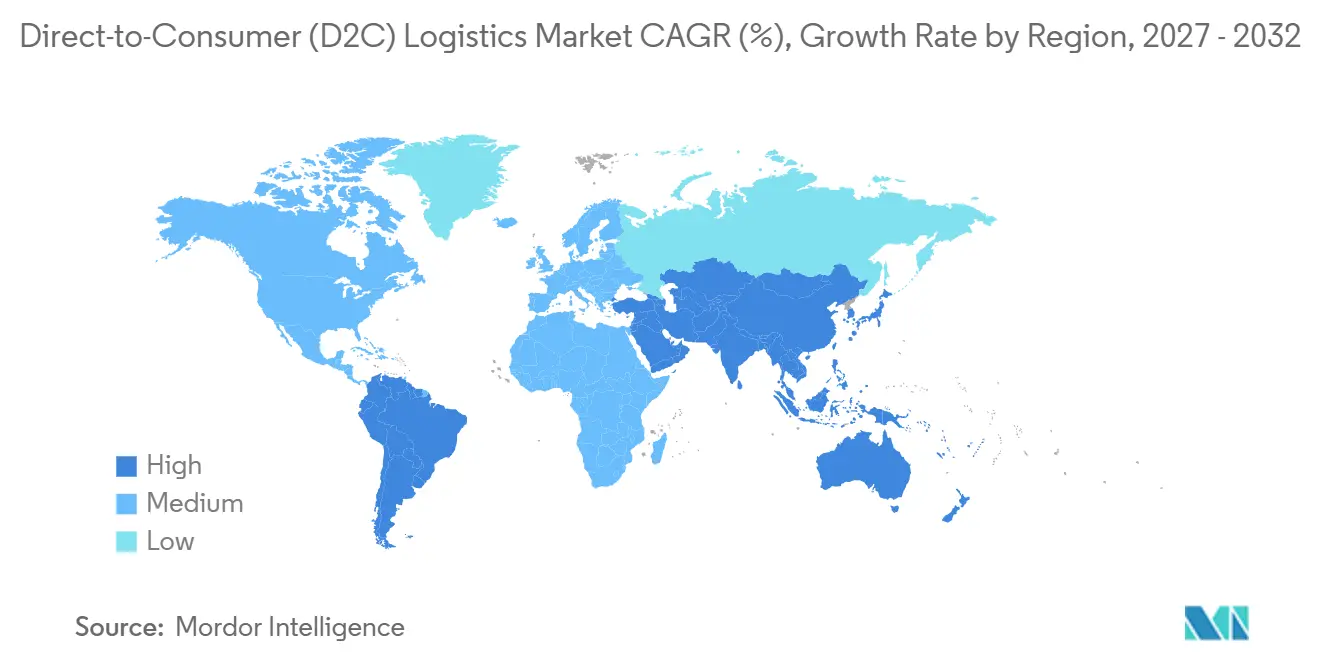
Asia-Pacific held a 34.49% share of the direct-to-consumer (D2C) logistics market in 2026 and is projected to register a 13.75% CAGR through 2032. Dense urban populations, established e-commerce platforms, and expanding direct-to-consumer retail support this position. China provides a large revenue base through its existing platform and last-mile infrastructure, while India provides rising demand from brands that are building direct relationships with a growing online customer base. India is supported by logistics digitization programs such as the National Logistics Policy and the Unified Logistics Interface Platform, which are intended to improve coordination among the many participants involved in moving goods across the country. Southeast Asia is supported by social commerce, rising digital payments, and investment in local delivery infrastructure, although providers still need to adapt service design to different urban patterns and national regulations.
North America remains the second largest geography in the direct-to-consumer (D2C) logistics market. The United States has a mature carrier network, a broad 3PL ecosystem, and a large group of digitally native brands, creating demand for both national capability and specialized local service offerings. The United States Postal Service Office of Inspector General reported that national carriers shifted attention toward higher-margin services, which created openings for specialized last-mile firms. Amazon has committed USD 4 billion to expand its delivery network and extend faster service to more rural United States communities.
Europe is the third-largest regional market and has high e-commerce adoption in Germany, the United Kingdom, and France. Central and Eastern Europe are attracting cross-border investment as brands pursue the broader EU consumer base, supported by brands that can use a regional inventory strategy rather than entering each country separately. The EU Packaging and Packaging Waste Regulation applied from August 2026, and placed packaging obligations on e-commerce parcels across member states.[4] The Middle East and Africa have a smaller current base, but the UAE and Saudi Arabia are attracting early investment in digital commerce.
Competitive Landscape
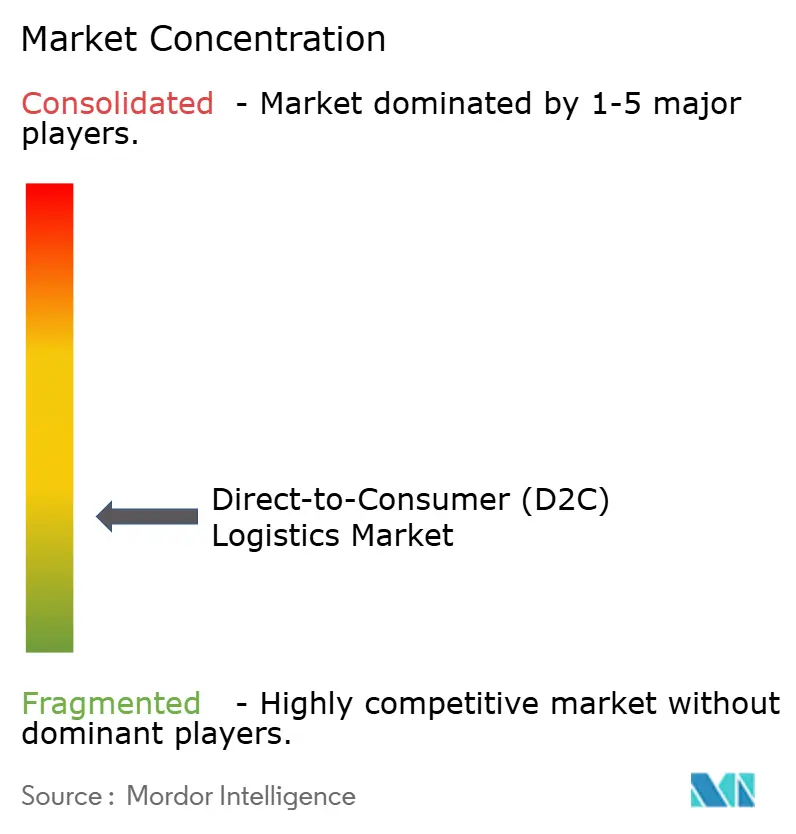
The direct-to-consumer (D2C) logistics market is fragmented across global integrators, fulfillment platforms, regional carriers, and technology-focused providers. DHL Group, FedEx, and UPS serve enterprise and cross-border customers through network scale and established regulated-market capability, including customs processes and service coverage that are difficult for smaller providers to replicate quickly. ShipBob and Stord focus more directly on growing brands that need distributed fulfillment and technology integration, including merchant-facing tools that connect an order to inventory and carrier choice. Regional providers compete through local coverage and flexible service models.
Technology is becoming a central basis for differentiation in the direct-to-consumer (D2C) logistics market. Delivery-date engines, branded tracking portals, inventory-positioning tools, and returns automation can influence vendor choice beyond a carrier's base rate, because brands want more control over the customer communication that follows checkout. DHL expanded international shipping services on Shopify for United States merchants in August 2025, bringing cross-border services directly into a common merchant platform. These moves show why network operators are adding technology and digital sales channels alongside physical capacity, since software can improve the use of existing assets and make a complex service easier for merchants to adopt.
Consolidation is raising the value of scale, technology depth, and geographic density. DHL Group took a significant minority stake in Evri and combined it with DHL eCommerce United Kingdom in May 2025. Evri also announced a GBP 36 million (USD 48.57 million) investment in its parcel network during September 2025. Managed returns, cold-chain fulfillment, and cross-border small-parcel operations remain areas where specialized investment can matter, because each requires operating procedures that differ from standard warehouse and parcel delivery workflows. The direct-to-consumer (D2C) logistics industry rewards providers that can link these capabilities to dependable transportation and inventory operations. The strongest positions are likely to come from disciplined execution, clear service definitions, and systems that make inventory, orders, and delivery events visible to both brands and consumers. Providers also need enough regional density to protect service quality when volume rises, while maintaining the specialized processes that distinguish their offer from a general parcel service.
Direct-to-Consumer (D2C) Logistics Industry Leaders
-
DHL Group
-
United Parcel Service, Inc.
-
FedEx Corporation
-
GXO Logistics, Inc.
-
ShipBob, Inc.
- *Disclaimer: Major Players sorted in no particular order
Direct-to-Consumer (D2C) Logistics Market Companies Covered in this Report
- DHL Group
- United Parcel Service, Inc.
- FedEx Corporation
- GXO Logistics, Inc.
- ShipBob, Inc.
- ShipMonk, Inc.
- Flexport, Inc.
- Stord, Inc.
- Delhivery Limited
- XpressBees
- Shadowfax Technologies Pvt. Ltd.
- Red Stag Fulfillment
- DCL Logistics
- Ship Network
- Cart.com
- Shiprocket
- Veho
- Byrd
- Ninja Van
- J&T Express
Recent Industry Developments in Direct-to-Consumer (D2C) Logistics Market
- October 2026: CMA CGM Group, through CEVA Logistics, completed the acquisition of FedEx Supply Chain for an enterprise value of USD 1.4 billion. The combined North American operation covers approximately 150 warehouses with more than 20,000 employees, materially expanding CEVA's D2C warehousing and e-commerce fulfillment footprint across the United States.
- September 2026: ShipBob and UPS announced the ShipBob Rapid program, a jointly operated same-day delivery network for D2C brands across 40 United States metro markets, with a phased rollout through Q1 2027. The service integrates UPS's urban micro-hub infrastructure with ShipBob's distributed fulfillment centers, directly targeting mid-market D2C merchants requiring same-day capability outside the Amazon ecosystem.
- February 2026: FedEx agreed to acquire a 37% equity stake in InPost as part of a USD 9.2 billion transaction, with FedEx's stake valued at approximately USD 2.6 billion. The deal grants FedEx access to InPost's parcel-locker network across Western Europe, enabling lower-cost out-of-home last-mile delivery and freeing FedEx network capacity for higher-margin B2B and premium e-commerce segments.
- August 2025: Nippon Express launched its DCX (Digital Commerce Transformation) cross-border e-commerce logistics service, enabling overseas sellers to ship directly to Japanese consumers through a cloud-based platform handling customs clearance, domestic delivery coordination, and AI-powered shipping forecasts. Initial coverage focuses on air freight from North America, Europe, and South Asia to Japan, with broader regional expansion planned.
Global Direct-to-Consumer (D2C) Logistics Market Report Scope
Segmentation Overview
| Transportation | Road |
| Rail | |
| Air | |
| Sea and Inland Waterways | |
| Warehousing and Storage | |
| Value-Added Services |
| Small and Emerging D2C Brands |
| Mid-Sized D2C Brands |
| Large and Established D2C Brands |
| Standard Delivery |
| Next-Day Delivery |
| Same-Day Delivery |
| Domestic |
| International / Cross-Border |
| Fashion and Apparel |
| Consumer Electronics |
| Beauty and Personal Care |
| Food and Grocery |
| Healthcare and Wellness |
| Home, Furniture, and Decor |
| Other Product Categories |
| North America | United States |
| Canada | |
| Mexico | |
| South America | Brazil |
| Argentina | |
| Peru | |
| Chile | |
| Rest of South America | |
| Europe | Germany |
| United Kingdom | |
| France | |
| Italy | |
| Spain | |
| Russia | |
| Nordics (Denmark, Finland, Iceland, Norway, and Sweden) | |
| Rest of Europe | |
| Asia-Pacific | China |
| India | |
| Japan | |
| South Korea | |
| Australia | |
| Southeast Asia (ASEAN) | |
| Rest of Asia-Pacific | |
| Middle East and Africa | Saudi Arabia |
| United Arab Emirates | |
| Qatar | |
| South Africa | |
| Nigeria | |
| Egypt | |
| Rest of Middle East and Africa |
| By Service Type | Transportation | Road |
| Rail | ||
| Air | ||
| Sea and Inland Waterways | ||
| Warehousing and Storage | ||
| Value-Added Services | ||
| By D2C Enterprise Size | Small and Emerging D2C Brands | |
| Mid-Sized D2C Brands | ||
| Large and Established D2C Brands | ||
| By Delivery Speed | Standard Delivery | |
| Next-Day Delivery | ||
| Same-Day Delivery | ||
| By Destination | Domestic | |
| International / Cross-Border | ||
| By Product Category | Fashion and Apparel | |
| Consumer Electronics | ||
| Beauty and Personal Care | ||
| Food and Grocery | ||
| Healthcare and Wellness | ||
| Home, Furniture, and Decor | ||
| Other Product Categories | ||
| By Geography | North America | United States |
| Canada | ||
| Mexico | ||
| South America | Brazil | |
| Argentina | ||
| Peru | ||
| Chile | ||
| Rest of South America | ||
| Europe | Germany | |
| United Kingdom | ||
| France | ||
| Italy | ||
| Spain | ||
| Russia | ||
| Nordics (Denmark, Finland, Iceland, Norway, and Sweden) | ||
| Rest of Europe | ||
| Asia-Pacific | China | |
| India | ||
| Japan | ||
| South Korea | ||
| Australia | ||
| Southeast Asia (ASEAN) | ||
| Rest of Asia-Pacific | ||
| Middle East and Africa | Saudi Arabia | |
| United Arab Emirates | ||
| Qatar | ||
| South Africa | ||
| Nigeria | ||
| Egypt | ||
| Rest of Middle East and Africa | ||
Key Questions Answered in the Report
Which service is growing fastest in the direct-to-consumer (D2C) logistics market?
Value-added services are forecast to register a 13.45% CAGR through 2032, supported by tracking, packaging, returns, and analytics services.
Why is same-day fulfillment becoming more important?
Same-day delivery is projected to register a 15.16% CAGR through 2032 as consumers expect faster delivery in major urban areas.
Which region leads the direct-to-consumer (D2C) logistics market?
Asia-Pacific held a 34.49% share in 2026 and is forecast to register a 13.75% CAGR through 2032.
What are the main operational risks for direct-to-consumer fulfillment?
Parcel cost pressure, labor constraints, returns complexity, and customs and packaging compliance can limit profitability and service reliability.
What is driving growth in the direct-to-consumer (D2C) logistics market?
Brand-owned commerce, demand for delivery visibility, social selling, distributed inventory, and cross-border purchasing are supporting expansion.
How large is the direct-to-consumer (D2C) logistics market in 2026?
The direct-to-consumer (D2C) logistics market size is USD 36.72 billion in 2026, and it is expected to become USD 41.76 billion in 2027, and USD 76.52 billion by 2032.