
Direct Part Marking Code Reader Market Size and Share
Market Overview
| Study Period | 2020 - 2031 |
|---|---|
| Market Size (2026) | USD 1.08 Billion |
| Market Size (2031) | USD 1.56 Billion |
| Growth Rate (2026 - 2031) | 7.63 % |
| Fastest Growing Market | Asia-Pacific |
| Largest Market | Asia-Pacific |
| Market Concentration | Medium |
Major Players *Disclaimer: Major Players sorted in no particular order Image © Mordor Intelligence. Reuse requires attribution under CC BY 4.0. | |
Direct Part Marking Code Reader Market Analysis by Mordor Intelligence
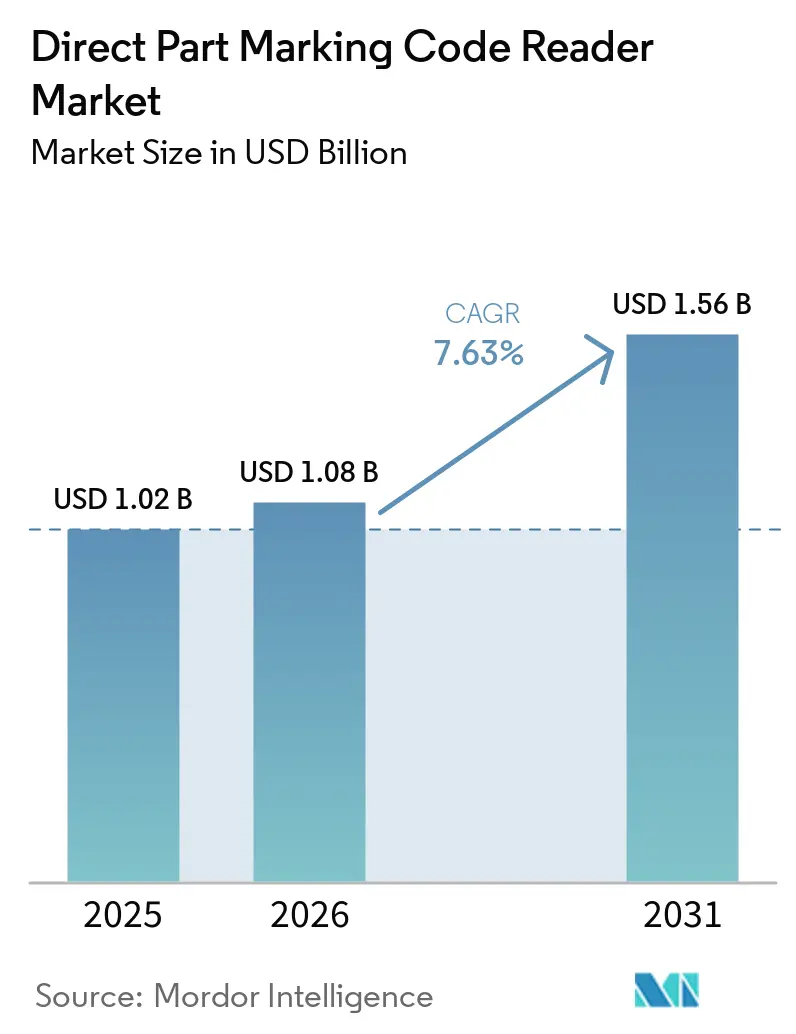
The Direct Part Marking Code Reader Market size is projected to be USD 1.02 billion in 2025, USD 1.08 billion in 2026, and reach USD 1.56 billion by 2031, expanding at a CAGR of 7.63% from 2026 to 2031. Regulatory traceability rules are making readable permanent identifiers necessary across medical devices, automotive components, and aerospace parts. Connected manufacturing systems also place readers closer to production, quality, and enterprise records. Suppliers are responding with imaging, AI decoding, and service models that support demanding line conditions. Costly retrofit work, uneven mark quality, and connected-device security requirements still slow adoption at many existing plants.
Key Report Takeaways
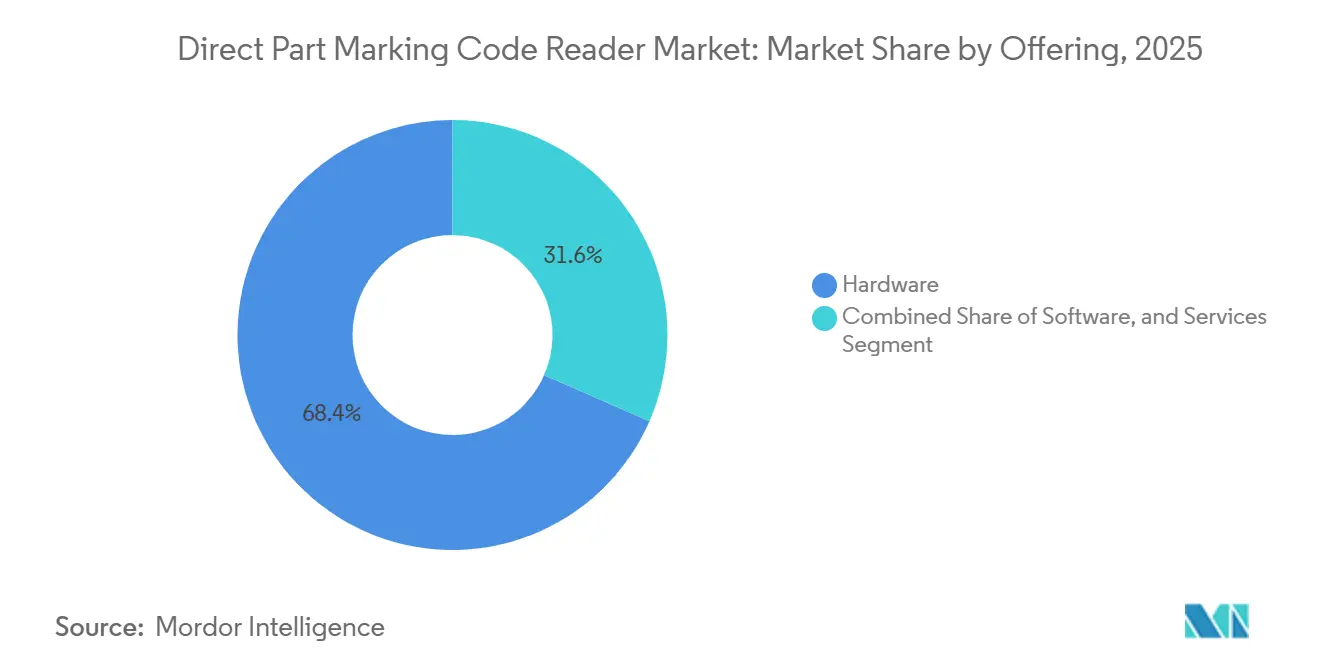
- By offering, hardware held 68.43% of the Direct Part Marking Code Reader Market share in 2025, while services are projected to expand at a 9.23% CAGR through 2031.
- By technology, image-based CMOS accounted for 69.73% of the technology segment in 2025, while hybrid and multi-modal technology is projected to expand at a 10.37% CAGR through 2031.
- By the marking method, laser etching held 51.83% of the segment in 2025 and is projected to expand at a 10.83% CAGR through 2031.
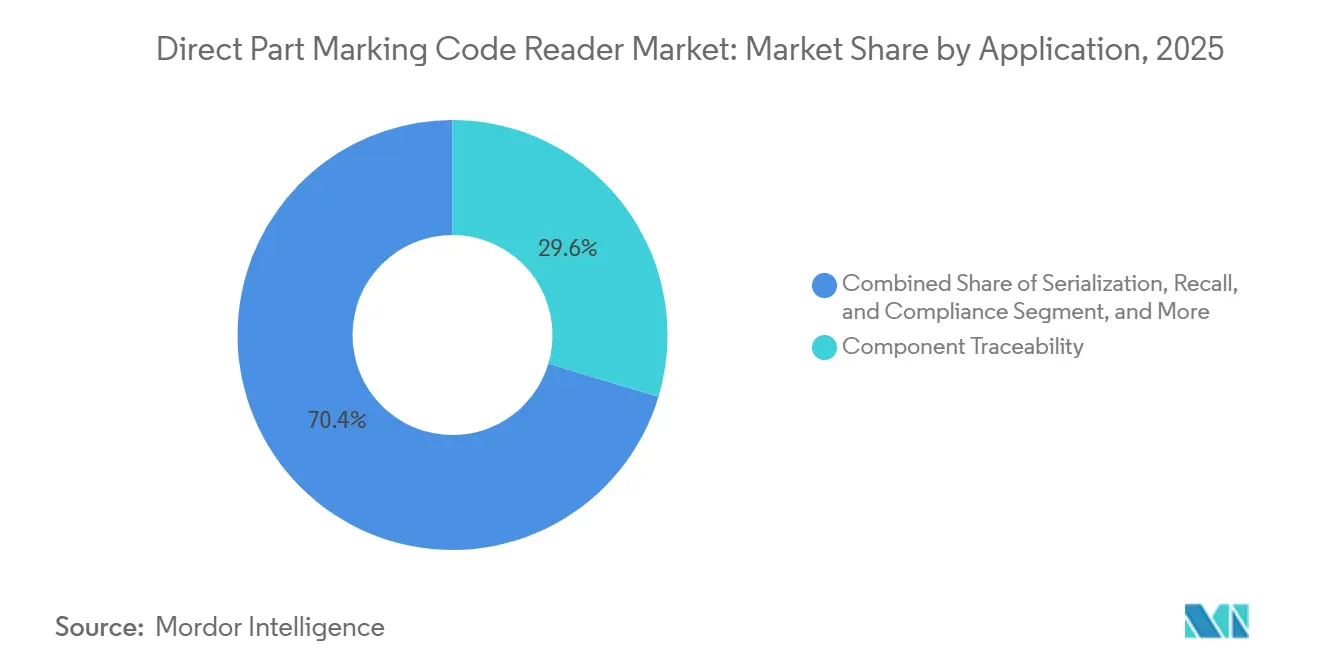
- By application, component traceability accounted for 29.63% of the segment in 2025, while serialization, recall, and compliance are projected to expand at a 10.93% CAGR through 2031.
- By end-user industry, automotive held 27.83% of the segment in 2025, while medical devices and pharmaceuticals are projected to expand at a 10.43% CAGR through 2031.
- By geography, Asia-Pacific accounted for 38.53% of the Direct Part Marking Code Reader Market share in 2025 and is projected to expand at a 10.27% CAGR through 2031.
Note: Market size and forecast figures in this report are generated using Mordor Intelligence’s proprietary estimation framework, updated with the latest available data and insights as of January 2026.
Global Direct Part Marking Code Reader Market Trends and Insights
Drivers Impact Analysis*
| Driver | (~) % Impact on CAGR Forecast | Geographic Relevance | Impact Timeline |
|---|---|---|---|
| Traceability Mandates in Regulated Manufacturing | +2.1% | Global, with highest concentration in North America and Europe | Medium term (2-4 years) |
| Industry 4.0 and MES-ERP Integration | +1.7% | Global, with Asia-Pacific and Europe leading deployment scale | Medium term (2-4 years) |
| Electronics and Automotive Component Manufacturing | +1.5% | Asia-Pacific core, with spillover to North America and Europe | Medium term (2-4 years) |
| Need to Read Damaged and Low-Contrast Codes | +0.9% | Global | Short term (≤ 2 years) |
| Mark-to-Read Feedback for Quality Control | +0.6% | Automotive-dense regions, including Germany, Japan, and South Korea | Long term (≥ 4 years) |
| AI Decoding for Mixed-Surface Production Lines | +0.5% | Global | Short term (≤ 2 years) |
| Source: Mordor Intelligence | |||
Traceability Mandates Strengthen Regulatory Demand
The Direct Part Marking Code Reader Market benefits from rules that require a durable identifier to remain linked to each regulated part. The FDA Quality Management System Regulation took effect on February 2, 2026, and aligns device quality systems with ISO 13485 requirements, including UDI-related controls.[1] U.S. Food and Drug Administration, “Quality Management System Regulation,” U.S. Food and Drug Administration The EUDAMED UDI and Device Registration module became mandatory on May 28, 2026, which made registration obligations more immediate for affected device manufacturers. Producers selling the same device in several jurisdictions must often support separate registration and traceability processes. That requirement favors readers who can verify machine-readable identifiers during production. Automotive and aerospace suppliers also face customer specifications for consistent direct part mark quality.[2]European Commission, “UDI/Device Registration,” European Commissio
Industry 4.0 and MES-ERP Integration Support Connected Production
The Direct Part Marking Code Reader Market is supported by manufacturers who link scan events to production and business records. ISA-95 defines models for the exchange of information between enterprise systems and manufacturing operations.[3] International Society of Automation, “ISA-95: Enterprise-Control System Integration,” International Society of Automation, A reader can send a part identity to a manufacturing execution system, update a work order, and support a nonconformance record without reentering data. This capability makes the device part of the production information flow rather than a separate inspection tool. Connected readers must work with factory communications such as OPC UA, PROFINET, and EtherNet/IP. Mark-to-read feedback can also allow a failed read to trigger a review of the upstream marking process.
Electronics and Automotive Production Sustains Reader Demand
The Direct Part Marking Code Reader Market follows production volumes in electronics and automotive component plants. Electronics lines use permanent identifiers to support traceability across wafer, printed circuit board, and packaged-device processes. Automotive electrification adds components that require marks able to withstand heat, abrasion, and chemical exposure. Laser marking systems can apply direct part marks to metal parts that meet the needs of industrial traceability. Battery cells, modules, and packs, therefore, create applications where ordinary labels are unsuitable. Service networks can also use marked parts to verify replacement components when vehicle software and hardware must remain linked.
AI Decoding Improves Results on Difficult Marks
The Direct Part Marking Code Reader Market is gaining from decoding tools designed for damaged, faint, and uneven codes. Conventional readers can reject a code when its contrast or reflectance falls below a fixed threshold. Keyence states that its SR-X series uses a dedicated AI chip and learning based on more than 100,000 code images.[4]Keyence Corporation, “AI-Powered Code Reader SR-X Series,” Keyence Corporation This approach can support reads on surfaces with oil, shallow marks, partial ink loss, or small defects. Research published in 2026 reported a mean average precision of 95.68% for barcode recognition under difficult industrial conditions. Progressive wear in dot-peen tooling can still change mark quality enough to require maintenance and retuning.
Restraints Impact Analysis*
| Restraint | (~) % Impact on CAGR Forecast | Geographic Relevance | Impact Timeline |
|---|---|---|---|
| Brownfield Capital and Integration Costs | -1.8% | Global, most acute in South America, South and Southeast Asia, and SME-heavy European economies | Medium term (2-4 years) |
| Reflective, Curved, and Damaged Mark Readability | -1.3% | Global, especially automotive and aerospace | Short term (≤ 2 years) |
| Calibration Across Marking-Reader Combinations | -0.8% | Global | Medium term (2-4 years) |
| Cybersecurity Exposure from Connected Readers | -0.6% | North America and Europe | Long term (≥ 4 years) |
| Source: Mordor Intelligence | |||
Brownfield Retrofit Costs Constrain Upgrade Decisions
The Direct Part Marking Code Reader Market faces its strongest barrier in older facilities that were not designed for modern connected devices. Legacy programmable logic controllers may need protocol translation before a reader can send data to a manufacturing execution system. Engineering time and gateway software can cost 2-3 times as much as reader hardware. Smaller plants in South America, Southeast Asia, and parts of Europe may struggle to justify that total expense. Reader-as-a-service and managed calibration contracts shift spending from capital budgets to operating budgets. These arrangements can improve access, while also creating a longer supplier relationship that buyers must assess carefully.
Surface Variation Limits Reliable Reading
The Direct Part Marking Code Reader Market must address the marking of curved, reflective, and stressed surfaces. Dot-peen marks on cast aluminum, laser marks on polished fasteners, and chemical marks on electrolytic surfaces require different lighting and decoding settings. A device calibrated for one material can return intermittent no-reads on another. Mixed-material lines can therefore experience delays when marks need repeated inspection or adjustment. OMRON introduced the VHV5-F in April 2025 with autofocus and X-Mode 6.0 decoding for difficult reading conditions. ISO/IEC 29158 provides a basis for direct part-mark quality evaluation, although material-specific implementations remain uneven.
*Our forecasts treat driver/restraint impacts as directional, not additive. The impact forecasts reflect baseline growth, mix effects, and variable interactions.
Segment Analysis
By Offering: Hardware Holds the Largest Revenue Base While Services Expand Fastest
Hardware held 68.43% of the Direct Part Marking Code Reader Market share in 2025, reflecting the capital-intensive nature of fixed-mount deployments. Automotive, electronics, and aerospace lines need readers, lenses, lighting, and mounts matched to part movement and code location. These installations support stable inspection at high production speeds. Plants also favor local processing, where response time and line continuity are important. The large installed base creates recurring opportunities for replacement, configuration changes, and performance upgrades.
Software plays a smaller revenue role but is gaining value as AI decoding and model management functions become standard purchase requirements. It helps readers handle variable contrast, code placement, and surface conditions across production lines. Services are projected to expand at a 9.23% CAGR through 2031, the fastest rate in this segment. Calibration, maintenance, and AI model updates help manufacturers sustain performance as marks and line conditions change. Cognex introduced the DataMan 290 and 390 AI-powered barcode readers in January 2025 for applications with variable code quality and surface conditions. The Direct Part Marking Code Reader Market is moving toward ongoing support models without reducing the need for dedicated hardware.



By Technology: CMOS Leads Current Use While Hybrid Systems Gain Relevance
Image-based CMOS technology accounted for 69.73% of the Direct Part Marking Code Reader Market share in 2025. Its position reflects a balance of cost, image quality, and applicability across electronics, automotive, and general industrial production. CMOS systems capture dense codes and support lighting arrangements for varied part surfaces. They also fit lines that handle several code sizes, mark positions, and product variants. Solid-state imaging remains a practical foundation for suppliers adding AI functions to existing reader platforms.
Laser-based readers retain a role in long-standoff applications with consistently marked surfaces and clear viewing conditions. Hybrid and multi-modal technology is projected to expand at a 10.37% CAGR through 2031. These devices combine imaging with structured light or multiple illumination sources for lines, using laser etching, dot peen, and inkjet marks. This flexibility can reduce the need for a separate reader at every marking station. Keyence launched the SR-X series in April 2024 with 6-core parallel processing, a dedicated AI chip, and autofocus from 32 mm to 1,000 mm. The Direct Part Marking Code Reader Market is shifting toward systems that can work across mixed production conditions.
By Marking Method: Laser Etching Leads Adoption and Forecast Expansion
Laser etching held 51.83% of the marking-method segment in 2025. The method creates a permanent code on metal parts without the use of consumable materials. It can retain readability after heat, abrasion, and chemical exposure. These properties support its use on engine components, implantable devices, aerospace fasteners, and battery-related parts. Laser-etched Data Matrix codes also support formal inspection against mark-quality expectations.
Laser etching is projected to expand at a 10.83% CAGR through 2031, the fastest rate among the listed marking methods. Fiber-laser development is improving marking on heat-sensitive materials. Dot peen retains a cost-driven installed base in which lower equipment expense matters more than fine-mark quality. Chemical etching remains relevant in specialized electronics and semiconductor applications where surface disruption must be limited. Inkjet, molded, and thermal spray marks are used in non-metal materials and packaging applications where surface penetration is unsuitable. The Direct Part Marking Code Reader Market must support these alternatives, even as laser etching remains its central industrial use case.
By Application: Component Traceability Holds the Largest Role While Compliance Accelerates
Component traceability accounted for 29.63% of the application segment in 2025. It connects each part's identity to the production point and preserves the link through assembly, distribution, service, and end-of-life. Manufacturers use the record to locate components within a production or supply-chain history. This function supports quality management by identifying specific lots and parts. It also provides the base information used by many other reader applications.
Work-in-process tracking follows parts through workstations, while quality inspection and mark verification assess whether codes meet readability requirements. Inventory and asset tracking extend the use of readers into warehouses and maintenance operations, where labels can deteriorate. Serialization, recall, and compliance are projected to expand at a 10.93% CAGR through 2031. FDA draft guidance issued in June 2025 addressed UDI requirements for combination products, supporting wider use of identifiers for products that combine device and drug or biological elements. Shipment and service-part verification also gains relevance as manufacturers seek authenticated components across service channels.
By End-User Industry: Automotive Leads Present Demand While Medical Uses Advance
Automotive held 27.83% of the end-user segment in 2025. The sector has invested in component traceability across powertrain, chassis, and supplier operations for decades. Quality rules and OEM specifications reinforce the requirement for readable permanent marks. Electrified vehicles add battery-related parts that need durable identification under demanding operating conditions. High-throughput automotive lines also favor fixed-mount readers that can provide consistent inspection.
Electronics and semiconductors form the next major end-user group because high-value components need identification through complex production steps. Aerospace and defense use premium readers where strict part history and code quality are required. Medical devices and pharmaceuticals are projected to expand at a 10.43% CAGR through 2031. OMRON introduced the VHV5-SRV Barcode Verification System in June 2026 for 100% inline inspection in pharmaceutical and life sciences production. Industrial machinery, logistics, food and beverage, energy, and utilities add diverse, smaller applications. Their uptake depends on traceability needs, automation levels, and the ability to justify installation costs.
Geography Analysis
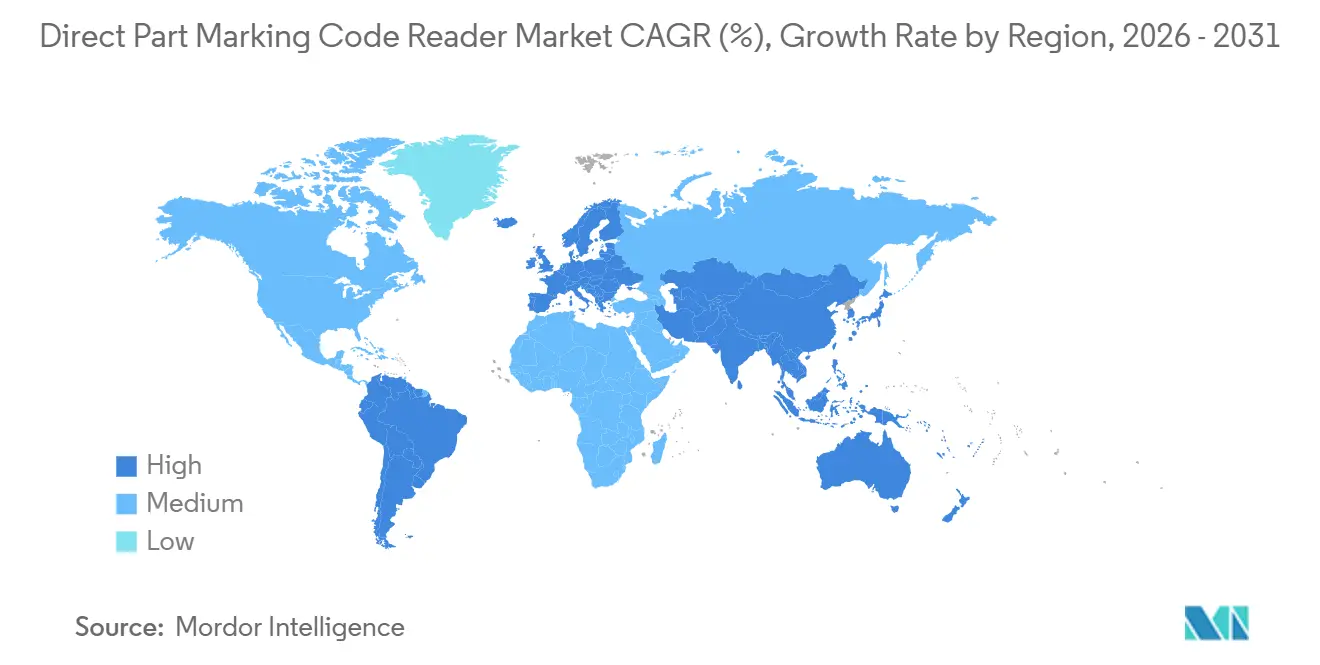
Asia-Pacific accounted for 38.53% of the Direct Part Marking Code Reader Market share in 2025 and is projected to expand at a 10.27% CAGR through 2031. The region combines large electronics, semiconductor, and automotive production bases. China, Japan, South Korea, and India support dense supplier networks that need component identification and verification. Japan is also home to established suppliers, including Keyence, OMRON, Panasonic Industry, and DENSO WAVE. India is adding electronics assembly capacity through the Production-Linked Incentive program for mobile manufacturing and semiconductors. These conditions place the reader's demand close to the facilities where permanent marks are created and checked.
North America and Europe form the next major combined demand pool for the Direct Part Marking Code Reader Market. North American demand comes from automotive powertrain and EV battery production, aerospace and defense, and medical device manufacturing. FDA quality-system changes that took effect in 2026 increase the focus on UDI-related production controls. German automotive and industrial machinery clusters, French aerospace supply chains, and precision manufacturing in Italy and Spain support Europe. European connected-device requirements also make cybersecurity a factor in procurement decisions for networked readers.
South America, the Middle East, and Africa, and other European locations offer developing opportunities with different constraints. Brazil leads South American demand through automotive assembly around the São Paulo manufacturing corridor. Subsidiaries of global OEMs often align local mark-and-verify specifications with worldwide supplier standards. Saudi Arabia and the United Arab Emirates are building industrial capacity in areas that include pharmaceuticals and aerospace maintenance. South Africa's automotive assembly plants and Nigeria's repair and refurbishment activity account for a more limited African contribution. Access to capital, production infrastructure, and compliance requirements will determine the timing of wider adoption in these locations.

Competitive Landscape
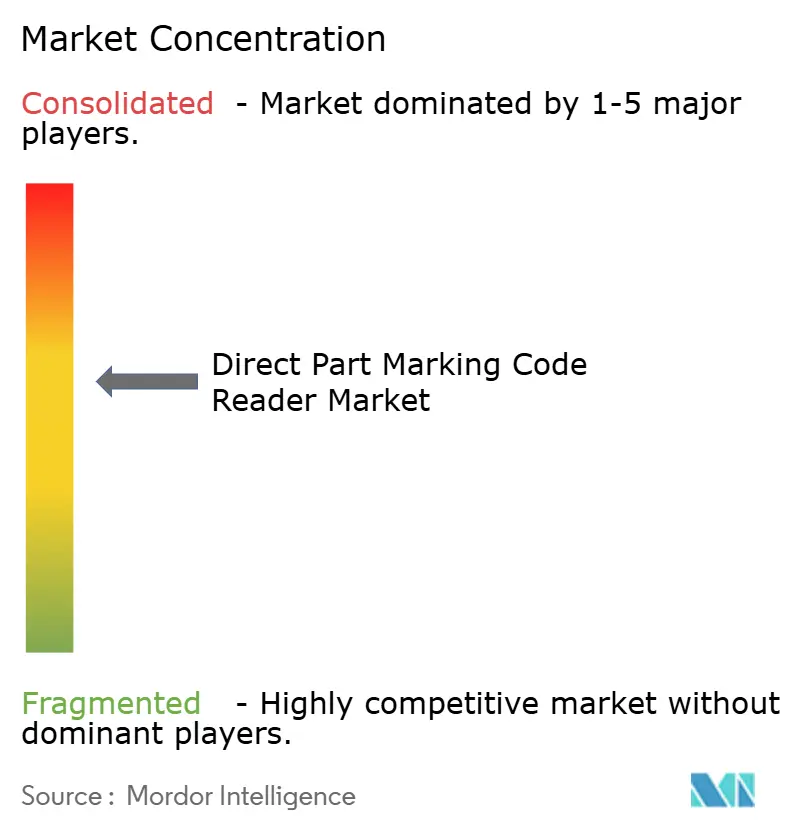
The Direct Part Marking Code Reader Market is moderately consolidated in industrial fixed-mount systems. Cognex, Keyence, OMRON, and SICK have strong positions in applications requiring industrial-grade direct part-mark reading. Competition is more fragmented in handheld systems, logistics scanners, and regional mid-market products. Suppliers increasingly differentiate themselves through decoding accuracy, edge processing, and integration with connected factory systems. This shifts product selection beyond optics and device form factor. Buyers also compare the depth of application support for their parts, marks, surfaces, and line communications.
Cognex launched the In-Sight 3900 Vision System in May 2026 with up to 25 MP resolution and edge AI processing without an external PC. OMRON introduced the VHV5 inline verifier in March 2026 for real-time verification of Code 128, Data Matrix, QR, and direct part marks. Zebra Technologies announced the NS42 Smart Vision Sensor in September 2026 with deep-learning functions for embossed characters and laser marks. These moves show that leading companies are broadening the scope of inspection, reading, and verification functions. The Direct Part Marking Code Reader Market is also shaped by middleware and model-management capabilities that connect readers to production systems.
Lower-priced direct-part-mark readers present an opportunity for small- and mid-sized manufacturers that cannot support complex integration budgets. This need is especially relevant in South America, Southeast Asia, and Eastern Europe. Hikrobot Technology and other Chinese challengers compete with cost-oriented platforms for standard laser-etched Data Matrix applications. Established suppliers retain an advantage in applications that require complex lighting, difficult-code recovery, or documented cybersecurity processes. IEC 62443 addresses cybersecurity for industrial automation and control systems, which raises the importance of secure product development for connected readers. The Direct Part Marking Code Reader Market, therefore, has room for price competition, while high-reliability requirements favor vendors with deeper application capabilities.
Direct Part Marking Code Reader Industry Leaders
Cognex Corporation
Keyence Corporation
Zebra Technologies Corporation
Datalogic S.p.A.
Honeywell International Inc.
- *Disclaimer: Major Players sorted in no particular order

Recent Industry Developments
- September 2026: SICK launched the sensingCam SEC200, a compact image-based code reader for logistics and industrial environments supporting 1D and 2D codes, QR, and Data Matrix codes at a resolution of ≥0.2 mm, with multi-code capability of up to 25 codes per scan and Ethernet integration for IIoT connectivity. The product extends SICK's portfolio into cost-accessible industrial identification and strengthens its position against mid-market challengers.
- September 2026: SICK launched the sensingCam SEC200, a compact image-based code reader for logistics and industrial environments supporting 1D and 2D codes, QR, and Data Matrix codes at a resolution of ≥0.2 mm, with multi-code capability of up to 25 codes per scan and Ethernet integration for IIoT connectivity. The product extends SICK's portfolio into cost-accessible industrial identification and strengthens its position against mid-market challengers.
- June 2026: OMRON Automation launched the VHV5-SRV Barcode Verification System, an inline direct part mark verification solution operating at up to 1,000 marks per minute and compliant with ISO/IEC standards for 1D, 2D, and direct part mark codes. The system combines reader and verifier functions for pharmaceutical, life-sciences, and automotive production-line verification.
- May 2026: Cognex launched the In-Sight 3900 Vision System, powered by Qualcomm Dragonwing platforms, with up to 25 MP resolution, 4x faster processing than its predecessor generation, and full edge AI execution without an external PC. The system integrates Cognex OneVision for cloud-to-edge AI model management and targets high-speed packaging, automotive, and electronics inspection applications.


Global Direct Part Marking Code Reader Market Report Scope
Direct Part Marking Code Readers are specialized optical scanning systems designed to read permanent, high-contrast or low-contrast codes etched, stamped, or printed directly onto industrial components, enabling robust traceability, quality control, and lifecycle management in harsh manufacturing environments where traditional labels cannot be used.
The Direct Part Marking Code Reader Market Report is Segmented by Offering (Hardware, Software, and Services), Technology (Image-Based CMOS, Laser-Based, and Hybrid and Multi-Modal), Marking Method (Laser Etching, Dot Peen, Chemical Etching, and Inkjet, Molded, and Thermal Spray Marks), Application (Component Traceability, Work-in-Process Tracking, Quality Inspection and Mark Verification, Inventory and Asset Tracking, Serialization, Recall, and Compliance, Shipment and Service-Part Verification, and Other Applications), End-User Industry (Automotive, Electronics and Semiconductors, Aerospace and Defense, Medical Devices and Pharmaceuticals, Industrial Machinery and Metals, Transportation and Logistics, Food, Beverage, and Consumer Goods, Energy and Utilities, and Other End-User Industries), and Geography (North America, South America, Europe, Asia-Pacific, Middle East and Africa). The Market Forecasts are Provided in Terms of Value (USD).
| Hardware |
| Software |
| Services |
| Image-Based CMOS |
| Laser-Based |
| Hybrid and Multi-Modal |
| Laser Etching |
| Dot Peen |
| Chemical Etching |
| Inkjet, Molded, and Thermal Spray Marks |
| Component Traceability |
| Work-in-Process Tracking |
| Quality Inspection and Mark Verification |
| Inventory and Asset Tracking |
| Serialization, Recall, and Compliance |
| Shipment and Service-Part Verification |
| Other Applications |
| Automotive |
| Electronics and Semiconductors |
| Aerospace and Defense |
| Medical Devices and Pharmaceuticals |
| Industrial Machinery and Metals |
| Transportation and Logistics |
| Food, Beverage, and Consumer Goods |
| Energy and Utilities |
| Other End-User Industries |
| North America | United States | |
| Canada | ||
| Mexico | ||
| South America | Brazil | |
| Argentina | ||
| Rest of South America | ||
| Europe | Germany | |
| United Kingdom | ||
| France | ||
| Italy | ||
| Spain | ||
| Rest of Europe | ||
| Asia-Pacific | China | |
| Japan | ||
| India | ||
| South Korea | ||
| Rest of Asia-Pacific | ||
| Middle East and Africa | Middle East | Saudi Arabia |
| United Arab Emirates | ||
| Turkey | ||
| Rest of the Middle East | ||
| Africa | South Africa | |
| Nigeria | ||
| Rest of Africa | ||
| By Offering | Hardware | ||
| Software | |||
| Services | |||
| By Technology | Image-Based CMOS | ||
| Laser-Based | |||
| Hybrid and Multi-Modal | |||
| By Marking Method | Laser Etching | ||
| Dot Peen | |||
| Chemical Etching | |||
| Inkjet, Molded, and Thermal Spray Marks | |||
| By Application | Component Traceability | ||
| Work-in-Process Tracking | |||
| Quality Inspection and Mark Verification | |||
| Inventory and Asset Tracking | |||
| Serialization, Recall, and Compliance | |||
| Shipment and Service-Part Verification | |||
| Other Applications | |||
| By End-User Industry | Automotive | ||
| Electronics and Semiconductors | |||
| Aerospace and Defense | |||
| Medical Devices and Pharmaceuticals | |||
| Industrial Machinery and Metals | |||
| Transportation and Logistics | |||
| Food, Beverage, and Consumer Goods | |||
| Energy and Utilities | |||
| Other End-User Industries | |||
| By Geography | North America | United States | |
| Canada | |||
| Mexico | |||
| South America | Brazil | ||
| Argentina | |||
| Rest of South America | |||
| Europe | Germany | ||
| United Kingdom | |||
| France | |||
| Italy | |||
| Spain | |||
| Rest of Europe | |||
| Asia-Pacific | China | ||
| Japan | |||
| India | |||
| South Korea | |||
| Rest of Asia-Pacific | |||
| Middle East and Africa | Middle East | Saudi Arabia | |
| United Arab Emirates | |||
| Turkey | |||
| Rest of the Middle East | |||
| Africa | South Africa | ||
| Nigeria | |||
| Rest of Africa | |||


Key Questions Answered in the Report
What is the Direct Part Marking Code Reader Market size?
The Direct Part Marking Code Reader Market is USD 1.08 billion in 2026 and is projected to reach USD 1.56 billion by 2031 at a 7.63% CAGR.
What is driving demand for direct part marking code readers?
Medical-device identification rules, regulated traceability, connected factory systems, and automotive and electronics production support adoption.
Which offering leads direct part marking code reader revenue?
Hardware held 68.43% of revenue in 2025, while services are projected to expand at a 9.23% CAGR through 2031.
Which technology is most used for direct part mark reading?
Image-based CMOS held 69.73% of the technology segment in 2025, while hybrid and multi-modal systems have the fastest projected CAGR at 10.37%.
Which end-user sector has the strongest demand?
Automotive held 27.83% of the end-user segment in 2025. Medical devices and pharmaceuticals is projected to expand at a 10.43% CAGR through 2031.
Which region leads demand for direct part marking readers?
Asia-Pacific accounted for 38.53% of revenue in 2025 and is projected to expand at a 10.27% CAGR through 2031.
Page last updated on:


 Your data is secure and never sold or shared.


