
Diet Soft Drinks Market Size and Share
Market Overview
| Study Period | 2022 - 2032 |
|---|---|
| Market Size (2027) | USD 4.88 Billion |
| Market Size (2032) | USD 6.47 Billion |
| Fastest Growing Market | Asia-Pacific |
| Largest Market | North America |
| Market Concentration | Medium |
Major Players *Disclaimer: Major Players sorted in no particular order Image © Mordor Intelligence. Reuse requires attribution under CC BY 4.0. | |
Diet Soft Drinks Market Analysis by Mordor Intelligence
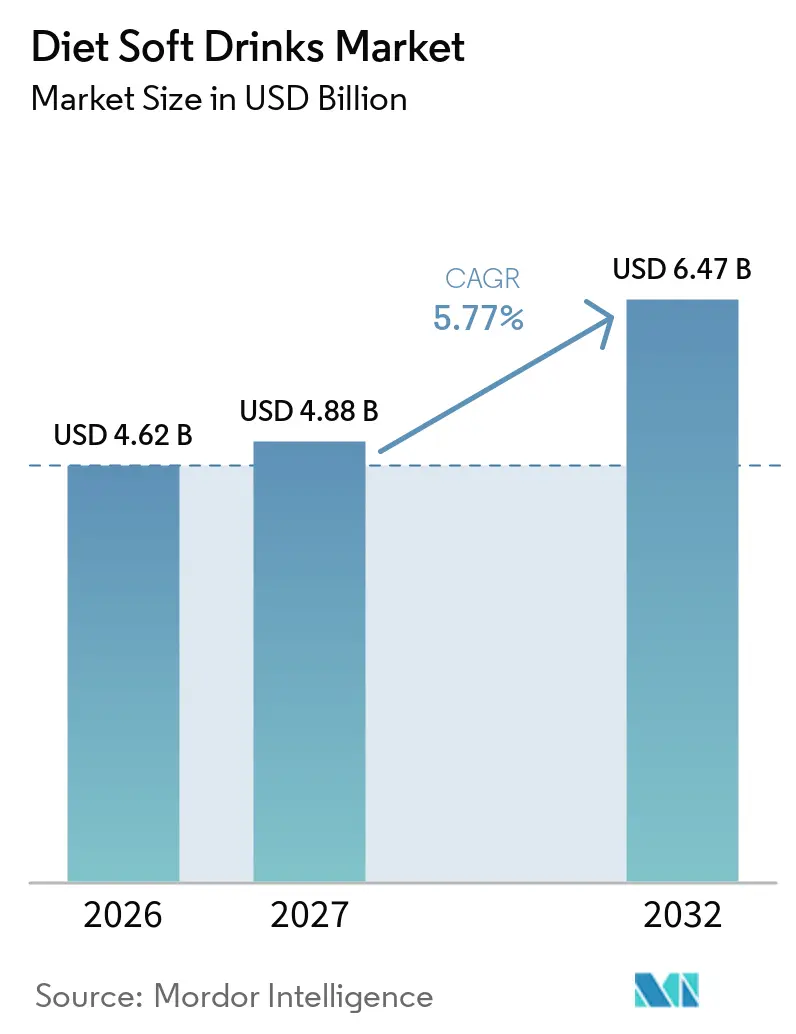
The diet soft drinks Market size was valued at USD 4.62 billion in 2026 and estimated to grow from USD 4.88 billion in 2027 to reach USD 6.47 billion by 2032, at a CAGR of 5.77% during the forecast period (2027-2032). Demand is shifting toward zero-sugar products as consumers seek lower-calorie refreshment without abandoning familiar beverage brands. Sugar taxes and reformulation rules are making lower-sugar recipes more commercially attractive in several countries. Product development is also moving beyond calorie reduction, with fiber, botanical ingredients, and plant-derived sweeteners creating more choices for consumers. The diet soft drinks market is becoming more competitive as established soda companies defend shelf space while functional beverage brands target the same health-conscious buyers.
Key Report Takeaways
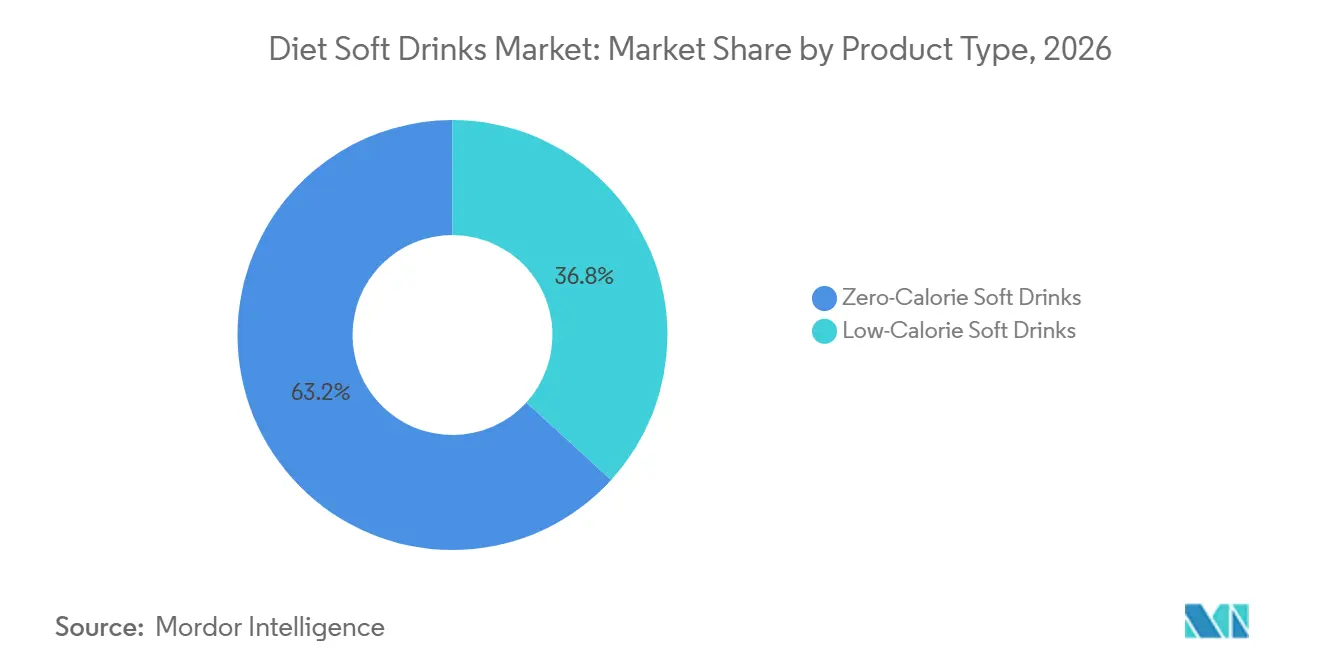
- By product type, zero-calorie soft drinks held 63.23% of the diet soft drinks market share in 2026, while low-calorie soft drinks are forecast to grow at a 6.32% CAGR through 2032.
- By format, non-carbonated drinks accounted for 54.28% of the diet soft drinks market size in 2026, while carbonated drinks are projected to expand at a 6.68% CAGR through 2032.
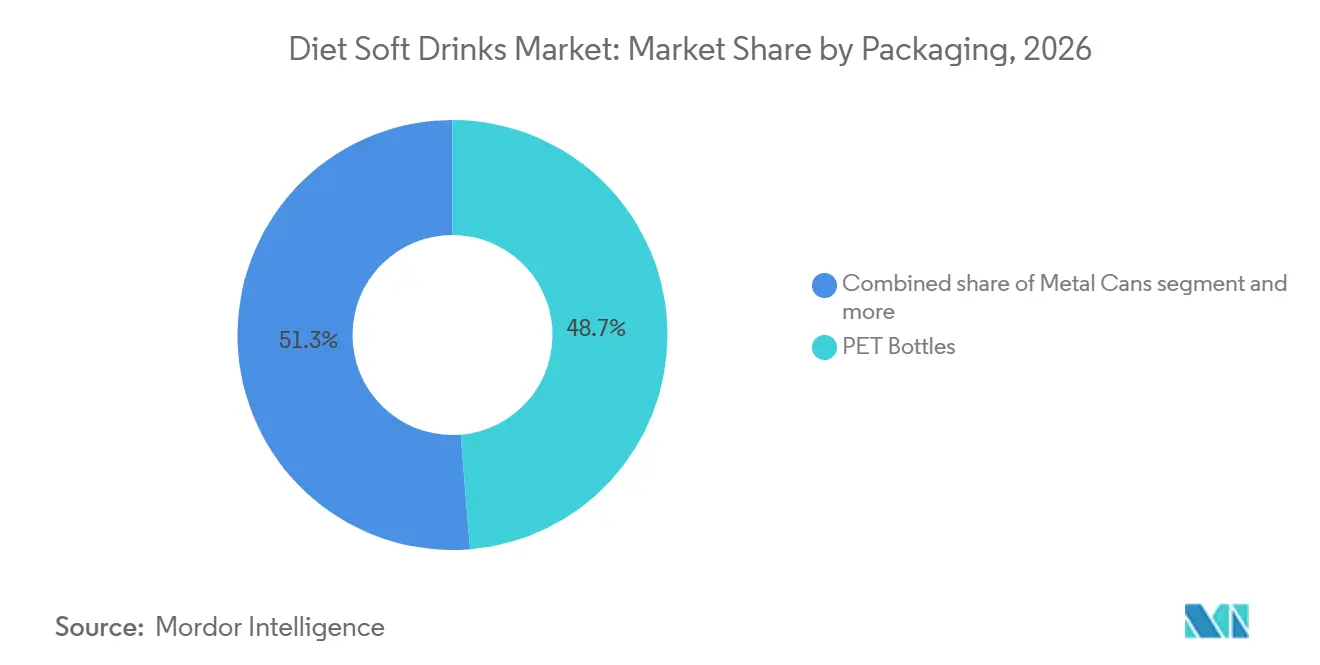
- By packaging, PET bottles led with 48.65% share in 2026 and are expected to grow at a 6.43% CAGR through 2032.
- By distribution channel, off-trade outlets represented 68.87% of sales in 2026, while on-trade channels are expected to record a 6.79% CAGR through 2032.
- By geography, North America held 41.56% of sales in 2026, while Asia-Pacific is forecast to register a 6.41% CAGR through 2032.
Note: Market numbers in this report are based on Mordor Intelligence's proprietary estimation framework, which combines nine months of actuals with Q4 projections for base year 2026.
Market Trends and Insights
Drivers Impact Analysis of Diet Soft Drinks Market*
| Driver | (~) % Impact on CAGR Forecast | Geographic Relevance | Impact Timeline |
|---|---|---|---|
| Rising Consumer Preference for Zero-Sugar and Reduced-Calorie Beverages | +1.8% | Global | Short term (≤ 2 years) |
| Expansion of Government Sugar Taxes and Beverage Reformulation Initiatives | +1.2% | United Kingdom, Europe, Middle East and Africa, Asia-Pacific, Latin America | Medium term (2–4 years) |
| Expansion of Functional Zero-Calorie Formulations | +0.9% | North America, Europe | Medium term (2–4 years) |
| Rising Demand for Naturally Sweetened Diet Soft Drinks | +0.8% | North America, Europe, Asia-Pacific | Long term (≥ 4 years) |
| Increasing Product Innovation in Fruit-Flavored and Specialty Diet Sodas | +0.5% | North America, Europe | Short term (≤ 2 years) |
| Rising Demand for Premium and Craft Sugar-Free Carbonated Beverages | +0.4% | North America, Europe | Medium term (2–4 years) |
| Source: Mordor Intelligence | |||
Rising Consumer Preference for Zero-Sugar and Reduced-Calorie Beverages
Zero-sugar branding is helping beverage companies reach consumers who had rejected the older diet label. Pepsi Zero Sugar recorded year-to-date sales growth above 30.8% in 2025 and reached more than 1 million additional households, according to PepsiCo. PepsiCo also reported that more than 60% of participants preferred Pepsi Zero Sugar in every one of its 34 U.S. Pepsi Challenge markets[1]. This response supports wider zero-sugar placement in retail assortments and promotional activity, while the diet soft drinks market benefits when lower-calorie products are presented as everyday choices rather than as restricted alternatives because the framing can encourage trial and give retailers a reason to place zero-sugar products beside mainstream soda brands across grocery, convenience, and foodservice channels.
Expansion of Government Sugar Taxes and Beverage Reformulation Initiatives
Sugar taxation is changing the relative cost of full-sugar and lower-sugar drinks. The Global Food Research Program recorded 98 national beverage taxes and 16 subnational taxes as of April 2025. In November 2025, the UK government announced a strengthened Soft Drinks Industry Levy that lowers the threshold to 4.5g of sugar per 100ml and extends coverage to milk-based and plant-based sugary drinks from January 2028[2]. The UAE announced a volumetric excise model that takes effect in 2026 and links tax liability to sugar content. These policies favor companies that can reformulate products and manage ingredient changes at scale, because large suppliers can spread the cost of recipe work, labeling changes, and retailer communication across broad portfolios while smaller producers may struggle with differing tax thresholds and implementation dates, influencing consumer prices and the speed of product replacement on shelves.
Expansion of Functional Zero-Calorie Formulations
Functional ingredients are giving lower-calorie sodas a role beyond thirst and calorie control. PepsiCo launched Pepsi Prebiotic Cola across the United States in February 2026 with 30 calories, 3g of prebiotic fiber, and no artificial sweeteners. The launch shows that a major cola supplier views fiber-enhanced products as a viable extension of its portfolio. The diet soft drinks market can gain from these products because they provide a more specific reason to try a lower-calorie drink. Keurig Dr. Pepper reported net sales of USD 16.6 billion in 2025 and 11.9% growth in its U.S. Refreshment Beverages segment, supporting continued investment in zero-sugar innovation. The shift raises the value of formulation capability, ingredient sourcing, and clear product claims, as brands must ensure that added fiber, botanicals, or naturally derived sweeteners work with the desired flavor, shelf life, and pack format while remaining simple enough for shoppers to understand, creating an opportunity for companies that combine familiar taste with a relevant benefit.
Rising Demand for Naturally Sweetened Diet Soft Drinks
Concerns about artificial sweeteners are encouraging brands to consider plant-derived alternatives. Tate & Lyle and Manus introduced Yume M Stevia Sweetener in February 2026, using bioconversion at their Augusta, Georgia, facility. The company positions the ingredient around traceability and an Americas-based supply chain. Better-tasting stevia options can help manufacturers reduce the aftertaste that limited earlier formulations. This development supports the diet soft drinks market by giving suppliers another route to meet clean-label expectations. It also allows brands focused on natural positioning to compete without relying only on established cola recipes, since citrus, fruit, tea, and sparkling water products broaden the occasions addressed by the diet soft drinks market, and better sweetener performance can reduce the compromise between a lower-calorie recipe and an acceptable taste experience that influences repeat purchase.
Restraints Impact Analysis of Diet Soft Drinks Market*
| Restraint | (~) % Impact on CAGR Forecast | Geographic Relevance | Impact Timeline |
|---|---|---|---|
| Consumer Skepticism Toward Artificial Sweeteners | -1.5% | Global, particularly North America and Europe | Short term (≤ 2 years) |
| Substitution by Functional and Better-for-You Beverages | -1.1% | North America, Europe | Medium term (2-4 years) |
| Flavor Fatigue and Repeat-Purchase Attrition | -0.5% | Mature markets, North America and Europe | Short term (≤ 2 years) |
| Taste and Aftertaste Limits of Alternative Sweeteners | -0.4% | Global | Short term (≤ 2 years) |
| Source: Mordor Intelligence | |||
Consumer Skepticism Toward Artificial Sweeteners
Consumer concerns about artificial sweeteners remain a constraint even when products meet regulatory requirements. The 2025 IFIC Food and Health Survey found that 27% of Americans had a positive view of low- and no-calorie sweeteners[3]. A 2025 study of Saudi Arabian adults found that 61% accepted foods containing artificial sweeteners, while 44% also agreed that some sweeteners were unhealthy. This gap between use and confidence can lead shoppers to examine labels more closely or move to naturally sweetened products. Taste concerns can add to the challenge when alternative sweeteners leave an aftertaste. The diet soft drinks market, therefore, needs clear labeling, better flavor performance, and formulas that address perceived health concerns.
Substitution by Functional Drinks and Better-for-You Beverages
Prebiotic sodas, functional sparkling waters, and adaptogen drinks compete for the same consumers seeking lower-calorie refreshment. PepsiCo acquired Poppi in March 2025, placing a major beverage company behind a prebiotic soda brand. Coca-Cola launched Simply Pop in February 2025 as a prebiotic soda option. These moves show that large companies are broadening their portfolios beyond traditional diet soda. Functional drinks can offer calorie reduction together with claims related to fiber, energy, or wellness. The diet soft drinks market must respond with products that combine familiar taste, competitive pricing, and credible added benefits.
*Our forecasts treat driver/restraint impacts as directional, not additive. The impact forecasts reflect baseline growth, mix effects, and variable interactions.
Diet Soft Drinks Market Segment Analysis
By Product Type:
Zero-Calorie Products Lead While Low-Calorie Products Broaden ChoiceZero-calorie soft drinks held 63.23% of sales in 2026, giving them the leading position within the diet soft drinks market. Established cola brands support this position through broad distribution, consumer familiarity, and ongoing zero-sugar extensions in the diet-soft-drinks market. The change from diet branding to zero-sugar branding has also made these products more relevant to younger adult consumers. Keurig Dr. Pepper announced that its 2026 innovation program would include zero-sugar extensions across its major carbonated soft drink trademarks. Large beverage companies can leverage their bottling systems and relationships with retailers to maintain availability across stores and foodservice locations.
Low-calorie soft drinks are projected to grow at a 6.32% CAGR from 2027 to 2032. This segment allows brands to include modest amounts of calories while adding ingredients that consumers may value, such as fiber, botanical extracts, or fruit juice. Pepsi Prebiotic Cola illustrates this approach with 30 calories and 3g of prebiotic fiber. These products appeal to consumers who do not want a fully zero-calorie drink or artificial sweeteners. They also give manufacturers a way to distinguish a new product from standard zero-sugar cola. The diet soft drinks industry can use this segment to test formulations that bring together taste, ingredient transparency, and functional appeal.
By Format:
Non-Carbonated Drinks Provide Scale While Carbonated Drinks Grow FasterNon-carbonated drinks accounted for 54.28% of sales in 2026. Their scale reflects demand for diet iced teas, enhanced waters, and other still drinks that suit everyday refreshment occasions. These products fit meals, work settings, and routine household purchases. Their broader use occasions provide a steady base for the diet soft drinks market, especially where consumers prefer familiar still beverages with meals. Non-carbonated products also offer manufacturers more room to develop products with fruit, tea, or botanical profiles. This variety can reduce reliance on a limited set of cola flavors.
Carbonated drinks are forecast to expand at a 6.68% CAGR through 2032. Flavor launches are an important part of this growth because they encourage repeat purchases and attract consumers who want variety. Coca-Cola expanded its U.S. and Canadian cherry portfolio in February 2026 with Coca-Cola Zero Sugar Cherry Float and the national return of Diet Coke Cherry. Carbonated products also benefit from premium single-serve occasions in restaurants, entertainment venues, and convenience retail. Their growth rate shows that familiar soda brands still have room to create demand through flavor, packaging, and zero-sugar positioning.
By Packaging:
PET Bottles Support Broad Access and Everyday UsePET bottles held 48.65% of packaging sales in 2026, the largest share among the listed formats. The format suits single-serve purchases, multipacks, and price-sensitive retail channels. It also supports product sizes that make lower-calorie drinks easier to try without a high spending commitment. For the diet soft drinks market, PET bottles remain important in countries where small packs are central to daily refreshment purchases. Their lightweight nature helps suppliers manage distribution across large retail networks. PET also gives brands flexibility to offer products in several sizes for different consumption occasions.
PET bottles are also projected to record a 6.43% CAGR through 2032. This forecast reflects the continued use of smaller packs and the need for accessible price points in developing consumer markets. The format can support the trial of zero-sugar flavors before a consumer moves to larger multipacks. Manufacturers are likely to use PET across both mainstream and newer functional products because it is familiar to shoppers. Metal cans remain relevant for premium single serves and on-trade locations, but they do not displace PET’s broad retail role. Packaging choices will continue to affect how brands balance convenience, price, and product positioning in the diet soft drinks market.

By Distribution Channel:
Off-Trade Retains Scale While On-Trade Builds Premium OccasionsOff-trade outlets represented 68.87% of sales in 2026. Supermarkets and other retail stores provide the refrigerated space, multipack options, and planned purchasing patterns that support high-volume sales. Convenience stores add important access for immediate consumption and single-serve carbonated drinks. This channel provides leading brands with broad visibility and supports promotional activity at the shelf level. The diet soft drinks market depends on off-trade distribution because consumers often purchase these drinks during routine grocery trips. Strong retailer relationships can also help brands protect space in the diet soft drinks market when new functional drinks enter the category.
On-trade channels are forecast to grow at a 6.79% CAGR from 2027 to 2032. Restaurants, cafés, hotels, and entertainment venues can place diet soft drinks within premium meals and social occasions. These venues give consumers an opportunity to try a new flavor or premium pack without buying a multipack. Placement in foodservice can later support repeat purchases in retail stores. Keurig Dr. Pepper’s stated approach of serving consumers across occasions reinforces the need for both at-home and away-from-home availability. A stronger on-trade presence can help brands build visibility beyond the traditional retail aisle.
Geography Analysis
North America Diet Soft Drinks Market
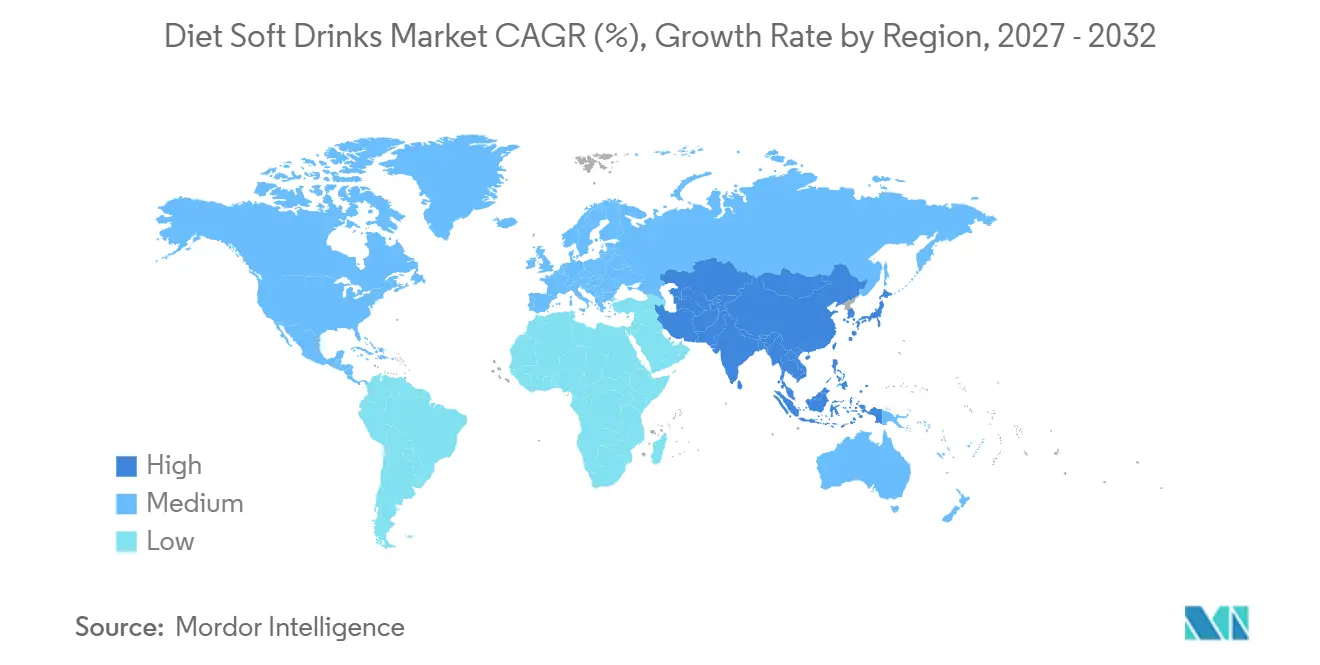
North America held 41.56% of sales in 2026, making it the largest regional market. The region has a mature retail distribution of zero-calorie beverages and long-standing consumer awareness of diet soda brands in the diet soft drinks market. The United States remains central because global brands use it to introduce new zero-sugar and functional products. Coca-Cola reported 14% global unit case growth for Coca-Cola Zero Sugar in the third quarter of 2025. Canada’s front-of-package nutrition labeling rules add pressure to provide clear product information and to reformulate. The diet soft drinks market in North America is supported by large bottling systems, strong brand awareness, and rapid product launches.
APAC Diet Soft Drinks Market
Asia-Pacific is projected to grow at a 6.41% CAGR from 2027 to 2032. Urban growth and rising disposable income are expanding the audience for packaged drinks in India, China, and South Korea. The region contains both markets where zero-sugar drinks are still developing and mature markets with established demand. Suntory renewed four All-Free products in Japan in January 2026 and added a sparkling Muscat of Alexandria product. These product changes show that even developed regional markets require frequent flavor and recipe updates. The diet soft drinks market has significant room to grow where affordable pack sizes, local flavors, and wider distribution improve access.
EMEA and South America Diet Soft Drinks Market
Europe remains an important regional bloc because tax policies and labeling expectations encourage reformulation. The strengthened UK levy creates a defined path for manufacturers to reduce sugar before the revised rules apply in 2028. South America offers demand potential as lower-sugar beverages become more visible to urban consumers. PAHO held a September 2025 workshop in Lima to support regional targets for reducing sweetened beverage consumption. In the Middle East and Africa, the UAE tax model rewards producers that reduce sugar content rather than simply absorb a flat tax. These regional differences require companies to adapt recipes, pack sizes, and price points to local rules and buying habits.
Competitive Landscape
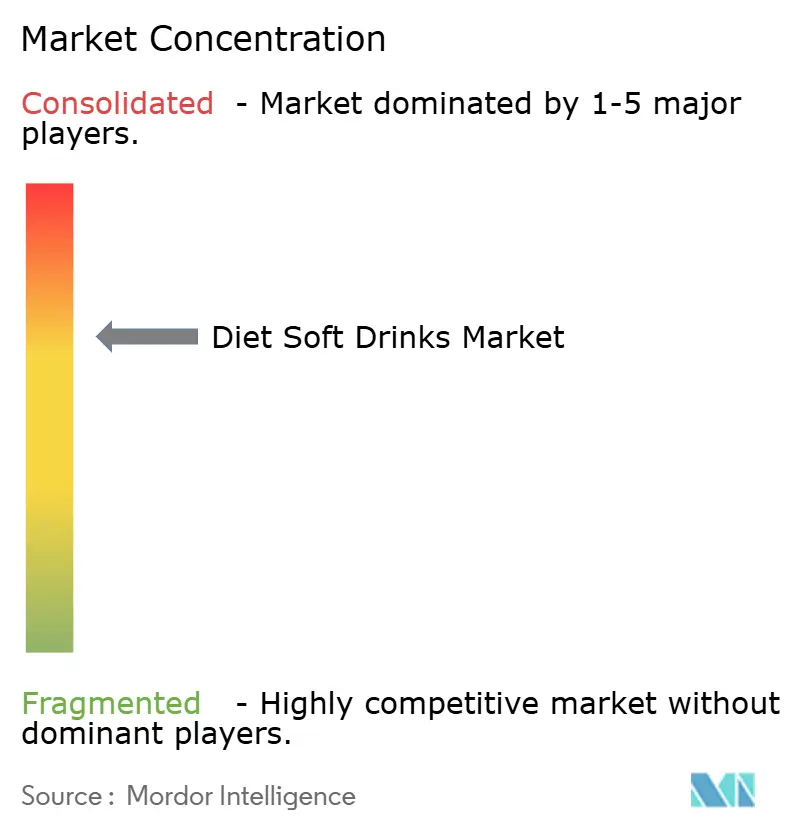
The diet soft drinks market is moderately consolidated among large beverage companies, but smaller brands remain active in natural and functional niches. The Coca-Cola Company and PepsiCo have broad zero-sugar portfolios, global bottling systems, and extensive retail relationships. Keurig Dr. Pepper is also investing in zero-sugar products across its major carbonated trademarks. These companies can support national launches with advertising, distribution, and shelf execution. Their scale creates barriers for newer brands that need broad retail access. At the same time, brands focused on naturally sweetened or specialized products can compete where large portfolios do not fully meet consumer preferences.
Product development and acquisitions are changing competitive positions. PepsiCo’s acquisition of Poppi adds a prebiotic soda brand to its global beverage portfolio. Coca-Cola’s launch of Simply Pop brings its own prebiotic option into a related category. PepsiCo also launched Pepsi Prebiotic Cola, connecting a familiar cola format with fiber and a no-artificial-sweetener formulation. These moves reduce the separation between diet soda and functional beverages across the diet soft drinks market. They also increase the pressure on challenger brands to maintain distinct formulas and strong consumer loyalty.
Natural sweeteners, flavor variety, and packaging will remain important areas of competition, because consumers now compare lower-calorie drinks not only on sugar content but also on ingredient familiarity, taste, availability, pack size, and whether a brand offers a clear reason to choose it over a functional alternative. This competitive pressure affects product planning throughout the diet soft drinks market. Ingredient suppliers can shape product differentiation by helping beverage makers improve taste while limiting artificial sweeteners. Tate & Lyle and Manus positioned Yume M Stevia around traceability and supply security, which can matter to brands seeking reliable ingredient sources. Regional beverage companies can also use local flavors and shorter supply chains to address specific consumer tastes. The diet soft drinks market is likely to reward companies that match innovation with dependable distribution and transparent product claims.
Diet Soft Drinks Industry Leaders
-
The Coca-Cola Company
-
PepsiCo, Inc.
-
Keurig Dr Pepper Inc.
-
Suntory Beverage and Food Limited
-
Red Bull GmbH
- *Disclaimer: Major Players sorted in no particular order
Diet Soft Drinks Market Companies Covered in this Report
- The Coca-Cola Company
- PepsiCo, Inc.
- Keurig Dr Pepper Inc.
- Suntory Holdings Limited
- Asahi Group Holdings, Ltd.
- Kirin Holdings Company, Limited
- Carlsberg A/S / Carlsberg Britvic
- A.G. Barr p.l.c.
- National Beverage Corp.
- Zevia PBC
- Reed's, Inc.
- Jones Soda Co.
- Talking Rain Beverage Company, Inc.
- Refresco Group B.V.
- Polar Beverages
- Lotte Chilsung Beverage Co., Ltd.
- Fraser and Neave, Limited (F&N)
- Green Cola Hellas S.A.
- Bundaberg Brewed Drinks Pty Ltd.
- Royal Unibrew A/S
Recent Industry Developments in Diet Soft Drinks Market
- February 2026: Coca-Cola expanded its zero-sugar cherry portfolio across the US and Canada, launching Coca-Cola Zero Sugar Cherry Float and Diet Coke Cherry nationwide, adding two zero-sugar SKUs to a lineup now spanning five cherry-flavored varieties and capitalizing on cherry's GBP 270 million in documented UK annual value sales momentum.
- February 2026: PepsiCo launched Pepsi Prebiotic Cola nationwide in the United States following a sold-out online debut in November 2025, positioning it as the first prebiotic offering from a legacy cola brand with 30 calories, 3g prebiotic fiber, and no artificial sweeteners.
- December 2025: Keurig Dr. Pepper announced a full 2026 zero-sugar innovation slate covering every major CSD trademark plus Mott's Zero Sugar Juice Drinks, its first zero-sugar juice product, consistent with a 10% total added-sugar reduction in US beverages since 2020.
Global Diet Soft Drinks Market Report Scope
Diet soft drinks are non-alcoholic beverages formulated with reduced or zero sugar and calories, typically using low- or non-caloric sweeteners while maintaining the taste and refreshment of conventional soft drinks. The Diet Soft Drinks Market is segmented by product type, format, packaging, distribution channel, and geography. By product type, the market includes Zero-Calorie Soft Drinks and Low-Calorie Soft Drinks. By format, the market is segmented into Carbonated and Non-Carbonated. By packaging, the market is categorized into PET Bottles, Metal Cans, Glass Bottles, and Others. By distribution channel, the market is divided into On-Trade and Off-Trade, with Off-Trade further segmented into Supermarkets and Hypermarkets, Convenience Stores, Online Retail Stores, and Other Off-Trade Channels. By geography, the report covers North America, Europe, Asia-Pacific, South America, the Middle East, and Africa, with market size and forecasts provided for each region. The market sizing has been done in value terms in USD and volume terms in liters for all the abovementioned segments.
Segmentation Overview
| Zero-Calorie Soft Drinks |
| Low-Calorie Soft Drinks |
| Carbonated |
| Non-Carbonated |
| PET Bottles |
| Metal Cans |
| Glass Bottles |
| Others |
| On-Trade | |
| Off-Trade | Supermarkets and Hypermarkets |
| Convenience Stores | |
| Online Retial Stores | |
| Other off-Trade Channels |
| North America | United States |
| Canada | |
| Mexico | |
| Rest of North America | |
| Europe | United Kingdom |
| Germany | |
| France | |
| Italy | |
| Spain | |
| Russia | |
| Sweden | |
| Belgium | |
| Poland | |
| Netherlands | |
| Rest of Europe | |
| Asia-Pacific | China |
| Japan | |
| India | |
| Thailand | |
| Singapore | |
| Indonesia | |
| South Korea | |
| Australia | |
| New Zealand | |
| Rest of Asia-Pacific | |
| South America | Brazil |
| Argentina | |
| Colombia | |
| Chile | |
| Rest of South America | |
| Middle East and Africa | United Arab Emirates |
| South Africa | |
| Saudi Arabia | |
| Nigeria | |
| Egypt | |
| Morocco | |
| Turkey | |
| Rest of Middle East and Africa |
| By Product Type | Zero-Calorie Soft Drinks | |
| Low-Calorie Soft Drinks | ||
| By Format | Carbonated | |
| Non-Carbonated | ||
| By Packaging | PET Bottles | |
| Metal Cans | ||
| Glass Bottles | ||
| Others | ||
| By Distribution Channel | On-Trade | |
| Off-Trade | Supermarkets and Hypermarkets | |
| Convenience Stores | ||
| Online Retial Stores | ||
| Other off-Trade Channels | ||
| By Geography | North America | United States |
| Canada | ||
| Mexico | ||
| Rest of North America | ||
| Europe | United Kingdom | |
| Germany | ||
| France | ||
| Italy | ||
| Spain | ||
| Russia | ||
| Sweden | ||
| Belgium | ||
| Poland | ||
| Netherlands | ||
| Rest of Europe | ||
| Asia-Pacific | China | |
| Japan | ||
| India | ||
| Thailand | ||
| Singapore | ||
| Indonesia | ||
| South Korea | ||
| Australia | ||
| New Zealand | ||
| Rest of Asia-Pacific | ||
| South America | Brazil | |
| Argentina | ||
| Colombia | ||
| Chile | ||
| Rest of South America | ||
| Middle East and Africa | United Arab Emirates | |
| South Africa | ||
| Saudi Arabia | ||
| Nigeria | ||
| Egypt | ||
| Morocco | ||
| Turkey | ||
| Rest of Middle East and Africa | ||
Key Questions Answered in the Report
How large is the diet soft drinks sector?
It is projected to grow from USD 4.62 billion in 2026 to USD 6.47 billion by 2032 at a 5.77% CAGR, reflecting continued demand for lower-sugar refreshment.
Which product type leads sales?
Zero-calorie soft drinks lead with 63.23% of sales in 2026, supported by established brands, broad availability, and the wider use of zero-sugar positioning.
Which sales channel is growing fastest?
On-trade channels are forecast to grow at a 6.79% CAGR through 2032, as restaurants, cafés, and hospitality venues create more premium consumption occasions.
Which region is growing fastest?
Asia-Pacific is forecast to grow at a 6.41% CAGR from 2027 to 2032, supported by urban demand, wider distribution, and more accessible product formats.